
Introduction
Over the past decades, Swedish preschools have navigated evolving pedagogical and organizational conditions that shape staff work and well-being. The preschool staff’s role, characterized by relational work, is complex, stressful, and demanding (Dicke et al., 2018; Sverke et al., 2016). Preschool teachers and childminders also face some of the highest turnover rates and sick leave rates among professions in Sweden (Swedish Insurance Fund, 2022). Additionally, the increasing number of early second language learners (L2 learners) in Swedish preschools (Swedish National Agency for Education, 2002, 2011, 2022) reflecting the demographic changes in Sweden (Swedish Central Bureau of Statistics, 2025) has presented new challenges in managing the diverse context for preschool staff (hereafter referred to as ‘staff’), like managing cultural, language and social differences (Lunneblad, 2009; Stier et al., 2012; Stier & Sandström, 2018, 2020). Despite these challenges and their consequences, there is a need for studies that clarify how working conditions relate to staff outcomes. This study therefore aims to investigate how psychosocial working conditions, including job demands (e.g., quantitative demands, qualitative demands, role conflicts) and job resources (e.g., influence, support from colleagues, and support from the principal), organizational factors (e.g., openness), structural factors (e.g., child group size, child–staff ratio, and especially the proportion of L2 learners in the child group), and individual factors (e.g., formal education and professional experience) relate to staff’s organizational commitment and job satisfaction.
This study examines these two key psychological concepts and outcomes: organizational commitment and job satisfaction. These are widely recognized as key work attitudes (Sverke et al., 2016). The literature sometimes refers to these central dimensions as professional well-being (Kwon et al., 2020, 2021). Organizational commitment is defined as an individual’s psychological attachment to their organization (Meyer et al., 2002), while job satisfaction is an employee’s contentment with their job, or more specifically described as ‘a pleasurable or positive emotional state resulting from the appraisal of one’s job or job experiences’ (Locke, 1976, p. 1304). We use the Job Demands-Resources (JD-R) model as a framework to organize predictors and interpret associations between working conditions and staff outcomes. JD-R posits that any job can be characterized by job demands—aspects of work that require sustained effort and are therefore associated with strain—and job resources—aspects that help achieve goals, reduce demands, or stimulate growth (Demerouti et al., 2001; Bakker & Demerouti, 2007). Two core processes follow: a health-impairment process, where high demands erode attitudes such as job satisfaction, and a motivational process, where resources foster positive work attitudes (including organizational commitment) and can buffer the effects of demands.
The Swedish preschool context
Since the introduction of its first dedicated curriculum in 1998, Swedish preschool has undergone significant transformations. The 2018 (Lpfö18) revision sharpened the focus on teaching and children’s learning, defining effective teaching as teacher-led, goal-oriented, and combining planned and spontaneous activities. Preschools must also promote democratic values, child-centered practice, holistic development, and lifelong learning. The input-based curriculum sets pedagogical guidelines rather than achievement targets, with preschool teachers responsible for implementation (Swedish National Agency for Education, 2018). In 2025, Lpfö18 was revised; this revision is not relevant for the current study’s participants (Swedish National Agency for Education, 2025).
These reforms have reshaped preschool organization, adding new expectations, responsibilities, and demands. Challenges include rapid changes in working conditions, larger group sizes (Vallberg Roth & Tallberg Broman, 2018), and limited social, organizational, and economic resources. High turnover and sick leave rates further strain the system (Persson & Broman, 2019; Swedish Insurance Fund, 2022).
Another key development is the growing share of L2 learners: 13% in 2002, 20% in 2011, and 25% in 2021 (Swedish National Agency for Education, 2002, 2011, 2022). L2 learners, defined as children entitled to first-language education due to speaking a language other than Swedish at home, add both opportunities and challenges, with implications for staff demands, organizational commitment, and job satisfaction (Finnman et al., 2024).
Two staff categories work directly and regularly with the preschool children. Preschool teachers (about 40% of staff) hold bachelor’s degrees in pedagogy and lead the educational work. They are less common in socioeconomically disadvantaged areas (often with higher immigrant populations) (Andersson & Sandberg, 2017; Persson, 2012) and have one of the highest sick leave rates among university-trained professions in Sweden (178 cases per 1,000 employees vs. national average of 105) (Swedish Insurance Fund, 2022). Childminders have no formal education requirements, focus on care and learning support, and have similarly high sick leave rates (174 cases per 1,000). Between 2014 and 2017, turnover rose from 12% to 21.2% for preschool teachers and from 6.7% to 12.4% for child-minders (Persson & Broman, 2019).
Preschool staff’s structural working conditions and formal education
Structural working conditions in the current study are the contextual, largely exogenous characteristics at the unit level that the preschool organization cannot directly modify in the short term. Typical examples include the proportion of L2 learners in the child group and neighborhood socioeconomic composition as well as child group sizes and child-staff ratios. Large child group sizes and child-staff ratios can be considered job demands and are widely acknowledged to negatively impact the quality of pedagogical processes (Rosenqvist, 2014; Skalická et al., 2015; Swedish National Agency for Education, 2015; Munton et al., 2002). In the Swedish preschool context, large child groups present a significant challenge, often leading to difficulties in planning (Pramling Samuelsson et al., 2015). In Finland, larger groups appear within demand profiles tied to turnover intentions (Heilala et al., 2024). Cross-national analyses also indicate that staffing patterns, such as who is on the team and how roles are distributed, relate to stress and job satisfaction, suggesting ratios matter via collaboration and division of labor. By contrast, a U.S. national study reported that merely meeting group size or ratio standards was not associated with lower psychological distress once other supports were considered (Madill et al., 2018). Policy synthesis warns that loosening ratios would likely raise stress and safety risks (Gilliam, 2025; Stein et al., 2022). Smaller group sizes and a low child-staff ratio have been argued to be particularly beneficial for younger children and those from socioeconomically vulnerable families (Hagström, 2010).
In Sweden, the average preschool group consists of approximately 16–17 children (12–13 for child groups where the children are aged 1–3 years), with groups exceeding 25 children considered large. Generally, the child-staff ratio is around five children per staff member. For international comparison, OECD data show that the average child–teacher ratio in pre-primary education is about 14:1, with substantial variation across countries, from fewer than 5:1 in Iceland and Ireland to more than 30:1 in the United Kingdom and Colombia. For younger children, the OECD average is 9:1, ranging from as low as 3:1 in Iceland to 29:1 in the United Kingdom (OECD, Education at a Glance 2023).
Formal education and practical working experience for an individual can be seen as personal resources and have been related to the JD-R framework (Xanthopoulou et al., 2007). The formal education of staff is crucial for children’s well-being, learning, and development (Barnett, 2003), fostering a positive classroom climate and interactions (Evertson & Weinstein, 2006; Pianta et al., 1995), and facilitating effective pedagogical processes (Howes et al., 2003). However, there are significant challenges related to the formal education of staff. There is considerable variation in preschool teacher programs, marked by a lack of continuity and consensus in their structure and content (Whitebook et al., 2014), which is also evident in Swedish universities (Karlstad University, 2024; Linköping University, 2024; Örebro University, 2024; Stockholm University, 2024). Additionally, the gap between academic knowledge from formal education and practical knowledge from work-life experience is a subject of ongoing discussion (La Paro et al., 2018). Studies indicate that some staff feel inadequately prepared through their education to support L2 learners (Licardo, 2020; Tobin, 2020), and those working with children of immigrant status often report the need for self-directed learning to adequately support these children (Firstater et al., 2015).
Preschool staff’s working conditions
Following the JD-R framework introduced, we focus on measured job demands and job resources relevant to preschool work and link them to organizational commitment and job satisfaction. Findings from a previous interview study have guided the choice of job demands and resources tested in the current study. The interview study with 27 participants focused on the preschool staff’s working conditions in child groups with high proportions of L2 learners in the Swedish preschool context (Finnman et al., submitted).
Quantitative demands (having too much to do in too little time) capture workload pressure (Walsh et al., 1980; Byrne, 1999; Curbow et al., 2000) and are well documented in preschool work (Hakanen et al., 2006; Schaufeli et al., 2009; Kwon et al., 2021). In ECEC, they are fueled by large child groups, administrative/documentation load, and persistent time pressure (Arvidsson et al., 2016; Heilala et al., 2024; Farewell et al., 2022; Skaalvik & Skaalvik, 2011) and are associated with burnout, lower engagement, and turnover intentions (Hakanen et al., 2006; Schaufeli et al., 2009; Skaalvik & Skaalvik, 2011; Heilala et al., 2024).
Qualitative demands (non-physical job requirements that draw on cognitive, emotional, and social effort and may be misaligned with staff’s formal education (Curbow et al., 2000)) are common in preschool work. They include emotional labor with children and parents, linked to stress and emotional exhaustion (Brown et al., 2023; Carey & Sutton, 2024); administrative and documentation requirements that encroach on pedagogical time and create role strain (Harrison et al., 2024); and temporal unpredictability that demands continual cognitive/organizational adjustment (Hjelt et al., 2023). Together, these demands predict lower job satisfaction (Menges et al., 2017), reduced organizational commitment (Alarcon & Edwards, 2011), higher turnover intentions (Gilboa et al., 2013), and increased sick leave (Rugulies et al., 2017).
Role conflicts (mismatched or incompatible expectations) arise when care and education requirements collide and when administrative expectations add competing demands (Rizzo et al., 1970; Zhao & Jeon, 2023). These contradictions are linked to heightened stress and work–family conflict and, in large samples, to elevated burnout risk (Gu et al., 2020; Zhao & Jeon, 2023). They also amplify uncertainty about role boundaries, especially when organizational communication is unclear (Liu et al., 2021).
The current study includes several job resources as well. Co-worker social support is a central job resource grounded in day-to-day collaboration around pedagogy. Across studies, supportive collegial relations are linked to staff well-being (Kwon et al., 2021; Tschannen-Moran & Hoy, 2000; Yin et al., 2016), job satisfaction (Van Maele & Van Houtte, 2012), and commitment to children (Lee et al., 2011). They are also associated with lower burnout and reduced work–family conflict (Chen et al., 2025), with teamwork structures that strengthen well-being and the meaningfulness of practice (Schlieber et al., 2023).
Principal (supervisor) support is a key job resource. Effective leadership helps staff manage complex work and stress and predicts job satisfaction and organizational commitment (Ho et al., 2016), whereas lack of support is tied to elevated job demands (Schaufeli, 2015). Feeling valued by leadership, through recognition, dialogue, and pedagogical guidance, is associated with higher satisfaction, retention, and psychological well-being, including under high-demand conditions (Wilson et al., 2023; Nong et al., 2022; Öqvist et al., 2024; De Los Santos et al., 2023).
Influence refers to perceived control over day-to-day procedures and the organization of one’s work (Lindström et al., 2000). It aligns with voice, is linked to engagement (Bakker & Bal, 2010), and is associated with more supportive, collaborative climates (Louis, 2007; Bostic et al., 2023) as well as preschool teachers’ sense of coherence (Semelius Granevald et al., 2024).
Openness is also considered a valuable job resource and an organizational norm (Luijters et al., 2008). In the current study, it is considered an organizational working condition, i.e., internal, malleable norms, practices, and processes shaped by the preschool’s leadership and work organization. Openness captures staff’s perceived ability to raise concerns about work quality and working conditions and to have those concerns heard and addressed (Luijters et al., 2008). Conceptually, it aligns with voice—the discretionary expression of ideas and concerns intended to improve organizational functioning (Bashshur & Oc, 2015). Studies of teacher voice show that open (rather than hidden) voice fosters participation, professional agency, and reflective capacity during curricular change, whereas constrained voice signals insecurity and resistance (Monkevičienė et al., 2025; Atkinson et al., 2023). In school settings, openness is also linked to trust within the workgroup and the wider organization (Tschannen-Moran & Hoy, 2000).
Rationale and aim
Swedish preschools have undergone pedagogical and organizational shifts that shape staff work and well-being. Staff roles are relational, complex, and demanding, and preschool teachers and childminders show among the highest turnover and sick-leave rates in Sweden. At the same time, the share of L2 learners has risen alongside broader demographic change, heightening cultural, linguistic, and social complexity in everyday practice. Despite this context, we lack integrated evidence on how psychosocial working conditions and organizational norms, together with structural and individual factors, relate to key staff attitudes. This study also addresses that gap and tests whether child-group linguistic composition adds explanatory value once job demands and resources are considered.
This study aims to investigate how specific psychosocial working conditions (e.g., support from colleagues, role conflicts), organizational factors (e.g., openness), structural factors (e.g., child group size, child–staff ratio, especially proportion of L2 learners), and individual factors (e.g., formal education, professional experience) relate to preschool staff’s organizational commitment and job satisfaction.
Methods
Participants, Procedures and Ethical Considerations
The project was approved by the ethics committee in Uppsala, Sweden (Dnr 2022/199–31). The sample included 221 staff from 66 preschool units spread across 18 preschools. Data were collected in autumn 2022 from one large municipality (population > 200,000) and several small municipalities (population < 50,000) in central Sweden, encompassing both urban and rural areas. The distribution of the proportion of L2 learners across preschool units showed substantial variation. Specifically, 15 units (22.7%) had a proportion between 0 and 0.20, 8 units (12.1%) between 0.21 and 0.40, 9 units (13.6%) between 0.41 and 0.60, 21 units (31.8%) between 0.61 and 0.80, and 13 units (19.7%) between 0.81 and 1.00 (see Appendix F for details on preschool level). Staff were recruited with support from heads of preschools (HPMs). The researcher visited units, informed staff, and collected data in group or individual sessions. All staff gave written informed consent after oral and written information. HPMs contacted principals (or shared their details), and principals provided unit data (child group size, numbers of teachers and child-minders) and gave written consent. Participation was voluntary; participants could withdraw at any time and direct questions to the researcher by email or phone.
Measures
Measures were informed by two prior studies: (1) an interview study with 27 staff (10 preschool teachers, 14 childminders, and 3 substitutes) and (2) a mixed-methods study in which the same staff interviewed and observed, alongside observations of an additional 148 staff and 446 children (Finnman et al., submitted; Finnman et al., 2024). Both studies examined working conditions in Swedish preschools—especially in groups with many L2 learners—combining staff interviews with observations of staff and children (for more information, see Finnman et al., submitted; Finnman et al., 2024). Findings were interpreted through the JD-R framework to identify job demands and resources; individual and structural variables were also found. In the current study, L2 learners are children entitled to mother-tongue education because at least one legal guardian’s mother tongue is not Swedish. Specific languages were not collected, nor were staff mother tongues.
Background variables are presented in Table 1.
Table 1
List of the background (i.e., individual and structural) variables used in the current study.
| INDIVIDUAL VARIABLES | Were collected through a questionnaire completed by the staff. |
| Gender | Female (0), male (1). |
| Formally educated preschool teacher | Qualified preschool teachers in the Swedish preschool context requires a three-year formal university level education (0 = no, 1 = yes). |
| Employed as preschool teacher | Employed as a preschool teacher at their current preschool (0 = no, 1 = yes). |
| Substitute staff | 0 = not employed as a substitute staff member, 1 = employed as substitute staff member. |
| Experience of working within the profession | The number of months in their profession as either preschool teacher, child minder or substitute. |
| Experience within the particular preschool | The number of months employed at their current preschool. |
| STRUCTURAL VARIABLES | Were collected through a questionnaire completed by the preschool principals. |
| Child group size | The number of children in the child group. |
| Child-staff ratio (in the child group) | The number of children in the child group divided by the total activity percent of the preschool staff working in that child group. Full time was 100% (or 1). |
| Proportion of L2 learners (in the child group) | The number of L2 learners divided by the total child group size. |
| Proportion of qualified preschool teachers (in the workgroup) | The number of qualified preschool teachers in the child group divided by the total number of preschool staff in the child group. |
| Proportion of substitute staff (in the workgroup) | The number of substitute staff in the child group divided by the total number of preschool staff in the child group. |
| Proportion of children with special educational needs (in the child group) | The number of children who formally receives special educational support of any kind (provided by the preschool) divided by the total child group size. A child being a L2 learner did not automatically count them in this category. |
| Principal’s education | 0 = the preschool principal lacks a principal education, 1 = the preschool principal had principal education. |
| Preschool principal’s experience of working as a principal | The preschool principal’s total number of months working as a preschool principal. |
| Preschool principal’s experience within the particular preschool | The preschool principal’s total number of months worked as a preschool principal in their current preschool. |
Job demands were collected through questionnaires completed by the staff.
Qualitative demands were measured using the mean value of three items. Statements were rated on a five-point response scale ranging from 1 (Not at all true) to 5 (Completely true) (Sverke et al., 1999). An example item was, ‘I have work tasks that I find too difficult to manage’. Cronbach’s α = .82.
Quantitative demands captured the feeling of work overload or having too much to do in too little time. This was measured using the mean of three items from the Perceived Job Characteristics scale, each rated on a five-point response scale ranging from 1 (Never) to 5 (Very often) (Walsh et al., 1980). An example item was, ‘How often does your workload lead to you not being able to do as good a job as you would like?’ Cronbach’s α = .87.
Role conflicts were measured using the mean value of four items from the General Nordic Questionnaire for Psychological and Social Factors at Work (QPS Nordic). The questions were rated on a five-point response scale ranging from 1 (Not at all true) to 5 (Completely true). (Lindström et al., 2000). An example item was, ‘In my work, I am faced with conflicting demands’. Cronbach’s α = .82.
Unreasonable tasks are the first dimension of illegitimate tasks from the Berlin Illegitimate Task Scale (BITS, Semmer et al., 2007). This was measured using the mean value of four items issued as statements. An example item was, ‘Do you have work tasks to take care of that make you wonder if are sensible and meaningful?’ The statements were rated on a five-point response scale ranging from 1 (Never) to 5 (Very often). Cronbach’s α = .80.
Unnecessary tasks are the second dimension of illegitimate tasks from the BITS (Semmer et al., 2007). This was measured using the mean value of four items, and statements were rated on a five-point response scale ranging from 1 (Never) to 5 (Very often). An example item was, ‘Do you have work tasks to take care of that you believe are going too far, which should not be expected from you?’ Cronbach’s α = .81.
Job resources were collected through questionnaires completed by the staff.
Openness was measured using the mean value of four items to capture the degree of openness within the organization. Statements were rated on a five-point response scale ranging from 1 (Not at all true) to 5 (Completely true) (Aronsson & Gustafsson, 1999). An example item was, ‘The workplace meetings are characterized by an open dialogue’. Cronbach’s α = .88.
Principal support was measured with items from QPS Nordic (Lindström et al., 2000). This was measured using the mean value of four items. The statements were rated on a five-point response scale ranging from 1 (Not at all true) to 5 (Completely true). An example item was, ‘My immediate management/supervisor provides me with the feedback necessary for me to know if I am doing a good job’. Cronbach’s α = .93.
Human resources orientation was measured by a scale from QPS Nordic (Lindström et al., 2000), with a mean value of five items. An example item was, ‘The management are concerned about the staff’s health and well-being’. Cronbach’s α = .94.
Co-worker support was measured using the mean value of three items from the Swedish Job Demands, Social Support, Control and Competence Scale 55 (ASK) (Hovmark & Thomsson, 1995). The statements were rated on a five-point response scale ranging from 1 (Not at all true) to 5 (Completely true). An example item was, ‘There is good cohesion at my workplace’. Cronbach’s α = .84.
Influence was measured with items from QPS Nordic (Lindström et al., 2000), using the mean value of four items. The questions were rated on a five-point response scale ranging from 1 (Not at all true) to 5 (Completely true). An example item was, ‘Do you think you have sufficient opportunities to discuss and influence the overall arrangement of your work?’ Cronbach’s α = .81.
Outcome variables were collected through questionnaires completed by the staff.
Job satisfaction was measured using the mean value of three items to capture an overall satisfaction. The questions were rated on a five-point response scale ranging from 1 (Not at all true) to 5 (Completely true) (Sverke et al., 1999). An example item was, ‘I feel satisfaction with my work’. Cronbach’s α = .93.
Organizational commitment was measured using the mean value of three items to capture the affective component of employees’ commitment to their organization. The questions were rated on a five-point response scale ranging from 1 (Not at all true) to 5 (Completely true) (Allen & Meyer, 1990). An example item was, ‘The organization really inspires me to do my best’. Cronbach’s α = .85.
Data analysis
All analyses were conducted in R (R Core Team, 2024). Correlations between the variables were examined using Pearson correlation coefficients. Intraclass correlations were also investigated to see if the outcomes were clustered. Job satisfaction had an ICC of 0.32, and organizational commitment had an ICC of 0.19. Although it is generally recommended to do a multilevel analysis with ICC this high, the groups are too small (3–8 participants in each preschool unit). Therefore, hierarchical regression analysis was used for both job satisfaction and organizational commitment. Given the small and uneven cluster sizes, random-effects estimates would be unstable, and the effective number of level-2 units would be too low to support reliable multilevel estimation; we therefore proceeded with single-level models and interpret results with this design limitation in mind. To balance coverage of candidate predictors with power and interpretability at n ≈ 221, we implemented a two-stage strategy: (i) nonparametric random forest (RF) for variable screening and convergent evidence, followed by (ii) hierarchical linear regression for inference within the JD-R framework. Consistent with guidance on parsimony and control of overfitting, we limited the confirmatory regression to a compact set of ≈10–12 predictors. This choice is supported by: (i) overfitting cautions and the observation-to-predictor guideline (~10–15 per predictor) for stable linear estimates (Babyak, 2004); (ii) Green’s sample-size heuristics for multiple regression (N ≥ 50 + 8 m for testing overall R²; N ≥ 104 + m for testing individual predictors), which at N ≈ 221 imply an upper bound of ~21 predictors for the overall model test but do not ensure estimate stability (Green, 1991); (iii) power-analysis logic under small-to-moderate effect sizes (f² ≈ .02–.15), meaning that as the number of tested predictors increases, numerator df increase and power to detect incremental effects drops at fixed N (Cohen, 1988), practical G*Power calculations indicate that with N ≈ 221, α = .05, and small-to-moderate f², models with a modest number of predictors retain acceptable power (Faul et al., 2009); (iv) recommendations to ration degrees of freedom and favour parsimonious, interpretable models over saturated specifications, particularly when effects are expected to be small and predictors correlated (Harrell, 2015); and (v) synthesis of common rules-of-thumb for planning regression that converge on keeping the predictor count conservative at this N (VanVoorhis & Morgan, 2007).
Random forest analysis
This study used random forest (RF) to screen 24 predictors for organizational commitment and job satisfaction before confirmatory regression. RF is well suited to high-dimensional, potentially nonparametric settings and guards against overfitting via bootstrap aggregation and out-of-bag (OOB) validation (Breiman, 2001; Matsuki et al., 2016; Malley et al., 2012; Steinberg & Colla, 1995). We implemented RF with the party package in R (Hothorn & Zeileis, 2023; R Core Team, 2024), growing 1,000 trees. Each tree used a bootstrap sample comprising 67% of observations; predictions were aggregated across trees (bagging), and the remaining OOB cases were used to estimate generalization error (Breiman, 2001; Fife & D’Onofrio, 2023). Variable importance (VI) was computed as the mean decrease in model fit; for continuous variables, VI reflects the difference in the sum of squared errors between bootstrapped and original datasets. We report bootstrapped R² for each RF. Because RF models are less interpretable than linear regressions (Fife & D’Onofrio, 2023), we used them primarily to prioritize predictors and to provide convergent evidence alongside hierarchical regression.
Following Guyon and Elisseeff (2003), RF was run in three stages for each outcome. Model 1 included all 24 predictors. Model 2 retained only variables with VI > 0.001, while always forcing Qualified Teacher, Professional Experience, Child Group Size, Child-Staff Ratio, and Proportion of L2 learners (for comparability with subsequent regressions). When Principal Support and Human Resource Orientation both ranked highly and were strongly correlated, one was removed in Model 2 to reduce redundancy. The final RF (Model 3) targeted a compact specification, aiming to include three to four job demands and three to four job resources (selected by VI variance), plus the forced individual and structural variables, to yield a manageable predictor budget (≈10–12 predictors) set for the hierarchical regressions.
Hierarchical regression analysis
Hierarchical regressions were estimated in R using lm (R Core Team, 2024). Missing item-level data (4 items across 11 participants) were imputed with Amelia II (Honaker et al., 2011). Following Lewis (2007), we fitted blockwise models aligned with JD-R and the structural/individual sets: (1) Individual (Formal Education, Professional Experience); (2) + Structural (Child Group Size, Child–Staff Ratio, Proportion of L2 learners); (3) + Job Demands; (4) + Job Resources; (5) + Openness (organizational factor; final model). Model improvements were evaluated with χ² deviance tests (Asparouhov & Muthén, 2021). To assess multicollinearity, we computed VIFs (car::vif), adjusted GVIF as GVIF^(1/(2·Df)) for multi-df factors, examined tolerance (1/VIF), and inspected the condition index with variance–decomposition proportions (olsrr::ols_coll_diag) (R Core Team, 2024). All diagnostics fell within recommended thresholds (recommended VIF is < 5 (ours were < 2.5); recommended tolerance is > .20 (ours were > .40); maximum recommended condition index is < 30 (ours were < 27)), indicating that collinearity was unlikely to bias estimates materially. The blockwise design enforces parsimony and keeps the final model within a defensible predictor budget (≈10–12 predictors).
Results
Descriptive statistics of the most important variable are presented in Table 2. See Appendix A for descriptive statistics on and correlations among all variables. See Appendix F for descriptive statistics at the preschool level of participating preschools.
Table 2
Descriptive statistics of the most important variables and correlations among them.
| VARIABLE | MIN | MAX | MEAN | SD | 1 | 2 | 3 | 4 | 5 | 6 | 7 | 8 | 9 | 10 | 11 | 12 | 13 |
|---|---|---|---|---|---|---|---|---|---|---|---|---|---|---|---|---|---|
| 1. Employed as preschool teacher | 0 | 1 | 0.51 | 0.5 | – | –0.02 | 0.05 | –0.11 | 0.03 | 0.26*** | 0.14* | 0.37*** | –0.07 | 0.02 | –0.13 | 0.15* | –0.03 |
| 2. Experience of working within the profession (months) | 3 | 492 | 152.84 | 133.4 | –0.02 | – | 0.10 | –0.00 | 0.07 | 0.01 | –0.01 | 0.13 | 0.06 | 0.07 | 0.08 | 0.02 | 0.04 |
| 3. Child group size | 11 | 42 | 19.8 | 6.07 | 0.05 | 0.10 | – | –0.09 | –0.01 | 0.01 | –0.06 | 0.03 | 0.03 | –0.04 | 0.02 | 0.05 | 0.02 |
| 4. Proportion of L2 learners | 0 | 1 | 0.53 | 0.31 | –0.11 | –0.00 | –0.09 | – | –0.02 | –0.00 | 0.14* | 0.00 | 0.19** | –0.02 | 0.01 | –0.06 | 0.03 |
| 5. Child–staff ratio | 3.5 | 15 | 5.47 | 1.56 | 0.03 | 0.07 | –0.01 | –0.02 | – | 0.08 | 0.14* | 0.18** | –0.08 | –0.04 | –0.05 | –0.13 | –0.08 |
| 6. Role conflicts | 1 | 4.75 | 2.66 | 0.87 | 0.26*** | 0.01 | 0.01 | –0.00 | 0.08 | – | 0.60*** | 0.64*** | –0.29*** | –0.11 | –0.38*** | –0.25*** | –0.33*** |
| 7. Qualitative demands | 1 | 5 | 2.74 | 0.96 | 0.14* | –0.01 | –0.06 | 0.14* | 0.14* | 0.60*** | – | 0.58*** | –0.19** | –0.23*** | –0.32*** | –0.21** | –0.31*** |
| 8. Quantitative demands | 1 | 5 | 3.26 | 0.87 | 0.37*** | 0.13 | 0.03 | 0.00 | 0.18** | 0.64*** | 0.58*** | – | –0.24*** | –0.14* | –0.30*** | –0.17** | –0.29*** |
| 9. Principal support | 1 | 5 | 3.92 | 0.94 | –0.07 | 0.06 | 0.03 | 0.19** | –0.08 | –0.29*** | –0.19** | –0.24*** | – | 0.48*** | 0.71*** | 0.42*** | 0.60*** |
| 10. Co-worker support | 1 | 5 | 4.27 | 0.79 | 0.02 | 0.07 | –0.04 | –0.02 | –0.04 | –0.11 | –0.23*** | –0.14* | 0.48*** | – | 0.55*** | 0.20** | 0.41*** |
| 11. Openness | 1 | 5 | 3.71 | 0.83 | –0.13 | 0.08 | 0.02 | 0.01 | –0.05 | –0.38*** | –0.32*** | –0.30*** | 0.71*** | 0.55*** | – | 0.31*** | 0.61*** |
| 12. Influence | 1 | 5 | 3.48 | 0.75 | 0.15* | 0.02 | 0.05 | –0.06 | –0.13 | –0.25*** | –0.21** | –0.17** | 0.42*** | 0.20** | 0.31*** | – | 0.39*** |
| 13. Organizational commitment | 1 | 5 | 3.67 | 0.89 | –0.03 | 0.04 | 0.02 | 0.03 | –0.08 | –0.33*** | –0.31*** | –0.29*** | 0.60*** | 0.41*** | 0.61*** | 0.39*** | – |
| 14. Job satisfaction | 1 | 5 | 4.01 | 0.82 | –0.11 | 0.02 | –0.01 | 0.02 | –0.11 | –0.33*** | –0.32*** | –0.42*** | 0.54*** | 0.50*** | 0.51*** | 0.30*** | 0.69*** |
[i] Note. * p < 0.05, ** p =< 0.01, *** p =< 0.001.
The random forest models were performed in three steps for each dependent variable in the study, using 1,000 trees for each model. A sample of 149 was used to create the decision trees, while the remaining 75 participants were used for cross-validation and to evaluate the performance of the models.
Organizational commitment random forest models (OC-RF models)
The first model (OC-RF model 1) used all 24 predictors to predict organizational commitment. It achieved an R2 of 0.422 with the OOB performance as follows: 0% = 0.002, 25% = 0.220, 50% = 0.404, 75% = 0.780, and 100% = 3.524. See Appendix B for a list of the 24 variables and VI for predicting organizational commitment.
The second model (OC-RF model 2) retained all variables with a higher VI than 0.001 from OC-RF model 1, resulting in 19 variables (including the forced variables: formal education, professional experience, child group size, child-staff ratio, and proportion of L2 learners). It achieved an R2 of 0.422 with the OOB performance as follows: 0% = < 0.0001, 25% = 0.192, 50% = 0.431, 75% = 0.737, and 100% = 3.497. Refer to Appendix B for the VI of the included variables.
The final model (OC-RF model 3) retained three job demands (role conflicts, quantitative and qualitative demands) and four job resources (openness, influence, co-worker support, and principal support) along with the forced variables. It achieved an R2 of 0.416 with the OOB performance as follows: 0% = 0.002, 25% = 0.191, 50% = 0.427, 75% = 0.723, and 100% = 3.681. Among job resources, principal support, openness, co-worker support, and influence had the highest VI scores, with principal support and openness significantly higher than the others. Job demands had lower VI scores, with role conflicts at the top, followed by qualitative and quantitative demands, each about half of role conflicts. Structural variables had low VI scores, with proportion of L2 learners at 0.045 and child group size at 0.028. See Figure 1 for VI scores for all variables. The variables from the OC-RF model 3 were analyzed in hierarchical regression analyses.
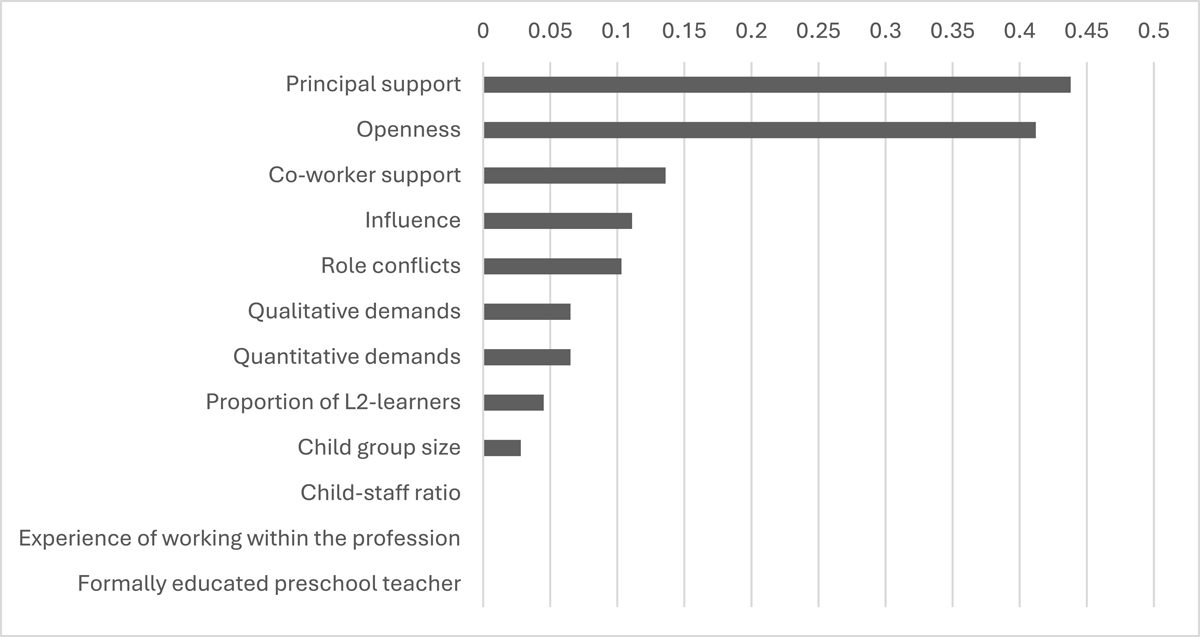
Figure 1
Final random forest model (OC-RF model 3) predicting organizational commitment.
Organizational commitment hierarchical regression models (OC-HR models)
The hierarchical regression analysis was conducted with blocks of variables, conducted stepwise, where each block generates a new model. The first model (OC-HR Education model) contained only the teacher education and professional experience variables. This model showed poor fit (R2 = 0.002, χ²(2) = 0.10, p = 0.810).
The OC-HR structural factors model included the forced structural factors: child group size, child-staff ratio, and proportion of L2 learners. It showed poor model fit (R2 = 0.010, χ²(5) = 0.45, p = 0.850), with no significant predictors. See Appendix D for all OC-HR models.
Job demands were introduced in the OC-HR job demands model, which showed a good fit (R2 = 0.147, χ²(8) = 6.77, p = < 0.001). Role conflicts and qualitative demands significantly and negatively predicted organizational commitment, while quantitative demands showed no significance.
Job resources were introduced in the OC-HR Job demands-resources model, which showed a good fit (R2 = 0.432, χ²(11) = 19.84, p = < 0.001). All job resources positively predicted organizational commitment, with Principal support being the strongest predictor, more than twice as strong as Influence and co-worker support. Role conflicts and Qualitative demands were not significant predictors of organizational commitment when job resources were accounted for.
In the final model (OC-HR job demands-resources-openness model), Openness was introduced separately since it is an organizational factor rather than a psychosocial factor (like the other job resources). The introduction of openness contributed significantly to the model (R2 = 0.467, χ²(12) = 21.29, p = < 0.001) and was the strongest significant positive predictor of organizational commitment. When openness was introduced, principal support became a weaker predictor of organizational commitment, and co-worker support was no longer significant. Influence remained a significant and positive predictor of organizational commitment (see Table 3).
Table 3
Final Hierarchical Regression model (OC-HR Job demands-resources-openness model) predicting organizational commitment.
| COEFFICIENTS | Est. | CI | p |
|---|---|---|---|
| (Intercept) | 1.12 | 0.17–2.08 | 0.021 |
| Education & Experience | |||
| Teacher (0 = No, 1 = Yes) | 0.10 | –0.10–0.30 | 0.321 |
| Experience within profession (in months) | 0.00 | –0.00–0.00 | 0.993 |
| Structural Factors | |||
| Child group size | –0.00 | –0.02–0.01 | 0.912 |
| Proportion of L2 learners in child group | –0.01 | –0.31–0.30 | 0.959 |
| Child-staff ratio | –0.00 | –0.06–0.06 | 0.928 |
| Job Demands | |||
| Role conflicts | –0.03 | –0.18–0.12 | 0.716 |
| Qualitative demands | –0.08 | –0.21–0.05 | 0.201 |
| Quantitative demands | –0.05 | –0.21–0.10 | 0.481 |
| Job Resources | |||
| Principal support | 0.25 | 0.10–0.41 | 0.001 |
| Influence | 0.15 | 0.01–0.29 | 0.035 |
| Co-worker support | 0.07 | 0.03–0.11 | 0.321 |
| Organizational Job Resource | |||
| Openness | 0.32 | 0.15–0.49 | <0.001 |
| Model fit | |||
| p | <0.001 | ||
| R2 | 0.467 | ||
Job satisfaction random forest models (JS-RF models)
The first model (JS-RF model 1) used all 24 predictors to predict job satisfaction. It achieved an R2 of 0.384 with the OOB performance as follows: 0% = 0.001, 25% = 0.260, 50% = 0.475, 75% = 0.696, and 100% = 2.307. See Appendix C for a list of the 24 variables and VI for predicting job satisfaction.
The second model (JS-RF model 2) retained all variables with a VI score higher than 0.001 from JS-RF model 1, including the forced variables. A total of 16 variables remained. It achieved an R2 of 0.390 with the OOB performance as follows: 0% = 0.007, 25% = 0.234, 50% = 0.451, 75% = 0.681, and 100% = 2.368. See Appendix C for VI scores for the variables in this model.
The final model (JS-RF model 3) retained three job demands (qualitative demands, quantitative demands, and unnecessary tasks) and three job resources (principal support, openness, and co-worker support), along with formal education, professional experience, child group size, child-staff ratio, and proportion of L2 learners. It achieved an R2 of 0.389 with the OOB performance as follows: 0% = 0.001, 25% = 0.225, 50% = 0.434, 75% = 0.701, and 100% = 2.336. Principal support had the highest VI on job satisfaction, followed by openness and co-worker support. Among the job demands, the order of VI was qualitative demands, quantitative demands, and unnecessary tasks, with qualitative demands having almost twice the VI of the other two job demands. The forced individual and structural factors had close to zero VI, with the proportion of L2 learners at 0.011. See Figure 2 for VI scores of the variables. The variables from the JS-RF model 3 were analyzed in hierarchical regression analyses.
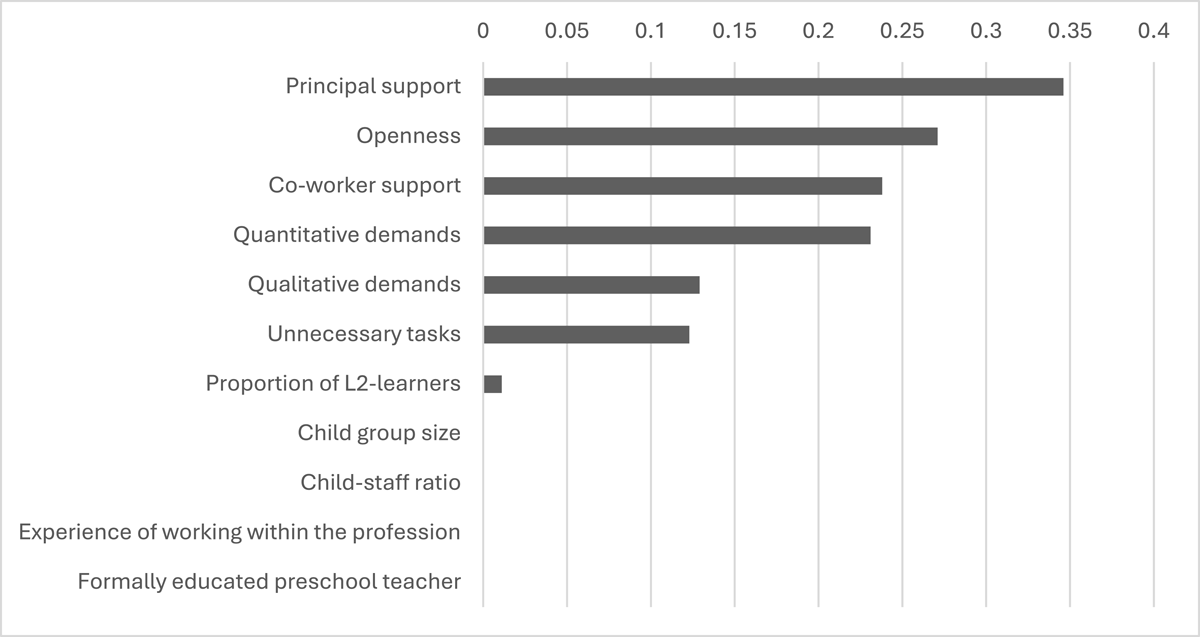
Figure 2
Final random forest model (JS-RF model 3) predicting job satisfaction.
Job satisfaction hierarchical regression models (JS-HR models)
The hierarchical regression analysis for job satisfaction was conducted stepwise using blocks of variables, similar to the process for organizational commitment. The first model (JS-HR Education model) contained only the teacher education and professional experience variables. This model showed poor fit (R2 = 0.011, χ²(2) = 0.50, p = 0.230).
The JS-HR structural factors model included the forced structural factors: child group size, child-staff ratio, and proportion of L2 learners. This model also showed poor fit (R2 = 0.023, χ²(5) = 0.93, p = 0.360), with no significant predictors. See Appendix E for all JS-HR models.
When job demands were introduced in the JS-HR job demands model, the model showed a good fit (R2 = 0.207, χ²(8) = 7.45, p = < 0.001), but only quantitative demands were negatively related to job satisfaction. Unnecessary and qualitative demands showed no significance.
Job resources were introduced in the JS-HR job demands-resources model, which showed a good fit (R2 = 0.455, χ²(11) = 17.09, p = < 0.001). Both job resources positively predicted job satisfaction, with principal support and co-worker support having similarly strong relationships to job satisfaction. Quantitative demands remained a significant predictor of job satisfaction in this model.
In the final model (JS-HR job demands-resources-openness model), openness was introduced. However, it did not contribute significantly to the model (R2 = 0.456, χ²(12) = 17.10, p = < 0.001) and showed no significant prediction for job satisfaction. Principal support and co-worker support remained significant, as did quantitative demands (see Table 4).
Table 4
Final Hierarchical Regression model (JS-HR Job demands-resources-openness model) predicting job satisfaction.
| COEFFICIENTS | Est. | CI | p |
|---|---|---|---|
| (Intercept) | 2.68 | 1.84–3.51 | <0.001 |
| Education & Experience | |||
| Teacher (0 = No, 1 = Yes) | 0.03 | –0.15–0.22 | 0.702 |
| Experience within profession (in months) | 0.00 | –0.00–0.00 | 0.853 |
| Structural Factors | |||
| Child group size | –0.00 | –0.02–0.01 | 0.842 |
| Proportion of L2 learners in child group | –0.07 | –0.35–0.21 | 0.628 |
| Child-staff ratio | –0.01 | –0.06–0.04 | 0.719 |
| Job Demands | |||
| Unnecessary demands | –0.05 | –0.17–0.07 | 0.384 |
| Qualitative demands | –0.01 | –0.12–0.10 | 0.855 |
| Quantitative demands | –0.26 | –0.39–0.13 | <0.001 |
| Job Resources | |||
| Principal support | 0.26 | 0.12–0.39 | <0.001 |
| Co-worker support | 0.29 | 0.16–0.42 | <0.001 |
| Organizational Job Resource | |||
| Openness | 0.05 | –0.10–0.21 | 0.510 |
| Model fit | |||
| p | <0.001 | ||
| R2 | 0.456 | ||
Discussion
This study aimed to investigate how specific psychosocial working conditions, organizational, structural (especially the proportion of L2 learners in the child group), and individual factors relate to preschool staff’s organizational commitment and job satisfaction. To address this aim, a series of models (eight for each dependent variable, 16) were examined. Random forest analyses were first used to reduce the 24 predictors to a more manageable set, which was subsequently examined through hierarchical regression analyses. Across both types of analyses, job resources consistently emerged as stronger predictors. Consistent with the JD-R framework, resources were more proximal correlates of motivational outcomes than demands or background factors. Among the job resources, principal support significantly predicted both outcomes in the final models. Influence predicted organizational commitment only, whereas co-worker support predicted job satisfaction only. The organizational resource of openness emerged as the strongest predictor in any model, albeit limited to organizational commitment. Among the job demands, only quantitative demands negatively predicted job satisfaction in the final model. Role conflicts predicted organizational commitment only when job resources were not accounted for. Neither individual factors nor structural factors were significant predictors of either outcome. Importantly, the proportion of L2 learners did not predict organizational commitment or job satisfaction. Within JD-R, a plausible explanation is that structural context (including L2 composition) exerts its influence primarily by shaping day-to-day demands and available resources rather than through direct associations with attitudes. These findings therefore suggest that when preschool staff have access to adequate job resources, they tend to report higher levels of organizational commitment and job satisfaction regardless of the proportion of L2 learners or other structural and individual background factors.
Principal support, openness, and staff influence emerged together as a cluster of leadership-related resources that were consistently associated with staff outcomes. Principal support was one of the strongest predictors of both organizational commitment and job satisfaction. This aligns with previous work showing that effective leadership in preschool settings helps staff cope with complex tasks and high levels of stress, promoting engagement and commitment (Ho et al., 2016). Feeling valued by leadership, receiving recognition, pedagogical guidance, and having access to constructive dialogue have also been linked to higher satisfaction and retention, even under elevated demands (Wilson et al., 2023; Nong et al., 2022; Öqvist et al., 2024; De Los Santos et al., 2023). In a previous study in the Swedish preschool, principals were considered even more important in L2 contexts (Finnman et al., 2024). In our data, principal support remained a robust predictor whilst the principal’s tenure or length of experience did not matter, which suggests that it is the enacted leadership behavior rather than seniority that is consequential.
Openness was a strong and consistent predictor of organizational commitment, although not of job satisfaction. This pattern suggests that openness functions primarily as a relational and identity-related resource: it appears to strengthen staff’s sense of belonging, loyalty, and identification with the organization rather than their immediate affective evaluation of how satisfied they feel at work. This interpretation is consistent with prior research linking opportunities to express criticism, concerns, and improvement ideas to trust and stronger staff–organization relations (Luijters et al., 2008; Tschannen-Moran & Hoy, 2000). Studies indicate that voice supports participation, professional agency, and reflective capacity during curricular change, whereas constrained or suppressed voice is linked to insecurity and resistance (Monkevičienė et al., 2025; Atkinson et al., 2023). Our findings extend this literature to the preschool context by showing that openness (voice) is not merely seen by staff as an abstract climate indicator but is empirically tied to higher organizational commitment.
Influence also predicted organizational commitment (but not job satisfaction). This mirrors evidence from broader teacher research suggesting that influence and voice are connected to engagement (Bakker & Bal, 2010) and to the emergence of a more supportive, collaborative environment (Louis, 2007; Bostic et al., 2023) as well as a sense of coherence for preschool teachers (Semelius Granevald et al., 2024). In earlier qualitative work underpinning the present study, staff described influence as essential for being able to carry out the curriculum in practice under real-world conditions, especially under time pressure and administrative load (Finnman et al., 2024). Taken together, influence appears to be the enacted, day-to-day experience of agency at the unit level, whereas openness reflects whether such agency is invited and legitimized at the organizational level.
From a JD-R perspective, this leadership/openness cluster can be understood as a set of job resources that serve motivational functions. Principal support represents a relational and instrumental resource (feedback, guidance, protection from overload); openness represents an organizational climate resource (voice, psychological safety, perceived responsiveness); and influence represents a procedural/decision-latitude resource (ability to shape one’s own work). In our hierarchical regression models, principal support predicted both outcomes, openness strongly predicted organizational commitment, and influence made an additional contribution to organizational commitment. This suggests that leadership support, openness, and influence are not redundant proxies for the same construct, but rather partially distinct facets of how decision-making power, recognition, and communicative space are distributed in preschool work. Multicollinearity diagnostics supported this interpretation: although these predictors are theoretically adjacent, all variance inflation factors were below accepted thresholds, indicating that their unique associations are statistically estimable in this sample.
The leadership-related resources are vertically structured: Being backed by the principal, being heard, and having influence over work arrangements. Co-worker support, on the other hand, is horizontal; it comes from daily collaboration in the workgroup. Co-worker support emerged as a central job resource and a robust predictor of staff outcomes. Although the effect on organizational commitment diminished when we included openness in the hierarchical models, it significantly predicted both job satisfaction and organizational commitment. Supportive co-worker relationships are positively associated with job satisfaction, organizational commitment, and broader staff well-being (Tschannen-Moran & Hoy, 2000; Lee et al., 2011; Van Maele & Van Houtte, 2012; Zinsser et al., 2016; Yin et al., 2016; Schad, 2017; Taris et al., 2017; Kwon et al., 2021). They are also linked to lower burnout and less work–family conflict and to teamwork structures that enhance the meaningfulness of practice (Chen et al., 2025; Schlieber et al., 2023). In line with JD-R assumptions, such support may buffer against high demands (Collie et al., 2012) and provide crucial social resources in contexts characterized by diversity and a high proportion of L2 learners (Finnman et al., 2024).
Within a JD-R perspective, this implies two complementary resource pathways. Leadership/openness resources appear especially important for organizational commitment, while co-worker support appears especially important for job satisfaction. Both are protective in the face of high demands, but they operate at different levels of the organization.
Job demands showed lower overall significance than job resources in the final models. However, they followed two different patterns that are informative. First, qualitative demands and role conflicts were (initially) negatively related to organizational commitment, but these associations weakened once job resources were included. Second, quantitative demands were consistently and negatively related to job satisfaction.
Qualitative demands and role conflicts can be understood as relational and value-based strains. Qualitative demands include emotionally and cognitively taxing work such as emotional labor with children and guardians, administrative overload, and constant reorganization of everyday practice (Brown et al., 2023; Carey & Sutton, 2024; Harrison et al., 2024; Hjelt et al., 2023). Role conflicts arise when expectations collide, for example, between care, documentation, curriculum delivery, and administrative requirements (Zhao et al., 2023). Both types of demand have been linked to elevated stress, emotional exhaustion, work–family conflict, and burnout risk (Gu et al., 2020; Zhao et al., 2023; Rugulies et al., 2017), as well as to reduced organizational commitment (Alarcon & Edwards, 2011; Gilboa et al., 2013), and have been related to L2 contexts (Finnman et al., 2024). In our analyses, they were negatively associated with organizational commitment before resources were added, which suggests that when staff experience work as contradictory, emotionally draining, or misaligned with expectations, they also feel less bonded to the organization. However, the demand effects became insignificant once we introduced leadership support, openness, and influence. This pattern is consistent with the JD-R perspective: in line with the motivational pathway, strong job resources appear to buffer the demotivating effect of these more relational/value-based pressures (Demerouti et al., 2001; Bakker & Demerouti, 2007).
Quantitative demands were a stable negative predictor of job satisfaction across models. This aligns with earlier evidence that time pressure, large groups, documentation load, and administrative requirements are linked to burnout, lower engagement, and turnover intentions among early childhood staff (Arvidsson et al., 2016; Skaalvik & Skaalvik, 2011; Heilala et al., 2024; Farewell et al., 2022). Unlike qualitative demands and role conflict, quantitative demands did not primarily map onto organizational commitment; instead, they mapped onto how satisfied staff felt with their work situation. One interpretation is that high quantitative demands are experienced as ‘the job is heavy right now’, rather than ‘this organization is not supporting me’. Within JD-R terms, this suggests that quantitative demands function as a classic health-impairment demand that erodes day-to-day job satisfaction, whereas leadership- and voice-related resources are more strongly tied to whether staff remain committed to the organization.
None of the individual variables were notably favored in any of the models. Consequently, the predetermined variables of preschool teacher education and professional experience did not demonstrate a significant relationship with organizational commitment or job satisfaction. Previously, personal resources have been associated with well-being in workplaces in relation to the JD-R framework (Xanthopoulou et al., 2007). The individual variables have been highlighted as important in previous research for shaping staff’s pedagogical approaches to children (Barnett, 2003; Evertson & Weinstein, 2006; Firstater et al., 2015; Howes et al., 2003; Licardo, 2020; Tobin, 2020). It is noteworthy, however, that in the current study, the variables representing formal education and professional experience did not yield significant results, suggesting that their impact on organizational commitment and job satisfaction may be less direct or less substantial compared to findings in earlier research.
The structural factors did not emerge as significant predictors in any of the models. Child group size, child–staff ratio, and the proportion of L2 learners were not directly related to either organizational commitment or job satisfaction. This is noteworthy because earlier work has argued that group size and staffing ratios shape planning possibilities, supervision, and pedagogical work (Balldin & Tallberg Broman, 2010; Hagström, 2010; Skalická et al., 2015), and staff have described diversity and multilingual groups as demanding and sometimes complex to navigate (Finnman et al., 2024; Lunneblad, 2009; Stier & Sandström, 2018). An interpretation is that these structural features matter indirectly rather than directly. In JD-R terms, the linguistic composition of the group can be understood as contextual conditions that shape day-to-day job demands and the availability of a job. Our results suggest that it is these psychosocial and organizational conditions that are most proximally related to organizational commitment and job satisfaction. By contrast, the structural backdrop (including the share of L2 learners) did not predict attitudes toward the job or the organization on its own. This implies that improving staff outcomes may depend less on structural characteristics per se and more on how preschools manage the demands that follow from those structures and whether they provide adequate resources in response.
These findings should be understood within the Swedish preschool context. The structural, linguistic, and organizational characteristics of Swedish preschool provision, including municipal governance, curriculum-led leadership responsibility, and multilingual child groups, are context-specific. The results may therefore be most relevant to Scandinavian preschool systems and should be generalized to other settings with caution.
Strength and limitations
A key strength is the two-stage analytic strategy that promotes cross-validation of findings across methods. We first used random forest (RF) with out-of-bag validation to prioritize predictors and quantify permutation-based variable importance and then estimated theory-ordered hierarchical regressions to obtain interpretable coefficients and confidence intervals. Predictors that emerged in both RF and regression provide convergent evidence across analytic families.
Another strength is the broad initial predictor set spanning individual, structural, organizational, and psychosocial working conditions, which allowed a JD-R–consistent comparison of levers within a single study. Internal consistency was acceptable-to-excellent for all scales used in this sample, supporting reliability at the composite level.
At the same time, several measurement limitations warrant a cautious interpretation of effect sizes and boundaries of construct coverage. First, some constructs were measured with short scales (e.g., three to four items). While brevity facilitates field administration, it can constrain content validity and the breadth of construct representation for complex domains (e.g., ‘openness’ or ‘co-worker support’). Thus, effects should not be over-interpreted as an absence of underlying relations. Second, instruments differ in age and provenance. Even if their core validity is established, there is a risk of temporal/cultural drift in item meaning given shifting preschool work practices in Sweden (e.g., administrative load, team structures, linguistic diversity). Consequently, constructs may not map perfectly onto today’s pedagogical and organizational realities. Third, although internal consistency was satisfactory, we did not revalidate factor structures or test measurement invariance across subgroups; therefore, construct comparability across units/roles should be inferred with care.
Design-related constraints also affect generalizability and inference. Although ICCs indicated non-negligible clustering, the small cluster sizes precluded stable multilevel modeling. We therefore used single-level regressions and acknowledge that standard errors and generalization beyond the sampled municipalities (central Sweden) require cautious interpretation.
In this study, L2 status was operationalized via entitlement to mother-tongue education (≥1 legal guardian with a non-Swedish mother tongue); we did not collect the specific languages spoken by children or the staff’s mother tongues. This limits our ability to examine heterogeneity by language type (e.g., English vs. less widely shared languages), language match/mismatch between staff and families, and communication demands that may vary with linguistic distance. Any resulting nondifferential measurement error in the L2 indicator likely attenuates associations with outcomes, and it constrains generalizability to settings with different language compositions.
The current study did not investigate the indirect effects of the proportion of L2 learners via job demands or resources, only its direct effects on job satisfaction and organizational commitment. Future studies should model these indirect pathways explicitly, for example, using mediation, to determine whether L2-related context affects staff outcomes primarily by shaping demands.
Practical implications
This study highlights that job resources are more critical for staff outcomes than job demands, individual, or structural factors. In line with this, previous research has shown that staff facing higher job demands often have access to fewer workplace resources (Farewell et al., 2022). Farewell et al. (2022) also suggest that enhancing resources can lead to increased job satisfaction. Therefore, strengthening job resources, particularly support from the preschool principal and openness within the organization, is likely to improve staff’s organizational commitment and job satisfaction, while simultaneously alleviating the impact of job demands associated with L2 groups. A principal who has sufficient resources, is well-informed about their context, and is supportive of their staff can have a substantial positive effect on these outcomes. Further enhancing support within staff workgroups, and fostering openness and influence, will not only boost organizational commitment and job satisfaction but also help staff manage job demands.
Conclusion
This study examined how psychosocial working conditions (job demands and job resources), organizational factors, structural factors (especially the proportion of L2 learners in the child group), and individual factors relate to preschool staff’s organizational commitment and job satisfaction. Through comprehensive analyses, these resources were found to outweigh the impact of job demands, individual factors such as education and experience, and structural elements including child group size and child–staff ratio. The proportion of L2 learners did not directly predict organizational commitment or job satisfaction. A plausible reading is that linguistic composition influences staff attitudes indirectly by shaping day-to-day demands and the resources mobilized in response. Methodologically, our L2 indicator was coarse, measured at the unit level, and cluster sizes were small, which likely attenuated effects. Future work should test mediated and cross-level pathways using finer linguistic measures and designs powered for multilevel and longitudinal analyses.
The findings suggest that focusing on improving job resources, in particular supportive leadership, openness, and collegial relationships, can effectively mitigate the impact of job demands and strengthen staff’s organizational commitment and job satisfaction. This has practical implications for preschool settings, underscoring the need for supportive and collaborative work environments to foster staff motivation and retention, as well as their ability to effectively manage the diverse needs of children, including those learning a second language early in life.
Additional Files
The additional files for this article can be found as follows:
Appendix B
Variable importance in organisational commitment random forest models. DOI: https://doi.org/10.16993/sjwop.329.s2
Appendix C
Variable importance in job satisfaction random forest models. DOI: https://doi.org/10.16993/sjwop.329.s3
Appendix D
Organizational commitment hierarchical regression models. DOI: https://doi.org/10.16993/sjwop.329.s4
Appendix E
Job satisfaction hierarchical regression models. DOI: https://doi.org/10.16993/sjwop.329.s5
Data Accessibility Statement
The data are available on request.
Acknowledgements
Parts of this article are based on the author’s doctoral dissertation (Finnman Grönaas, 2024), in which an earlier version of the present study is included. The dissertation is explicitly cited in the manuscript and listed in the reference list. Given the shared empirical basis and analytical framework, some sections, particularly within the discussion, overlap with the corresponding sections in the dissertation. This reuse of material is intentional and reflects the development and dissemination of the same line of research.