
In recent decades, the prevalence of standard employment relationships, which involve a permanent employment contract with one employer, has declined and there has been a rise in levels of non-standard employment (Tanimoto et al., 2021). Non-standard employment refers to forms of employment such as temporary work, self-employment, freelancing or gig work. Gig work in particular has been increasingly used by companies (Watson et al., 2021). Approximately 88% of all U.S. companies employ gig workers (Cropanzano et al., 2023). In Europe, it is believed that around 28 million workers have experience with gig work (Liboreiro et al., 2023). In Sweden, the focus of this study, an estimated 2% to 10% of the working population are considered gig workers (Palm, 2019).
A gig worker is anyone who works with short-term assignments (gigs) and multiple clients (Bellesia, 2023) in so-called ‘fluid’ work arrangements outside of traditional organizational employer-employee relationships (Sutherland et al., 2020). Although the typical gig worker is portrayed as food courier or taxi driver working through a platform that assigns work tasks, gig workers can work in diverse sectors and professions, like arts, media, law, engineering, higher education, manufacturing, etc. (Cropanzano et al., 2023). Gig workers can also work without mediation through platforms. In fact, gig workers in Sweden can be employed, yet neither by platforms nor by client organizations but by so-called umbrella companies. These umbrella companies serve as legal employers for gig workers during their assignments and handle administrative tasks (invoicing, tax payments). However, it remains the worker’s responsibility to secure their own gigs. This study focuses specifically on these employed gig workers—who are engaged through umbrella companies but who are independently sourcing their work.
Previous research has highlighted the precarious nature of gig work, particularly the high income volatility, and limited development opportunities for workers (Watson et al., 2021). Gig work is assumed to be a vulnerable and insecure form of employment (Wu & Huang 2024). Perceptions of job insecurity, threatening latent and manifest benefits such as income, social identity or future employment prospects, are known to be stressful experiences with negative implications for individual well-being and health (Selenko & Batinic, 2013; Vander Elst et al., 2016). In this paper, we aim to test the implicit assumption that has been portrayed in the literature, that gig work is unequivocally an insecure employment form, and explore perceptions of insecurity in employed gig work.
Our study follows recent calls in the job insecurity literature to adopt a more dynamic view and to examine job insecurity not in isolation, but in its complex interplay with other circumstances (Klug et al., 2020). Using a person-oriented approach, we explore gig-related job insecurity in the context of other aspects of insecurity that may come with gig work to varying degrees, namely financial insecurity, career insecurity or insecurity regarding one’s business actions and decisions. The extent to which these experiences are interrelated or whether there are subgroups of employed gig workers with distinct, perhaps high and low insecurity profiles, or profiles of varying shapes is not yet known. Here, this study can make an important contribution to the literature.
To further understand these potential subgroups of employed gig workers with distinct insecurity profiles, this study also aims to provide relevant groundwork by linking insecurity profiles to potential antecedents. Employed gig work can be carried out by a highly diverse group of individuals with different personal backgrounds, who offer different products and services across various occupational sectors, and who may combine employed gig work with standard employment (Hedenus & Nergaard, 2021; Wu & Huang, 2024). To better understand and validate insecurity experiences, potential antecedents that are coupled to environmental threats (e.g., shortage of clients) that may vary for these workers, or that may influence their perception of threats (e.g., earlier experiences of unemployment) need to be considered (Shoss, 2017).
Employed gig work in umbrella companies
Umbrella companies occupy their own niche in the labor market, offering a third alternative in addition to standard employment and self-employment (Hedenus & Nergaard, 2021). Contrary to most employers, umbrella companies do not guarantee minimum income and make no use of their employer right (and obligation) to lead and distribute work tasks (Westregård, 2021). Instead, umbrella companies invoice the assignment carried out by the gig worker, deduct taxes and pay social security contributions. In addition, they can offer legal advice, education and training, undertake efforts concerning work environment and sign collective bargaining agreements (Hedenus & Nergaard, 2021). In Sweden, some umbrella companies also assume full employer responsibilities and have signed agreements with unions.
Independent of the used umbrella company, employed gig workers have the sole responsibility to find clients and work tasks and to follow workplace safety guidance – while the umbrella company only establishes contact with the workers’ clients for the remuneration of the workers’ executed labor. Thus, while the aspects of administration resemble those of being organizationally employed, the process of finding and executing work resembles that of being self-employed.
Research on umbrella companies and their employees is in its infancy. Most research has been conducted in the field of labor law and on questions concerning workers’ access to social security networks (Westregård, 2021). Other studies (Pietro, 2018) focus more generally on new employment forms situated between self-employment and organizational employment – liminal employment – of which umbrella company employment is just listed as one of many. A case study in one umbrella company in Sweden (Hedenus & Nergaard, 2021) has identified autonomy and flexibility, as well as the opportunity to test-run a business, as major advantages with employed gig work in umbrella companies. Challenges mainly relate to the in-between status of employment and self-employment, and since the Swedish welfare system is designed with permanent employment as the implicit norm (Hedenus & Nergaard, 2021), employed gig workers have witnessed, as those in temporary positions or in self-employment, that they encounter difficulties when applying for welfare benefits, such as unemployment insurance or sick leave (Westregård, 2021). Although the majority of employed gig workers in Sweden are believed to combine this form of work with other employment (SOU, 2017:24), it is not well-known whether there may be a proportion of workers with (intermitted) unemployment experiences (Palm, 2019), or to what extent employed gig workers in umbrella companies experience insecurity regarding their employment form and their finances (Hedenus & Nergaard, 2021; SOU, 2017:24). Studies on the experiences of insecurity in umbrella company employment have therefore been called for (Palm, 2019).
Insecurity in employed gig work
There is extensive research on job insecurity, that is, the employees’ perceptions that the continuity of their current job may be threatened (De Witte, 1999; Shoss, 2017). It is a subjective experience and thus, may differ between individuals in the same objective situation (Probst, Jiang, & Benson, 2018). Job insecurity involves an unwanted potential disruption of one’s job continuity (Sverke, Hellgren, & Näswall, 2002) and may concern the uncertainty of losing the job entirely (quantitative job insecurity) or losing valued job features (qualitative job insecurity, see Hellgren, Sverke, & Isaksson, 1999). Job insecurity has been studied in employees with permanent and temporary employment, and the negative consequences of job insecurity on employee health, work attitudes and organizational behavior are well-documented (Klug et al., 2020). In contrast, there is limited empirical evidence regarding job insecurity perceptions in newer forms of non-standard employment, such as platform and gig work (Wu & Huang 2024), but experiences of job insecurity, financial and career path uncertainty are believed to be widespread (Ashford, Caza, & Reid, 2018).
The case of employed gig work is particularly interesting for the study of job insecurity as there are fundamental differences regarding the conceptualization of what constitutes a job that offers employment. Since umbrella companies do not distribute assignments or work tasks to their employed gig workers, they cannot let them go either. Instead, for the employed gig worker, a job exists when there is a client who orders a product or a service. In other words, the possibility to continue working as an employed gig worker is threatened not because the umbrella company has run out of jobs, but because the employed worker worries that there may not be enough clients or assignments to be acquired. Without clients, the gig worker cannot register an assignment with the umbrella company, and thus, there is no job that the worker can be employed for. To accentuate these differences to the established definition and meaning of job insecurity in more traditional employment, we will refer to gig job insecurity in this paper, and it is believed that this type of insecurity is present for gig workers (Wu & Huang, 2024).
Client-based work may also be related to experiences of insecurity regarding one’s finances. Worrying about one’s finances has been found to have negative consequences for mental health and well-being (de Bruijn & Antonides, 2020; Gorgievski et al., 2010). Risks to experience financial insecurity are elevated when one’s income is low (de Bruijn & Antonides, 2020) or highly unstable (OECD, 2023). Earlier research studies show that income instability is a major concern for individuals in temporary on-call jobs (Aronsson et al., 2005) especially if the cash margin is low (Waenerlund, Virtanen, & Hammarström, 2011). Similar findings are reported for those working client-based, such as self-employed workers (Annink, Gorgievski, & Dulk, 2016), whose financial worries have been identified as a major stress factor (Grant & Ferris, 2012). Studying financial insecurity as experienced by employed gig workers who also work client-based may thus be warranted. To date, it remains unknown to what extent employed gig workers in Sweden are in economically precarious situations and worry about their finances, or whether some of them engage in this employment to earn an extra income that they do not depend upon (Palm, 2019).
Experiences of insecurity in employed gig work may further extend to the future of one’s career (Caza et al., 2022). Broadly, career insecurity is defined as ‘an individual’s thoughts and worries that central content aspects of one’s future career might possibly develop in an undesired manner’ (Spurk et al., 2021, p. 253). Career insecurity as a multidimensional concept may include career prospects and promotion, changes of contractual conditions and workplaces, changes in qualification requirements and prestige, risks for unemployment, and conditions regarding retirement. Careers in the gig economy lack a clear structure, which makes gig employment a risky and rather unpredictable career choice (Wu & Huang, 2024). Thoughts and worries may, for example, concern uncertainty related to starting a real business (Hedenus & Nergaard, 2021), insecurity about how gig work can help to get more preferable employment (Newlands, 2022), or the risk that work in an occupational field becomes gradually more gig-based so that one may get stuck in this employment form (Palm, 2019).
Workers in more traditional employment forms often feel qualitative job insecurity, worrying about negative developments in their jobs and organizations, which they have little or no control over (De Witte, 1999; Vander Elst et al., 2016). Similarly, employed gig workers are confronted with uncontrollable factors (Caza et al., 2022), e.g., they do not know how markets or legislation regarding their services or products will develop. However, as has been found in research on self-employed business owners, this worry may be intertwined with the feeling that one’s future partly depends on oneself, since the worker is solely responsible for identifying suitable entrepreneurial opportunities (Grant & Ferris, 2012). For example, choosing the ‘right’ kind of clients, or developing skills that are sought-after in the future may influence the development of their job and career positively. Many self-employed business owners therefore feel stressed by the unpredictability of how their entrepreneurial actions of today may influence their work opportunities in the long run (Grant & Ferris, 2012). In this paper, we argue that employed gig workers, just like self-employed business owners, may also have to deal with such entrepreneurial uncertainty, which we will refer to as business insecurity to mark the difference between entrepreneurs and employed gig-workers, whilst acknowledging that the latter are engaged in business activities that they, however, do not get paid for not via their own, registered business, but via employment in the umbrella company.
To date, it is not well-known how employed gig workers perceive these aspects of insecurity regarding clients, finances, their career, and their business activities. A plausible scenario, argued for in some of the literature on gig and precarious temporary employment (Caza et al., 2022; Wu & Huang, 2024), may be that of high job and financial insecurity, coupled with high career and business insecurity. However, those who only occasionally engage in employed gig work for an extra income may perceive such insecurity to lesser degree (Palm, 2019). For others, client networks and low financial insecurity may exist for the moment, but future career prospects or business actions necessary for favorable long-term developments may feel more insecure. Thus, instead of studying each insecurity variable in isolation, we argue that more can be learned if we use a pattern approach (sometimes also termed person-centered approach), since typically variables interact and thus shape a complex context for the individual (Bergman, Magnusson, & El-Khouri, 2003). Also, the use of a pattern approach is particularly warranted when a heterogeneous population is studied, in which subgroups may exist who are characterized by a specific pattern of the variables under study (Mäkikangas et al., 2018). Moreover, the study of patterns instead of single variables has gained momentum in job insecurity research as it helps to unravel more complex dynamics (Klug et al., 2020). Several studies have already demonstrated the usefulness of this approach to differentiate subgroups of workers regarding aspects of precariousness and job insecurity (Allan, Kim, & Pham, 2023; Urbanaviciute, Lazauskaite-Zabielske, & De Witte, 2021). In these studies, profiles were found to differ in predictors, correlates and consequences, and as can be expected, workers with temporary work and lower education were more often found in the highly insecure or precarious profiles (Allan, Kim, & Pham, 2023; Urbanaviciute, Lazauskaite-Zabielske, & De Witte, 2021). Applying this logic in the context of employed gig workers’ gig, financial, career and business insecurity, it may be assumed that there is at least one profile with high vs low insecurity perceptions, and potentially more patterns with different combinations exist, as we have outlined above. However, as there are no earlier studies from a similar context, we formulate a research question rather than a hypothesis:
RQ1: Which subgroups with different profiles of insecurity perceptions regarding the job, finances, career prospects and business can be identified in Swedish UC employees, and how prevalent are these profiles?
Antecedents of insecurity perceptions in employed gig work
As systematic research on employed gig workers is still missing, we base our exploration of potential antecedents of employed gig workers’ insecurity profiles on prior research from antecedents of job insecurity (Keim et al., 2014; Klug et al., 2020; Shoss, 2017), research on uncertainty in self-employment (Grant & Ferris, 2012), as well as characteristics and precarity of gig work (Caza et al., 2022). Figure 1 illustrates the four groups of antecedents we explore: personal demographic factors, personal motivation, gig-employment characteristics, and surrounding labor market factors. Theoretically, gig-employment characteristics (e.g., sector, lack of clients) and labor market factors (e.g., increasing digitalization) can be considered as being environmental threats or risks (Shoss, 2017), endangering the possibilities for employed gig work in the future. The underlying mechanism is explained by appraisal theory (Lazarus & Folkman, 1984): if individuals appraise a certain environmental stimulus as a threat or risk, the cognitive appraisal is coupled to emotions such as worry or fear. Apart from the fact that certain environmental conditions are appraised as threats by the majority of people, appraisal and perceptions of threats also depend on the individual. This study includes individual variables in terms of personal demographics and personal motivation. These individual variables may be understood as personal resources or lack thereof, influencing how vulnerable a person is (Lazarus, 2006). In terms of demographic characteristics, a lack of education may be considered a risk and lead to worries for one’s career and job opportunities in the long run. Other individual variables of importance (e.g., motivation for gig work) are those that can undermine the appraisal process and lead to biases in risk perception (Shoss, 2017). For example, those who choose to work with gigs may disregard the inherent insecurity of future employment, whereas those who do it to make a living may be much more aware and as a result more worried for the risks this type of work can entail.
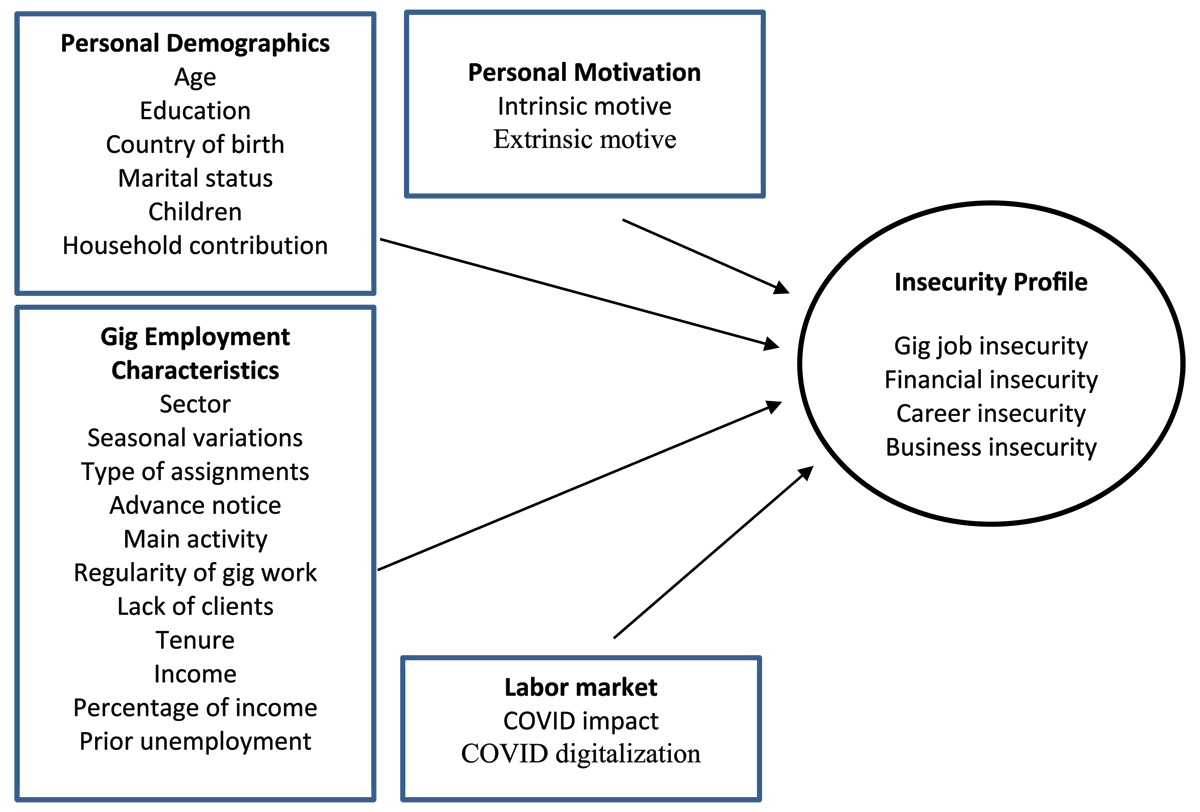
Figure 1
Conceptual model.
Personal demographic factors
Although systematic research is still missing, employed gig workers are believed to be a highly diverse group regarding their personal backgrounds (Hedenus & Nergaard, 2021). Reviews and meta-analyses suggest that age, education, gender, and family situation may be important antecedents for job insecurity (Probst et al., 2018; Shoss, 2017) but results have not been consistent (Klug et al., 2020). How such demographic factors play out for employed gig workers in Sweden, and when gig job insecurity is studied in the context of other insecurity perceptions (e.g., career or business insecurity), is not known. It is not unreasonable to assume that certain background factors are more advantageous for perceiving less insecurity, for instance, higher education, being born in Sweden, and not having the sole provider role for the household, since risks to not find gigs may be lower, or consequences of less availability of gigs are less severe.
Personal motivation
Motives for working in a specific employment form may also play a role for how job insecurity is perceived, because they may influence the appraisal process and thus alter risk evaluations (Shoss, 2017). For example, voluntary choices for temporary employment have been associated with lower levels of job insecurity perceptions (Bernhard-Oettel et al., 2013). Similarly, research in self-employment has found that business owners who started a business out of necessity had lower intrinsic work motivation than those who preferred self-employment (Johansson Sevä et al., 2016). Voluntary motives reflect an autonomous, intrinsic motivation, whereas involuntary motives reflect a controlled or extrinsic motivation (Deci & Ryan, 2008). Both motives for working in a certain employment form can be present at the same time (Lopes & Chambel, 2014), for example, studies on gig workers show that flexibility and autonomy, which should fuel more intrinsic motivation, but also economic needs for extra income, which links to external motivation, are important drivers for choosing to work gig-based (Klein, et al., 2024). How motivation for employed gig work relates to different profiles of insecurity experiences has not yet been studied, but the evidence from temporary and self-employment suggests that higher extrinsic motivation for gig employment may be found in profiles with higher insecurity perceptions.
Gig-employment factors
Gig work is believed to be more prevalent in certain human-facing services (food delivery, ridesharing) and creative industries (Cropanzano et al., 2023) but according to a small interview study with umbrella companies in Sweden, it may in fact be rather widespread across different sectors and industries. For example, IT consultants, doctors, transportation workers, those providing repair or laundry services, or art workers may be employed for gigs (Hedenus & Nergaard, 2021). Depending on the type of service or product provided for clients, gig employment circumstances, and thus perceptions of insecurity, may vary. There may be seasonal variations for certain services, and times with a shortage of potential clients. The amount and length of client assignments may differ, and whereas some employed gig workers may know about the line-up of potential clients well ahead of time, others may get assignments on much shorter notice (Caza et al., 2022). Some employed gig workers may have experienced periods of unemployment (Hedenus & Nergaard, 2021), a factor related to perceiving higher job insecurity (Probst et al., 2018). Depending on whether employed gig work is done on a regular basis or only occasionally, the volume of income and its role for the household income may differ. All these factors may relate to how volatile the employment situation is and thus may constitute different risks and threats for the availability and type of future gig work with decent payment. In theory, differences in such potential antecedents of job insecurity regarding employment factors can be expected to be associated with differences in insecurity profiles.
Labor market factors
Macro-economic factors, such as technology change, industry decline or economic downturns, are circumstances that can be appraised as threatening to the future existence of job opportunities and are known to influence job insecurity perceptions (Klug et al., 2020) as they also elevate business risks (Klapper & Love, 2011). Starting in March 2020, COVID-19 let to considerable economic turmoil for many self-employed in Sweden and elsewhere (Eib & Bernhard-Oettel, 2023) and likely also affected gig work possibilities (e.g., more home deliveries, less travel-related service needs). Partly as a result of rules for social distancing, COVID-19 also fueled technology change, as digitalization to provide services online was advantageous to continue business activities. To what extent this was the case for employed gig workers, and how it relates to perceptions of insecurity, have yet to be studied.
In summary, this leads to our second research question:
RQ2: How do employed gig workers with distinct insecurity profiles differ in terms of (a) personal demographics (b) personal motivation, (c) gig-employment characteristics and (d) labor market factors?
Method
Context and sample
Data for this study were collected with online surveys from November 2021 until March 2022. Respondents for this study were recruited mainly via the umbrella companies at which they were registered. The umbrella companies either informed workers about the study and enclosed the link to the survey via emails to their employees or via their newsletter. To increase dissemination, we applied snowball sampling methods and encouraged respondents to share the link to the survey with other employed gig workers. Moreover, we published information about the study and the link to the survey in relevant social media channels.
Before being able to answer the survey questions, respondents were informed that participation was voluntary, that answers were treated confidentially, and details were given about data storage and security measures. Respondents had to give active consent of participation before they could start to answer the survey. We used two control questions to make sure that each respondent was registered at an umbrella company at the time of the study and that they were active employed gig workers by asking whether they have had an assignment for which they received a salary from the umbrella company during the previous 12 months. The study was approved by the ethics review authority of Sweden (registration number 2021-03852, 2022-00626-02).
In total, 509 individuals clicked on the link to the survey. Among these, 265 were actively employed gig workers and started to answer the questionnaire. Due to drop out as the questionnaire progressed the final analytical sample consisted of 227 employed gig workers. Of these, 44% were women and 56% men. On average, respondents were 53 years old (Range: 21–80, SD = 14). The overwhelming majority was born in Sweden (87%) and very few were born outside of Europe (4%). Regarding education, 54% had an education below university level, 21% had an equivalent of a Bachelors degree, and 25% a university qualification equivalent to a Masters, Licentiate or Doctorate. In terms of sector, most of the employed gig workers worked in culture and entertainment (30%); this was followed by communication and information (16%); business services, such as law; economic, technology and sciences (11%); and human services, such as education (11%). Respondents lived mostly in the big cities, but all geographical areas of Sweden were represented in the sample.
Measures
Respondents were asked to always think about their assignments/clients related to their umbrella company employment when answering the survey questions. If not stated otherwise, answers were given on a five-point Likert scale ranging from 1 (totally disagree) to 5 (totally agree).
Types of insecurity of employed gig work
Gig job insecurity was assessed with three items adapted from items for measuring quantitative job insecurity (Hellgren & Sverke, 1999). The items were phrased with a focus on worries that concerned the potential loss of clients. The items were ‘I’m worried about not having enough assignments’, ‘I worry about being able to keep my assignments’, ‘I’m afraid I’m losing out on demand for my services/products’. Following recent recommendations when latent constructs are used in subsequent analyses, we report composite reliability (CR), the shared variance of the observed indicators, to demonstrate internal consistency. CR should not be lower than 0.7 and ideally not significantly lower than 0.8 (Cheung et al., 2023). CR for gig job insecurity was 0.87. Financial insecurity was measured with two items from the scale on financial worry-related cognitions by de Bruijn and Antonides (2020), namely ‘I constantly think about the uncertainty of my financial future’ and ‘I often wonder whether I have enough money to make ends meet’. CR was .92. Career insecurity was measured with one item (‘I am worried that the career opportunities in my occupational field could develop unfavorably’) adopted from (Spurk et al., 2021). Business insecurity was measured with three items based on Grant and Ferris (2012) that had earlier been used in a study on self-employed business owners (Stephan et al., 2021). Items were geared to fit the context of gig employment and tapped into uncertainty related to working in gig (‘I face uncertainty about the future working as employed gig worker’, ‘I have to make decisions where I am unsure about their effects for my work as employed gig worker’, ‘There seem to be many risks and a lot of uncertainty in my work as a employed gig worker’). CR was .79.
A series of confirmatory factor analyses (CFA) were employed using the robust maximum likelihood (MLR) method of estimation for all latent insecurity measures (gig job insecurity, business insecurity, financial insecurity), excluding the single item measure for career insecurity.1 Results revealed that the model with the three-factor structure (gig job insecurity, business insecurity, financial insecurity) provided a good fit to the data (Κ2(17) = 28.11; p = .04; Root Mean Square Error of Approximation (RSMEA) = .05 (90% Confidence Interval (CI) = .01–.09); Standardized Root Mean Square Residual (SRMR) = .022, Comparative Fit Index (CFI) = .987). The Κ2 difference tests with Satorra-Bentler (Satorra & Bentler, 2010) correction revealed that the three-factor model also had a significantly better fit to the data (ΔΚ2 = 14.82, df = 2, p <.001) than the two-factor model (gig job insecurity and business insecurity vs. financial insecurity), which, however, still had an acceptable fit to the data (Κ2(19) = 50.38; p = .00; RSMEA = .09 (90% CI = .06–.11); SRMR = .031, CFI = .965,). The one-factor model did not provide a good fit to the data (Κ2(20) = 131.38; p = .04; RSMEA = .16 (90% CI = .13–.18); SRMR = .052, CFI = .874). We used conventional standards (Hu & Bentler, 1999) to assess model fit: RMSEA <0.06: very good fit; the SRMR <0.08: good fit; and the CFI <0.95: good fit. Descriptive statistics (means, standard deviations, Pearson correlations) for all insecurity variables are provided in Table 1.
Personal demographics
Respondents indicated their gender (0 = male, 1 = female, 2 = other) but due to few responses, ‘other’ has been recoded as missing. Respondents further provided information about their age (years), education (0 = up to high school or vocational degree; 1 = university degree), country of birth (0 = outside of Sweden, 1 = Sweden), marital status (0 = single, 1 = married/cohabiting), and children under the age of 18 years in their household (0 = no; 1 = yes). For household contribution, respondents were asked how much they contributed to their household income (4 = all income, 100%, 3 = more than 50% but less than 100%, 2 = about 50%, 1 = less than 50%).
Personal motivation
Motives to work as an employed gig worker was assessed with two single items, adapted from a scale on intrinsic and extrinsic contract motivation developed by Lopes and Chambel (2014). Respondents were asked to what extent they agreed to the following statements: ‘I work in gig employment because I really like to work as employed gig worker’ (intrinsic motivation), ‘I work in gig employment because I need to make a living’ (extrinsic motivation).
Gig employment characteristics
Sector was measured with the Swedish standard for sector classifications, SNI2007. Similar to (Cerdas et al., 2019), we classified the sectors into categories that takes gender composition of the labor market into account. Because only few respondents worked in certain sectors, we applied a more general classification than the one used by Cerdas et al. (2019), which resulted in four categories with different dominance of female and male workers: (1) goods, energy production and machinery were male dominated (76% men); (2) public administration, education, health and social work were female dominated (73 women %); (3) knowledge intensive work-types (e.g., IT, communication, law, economy, technology and science) were gender-balanced, with slightly more men (54% men); (4) labor intensive work-types (e.g., sales, hotel and restaurant service, art and entertainment) were gender-balanced, with slightly more women (53%). For seasonal variation, respondents indicated how assignments were distributed throughout the year (1 = well distributed throughout the year; 2 = amount of assignments varies a lot during the year). Type of assignment indicates what kind of assignments respondents typically had (1 = one long-term assignment; 2 = several smaller assignments; 3 = many short client contacts). Advance notice asked respondents to indicate how long in advance they knew about an incoming assignment (0 = up to four weeks in advance; 1 = more than one month in advance). Main activity asked respondents to indicate whether their main activity was employed gig work (1), another employment (2) or other activity (retirement, studies) (3). Labor market activities concerning unemployment or labor market action mandated from employment office were coded as missing, because numbers (N = 6) were too small for further analyses. Regularity of gig work measured how often respondents gig worked, recording higher values as reflecting more regular gig work (1 = a few hours per year, 2 = a few hours per month, 3 = a few hours per week, 4 = daily part-time, 5 = daily full-time). For lack of assignment, respondents indicated how often they did not have an assignment as an employed gig worker although they would have wanted to via a five-point scale (1 = never, 5 = very often). Tenure (in years) assessed how many years respondents had been working as employed gig worker in the umbrella company. Income measured how much money respondents had earned in their gig employment in the previous year and was recoded via a dichotomous variable (0 = less than 250k Swedish crowns; 1 = more than 250k Swedish crowns). Percentage of income through gig employment indicates whether respondents derived at least 25% of their monthly income from umbrella companies (0 = below 25%; 1 = 25% or more of monthly income from umbrella companies). For prior unemployment, respondents were asked if they had been unemployed during the two years previous to the data collection (0 = no, 1 = yes).
Labor market factors
As relevant labor market factors, we measured two variables related to the impact of the COVID-19 pandemic. Covid impact asked respondents to indicate how much the COVID-19 pandemic had changed their possibilities to get assignments in the previous fiscal year and answers could be given as percentages on a scale from –100% (losses) to +100% (gains). For digitalization during Covid, respondents were asked to answer the question ‘Has the digitalization of your services increased during the COVID pandemic?’ on a scale from 1 (not at all) to 5 (very much).
Statistical analysis
Regarding RQ1, a latent profile analysis (LPA) was employed based on the measures of gig job insecurity, financial insecurity, career insecurity and business insecurity. This analysis allowed us to find homogeneous latent profiles of individuals who differ in their experiences regarding insecurity. To find the most appropriate number of latent profiles with distinct insecurity experiences, we made use of various criteria. First, we inspected ABIC (Adjusted Bayesian Information Criterion), where a decrease indicates better fit of model to the data. Next, entropy values should preferably be above .80, even though cut-offs of 0.60–0.80 have also been discussed as appropriate (Spurk et al., 2020). In addition, average posterior probabilities for the profiles are recommended to be above .70, which indicates that individuals with similar profiles indeed are grouped together (Jung & Wickrama, 2008). We also considered the Lo-Mendell-Rubin adjusted likelihood ratio test (LMR), and the parametric bootstrapped likelihood ratio test (BLRT), in which values >.05, imply that k profiles are enough compared to k+1 profiles (Jung & Wickrama, 2008). We also checked replicability with the OPTSEED option in Mplus twice to ensure that solutions do not represent local maxima. As a rule of thumb, profiles containing <1% of all participants or fewer than 25 individuals should not be retained (Lubke & Neale, 2006).
Finally, for answering RQ2, we compared whether individuals in the found insecurity profiles differed in antecedents using the BCH method (Asparouhov & Muthén, 2021). This procedure avoids shifts in latent classes in the final stage that may occur when using the 3-step method (DU3step and DE3step) for comparing latent classes in levels of auxiliary variables. It is also advantageous when the variance of the outcome variable differs substantially across profiles, which is the case in our data. It is also recommended for binary variables (Asparouhov & Muthén, 2021), particularly when the assumption of conditional independence is violated. In the BCH method, an overall significant Chi-square value signals mean differences, which are followed up by pairwise comparisons between the different profiles. For categorical variables with more than two categories, the results of pairwise tests are expressed as OR (95% CI). For example, if group a is compared to group b in a categorical variable with three categories (1, 2, 3), test results show the odds to cross thresholds to category 2 and category 3 in group a and b. All analyses were performed in Mplus 8.3.
Results
Latent profile analysis
Table 2 displays information on fit indices and estimated size of latent profile solutions for all tested models. BIC decreased as we added more latent profiles, but the decrease slowed down considerably when the fourth and fifth profiles were added. The five-profile solution showed slightly better entropy (.917) than the four-profile solution (.913). The four-profile solution had higher posterior probabilities (.92 and above) than the five-profile solution (.90 and above). Still, both models pass the criteria of entropy above .90 and posterior classification values exceeding .70. The significance test for LMR-LRT revealed that LMR-LRT of the model with five latent profiles was not significant, thus rejecting the model in favor of the previous one with four latent profiles. Further tests for more latent profiles did not yield better results and profile sizes became very small. This signals that adding more profiles did not result in the detection of more meaningful and sizeable subgroups. In sum, considering all fit indices, the model with four latent profiles was identified as the best fitting model.
Table 2
Results from the Latent Profile Analysis Models (with scales).
| NO. OF PROFILES | TECH 14 BLRT Chi2 (df) | BIC | SABIC | VLMR | LMR | ENTROPY | AVERAGE CLASS PROBABILITY | POSTERIOR PROBABILITY |
|---|---|---|---|---|---|---|---|---|
| 1 | – | 3176.158 | 3150.803 | |||||
| 2 | –1566.379*** | 2669.900 | 2628.699 | –1566.379*** | 514.418*** | .929 | [0.97; 0.99] | [0.43; 0.57] |
| 3 | –1299.688*** | 2577.592 | 2520.545 | –1299.688 | 115.186 | .873 | [0.90; 0.97] | [0.25; 0.45] |
| 4 | –1239.972*** | 2540.215 | 2467.322 | –1239.972* | 62.208* | .913 | [0.92; 0.96] | [0.16; 0.40] |
| 5 | –1207.721*** | 2512.002 | 2423.262 | –1207.721 | 53.370 | .917 | [0.90; 0.98] | [0.10; 0.41] |
| 6 | –1180.052*** | 2497.609 | 2393.023 | –1180.052 | 40.042 | .908 | [0.87; 0.97] | [0.08; 0.36] |
Figure 2 depicts the latent standardized solutions for the four insecurity profiles. The first profile (‘Highly secure’) included 90 individuals (40%), who reported the lowest values in all four insecurity measures, which differentiates them from all other groups. The second profile (‘Career secure’) consisted of 45 individuals (20%) with ratings in insecurity close to the average of the entire sample. However, ratings for career insecurity stood out, as these were considerably lower than ratings in gig job and financial insecurity as well as business insecurity. A third profile (‘Gig and career insecure’) incorporated 54 individuals (24%), who reported values close to the sample average for financial insecurity and business insecurity, rated gig job insecurity somewhat above, and career insecurity considerably above the sample average. The fourth profile (‘Highly insecure’) was the smallest with 38 individuals (17%). This profile was characterized by the highest values in gig job, business and financial insecurity compared with the other three profiles. Career insecurity reports, however, were comparable in magnitude to the third profile. Regarding RQ1, the results show that four different insecurity profiles could be distinguished in the employed gig workers in this study.
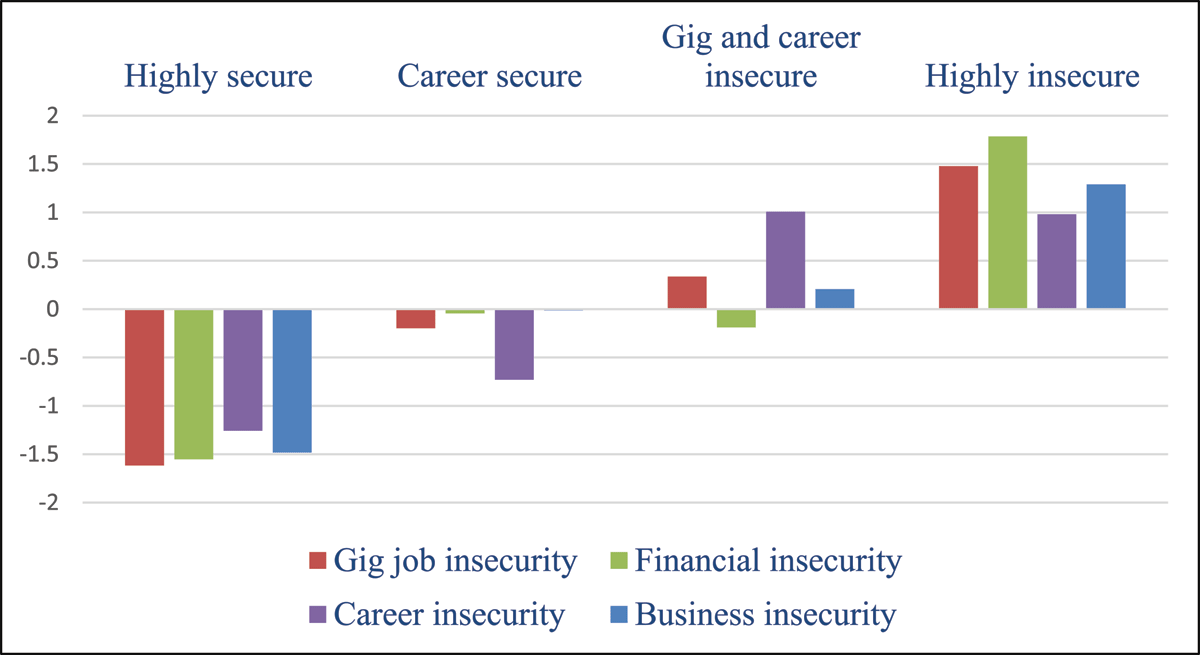
Figure 2
Latent profiles, standardized solution. ‘Highly secure’ N = 90, ‘Career secure’ N = 45, ‘Gig and career insecure’ N = 54, ‘Highly insecure’ N = 38.
Differences in antecedents of insecurity profiles
Tables 3, 4, 5 show the analyses related to RQ2. In the following, each profile is described narratively, and readers are referred to the tables for details about statistical significance between profiles.
Table 3
Personal demographic antecedents to insecurity profiles.
| HIGHLY SECURE [1] | CAREER SECURE [2] | GIG AND CAREER INSECURE [3] | HIGHLY INSECURE [4] | Chi2 | PAIRWISE | |
|---|---|---|---|---|---|---|
| Number | 90 | 41 | 52 | 35 | ||
| Gender (% female) | 34 | 44 | 48 | 61 | 7.67* | 1 < 4 |
| Age (in years) | 58.5 | 48.0 | 50.4 | 48.1 | 26.49*** | 1 > 2–4 |
| Education (% academic degree) | 45 | 39 | 48 | 52 | 1.39 | – |
| Country of birth (% Sweden) | 87 | 91 | 91 | 82 | 1.36 | – |
| Marital status (% married/cohabiting) | 78 | 70 | 49 | 67 | 11.72** | 3 < 1,2 |
| Children (% child at home) | 14 | 41 | 29 | 35 | 11.00* | 1 < 2,4 |
| Household contribution | OR | |||||
| Less than 50% | 10.2 | 44.1 | 10.1 | 11.2 | 6.960a .143b .160c | 1 > 2 2 < 3 2 < 4 |
| 50% | 26.0 | 18.2 | 22.3 | 29.2 | 2.911d .291e | 1 > 2 2 < 3 |
| Between 50–100% | 33.5 | 15.7 | 16.7 | 18.8 | .419f .272g | 1 < 3 2 < 3 |
| 100% | 30.3 | 22.0 | 50.9 | 40.8 | – |
[i] Note: N = 218; *p ≤ .05; **p ≤ .01; ***p ≤ .001.
a Comparison of class 1 to class 2 threshold from category 1 to higher OR = 6.960, 95% CI [2.582;18.763]
b Comparison of class 2 to class 3 threshold from category 1 to higher OR = 0.143, 95% CI [0.042;0.484]
c Comparison of class 2 to class 4 threshold from category 1 to higher OR = 0.160, 95% CI [0.047;0.541]
d Comparison of class 1 to class 2 threshold from category 2 to higher OR = 2.911, 95% CI [1.257;6.742]
e Comparison of class 2 to class 3 threshold from category 2 to higher OR = 0.291, 95% CI [0.111;0.760]
f Comparison of class 1 to class 3 threshold from category 3 to higher OR = 0.419, 95% CI [0.202;0.870]
g Comparison of class 2 to class 3 threshold from category 3 to higher OR = 0.272, 95% CI [0.095;0.776]
Table 4
Gig employment characteristics antecedents to insecurity profiles
| HIGHLY SECURE [1] | CAREER SECURE [2] | GIG AND CAREER INSECURE [3] | HIGHLY INSECURE [4] | Chi2 | PAIRWISE | |
|---|---|---|---|---|---|---|
| 90 | 41 | 52 | 35 | |||
| Sector (%) | OR | |||||
| Machines, goods, energy | 18.2 | 13.2 | 11.6 | 2.1 | ||
| Education, health care, social work | 14.5 | 18.5 | 19.2 | 7.2 | .211a .220b .229c | 1 < 4 2 < 4 3 < 4 |
| Knowledge intensive | 32.0 | 16.8 | 33.6 | 48.2 | ||
| Labour intensive | 35.4 | 51.4 | 35.6 | 42.5 | ||
| Seasonal variations | 1.51 | 1.52 | 1.52 | 1.66 | 2.705 | – |
| Type of assignment (%) | OR | |||||
| One long-term | 30.4 | 19.6 | 10.6 | 27.3 | 0.271d | 1 < 3 |
| Several smaller assignments | 62.0 | 68.6 | 85.8 | 67.3 | ||
| Many short client contacts | 7.6 | 11.8 | 3.6 | 5.4 | ||
| Advance notice (% <1 month in advance) | 39.5 | 24.9 | 52.1 | 47.9 | 6.537# | 2 < 3,2 < 4# |
| Main activity (%) | OR | |||||
| Employed gig | 48.9 | 33.6 | 35.2 | 59.9 | ||
| Other work | 26.2 | 48.4 | 45.7 | 29.6 | 2.949e 2.749f | 2 > 4 3 > 4 |
| Other activity | 25.0 | 18.0 | 19.1 | 10.6 | ||
| Regularity of work | 3.06 | 3.19 | 3.06 | 3.64 | 7.85* | 1;3 < 4 |
| Lack of assignments | 1.70 | 2.89 | 2.85 | 3.63 | 83.499*** | 1 < 3–4; 2–3 < 4 |
| Tenure (years) | 4.13 | 7.50 | 5.56 | 4.94 | 4.520 | – |
| Income (% above 250 000 SEK/year | 27.6 | 38.9 | 24 | 29.2 | 1.875 | – |
| Percentage of income (% more than 20%) | 41.6 | 48.4 | 42 | 72.6 | 11.512** | 1–3 < 4 |
| Unemployment last 2 years (%) | 13.9 | 32.5 | 34.6 | 53.8 | 22.544*** | 1 < 2–4 |
[i] Note: N = 218; *p ≤ .05; **p ≤ .01; ***p ≤ .001; # p = .085.
a Comparison of class 1 to class 4 threshold from category 2 to higher OR = 0.211, 95% CI [0.056; 0.792]
b Comparison of class 2 to class 4 threshold from category 2 to higher OR = 0.220, 95% CI [0.053; 0.911]
c Comparison of class 3 to class 4 threshold from category 2 to higher OR = 0.229, 95% CI [0.055; 0.959]
d Comparison of class 1 and 3 threshold from category 1 to higher OR = 0.271 95% CI [0.097; 0.760]
e Comparison of class 2 and 4 threshold from category 1 to higher OR = 2.949 95% CI [1.078; 8.066]
f Comparison of class 3 and 4 threshold from category 1 to higher OR = 2.949 95% CI [1.047; 7.216]
Table 5
Labor market and Personal motivation antecedents to insecurity profiles.
| HIGHLY SECURE [1] | CAREER SECURE [2] | GIG AND CAREER INSECURE [3] | HIGHLY INSECURE [4] | Chi2 | PAIRWISE | |
|---|---|---|---|---|---|---|
| 90 | 41 | 52 | 35 | |||
| Labor market | ||||||
| Covid impact (–100; 100) | 3.39 | 10.97 | 7.45 | -8.72 | 3.177 | – |
| Digitalization during covid (0 not at all – 5 a lot) | 1.63 | 2.37 | 2.14 | 2.51 | 14.444** | 1 < 2;4 |
| Personal Motivation | ||||||
| Intrinsic | 4.27 | 3.82 | 3.67 | 3.33 | 15.010*** | 1 > 3–4 |
| Need to make a living | 2.09 | 3.03 | 3.41 | 3.61 | 34.877*** | 1 < 3–4 |
[i] Note: N = 218; *p ≤ .05; **p ≤ .01; ***p ≤ .001.
Members of the first profile ‘highly secure’ had a higher proportion of men (34% female), and were comparatively older, with an average age of 59 years. An overwhelming majority were married or cohabiting (78%), and had only limited childcare responsibilities (14%). Members of this profile had higher intrinsic motivation and lower extrinsic motivation to work as employed gig workers than other profiles. They worked less often than other profiles, did not experience a lack of assignments or have had any recent unemployment experiences. Furthermore, they did not increase digitalization of their products/services during the COVID-19 pandemic and worked in various sectors.
In the second profile ‘career secure’ the gender composition was relatively equal (44% female), the average age was 48 years, and most were married or cohabiting. Compared to the other profiles, they had higher levels of childcare responsibilities (41%), and members of this profile contributed little to the household income (44% contributed less than half). About half of the employed gig workers in this profile worked in labor-intensive sectors. They had much longer advance notice of assignments than other profiles, although it was not uncommon for them to wish for more assignments. Members increased digitalization of their products/services during the pandemic.
In the third profile ‘gig and career insecure’ the gender composition was equal, and the average age was 50 years. Members of this profile were less likely to be married or cohabiting (49%), and they were more likely to be the sole provider of household income (51%). They had less intrinsic motivation and more extrinsic motivation than profile 1. They were also less likely to have one long-term assignment and, instead, 86% had several smaller assignments. Just as profile 2, it was not uncommon for them to wish for more assignments, but members of profile 3 had much shorter advance notice of assignments. That is, 52% of members of profile 3 stated that they had less than one month of advance notice for assignments.
Members of the fourth profile ‘highly insecure’ were more likely to be female (61% female), with an average age of 48 years, and around 35% had childcare responsibilities. Members of this profile had the highest percentage of income from gig employment, and 41% provided all household income. They were also significantly more likely to have employed gig work as their main activity than those in profile 2 and 3. Moreover, members were more likely to have been unemployed in the past two years (54%), and they had the highest values compared to the other profiles regarding wanting more assignments. They were more likely to work in knowledge-intensive or labor-intensive sectors, and less likely to work in healthcare or education. They perceived that digitalization of their products/services increased the most during the pandemic. Similar to profile 3, they had less advance notice than other profiles, and their motivation to make a living was comparably higher than their intrinsic motivation to work as an employed gig worker.
Discussion
With this study, we aimed to explore how employed gig workers in Sweden experience gig job, financial, career and business insecurity. To better understand their insecurity experiences, we studied associations to potential antecedents regarding personal demographics and motivation for gig work, gig job characteristics and labor market factors.
Although correlated, gig job insecurity, financial insecurity, career insecurity and business insecurity combined into distinct and meaningful profiles, which illustrates the merit of the person-centered approach to add to our understanding of how job insecurity is experienced in the context of other important factors (Klug et al., 2020). This approach also helps to carve out distinct profiles of experiences in the heterogeneous group of employed gig workers. Among these, clearly, some indeed seem to be in more precarious situations (Hedenus & Nergaard, 2021) whereas others may hold a more privileged position (Palm, 2019).
Regarding prevalences, the results of this study show that the majority of the employed gig workers in this sample perceived their situation to be highly secure (40%) or career secure (20%). In contrast to past studies that emphasized the precarious and insecure nature inherent in gig work (Wu & Huang, 2024), for these two profiles this was not the case. However, almost one in four (24%) felt gig job and career insecure, and, albeit being the smallest group, a considerable share (17%) reported high insecurity. Particularly this latter group fits the wide-held assumption that gig workers have heightened and more widespread job insecurity perceptions (Cropanzano et al., 2023) but clearly, this does not hold true for everyone. Also, contrary to assumptions made in the literature (Caza et al., 2022), financial insecurity was not necessarily experienced by all gig workers.
Another interesting observation concerns the role of career insecurity: having average levels across business, financial and gig job security, the ‘career secure’ profile stood out as perceiving good career prospects in the long run, which differentiates them from another profile of employed gig workers (‘gig and career insecure’), who were similar in their views of financial and business insecurity but reported elevated levels of both gig job and career insecurity. This result illustrates the merits of considering the more long-term perspective of career insecurity in addition to the short-term perspective of job insecurity (Spurk et al., 2021).
Furthermore, career insecurity and business insecurity—the latter a concept stemming from literature on the self-employed—did have different roles in the identified profiles, which provides some evidence that they may be seen as conceptually distinct. Others have stated that employed gig workers have certain similarities to self-employed workers (Hedenus & Nergaard, 2021), but the idea of considering how gig workers manage the insecurity and uncertainty related to their assignments and their ‘business’ is new and needs to be explored more.
When inspecting the insecurity profiles it needs to be kept in mind that this study tapped into the affective but not the cognitive component of insecurity perceptions (Keim et al., 2014; Sverke & Hellgren, 2002), emphasizing worries regarding potential threats to client-based work, financial aspects and career prospects rather than asking for judgements concerning the likelihood of such threats. It is possible that employed gig workers perhaps would rate the likelihood of said threats higher than their worries about these.
Through studying important groups of antecedents to insecurity we further validated the found insecurity profiles. Incorporating a variety of personal and work-related factors into this analysis helped to uncover distinct features in each of the subgroups. The biggest group with the secure profile contained more men and members were relatively old, illustrating that employed gig work may be attractive to more senior workers, whose skills may be more valued in an external labor market (Cropanzano et al., 2023). The secure group was the least dependent on clients, had been least affected by labor market changes such as digitalization during COVID-19, and viewed their gig work as intrinsically motivated. Fewer experiences of unemployment and the relatively high age, combined with the fact that gigs were worked on more occasionally may also well explain the relatively low levels of business and career insecurity. Clearly, this group was not economically dependent on gig work (Brawley Newlin, 2023). Conversely, the most dissimilar group, characterized by high levels of insecurity, exhibited the highest percentage of women, many of whom bear significant responsibilities for children living at home. Additionally, a substantial portion of this group contributes the entirety of their household income, alongside a considerable number who rely on gig work for more than 20% of their monthly earnings, highlighting their economic dependency on such work (Brawley Newlin, 2023). More than half of the group had employed gig work as their main labor market activity, which differentiated them significantly from the ‘career secure’, and the ‘career and gig job insecure’. Findings in this group fit well with earlier research on job insecurity, such that being female, having child responsibilities, and being dependent on the income creates vulnerability and elevates insecurity perceptions (Shoss, 2017). In addition, the specific circumstance of how much advance notice employed gig workers have for their assignments brings a new perspective to important antecedents that are specifically important for gig workers and those working on their own. Similarly, the lack of clients or wanting to have more assignments mattered as antecedent, with many employed gig workers wanting more assignments than they currently had. Thus, advance notice and lack of clients may be important antecedents related to job insecurity in non-standard employment forms.
Both the ‘career secure’ and the ‘gig job and career insecure’ profiles shared characteristics with the two most extreme groups, and this further illustrates the complexity in which different potential antecedents may lead to experiences of insecurity (Klug et al., 2020). The ‘gig job and career insecure’ group stood out as the profile with most single people and thus also the highest share of sole-income earners, who work less regularly than others in gigs, and least of all groups with long-term assignments. The ‘career secure’ profile contained individuals contributing less to the household income but also had rather long advance notice for assignments. A majority worked in the labor-intensive sector and had experienced changes during COVID-19 due to digitalization. Compared to the other groups, they took a middle position in regularity of gig work, lack of client assignments and many of them combined employed gig work with other employment. This may also explain their average levels of insecurity perceptions regarding gig job, business and financial insecurity.
Concerning motives to engage in gig work, our results largely confirm what has been found for temporary employment: more involuntary, extrinsic contract motivation relates to higher values of insecurity (Bernhard-Oettel et al., 2013). In this study, the majority (60%) had considerably higher extrinsic than intrinsic motivation to engage in employed gig work, and workers in these groups (‘career secure’, ‘gig job and career insecure’, ‘highly insecure’) were characterized by experiences of insecurity that differentiated them from the secure group. So, for most of the workers, gig work offered a possibility to add to their income (Palm, 2019). In contrast, the secure profile seemed to enjoy employment as gig workers as they had high levels of intrinsic and low levels of extrinsic motivation. Here, our study can contribute to a better understanding as to why they may do so, something that has been called for in the literature (Cropanzano et al., 2023). For them, this employment form seems to be a welcome opportunity for bridge employment during the transition into retirement, illustrating how new employment forms in the gig economy may not only erase boundaries for the organization of work (Watson et al., 2021), but also for occupational career choices and length of active participation in working life (Wu & Huang, 2024).
Limitations and conclusions
This study has certain limitations that need to be addressed. First, concerning respondents, the studied sample contained few of the individuals that are typically portrayed as gig workers, that is, participants were mostly born in Sweden or Europe and were not migrant workers (Newlands, 2022), and, as has been noted in other studies, were rather well-educated (see Watson et al., 2021). As systematic research on the numbers and demographics of gig workers and especially employed gig workers are missing, it is difficult to know how representative the sample is for employed gig workers in Sweden. The fact that the sample contained relatively many well-educated and older workers could mean that the number of workers in the secure profile may be overestimated, so that generalizability in regard of the size of each profile may be hampered. Concerning the study’s purpose to examine insecurity perceptions of employed gig workers, however, variation was found, illustrating that despite the legal employment offered via umbrella companies, gig-based work still can be perceived as highly insecure and this profile perhaps is more dominant in younger employed gig workers. Another relevant consideration is the Swedish context. The fact that the studied workers are legally entitled to welfare benefits (e.g., for unemployment or parental leave) may set them apart from non-employed gig workers or gig workers in other countries. This may also have an impact on the types and shapes of insecurity profiles and thus further studies on this group that target larger samples or other countries (e.g., employed gig workers in umbrella companies in France or Norway) are highly warranted.
A second limitation is that the study is based on cross-sectional data and the sample size is relatively small. Thus, we cannot know how stable or malleable the found insecurity profiles are over time. In addition, future research with a larger sample would be needed to test the replicability of profile solutions. Given the calls in the gig work literature to consider the heterogeneity in more detail (Watson et al., 2021; Wu & Huang, 2024), we see it as a strength that this study explored differences between profiles for a variety of potential antecedents. Due to the cross-sectional nature of the study, these variables have been studied as correlates and their potential to predict insecurity perceptions still needs to be tested. Also, other variables, for example in terms of personality, may need to be added (see Shoss, 2017). Another important aspect that future research may explore is how relevant these insecurity profiles are for outcomes of interest, for example health or well-being outcomes.
Third, while we considered various facets of job insecurity adapted for employed gig work, drawing upon insights from the literature on job insecurity, career development and self-employment, qualitative approaches might be valuable to explore which additional kind of insecurities employed gig workers face. For example, Newlands (2022) proposed the relevance of identity challenges for gig workers, which suggests that other insecurity forms may exist that this present study has not covered. Furthermore, though not being a limiting factor for the person-centered analyses, the insecurity aspects in this study correlated highly with one another, suggesting some overlap between the insecurity aspects, perhaps particularly with regard to career insecurity. Yet, as the existence and continuation of employed gig work hinges on the gigs a worker can get, stronger interrelations may not be surprising. At the same time, the confirmatory factor analyses, the size of the correlations and the identification of the four distinct profiles also indicate that the different aspects assess distinct perspectives, and clearly, this could be explored further in future studies in (employed) gig workers.
Despite its limitations, this study offers valuable insights in both theory and practice. Primarily, it suggests that gig work, as evidenced by the studied respondents, may not universally entail precariousness, insecurity, and vulnerability in employment, as demonstrated by the ‘highly secure’ profile. Here, future research is needed to disentangle whether the relatively well-defined and regulated employment form, the specific resourcefulness of this particular group, or their wish to create a meaningful bridge employment towards the end of their working life, may explain the fairly large proportion that fell into the group of the ‘highly secure’. Secondly, participants in the insecurity profile relied on employed gig work as a main activity and for household income, which signals that gig work is not only used as sideline activity alongside standard employment. Thirdly, with the emergence of more non-permanent work forms that dissolve the lines of organizational and self-employment—as in the case of employed gig work—there is a need to explore new dimensions of what constitutes job insecurity. Here, we studied gig job-insecurity and business insecurity, two aspects that are new and potentially relevant for employment forms that are client-based. Along with these developments, we also see a need to reconsider potential antecedents for insecurity experiences in client-based work and hope that this study can provide a first important step to inspire future research on insecurity perceptions in (employed) gig work.
Finally, this study has several practical implications for different stakeholders involved in employed gig work. For individual workers, proactively seeking assignments by engaging with potential clients may help to mitigate aspects of gig employment insecurity. For umbrella companies, additional support could include training on negotiating better terms and conditions, offering guidance on pricing strategies, and directly assisting workers in contract negotiations. Such support may be specifically needed to target those who use employed gig work more regularly to generate a large part of their income. For policymakers, our findings offer important insights. Contrary to the widespread belief that all gig work means insecure and precarious employment, our results show that this is not necessarily true for all gig workers. However, particularly those who engage in gig work as their main activity, precariousness and insecurity prevail despite the fact that they are legally employed. Yet it may be advantageous to organize gig work as legal employment, as this creates opportunities for policymakers to collaborate with stakeholders (employers, clients, unions) to improve conditions for workers facing insecurity while preserving the benefits and freedom that employed gig work apparently also offers.
Appendices
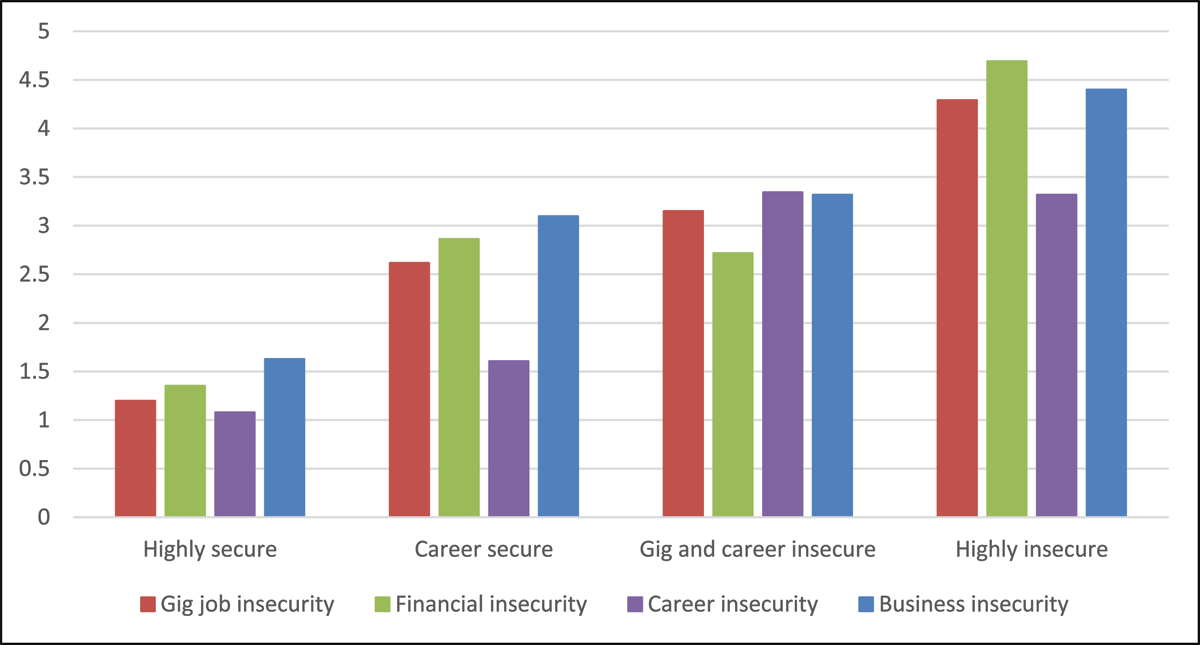
Notes
[5] We also ran CFAs including career insecurity as a single item factor with an assumed error variance of (1–0.70)*sample variance. The suggested four-factor model provided a significantly better fit to the data than alternative one-, two- and three-factor models. One three-factor model (combining gig job and career insecurity) fit the data equally well as the four-factor model (ΔΚ2 = 1.38 (2) > 0.05). Since the four-factor model provided a good fit to the data (Κ2(22) = 34.97; p = .04; RSMEA = .05 (CI = .01– .08); CFI = .99) and is the theoretically more reasonable model, we have kept our conceptualization of four different aspects of insecurity perceptions in all further analyses.
Competing Interests
The main author is also editor of this journal, and was therefore removed from all editorial tasks for this paper. The guest editors for the special issue on job insecurity part II have been assigned responsibility of overseeing peer review.