
Deciding whom to hire is often conceived as a matching process through which employers seek candidates who align with their perceptions of the required skills, capabilities, experience, and other requirements for the specific job and the organization (Rivera 2020). One type of matching concerns a fit between the stereotype content of social groups and occupations (Cuddy et al. 2011; Heilman et al. 2001; Heilman & Caleo 2018). That is, whether social groups are perceived to share specific attributes with the incumbents of a particular occupation. Research on universal dimensions of stereotype content has shown that social groups, their intersections (Fiske 2018; Nicolas & Fiske 2023), and occupations (Fiske & Dupree 2014) can be reliably distinguished in terms of warmth (e.g., friendly, empathic, benevolent) and competence (e.g., intelligent, skillful, ambitious) attributes. Drawing on the stereotype content model (SCM; Cuddy et al. 2011; Fiske et al.,2002), we argue that social groups that are stereotypically perceived as warmer than competent (e.g., women) would be preferred for occupations (e.g., server) characterized by higher warmth (e.g., sociability) than competence (analytic skills). Similarly, groups stereotyped as higher in competence than warmth (e.g., men) would be deemed more suitable for technical occupations (e.g., engineers) characterized by higher competence than warmth.
Thus far research on stereotype based matching effects (or stereotype fit) seems to have focused on race/ethnicity or gender, and isolated social categories rather than through an intersectional lens that looks at the effect of the combination of social categories (He et al. 2019). Moreover, only a few studies seem to have used SCM as a framework to examine matching effects even though warmth and competence are widely recognized as universal dimensions of stereotype content that can parsimoniously explain the stereotype content of both social groups and occupations, including potential fit (Fiske 2018). The SCM extends beyond gender and associated attributes concerning masculinity and femininity (agency and communion; Abele 2003), and hence should allow for a comprehensive analysis of a broader set of social and occupational categories by placing them on the same metric (He et al. 2019). The current study attempts to address these limitations by examining stereotype matching effects of intersected social categories (gender and sexual orientation) and occupations, using a SCM framework. Another limitation of previous SCM research on stereotype matching is that it tends to be based on correlational evidence that is relatively silent regarding the origin of matching effects. For example, while He et al. (2019) show that social groups are more likely to be represented in occupations with similar warmth/competence stereotype content profiles in the US labor market, it is unclear whether such matching is caused by unequal treatment (discrimination) by the employers as opposed to the social groups themselves self-selecting into different occupations. The current study focuses on the demand side of stereotype matching where employers hire individuals perceived to possess characteristics most relevant to the job. We experimentally manipulate the combinations of hypothetical job seekers’ social group membership (gender * sexual orientation) and the occupations they are considered for to rigorously assess whether matching occurs when evaluators judge the perceived job suitability of otherwise identical job applicants.
Stereotypes of job seekers and occupations in hiring. What can SCM contribute?
A notable characteristic of the SCM model is that it addresses stereotype content on two dimensions that are orthogonal in their relationship and that create a bi-dimensional space with four quadrants (Yzerbyt 2018). Many groups fall in the ambivalent quadrants of high warmth/low competence and low warmth/high competence (Yzerbyt 2018), and the position of the groups within quadrants will depend on social structural factors (see Fiske 2018). Warmth perceptions stem from how cooperative and competitive groups are perceived to be (shared values, economic interdependence; Fiske 2018). Warmth perceptions are less consensual and highly correlated with intergroup similarity (Koch et al. 2020). In contrast, competence perceptions follow from perceived status (prestige of jobs generally held, economic success; Fiske 2018). The relationship between these dimensions remains an unresolved issue. They can be positively, negatively, or not correlated and even at times show curvilinear relationships depending on the study’s design and the selection of groups included for rating (Bai et al. 2024). Despite this the model is well used and with respect to the current study allows for testing the matching of stereotypes of occupations with those of personal characteristics, as it encompasses differences based on several characteristics and their positioning in society. Research also shows that the role of context, comparison groups, and intersections of specific categories may produce unique perceptions (Abele et al. 2021; Nicolas et al. 2023; Yzerbyt 2018) highlighting the need to use a model that could capture these changes in perception.
Several other theories and models focus on stereotype fit by exploring perceptions associated with a particular group or examining overrepresentations of groups in particular occupations. The lack of fit model is one of the most notable accounts and was developed to specifically understand gender discrimination (Heilman et al. 2001; Heilman & Caleo 2018). The model explores the perceived mismatch between expectations that women may lack the characteristics (competence) needed for male-typed and higher-level positions which can lead to adverse outcomes concerning selection decisions, competence assessments, and other workplace outcomes (Heilman & Caleo 2018). Focus on a mismatch based on gender and occupational and leadership stereotypes has enriched the understanding of how women are treated at work. Still, there are many other characteristics a job seeker may possess simultaneously (e.g. age) that may induce additional stereotypes and need to be accounted for in an evaluation process.
Koenig and Eagly (2014) test social role theory, which is typically associated with gender stereotypes stemming from observations of gender roles, as a general theory of stereotype content. More specifically they explore whether beliefs about different social groups are created in relation to their occupational roles. They find quite accurate predictions by participants as to which occupations different groups of people (e.g., Asians, Black women) are perceived to be overrepresented in comparison to the actual labor statistics. They show how stereotypes of social groups measured in terms of competence/agency and communion could be predicted from the attributes, behaviors, and career interest profiles associated with their typical occupational roles. Similarly, He et al. (2019) compare warmth/competence ratings of occupations with the U.S. labor market statistics and find support for these stereotypes predicting occupational segregation. For example, there is a higher percentage of women in occupations characterized by higher warmth than competence. The authors conclude that future research should focus more on the specific mechanisms behind the stereotypes’ impact on occupational segregation. These studies show a relationship between occupational stereotypes and those of people stereotypically perceived to occupy these roles (He et al. 2019; Koenig & Eagly 2014). However, they are correlational, focus on slightly different dimensions of stereotype content, and examine only particular groups without a specific focus on their intersection or the hiring stage.
Several studies show the relevance of accounting for multiple identities and how they influence stereotypical perceptions. For example, Petsko and Bodenhausen (2019) show that combining sexual orientation and ethnicity resulted in perceptions of Hispanic and Black targets as less stereotypical of their ethnic group resulting in more positive perceptions. Recent research has also found some support for the intersectional invisibility hypothesis. The model proposes that groups that have intersecting identities (e.g. minority lesbian woman) may be seen as less prototypical and ascribed unique characteristics due to ideologies of androcentrism (prototypical group member: male), ethnocentrism (majority) and heterocentrism (straight; see Ball et al. 2022; Purdie-Vaughns & Eibach 2008). These perceptions may influence favorable treatment in some situations, for example experiences of less direct discriminatory behaviors and prejudice. More prototypical group members may be exposed to more active forms of discrimination. In other situations, disadvantages may consist of difficulties in advocating for group issues and being less prone to attain positions of influence or leadership (Purdie-Vaughns & Eibach 2008). Considering these results, how would the characteristics of a job seeker be perceived in relation to the occupational characteristics if the combinations allow for unique impressions to form? The SCM may allow comparisons encompassing several factors and potentially capturing these subtle differences. The intersection of gender and sexual orientation is suitable for exploring the matching process based on SCM, since it produces opposite warmth/competence profiles (see Table 1) and may be tested with matching profiles of occupations.
Table 1
Previous research findings on the stereotype content of the intersection of gender and sexual orientation.
| REFERENCE | CONTEXT | SURVEY | CATEGORY | WARMTH | COMPETENCE |
|---|---|---|---|---|---|
| Strinić et al. (2021) | Sweden, workplace context | Warmth: friendly, benevolent, warm, and considerate Competence: competent, talented, skillful, and ambitious 5-point Likert scale (1 = not at all; 5 = extremely) | Swedish man | 3.20 | 3.91 |
| Swedish woman | 3.68 | 3.67 | |||
| Swedish gay man | 3.83 | 3.60 | |||
| Swedish gay woman | 3.28 | 3.58 | |||
| Klysing et al. (2021) | Sweden | Agency/Communion scale (e.g. competitive, efficient/caring, friendly) 5-point Likert scale (1 = not at all to 5 = a great deal) | Heterosexual men | 2.79/3.22* | 3.71/3.59 |
| Men | 2.74/3.22 | 3.93/3.79 | |||
| Heterosexual women | 3.71/3.79 | 2.92/3.41 | |||
| Women | 3.74/3.96 | 2.73/3.36 | |||
| Gay men | 3.43/3.44 | 2.83/3.18 | |||
| Lesbian women | 3.04/3.45 | 3.58/3.50 | |||
| Vaughn et al. (2017) | U.S. | Competence—capable, competent Warmth—warm, friendly 5-point Likert scale (1 = not at all; 5 = extremely) | Gay men | 3.75 | 3.12 |
| Lesbians | 2.94 | 3.28 | |||
| Fiske et al. (2002) | U.S. | Warmth/competence scale 5-point Likert scale (1 = not at all; 5 = extremely) | Gay men | Middle of warmth/competence space Individual level—higher warmth than competence | |
| Women | High competence, high warmth cluster Individual level—higher warmth than competence | ||||
| Men | High competence, lower warmth | ||||
[i] *The results are from two separate studies done on different samples. The format is as follows study 1 results/study 2 results.
Discrimination based on sexual orientation and occupational stereotypes
Reports of social exclusion, experiences of threats of violence/attacks and insults, sexual harassment, and maltreatment, fear of disclosing sexual orientation in the workplace and findings of wage inequality, hiring discrimination, denial of promotion, or loss of job due to discrimination based on sexual orientation have been obtained (for reviews see McFadden 2015; Steffens et al. 2016). Understanding this type of workplace discrimination carries layers of complexity as experiences vary within the group (e.g., gay men report the highest percentage of insults in everyday life), subgroups are not sufficiently researched (e.g., experiences of bisexual people), and there is a need to explore further the specific conditions (e.g., level of prejudice) that may lead to discrimination (Steffens et al. 2016). Steffens et al. (2016) also conclude that experimental research on hiring discrimination based on sexual orientation is still in its beginning and that one should further research how characteristics of the job (e.g. perceived masculinity of job description) and perceived lack of fit to the job requirements affect discriminatory treatment.
Several types of experimental studies find occupations to be of importance for the treatment of gay men and lesbians, but which group is disadvantaged the most varies depending on the types of occupations included. Flage (2020) finds in a meta-analysis of correspondence studies that gay job applicants receive a 40% lower callback rate in the resume screening stage in the OECD labor markets. The level of discrimination varies by gender and occupation type, as gay men in low-skilled jobs experience higher levels of discrimination compared to their straight counterparts. Ahmed et al. (2013) find in their correspondence study that gay men are disadvantaged compared to heterosexual men in male-dominated occupations, while lesbians are disadvantaged in female-dominated occupations. Using subtle cues of sexual orientation like audio stimuli to sound gay, Fasoli and Hagerty (2020) find that both gay men and lesbians are perceived as less suitable for leadership positions and especially lesbians experience most discrimination regardless of being ascribed more masculine traits than their heterosexual counterparts. Niedlich and Steffens (2015) use fabricated resumes where they manipulate gender and sexual orientation (same-sex partner) and find that gay men and lesbians are seen as more task-competent and socially skilled than heterosexual candidates. However, perceived hireability did not show this pattern since this differed for groups and type of job. For example, task competence did not predict hireability for lesbians for a masculine occupation of construction engineer. Fasoli and Hegarty (2020) rely on competence, sociability and morality to measure perceptions of applicants, while Niedlich and Steffens (2015) rely on warmth/competence to hypothesize how positive discrimination may occur as gay men and women may be perceived as crossing traditional gender roles, although both studies did not rely on these dimensions when selecting which occupations to include.
While there is admittedly considerable overlap between competence/warmth and agency/communion, we base our predictions on the SCM’s warmth and competence dimensions as they are arguably broader dimensions and less conceptually rooted in masculinity and femininity (He et al. 2019). Even if lesbian and gay workers often are found to work in occupations that are traditionally associated with the opposite sex (crossing gender lines), there is a great deal of variation in the US. Notably, there is a relatively high proportion of gay men in occupations where men constitute the majority of workers, and a relatively high proportion of lesbians work in female-majority occupations (Tilcsik et al. 2015). Arguably, gender characteristics may not be the whole story. Hancock et al. (2020) in a correlational survey study explore occupational stereotypes based on sexual orientation, by asking participants to report the proportion of men or women they believe to work in a particular occupation as well as whether they expect the man (gay typed job) or woman (lesbian typed job) to be gay. Findings show that with respect to male sexual orientation 7 out of 60 occupations were perceived as gay jobs (hairstylist) and 16 were seen as neutral (flight attendant). None of the tested occupations satisfied parameters to be categorized as lesbian typed, while 14 were perceived as neutral (physical education teacher). They conclude that it is important to understand the role of sexual orientation typing of occupations and that only focus on masculinity/femininity, gender inversion or associated prestige may not be enough to explain how these groups may be perceived with respect to different occupations. We propose that warmth and competence could be particularly suited for examining stereotype intersectional effects (gender × sexual orientation × occupation) as gender perceptions, status and interdependence affecting positioning of the groups/occupations should be encompassed in the perceptions.
The current research
Due to the scarcity of previous research on this topic, we explore stereotype matching in a hiring context where letters of interest ostensibly sent to companies by job seekers, men and women, straight and gay, were evaluated for two different positions. Our reference points for predicting matching effects are ratings from Strinic et al. (2022) regarding occupations and ratings from Strinic et al. (2021) regarding demographic group intersections collected in Sweden with participants (mainly recruiters) instructed to consider the work context. We also rely on additional research on the stereotype content of occupations and demographic groups conducted on either the US, our intended sample, or Swedish samples, which we find comparable to support our reasoning (Tables 1 and 2).
Table 2
Warmth and competence ratings forming the basis for job position selection.
| REFERENCE | CONTEXT | SURVEY | CATEGORY | WARMTH | COMPETENCE |
|---|---|---|---|---|---|
| Strinić et al. (2022) | Sweden | Warmth: friendly, benevolent, warm, and considerate Competence: competent, talented, skillful, and ambitious 5-point Likert scale (1 = not at all; 5 = extremely) | Personal assistant | 4.15 | 3.00 |
| Higher warmth than competence | |||||
| Accountant | 2.61 | 3.87 | |||
| Higher competence than warmth | |||||
| Fiske and Dupree (2014) | U.S. | ‘To what extent do most Americans view holders of this job as competent? Warm? Capable? Trustworthy?’ 5-point Likert scale (1 = not at all; 5 = extremely) | Nurse | The high-warmth, high-competence, ‘pride’ corner | |
| Accountant | The high-competence, low-warmth, ‘envied’ professions | ||||
| He et al. (2019) | U.S. | Warmth: warm, good-natured, sincere, friendly, well-intentioned, trustworthy Competence: competent, capable, intelligent, efficient, skillful, confident 7-point Likert scales (1 = not at all; 7 = extremely) Residualized mean ratings presented | Nurse | 1.34 | 0.22 |
| Medical assistant | 0.90 | –0.18 | |||
| Accountant | –0.55 | 1.02 | |||
| The current (our) pilot study | U.S. | Warmth: friendly, well-intentioned, warm, and considerate Competence: competent, intelligent, skillful, and ambitious 5-point Likert scale (1 = not at all; 5 = extremely) | Personal Care Assistant | 4.29 | 3.47 |
| Accountant | 2.91 | 4.42 | |||
Men, by signaling they are gay, receive a boost in warmth perceptions, while their competence perception is lowered. Women experience the opposite effect (Strinic et al. 2021, Table 1). Although Klysing et al. (2021) have a slightly different focus and find that gay and bisexual groups could be seen as more androgynous compared to heterosexual counterparts, we still find the ratings relevant as they show that the content associated diverges and does not overlap with the heterosexual targets.
We assumed based on previous research that the position of Accountant would be perceived as having higher competence than warmth and conversely that the Personal care assistant (PCA) would be perceived as higher on warmth than competence. We tested and confirmed these perceptions with a pilot study on a U.S. sample drawn from the same population used for the main study (Table 2).
Hypotheses
We assume that the matching effects operate for jobseekers if the intersection of demographic groups and the position have similar mixed stereotype content. We created the following hypotheses, which together would indicate a matching effect if supported by the data:
H1a:1 Gay men job seekers and straight women job seekers will receive higher job suitability ratings for the position requiring more warmth than competence (Personal care assistant) than for the position requiring more competence than warmth (Accountant).
H1b: Straight men job seekers and lesbian women job seekers will receive higher job suitability ratings for the position requiring more competence than warmth (Accountant) than for the position requiring more warmth than competence (Personal care assistant).
To identify how each occupation and the job seeker characteristics will match in terms of stereotype content and consequently affect job suitability, we also make predictions for each occupation and group separately:
H2a: Gay men job seekers will receive higher job suitability ratings relative to their straight counterparts for the position requiring more warmth than competence (Personal care assistant).
H2b: Straight men job seekers will receive higher job suitability ratings relative to their gay counterparts for the position requiring more competence than warmth (Accountant).
H3a: Lesbian women job seekers will receive higher job suitability ratings relative to their straight counterparts for the position requiring more competence than warmth (Accountant).
H3b: Straight women job seekers will receive higher job suitability ratings relative to their lesbian counterparts for the position requiring higher warmth than competence (Personal care assistant).
A complete matching effect, where the above hypotheses (pairwise comparisons) are supported, would give rise to a three-way interaction effect, reflected by two separate two-way cross-over interactions (for male and female jobseekers, respectively). Graphical illustrations of the expected pattern of results appear in Figures 1 and 2, respectively.
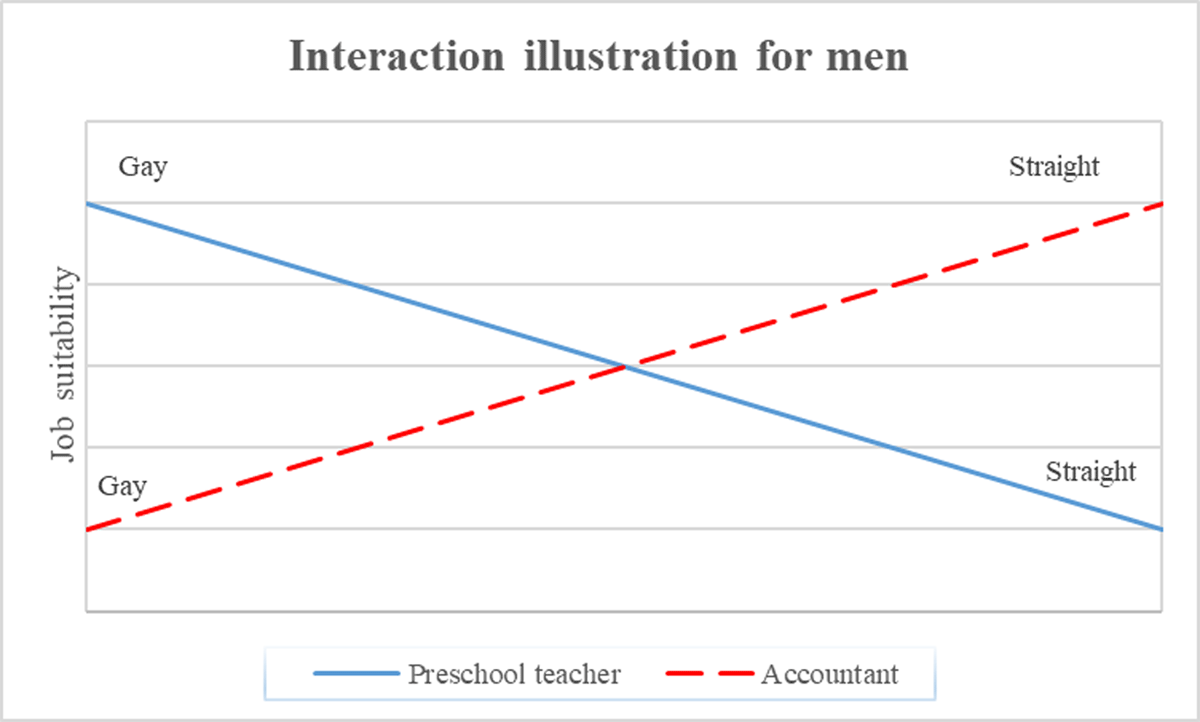
Figure 1
Illustration of hypothesized interaction effect for fabricated men job seekers.
Note that the illustration pertains only to the direction of the effect and not to the size of expected differences.
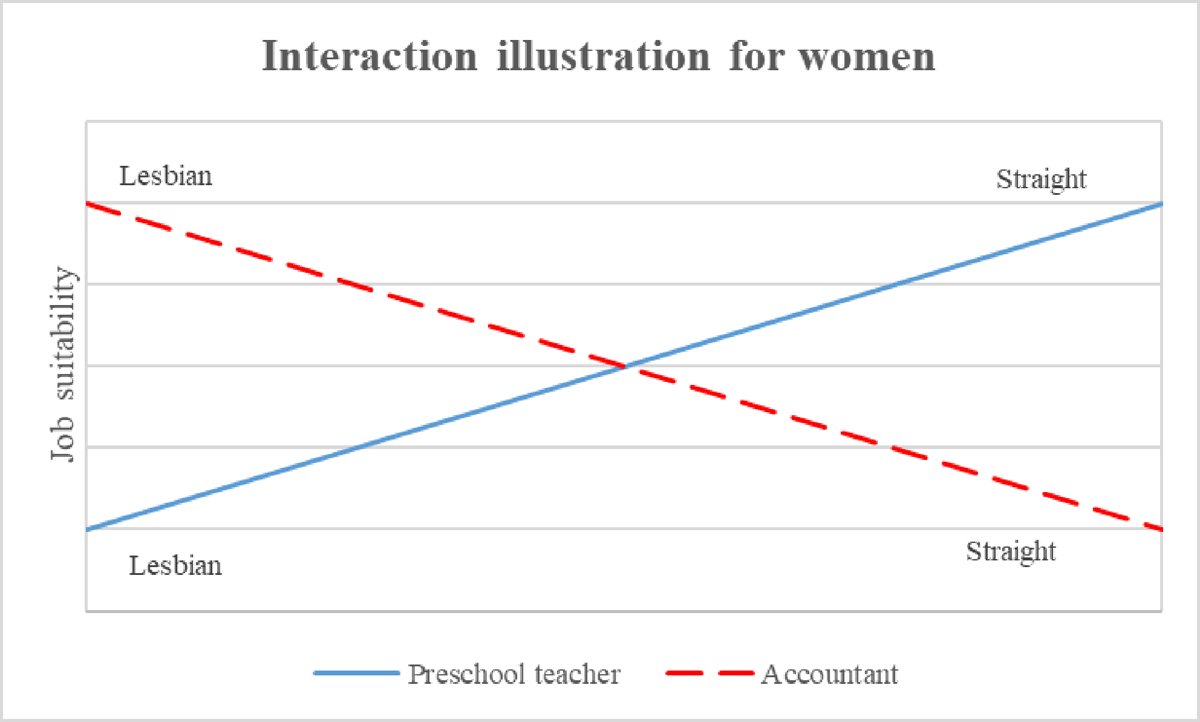
Figure 2
Illustration of hypothesized interaction effect for fabricated women job seekers.
Note that the illustration pertains only to the direction of the effect and not to the size of expected differences.
Pilot study
We conducted a pilot survey study to confirm that the participants hold different stereotype content profiles of accountants and personal care assistants. Note that this direct approach to measuring stereotype content of occupations differs from most research on matching effects which typically uses gender proportions in different occupations as a proxy for stereotype content. The total sample size comprised 200 (age M = 37.33, SD = 11,66; 60% women, 38.5% men) participants who were recruited through Prolific using the online questionnaire tool Qualtrics. They were informed that the study explores general perceptions of occupations and aims to understand which qualities are essential for specific occupations.
The first part of the survey asked participants for general perceptions of the two occupations of interest in terms of warmth and competence. We used the Warmth/Competence survey items based on Strinic et al. (2022) which showed good psychometric properties when applied to occupations and intersected demographic groups (see Table 2). The only change to the survey was that we used ‘intelligent’ instead of ‘talented,’ as it was considered a better term in the current context. We use the wording from Fiske and Dupree (2014): ‘To what extent do most Americans view job holders of the following occupations as….’ We tested Cronbach’s alpha for the survey and found good reliability with 0.79 for the warmth scale and 0.77 for the competence scale.
The second part of the survey asked participants to choose whether warmth or competence is central to performing the job well. To make the task more substantial and challenging, we asked the participants to choose the most important dimension for 12 occupations that might evoke associations of different levels of warmth and competence.
The third part of the survey asked the participants to describe the core tasks of the accountant and personal care assistant jobs in their own words. One of the study authors coded whether the participants correctly described the core job tasks. The fourth part asked demographic questions (gender, age, and hiring experience).
The accountant position is perceived as requiring higher competence (M = 4.42, SD = 0.55) than warmth (M = 2.91, SD = 0.65) (t = –25.426, p = 0.000, d = –1.80) with 99% of the sample choosing competence as the most important characteristic to perform this job successfully. The PCA position is perceived as requiring higher warmth (M = 4.29, SD = 0.59) than competence (M = 3.47, SD = 0.76), (t = 14.738, p = 0.000, d = 1.04) with 85.5% of participants choosing warmth as the most important characteristic for the position. In total, 98.5% described the job tasks of the accountant correctly, and 87% identified PCA tasks correctly. Given the clear results with strong effect sizes, we conclude that the positions of accountant and PCA are perceived as having opposite stereotype content and that most participants are familiar with their respective core tasks.
Main Study Method and Materials
The study is preregistered on the Open Science Framework https://doi.org/10.17605/OSF.IO/SBF4V.
Design
We employed a survey experiment where we presented participants with three hypothetical letters of interest for one of the two types of positions. A letter of interest usually contains a short description of the job seeker’s qualifications and an expression of interest in the company. Because letters of interest are commonly sent to potential employers and are less technical than resumes, they were considered suitable for the current research purposes.
Based on letters of interest for the assigned position, each participant is asked to evaluate three candidates with respect to job suitability. Two of these are fillers that contain no experimental manipulation. The target letter of interest always appears last and contains the experimental manipulation. Levels of independent variables are randomly assigned and consist of: (a) man vs. woman candidate; (b) gay vs. straight candidate; (c) PCA vs. Accountant position. These combinations result in eight different target letters of interest randomly assigned to participants.
Participants
We recruited participants using Prolific. The participants had to be between 18 and 70 years of age, fluent in English, residents in the US, and either full or part-time employees. We conducted an a-priori power analysis using the Gpower software (Faul et al. 2007). We calculated the planned sample size for a study with a priori power set to 0.95 to detect a small effect size (f = 0.100) with an alpha level of 0.05 (two-tailed), in the context of a between-subjects ANOVA with eight groups. Sinclair et al. (2023) employed a similar design when examining discrimination based on political orientation using the same platform (Prolific) and found that 20.6% of participants failed the manipulation check. We also assumed that roughly 20% would fail manipulation checks, so we added 260 participants to the required total to achieve a priori power of 0.95, making our total planned sample size 1,562.
The platform registered 1,610 unique Prolific IDs that accessed the survey. After removing all categories of incomplete or unusable data due to withdrawn participation, we are left with responses from 1,563 participants. We collected one more participant than originally planned as one accurately completed submission was mistakenly registered by Prolific as a timed-out submission.
As a manipulation check we examined whether participants could correctly recognize the task they were given, if they could remember the job position they were evaluating letters of interest for, and the sexual orientation and gender of the last applicant they evaluated. The manipulation check questions with respect to all the hypothetical applicants they reviewed was answered by 19.4% of participants. This response was kept in the analysis if they correctly answered all manipulation checks concerning the manipulation and filler hypothetical applicants. The manipulation check was failed by 12.7% of participants, which was lower than expected. We excluded these respondents, leaving us with a total sample of 1,365 participants (age M = 35.9, 38.4% within 18–30 age group, 61.6% within the 31–70 age group; 45.1% men, 53.4% women). Most participants consist of full-time employees (77.6%; 22.4% part-time employees). Most of the sample reported some hiring experience (35.6% no experience; 7.5% extensive experience). In addition, 12.3% of participants reported that they have experience working as recruiters. Participants hold positions in various occupations, such as accountants, administrative assistants, cooks, delivery drivers, IT, and HR personnel.
Experimental manipulations
All fictitious job seekers were of the same European American ethnicity (including the fillers). The gender is signaled by using a stereotypically female or male name (Emily/Matthew Sullivan). We relied on the names used in Bertrand and Mullainathan (2004) correspondence experiment to choose stereotypically white sounding names and then relied on the US Social Security list of the most common baby names in the 2000s to ensure that the chosen names were common in the intended age group. The sexual orientation manipulation consisted of mentioning a partner of either the same or opposite sexual orientation which is a common way of manipulating sexual orientation in correspondence experiments (e.g., Baert 2014). We created a template of a letter of interest loosely based on those used in Sinclair et al. (2023). We ensured that each letter of interest followed a similar structure. We also tried to include equivalent information across occupations, such that target letters of interest included job seekers who were qualified applicants at the beginning of their careers. The filler letters of interest contained a male and a female candidate at the beginning of their careers with the target letter of interest being the most qualified in comparison.
After each letter of interest, participants were asked to evaluate the job seeker with regards to job suitability. This design implies that each participant saw only one target letter of interest, more specifically, only one type of intersection of gender and sexual orientation and one position. This between-subjects factorial design means that we do not directly compare the effect of these signals for each participant. This design should reduce contrast effects arising from a repeated measures design where multiple matched target letters of interest are evaluated and help mask which comparison is of interest to the study. The outcome of interest is the job suitability composite score, while dummy indicators are created for the position, gender, and sexual orientation, and they act as independent variables.
Measure
Job suitability scale
This scale is based on the job suitability scale used by Derous et al. (2017). A Likert scale ranging from 1 to 7 is employed, with the following items: 1. How suitable do you believe this job seeker is for the [name of the position]? (1 – not at all; 7 – very suitable); 2. How likely is it that you would invite this job seeker for a job interview? (1 – not at all likely; 7 – very likely); 3. What is your general impression of this job seeker? (1 – very negative; 7 – very positive). The scale showed excellent internal reliability in this study (Cronbach’s α = 0.92).
Procedure
Participants were told that the research is exploring how letters of interest are evaluated with respect to job seekers characteristics and which qualities are important for specific occupations. After each of the three presented letters of interest for one type of job position, they were asked to answer several questions about the candidate’s job suitability. After completing the ratings, participants answered manipulation check questions and some demographic questions (age, experience recruiting and making hiring decisions etc.).
Results
We first examined mean differences across intersections of demographic groups and job positions (Table 3). The highest job suitability rating was given to a lesbian woman seeking a job as a PCA (M = 5.33, SD = 1.23), while the lowest rating in the sample was found for the straight woman seeking a position as an accountant (M = 3.60, SD = 1.43).
Table 3
Mean job suitability scores for intersected demographic groups across job positions.
| JOB POSITION | GROUP | M | SD |
|---|---|---|---|
| Accountant | Straight man | 3.62 | 1.40 |
| Gay man | 4.08 | 1.45 | |
| Straight woman | 3.60 | 1.49 | |
| Lesbian woman | 4.27 | 1.43 | |
| Personal care assistant | Straight man | 4.98 | 1.23 |
| Gay man | 5.19 | 1.24 | |
| Straight woman | 4.88 | 1.21 | |
| Lesbian woman | 5.33 | 1.23 |
We then turned to formal testing of hypotheses. We used a 2 × 2 × 2 between subjects ANOVA to test the expected pattern of results with regards to overall matching effects (H1–H3). The expected pattern of results (H1–H3) would give rise to two significant sexual orientation by job position interactions (one for each gender) which we test for with between-subjects factorial ANOVAs. Planned comparisons in the form of independent samples t-tests are performed to test the specific comparisons stated in our hypotheses.
The three-way between-subjects factorial ANOVA shows that there is no significant interaction effect between the gender of the fabricated applicants, sexual orientation and the job position F (1, 1357) = 0.004, p = 0.948, η2 = 0.000. We find a significant main effect of sexual orientation F (1,1357) = 38.156, p < 0.001, η2 = 0.023 and a significant main effect of job position F (1, 1357) = 274.066, p < 0.001, η2 = 0.164.
We examine the results for the men job seekers. We find a significant main effect of sexual orientation F (1,674) = 10.696, p = 0.001, ω2 = 0.012, a significant main effect of job position F (1, 674) = 145.616, p = 0.000, ω2 = 0.174, but more importantly no significant interaction effect between the sexual orientation and position F (1, 674) = 1.535, p = 0.216, ω2 = 0.001. Examining the confidence interval plot for men job seekers (see Figure 3) we find that gay job seekers receive higher job suitability ratings than their straight counterparts. Also, ratings for the PCA position are higher than for the accountant position.
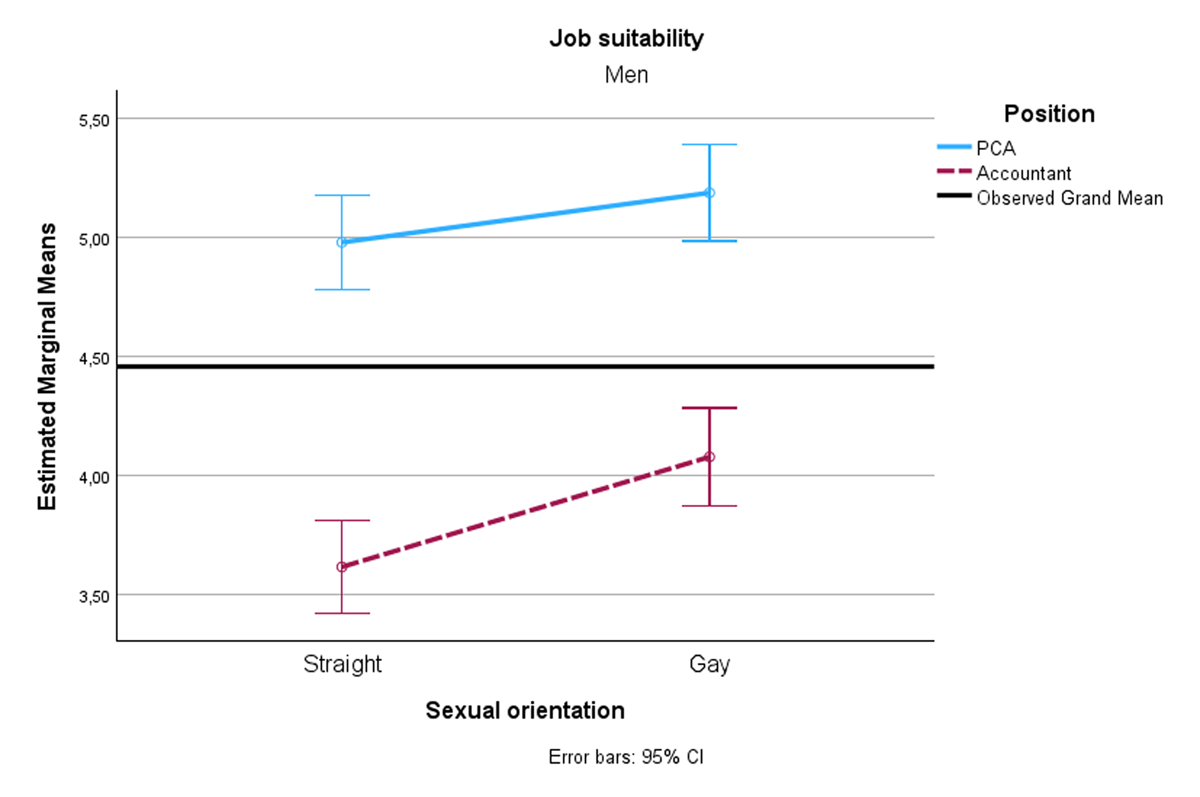
Figure 3
Men job seekers’ job suitability ratings as a function of occupation and sexual orientation.
We find a similar pattern of results for women job seekers. The ANOVA yielded a significant main effect of sexual orientation F (1,683) = 29.819, p = 0.000, ω2 = 0.034, a significant main effect of position F (1, 683) = 128.788, p = 0.000, ω2 = 0.151, and contrary to prediction, no significant interaction effect between the sexual orientation and the job position F (1, 683) = 1.303, p = 0.254, ω2 = 0.000. As with men, lesbian women job seekers receive higher job suitability ratings than their straight counterparts, and the ratings are higher for the PCA position (see Figure 4).
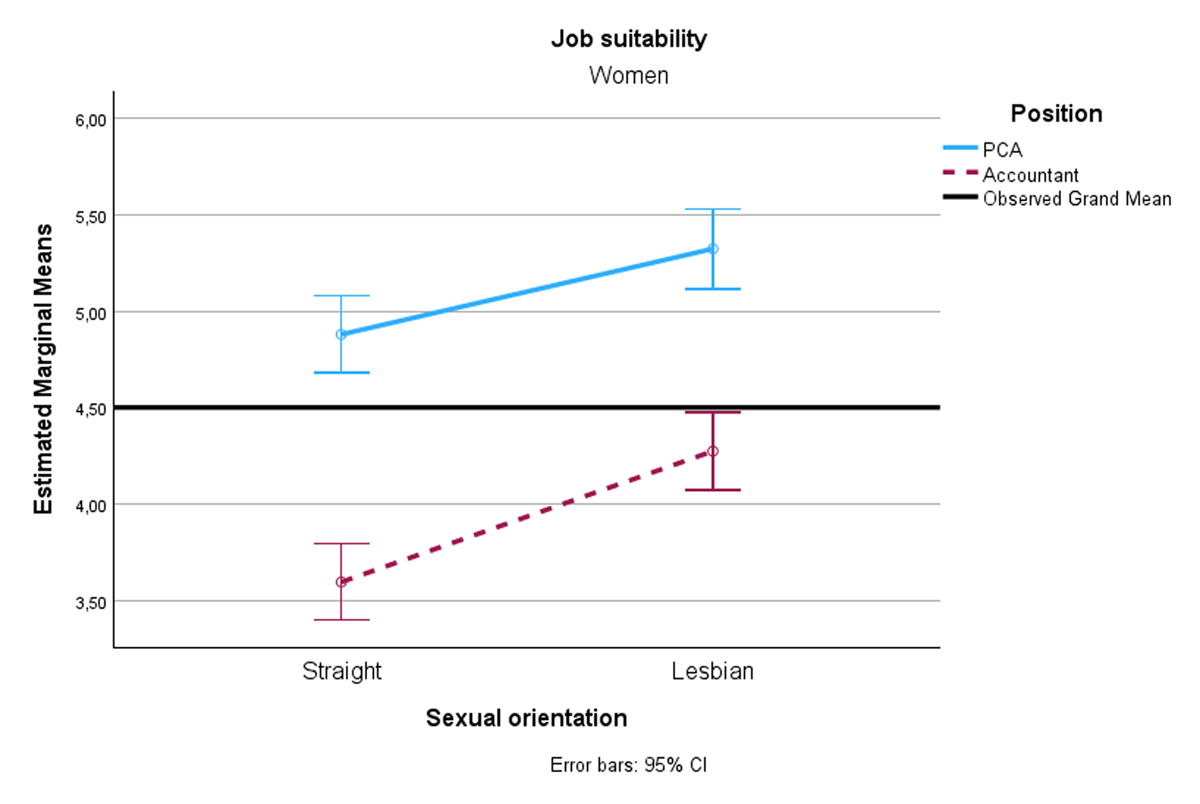
Figure 4
Women job seekers’ job suitability ratings as a function of occupation and sexual orientation.
Although the lack of significant interaction effects suggests the absence of a matching effect, we proceed by conducting pairwise comparisons to test each of our six hypotheses. We find support for hypothesis H1a, as both straight woman (t = 8.926, p = 0.000, d = 0.949) and gay man job seeker (t = 7.450, p = 0.000, d = 0.820) received higher job suitability ratings for the PCA compared to the accountant position. However, we did not find support for hypothesis H1b. Both the straight man (t = 9.670, p = 0.000, d = 1.036) and lesbian woman job seeker (t = 7.148, p = 0.000, d = 0.785) also received higher job suitability ratings for the PCA position compared to the job seekers inquiring about an accountant position, which is opposite to what we expected.
Hypothesis H2a that gay men job seekers will have a higher job suitability rating than straight counterparts for the job with higher warmth than competence, namely PCA, was not supported. Although the gay job seeker had a slightly higher rating than the straight counterpart, the difference was not statistically supported (t = –1.546, p = 0.123, d = –0.168). We find a difference for the accountant position with the gay man job seeker having a higher rating than straight counterpart (t = –2.993, p = 0.003, d = –0.325). As we hypothesized an opposite effect, we do not find support for H2b.
We similarly examined differences for women job seekers and found support for H3a, as lesbian women job seekers had a higher job suitability rating than their straight counterparts for the accountant position (t = –4.344, p = 0.000, d = –0.465). However, we also find that lesbian women job seekers received higher job suitability scores for the PCA position compared to their straight counterparts (t = –3.346, p = 0.000, d = –0.364), which is the opposite effect of that predicted by H3b.
In sum, we find no evidence of a matching effect. Rather, gay job seekers (M = 4.71, SD = 1.45) receive higher job suitability ratings than straight job seekers (M = 4.26, SD = 1.49), and this is the case for both men and women job seekers (see above).
Discussion
Drawing on the SCM, we proposed that job applicants should be perceived as more hireable when they belong to a social group whose stereotype content matches that of the occupation. However, we do not find support for the proposed matching effect. We find that gay job seekers receive higher job suitability ratings across gender and tested occupations.
One of the reasons for this could be that we employed combinations of groups and occupations that are less common and not expected, resulting in gay job seekers being ascribed more positive perceptions overall. Indicative of the potential emergence of unique stereotype content is that the category that received the highest rating was a lesbian woman for the PCA position, which is in direct conflict with our posed hypothesis and what one would expect based on previous research. Nicolas and Fiske’s (2023) findings show that intersecting groups in a nontypical/novel or incongruent manner (where the stereotypes of the two groups individually mismatch) may influence the emergence of new characteristics/perceptions ascribed to the intersected group to reconcile this incongruence or novelty of perceptions. While they find some patterns as to how these emergent characteristics may be ascribed (e.g. often related to the morality dimension), they did take a generalist approach without a specific context. They point out the need to further explore the emergent properties of stereotype content, and to study more specific intersections and contexts. Our results could also be interpreted through the lens of the intersectional invisibility hypothesis (Purdie-Vaughns & Einbach 2008). It is possible that since the fabricated gay job seekers appear at the intersection of multiple identities, they may have been seen as less prototypical of their identities and, hence, experienced advantages in terms of more positive perceptions. Considering evidence of significant discrimination toward this group (Flage 2020; Steffens et al., 2016), future research should address whether these positive perceptions translate into actual behavior.
Possibly, our participants may not have acted on prevalent stereotypes about gender and sexual orientation. One reason for this could be that our letters of interest contained warmth and competence signals that may have prevented the stereotype from being acted upon. Our candidates stressed both warmth (e.g., social skills) and competence (e.g., capability) attributes. After all, the jobseeker who submits the letter of interest needs to convince the potential employer that he/she is suitable for the job. Also, not mentioning qualities and attributes in the letter would be perceived as odd by the employer. Hence, to create realistic letters of interest, this information was needed. Nevertheless, it is possible that it counteracted the stereotype from influencing judgments of job suitability. For example, the gay woman jobseeker who stressed social skills, may have compensated for the stereotype content of low warmth by providing such information in the letter. Field experimental research conducted in the Swedish labor market suggests that signals of warmth and competence in real job applications could compensate for negative stereotype content (low warmth and low competence). For example, Arab (outgroup) job applicants, who are stereotyped as lacking both these attributes relative to Swedish (ingroup) job applicants, need to describe themselves as both warm and competent in the personal letter of to be invited for a job interview to the same extent as Swedish applicants, but only when the Swedish applicants also send counter-stereotypical signals (low warmth and competence) in their personal letters (Agerström et al. 2012). Similarly, Flage (2020) found that when more positive information was provided in job applications, the level of discrimination was significantly reduced.
Our results show a robust main effect of sexual orientation that may have several explanations. Both gay men and women job seekers receive higher job suitability ratings than their straight counterparts, and the type of position does not seem to moderate this effect. This finding is contrary to the meta-analytical conclusions of Flage (2020), who finds discrimination based on sexual orientation with a higher level of disadvantage for gay male candidates in low-skilled jobs. Recent field experimental findings show the absence of gay discrimination in contexts such as the housing market (Mazziotta et al. 2015) and prosocial behavior (Agerström et al. 2021). With respect to these results, one might want to explore whether an ongoing attitude change toward gay people is occurring in society. Indeed, a recent study finds that attitudes toward gay people are changing to become more positive not only in developed countries, but also in developing countries, and that this change can be predicted from increases in gay people’s legal rights in conjunction with legal reforms (Kenny & Patel 2017). One should note that there is a large variation in the extent and acceptance of LGBTQI rights. In many countries LGBT people face physical, psychological and structural violence, workplace discrimination in terms of hiring discrimination, wage inequalities and harassment, health disparities and educational exclusion (Badgett et al. 2019). Eagly et al. (2020) have shown that gender stereotypes have changed over the decades. While women still seem to be more strongly associated with communion (overlaps with warmth), than men, their level of perceived agency (overlaps with competence), seems to have increased to similar levels as for men. Moreover, a recently published meta-analysis (Schaerer et al. 2023) focusing on field experimental research on gender discrimination in hiring across many countries shows that discrimination against women job applicants has diminished and is no longer observable in the last decade. Interestingly, traditional discrimination effects where women applicants are discriminated against in stereotypically male (‘competence’) occupations (e.g., engineer) is no longer found. Male applicants still seem to be subjected to discrimination in stereotypically female (‘warmth’) occupations (e.g., primary school teacher). Taken together, ongoing changes in attitudes and stereotype content pertaining to both sexual orientation and gender could explain why we do not find support for a matching effect. However, further research is needed to pinpoint the extent to which warmth and competence perceptions of gay men and women in fact are changing. Identifying micro- and macrolevel boundary conditions of such possible changes and examining whether changes translate into actual selection decisions in hiring is of importance. For example, one might want to consider individual differences in attitudes, level of prejudice toward the group, chronic egalitarian goals and decision makers’ motivation among others. According to Kulik et al. (2007), these factors may influence which categories become salient in a multiple category situation and how they affect the overall perceptions of candidates. The role of political orientation could be another individual factor worthy of empirical examination since conservatism and right-wing authoritarianism predict prejudice toward gay men and women (Poteat & Mereish 2012). Occupational matching effects concerning gender and sexual orientation should be more evident in populations where stereotypes about gay men and women are stronger.
Another possible explanation of the reversed discrimination effect of sexual orientation is that it is due to overcompensation. That is, participants may have tried to compensate with higher ratings due to feelings of empathy stemming from a perception of the many disadvantages that gay applicants face in society. Another explanation could be that participants became aware of the signal of sexual orientation and provided more socially desirable answers. This explanation differs from that of the proposed attitude change since the ratings would be motived by the impression that they are believed to give the researchers. However, we employed several strategies to mitigate socially desirable ratings such as anonymous participation (see also limitation section). The results could also be influenced by the fact that we used a simulated hiring situation that does not carry any real-world consequences. Hence, it was easy for participants to provide generous job suitability ratings in response to our jobseekers, and to gay jobseekers in particular. Relatedly, the fact that we did not ask our participants to rank the jobseekers, or provide relative ratings, may also have contributed to the generous ratings and the absence of stereotype matching effects. Possibly, relative ratings would likely have forced participants to consider differences among the jobseekers.
One should not forget that the focus was on gay men and lesbians and that signals of bisexuality or intersecting these signals with other salient categories may change the pattern of results and require further research. Future research could consider raters’ characteristics, such as their sexual orientation and gender, as they might potentially affect the results. Another avenue of interest could be whether the hiring context has made the competence dimension more salient in perception of occupational characteristics, as we found that the occupation of PCA produced higher ratings overall despite warmth being judged as an essential characteristic in the pilot study.
Research has found that LGBTQ+ employees report higher levels of wellbeing and health perceptions when they report the presence of diversity interventions in terms of educating and advocating for sexual minorities as well as employee networks that try to create a supportive climate in the workplace (Perales 2022). If our findings were replicated in real hiring situations, one could conclude that different types of positive perceptions may emerge for gay job seekers. Managers could take note and use these positive perceptions to build diversity initiatives. However, one should note that our study was set in a very particular context where fictitious white US applicants in a subtle manner expressed they are gay, which would require further testing of the conditions in which stereotypes become salient.
Limitations
The study design carries a couple of limitations regarding the generalizability of the findings. We conducted the study with a Prolific convenience sample and employed an experiment where participants rated hypothetical letters of interest. Due to this, we do not know how actual employers would behave when evaluating letters of interest. Although only a small number of the participants were recruiters, more than half had at least some hiring experience, and 7.5% had extensive hiring experience. Hence, evaluating letters of interest should not be an unrealistic task.
Another limitation is that we employed a between-subjects factorial design across all factors. Hence, we could not assess discrimination at the level of the individual research participant, only at the group level. We chose a between-subjects design to reduce the risk that participants would understand the purpose of the study, which was our priority.
The ratings may have been adjusted to appear less prejudiced due to social desirability processes operating. However, we believe this is relatively unlikely due to the anonymous participation via Prolific. Also, this would require that participants could identify the true purpose of the study—a risk that we believe is low due to the use of filler candidates, etc. Moreover, a recent study using a similar design and Prolific participants found a robust discrimination effect in the predicted direction whereby participants discriminated against job candidates with a political affiliation dissimilar to their own (Sinclair et al. 2023). Although discrimination based on politics may be a less sensitive issue, we do not believe that the current results could be entirely driven by social desirability. Rather, we believe that gay job seekers received higher ratings because our participants realize that they constitute a disadvantaged group. This could have resulted in over-compensation when providing job suitability ratings. Unlike social desirability, such over-compensation stems from genuine beliefs.
The critical reader may have noticed that the two occupations selected for the current study most likely differed with respect to perceived status with accountants possessing higher status than personal care assistants. However, perceived status is an integral part of the SCM which posits that competence follows from perceived status and warmth from perceived competition (Fiske et al. 2002). Nevertheless, future research may want to examine stereotype matching effects in occupations that are perceived differently in terms of stereotype content but similar with respect to status, although we believe this would constitute an overly conservative test of SCM based stereotype matching effects.
The manipulation check was failed by 12.7% of participants who were excluded from the analysis. In comparison, in Sinclair et al.’s (2023) study which had a similar design, the rate was 20%. Hence, the manipulation check failure in our study was substantially lower than we predicted. Still, this could indicate that a clearer manipulation may have been needed or that participants missed the information due to inattentiveness.
Conclusions
We do not find support for the hypotheses that a match between the stereotype content of occupations and intersected demographic group membership would increase job suitability ratings. We find that sexual orientation was an important signal whereby a gay sexual orientation increases job suitability ratings regardless of gender or position. An important task for future research is to examine whether there is an ongoing positive attitude change toward gay people and whether such a change is accompanied by more positive treatment across a wide range of contexts.
Data Accessibility Statement
The data that support the findings of this study are openly available in OSF at https://doi.org/10.17605/OSF.IO/HMCSB.
Notes
Ethics and consent
Before taking part in the survey, participants signed an informed consent, in accordance with the Declaration of Helsinki. No ethical review board was consulted, since the Swedish Act concerning the Ethical Review of Research Involving Humans (2003:460) states that the types of research that shall be submitted to ethical review is research dealing with sensitive personal data as defined by GDPR article 9.1, research dealing with personal data regarding criminal offenses, research involving a physical operation on the participant or a deceased person, research using a method intended to physically or psychologically influence the participant or where there is an obvious risk of physical or psychological injury, research involving biological traces from living or deceased people. As the current study does not belong to any of these categories, it is exempt from ethical review.
Competing Interests
The authors have no competing interests to declare.