
Introduction
Humans are applying technology in a breathtaking pace to reshape their working world. They are not only substituting or augmenting previous ways of work, but profoundly modifying and redefining their working tasks and systems (Puentedura, 2014). From this digital transformation new marketplaces have emerged (e.g., on-demand services, cloud working, crowdsourcing), new forms of assistance systems are being applied (e.g., robotics, AI-powered support and tutoring entities), and new opportunities for monitoring, controlling, and steering are being experimented with (e.g., live-tracking of social behavior, digital biomarkers, harvesting of big data for predictive analytics in HR management) (BMAS Bundesministerium für Arbeit und Soziales, 2016). Psychologists who design interventions to improve health and well-being at the workplace can follow two approaches: (a) they will make targeted use of the emerging digital technologies themselves and design what we call in the further course “digital occupational health interventions” (DOHI), and (b) they will try to influence the ongoing digital transformation in terms of healthy change and work design (Parker & Grote, 2022), thus co-creating the future of work. In what follows, we reflect on both perspectives: The use of DOHI to promote health and well-being in the working population, and the healthy co-creation of the future of work. We first aim to provide a narrative synthesis of the techniques and topics behind DOHI, illustrated by examples and followed by a discussion of limitations and opportunities. Secondly, we aim to provide an impulse on how the ongoing transformation of work could be co-created and shaped by organizations, their members and occupational health experts who can contribute their knowledge of human-centered design principles to the future of work. We conclude with a discussion of how these two approaches relate to each other and could be integrated in the future.
Digital Occupational Health Interventions (DOHI)
Techniques of digital health interventions
Regarding DOHI, we can learn from electronic (e-) and mobile (m-) health developments, especially from the therapeutical area, where online interventions have been researched systematically for a long time (see e.g., White et al., 2022), and where outlets like the Journal of Medical Internet Research (JMIR) are overflowing with studies on the design, adherence, and effectiveness of e-/m-health interventions. But researchers in the field of health promotion too have adopted new technologies very early and applied behavior change techniques with digital means (Webb et al., 2010). As stated by the European Commission, the aim of digital health and care is to “(…) use information and communication technologies (ICTs) to improve prevention, diagnosis, treatment, monitoring and management of health-related issues and to monitor and manage lifestyle-habits that impact health” (European Commission, 2018). ICTs encompass the use of computers and internet platforms, mobile devices such as smartphones, smartwatches and other wearables, gaming devices, headsets for augmented and virtual reality applications (AR/VR), and an emerging range of body and environmental sensors (Ebert et al., 2019; Harari et al., 2017; Lehr et al., 2016). Software applications that make use of these hardware devices aim to collect and process data on every aspect of the human condition and behavior, then offer a variety of behavior change modules, and incorporate a (partly automated) dialogue component to interact with the user.
This process of use is being intensively researched by both psychologists and ICT researchers, so that a range of factors that persuade users and promote the uptake and use of applications are known (Borghouts et al., 2021; Jakob et al., 2021; Kelders et al., 2012; Ludden et al., 2015; Perski et al., 2017; Szinay et al., 2020; Wei et al., 2020; Wildeboer et al., 2016). The “use” of such applications is described as “adherence” and “engagement”: Put very simply, adherence refers to the use of an intervention as intended by the developers, whereas engagement refers to behavioral, cognitive, and affective intensity or depth of use (for an informative discussion see Kelders et al., 2020; Perski et al., 2017; Short et al., 2018; Yardley et al., 2016). First meta-analyses reveal that engagement is related to changes in health outcomes (Gan et al., 2021). In addition, health psychologists have compiled a compendium of diverse techniques to initiate and sustain behavior changes (Kok et al., 2016; Michie et al., 2013). Drawing from these findings, we broadly summarize that applications encompass techniques such as (1) self-monitoring, accompanied by goal setting, progress tracking, reminders, feedback and rewards for achieving goals, (2) tailoring and personalization of the content and timing of delivery, (3) social learning and comparison processes, often in form of “challenges,” (4) game-like activities, known as “gamification,” (5) storytelling to engage users and shape their mental models of the topic at stake, and (6) support and guidance through the process, which can be provided both by an automatized text- or voice-based conversational agents (chatbots, avatars, Alexa and the like.) and real humans. Latter constitutes a “blended” system of support, which can be “matched” to a combined treatment procedure or “stepped,” that is, human support will only be provided if automatic support didn’t yield a solution.
Hereby, much research is conducted on the self-monitoring component, applying active assessments in everyday life settings (e.g., “Ecological Momentary Assessment,” EMA), as well as passive sensing methods (e.g., “Smartphone Sensing Methods,” SSM; Harari et al., 2017), that is, using accelerometers, microphones, Bluetooth, light sensors, and the like, to collect data on the user. Based on this data, ultimately, AI powered algorithms aim at predicting states of vulnerability (e.g., high stress levels, high blood glucose), states of receptivity (e.g., break time, waking up in the morning), and delivering tailored interventions (e.g., mindfulness exercise, medication) (Kowatsch & Fleisch, 2021). For this the term “JITAI” is also used, meaning “just in time adaptive interventions” (Nahum-Shani et al., 2016).
In Figure 1, we label the six techniques outlined above as “Psychological Design,” as they build primarily on psychological knowledge about behavior change. This psychological perspective must be combined with the knowledge about the use of ICT applied in interventions, as mentioned above. We label this (simplified for our purposes) as “Interaction Design,” that is, the design of the user interface (UI) and of the overall user experience (UX), informed (amongst others) by principles of “human-computer interaction” and “human-centred design” that are applied in ICT development. These principles show overlap with behavior change techniques—as the use of ICT is also a behavior and ICT often aims at behavior change too—but stem from different mindsets and apply different methods. For an in-depth elaboration on the integration of design sciences and behavioral sciences we refer to Cash and colleagues (2022). Similarly, Perski et al. (2017) distinguish between “content” and “delivery” in their framework of engagement in digital behavior change interventions. Both psychological and interaction design aim at triggering a process of change (also referred to as “mechanisms of action,” Perski et al., 2017; see also Michie et al., 2021), where awareness is raised, knowledge built, attitudes, beliefs and norms are shaped, and outcome expectancies and self-efficacy are strengthened—all of which is supposed to contribute to the desired behaviors and the resulting health effects. These behaviors are ideally maintained and become routines, supported by regular use of the application, as far as required. And finally, there are also discussions around the use of behavioral economics insights (such as “nudging”) in designing applications (Mejía, 2021).
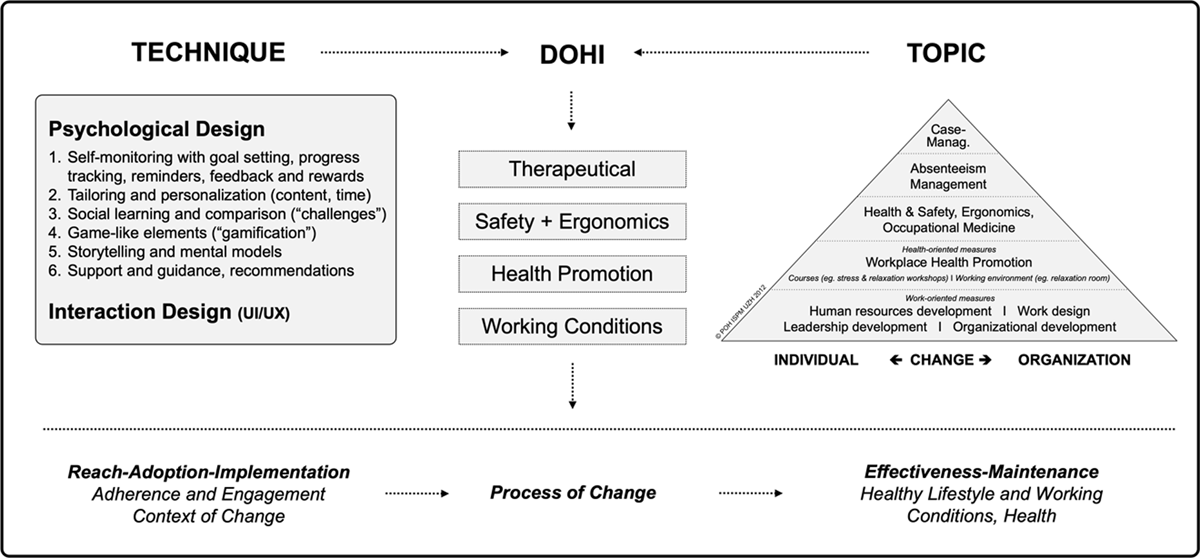
Figure 1
Synthesis of techniques and topics informing DOHI, triggering a process of change.
Categories of digital occupational health interventions
Building on the above definition of general digital health interventions, we define DOHI as the use of information and communication technologies (ICTs) in the occupational context to promote health and prevent disease through lifestyle changes and improved working conditions. We organize the broad scope of possible DOHI into four categories. These topics refer to a pyramid of general occupational health topics (see Figure 1), illustrating the proportion of the working population potentially benefitting from respective interventions (Bauer & Jenny, 2017): (a) Therapeutical: solutions for the small part of the working population that is already experiencing (mental) health issues; (b) Safety + Ergonomics: solutions for a larger part of the working population that needs to improve their physical safety and ergonomics at the workplace, despite much progress made in this (mostly) legally required area of action; (c) Health Promotion: solutions for traditional workplace health promotion for those who want to improve their lifestyle, such as nutrition, exercise, and relaxation; and (d) Working Conditions: solutions for improving working conditions targeting the individual, group, leader, and the organizational level (“IGLO,” Nielsen et al., 2017). As the authors develop and research DOHI in the German speaking part of Europe, the examples below used to illustrate the four topics are also mainly from this area. We will also refer to both commercialized DOHI and DOHI developed by researchers, which reveals a certain tension (Arigo et al., 2019), something we pick up again in the limitations section. Further, we do not dwell on the well-established field of online counselling and coaching of employees, which makes use of ICT solutions to provide distant support via e-mail, messaging systems, or video conferencing software. The same is said for the use of routine, work-related online tools for remote and decentralized teamwork, ranging from Zoom, MS Teams, or Slack, and in future expanding to the Metaverse.
Examples of digital occupational health interventions (DOHI)
(a) Therapeutical DOHI for treating (mental) health issues: Online interventions that have been developed to treat (primarily mental) health issues in the broad population are increasingly offered by companies directly to their employees. This goes hand in hand with insurance companies providing such applications to their customers, as well as governmental regulation allowing to reimburse their use through the insurers (see for example the Federal Institute for Drugs and Medical Devices in Germany, that provides an official list of digital health applications: https://www.bfarm.de/EN/Medical-devices/Tasks/Digital-Health-Applications/_node.html). Many of these applications are based on cognitive behavioral therapy (CBT), often combined with mindfulness activities (MCBT), and they have proven to be effective in RCT studies (Carolan et al., 2017; Phillips et al., 2019; Stratton et al., 2017). Particularly (M)CBT follows a standardized protocol, which facilitates their delivery via the internet, using self-reports, diaries, goal setting, feedback on progress, as well as psychoeducational contents, amongst others. An example of DOHI developed by researchers and brought to the market are the web-applications of the company “Hello Better,” some of which are available in English (https://hellobetter.de/en/online-courses/). They are also involved in the “H-Work” project funded by Horizon 2020, which is dedicated to promoting mental health at the workplace (https://h-work.eu). The (M)CBT approach has also been integrated into chatbot-based systems, such as the “Woebot” (https://woebothealth.com), an evidence-based smartphone app for young adults, prompting them to track their mood and to reflect on cognitive distortions, for example (Fitzpatrick et al., 2017).
(b) DOHI for safety and ergonomics: Governmental institutions, such as the “Federal Commission for Occupational Safety” (FCOS) in Switzerland, are adding digital solutions to their regulatory mandate of protecting the working population from physical harm. Most commonly these are dynamic e-learning applications such as the FCOS-Box (https://www.ekas-box.ch/en/), making use of videos, quizzes, and the like. These are combined with smartphone applications to document hazardous situations, which can be fed into a safety management system. In terms of ergonomics, DOHI are available for musculoskeletal disorders, tracking body motions with smartphone cameras and providing tailored exercises, which can be blended with support by health care providers (for a commercialized version see, e.g., https://kaiahealth.com/).
(c) DOHI for worksite health promotion: The market is buzzing with lifestyle applications for promoting exercise, healthy nutrition, and relaxation. This largely unregulated field of wellness and coaching applications is vast, and choices are hard to make. Still, we see companies like “Headspace” (https://www.headspace.com/) prevailing in the field of mindfulness, acquiring large sums of venture capital, and being licensed within the company context. Researchers too have been designing online mindfulness interventions at work, infused with positive psychological elements such as personal strengths and gratitude exercises, and demonstrating their effectiveness (Althammer et al., 2021; Michel et al., 2021). Further, companies like “Humanoo” (https://www.humanoo.com/en/) offer all-in-one solutions for companies to promote exercise, healthy nutrition, and relaxation, which encompass videos, daily activities, challenges, monitoring, and rewards for achieving health goals. It is common that larger enterprises implement such solutions as customized internal health platforms. Such platforms and apps are also offered by health insurance companies to their clients (see, e.g., https://www.helsana.ch/en/individuals/services/apps/helsana-coach.html), rewarding them for healthy lifestyle changes. Finally, research centers such as the “Centre for Digital Health Interventions (C4DHI)” (https://www.c4dhi.org) are developing, amongst others, open source systems for fully automatized, chatbot-based health promotion applications (https://www.mobile-coach.eu). They are also researching augmented reality solutions for exercising with a virtual coach, or gamified approaches to mindfulness practices, thereby experimenting with hardware options and drawing inspiration from the game industry, pushing the boundaries of health behavior change techniques.
(d) DOHI for improving working conditions: Building skills of individual employees and leaders, as well as developing teams and organizations—targeting all “IGLO” levels (Nielsen et al., 2017)—has for a long time been accompanied by e-learning systems. So far, to our knowledge, these make only little use of the DOHI techniques described above, apart from self-monitoring and goal setting, and are best applied in a “blended” or “matched” combination with real-life workshops and courses. We observe this especially in the field of leadership development, the management of boundaries between life-domains, and building employees’ skills for dealing with work stressors, which includes both traditional worksite health promotion elements and aspects of work redesign, such as “Job Crafting” (Verelst et al., 2021). Hereby we also observe a trend towards smaller but more varied training units and chunks of information (see for example the “bite-sized trainings” of https://www.mindtools.com), which corresponds to daily (micro) activities provided in traditional health promotion solutions. The same can be said of “plays” for teams, such as Atlassian’s “Team Playbook” (https://www.atlassian.com/team-playbook) to improve teamwork. Regarding the latter, DOHI will make use of tools for social and emotional exchange, using online whiteboards, repositories of icebreaker questions and games, digital Kanban boards, and others. A rather special solution in this regard is the “wecoach” (https://wecoach.ch), a chatbot-based web application that guides leaders through a team-development process, empowering them to conduct a survey on job demands and resources and to moderate a solution-oriented workshop, for which online tools are integrated in the application (Grimm et al., 2020). Finally, we just briefly want to mention the topic of digitally monitoring health and well-being at the workplace, which is advancing from traditional employee surveys to short “pulse” surveys (e.g., https://officevibe.com) and the use of “HR Analytics,” which potentially harvests all forms of data generated through human-computer interactions. These are often included in communication tools like MS Teams or Slack (or can be integrated through application programming interfaces, “API”), for example, offering automatic sentiment analysis derived from the messages written (e.g., https://chatacuity.com).
Limitations and opportunities of DOHI
There is a range of typical pro and contra topics regarding DOHI, ranging from their reach to their use of data, as well the risks and side effects when applied in a company context.
Reach, adoption, and implementation of DOHI: In the field of public health, the RE-AIM model is an established framework to evaluate the impact of interventions, illuminating the adoption of projects and programs through the target system, the reach of the target population, and the implementation as intended, as well as their effectiveness and maintenance in terms of routinization in everyday practice (Glasgow et al., 1999). Regarding DOHI, it has been claimed that thresholds are lowered, and larger populations can be reached (Ebert et al., 2019). But we witness low adherence to DOHI, which is one of the biggest concerns of digital-mobile intervention research, as it limits both the intended implementation and the maintenance of the intervention. Thus, suggestions have been made to report adherence—as well as engagement—in a more standardized fashion (Beintner et al., 2019; Miller et al., 2019). Beyond adherence to DOHI in research studies, a review of real-world usage revealed a 30-day retention rate of 3.3% (Baumel et al., 2019). It is acknowledged that different populations (age, gender, baseline health status, etc.) need to be approached in differential ways, where unguided interventions may work for some people, but for others a guided approach is indispensable (Karyotaki et al., 2021). In any case, without embedding behavior change modules in a guided journey, supported by a recommendation system or conversational agent, choices are difficult to make for the user. But on the other hand, programs that stretch over several weeks and which must be followed-through step-by-step, such as CBT-based interventions, face these adherence problems too. Finally, in all these DOHI we reflected upon, we are obviously dealing not only with technological issues and the acceptance of technological solutions (Rajak & Shaw, 2021), but with the complexities of changing individual (health) behavior, and—to complicate things—with implementing DOHI in complex social systems such as business companies (Jenny & Bauer, 2013). Thus, adopting and implementing DOHI into this context confronts us with topics well-known from “traditional” intervention research, such as poor support for the intervention, low fit to the company culture, lack of readiness to change, little perceived time for the intervention, or social pressure to take part (Ipsen et al., 2015). Given a DOHI based on the perfect combination of behavior change techniques and proven in RCTs to be effective in differential sub-groups, we still need to consider—and adapt—strategies of organizational change, and discuss if our present approaches to context, process, and outcome evaluation in this field of research are still valid (Fridrich et al., 2015). Hereby the general question arises, if certain economic sectors and segments of the working population are inherently more responsive to DOHI and also engage more readily in new forms of digital interventions and change (see conclusions too).
Quality of DOHI: As Arigo et al. (2019) have outlined very clearly, there is a tension between research-based developments and commercial endeavors (see also Michie et al., 2017). Researchers have been developing DOHI with a very strong theory base, conducting RCTs, and accumulating evidence on the differential effects of DOHI. But they lack speed and commercialization knowledge, the resources for designing and programming applications, and to some extent also the motivation to bring their DOHI to the market. On contrast, the industry is building the plane while it’s flying, maximizing commercialization and usability through agile and iterative design processes, respectively. Some researchers have followed this path and founded spin-offs or went to work for the industry. A promising approach to this dilemma is state-funded research with a strong dissemination requirement, involving the industry in developing and maintaining DOHI, which includes not only the target group, but also programmers and designers (Arigo et al., 2019). The latter has only been marginally discussed in this paper, but the importance of up-to-date design in terms of (positive) user experience, and human-centered design in general, can’t be overstated (Ludden et al., 2015; Wei et al., 2020). Furthermore, there is a call for quality control, checklists, and best-practice examples, something we presently see primarily for DOHI in the therapeutical field. For all other fields of DOHI, checklists have emerged (see, e.g., Stoyanov et al., 2015), but their application is left to potential user, public institutions, or private companies (see, e.g., https://appfinder.orcha.co.uk), as researchers have neither the resources nor the mandate to provide quality seals to what are ultimately commercial products. Finally, the abundance of—and competition between—applications raise the question for companies whether to invest into own health platforms or leave the “job” to the insurers, who cover the target group of employees too and might offer a more compelling case to engage in health promoting activities through direct cost benefits.
Use and protection of data generated in DOHI: The promise of the “JITAI” relies on cheap and abundant data. Only through integrating all data sources—and without compromising personality rights—the dream of providing tailored and timely interventions will work out in full. Data can be everything from logins, clicks, feedbacks, generated text, communication patterns, sensor data (if applied), and so on, for all of which machine learning algorithms can be applied (the skills provided). Such high-resolution data of individual behavior trajectories would allow for “dynamic computational modelling” and the “continuous tuning” of interventions (Chevance et al., 2020), so that we could provide the most potent intervention on an empirical basis (Collins et al., 2007). Research centers such as the C4DHI demonstrate how social scientists, data scientists, and computer specialist working closely together can make this happen. Yet from an implementation perspective, there will be many technical and regulatory issues to be overcome before data can be collected and integrated on such a scale in everyday (corporate) life. As Kowatsch and Fleisch (2021) put it in a nutshell: “Only a transparent collection, monitoring, use, and distribution of data governed by ethical considerations and regular audits by independent third parties will likely lead to broad adoption of and trust into digital health interventions” (p. 89).
Risks and side effects of DOHI: With DOHI, we need to add “digital stress” to the intervention experience, that is, the feeling of being observed and transparent, the unreliability of IT systems, or being constantly interrupted and flooded by push messages (Gimpel et al., 2020). This phenomenon has also been broadly researched under the term “techno-stress,” for which we refer to a systematic review by La Torre and colleagues (La Torre et al., 2019). There are a range of criteria from the fields of (occupational) health research that we could apply to the judgement of DOHI. Questions could be for example: Does the DOHI enhance the balance of job resources and demands (Jenny et al., 2020; Jenny et al., 2022), or is there a risk of further stress and strain? Does it truly empower the users and give them more control over their health (Eriksson & Lindström, 2008), or is there a risk of being externally controlled? Does it support the users’ self-determination (i.e., autonomy, relatedness, competence) (Deci & Ryan, 1985), or is there a risk of self-undermining? Does it strengthen the users’ sense of coherence, that is, their feeling of comprehensibility, manageability, and meaningfulness (Antonovsky, 1987), or is there a risk of confusion and irritation? Does it ultimately enhance their mental well-being, such as the feeling of self-acceptance, purpose, autonomy, mastery, growth, and positive relationships (Ryff & Singer, 2006), or is there a risk of trade-offs in these facets through digital self-monitoring, self-regulation, and social comparison? Finally, DOHI might further contribute to a one-sided exposure to digital technologies and user interfaces both at work and in private life. Attention restoration theory (Kaplan, 1995) points out that sustained efforts to direct attention to certain stimuli can deplete the attention resource—suggesting that DOHI might aggravate instead of ameliorating digital stress by offering more of the same. Or to quote Kowatsch and Fleisch (2021) again, “(…) developers must be aware that digital health interventions should offer a minimum of technology-related interactions (…) to let individuals live their lives without (too much) being dependent on technology” (p. 87–88).
From DOHI to the Co-Creation of a Human-Centered Future of Work
Above, we discussed how the field of occupational health psychology is utilizing ICT to improve health and well-being at the workplace through targeted digital interventions (labelled “digital occupational health interventions”, DOHI). In this second section we want to provide an impulse on how our field also should try to influence the ongoing digital transformation in terms of healthy change and work design, thus co-creating the future of work. These two perspectives can be elaborated independently, as the majority of DOHI target the individual level and focus on personal health protection and promotion, whereas the ongoing digital transformation targets the collective level and focuses on business processes. Yet we will provide examples and ideas how these two perspectives can be blended in the future. Currently, the digital transformation forces most companies to rethink and redesign their business models and the way they organize work, to remain competitive and become part of the digitalized future of work (BMAS Bundesministerium für Arbeit und Soziales, 2016). This general fluidity and readiness for change of companies provides a unique opportunity to contribute our knowledge base to the transformation of work.
Socio-technical design of work in the ongoing digital transformation
Parker and Grote (2022) argue that work design “matters more than ever in a digital world.” They provide a thorough overview of how digital technologies such as AI, robots, or algorithms influence key characteristics of work design and recommend four combined intervention strategies to shape these technological developments: (A) proactively designing work roles when implementing technology; (B) considering human-centered principles in the development, design, and procurement of technology; (C) changing macro-level policies to support work design and human-centered approaches; and (D) educating and training employees and other stakeholders in digital skills and work design (amongst others). Especially strategy D can be supported by the kind of DOHI that were designed for improving safety, ergonomics, and working conditions, such as dynamic e-learning systems or chatbot-based web applications. Further, Parker and Grote (2022) mention that this influence is not only shaped by technology itself, but also by individual (e.g., skills, personality) and higher-level factors (e.g., policies, management ideology). In designing the future of work, we suggest to explicitly consider these greater societal developments which are transforming organizations, leadership, and expectations regarding the experience of work.
Transformation of organizations, leadership, and expectations towards work
Although new technologies are a key driver of digital transformation, they are only part of the game. Globalized competition and international supply chains, the interrelated crises of pandemics, climate change, migration, and (inter-)national conflicts, along with critical public observation of business conduct (voiced in social media) all make it ever truer that companies operate in a “VUCA” environment, which is characterized by volatility, uncertainty, complexity, and ambiguity (Mack et al., 2016). These global trends meet a working population that is increasingly well-educated and has shifting values towards self-actualization, the seeking of meaning, and a good work-life balance. This population has also been experiencing more self-determination during the pandemic lockdowns, and they indulge in exciting customer experiences as consumers, which may raise similar expectations towards a more exciting and humane work experience (Gruber et al., 2015). Further, companies are more than ever dependent on highly qualified and innovative employees who engage well with their task, colleagues, and customers. They try to deal with these challenges by testing out new forms of organization that can be characterized by three approaches (Diefenbach & Deelmann, 2016): (1) Networking, that is, “(…) democratic-like decision processes where the network and not managers prepare decisions for the top management”; (2) subsidiarity, that is, “(…) decentralized competence [with] teams that somehow act autonomously with ability to decide within a given framework [and] working on a common objective”; and (3) meaning, that is, “(…) the dedication to a goal and unmeasurable entrepreneurial spirit [that] is able to free energy” (p. 202). Such general approaches can be found in agile forms of work and organization (Weinländer, 2022) or—more rarely—in experimental forms such as holacracy (Schell & Bischof, 2022). On a leadership level, for example, “VUCA prime” (Johansen, 2007) has been suggested as a framework to deal with the VUCA environment, that is, building (V) vision, (U) understanding, (C) clarity, and (A) agility. Generally, it is acknowledged that the digital transformation and the accompanying organizational changes require new leadership styles (McCarthy et al., 2021). As mentioned in the DOHI section, we see digital programs emerging for leadership development in the context of “new work,” often combined with the topics of boundary management and hybrid working, some of which refer directly to the VUCA acronym, such as https://vucit.com (German only).
Design thinking for a new workplace experience
The socio-technical work design approach suggested by Parker and Grote (2022) is very valuable for addressing the digital transformation from an occupational health perspective when we focus on the “proactive design of work roles when implementing technology” (p. 24). They also suggest exploring how “design thinking” could inform the socio-technical systems approach to work design. Originally, human-centered design thinking is a methodology to put the customer first. It typically follows the “double diamond” process (British Design Council, www.designcouncil.org.uk), which broadly explores an issue (divergent thinking) and then takes focused action (convergent thinking). It is defined by four reiterative phases: (a) discover, that is, understand the issue from the perspectives of people affected by it; (b) define, that is, define the issue in a relevant way; (c) develop, that is, co-design new solutions with a range of stakeholders; and (d) deliver, that is, testing out different solutions at a small-scale, selecting and improving the best solutions. Meanwhile, design thinking has been used in a wide range of commercial organizations (Wrigley et al., 2020), including health care and public health (Abookire et al., 2020). Not surprisingly, the health care sector pursuing the “product” of health is also in the forefront of pursuing the double aim of improving the experience and health of both their customers and employees—as various case studies presented in a recent book demonstrate (Tevik Løvseth & de Lange, 2020). Overall, the fluid, “unfrozen” situation of organizations is an opportunity for occupational health experts to shape these profound transformations in a health promoting way. Indeed, Gruber, Leon, and George (2015) already linked design thinking to shaping the experience of work. They refer to Pine and Gilmore (2011) who argue that the “experience economy” is now succeeding the agrarian, industrial, and service economies. In the experience economy, companies provide not only high-quality services, but create memorable events for their customers. Thus, successful companies put the customer journey and user experience at the heart of their business strategy. Building on this trend, Gruber, Leon, and George (2015) suggest to use design thinking beyond the customer experience and improve the “new workplace experience (NWX)” of employees by considering six design principles: (1) identify real and compelling needs; (2) focus on value and values; (3) design experiences, not just workflows and tools; (4) strengthen real collaboration, co-creation, and co-production; (5) evoke sensory and emotional engagement; and (6) create a gripping narrative.
Co-creating a human-centered future of work
Taken together, occupational health psychology can utilize the described momentum of the ongoing transformation of organizations, leadership, and employee expectations and practically build on the increasing familiarity of organizations with design thinking and its diffusion in the management literature. We propose to utilize this approach to improve the employees’ (new) work experience and suggest that occupational health professionals work more closely with experts in design thinking to link the respective knowledge domains. All the more because strategies and methods of occupational health psychologists are very compatible with design thinking: they are by principle highly participatory and iterative, and they utilize various forms of brainstorming, visualization, and planning techniques such as drawing team visions, building mental models and narratives, mapping of job demands and resources, creating visual objects for progress evaluation, or using Kanban boards, for example (Abildgaard et al., 2020; Bauer & Jenny, 2013, 2018; Ipsen et al., 2020; von Thiele Schwarz et al., 2016; von Thiele Schwarz et al., 2021). Such methods have also been digitalized, as in the example of the https://wecoach.ch, which was built as a DOHI for improving working conditions (Grimm et al., 2020). Further, the focus of design thinking on needs, value(s), collaboration, and engagement also resonates with occupational health psychology’s concern for meeting basic human needs such as autonomy, competence, and relatedness (Deci & Ryan, 1985), or the broader DRAMMA needs of detachment, relaxation, autonomy, mastery, meaning, and affiliation (Kujanpää et al., 2020; Newman et al., 2014). With concepts like the DRAMMA needs or similar criteria (see above, risks and side effects of DOHI), the field of occupational health also offers attractive narratives and measurable indicators. These can provide orientation and a mind-map for employees, managers, occupational health professionals, design thinking specialists, and other disciplines, for example from the arts, when designing, experimenting, and also improvising (Zenk et al., 2022) with workplace innovations (see also https://workplaceinnovation.eu/euwin/). Finally, a whole range of new work labs, hubs, bootcamps, networks, and other dynamic and transdisciplinary formats have emerged (see, e.g., https://futureworklab.de/en.html), in which we can engage along with other disciplines to support companies and their members in experimenting with new forms of co-creating a human-centered future of work.
Conclusions
In this article we proposed considering two approaches to health and well-being interventions in the workplace: (a) the targeted use of digital tools (labelled “DOHI”) and (b) the ongoing transformation of work driven by digitalization and broader societal changes. We first outlined the techniques, categories, limitations, and opportunities to be considered when applying DOHI. We then provided an impulse on the potential of aligning—or even fusing—the methods and concepts of occupational health psychology with design thinking approaches. Both perspectives can be considered independently, as stated above: DOHI mostly have been focusing on the individual level, whereas design thinking approaches mostly operate on a collective level. Nevertheless, various blended combinations of DOHI with design thinking processes are imaginable and could enhance their respective effectiveness for occupational health. On the one hand, design thinking approaches can be applied to involve decision makers and employees of pilot companies already during the development of DOHI. This would help to early on address factors that promote the adoption and adherence of future DOHI. On the other hand, new types of DOHI might be developed that support remote design thinking processes across sites and organizations. DOHI could also be used for training individual employees or groups to engage better in such co-design processes: Presently, apps are already being developed to specifically support individuals during general transformation processes, in regard to their basic human needs (e.g., https://www.hello-vera.ch, German only). As a final statement, the promise of a co-created and human-centered future of work must also critically reflect on inadvertently enhancing divisions in society. The narrative that digitalization is not only transforming, but also disrupting society and its economy is constantly forming. On an individual level, for example, this has been discussed regarding the “digital divide,” where digital health interventions may both enhance or diminish social inequalities in health (Gibbons, 2005). On a systemic level, we also need to understand what organizations and sectors of the economy are driving this digital transformation and who benefits or is left out of the promise of new work. This will allow us to develop and disseminate approaches that assure that the whole workforce will be included in and benefit from the future of work.
Competing Interests
The authors have no competing interests to declare.