
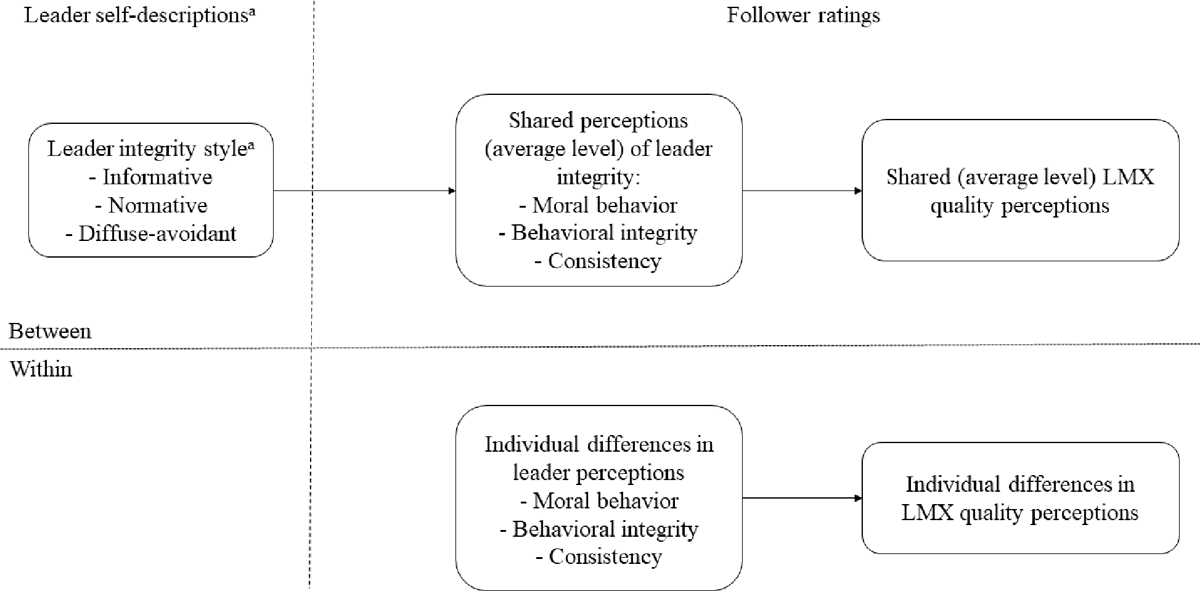
Figure 1
Theoretical Model of the Study.
Note: a Leaders’ personal descriptions of their moral decision-making were analyzed and coded to represent different integrity styles by the authors. LMX = leader-member exchange.
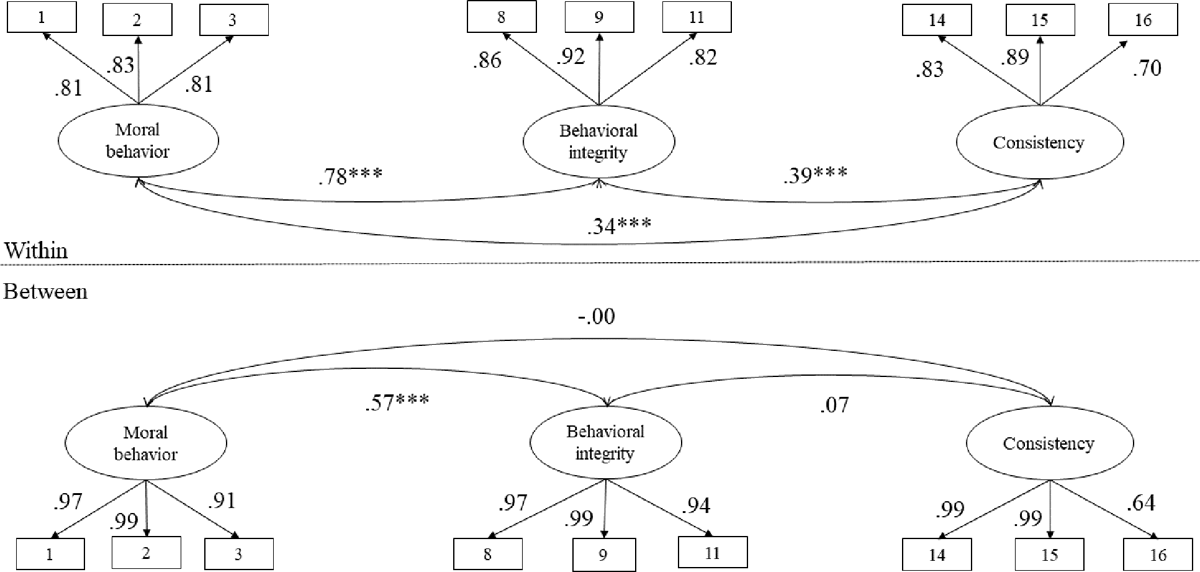
Figure 2
Modified Factor Model of Perceived Leader Integrity (PLI) Measure.
Note: Item numbers refer to the original items from the 16-item PLI-model (Moorman et al., 2013).
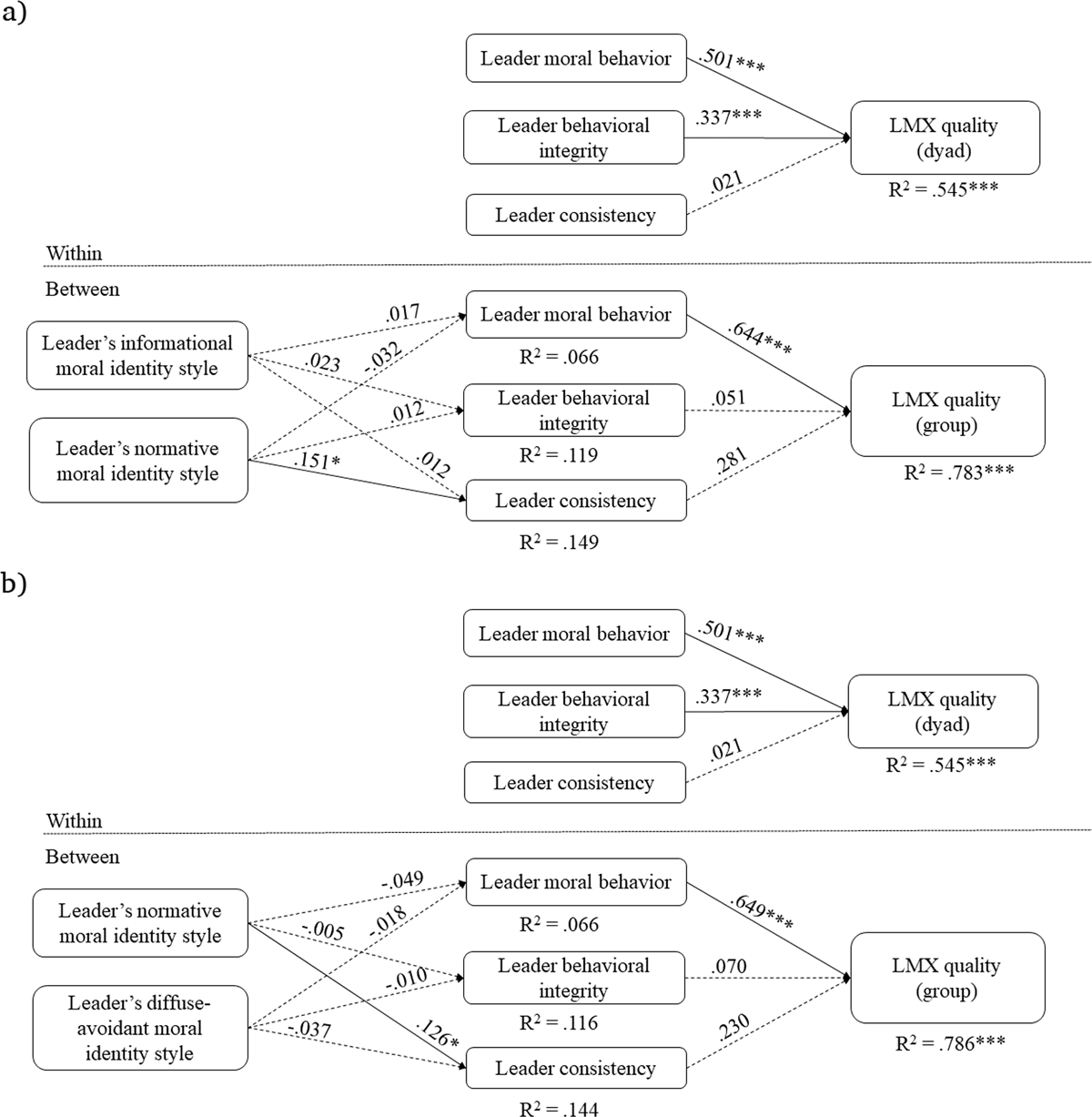
Figure 3
(a) Results from the final multilevel model, diffuse-avoidant moral identity style as the reference group. (b) Results from the final multilevel model, informative moral identity style as the reference group.
Table 1
Examples of Coding the Empirical Data Based on the Leaders’ Personal Descriptions of Moral Conflict Solving.
| IDENTIFIED THEMES | INTERPRETATION | INTEGRITY STYLE |
|---|---|---|
| I always aim to be objective. | Decisions are controlled by situational demands or factors. A moral issue can be reframed as a factual one. Postponing the decision (reluctance to confront and deal with the moral conflict). | Diffuse-avoidant |
| I look at the facts. | ||
| I make practical decisions. | ||
| I haven’t faced such situations. | ||
| I use common sense. | ||
| I postpone making a decision. | ||
| The decision happens quickly in the moment. | ||
| I look at the numbers. | ||
| I rationalize the decisions. | ||
| I compare the situation to a similar one in the past. | ||
| I try to find the way that would cause least trouble. | ||
| I trust my intuition and my interpretation of the situation. | ||
| I think what is best for the organization. | Making decisions by conforming to other people’s prescriptions and complying with rules and official guidelines. Instead of acknowledging the consequences from a broader perspective, decisions are made solely based on what benefits the organization. | Normative |
| I follow the law and official protocols. | ||
| According to the values of my employer. | ||
| Based on the values and culture of the organization. | ||
| I make my decisions based on equality. | ||
| I follow commonly agreed rules. | ||
| I strive to be as consistent as possible in my decisions. | ||
| I follow norms: a similar problem produces a similar solution without any personal consideration. | ||
| I always try to find what is best for the target of the decision (e.g., client). | ||
| I look at the whole picture. | Looking at the moral situation broadly from different perspectives and processing the solution through assessing the fairness of the potential solution. Using an open-minded approach to explore a variety of options, evaluating the potential consequences of each solution. | Informational |
| I spend a lot of time finding out different viewpoints before making a decision. | ||
| I discuss with different parties in order to get a broader picture of the problem. | ||
| I try to evaluate what is fair, I have discussions with the people who will be affected by my decision. | ||
| I find out the background of the situation as well as I can and evaluate the solution as it concerns different parties. | ||
| I analyze different options and their consequences. | ||
| After hearing different sides of the situation I try to find a fair and just decision. | ||
| After several rounds of discussions I try to find the best or the least bad option. |
Table 2
Sample Correlation Matrix of Observed Variables. Within (Individual) Level below the Diagonal and Between (Leader-Follower Groups) Level above the Diagonal (Nwithin = 963; Nbetween = 223).
| M | SD | 1 | 2 | 3 | 4 | 5 | 6 | 7 | 8 | |
|---|---|---|---|---|---|---|---|---|---|---|
| 1. Informationala | 1.00 | –.68*** | –.41*** | .05 | –.01 | –.17 | –.14 | –.09 | ||
| 2. Normativea | – | 1.00 | –.39*** | –.06 | .02 | .31** | .08 | .08 | ||
| 3. Diffuse-avoidanta | – | – | 1.00 | .01 | –.01 | –.17 | .07 | .01 | ||
| 4. Moral behavior | 4.04 | .557 | – | – | – | 1.00 | .56*** | .04 | .81*** | .23 |
| 5. Behavioral integrity | 4.14 | .554 | – | – | – | .70*** | 1.00 | .13 | .57*** | .33* |
| 6. Consistency | 3.78 | .566 | – | – | – | .33*** | .39*** | 1.00 | .29 | .25 |
| 7. LMX | 4.04 | .608 | – | – | – | .70*** | .66*** | .30*** | 1.00 | .46** |
| 8. Genderb | – | – | – | –.00 | .03 | .02 | –.03 | 1.00 |
Note: a Between-level variable with no variance at the within-level. b Follower gender. * p < .05; ** p < .01; *** p < .001.