
1. Demands for an Inclusive Working World
The United Nations Convention on the Rights of Persons with Disabilities (UNCRPD) formulates the objective of an inclusive working world. Article 27 (Work and Employment) outlines the right of people with disabilities1 to work and includes the possibility of earning a living with employment that is chosen genuinely and accepted in an open, inclusive, and accessible labour market. It also includes the state’s duty of taking appropriate steps to ensure and promote the realization of the right to work.
Germany as well as the Nordic countries implement the requirements of the UNCRPD in national laws. The concrete implementation of the UNCRPD in Germany is explained below; for the situation in some Nordic countries, see Gjertsen, Hardonk & Ineland (2021).
The Federal Participation Law (Bundesteilhabegesetz – BTG) transposes the principles of the UNCRPD into German law. One of the BTG’s aims is to improve the participation of people with disabilities in working life, for example, by introducing a budget for work and strengthening the scope for individual decision-making with regards to deploying one’s labour. The Law on Equal Opportunities for People with Disabilities (Bundesgleichstellungsgesetz – BGG) and the General Equal Treatment Law (Allgemeines Gleichbehandlungsgesetz – AGG) aim at boosting opportunities for the participation of disabled people in society. Thus, they go hand in hand with the BTG. In addition the Federal Government formulates political aspiration that the working environment be organized inclusively (BMAS 2016). The Federal Ministry of Labour and Social Affairs (BMAS) has additionally granted a substantial sum of 140 million Euros to place more severely disabled people in regular employment. However, current (labour market) realities have not been reflecting these differentiated normative and legal aspirations so far. There has hardly been any improvement in the participation of disabled people in the labour market in Germany (BGW 2021; Institut für Menschenrechte 2019).
This article aims to illustrate the specific situation in Germany for the international scientific context by taking a critical look at the normative claim of implementing the UNCRPD goal to create an ‘inclusive’ labour market.
At first we outline the employment realities of people with disabilities in the primary labour market and sheltered workshops for disabled people. The following part addresses the socio-structural processes of change discussed under the label of ‘Work 4.0’. These include the aspects of technical potentials, the pluralization of employment constellations, the expansion of education, and the depreciation of qualifications. Subsequently, the article discusses opportunities and risks for people with disabilities in between ‘safekeeping’ in special disability assistance systems and new occupational possibilities.
2. Labour Market Structures and Employment Realities of People with Disabilities
This section explores the question of what the current employment situation for people with disabilities in Germany looks like. To do so, we first lay out the constructions of disability and employability.
In Germany, people with disabilities work both in the general labour market as well as in segregated systems like the sheltered workshops. Therefore, the situation in the general labour market is described first, followed by a depiction of segregated systems and alternative employment opportunities. Finally, the situation is classified according to selected particularities of the German education and employment system.
In Order to answer our question about the employment situation of people with disabilities, we conducted desktop research. Specifically, previously collected data was analyzed and reinterpreted in light of our question. We use secondary data and labour market statistics for our argumentation, for example from the German Federal Employment Agency and the Federal Ministry of Labour and Social Affairs. In Germany, no difference is made regarding individual forms of disability (e.g. learning, sensory or physical disability) for the group of people with disabilities in employment.
This section solely analyses the situation in Germany. Instruments and structures of labour market inclusion of persons with disabilities in Nordic labour markets of Iceland, Norway and Sweden are described comparatively by Gjertsen, Hardonk and Ineland (2021). For the situation in Iceland see Rice and Stefánsdóttir (2018), in Norway see Sandvin (2018) and in Sweden see Ineland (2020) in more detail.
2.1 Disability and Employability Constructions
In the debate on the inclusion of people with disabilities, gainful employment plays an important role (Sainsbury and Coleman-Fountain 2017). Access to work is seen as a central aspect of enabling participation. The inclusion of people with disabilities in the labour market is intended to prevent exclusion.
In the Scandinavian countries, promoting the participation of people with disabilities in labour is closely linked to concepts of normalization, deinstitutionalization and non-discrimination (Tøssebro 2016; Ineland 2020). These have also found their way into German disability policy and come back into focus with the ratification of the UNCRP (Misselhorn and Behrendt 2017; Wansing, Welti & Schäfers 2018). At the same time, a critical debate on the meaning and purpose of wage labour – as it is being held in the United Kingdom (Grover and Piggott 2015) – only plays a subordinate role in German-speaking disability research (Karim 2022; Misselhorn and Behrendt 2017; Wansing, Welti & Schäfers 2018).
To accurately describe the labour situation of people with disabilities in Germany, it is necessary to clarify who is labeled and also statistically recorded as ‘disabled’. The label ‘people with disabilities’ currently functions as a collective term rather than an empirical category which makes a proper definition of inclusion and exclusion criteria essential.
According to the Ninth Social Code (SGB IX), ‘persons with disabilities are people who have physical, mental, psychological or sensory impairments that, in interaction with social attitudes and environmental barriers, can prevent them from equally participating in society for more than six months with a high degree of probability […]’.
Further distinctions are made regarding the categories ‘severely disabled’ and ‘impaired’.
Paragraph 2 SGB IX defines people as severely disabled ‘if they have a degree of disability of at least 50 and if they are legally resident, habitually resident or employed in a workplace’ within the scope of said paragraph.
Conforming to the Federal Government‘s third participation report on the living conditions of people with disabilities (BMAS 2021), impairment results from specific restrictions that arise in interaction with environmental conditions and thus influence the opportunities for participation in society. This ‘broad version’ of the term impairment considers both people with recognized disabilities as well as people with chronic illnesses or long-term health issues as impaired (BMAS 2021).
In the German school system, the socio-legal construction of disability is not applied. Students are classified with the label of ‘special educational needs’, differentiated into various special needs and types of disabilities. Thus labeled students are either schooled inclusively together with other students, or in separate school forms for children with special needs.
Regarding the working context, we need to further clarify who is regarded as being able to work at all. The Second Social Code (SGB II) § 8 defines employability as follows: ‘Deemed able to work is a person who is not unable to work for at least three hours a day for the foreseeable future due to illness or disability under the usual conditions of the general labour market’ (BMAS 2021).
At this point, we can already state that multiple instances of German technical definitions for disability, impairment and special educational needs are not compatible with UNCRPD terminology. Without insight into this complex array of terms, however, it is not possible to present data on disabled people and their working situation in Germany in a legally and mathematically correct way.
In the following, we argue from a sociological perspective with particular emphasis on rehabilitational sociology. This means turning away from an individual-centered, medical point of view, that is a deficit-oriented view on disability. In contrast the sociological construct of disability describes a social process of ‘becoming disabled’ rather than ‘being disabled’. This happens, for example, through non-barrier-free workplaces or a lack of assistance, which hinder ‘dis-abled’ people from taking up gainful employment. The social labelling approach and the attribution of a lack of usefulness and usability of labour, for example, hinders access to work.
2.2 General Labour Market
The employment rate of severely disabled people in Germany has increased in recent years (see Figure 1) (BMAS 2021).
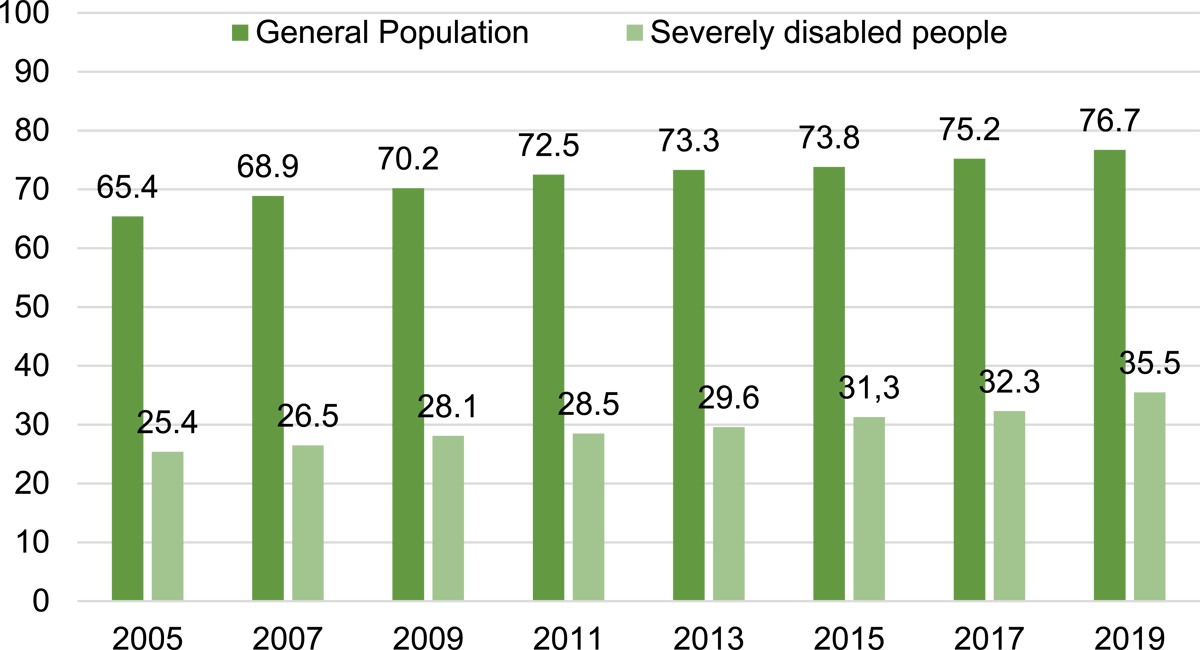
Figure 1
Employment rates in Germany (in %).
Own presentation based on (BA 2021b, 2021d; DESTATIS 2021b).
In 2019, 1,051,492 severely disabled people were successfully employed, only 154,696 were listed as ‘arbeitslos’2 and 2,030,857 as ‘erwerbslos’3 out of 3,237,045 severely disabled people (disability level of ≥50) of working-age 15 to 65 years (BA 2021b, 2021d, 2021a).
2019 represents the year with the highest employment rate in Germany over time: 35.5% among the severely disabled and 76.7% among the general population (DESTATIS 2021b, 2021c). Furthermore, the data shows that the employment rate across all groups, with or without impairment, and differentiated according to chronically ill and severely disabled, increased significantly. A closer look shows that 49% of chronically ill people without any recognized disability, 68% of people recognized as disabled with a disability level of <50, and 46% of severely disabled people with a disability level of ≥50 were in employment (BMAS 2021).
These employment rates of people with disabilities are comparable to those of other European countries including the Nordic countries (Sainsbury and Coleman-Fountain 2017).
In addition to demographic trends and a reduction in early retirement, the reasons for this are increased pressure on people without and with disabilities to become active and take up employment. Furthermore, the economic boom phase and the associated rise in demand for labour explain the enhancement in recent years.
A closer look at the employment details reveals further substantial differences between the employment relationships of people with and without impairments. Differences can be seen between the employment relationships in the ability to earn a living and in the level of satisfaction with one’s employment situation. Compared to people with impairments people without impairments work full-time (from 31 hours) more often (77% vs. 68%), while people with impairments are more likely to work part-time (15 to 31 hours – 22% to 17%) or are marginally employed (under 15 hours – 10% to 6%) (BMAS 2021). Against this background, we cannot make a statement with regards to desired part-time employment, which may also be compelled due to impairment. Over three-quarters of people without impairments make their living mainly from earned income, compared to only 44% of those with impairments (BMAS 2021). People with impairments work in atypical employment more often (28%) than people without impairments (22%) (BMAS 2021). Surveys on satisfaction with the work situation show differences between people with and without impairments: While people with impairments scored 6.4 on a scale from 0 (low) to 10 (highly satisfied), the satisfaction of people without impairments reached 7.2 (BMAS 2021). Looking at the median gross hourly wages of people with and without impairments, there are hardly any differences in wages. Relevant differences result from the qualification profile (BMAS 2021).
2.3 Segregated Systems and alternative Employment Opportunities
The sheltered workshop for disabled people (WFDP) is a social participation and vocational rehabilitation facility and thus fulfills the statutory mandate of offering benefits for participation in working life in accordance with § 49 SGB IX. As the largest segregated system with restricted competitive conditions, the workshops form a so-called ‘catchment basin’ for the group of people whose labour is not needed or cannot be used in the labour market. The majority of employees in workshops are people with learning disabilities (75%), a further 4% of the employees are people with physical disabilities and 21% are people with mental disabilities (BAG WfbM 2021). The beneficiaries of the WFDP work area according to § 219 (2) of SGB IX are people who ‘will provide a minimum amount of economically usable work performance’. Therefore, the law uses the measure of ‘economic usability’ (Becker 2017).
Furthermore, it is explicitly formulated under § 219 (1) SGB IX for the WFDP to promote and prepare the transition to the general labour market. Observing the transitions from the WFDP to the labour market, the workshops systematically do not fulfill the specified legal requirements. The ‘exit rates’ from the WFDP are around 0.1 – 0.2%. This clearly shows the paradox of workshop employment: protection against high-performance expectations in the labour market on the one hand and preparation for the same on the other (Jochmaring 2019).
Social security terms protect workshop employees until they enter retirement, which offers employees high material security and a low-risk employment biography (Schreiner 2017). This shows the dual function of the workshops: protection against excessively high-performance requirements with simultaneous economic security, but also resulting in exclusion from the labour market (Schreiner and Wansing 2016).
Although the labour market participation rate of people with disabilities has increased over the past few years, there has been no increase in the number of people entering the labour market with severe impairments or ‘deficient performance ability’ (BAGüS 2021; BGW 2021; Institut für Menschenrechte 2019). The vast majority of severely disabled people or equivalent workers in the labour market are employees whom businesses ‘recruited internally’ after the disability occurred. This means that they were already employed at the organization and were afflicted with a recognized (severe) disability in the course of their lives. This mostly applies to people of a higher working age over 55 years (BMAS 2021).
The number of all workshop employees, however, has more than doubled in the past 20 years and has currently reached a new peak at approximately 320,000 (see Figure 2) (BAG WfbM 2021; BAGüS 2021).
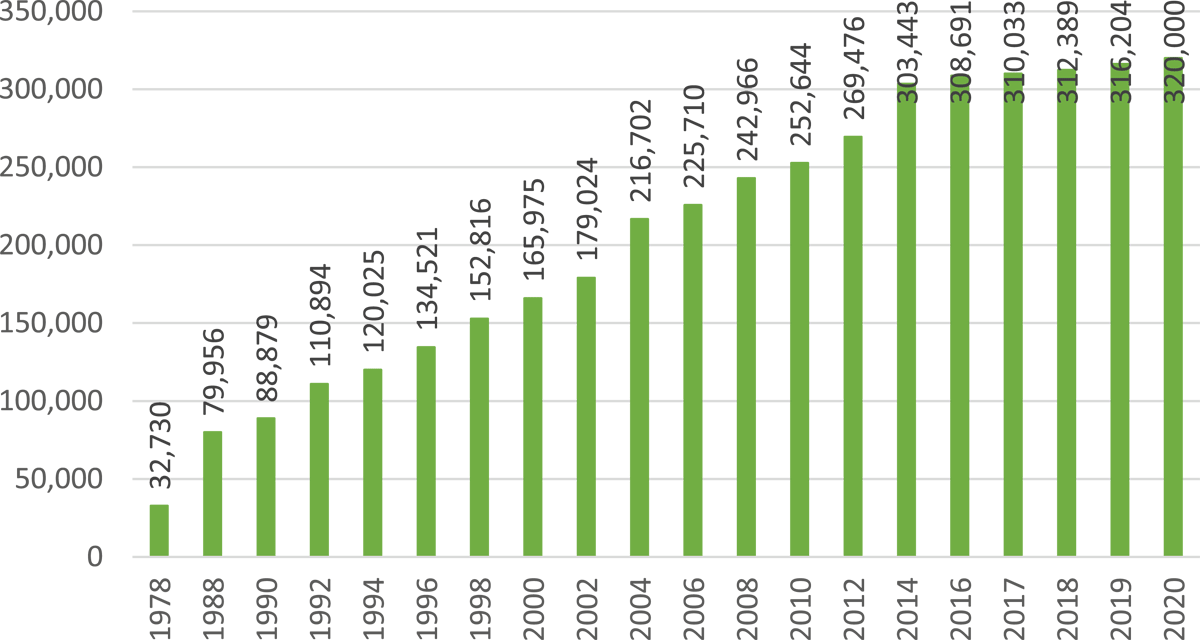
Figure 2
Employees in WFDP.
Own presentation based on (BAG WfbM 2021; BAGüS 2021).
Besides the WFDP there are additional institutions also worth mentioning. Among the range of services offered by the WFDP are special needs daycare centers. Almost 40,000 people (figures do not include North Rhine-Westphalia) who cannot be employed in a WFDP due to the severity of their impairment visit the special needs daycare centers (BAGüS 2021).
Further employment alternatives are the ‘inclusion companies’ (§215 SGB IX), which are supposed to employ between 30–50% of their staff as severely disabled persons according to legal requirements. Currently, 13,590 people with recognized severe disabilities work in 975 inclusive companies in Germany (BAG IF 2020). With the socio-political measure of ‘Supported Employment’ (§55 SGB IX), more than 3,000 people work in the general labour market on an annual average. Comparatively few people take advantage of other employment opportunities in the rehabilitation system with low funding figures, including support through the ‘Budget for Work’ (§61 SGB IX).
In Germany, employment of people with disabilities in the segregated system of the WFDP is the standard. In contrast, alternative employment options in inclusive settings are marginal. In Scandinavian countries, inclusive labour market instruments are more important, although the old principle of ‘first train, then place’ still dominates (Gjertsen, Hardonk & Ineland 2021). In Norway, for example, the measure ‘Permanently Adapted Work’ (VTA) is used for the workplace inclusion of people with disabilities (Gjertsen, Hardonk & Ineland 2021). Another good instrument supporting the transition to the regular labour market is ‘Workplace-Based-Learning’ from Sweden. The aim is to increase the students’ professional maturity by making them aware of the requirements of the labour market, their own strengths and weaknesses, and the identity as an employee that is considered socially adequate. The basic idea is that students have the opportunity to put theory from school into practice in a ‘real-life’ context and broaden their work experience (Ineland, Karhina & Viktröm 2021).
2.4 Particularities of the German Education and Employment System
In order to interpret the employment data on the labour market and the WFDP more effectively, we have to consider several theoretical background aspects that make it possible to classify the ‘German particularities’ of the education and employment system and their socio-political embedding.
One cannot speak of a considerable increase in employment of severely disabled people in the first place, but rather a higher employment rate in Germany overall. This includes the whole population. So it can be said that people with severe disabilities scarcely benefit. There are neither more work for people with disabilities nor did employment opportunities expand. The internal recruitment within companies is a conclusive explanation for the (apparent) increase rather than the early retirement or invalidity of older employees who ‘acquire’ a recognized severe disability at a higher working age (mostly 55 years and older). The growth of the low-wage sector and the (precarious) service sector to some extent cause increases in employment figures. Less often, qualified skilled work in the industry, academic ‘knowledge work’ or the high wage segments of the labour market are the reasons for the development (Biermann 2015).
Furthermore, there is a need to explain why the exogenous economic shock of the global economy during the financial crisis hardly affected the group of disabled people. The economic review following the global financial crisis since 2008 only had a temporary minor impact on employment figures in Germany. Political decision-makers supported the German economy using Keynesian steering elements, which included stimulating domestic demand and ensuring a high level of job security through flanking political measures such as short-time work allowances (‘Kurzarbeitergeld’). Not least, this success was demonstrated by the current Corona crisis, where Germany maintained a high level of employment and minimizing the contraction of Germany’s gross domestic product despite the pandemic challenges (DESTATIS 2021a). To classify and interpret, it is, therefore, necessary to extend the framework to the German history of welfare policy. With its social and welfare state policy, Germany is an exemplary type of conservative welfare state regime (Esping-Andersen 1990). Relying heavily on the ‘provision’ of particular groups is one distinguishing feature. On the one hand, it describes a comparatively high proportion of care services for individual groups, including suitable protection for people with disabilities. On the other hand, the varying degree of decommodification also ensures the preservation of groups and status differences, while corporatist social security is organized according to occupational groups. This results in a relatively high level of employment protection for (qualified) workers.
The separation between people with and without disabilities seemingly specifical to Germany start very early in the life course. Segregating structures are first established in school education, continued in vocational preparation and training, and are further manifested in the working life. The proportion of students with special educational needs has increased continuously in recent years as a result of the new legal entitlement under the UNCRPD. However, despite the obvious change in the legal situation, the separated school system for children with special needs has not lost its functional, organizational or empirical significance. On the contrary, it contributes to the preservation of existing exclusionary structures in separating places of socialization and learning. Due to the ‘funding boom’ and the increased labeling of students as ‘in need of special education’ more resources are being acquired for schools. At the same time, the proportion of students and locations of separating special schools is hardly reduced (Autorengruppe Bildungsberichterstattung 2020; KMK 2021). The transition processes and thus the access to vocational training with the optional intermediate steps of vocational preparation are still strongly characterized by rehabilitation-specific exclusionary measures (Blanck 2020).
In Germany, 7,4% of students currently are labeled as having special educational needs. The German federal states (‘Bundesländer’) show ranges in the ‘disability rates’ between 5% and 10% (Autorengruppe Bildungsberichterstattung 2020; KMK 2021). Some states teach mostly in inclusive settings, other more often in separate school types. However, these differences in the ‘disability rates’ of German educational federalism are not evident in the area of vocational training and vocational preparation.
The effects of ‘Stigmatization by Negative Selection’ (Solga 2002) due to the highly pronounced school segregation in Germany have led directly to a segregated occupational environment such as the sheltered workshops. Qualitative and quantitative long-term studies using the example of the German school and training system (Pfahl 2011; Blanck 2020) have shown how powerful school segregation is and what negative consequences it has for the occupational choice process of young people with disabilities. The limited educational and employment opportunities of the special schemes contribute to the need for those special schemes themselves. They integrate and provide for the group of people they claim to promote. On the one hand, this leads to a reproduction of social inequality in the education and training system and, later on, in labour markets. On the other hand, it causes a significant ‘cooling out’ in occupational demands, furthermore causing a need for socio-political care among the clientele of disabled people of working age.
3. Work 4.0 and Socio-Structural Change Processes
In this section, we will illustrate the societal changes that the concept of ‘Work 4.0’ entails and is associated with.
Under the ‘Work 4.0’ label Germany discusses current change processes in the working world as well as conceivable future scenarios of networked, digitized, and flexible work (Federal Ministry of Labour and Social Affairs 2017, 2015). Work 4.0 not only includes conceptions of a fourth industrial revolution (Industry 4.0),4 but also looks at the working and living environment as a whole going beyond the industrial sphere, which is closely linked to negotiating new social compromises between society and politics (Möller 2015). The changes that a working world 4.0 brings with it pose challenges for all welfare states, regardless of their individual welfare state model (Ferragina and Seeleib-Kaiser 2011; Esping-Andersen 1990).
The Work 4.0 discourse can loosely interlink different aspects of the changing working world and subsume them from a practical perspective. In addition to the technical potential of a digital and global economy, the concept describes changes in societal value constellations and expectations of work. Furthermore, it discusses new uncertainties in the course of reorganizing employment constellations as well as the continuing effects of the megatrends of demographic change, globalization, and development into a knowledge society (Federal Ministry of Labour and Social Affairs 2015, 2017).
Thus, the discourse on Work 4.0 is specifically a ‘German discussion’ in its conceptual form. But with its complex list of topics it deals with global fields of discourse that affect the changes in the international working world (Möller 2015).
The concept of Work 4.0 is limited in its empirical-analytical terms. If the discourse primarily deals with abstract guiding principles, overarching norms, values, and visions, it seems entirely appropriate to operationalize selected aspects of change in a more precise way. We examine the selected aspects of technical potential, changes in employment relationships, and the trend towards the development of a knowledge society in more detail below.
3.1 Technical Potential
Realities of work will change hugely as a result of automation, digitization, and computerization processes. Frey and Osborne (2013) published a widely acclaimed study based on expert assessments and the analysis of occupational activity structures in which they draw attention to the pronounced automation potential of professions in the USA. According to their estimation, 47% of US employees are working in occupations that are highly likely (>70%) to be automated within the next 10 to 20 years. Overall, the probability of automation for low-skilled employees and low-wage earners is significantly higher than it is for more highly qualified employees.5 Despite the limitations mentioned, the results clearly indicate the challenges coming with the high substitutability potential6 of workers (Frey and Osborne 2013).
A similar study attested a high substitutability potential, or rather a high degree of substitutability of professional segments, through computers or computer-controlled machines for Germany (Dengler and Matthes 2021; Bonin, Grogory & Zierahn 2015): 42% of employees work in jobs with a high probability of automation; which concerns 12% of workplaces. Automation particularly affects people with lower levels of education and qualification which thus leads to a higher employment loss (Bonin, Grogory & Zierahn 2015). The probability of automation is as high as 80% for individuals without a secondary school qualification, whereas the probability for those with a secondary school qualification is only 65%. With approximately 50%, the percentage is still high for qualified professionals though it is just about 25% for people with degrees in higher education.
Dengler and Matthes (2021, 2018) also show the substitutability potential according to occupational segments in Germany. A calculated substitutability potential of 72–84% mostly affects manufacturing jobs or in technical production. Cleaning, health care professions and the security industry have a moderate substitution potential (20–44%), with the lowest substitution (approx. 13%) to be expected in social and cultural service professions.
Based on calculations with data from the Institute for Employment Research (IAB), there are various scenarios of how strongly the loss of jobs through substitution is likely to affect the economy. There are no indications that technological progress will generally lead to lower employment. However, technological developments will further promote the structural shifts between sectors and occupations (IAB 2019). Despite differences in the scenarios, the IAB assumes only small job losses in total (i.e. less than 1 million in absolute numbers of all employees) (Möller and Walwei 2017; IAB 2019). The balance between the loss and gain of new jobs heavily depends on the individual sector. These authors assume strong increases in the number of employees for highly qualified technical work fields. In addition, increases are expected in most service occupations. One can expect many job losses in plant engineering, on the middle management level and, above all, in the manufacturing sector – this applies to both non-skilled employees and occupations for skilled workers (qualified persons with a professional qualification). This once again confirms the finding that upgrading the population’s skills and qualifications generally ‘pays off’ and offers workers the best protection against job losses caused by digitization and automation. At the same time, digitization mitigates an impending shortage of skilled workers in some industries (Möller and Walwei 2017).
3.2 Pluralization of Employment Constellations
The predicted erosion of normal employment relationships with the simultaneous growth of atypical gainful employment structures with poor social security safeguards has characterized the working world in recent decades (Mückenberger 2015). At the same time, the number of atypical employments is rising. To be more precise, the common employment relationship has lost its importance in both relative as well as absolute terms (DESTATIS 2021c; Seils and Baumann 2019; Sperber and Walwei 2017). From 1991 to 2007, the proportion of atypical employees rose from 12.8% to 22.6% (Seils and Baumann 2019). The proportion of atypical employees in the permanent staff currently stagnates at a high level Women finding themselves more often in atypical employment than men: At present, 30.5% of all women in employment pursue atypical employment, as opposed to only 12.2% of all men. Individuals without a recognized professional qualification make up 36.6% of the entire labour force in atypical employment (Seils and Baumann 2019).
The concept of ‘normal employment’ is an empirical category representing dependent, permanent full-time employment relationships with full integration into the social security systems of unemployment, health, nursing, and pension insurance. It is also a model of traditional standards (Weinkopf, Hieming & Mesaros 2009) that structures the expectations and demands of good work to this day (Brinkmann et al. 2006; Fuchs 2006; Mayer-Ahuja 2011).
Employment relationships that deviate from normal employment relationships, particularly through shorter working hours, fixed-term contracts, new forms of self-employment, or through employment in a temporary employment relationship, are specially tagged as precarious (Castel and Dörre 2009; Kasch 2008) or atypical employment (Keller and Seifert 2013). A lack of definition and the resulting dilemma of differentiation characterize all terms in this field (York 2019). On the one hand, the erosion of the constituent social element of normal employment presents opportunities for the development of new gender, as well as ecologically and socially related constituent elements. On the other hand, however, the change is accompanied by new types of precariousness and health risks manifesting themselves in unequal access to participatory, economic, and health capabilities which fuel new inclusion and exclusion mechanisms in the working world (York 2019).
3.3 Expansion of Education and Devaluation of Qualifications
The qualification profile of employees is changing due to the progressive expansion of education and the rise in increasingly higher education qualifications. The proportion of people with a lower secondary school graduation of the total population decreased from 41% in 2006 to 30% in 2018. Simultaneously, 23% of the population in 2006 had acquired a university entrance qualification, compared to 33% in 2018. At the same time, the proportion of university graduates increased from 12% to 18% and the proportion of those with apprenticeship/semi-skilled training continues to decline (Autorengruppe Bildungsberichterstattung 2018, 2020).
While he formal requirements for employment have increased, at the same time a larger share of the population than before is striving for a higher level of school education. Being able to compete for professional positions with comparably more highly certified formal education titles becomes increasingly important for individuals. People need increasingly more investment in education to acquire and maintain their status (Quenzel and Hurrelmann 2019). This process of educational expansion and the competition for high-level qualifications and skills inevitably produces losers in the educational race, whose lower educational titles tend to be devalued and less demanded in the labour markets. Furthermore, today’s working world requires flexibility in many professions. A ‘corrosion of character’ (Sennett 1999) depends more than ever on individual variability, spatial mobility and professional development. The expansion of education together with the requirements of the working world result in a lifelong need to acquire qualifications (Quenzel and Hurrelmann 2019). Achieved educational titles are no longer sufficient but must be ‘refreshed’ or renewed through further qualifications. Likewise, changing industries and professions are not uncommon, which means that individuals are required to familiarize themselves with new subject areas and work in new professions. The resulting pressure of constantly achieving even more ‘highly skilled qualification’ due to technological change also leads to a contradictory effect. Paradoxically, the exponential growth of knowledge leads at the same time to a permanent devaluation of qualifications (Hirsch-Kreinsen 2014).
4. People with Disabilities in a Changing Working World
Below we examine the status quo of employment opportunities and challenges in the current change of the working environment for people with disabilities. The focus will in particular lie on the technical potential, the pluralization of employment situations, and the aspects of educational expansion, as well as qualification.
Although expectations of a future working world with a high potential for inclusion are explicitly formulated (UNCRPD, BTG), real implementation deficits and future risks do exist. Since the UNCRPD was ratified in 2009, employment of people with disabilities in segregated systems has continued to grow (BAG WfbM 2021). This development in the training and labour market contradicts the demands of Article 27 (equal right to work) of the UNCRPD (Autorengruppe Bildungsberichterstattung 2018, 2020; Kasch 2008; Jochmaring 2019).
The average substitutability potential of workplaces of employees with disabilities is significantly higher than that of employees without disabilities (Weller 2020). The potential for substitutability is not primarily dependent on the characteristics of a disability, but on the workplaces where people are employed (Weller 2020). One can never exactly predict the technical potential of the labour market and the resulting substitutability potential (Wajcman 2017). However, we can assess trends and highlight scenarios. For low-skilled workers or people without a school-leaving certificate, a range of unqualified jobs will cease to exist in the labour market. This particularly applies for the manufacturing sector. Large proportions of the younger and middle-aged people with learning disabilities having made it into the labour market will likely be affected by a loss of unqualified jobs. Due to the increasing complexity of work processes, the digitization process is expected to raise the hurdles for this group of people with disabilities and reduce individual opportunities for employment (Engels 2016; Weller 2020).
The consequences of digitization and possible job substitution are less precarious for older employees who are firmly established in their professional life and have become afflicted with severe disabilities in the course of their professional careers. Technological and social-structural upheavals affect these mostly better-qualified workers far less often than low-skilled workers.
However, the processes of automation and digitalization also open up new opportunities for participation in the working world, especially for people with physical or sensory impairments, for example through the reduction of physically demanding activities and the use of new communication technologies (Metzler, Jansen & Kurtenacker 2020; Mikfeld 2017). Assistive technologies, software and universal design solutions can contribute to increased participation at work. The IT sector is expected to create new jobs attractive for highly qualified people with disabilities (Mikfeld 2017; Engels 2016). New work forms such as crowd working, teleworking or home office offer improved employment opportunities for the group of highly qualified people with physical or sensory impairments, provided they can intellectually cope with the complex work demands and use newly developed techniques. In terms of simple work occupations, the growing Internet mail order business is creating new employment opportunities in logistics, courier services, storage, and packaging (Engels 2016). Basendowski and Leibeck (2019) warn against the judgment that digitization should be seen purely as a ‘job destroyer’. They and others also explore opportunities of digitization and their potential facilitated by assistive technologies not only for people with disabilities (IAB 2019; Möller 2015).
Mobile work has become an integral part of the German workplace since the Corona pandemic (Böhm, Götz & Baumgärtner 2020). The use of new forms of communication, such as video conferencing and calls, are a digital normality for people with and without disabilities by now.
In Germany, there are a number of pilot projects aiming to increase the opportunities for people with disabilities to participate in the labour market through the targeted use of technology. For example, in the research and development project ‘LernBAR – Learning on the basis of Augmented Reality – An inclusive training concept for home economics’ augmented-reality-based vocational learning for people with disabilities is examined. LernBAR makes use of the ‘potential of new technologies to develop work process-oriented learning programs to support people with learning disabilities in their workplace’ (Fachgebiet Rehabilitationstechnologie 2022b). As a further example, the project ‘EJO – Electronic Job Coach’ focuses on the inclusion of people with learning disabilities in work using an app, that shows the work steps one by one and in the right order (Fachgebiet Rehabilitationstechnologie 2022a). The project ‘Working the way I want to!’ supports people with disabilities in accessing the labour market with an AI-supported app (Sozialforschungsstelle Dortmund 2022).
The increasing pluralization of employment constellations creates participation opportunities for broad sections of the population through new and diverse chances of access to the labour market. However, the changes in traditional employment constellations also involve precariousness, exclusion, and health risks. These go hand in hand with restrictions in employment and company participation opportunities, a reduction in income, incomplete or total lack of integration into the social security systems as well as into the occupational health and safety systems (York 2019). It is not yet possible to foresee the tangible impact of these mechanisms on people with disabilities.
The opportunities of educational expansion lie within enlarged occupational change and reorientation provided by the broadening of diverse educational and qualification options. This, of course, also affects people with disabilities, as the need to increase necessary skills and professional qualifications intensifies. It can be assumed that people with learning disabilities will be disadvantaged in the competition for even higher educational qualifications and with the increase in knowledge work (Biermann 2015). In addition, digitization and automation put areas of activity at risk where impaired and low-skilled people are primarily working, particularly in the manufacturing sector. For the majority of people with disabilities, however, the qualitative changes and the trend towards higher qualifications are more challenging than the quantitative loss of unqualified jobs in the labour market. Above all, the growing demands for qualifications in the working world and the pressure of lifelong learning will likely exacerbate the situation (Quenzel and Hurrelmann 2019).
5. Discussion and Conclusion
In the sense of the capability approach, developed by Amartya Sen (1999, 1985) later extended by Martha Nussbaum (2011), we can outline access routes into work for people with disabilities. The approach focuses both on socially conditioned opportunity structures and individual potential. It is thus suitable for taking a differentiated and at the same time relational look at (in-)equality in the working work. According to Sen (1999), unequal conversion factors of individuals due to age, gender, health, and illness, or disability result in different needs. This means that people sometimes need more resources than other people to do things to which they attach a central value, depending on the available individual conversion factors. From the (critical) perspective of a sociology of disability we can argue that limited resources and conversion factors determine workers so that there is often no freedom of choice of occupation and the functional skills achieved allow only for ‘protected’ employment.
Following Sen (1999) and Nussbaum (2011) the concept of the capability approach, we argue that people with disabilities need to raise more resources to take advantage of participation opportunities in the world of Work 4.0. In a sociological interpretation and against the background of the structural changes of digitalization, the pluralization of employment constellations and educational expansion described above, it is more difficult for this group of people to develop the specific skills that are required in the German labour market as a high-performance economy in order to be ‘needed’ and to be successful. Or put in other less harsh and distanced sociological terminology: People with disabilities are not sufficiently supported and the existing measures are inadequate. It is thus contrary to the principles of human rights treaties and the requirements of Article 27 of the UNCPRD.
The described socialization into disability-specific special systems of segregated schools and workplaces is playing a central role in this. A large part of the group of disabled people has already been ‘cooled out’ beforehand. That means they have not even been able to acquire the skills, qualifications, and entitlements in the education system necessary to enter the labour market. This also explains the constant growth rates in the sheltered workshops for disabled people and in the special systems, which withdraw this group of people with a lack of employability or adjustment from the labour market.
The already tense labour market situation for people with disabilities may become even more tense in the future. There is much reason to suggest that the economic, educational, and labour market policy changes will contribute to a further reduction in employment options for low-skilled individuals in the labour market. This will result in increasing numbers of redundant workers. Jantzen (1974) was the first to make a reference to this context in a politico-economic interpretation. Based on Marxist reasoning (Marx 1867/2013; Vogel 1999), the rehabilitation system thus fulfills the function of absorbing unprofitable workers from the labour market who then find their use as a ‘reserve army’ if there is sufficient demand. One can thematically link this to the twofold function of the WFDP as described: In addition to the protective function, the task has always been to absorb workers who cannot be placed on the labour market. This ambiguity is evident in the de facto expansion of workshops on the one hand, while the dismantling of segregated systems is demanded on the other.
If we are not ready to completely tear down established structures by closing the workshops, there remains a contradiction: Segregated systems are expected to dismantle while they are still in full use. For the time being, no real alternatives are being created for this group of people on the labour market in the foreseeable future.
This means that segregated systems for participation in working life cannot even be dispensed with prospective terms. Although the statutory normative requirement increases the moral and political pressure, it does not create any new job and participation opportunities or areas of activity in the labour market. On the contrary, these opportunities may be, further and more significantly reduced due to the anticipated substitutability potential of digitization, as we have shown above.
If we consider the dynamics of automation and digitization already outlined, the resulting potential for substitutability, the consequences of the pluralization trends described above, and the expansion of education as a whole, the outlook appears uncertain. One should not expect improvement with regards to participation in working life but rather a further deterioration and permanent exclusion from the labour market. The segregated systems, subject to criticism politically and in terms of human rights, will continue to be needed more instead of fewer people will have to be integrated into alternative labour markets in the future.
Ultimately, we are facing the ‘big question’ of how much ‘dis-ability’ is allowed in a capitalist economic system. What is formulated as an inclusive aspiration would only be conceivable and feasible in the working world subject to the acceptance of non-performance or a lower performance level. After all, merely calling for inclusion does not generate practical participation opportunities in any way, but instead remains at the level of legal and political demands meeting the limits of reality. It is also necessary to debate the extent to which ‘more gainful employment’ can and should continue to be a requirement for society as a whole as far as possible, or whether it is feasible to open up avenues towards solidarity-based activity structures.
In summary, it would be too short-sighted to interpret the relationships outlined here as a dystopian doomsday scenario. At present, the facets of change cannot yet be conclusively determined. With the development of Work 4.0, the third major technological innovation of the last 150 years has already been initiated. As shown, serious changes in the fields of employment are to be expected this time as well, but not a massive replacement of human work by machines and technology as feared without opening up new fields of activity. It is therefore just as appropriate to remain optimistic and see what the future brings.
Notes
[1] The use of the terms ‘people with disabilities’ and ‘disabled people’ needs to be explained: In this paper, we mostly use the term ‘people with disabilities’ as it is also used in the Federal Participation Law or the UNCRPD and is advocated by self-representation organizations, such as the ‘Selbstbestimmt Leben e.V.’ lobby group or the People First e.V. network. With the use of the construct ‘disabled people’, we wish to refer to the socially and structurally critical explanation approach in the respective context, which is opposed to overemphasizing individual characteristics and refers to the social construction of disability.
[2] Defined as ‘arbeitslos’ (ALO) are those people who are temporarily not in employment and who are looking for employment that is subject to compulsory insurance and must be undertaken for at least 15 hours per week (own efforts). They must also be available for the placement endeavors of the employment agency or job center, i.e. they must be allowed, able, and willing to work (availability), live in Germany, not be under 15 years of age, and not yet have reached the age limit for retirement and have personally registered with an employment agency or job center (BA 2021c).
[3] According to the employment concept of the International Labor Organization (ILO) defines people as ‘erwerbslos’ who were not in gainful employment during a data collection period but who, according to their own information, were actively seeking work in the four weeks preceding the survey and are available for the new job within two weeks. The type of employment is not relevant. The involvement of an employment agency or a municipal provider in the search efforts is not required (BA 2021c).
[4] ‘Industry 4.0 describes a revolution in the manufacturing sector. At the heart of Industry 4.0 is a highly automated and interconnected industrial production and logistics chain. Virtual and real processes merge based on what is known as cyber-physical systems. This permits highly efficient and highly flexible production, with customer wishes being taken into account in real-time, and allows a large number of product variations to be produced’ (Federal Ministry of Labour and Social Affairs 2015, 15).
[5] The information should be interpreted with caution since it is based on expert assessments, in which the technical potential is overestimated as a rule. The results only relate to the technical automation potential, which is by no means to be equated with real employment effects (Bonin, Grogory & Zierahn 2015).
[6] The substitutability potential describes the extent to which occupations could be replaced by computers or computer-controlled machines (Dengler and Matthes 2021).
Acknowledgements
We acknowledge financial support by Deutsche Forschungsgemeinschaft and Technische Universität Dortmund/TU Dortmund University within the funding programme Open Access Costs.
Competing Interests
The authors have no competing interests to declare.