Have a personal or library account? Click to login
Rethinking Practices by Rethinking Expertise: A Relational Approach to Family-Centred Inclusive Services Cover

Rethinking Practices by Rethinking Expertise: A Relational Approach to Family-Centred Inclusive Services

Open Access
|Jan 2021

Figures & Tables

Table 1

Edwards’ three ‘gardening tools’ in relation to family-centred inclusive practices.

The gardening toolsCommon characteristics and principlesFCIP core values
1. Common knowledge
  • Transfer, translation, and transformation of expert knowledge.

  • Professionals being able to identify and integrate one’s own expertise with what others know and do.

  • What affects one member of the system impacts on the other members.

  • Equal power relations.

  • Parent/professional partnership.

  • Recognising and respecting one another’s knowledge and expertise.

  • Parents are seen as experts in their own matters.

  • Meaningful parent involvement.

  • Stakeholders have a clear and shared understanding of their roles and responsibilities and know that they are expected to collaborate with partner organisations.

2. Relational expertise
  • To be explicit about what matters for you.

  • To recognise what matters for others.

  • Joint interpretation of the problem.

  • To attune ones actions with those of others.

  • Adds to existing knowledge.

  • An ecosystems relational thinking.

  • The children exist within the context of their families, wider community, and society.

  • Take advantage of both core expertise and additional capabilities.

  • Augments specialist expertise and enables fluid responsive collaborations.

  • A curriculum which requires staff to collaborate with children, colleagues, and parents and to reflect on their own practice.

  • Individualised, flexible, coordinated, and responsive services.

  • Monitoring and evaluation which is in the best interest of the child.

3. Relational agency
  • Collaboration within and between activity systems.

  • Professionals can, and need to, draw on and contribute to systems of distributed expertise.

  • Experts build links and try to integrate what they know with what others want to, or should, know and do.

  • All entities are working towards a common goal.

  • Families are key decisionmakers in addressing their children’s and families’ needs.

  • Parents are seen as equal partners in decision making and goal setting.

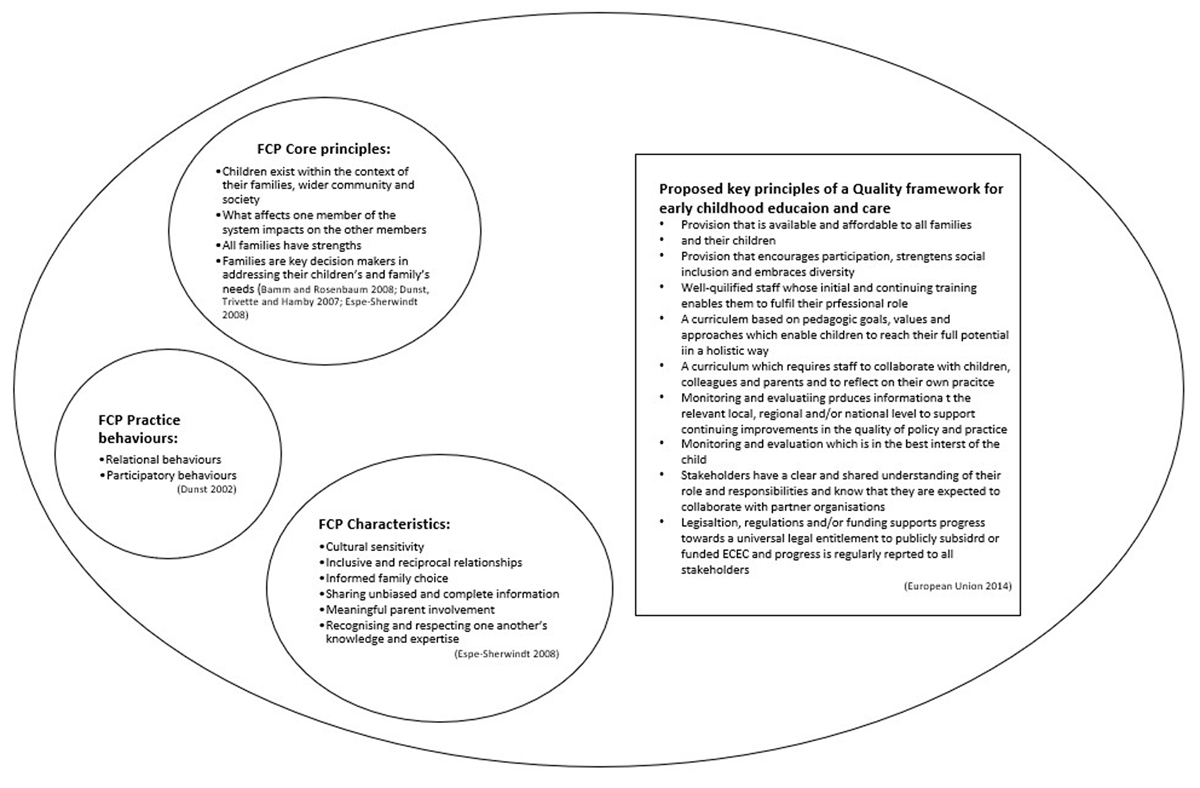
Figure 1

A model of family-centred inclusive practices.

DOI: https://doi.org/10.16993/sjdr.734 | Journal eISSN: 1745-3011
Language: English
Page range: 1 - 13
Submitted on: May 4, 2020
Accepted on: Dec 14, 2020
Published on: Jan 11, 2021
In partnership with: Paradigm Publishing Services

© 2021 Jóna G. Ingólfsdóttir, Rannveig Traustadóttir, Snæfríður Þóra Egilson, published by Stockholm University Press
This work is licensed under the Creative Commons Attribution 4.0 License.