
Introduction
Housing studies have long held that the dwelling is simultaneously a site of social reproduction, an instrument of capital accumulation, an arena of identity-making, and a mediator of profoundly unequal life chances (Marcuse and Madden 2016; Saunders 2021). For many neurodivergent people (NDP), however, the residential environment itself may become a significant source of sensory burden when designed around neurotypical assumptions. Acoustic and lighting conditions, along with spatial configurations that are designed for a neurotypical majority, may impose chronic neurological costs on NDP. These costs are not incidental but structurally produced by design standards and practices that have been built around a narrow configuration of the ‘normal’ occupant—neurotypical people (NTP). NTP is understood in this study as an individual with neurocognitive functioning that falls within societal norms for their age and sociocultural context (Shah et al. 2022). For the purposes of this study, the term NDP refers to individuals with neurodevelopmental diagnoses as defined in the Diagnostic and Statistical Manual of Mental Disorders (DSM-5-TR) (APA 2022). These include, but are not limited to, autism, attention-deficit/hyperactivity disorder (ADHD), specific learning disorders (including dyslexia, dyscalculia, and written expression disorder), developmental coordination disorder, tic disorders (including Tourette’s disorder), and intellectual disability. In addition, this term is used to include individuals with neurological conditions that influence sensory processing, including those that may be acquired rather than developmental in origin (e.g., brain injury or neurological illness). This study combines existing neurodiversity scholarship to argue against equating ‘typical’ with ‘normal/better,’ emphasizing that conceptual and methodological choices can reinforce normalization agendas and, consequently, marginalization (Dwyer 2022).
Neurodiversity, understood in this study through the social model orientation developed by the autistic self-advocacy movement and elaborated in disability theory (Den Houting 2019; Fung 2021), refers to the natural variation in neurological function across human populations. Current estimates indicate that around 15–20% of people worldwide live with a neurodevelopmental or neurological condition that influences sensory processing (Steinmetz et al. 2024). Existing studies on sensory over-responsivity in autism confirm a large population-level effect size (Than et al. 2024; Wood et al. 2021), and 95% of autistic children exhibit clear sensory processing differences in their daily lives (Green et al. 2018; Patil and Kaple 2023). The social model of disability (Goering 2015; Mike Oliver 2013) identifies the production of disability not in individual impairment but in the disabling structures of built and social environments. For NDP, the ‘normal’ user is implicitly imagined as an individual with average sensory gating, typical auditory-cortex habituation, and no particular sensitivity to fluorescent flicker (Dissanayake et al. 2013). Housing environments—referred to as private residential dwellings and domestic environments that support independent living—designed for this user profile can affect sensory accessibility of users whose nervous systems diverge from it. Applied to the design qualities of housing environments, this framework provides actionable insights to understand that most of the distress, dysregulation, and restricted participation experienced by NDP in their homes are environmentally produced and, therefore, remediable. The United Nations Convention on the Rights of Persons with Disabilities (UNCRPD 2006) reinforces this framing: Articles 9 (accessibility), 19 (independent living), and 28 (adequate standard of living) establish positive obligations for governments to ensure that housing environments support full participation of disabled people in social life.
Despite these theoretical and rights-based frameworks, the relationship between housing design qualities and NDP’s lived experiences has received remarkably little attention. While building standards address physical mobility and, to a limited degree, sensory impairment in its traditional clinical sense, sensory accessibility remains fragmented and not systematically integrated into housing design recommendations and practices (e.g., BS 8300 (BSI 2018)). This study asks three interrelated questions: First, what does the available evidence unveil about how residential built environments affect the daily lives and rights of NDP? Second, how is neurodiversity framed within that evidence base, and whose knowledge counts? Third, what are the implications for housing design practices, sensory accessibility, and the provision of ‘accessible’ residential built environments? Adopting a neurodiversity-affirming orientation, this study understands neurological variation as natural human diversity. The central concern is how housing environments can be restructured to enable NDP’s full participation in their home and social life (Dwyer et al. 2025; Srinivasan 2025).
To the authors’ knowledge, this is the first study that maps the intersection of neurodiversity and housing design qualities across the disciplines of neuroscience, environmental psychology, architecture, and housing policy. Thus, the primary contributions are a synthesis of what is known about how certain housing design qualities may affect NDP, a critical analysis of the methodological and conceptual limitations of the field, and a set of neuro-inclusive design (NID) principles for residential architecture.
Methodology
A scoping review was conducted in accordance with the PRISMA Extension for Scoping Reviews (Pollock et al. 2024), guided by Arksey and O’Malley’s (2005) iterative framework. A scoping review, instead of a systematic review, was conducted to map the extent of an evidence base that spans multiple disciplines, characterized by heterogeneous methods and epistemologies. Scoping reviews are also particularly well suited to interdisciplinary research topics that remain at an early stage of conceptual integration (Mak and Thomas 2022). For the purpose of this study, institutional settings such as residential care homes were excluded to keep the focus on independent domestic life. ‘Design’ includes all physical variables of the dwelling: acoustics, lighting, spatial layout, materiality, thermal environment, and access to outdoor space. Four databases were used to search studies published until February 2025: Web of Science (Core Collection), Scopus, PubMed for their cross-disciplinary coverage of neuroscience, psychology, and public health, and the Avery Index to Architectural Periodicals to reduce disciplinary siloing, a central concern this study seeks to interrogate. No lower publication-year restriction was applied to capture the full spectrum of this emerging interdisciplinary field. The search resulted in 4,812 records, of which 4,595 remained after duplicate removal. After applying the eligibility criteria, a final set of 66 articles was included for thematic analysis. Thematic synthesis was conducted by using a six-phase framework (Braun and Clarke 2006) adapted for an interdisciplinary scoping review. This approach was selected to generate analytical themes capturing patterns across a heterogeneous evidence base that spans neuroscience, environmental psychology, architecture, and occupational therapy, as well as disability studies and rights (see Supplementary file 1 Appendix for further details). As a reflexive note, the involvement of a neurodivergent co-researcher in the design of this study represents a strength, contributing valuable lived-experience perspectives and supporting efforts to address the co-production gap identified in the literature.
Results
Results showed disciplinary skew: 48% in neuroscience or clinical psychology, 31% in environmental psychology or human factors, and only 21% in architecture or built environment studies, with no studies addressing housing design qualities explicitly. This distribution is itself a significant finding, indicating that the discipline most responsible for shaping residential environments contributes least to the evidence base influencing neurological effects. Geographically, most studies are from North America, Western Europe, and Australia, with relatively limited representation from the Global South. Publication frequency increased substantially after 2015, indicating growing academic interest in sensory accessibility and neurodiversity. Methodologically, literature covered quantitative experimental (34%), observational/cross-sectional (28%), qualitative/ethnographic (18%), mixed methods (12%), and review/modelling (8%). Three overarching themes, with significant overlap, emerged from the reviewed literature: Theme 1, the home as a site of sensory adversity; Theme 2, spatial autonomy, self-regulation, and implications for independent living; Theme 3, deficit framing, epistemic injustice, and residential knowledge. For analytical clarity, they are presented separately (full list of studies in Supplementary file 2 Appendix).
Theme 1: The home as a site of sensory adversity
Acoustic environments and the architecture of exclusion
The most consistent finding across the studied literature was the barrier that typical residential acoustic environments constitute for a significant proportion of NDP. Neuroimaging research indicates that atypical sensory gating—the neurological process by which irrelevant ambient sounds are filtered before reaching conscious awareness (Lee and Syu 2024)—is reported across NDP (Braff 1990; Grillon et al. 1990; Marco et al. 2011; Green et al. 2013). For people with reduced sensory gating capacity, sounds that NTP habituate to almost immediately (e.g., domestic appliances, plumbing, voices from neighborhoods) remain permanently prominent, generating chronic cognitive and emotional demands (Isaacs et al. 2024). Studies deploying magnetoencephalography identify that autistic people may process everyday sounds more slowly, requiring more mental effort to interpret. This can potentially create an accumulating neurological burden in day-to-day activities (Roberts et al. 2010). For instance, acoustic control, including the management of reverberation and background noise, has been identified as an important aspect in environments designed for autistic people (Mostafa 2008), but specific acoustic thresholds and effects on sensory distress have not yet been validated in residential settings. Pan-European studies commonly derive dose-response relationships linking residential noise exposure to health outcomes in the general population, but such population-level frameworks have yet to incorporate neurodivergent amplification of these pathways (Niemann et al. 2006). Poor acoustic conditions, insufficient lighting, and spatial layouts that constrain everyday functioning may contribute to behavioral dysregulation with higher impact among NDP (Kwakye et al. 2011).
Lighting, circadian disruption, and disability in the housing environment
Lighting represents a second driver of sensory inaccessibility in residential environments. Different neurological mechanisms produce distinct profiles of visual sensitivity across NDP, including atypical visual-cortex habituation in autism (Simmons et al. 2009), magnocellular-pathway disruption in dyslexia associated with specific sensitivity to high-contrast fields and fluorescent flicker (Stein 1997), and circadian dysregulation across people with ADHD that can be intensified by high correlated color temperature (CCT) lighting. In particular, cooler-spectrum sources can reduce melatonin production by more than 50% compared with warmer-spectrum lighting (Viola et al. 2008; Malow et al. 2006). At the same time, autistic people often experience differences across several sensory systems, including vision, hearing, touch, smell, balance, body position, and internal bodily sensations (Robertson and Baron-Cohen 2017). Lighting should therefore be understood as one element of a wider sensory experience within the living environment.
Spatial complexity and the costs of open-plan design
Open-plan residential design may constitute a third barrier to inclusion. Brain function theories (Clark 2016; Friston 2010) emphasize that environments containing continually difficult-to-predict sensory information require greater mental and physiological effort to navigate. Pellicano and Burr (2012) argue that autistic people may experience these demands more intensely, making busy and sensory-rich domestic environments feel more vivid and harder to filter over time. Consistent with this, Gomot and Wicker (2012) report heightened neural responses to unexpected environmental changes in autistic adults. The provision of a ‘sensory sanctuary,’ or a dedicated low-stimulus space, consistently emerged as a key feature of sensory-inclusive environments (Jones et al. 2003; Higashida and Mitchell 2021; Fletcher-Watson and Happé 2019).
Theme 2: Spatial autonomy, self-regulation, and implications for independent living
Results showed that spatial organization can influence self-regulation (i.e., a person’s ability to manage their thoughts, emotions, and behavior in response to different situations) and opportunities for social participation (Romero-Ayuso et al. 2020). This theme aligns closely with Article 19 of the UNCRPD, which affirms the right of disabled people to choose where and with whom they live, and to participate in community life on an equal basis. Across the literature, the most consistently reported barrier identified by NDP was the absence of a dedicated, low-stimulus retreat space (Mahan and Kozlowski 2011; Jones et al. 2003; Higashida and Mitchell 2021). Evidence shows that NDP may experience greater physiological arousal and stress during periods of unavoidable social interaction or sensory exposure (Tola et al. 2021).
Another factor concerns the ‘legibility’ of the living environment—that is, how easily residents can understand, navigate, and predict their surroundings. Spatial legibility emerged in the review as an important contributor to self-regulation. Attention Restoration Theory identifies that coherent environments help people recover their ability to concentrate, whereas confusing settings can increase mental fatigue (Kaplan and Kaplan 1989). Prolonged exposure to complex information, competing sensory inputs, or frequent interruptions can therefore exhaust attentional resources, resulting in directed attention fatigue (DAF) (Friston 2010). Research involving autistic people indicates that environments with clear spatial organization can support visual processing and encourage participation (O’Brien et al. 2009; Stevenson and Gernsbacher 2013; Watling and Dietz 2007). Similarly, studies have reported improved social participation among autistic adults with higher support needs when they are given greater control over their environment and personal-space boundaries are clearly defined (Caldwell 2007; Groen et al. 2008).
Existing evidence shows a two-way relationship between sensory over-responsivity— defined as unusually intense reactions to everyday sensory experiences, such as sudden noise, touch, visual stimuli (Green et al. 2018)—and anxiety in autistic people and/or ADHD (Lane et al. 2012; Kern et al. 2006). Research also found that dissatisfaction with living arrangements, often accompanied by feelings of isolation, is associated with an increased risk of suicidality in autistic adults (Cassidy et al. 2018). The effects of inadequate living environments are not limited to NDP themselves. For instance, Bromley et al. (2004) document negative implications for the mental health of family carers. More broadly, Thye et al. (2018) show that atypical sensory processing may contribute to difficulties in social participation.
Further evidence addressed tactile, proprioceptive, and vestibular aspects of everyday functioning. Puts et al. (2014) and Cascio et al. (2008) document meaningful differences in tactile processing among autistic people, while emerging evidence suggests that individuals with developmental coordination disorder (DCD) may experience atypical sensory processing across vision, hearing, balance, and body position (Tran et al. 2022). These differences may contribute to reduced participation in motor activities and other everyday tasks. People with DCD may also struggle to anticipate the sensory consequences of their movements, which can increase the cognitive effort required for routine activities (Opitz et al. 2020; Flanagan et al. 2001; Press et al. 2023).
Theme 3: Deficit framing, epistemic injustice, and residential knowledge
Whereas Themes 1 and 2 focus on the characteristics of living environments and their effects, Theme 3 examines how knowledge about those environments is produced. Specifically, it considers how neurodivergence is conceptualized within the literature and whose perspectives are treated as authoritative when defining residential needs and accessibility.
Most of the reviewed studies adopt a medical-model perspective, where sensory differences are typically described as deficits, measured against neurotypical norms, and addressed through interventions aimed at reducing functional impairment (Brown and Dunn 2002; Tavassoli et al. 2014; Johnson-Ecker and Parham 2000; Baranek et al. 2017). As a result, research often focuses on individual differences from neurotypical standards, rather than on whether residential environments support the rights, autonomy, and participation of NDP. This orientation reflects what disability scholars have defined as the individualization of disability, where difficulties are attributed primarily to the person rather than to inaccessible environments and infrastructures (Michael Oliver 1990; Verdugo et al. 2023). For instance, findings reporting that 95% of autistic children exhibit significant sensory processing differences (Tomchek and Dunn 2007) are often interpreted as evidence of individual pathology, rather than as a mismatch between standardized residential environments and the diversity of human sensory experience.
Across the reviewed literature, the clearest expression of this knowledge-production problem is the repeated absence of co-production. Few studies involve NDP as co-researchers or adopt genuinely participatory approaches. This is more than a methodological limitation and raises important ethical concerns (Barnes and Mercer 1997; Nind 2014). When research is conducted without meaningful involvement of NDP, the questions that are asked, the outcomes that are measured, and the knowledge that is produced are often shaped by non-neurodivergent assumptions. In studies in which outcomes are defined by neurotypical researchers and assessed against neurotypical standards, living environments are frequently evaluated in terms of their ability to reduce or suppress ‘autistic characteristics’ rather than their capacity to support NDP’s needs and preferences. By contrast, autistic-led perspectives tend to prioritize well-being, autonomy, and the recognition of diverse ways of experiencing and engaging with the world (Den Houting 2019). This pattern is consistent with what Frickel et al. (2010) describe as ‘undone science’: knowledge that remains under-researched or poorly translated into practice because it may challenge existing institutional arrangements or create new demands for accountability. Against this backdrop, the neurodiversity paradigm is not simply an alternative way of interpreting evidence; it advances a broader claim about whose needs should shape decisions (Armstrong 2025).
Discussion
Sensory accessibility, quality of life and user rights
The evidence synthesized in this study suggests that sensory inaccessibility is consistently associated with health, wellbeing, and service-use outcomes in residential settings. According to the included studies, sensory-accessible environments may help reduce demand for crisis services (Alizadeh et al. 2024; Mitchell et al. 2025), anxiety-related symptoms (Lane et al. 2012), and suicidality risk amongst NDP (Cassidy et al. 2018). These findings suggest that residential sensory-accessible environments can have measurable consequences for health and wellbeing and that these consequences are foreseeable rather than incidental. By synthesizing prior evidence, this study argues that sensory inaccessibility should not be understood merely as a design oversight or as the absence of individualized accommodations. Rather, it can be conceptualized as a structural form of exclusion that limits equal participation in everyday life (United Nations, n.d.). From this perspective, sensory accessibility—including appropriate acoustic conditions, lighting specification, spatial legibility, and access to retreat spaces—should be regarded as a baseline requirement of residential design and ethical duty rather than an exceptional adjustment.
Further findings emerging from this study concern the gap between available evidence and regulatory implementation. Existing estimates suggest that the translation of neuroscientific and clinical evidence into building standards may take 14–22 years (Li et al. 2025). Furthermore, despite increasing evidence regarding sensory accessibility, housing regulations and mainstream design practices continue to address these issues inconsistently. This temporal lag is particularly consequential in the housing sector because residential buildings are long-lived assets that are costly and difficult to retrofit. Thus, sensory inaccessibility can become embedded within the housing stock for prolonged periods, affecting residents who often have limited influence over design and procurement decisions.
Drawing on scholarship on disability, professional power relations, and the built environment, this study shows sensory accessibility as marginalized by normative assumptions regarding desirable bodies and ways of sensing (Goodley 2025). Furthermore, through the lens of ‘undone science’, the persistence of sensory inaccessibility in existing mechanisms and regulatory response cannot be attributed solely to a lack of evidence (Frickel et al. 2010). Instead, weak institutional accountability and limited regulatory incentives may contribute to the delayed translation of existing knowledge into housing policy and practice. We highlight the need to frame sensory accessibility not only as a technical design issue but also as a question of rights, governance, and professional responsibility.
Epistemic justice and the co-production of knowledge
Results consistently revealed limited involvement of NDP in the production of knowledge. Across the literature, research agendas, methodological choices, and interpretations are predominantly shaped by researchers, clinicians, and design professionals, while the experiential knowledge of NDP is rarely positioned as an authoritative source of evidence. This pattern is reflected in the persistent divide between insider knowledge derived from lived experience and outsider knowledge generated through professional and academic perspectives (Den Houting et al. 2022). Both forms of knowledge are valuable, but the exclusion of lived-experience expertise may result in research priorities that fail to reflect the everyday realities of NDP.
The evidence reviewed also identifies recurring priorities across studies involving NDP. Sensory sanctuary provision, acoustic management, and spatial predictability were repeatedly highlighted as important factors influencing experiences of the built environment (Crane et al. 2009; Fletcher-Watson and Happé 2019; Higashida and Mitchell 2021; Gaiani et al. 2022). At the same time, studies adopting more deficit-oriented approaches frequently describe the same environmental characteristics as triggers for behaviors requiring clinical management. While the interpretation of responsibility differs substantially, the literature appears to identify similar environmental variables regardless of theoretical orientation.
Our analysis argues that the failure of co-production identified in this body of research is not only a methodological limitation but also raises questions of epistemic justice, referring to the harm experienced by individuals in their capacity as knowers, particularly if their knowledge is systematically excluded (Frickel et al. 2010). From this perspective, the limited involvement of NDP in housing research is not merely a methodological weakness, but a broader pattern in which lived-experience expertise is marginalized despite its relevance for understanding how residential environments are experienced. The distinction therefore lies less in the environmental factors themselves than in where causality and responsibility are placed: whether difficulties are understood primarily as characteristics of individual nervous systems or as consequences of environmental conditions and design decisions.
Through the Emancipatory Disability Research (EDR) paradigm, meaningful progress in sensory-accessible environments requires NDP to be positioned as active producers of knowledge rather than solely as research participants, with researchers acting as facilitators of knowledge co-production aimed at challenging exclusion and removing social barriers (Beesley 2025; Kaur 2026). Addressing this deficit, however, requires structural intervention at the level of funding and governance, including co-production as a condition of publicly funded research on sensory accessibility in housing design (UNCRPD 2006).
Implications for policy and practice: Neuro-inclusive design principles for residential architecture
The results of this review show that sensory accessibility remains insufficiently addressed within existing built-environment design frameworks, including universal design (Hedvall et al. 2025; Ronald L. et al. 1996; Talay-Ongan and Wood 2000). Sensory experiences were consistently identified as key determinants of usability, wellbeing, and residential satisfaction for NDP. For example, the reported prevalence of sensory differences among autistic people ranges from 30% to 96% depending on the study design and measurement approach (Marco et al. 2011; Tavassoli et al. 2016, 2018; Dawson and Watling 2000). Collectively, these findings suggest that sensory accessibility should be recognized as a fundamental component of residential accessibility rather than as an individualized accommodation.
The literature further demonstrates that environmental characteristics such as acoustic conditions, lighting conditions, retreat opportunities, and spatial legibility can significantly influence residents’ experiences and everyday functioning (Crane et al., 2009; Gaiani et al., 2022; Hallinan et al., 2024). Interpreted through a neurodiversity and rights-based perspective, these findings challenge prevailing assumptions that accessibility is primarily concerned with physical or mobility-related requirements. Instead, they point to the need for a broader understanding of accessibility that encompasses sensory and cognitive dimensions of environmental experience. This study extends existing discussions by conceptualizing sensory accessibility as a core criterion of inclusive residential design.
Although the principles of universal design suggest that environments accommodating those facing the greatest constraints may also benefit a wider population, the reviewed evidence highlights persistent implementation barriers. Practitioners frequently report limited client awareness, weak institutional incentives, and difficulties communicating the value of inclusive design, contributing to perceptions that accessibility represents an additional cost rather than a fundamental design responsibility (Heylighen et al. 2017; Hallinan et al. 2024; Watchorn et al. 2023). The literature also identifies a structural economic challenge whereby the costs of inclusive design are often assumed by developers or housing providers, while benefits go to residents (Singhal et al. 2025). This split-incentive dynamic may help explain the persistent gap between available evidence and implementation in housing practice.
The practice-based analysis undertaken in this study provides further insight into this gap. Comparison between renovation-to-inclusion and new-built inclusive scenarios suggests that integrating inclusive requirements during the earliest stages of design is generally more cost-effective than introducing modifications after construction. When considered alongside evidence linking improved sensory accessibility with reduced crisis-related service use and support needs (Terashima and Clark 2021; Hallinan et al. 2024), these findings indicate that the costs of inclusive housing should be evaluated across the life course of residents rather than solely through short-term construction expenditure. This contribution adds an economic and implementation perspective to current debates on inclusive housing by highlighting the potential long-term value of proactively embedding sensory accessibility within mainstream residential design practice.
Building on the reviewed evidence, this study proposes NID as a conceptual framework for residential architecture that extends existing design approaches by positioning sensory accessibility as a fundamental design requirement (Figure 1). While the reviewed literature consistently identifies sensory environments as significant influences on the wellbeing, autonomy, and everyday experiences of NDP, this evidence remains fragmented across disciplines and is rarely translated into a coherent framework for housing design. This study addresses this gap by synthesizing insights from existing research into a structured framework that can inform residential design practice, policy development, and future research. The intention is to support the design and adaptation of individual dwellings, guide new residential developments, and inform revisions to housing standards and regulatory processes. The four operational domains were derived from recurring themes identified across the reviewed evidence and are designed to be applicable across multiple scales of housing design and governance. Domain 1, sensory environment calibration, concerns the alignment of acoustic, visual, thermal, and olfactory conditions with diverse sensory needs to reduce excessive sensory loads; for example, management of background noise and warm-spectrum lighting to minimize sensory distress and circadian disruption. Domain 2, spatial autonomy and control, focuses on supporting residents’ ability to regulate their sensory environment, including access to dedicated retreat or ‘sensory sanctuary’ spaces. Domain 3, predictive legibility, emphasizes coherent spatial organization, clear environmental cues, and intuitive navigation to support orientation and enhance residents’ sense of control. Domain 4, social connectivity with opt-out, responds to evidence demonstrating that social participation is often constrained by environmental conditions rather than by a lack of interest in social interaction. It promotes graduated opportunities for engagement through tailored social zones, privacy gradients, and acoustic separation, allowing residents to modulate participation without being forced into either social isolation or constant exposure.
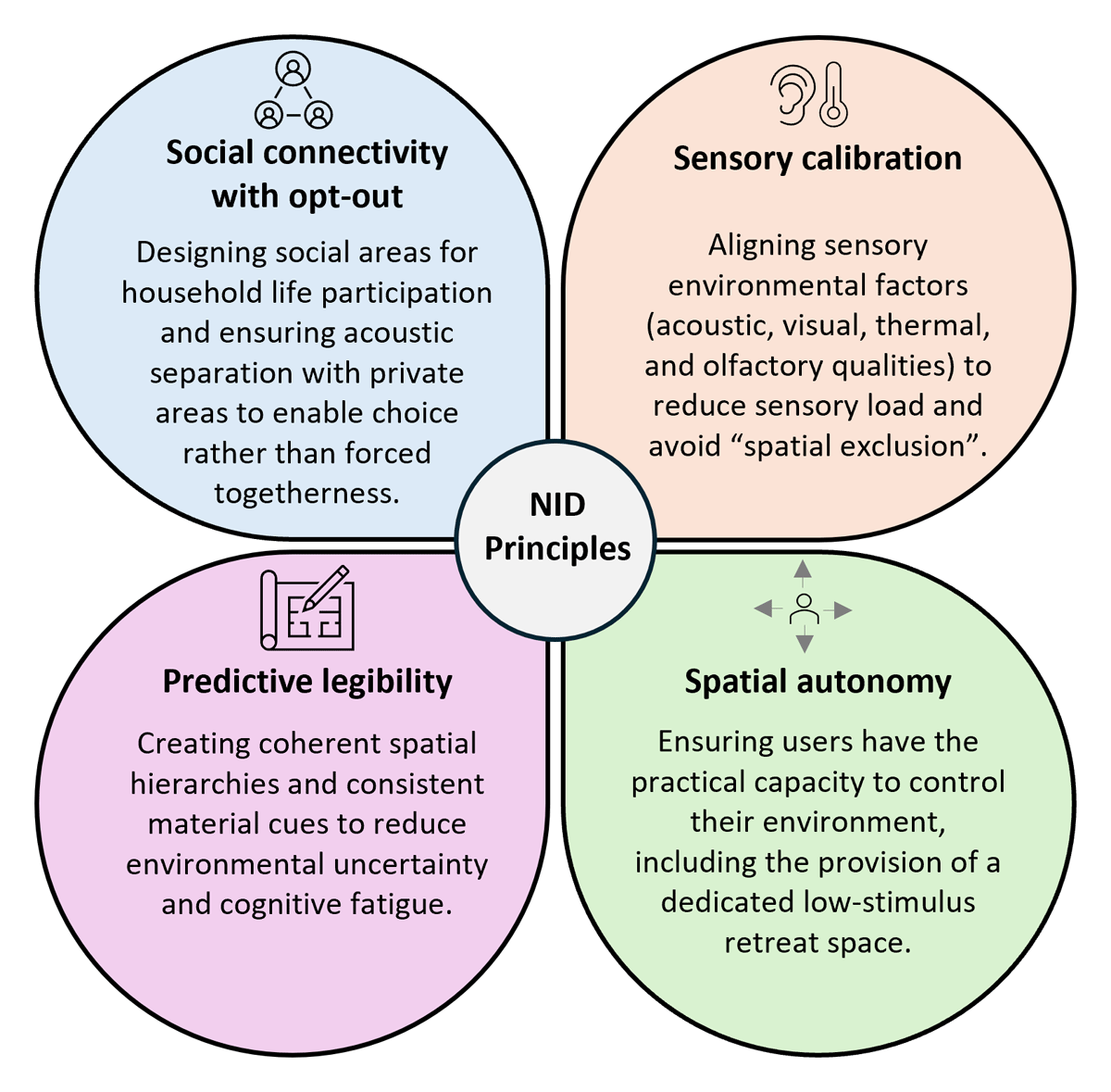
Figure 1
Neuro-inclusive design (NID) principles for residential architecture based on the reviewed literature.
A further contribution of this study is the conceptual positioning of NID within existing design traditions. NID does not replace universal design, inclusive design, or autism-focused architectural frameworks; rather, it builds upon and integrates elements of each. Universal design seeks to maximize accessibility across the widest possible population, while inclusive design emphasizes responsiveness to diverse users. Autism-oriented frameworks, such as ASPECTSS (Mostafa 2015), have contributed important insights regarding sensory needs in the built environment. NID extends these approaches by adopting a cross-neurodivergent perspective, explicitly foregrounding sensory accessibility, drawing upon disability-rights and neurodiversity paradigms, and emphasizing co-production and epistemic justice in the identification of design priorities. Unlike approaches centered on a single diagnostic group, NID considers variation in sensory processing, attention, executive functioning, emotional regulation, and environmental predictability across multiple neurotypes. In this sense, NID is best understood as a neurocognitive lens through which existing and emerging design strategies can be evaluated and refined. Its primary value lies in creating a conceptual bridge between evidence from neuroscience, neurodiversity research, disability studies, and housing design practice.
However, it is important to distinguish between evidence-supported findings and the framework proposed in this study. While the reviewed literature provides substantial evidence concerning relationships between environmental characteristics and sensory, cognitive, and emotional experiences, direct empirical validation of many housing-specific NID recommendations remains limited. Accordingly, the proposed principles should be interpreted as research-informed propositions derived from interdisciplinary evidence rather than as fully validated design standards. Future empirical studies are needed to evaluate the effectiveness, feasibility, and generalizability of these recommendations across different housing contexts.
Limitations
This study had several limitations. Most of the neuroimaging and experimental studies reviewed were undertaken in laboratory or simulated environments. While these studies provide valuable mechanistic insight, the absence of sustained residential ecological validation constrains the confidence with which precise numerical thresholds can be translated into housing design guidance. It is also important to note that translation of findings into the residential environment was not mentioned explicitly in the reviewed literature, meaning a certain level of assumptions were made. Furthermore, articles published after the completion of this literature review were not considered and, consequently, the selected articles do not necessarily mirror the actual prevalence but the academic research interests at the time of the review. Several studies were retained as they provided foundational evidence, but their findings were interpreted in relation to their historical and conceptual context.
Conclusions
By systematically synthesizing evidence across built environment, neurodiversity, and disability scholarship, this study provides the first critical examination of residential sensory accessibility as a matter of both housing design and human rights for NDP.
This study makes four interrelated contributions to existing knowledge. First, it argues that the impact of residential built environments on the daily lives, wellbeing, autonomy, and rights of NDP cannot be adequately understood through individual impairment or adaptation models alone. The evidence reviewed shows that residential environments can function as structurally disabling contexts when designed around neurotypical sensory assumptions, thereby constraining the realization of rights articulated within the UNCRPD. In doing so, this study reframes sensory accessibility as a housing and human rights issue rather than merely a matter of personal accommodation.
Second, the study reveals that existing evidence remains shaped by particular constructions of neurodiversity and unequal distributions of epistemic authority. Despite growing recognition of neurodiversity, much of the literature continues to privilege professional and clinical perspectives, while neurodivergent lived experience remains underrepresented in the production of knowledge. By systematically examining whose knowledge informs housing research and practice, this study extends debates within disability studies and neurodiversity scholarship into the residential built environment domain. The organization of research funding should change in line with UNCRPD Article 4.3 (UN n.d.) and long-standing arguments within EDR, where co-production should be required as a condition of publicly funded research on inclusive housing design. This involves resourcing NDP as primary investigators and decision-makers rather than limiting their participation to consultation (Nind 2014).
Third, the study identifies a persistent gap between evidence regarding sensory needs and its translation into housing design, standards, procurement processes, and regulatory frameworks. The findings therefore move beyond documenting environmental barriers to highlight the institutional mechanisms through which sensory inaccessibility is reproduced across housing systems. This study argues that practitioners and policymakers should treat sensory accessibility as a positive and explicit duty.
Finally, the study introduces NID principles for residential architecture as a novel conceptual framework that integrates insights from neurodiversity, neuroscience, psychology, environmental design, and disability rights scholarship. The contribution of NID lies in providing the first coherent framework that links sensory accessibility, neurocognitive diversity, and housing design within a rights-based perspective. By synthesizing fragmented evidence and translating it into a set of design principles, NID offers a conceptual bridge between research and practice, creating a foundation for future empirical testing, policy development, and the design of more equitable residential environments.
Additional Files
The additional files for this article can be found as follows:
Supplementary File 1 Appendix
Appraisal strategy and thematic analysis. DOI: https://doi.org/10.16993/sjdr.1540.s1
Supplementary File 2 Appendix
Studies and data extraction. DOI: https://doi.org/10.16993/sjdr.1540.s2
Data Accessibility Statement
The authors confirm that data sharing is not applicable to this article as no new data were created or analyzed in this study.
Ethics and Consent
This study is a secondary analysis of published literature. No primary data involving human participants were collected, and no ethics committee approval was required.
Acknowledgements
The author(s) acknowledge that meaningful co-production should not be understood as requiring public disclosure of neurodivergent identities. Participation in knowledge production can take multiple forms, and we should avoid creating expectations that individuals disclose diagnostic information in order to contribute their lived-experience expertise. Multiple forms of participation and expertise should be respected.