
1 Introduction
While recent research has begun to explore humour and smiling within atypical communication interactions, particularly between children with disabilities and their communication partners, this remains an emerging area of inquiry. Given humor’s dual role —both as a developmental resource that supports learning, agency, and social participation, and as an analytical lens for examining cognition, affect, and social intent—this gap is striking. Humour and smiling are fundamentally social events that offer insight into the relational, emotional, cognitive, and cultural skills of children with disabilities (Reddy, Williams and Vaughan 2002). This article adopts an autoethnographic approach and draws on my family’s lived experience, mine as a parent and that of my son, Matthew, who had Cerebral Palsy (CP). Matthew communicated via the Pragmatic Organisation Dynamic Display (PODD) language system developed by the Cerebral Palsy Education Centre (CPEC) in Melbourne and helped shape my understanding of how disability is linguistically and socially created in everyday life. His interactions revealed how people with disabilities live their lives, how others view them, and how these perceptions shape family life. Matthew passed away in 2015 at the age of 13, after a life marked by curiosity, cheerfulness, and courage. Autoethnography provides me with access to information often unavailable through traditional research methods, particularly embodied, affective, and interactional dimensions of communication, whilst ELAN software enables detailed multimodal video analysis of the quantitative components of communication. As Snyder (2015) argues, combining self-narrative with detailed analysis of naturalistic interaction allows disability research to be written more sensitively and responsibly. This approach contributes to recent research in understanding aided communication among children with complex communication needs (CCN), particularly in relation to humour and smiling.
Disability literature has increasingly critiqued what Shuster and Westbrook (2024) describe as a persistent ‘joy deficit’ in disability narratives, whereby disabled lives are framed primarily through suffering, lack, or tragedy. Such narratives leave little space for pleasure, creativity, and everyday connection as socially produced experiences. Ginsburg and Rapp’s (2013) concept of ‘disability kinship’ reframes disability as a world-making process embedded in dense networks of relationships, care, humour and shared communicative practices. From this perspective, joy is collective and ordinary rather than exceptional or inspirational. Dokumaci’s (2023) notion of people as affordances further illuminates how communication and participation are co-produced within interactional environments. Access, agency, and affective connection are achieved not through individual capacity alone, but through coordinated communicative practices. This perspective challenges dominant ableist narratives by highlighting new ways of understanding human differences (Ginsburg and Rapp 2013), echoing Sunderland, Catalano and Kendall’s (2009) argument that disability discourse must address the systematic absence of joy and happiness. Within AAC interactions, communication partners function as co-constitutive affordances, anticipating turns, interpreting intent, and adjusting pacing, modality, and attention. This relational view aligns with Kasnitz and Block’s (2012) argument that shifting analytic focus away from individual impairment and toward social and cultural contexts enhances agency for the most marginalised, particularly those with communication impairments.
Research grounded in lived experience reinforces the importance of centring joy within disability relationships. Studies by Green (2002), Doak (2018), Thomas (2025), and Ryan (2025) demonstrate that humour is collaboratively produced through interaction rather than residing solely within individual affect. Recent AAC research has begun to recognise humour and other subtle interactional practices as essential rather than peripheral aspects of communication. Weinberg, Kadoma et al. (2025) argue that humour is central to relationship building, identity, and social participation, yet remain poorly supported by current AAC systems because successful humour depends on conversational timing. Similarly, Weinberg, O’Connor et al. (2025) demonstrate that AAC interaction relies on distinctive ‘micro-culture’ in which backchannel behaviour, including smiles, acknowledgement, and partner adaptation, are collaboratively produced to sustain conversational flow. Together, these studies explicitly identify humour and backchanneling as an insufficiently documented field of AAC research. In this context, attending to the interactional processes underlying the events that elicit smiles and humour during Matthew’s PODD exchanges, offers a way to access silenced discourses of joy and challenge deficit-based frameworks that overlook the richness, creativity, and relational depth of disabled lives.
1.1 Matthew and PODD
Matthew was born in 2001 as second twin to a brother. Following a severe perinatal hypoxic brain injury, he was diagnosed with spastic quadriplegic CP and classified as GMFCS level V.1 Matthew was non-ambulatory, fully dependant on others for care, and experienced significant medical challenges throughout his life including epilepsy, feeding difficulties, and cerebral vision impairment (CVI). Early medical prognoses were pessimistic, and our family initially received deficit-focused guidance that emphasised limitation rather than possibilities. Despite these challenges, Matthew was a socially engaged and joyful child with a strong capacity for connection. From early infancy, he expressed affective intentionality through smiling and laughter, which became central to his social world. His life serves as an example of how access to communicative opportunities, meaningful participation, and responsive relationships positively impact quality of life and agency.
A significant turning point occurred when Matthew began receiving multidisciplinary care at the Royal Children’s Hospital in Melbourne and early intervention at CPEC, where participation in meaningful life activities was prioritised. At the age of two he was introduced to aided AAC through a PODD communication book. PODD was developed at CPEC to support autonomous communication by incorporating the flexibility to construct messages according to a user’s needs and preferences (Supplementary Appendix A provides more information on aided communication and PODD development).
Through early aided language stimulation, consistent modelling, and sustained physical therapy, Matthew learnt to monitor his body to develop movements for communication. His progress aligns with evidence that early AAC introduction supports communicative competence, agency, and social participation, while reducing passivity (Light and Drager 2007, Branson and Demchak 2009, Midtlin et al. 2015). Although constrained by the vocabulary available within his PODD system, the communication book was individually customised to his motor, sensory, cognitive, and communicative strengths and accessed through partner-assisted visual scanning (PAVS). This personalised system enabled Matthew to initiate communication, construct multi-step messages, and communicate across a wide range of pragmatic functions despite his severe physical impairments. His communication was inherently multimodal, combining PODD with facial expressions, vocalisations, eye gaze, and body movement.
The accounts and descriptions of the processes for learning and using the PODD communication book in this article are based on the guidelines established for a child with multiple impairments as per the GMFCS V classification (i.e., PODD is a low-tech book with fewer symbols per page, formulated on the PAVS access method). Figure 1 demonstrates the master navigational index page with pragmatic conversation starters of Matthew’s PODD book. For additional information about Matthew’s PODD and communicative behaviours, see Supplementary Appendix B.
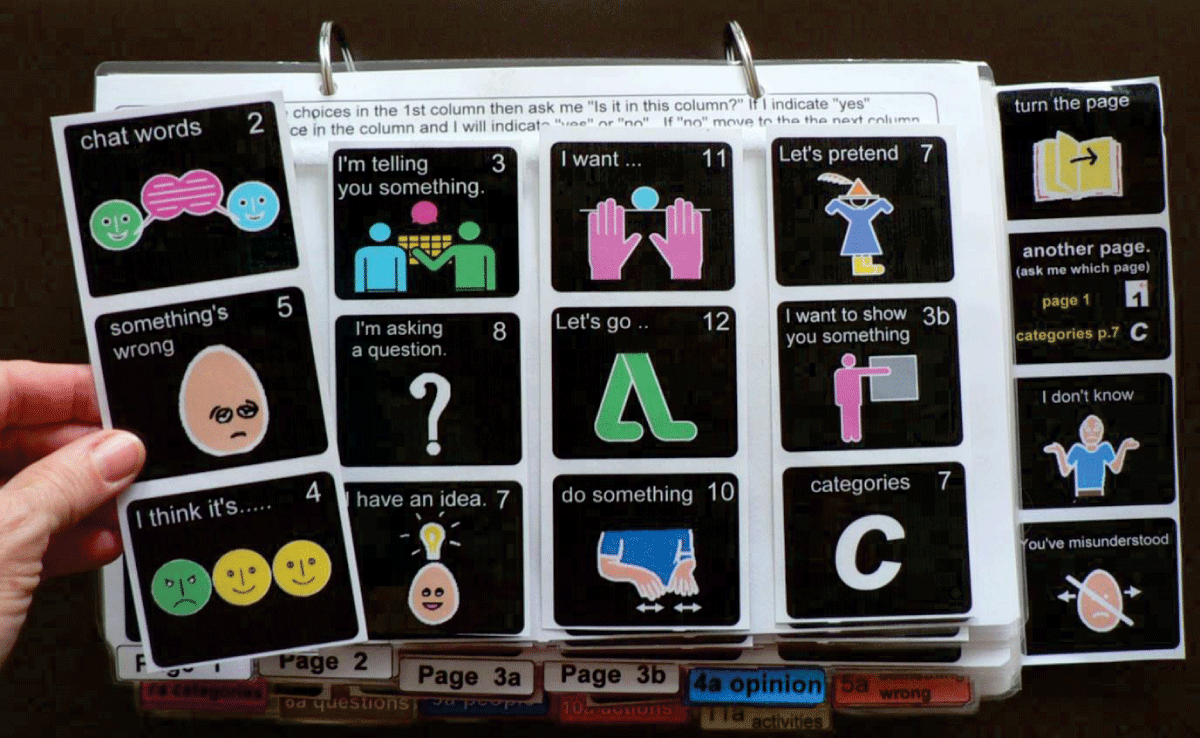
Figure 1
Main navigation index of Matthew’s PODD book.
PODD communication prioritises effective interaction rather than the formulation of a ‘perfect’ message (Porter 2017). Meaning-making is understood as collaborative and multimodal. By treating all behaviour as intentional and allowing Matthew to control the pace and structure of interaction, communication partners enabled him to express preferences, complaints, stories, and social intent. Adaptations for CVI, such as high contrast symbols, reduced visual load, and verbal scanning of symbols by his partners capitalised on Matthew’s auditory strengths (Burkhart and Porter 2006, Chokron and Dutton 2023). His capacity to build interpersonal relationships highlights how responsive partners, appropriate AAC strategies, and respect for personal strengths facilitate the co-construction of communicative competence (Light and McNaughton 2012, Beukelman 2013). Matthew’s experience challenges deficit-based assumptions about pre-intentional communicators and underscores the importance of individualised AAC systems that support autonomy and participation.
1.2 Humour and smiling in the context of disability
Previous research on humour in the context of disability has focused primarily on children with Down syndrome and autism. James and Tager-Flusberg (1994) found that children with autism produced less humour overall and fewer incongruity-based humour acts than children with Down syndrome, suggesting that social communication differences shape humour production. Similarly, Reddy, Williams and Vaughan (2002) found that while overall laughter frequency was comparable, children with autism engaged less in shared humour, such as attempts to join in laughter or re-elicit laughter through clowning and teasing. They displayed more unshared laughter, or laughter not oriented to a communication partner, highlighting divergent social use of humour in autism versus other developmental profiles. Further research suggests that humour processing in autism may be content dependent and linked to social motivation and pragmatic challenges, particularly with non-literal humour (Reddy and Mireault 2015). In children with intellectual disability (ID), Degabriele and Walsh (2010) found a preference for physical and visual humour, with comprehension enhanced through gesture and multimodal support. A systematic review by Chadwick and Platt (2018) highlights humour’s role in social interaction and stigma reduction, while noting the scarcity of research examining humour in everyday contexts.
Humour has also been examined in non-speaking modalities. Willoughby et al. (2019) describe humour in tactile sign language interactions as collaboratively constructed through smiles and laughter, often involving incongruity. Participants actively framed utterances as humorous and invited communicative partners to engage in shared laughter. Research involving children with severe disabilities demonstrate that humour does not require high cognitive functioning. Brigg, Schuitema and Vorhaus (2016) show that when interactions are responsive and supportive, children with severe disabilities can engage in complex, intentional humour, expressing playfulness and personality through smiling and laughter. Together, these findings demonstrate that humour is present across disability contexts, though its expression may not conform to normative expectations.
This article expands disability scholarship by foregrounding humour and smiling within the everyday, multimodal practice of AAC exchanges between a child with CCN and his partners. While existing studies demonstrate that humour is collaboratively produced and variably expressed across disability contexts, few have examined how humour emerges moment-by-moment with systems such as PODD, or how communicative partners function as co-constitutive affordances in the production of joy. By drawing on in-depth analysis of naturalistic interaction, this research makes visible the subtle timing, anticipation, embodied attunement, and relational work that goes into creating humour in AAC.
2 Methodology
2.1 Context and data
To investigate the use of humour in facilitating communication during PODD interactions, the research design in the present study combines two approaches: a multimodal analysis of naturalistic video data showing PODD interaction, which is supplemented by a self-reflective narrative. This approach allows a distinctive perspective on aided communication to be presented by combining what can be regarded as an ‘objective’ analysis of video recorded communicative events (the ELAN2 analysis of observable features) with an autoethnographic commentary that draws on my memories of communicating with Matthew and of observing his communication with others. The analysis focuses on naturalistic video recordings of Matthew’s PODD interactions alongside reflective narrative grounded in my lived experience as his close communication partner. This dual approach enables the integration of detailed observation of communicative behaviour with contextual and experiential insight that cannot be fully captured through video data alone.
Approval for this study was granted by the Ethics Committee at Monash University in early 2020. The original study design involved prospective recruitment of families from CPEC; however, it was amended to an autoethnographic design due to the COVID-19 pandemic. Consent was obtained for the use of archived CPEC video recordings (captured by CPEC staff and utilised in a prior CPEC research project) and digitised personal family video footage for research purposes. The final dataset comprises 16 recordings of Matthew’s PODD interactions, which cover all existing recordings of Matthew’s PODD use. Recordings of extended exchanges that took place without the PODD present were excluded from this corpus. The recordings were made between December 2004 and February 2007, when Matthew was aged between 3 years and 1 month and 5 years and 3 months. They total over 2 hours of footage and represent a range of interactional contexts, physical settings, and a variety of communication partners and support persons including therapists and family members. For a more in-depth description of all recordings featured in the corpus, refer to Velegrinis (2026).
Analytically, the study adopts a hybridised framework informed by Conversation Analysis (CA) principles, Ethnography of Communication (EOC), and multimodal analysis, following Doak’s (2019) work on AAC interactions. This approach enables examination of how Matthew and his communication partners collaboratively achieve interactional goals through coordinated use of multiple communication modes. CA contributes a sequential and interactional focus, highlighting how turns are organised and meaning emerges moment by moment. The PODD exchanges are transcribed following conventions developed specifically for PODD by CPEC combined with the basic principles of embodied CA (Goodwin 2000, Mondada 2019) (see, Supplementary Appendix C). Multimodal analysis foregrounds the role of embodied, material, and affective resources, while EOC situates PODD exchanges within broader social, cultural, and relational contexts.
Ethnography further provides a means of illustrating how living with CP and CCN is culturally constructed through everyday practice, while also recognising how families develop their own communicative cultures. An autoethnographic perspective allows access to tacit knowledge derived from long-term relational engagement, such as sensitivity to Matthew’s affective state, preferences, and interactional rhythms. Together, these perspectives emphasise communication as socially situated, embodied, and co-constructed rather than as an individual skill located solely within the communicator. Combining fine-grained multimodal annotation with ethnographic contextualisation enables detailed microanalysis while maintaining attention to meaningful social context.
I write this article from the dual position as both Matthew’s mother and researcher. Throughout this study, I sought to hold these tensions in view, using systematic multimodal analysis to inform and discipline my interpretations. Rather than attempting to eliminate subjectivity, I treat it as a methodological resource that shapes the questions asked, the experiences observed, and the meanings revealed; however, I acknowledge the potential for confirmation bias in smile classification and sequence analysis. To support interpretive transparency, I offer a thorough account of Matthew’s communicative behaviour (Supplementary Appendix B), including those not visible on camera, the influence of his physical impairments, and related knowledge developed through years of communicating with PODD. This article therefore presents a contextual interpretation grounded in relational knowledge and disability kinship rather than a detached explanation of interaction.
2.2 Data annotation
Behavioural research consistently identifies smiling as one of the most universally recognised signs of positive affect and social approval (Bavelas and Chovil 1997, Messinger and Fogel 2007, Dunbar and Mehu 2008, Mireault et al. 2018). In this paper, Matthew’s smiles are treated as salient communicative resources and interpreted as indicators of his levels of comfort, engagement, and willingness to engage in exchanges. While acknowledging that affective expression is complex and context-dependent, the presence, form, and timing of Matthew’s smiles are used as analytical entry points into understanding how humour and positive affect function within his PODD exchanges.
All video data were imported into ELAN (Wittenburg et al. 2006), a specialised software tool for multimodal audio-visual analysis. ELAN enables time-aligned, frame-by-frame annotation across multiple tiers, supporting detailed examination of verbal, non-verbal, embodied, and material aspects of communication. An embodied approach to transcription was adopted, consistent with previous AAC research that foregrounds the interactional relevance of gaze, posture, facial expression, and movement (Bloch et al. 2001, Wilkinson 2013, Korkiakangas and Rae 2014).
All recordings were annotated according to principles outlined by Doak (2018), ensuring that transcription captured the sequential unfolding of interaction, the coordination of multiple communicative modes, and behaviours relevant to communicative competence and agency. Descriptive commentary and categorical coding were included across tiers to support interpretive analysis. To facilitate systematic comparison, extensive metadata were embedded within file naming conventions, including Matthew’s age, communication partner, physical position, and recording location. This enabled analysis of how contextual variables such as partner familiarity, posture, and environment influenced engagement, affect, and meaning-making.
All recordings were systematically coded for smiles following findings from a pilot study. Smiles were treated as independent, intentional communicative acts and analysed in terms of both form and function. Smile classification drew on established literature (Messinger and Fogel 2007, Lancioni et al. 2011) and included four categories: Duchenne smiles (DS) were high-intensity smiles involving both mouth and eye contraction and are commonly associated with intense positive affect and resistance to voluntary control (Dunbar and Mehu 2008). These smiles are perceived more positively by communication partners and contribute to relational bonding (Johnston et al. 2010). Non-Duchene smiles (NDS) were lower intensity smiles with limited eye involvement. Simple smiles (SS) involved minimal lower-face movement and were interpreted as playing a regulatory role in social interaction, often functioning as opportunities for affiliation (Messinger and Fogel 2007). Mixed smiles (MS) represented transitions or combinations between these categories. Examples of each smile classification can be seen in Figure 2.
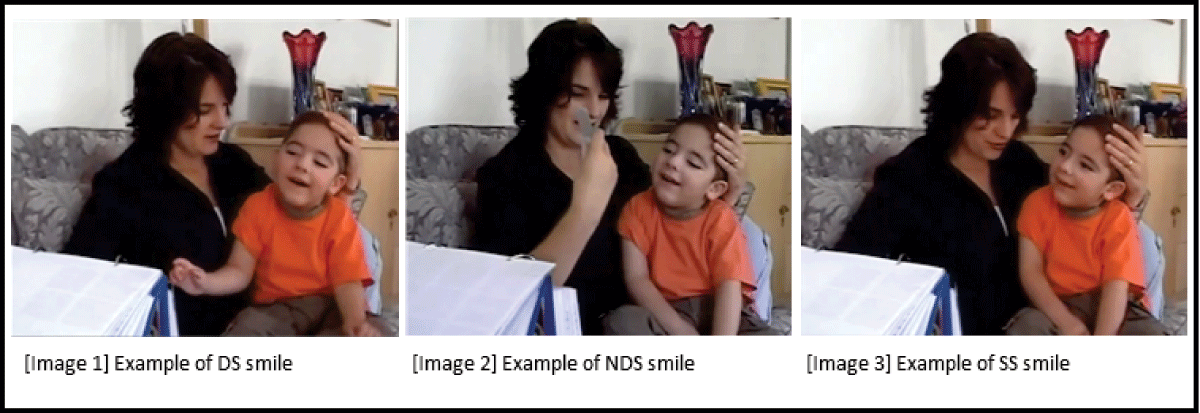
Figure 2
Matthew’s smile classifications.
Smiles were annotated frame by frame and time-aligned with a facial expression tier. The ability to distinguish between smile types is particulalry relevant in parent-child interactions, as parents develop heightened sensitivity to their children’s affective cues (Messinger et al. 2008). A search across the 16 recordings identified 163 tokens of smiles. Smiles were distributed across recordings in correlation with certain attributes, including settings, communication partners, and Matthew’s physical position during interactions. To enable comparison across scenarios a smile-per-minute rate was calculated across the duration of each recording. Whilst acknowledging limitations associated with pauses and silences during exchanges, this metric provided a useful comparative measure of affective engagement. Coding involved repeated viewing of each exchange and careful consideration of concurrent communicative modes, including vocalisations, eye gaze, head, and body movement. All annotations were self-reviewed multiple times to ensure consistency and accuracy.
This methodological approach enabled a nuanced examination of smiling as a meaningful communicative resource within PODD interactions rather than a by-product of affect alone. Here, I draw on detailed interactional analysis of two such scenarios from the corpus where Matthew’s frequent smiles correlate with his feelings of comfort, ease, and engagement. Matthew’s smiles appear to lead to more capacity for successful and/or pleasurable and satisfying communication exchanges by supporting his playful anticipation, signal readiness to continue the exchange, and mark moments as humorous. Matthew uses smiles alongside vocalisations and timing to shape the interaction, while partners respond by aligning with his affective stance. As a result, exploring the contextual and relational features that enable such interactions highlight the importance of responsive partners, affective attunement, and communicative environments that value joy as a legitimate and meaningful dimension of AAC interaction (Griffiths and Smith 2016).
3 Results: How and when Matthew smiles
Matthew is seen actively engaging in humorous interactions in the following qualitative analysis of scenarios that represent two of the corpus’s highest rates of smiles. Scenario 1, in which Matthew finds amusement in his partner’s inadvertent mistakes during a PODD exchange, has one of the highest numbers of smile tokens in the data set (23 tokens). With smiles occurring every 19 seconds, Scenario 2 has one of the highest overall smile frequencies in the data set and highlights Matthew’s playfully mischievous teasing of his communication partners.
3.1 Scenario 1: ‘What’s Daddy doing?’
This scenario showcases an interaction between Matthew and his father at CPEC. His father is attempting to use the PODD book to model a question-message as he would like Matthew to offer his opinion of the storybook they have been reading together. However, his father finds it difficult to formulate the question through the PODD pathways, which was something that Matthew was able to do effortlessly. Matthew observes his father as he flips back and forth through pages of the PODD book and finds this extremely amusing because he immediately realises that the page-flipping is an unmistakeable sign of his father’s confusion. Ten of the 23 total smile tokens take place within the first two minutes of this five-minute exchange indicating the intensity and exuberance of Matthew’s initial response (see Extract 1). The tokens are characterised by either standalone SS smiles or Mixed smile categories which all contain intense DS smiles accompanied by vocalisations. Matthew’s frequent smiles, while his father is trying to navigate the PODD, are an indication of his innocent teasing of his father. When Matthew draws connections between his father’s actions, he demonstrates his cognitive visual functioning and his awareness of his father’s difficulties.
Extract 1
Dad’s confusion (0:00:00–0:1:41, line 01–30).
| 01 Dad: | ((flicking to page 1)) |
| 02 Dad: | (0.3) Matthew, (2.1) Daddy’s ((I’M)) ASKING A ↑QUESTION. ((holding symbol)) |
| 03 Matthew: | ((smiles – SS)) |
| 04 Dad: | ((flicking pages)) Turn the page (9.6) |
| 05 Dad: | ((holding symbol)) you need to answer (0.6) YES OR NO |
| 06 Matthew: | ((smiles – SS)) |
| 07 Dad: | (14.2) ((flicking pages)) |
| 08 Matthew: | ((smiles – MS:DS-SS)) £vocalisation£ |
| 09 Dad: | ((selects column with DESCRIPTION symbol)) |
| 10 Matthew: | ((smiles – DS)) £vocalisation£ |
In lines 01–05, Matthew’s eye gaze is trained on the column his father holds out to him (Image A in Figure 3) as he begins the exchange by using the ‘I’m asking a question’ phrase. His father goes on to indicate the question will be in a ‘Yes/No Question ‘ form, e.g., a ‘Do you’, ‘Can you’, or ‘Are you’ question. Matthew’s small, courteous smiles in line 03 and line 06 round off each of his turns by functioning as a confirmation marker which demonstrate Matthew’s openness to, and understanding of, the progression of the conversation. In line 05, his father has selected the ‘Yes/No Question’ symbol, which is located on page 8a. The predictive text link (highlighted in the corner of the pictograph symbol) indicates that the partner should now progress by turning to page 8c; however, his father begins to flip the pages back towards the PODD conversation starters on page 1. In lines 08–10, after a long pause (14.2 seconds) and considerable page flipping back and forth by his father (line 07), Matthew, who has been quietly observing him (Image B in Figure 3), responds by smiling and vocalising (Image C in Figure 3).
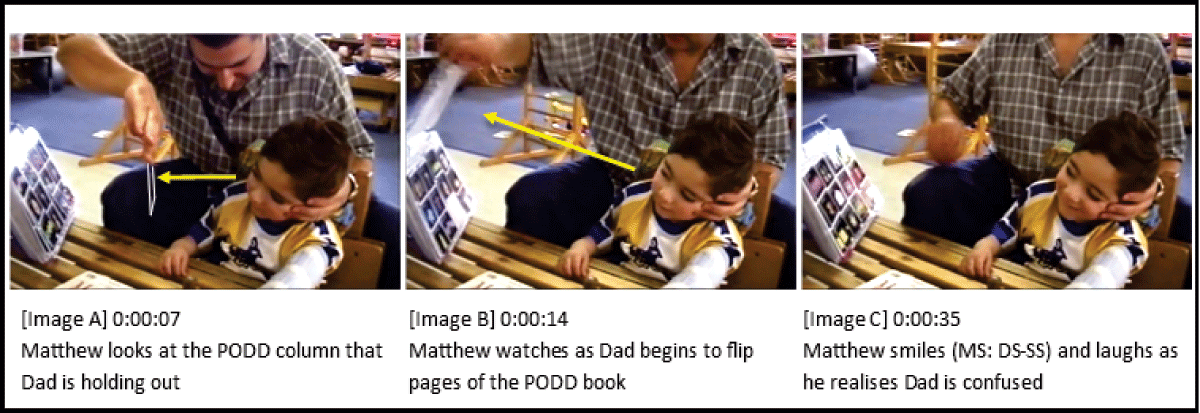
Figure 3
Matthew’s response behaviour to Dad’s confusion.
| 11 Dad: | I’m looking for (0.5) a DESCRIPTION |
|---|---|
| 12 Dad: | (18.4) ((flicking pages)) |
| 13 Matthew: | ((smiles – MS:SS-DS)) £vocalisation£ |
| 14 Matthew: | ((smiles – MS:NDS-SS-DS)) £vocalisation£ |
| 15 Dad: | ((flicking pages)) No I’m not (.) |
| 16 Dad: | [[to SP: I’m looking for a description of it (.) ((laughs))]] (2.8) |
| 17 Support Person: | No <probably LIKE or DON’T LIKE. <LIKE or DON’T LIKE (.) it’d be, I think. |
| 18 Dad | ((leaning close to Matthew)) I’m not after a DESCRIPTION of it at all ((shaking head at Matthew)) (0.8) ((laughs)) (0.5) |
| 19 Matthew: | ((smiles – MS:NDS-SS-DS)) £vocalisation£ |
| 20 Support Person: | ((quiet laugh)) £*Uh oh*£ ((louder laugh)) |
| 21 Dad: | £What’s Daddy doing?£ ((shaking head))(0.3) Okay (1.2) |
| 22 Dad: | So, (0.3) |
| 23 Support Person: | Or an opinion, <opinion it’d be |
| 24 Dad: | ((holding symbol)) I’M ASKING A QUESTION (6.8) |
| 25 Dad: | ((returns symbol to book, flicks pages to OPINION page)) |
| 26 Matthew: | ((smiles – MS:SS-DS)) £vocalisation£ |
| 27 Matthew: | ((smiles – MS:DS-DS-SS)) £vocalisation£ |
| 28 Dad: | ((not using PODD book)) Daddy wants to> (.) know what you thought of this book. (0.8) |
| 29 Dad: | ((holds up storybook)) Daddy wants to know (0.9) |
| 30 Matthew: | ((smiles – SS)) |
As a physical result of his intense amusement, Matthew begins to throw his head back as he laughs, and his father must re-position Matthew’s body which has de-stabilised from his sitting position. His father does not ignore Matthew’s vocalisation and physical movements, but neither does he attempt to engage in the interactional work of determining the meaning of his laughter while he is preoccupied with locating his target words. He goes back to flipping through the PODD pages. His father indicates to Matthew that he is looking for a ‘Description’ PODD word (line 11). After an even longer pause (18.4 seconds), while he continues to flip through the pages of the PODD book searching for a suitable descriptive word (line 12), Matthew’s smiles and laughter peak in lines 13 and 14. In response, his father acknowledges his confusion (line 15) and initiates a self-repair (line 16), to which he receives advice from the Support Person (filming the exchange) on the appropriate PODD options (line 17). Underscored by the humorous expression of alarm, ‘uh oh’, and the laughter of the Support Person, his father pokes fun at himself (lines 18–21). After another unsuccessful attempt to use the PODD book, and more sustained smiles and laughter from Matthew (lines 22–27), his father sets it aside and simply asks Matthew his question directly (lines 28–29). In response to his father’s question, ‘Daddy wants to know [Matthew’s opinion]’, Matthew rounds off this sequence with a tentative smile (line 30), and the exchange shifts into a more serious frame as he begins to formulate his response. The majority of the remaining smile tokens (8 of 13) occur as Matthew anticipates selecting his target PODD words. However, these smiles are less intense NDS or SS smiles and are largely unaccompanied by vocalisations.
Extract 1 above provides an example of how each of the participants contribute to the playful episode. It is notable that Matthew initially responds with the normative convention of a polite smile as his father attempts to use the PODD book. However, his subsequent impulsive laughter is taken up and developed as playful when his father modestly acknowledges his poor performance with the PODD. Moreover, the participants interpret the Support Person’s remark as humorous and a further marker of the episode’s cheerfulness, characterising his father’s unsuccessful PODD effort as funny. When his father recognises that Matthew is teasing him regarding his PODD ability by adopting a mocking stance, Matthew establishes himself as a participant with significant agency in the talk (Clarke and Wilkinson 2009). His father engages with Matthew by laughing along and builds on this teasing episode by jokingly asking him, ‘What’s Daddy doing?’ whilst shaking his head self-deprecatingly (line 21), signalling his interpretation of Matthew’s reaction as a sign of his good intentions and active engagement in his father’s efforts to utilise the PODD. Thus, Matthew’s smiles, vocalisations, and physical responses contribute to the interaction as active and consequential behaviour. The episode’s co-construction, in which all three participants recognise, appreciate, and share the same joke, fosters increased affiliation through mutual smiles and laughter. Together, these interactional achievements demonstrate that humour emerges not from Matthew alone but through the reciprocal action of participants. Consistent with this finding, the following scenario further reinforces the role of people as affordances, illustrating how communication partners actively create, recognise, and sustain opportunities for humour within interaction.
3.2 Scenario 2: ‘Are you playing games?’
In scenario 2, also filmed at CPEC, Matthew converses with me while seated in his wheelchair. After initiating an exchange (off camera and thus not included in the transcription), I begin the exchange by asking Matthew, ‘Is it [his target word] in this column?’. He initially smiles (DS) and laughs in response, and I caution Matthew to utilise his head gestures to respond. As his communication partner, my discretion, familiarity, and proficiency in interpreting and attributing intentionality to Matthew’s response movements are essential to support and enhance his communication skills and the effective use of his PODD. However, Matthew is unable to use his head in a functional manner due to his body positioning and response to physiological stimuli at the time (see Figure 4).
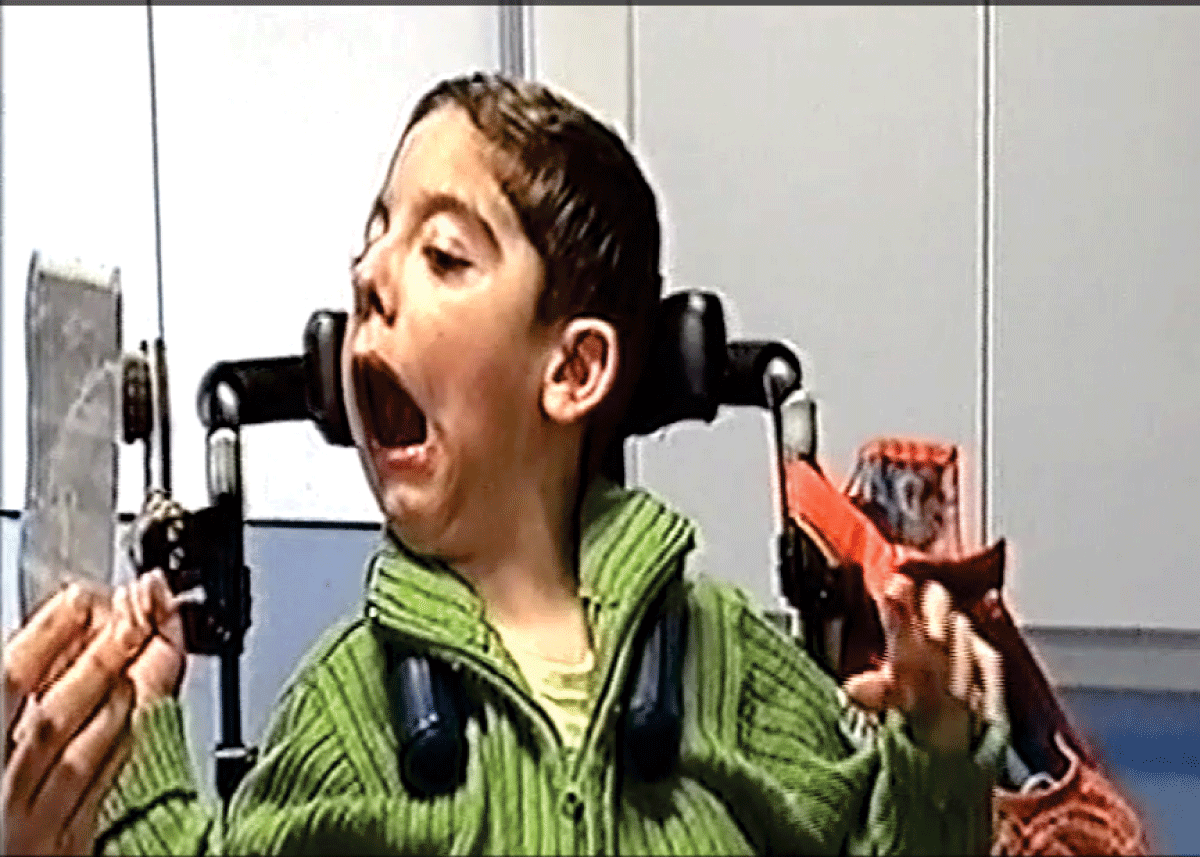
Figure 4
Matthew’s dystonic head position.
Due to the muscle spasms he is experiencing, he is flailing his arms, hands up, with both arms flexed at the elbows. His right fist is clenched tightly, and his left arm moves erratically and uncontrollably. He jerks his body backwards with momentum as a result of his physically heightened state. In this position, with his mouth open and his head turned to the right, he is unable to create or regulate any head response gestures. When Matthew is unable to use his head to gesture in a functional way, I interpret his posture and related vocalisations as a trouble-telling source and interrupt the exchange to caresses his chest and gently encourage him to breathe deeply, in an effort to soothe him and aid in the relaxation of his tense muscles.
To help Matthew stabilise his elbow joints and inhibit the involuntary pattern of arm movement, I reposition his right hand (which is closest to me) and the Support Person assists him to extend his left arm out in front of him with both hands holding a grasp bar. This gives Matthew better control of his head movements, and his posture becomes relaxed and settled (Figure 5). As I re-initiate the exchange by going back to column one of page one, Matthew listens attentively while he prepares to move his head. With careful and subtle movements, he is then able to execute head gestures that are easily interpreted, and the exchange continues (see Extract 2).
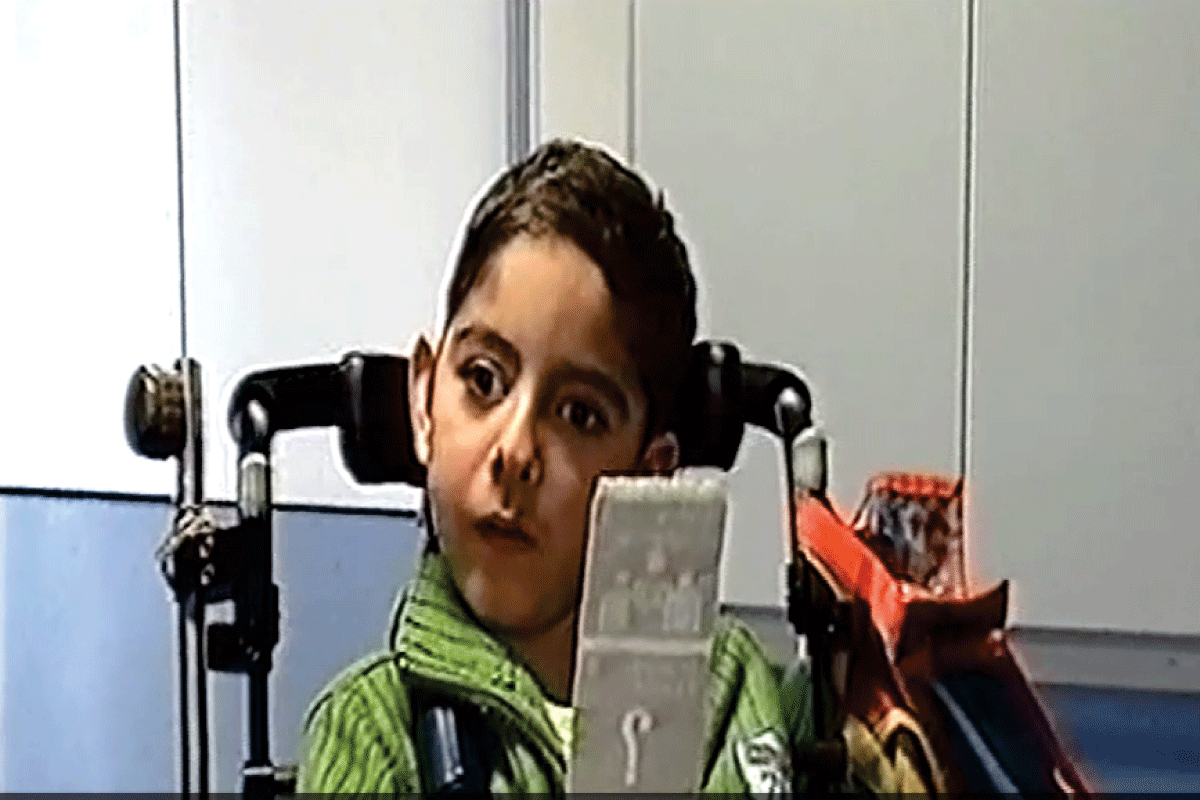
Figure 5
Matthew’s relaxed head position.
Extract 2
Matthew’s mischievous turn (0:02:22–00:04:14, lines 39–69).
| 39 Mum: | See how much better you’re talking (.) now that you’re keeping your arms still ((holds up column 2)) |
|---|---|
| 40 Mum: | Is it in column two, IT’S TIME TO/DAYS AND TIMES? |
| 41 Matthew: | ((smiles – DS)) £vocalisation£ .hhh |
| 42 Mum: | No (.) okay |
| 43 Mum: | [[( ) side to side]] ((verbally affirms head gesture)) |
| 44 Mum: | Is it in column three IT’S ON MY STEP COMMUNICATOR? ( ) no ( ) |
| 45 Matthew: | .hhh ((uses right arm, knocks column in Mum’s hand)) |
| 46 Mum: | Is it in column four REMEMBER/CATEGORIES. (3.2) Yes |
| 47 Mum: | You saying REMEMBER? (8.3) No |
| 48 Matthew: | ((smiles – SS))((releases grip of right hand, lifts arm)) |
| 49 Mum: | [[Hang on (you gotta keep your hand grasping)]] |
| 50 Mum: | ((grabs Matthew’s right hand, places it on grasp bar)) |
| 51 Matthew: | ((smiles – MS:NDS-SS)) |
| 52 Mum: | Don’t laugh, it’s not funny. |
| 53 Matthew: | ((smiles- SS)) |
| 54 Mum: | You saying CATEGORIES. (7.6) No |
| 55 Matthew: | .hhh ((smiles – SS)) |
In Extract 2, after re-positioning Matthew’s body, I praise him on his relaxed posture and the subsequent clarity of his responses and continue with the exchange (lines 39–42). Matthew responds by showing his pleasure with a DS smile and vocalisation. Because of the continued accuracy of his response gestures, as demonstrated by my verbal (‘side to side’) acknowledgement of Matthew’s well-executed rejection gesture (line 43), the exchange continues smoothly (lines 44–47). Matthew appears pleased and responds with another small smile (line 48). However, the interaction now shifts from a serious frame into a non-serious frame when Matthew begins to mischievously provoke his partners.
In line 48, after rejecting the symbol I am verbalising (‘remember’), Matthew gives a little smile and releases his grasp so that his right arm is flailing once more. I gently scold him as I reposition his hand on the grasp bar in front of him (lines 49–50), however, he escalates his smile in response (line 51). I lightly chastise him that the situation is ‘not funny’ (line 52). This does not deter Matthew from smiling in response (line 53). When I continue the exchange in line 54, I offer the remaining option in column four, ‘Categories’. However, Matthew rejects this option and proceeds to mischievously smile again (line 55). After previously responding ‘yes’ to column four, Matthew has now rejected both of the options in the column. At this point, the exchange appears to falter and will require cooperation from both partners to resolve.
| 56 Mum: | You said it was in column four Matthew. Is it in column four? (6.3) No? |
| 57 Matthew: | .hhh |
| 58 Matthew | ((Matthew releases right hand from grasp bar)) |
| 59 Mum: | [[Hey. ((takes Matthew’s right hand, assists him to grip grasp bar)) <*Hey hey hey hey*]] |
| 60 Matthew: | .hhh ((smiles – SS)) |
| 61 Mum: | You playing games with me? ((leans in closer)) *Hey* ((chuckles)) |
| 62 Matthew: | ((smiles – SS)) |
| 63 Mum: | You’re smilin |
| 64 Mum: | Are you playing games? Are you £trickin£ that you got somethin to say? ((chuckles)) (3.6) |
| 65 Matthew: | ((opens eyes wide and gestures ‘no’)) ((smiles – NDS)) |
| 66 Mum: | Yeah |
| 67 Support Person: | ((laughter)) |
| 68 Mum: | Yeah I think you are Mister |
| 69 Support Person: | Were you just> (.) were you making it up? |
I attempt to repair the miscommunication by clarifying Matthew’s previous response (line 56) and by bringing the symbols close to his field of vision. Matthew rejects the repetition by rotating his head to the left, snorting loudly, and releasing his hold with his right hand again (lines 57–58). In line 59, Matthew smiles in response to my repeated ‘hey’ interjection as I take his arm and re-position it on the grasp bar in front of him. Earlier, Matthew had actively contributed to the exchange by responding with gestures of both acceptance and rejection and had been praised for the precision and clarity of his movements while maintaining his body and arms in an appropriate position for communication. After repeated attempts to advance the conversation, I begin to question Matthew’s motivations as I note that he has now consistently rejected each of the offered options and released his hold of the grasp bar while smiling after doing so. Additionally, Matthew smiles in response to my attempts to reposition his grasping right hand (line 60) as he continues to deliberately release it (the Support Person is holding his left arm straight and he is unable to release this one).
In line 61, I come to the realisation that Matthew may deliberately be teasing us by refusing to cooperate and I lean in closer and accuse him wryly, ‘You playing games with me?’. Matthew’s answering smile (line 62) to my chuckle, serves to confirm my suspicion. In line 63, I acknowledge his playfulness by repeating my humorous accusation (line 64). The repeated accusation of game playing is followed by my laughter, marking what I am saying as humorous. At the point of potential tension in the exchange, I continue to laugh that Matthew may be ‘trickin’ that he has something to say as I collaborate with him in the non-serious turn. In line 65, Matthew appears to indicate surprise (eye widening) in response to my amusement and at being caught teasing me (there was a risk I would have responded unfavourably to the teasing). With a turn of his head to the right, he indicates a ‘no’ gesture, that he is not being deceptive and that he, in fact, does have something to say. However, as soon as he responds, he cannot help but smile broadly, explicitly marking his answer as false and intended as a joke. This is immediately followed by the laughter of the Support Person and my agreement marker ‘Yeah’ (lines 66–68) where the Support Person questions Matthew whether he was pretending to have something to say (line 69). Throughout this extract, Matthew has been actively marking his deliberate mischief through the sequencing of his smiles, laughter, and rebellious behaviour.
4 Discussion
Overall, the findings in Matthew’s data suggest that he smiles more when he is relaxed and at ease with a familiar partner, highlighting the relational condition under which his communicative strengths are most fully realised. Previous research has focused on the over-dominant role of speaking participants in exchanges with children who have communication impairments, often resulting in children’s passivity due to insensitivity to their communication styles (Light et al. 1985, McConachie 1999). However, consistent with Clarke and Wilkinson (2009) and Brigg, Schuitema and Vorhaus (2016), Matthew is far from passive. His interactions emerge within relationships of disability kinship, where familiarity, emotional attunement, and mutual responsiveness foster communicative joy. Within these relational spaces, Matthew frequently engages in episodes of humorous play and laughter, actively shaping the interactions rather than merely responding to it.
Matthew’s sequencing of communicative resources (such as smiling, laughing, and other non-verbal behaviour patterns) along with his orientation to playful interactional frames, demonstrates active alignment with his communication partners’ talk. These resources depend on partners functioning as social and physical affordances whose sensitivity and responsiveness enable particular forms of action and affect to emerge. By engaging and disengaging from humorous interactions, Matthew shows emotional sensitivity to unfolding exchanges and the ability to participate fully in playful episodes, including teasing partners from a position of good-natured superiority.
Teasing is a fundamentally relational discourse requiring partners who recognise humour rather than offense (Reddy and Mireault 2015, Colle et al. 2023). While such exchanges involve interactional risk, successful teasing contributes to relational closeness and shared enjoyment, as observed in Matthew’s interactions. From a disability kinship perspective, these playful risks are practices through which trust and mutual recognition are produced. Notably, the degree to which children tease their parents, particularly in relation to children with CCN, remains underexplored in language acquisition research.
Although children with atypical patterns of development may not always find the same qualities and situations amusing, Matthew’s ability to elicit affective response through teasing demonstrates highly developed social cognitive competencies. Consistent with findings from Willoughby et al. (2019), Matthew both responds to and initiates humorous interactional frames. Through carefully placed smiles and laughter, he presents himself as a competent and capable contributor with clear interactional agency. These opportunities are enabled by partners who treat his actions as meaningful, underscoring the relational nature of communicative agency. Matthew’s communicative practices indicate both his strong cognitive abilities and an orientation toward interpersonal collaboration. For Matthew, smiles constitute significant communicative capital, enabling the expression of agency, relational intent, and affective stance (Paterson 2013).
As the study’s conclusions are based on a single case of a child with CP who utilised PODD with a limited number of communication partners, they should be interpreted cautiously. To examine generalisability of these findings, future research should more carefully qualify implications for broader AAC practice by including participants with diverse disabilities, AAC access methods, partner experiences, and cultural backgrounds. Nonetheless, the study contributes to the growing body of research exploring aided AAC interaction between communication partners and children with severe disabilities.
5 Conclusion
In line with Garland-Thomson’s (2006) call for humanising research, this study contributes to scholarship foregrounding joy in disability relationships by centring smiles and humour as significant, agentive practices within everyday interaction (Ryan 2025, Thomas 2025). An examination of Matthew’s PODD exchanges demonstrates that smiling and teasing are not just peripheral expressions of affect but socially organised resources through which agency, relational intent, and cognitive competence are made visible. In this way, this study directly addresses the persistent ‘joy deficit’ in disability narratives by documenting joy as an ordinary, co-constructed achievement embedded in relationships of disability kinship.
Drawing on the concept of people as affordances, the findings show how humour emerges through coordinated, responsive partnerships in which communication partners scaffold, interpret, and align with embodied cues, enabling participation and playfulness to flourish. By expanding multimodal discourse analysis to foreground embodied, affective, and relational dimensions of AAC interaction, this study has the potential to inform partner training, interventional design, and PODD implementation, while highlighting the value of detailed interactional analysis for recognising communicative competence that might otherwise be overlooked. Ultimately, it reframes smiles and humour as distinctly human, socially binding practices that challenge deficit-based assumptions and acknowledges the diversity of lives of people with disability.
Additional File
The additional file for this article can be found as follows:
Notes
[1] The Gross Motor Function Classification System (GMFCS) is a 5-level classification that differentiates children with CP based on the child’s current gross motor abilities, limitations in gross motor function, and the need for assistive technology and wheeled mobility. GMFCS level V is the more severe category in that the child has mobility impairments in all areas of motor function.
[2] For further information on the Max Planck Institute’s ELAN software, see https://archive.mpi.nl/tla/elan.