
Introduction
In societies where digital technologies are increasingly shaping social participation and the delivery of public services, individuals with impairments encounter both opportunities and challenges (Dobransky and Hargittai 2016; Johansson et al. 2021). The Convention on the Rights of Persons with Disabilities (CRPD) mandates that member states provide accessible information and communication technologies (United Nations 2006). Advancements in technology offer many functionalities that open up ways to participate in society, but they can also create barriers and dependencies, particularly for older adults (Gilleard and Higgs 2008), people with impairments (Raja 2016), and older adults with impairments (Yang and Chen 2015). In order to better support older individuals with impairments to participate in an increasingly digitalising society, it is essential to form a deeper understanding of the positive and negative impacts of digitalisation in society on older individuals with impairments (WI) and without impairments (WOI). Due to the intersecting effects of ageing and impairment in the use of digital technologies, it is crucial to disentangle the intersecting factors of ageing and impairment with regard to digital participation (Gell et al. 2015; Yang and Chen 2015). It is also important to examine injustices and the potential accumulation of disadvantage in digital societies (Dannefer 2003). The concept of cumulative disadvantage describes the ‘systemic tendency for interindividual divergence in a given characteristic with the passage of time’ (Dannefer, 2003, S327) and highlights that structural realities can shape inequalities across the life course.
The present study builds on our initial work on the intersection of ageing and impairment in a digital society, which highlighted that, for older adults WI, digital participation is not a binary experience but rather a complex and dynamic process with underlying tensions (Reuter, Gustavsson, and Johansson 2026). With this study we were interested in further exploring differences between older adults WI and those WOI. The aim of this study was to explore to what extent older adults WI and WOI feel included in and participate in digital society by analysing data from a Swedish nationwide survey on digital participation. In this study we draw on the social model of disability, distinguishing between impairment, understood as a functional limitation of the body or mind, and disability, understood as a disadvantage created by a society that fails to accommodate for people with such impairments through accessible environments, attitudes, and institutional arrangements (Oliver 1990).
Digital participation and digital divides
As digital technologies are becoming deeply embedded in everyday life, the term digital society encapsulates the digital transformation of society, in which information and communication technologies are rapidly transforming human experience (Levin and Mamlok 2021). Digital participation refers to the active involvement of citizens in digital society by using the internet for social, political, or daily life activities (Seifert et al. 2019). The entanglement of digital technologies in societal structures can be experienced in many different, complex, and even contradictory ways (Dufva and Dufva 2019). Dufva and Dufva (2019) argue that even though knowing how to be and how to act in the digital world is becoming an increasingly necessary societal skill, many citizens find the concept of digitalisation and its consequences on society hard to grasp, due to the intertwining of the digital and the physical. Examples include disinformation, fake news, influenced elections, or hate speech on social media (van Dijck 2020), and many human experiences are mediated through structures connected to big data (Levin and Mamlok 2021). Indeed, the mechanisms that increasingly underpin the ecosystems of digital societies largely lack transparency for their users, often making it difficult to assess how algorithms influence social infrastructures (van Dijck 2020). Unlike the injustices driven by the technological side, digital divides describe the disparities that occur on the social side. The increasingly digitalising society does not provide equal opportunities to all individuals, which can cause inequalities and result in a gap between people who have adequate access to and use of digital technologies and those who do not, known as the digital divide (Lythreatis, Singh, and El-Kassar 2022). Accelerated by the COVID-19 pandemic, experiences of exclusion are exacerbated for those who are not well-connected to the internet (Pettersson et al. 2025; Lythreatis, Singh, and El-Kassar 2022). This gap in infrastructural access constitutes the ‘first-level digital divide’ (Scheerder, van Deursen, and van Dijk 2017). The ‘second-level digital divide’ encompasses the gap in digital skills and usage patterns (Scheerder, van Deursen, and van Dijk 2017). Beyond these two divides, a gap in individuals’ capacities to translate their internet access and use into beneficial offline outcomes has been labelled as the ‘third-level digital divide’. However, the majority of research focuses on the second-level digital divide (Scheerder, van Deursen, and van Dijk 2017) and little is known about how outcomes of internet use are linked to (dis)advantages (van Deursen and Helsper 2015). Research on the first- and second-level digital divides has identified different socio-economic or demographic indicators, such as income, age, gender, or education, which can lead to differences in internet access and use (van Deursen and Helsper 2015). It also suggests that access to and use of the internet have the potential to amplify existing inequalities beyond the intensity of internet use, thus making individuals with a higher social status more successful at achieving beneficial offline outcomes through digital engagement (van Deursen and Helsper 2015).
The digital divide at the intersection of age and disability
A literature review on digital divides conducted by Lythreatis et al. (2022) showed that, even though internet use in later life has increased in recent years, older age is strongly linked to the first- and second-level digital divides. This echoes other research, which highlights that older adults are less likely to use the internet compared to younger adults, and links a lack of involvement in digital society to new forms of social exclusion in later life (Seifert et al. 2019). Further research shows that older adults are a heterogeneous group of internet users (Hunsaker and Hargittai 2018), who choose to engage in different ways beyond the binary assumption of use or non-use (Gallistl et al. 2021). Similar to age, disability has been identified as a factor that results in a digital divide (Pettersson et al. 2023; Johansson, Gulliksen, and Gustavsson 2021; Pettersson et al. 2025). The so-called disability digital divide exists between people with impairments and those without, and it is often linked not only to access, but also accessibility (Sachdeva et al. 2015; Pettersson et al. 2023). However, not all types of impairment are equally disadvantaged (Dobransky and Hargittai 2016), and the disability digital divide can encompass divides in access to devices, divides in use related to gender, and divides in perceived inclusion in digital society (Johansson, Gulliksen, and Gustavsson 2021). Similar to research on age and digital engagement, research on the disability digital divide highlights the need to treat disability and digitalisation in a heterogeneous way (Johansson, Gulliksen, and Gustavsson 2021) and consider intersections with other inequalities (Dobransky and Hargittai 2016). Previous research has investigated the prevalence of technology use among older adults WI and WOI, showing that technology use decreases as the level of disabling impairment increases (Gell et al. 2015), and highlighted digital technologies such as voice assistants as a potential path to technology access for older adults WI and WOI who do not use computers (Schlomann et al. 2021).
Methods
Study design and procedures
This study had an explorative study design with a mixed-methods convergent approach (Creswell and Plano Clark 2017), using quantitative and qualitative survey data to gain insights into the extent to which older adults WI or WOI feel included in and participate in digital society. We used data from the cross-sectional survey ‘Swedes with impairment and the Internet 2023’ (SMFOI23). The survey was distributed nationwide in Sweden to people WI and to matched individuals WOI in the general population. Participants with self-reported impairments were recruited to the SMFOI23 survey between September and December 2023 by snowball sampling (Parker, Scott, and Geddes 2019). Snowball sampling involved distributing information about the survey nationwide via social media, disability organisation networks, and personal communication. Recipients were encouraged to share and further disseminate the survey. Impairment status was self-reported in the survey by a disability qualifying question phrased, ‘Which of these diagnoses, disabilities and difficulties do you have?’, followed by a multiple-choice list with 43 checkboxes of diagnoses and activity limitations and a free-text response option for reporting ‘Other impairment’ (Appendix 1). Subsequently, people WOI were invited to participate in the study between January and March 2024. For each participant WI, six individuals from the general population, matching in age, gender, and county of residence, were invited. Participants could take part in the survey in several ways: by responding online or on paper, by requesting a telephone interview, or by scheduling an appointment with a sign-language-speaking research assistant.
The study was approved by the Swedish Ethical Review Authority (Ref. No. 2023-03212-01, Decision date: 21 July 2023). After reading information about the survey, the participants provided informed consent prior to participation by ticking a box clarifying that by responding to the survey they also gave consent. Participation in the survey was anonymous. More information on the survey procedures is presented in previous publications (Pettersson et al. 2023; Johansson, Gulliksen, and Gustavsson 2021).
Data collection and analysis
For the present study, we used responses from the two oldest age groups in the SMFOI23 survey: aged 65–75 years, and ≥76 years. We analysed responses to the question in the SMFOI23 that captures whether participants feel included in digital society and their views on participation. The question is divided into two parts: first, there is a question with four fixed-response options followed by a free-text follow-up response option (Figure 1). In addition, responses to SMFOI23 questions regarding perceived difficulties using digital systems and services and participant characteristics were collected.
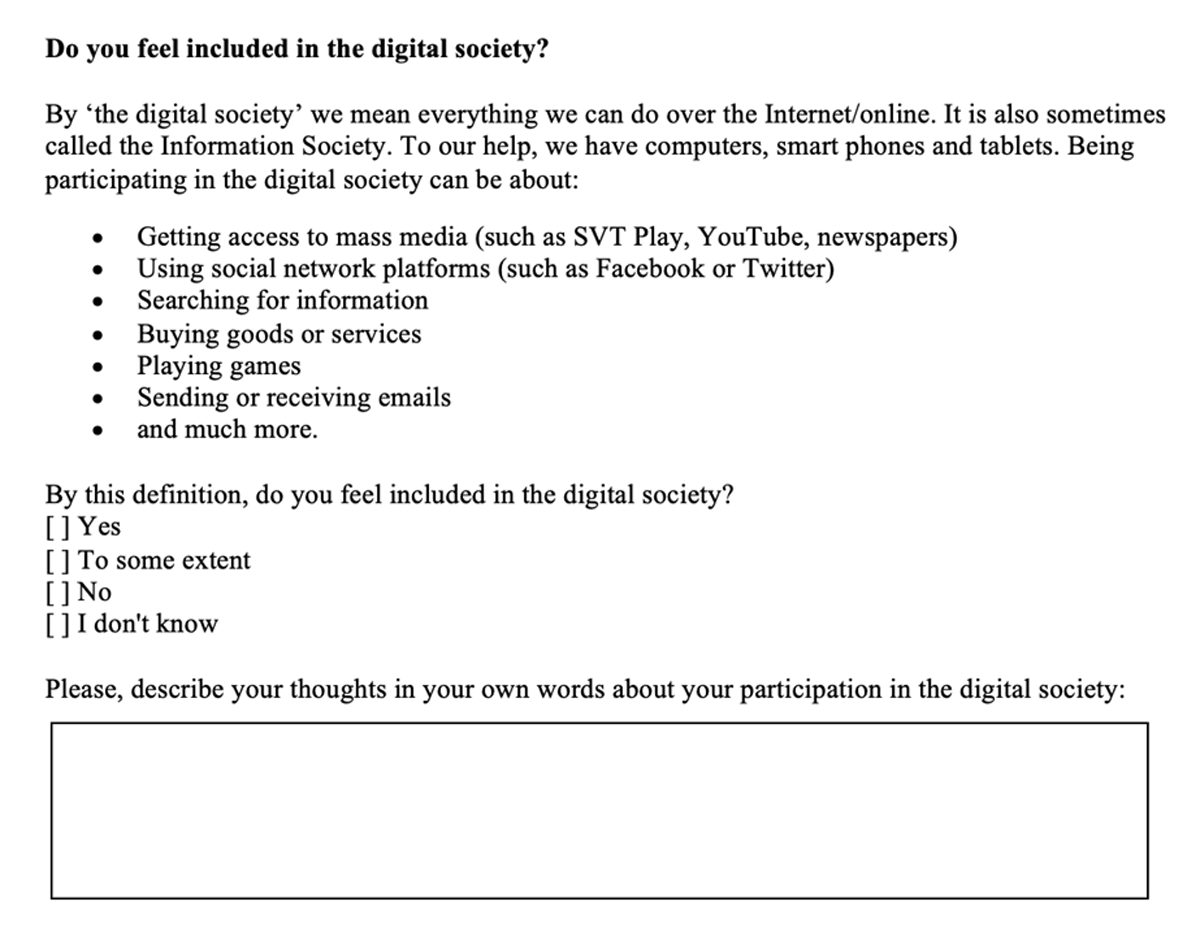
Figure 1
The SMFOI23 question on perceived inclusion and participation in digital society.
The fixed-response options to the question ‘do you feel included in the digital society’, as well as responses to questions regarding perceived difficulties in the use of the internet and data on participant characteristics, were analysed using descriptive statistics. Between-group differences were analysed using the chi-square test for categorial variables. For the question ‘do you feel included in the digital society’, the category option ‘I don’t know’ was excluded from the chi-square analysis. Univariable binary logistic regression analyses were conducted to examine the associations between the independent variables—age category (65–75 years vs. ≥76 years); impairment status (WOI vs. WI); and group allocation based on combining age category and impairment status (65–75 years/WOI (reference group); ≥76 years/WOI; 65–75 years/WI; and ≥76 years/WI)—and the dependent variable: inclusion in digital society. Multivariable binary logistic regression analyses were conducted to examine the association between group allocation and inclusion in digital society (independent variables), and reported difficulties in using the internet (dependent variables). A p-value ≤0.05 was accepted as statistically significant.
The free-text responses were analysed using qualitative reflexive thematic analysis (Braun and Clarke 2019). This emphasises a reflexive and context-sensitive analysis of data, where researcher subjectivity is considered a valuable resource in the meaning-making process (Braun and Clarke 2019). We used inductive coding to ensure a thorough understanding of the data. First, we coded the data collected from participants WOI inductively. Then, we coded the data from participants WI. The online platform Miro was used for the collaborative data coding process. All researchers took part in discussing the coding and developing the themes through a reflective iterative process until consensus was reached. The research team consisted of a female postdoctoral researcher in ageing and technology with extensive experience in qualitative methods; a male postdoctoral researcher in human–computer interaction with substantial qualitative research expertise; a postdoctoral researcher in public health and epidemiology with extensive experience in quantitative methods; and a female senior researcher in medical science with broad experience in both qualitative and quantitative methodologies.
We then used a mixed-methods convergent approach to integrate quantitative and qualitative data and generate themes that present the study findings. The quantitative findings identified statistical patterns related to perceived inclusion and participation in digital society and the qualitative data added the lived experiences behind these patterns.
Findings
Participant characteristics
Characteristics of the participants WI (n = 236) and WOI (n = 522) who were 65 years or older and who responded to the SMFOI23 survey are outlined in Table 1. A larger proportion of participants aged 65–75 years were women (WI = 62%, WOI = 61%) and a larger proportion of participants aged ≥76 years were men (WI and WOI = 58%). In the 65–75 age category, 50% of the participants WI had attended university compared to 45% of participants WOI. In the ≥76 years group, 46% of participants WI and 38% of participants WOI had attended university. The vast majority of participants reported having access to a smartphone (65–75 years 92% WI, 97% WOI; ≥76 years 84% WI, 91% WOI) and the proportions of those with a smartphone were larger among participants WOI as compared to participants WI (p = 0.001 65–75 years, p = 0.015 ≥76 years). There were no differences between the groups in terms of access to a computer (65–75 years 89% WI, 90% WOI; ≥76 years 86% WI, 90% WOI) or a tablet (65–75 years 70% WI, 63% WOI; ≥76 years 60% WI, 55% WOI). The proportion of participants that reported using the internet in the 65–75 age category was the same in both groups (98%). In the ≥76 years age category, a larger proportion of participants WOI (94%) than participants WI (88%) reported using the internet (p = 0.008).
Table 1
Descriptive characteristics of older participants in SMFOI23 with impairments (WI) (n = 441) and without impairments (WOI) (n = 883) by age categories and comparison between participants WI and WOI.
| WI 65–75 YEARS n = 236 | WOI 65–75 YEARS n = 522 | COMPARISON WI TO WOI BY AGE CATEGORY | WI ≥76 YEARS n = 205 | WOI ≥76 YEARS n = 361 | COMPARISON WI TO WOI BY AGE CATEGORY | |
|---|---|---|---|---|---|---|
| n(%) | n(%) | CHI2 | n(%) | n(%) | CHI2 | |
| Types of impairment | ||||||
| Language impairments | 34 (14) | 39 (19) | ||||
| Intellectual impairments | 16 (7) | 17 (8) | ||||
| Attention & memory | 51 (22) | 40 (20) | ||||
| Neurological & musculoskeletal | 96 (41) | 67 (33) | ||||
| Mental & emotional | 21 (9) | 19 (9) | ||||
| Blindness | 4 (2) | 5 (2) | ||||
| Visual impairments | 80 (34) | 102 (50) | ||||
| Deaf-blindness | 3 (1) | 1 (<1) | ||||
| Deafness | 21 (9) | 10 (5) | ||||
| Hearing impairments | 14 (6) | 15 (7) | ||||
| Other impairments | 30 (13) | 26 (13) | ||||
| Gender | n = 235a | n = 521a | p = 0.789 | n = 203a | n = 357a | p = 0.994 |
| Woman | 146 (62) | 317 (61) | 85 (42) | 149 (42) | ||
| Men | 88 (37) | 203 (39) | 117 (58) | 206 (58) | ||
| Other | 0 (0) | 0 (0) | 0 (0) | 0 (0) | ||
| I don’t want to answer | 1 (<1) | 1 (<1) | 1 (<1) | 2 (1) | ||
| Education (highest) | n = 236a | n = 518a | p = 0.048 | n = 203a | n = 358a | p = 0.134 |
| Compulsory school | 20 (8) | 50 (10) | 25 (12) | 53 (15) | ||
| Special education school | 4 (2) | 4 (1) | 2 (1) | 5 (1) | ||
| Upper secondary school | 54 (23) | 127 (24) | 39 (19) | 58 (16) | ||
| Vocational or Folk high school | 32 (14) | 100 (19) | 37 (18) | 84 (23) | ||
| University | 119 (50) | 233 (45) | 94 (46) | 135 (38) | ||
| Other/I don’t know | 7 (3) | 4 (1) | 6 (3) | 23 (6) | ||
| Monthly incomeb | n = 232a | n = 514a | p = 0.027 | n = 200a | n = 358a | p = 0.999 |
| Very low income | 3 (1) | 11 (2) | 3 (2) | 6 (2) | ||
| Low income | 38 (16) | 84 (16) | 25 (13) | 48 (13) | ||
| Lower-middle income | 89 (38) | 192 (37) | 88 (44) | 155 (43) | ||
| Higher-middle income | 58 (25) | 137 (27) | 48 (24) | 87 (24) | ||
| High income | 7 (3) | 41 (8) | 10 (5) | 17 (5) | ||
| I don’t want to answer | 37 (16) | 49 (10) | 26 (13) | 45 (13) | ||
| Cohabitant status | n = 234a | n = 521a | p = 0.001 | n = 199a | n = 358a | p = 0.124 |
| Living alone | 90 (38) | 140 (27) | 82 (41) | 124 (35) | ||
| Cohabiting | 144 (62) | 381 (73) | 117 (59) | 234 (65) | ||
| Support in daily life activities | n = 234a | n = 516a | p > 0.001 | n = 199a | n = 354a | p > 0.001 |
| Yes | 49 (21) | 6 (1) | 48 (24) | 21 (6) | ||
| No | 185 (79) | 510 (99) | 151 (76) | 333 (94) | ||
| Access to a smartphone | n = 230a | n = 517a | p = 0.001 | n = 196a | n = 348a | p = 0.015 |
| Yes | 212 (92) | 503 (97) | 165 (84) | 317 (91) | ||
| No | 18 (8) | 14 (3) | 31 (16) | 31 (9) | ||
| Access to a computer at home | n = 234a | n = 519a | p = 0.718 | n = 197a | n = 352a | p = 0.148 |
| Yes | 209 (89) | 468 (90) | 170 (86) | 318 (90) | ||
| No | 25 (11) | 51 (10) | 27 (14) | 34 (10) | ||
| Access to a tablet | n = 232a | n = 514a | p = 0.064 | n = 192a | n = 350a | p = 0.315 |
| Yes | 162 (70) | 323 (63) | 115 (60) | 194 (55) | ||
| No | 70 (30) | 191 (37) | 77 (40) | 156 (45) | ||
| Do you use the internet? | n = 236a | n = 522a | p = 0.565 | n = 205a | n = 361a | p = 0.008 |
| Yes | 231 (98) | 514 (98) | 181 (88) | 341 (94) | ||
| No | 5 (2) | 8 (2) | 24 (12) | 20 (6) | ||
| Do you usually ask someone for help to do things online? | n = 232a | n = 467a | p = 0.960 | n = 194a | n = 317a | p = 0.357 |
| Yes | 66 (28) | 132 (28) | 87 (45) | 129 (41) | ||
| No | 166 (72) | 335 (72) | 107 (55) | 188 (59) | ||
[i] a Number of participants responding to the question.
b Definition of income levels: Very low income = ≥9,999 Swedish Krona (SEK), Low income = 10,000–14,999 Swedish Krona (SEK), Lower-middle income = 15,000–24,999 Swedish Krona (SEK), Higher-middle income = 25,000–49,999 Swedish Krona (SEK), High income = ≥ 50,000 Swedish Krona (SEK).
Autonomy as a pillar of digital participation
In the 65–75 age category, 62% of participants WI (n = 143) and 67% of participants WOI (n = 346) reported feeling included in digital society (Table 2). A total of 32% (n = 73) of participants WI and 29% (n = 149) of participants WOI reported feeling included to some extent. A total of 6% (n = 13) of participants WI and 4% (n = 18) of participants WOI reported that they did not feel included in digital society. The chi-square test showed no difference between the participants WI and WOI. However, findings from the qualitative data showed that autonomy is an important aspect of digital participation. There was a difference in how participants aged 65–75 perceive their autonomy in digital society, depending on whether they have an impairment or not, shedding light on a potential second-level digital divide. Participants WI mainly voiced that they experienced autonomy through their participation in digital society: ‘Freedom. Without the internet, I would be dependent on others. When you are seriously ill, it means a lot to be able to take care of your life as much as possible without the involvement of anyone else’ (ID1455, WI, Age 65–75) and ‘It makes me independent, and I don’t need help’ (ID992, WI, Age 65–75). Other participants shared that they ‘keep in touch and search for activities. At my age, it can not always feel comfortable to participate physically’ (ID1561, WI, Age ≥76) and ‘I think I’ve become more involved, since I don’t have to use my hearing’ (ID863, WI, Age ≥76). All of these quotes highlight how digital tools can foster autonomy for older adults WI. The quotes reflect that taking part in digital society provides freedom and the ability to manage one’s own life, which is especially important for people WI, for whom maintaining autonomy is vital. In contrast, participants WOI in the 65–75 age category voiced a loss of autonomy, for example with regard to keeping up with changes: ‘It is constantly evolving and sometimes you do not keep up with all the changes’ (ID1095, WOI, Age 65–75). Additionally, a lack of autonomy was related to a lack of choice as to whether to be involved or not: ‘I think in Sweden we have become too digitalised, you have to do everything at the computer’ (ID1003, WOI, Age 65–75). Participants also reported the feeling that digital society is taking over like a drug: ‘I would like to be less dependent on the digital society (social media) because there is a lot that is addictive in an unpleasurable way’ (ID25, WOI, Age 65–75), and ‘Trying to have a lot of time without the digital society. It’s a drug’ (ID769, WOI, Age 65–75). As one participant summed up, ‘Participation is also about deciding for yourself what you want to have access to and use’ (ID693, WOI, Age 65–75).
Table 2
Results from the question with fixed-response options on feeling included in digital society by impairment status and age category and comparison between participants with impairments (WI) and without impairments (WOI).
| WI 65–75 YEARSN = 236 | WOI65–75 YEARSN = 522 | COMPARISON WI TO WOI BY AGE CATEGORY | WI ≥76 YEARSN = 205 | WOI≥76 YEARSN = 361 | COMPARISON WI TO WOIBY AGE CATEGORY | |
|---|---|---|---|---|---|---|
| n (%) | n (%) | CHI2 | n (%) | n (%) | CHI2 | |
| Do you feel included in the digital society? | n = 229a | n = 513a | p = 0.246 | n = 193a | n = 341a | p = 0.012 |
| Yes | 143 (62) | 346 (67) | 80 (41) | 176 (50) | ||
| To some extent | 73 (32) | 149 (29) | 87 (45) | 143 (42) | ||
| No | 13 (6) | 18 (4) | 26 (13) | 23 (7) |
[i] aNumber of participants responding to the question.
Taken together, these findings suggest that while overall feelings of digital inclusion may appear similar across groups, the underlying experiences concerning autonomy are qualitatively distinct, revealing how impairment can shape the value of digital participation and highlighting a fine line between freedom and pressures in a digital society.
Compounding vulnerabilities: Age, impairment, and structural exclusion
In the ≥76 years age category, a larger proportion of participants WOI reported feeling included in digital society (50%, n = 176) than participants WI (41%, n = 80) (p = 0.012) (see Table 2). Additionally, univariable binary logistic regression analyses (Table 3) showed that participants aged ≥76 years had a higher likelihood of not feeling included in digital society compared to those aged 65–75 years (OR = 2.11, 95%CI [1.68, 2.65], p < 0.01). Participants WI were more likely not to feel included in digital society compared to participants WOI (OR = 1.40, 95%CI [1.11, 1.77], p < 0.01). When grouping the participants by combining age category and impairment status, participants aged ≥76 years WOI were almost twice as likely not to feel included in digital society compared to the reference group aged 65–75 years WOI (OR = 1.95, 95%CI [1.48, 2.59], p < 0.01), suggesting that older age is associated with a higher risk of experiencing exclusion from digital society. Participants aged ≥76 WI were nearly three times as likely to not feel included in digital society (OR = 2.93, 95%CI [2.09, 4.13], p < 0.01) compared to the reference group, indicating that the intersection of older age and impairment greatly increases the likelihood of being excluded from digital society.
Table 3
Univariable binary logistic regression analyses examining the associations between age category, impairment status, and a group allocation combining age category and impairment status (independent variables) and feeling included in digital society (dependent variable).
| FEEL INCLUDED IN DIGITAL SOCIETY | DON’T FEEL INCLUDED IN DIGITAL SOCIETY | UNIVARIABLE LOGISTIC REGRESSION ANALYSES | |||
|---|---|---|---|---|---|
| n (%) | n (%) | OR | CI | P-VALUE | |
| Age categories | |||||
| 65–75 years | 489 (65.9) | 253 (34.1) | 1.00 | Ref. | |
| ≥76 years | 256 (47.8) | 279 (52.2) | 2.11 | 1.68–2.65 | <0.01 |
| Impairment status | |||||
| WOI | 522 (61.0) | 333 (39.0) | 1.00 | Ref. | |
| WI | 223 (52.8) | 199 (47.2) | 1.40 | 1.11–1.77 | <0.01 |
| Group allocation | |||||
| 65–75 years, WOI | 346 (67.5) | 167 (32.5) | 1.00 | Ref. | |
| ≥76 years, WOI | 176 (51.5) | 166 (48.5) | 1.95 | 1.48–2.59 | <0.01 |
| 65–75 years, WI | 143 (62.5) | 86 (37.5) | 1.25 | 0.90–1.72 | 0.19 |
| ≥76 years, WI | 80 (41.5) | 113 (58.5) | 2.93 | 2.09–4.13 | <0.01 |
[i] WI: with impairments, WOI: without impairments.
These patterns of compounding vulnerability with age and impairment are echoed in the qualitative findings, where participants WOI voiced concerns about the impact of digital society on others, i.e., people who are digitally excluded due to disabilities, financial resources, or a lack of support in acquiring digital skills:
It’s so vulnerable. We are more or less forced to use the internet in everyday life—as the alternatives disappear or become too expensive. In addition, I think that the dependence on the digital in Society is discriminatory against all those who cannot use it. For example, people with intellectual disabilities, and many others who find it difficult. (ID1015, WOI, Age ≥76)
I have both the equipment and the knowledge to be involved. But I often think about people who don’t have it and how difficult it must be for them. Thinking that we are creating a society that is becoming more and more vulnerable. (ID548, WOI, Age ≥76).
Both quotes highlight the concerns of becoming vulnerable due to inequalities. The first quote critiques the structural inequality brought on by a digitalising society, in which inclusion is tied to digital skills. The second quote conveys a reflection on privilege and reflects a fear of growing dependency on digital infrastructures.
These concerns of compounding vulnerabilities are reflected in the experiences of participants WI, one of whom shared that, ‘Development is so fast that by the time you, as a slow and poorer sighted person, have learned something, there is already something new’ (ID357, WI, Age ≥76), showing that the individual’s initial disadvantage through impairment (poorer eyesight and slower learning process) is compounded by the continuous evolution and inaccessible design of digital technologies, magnifying a second-level digital divide. Another participant WI wrote that, ‘It’s too complicated for me. It is not designed with an understanding of normal aging or cognitive disabilities, such as aphasia. I don’t feel included. I am left out and have to work hard to have control in the little contact with the digital society I have’ (ID1707, WI, Age 65–75). This illustrates how one form of exclusion, in this case the inaccessible design of digital technologies, results in further experiences of exclusion from digital society and having to put in extra effort compared to individuals WOI. Such qualitative accounts reflect the statistical findings and show that digital exclusion is not merely due to a lack of digital access. Instead, it is tied to broad and tangible systemic inequality and compounding vulnerabilities.
Exclusion by design
The issue of structural exclusion from participation in digital society becomes even more visible when looking at the participants’ perceived difficulties in using digital systems and services. Multivariable binary logistic regression analyses (Table 4) revealed that both age and impairment were associated with experiences of difficulty using the internet. Compared to the reference group (age 65–75 years, WOI), participants aged 65–75 years WI were more likely to report finding it difficult to search for information (OR = 4.09, 95%CI [1.63–11.10], p < 0.01) and experiencing difficulties due to how web content or web pages were designed (OR = 5.30, 95%CI [2.82–10.39], p < 0.01). Among participants aged ≥76 years WI, there was a higher likelihood of finding it difficult to search for information (OR = 5.17, 95%CI [2.14–13.83], p < 0.01), finding it difficult to navigate on the internet or to find the right web pages (OR = 2.09, 95%CI [1.25–3.48], p < 0.01), finding it difficult to use online services (OR = 2.04, 95%CI [1.21–3.45], p < 0.01), finding it difficult to handle passwords (OR = 1.80, 95%CI [1.11–2.88], p = 0.01), and experiencing difficulties with how web content or web pages were designed (OR = 4.44, 95%CI [2.29–8.88], p < 0.01).
Table 4
Multivariable binary logistic regression analyses (n = 1175) examining the association between groups based on combining age category and impairment status, and feeling included in digital society (independent variables), and perceived difficulties in the use of digital systems and services (dependent variables).
| GROUPS BY AGE CATEGORY AND IMPAIRMENT STATUS | FEELING INCLUDED IN DIGITAL SOCIETY | ||||||
|---|---|---|---|---|---|---|---|
| 65–75 YEARS, WOI | ≥76 YEARS, WOI | 65–75 YEARS, WI | ≥76 YEARS, WI | INCLUDED | NOT INCLUDED, OR INCLUDED TO SOME EXTENT | ||
| Find it difficult to search for information | n (%) | 7 (1.5) | 15 (4.8) | 13 (6.0) | 16 (9.4) | 12 (1.7) | 39 (8.3) |
| OR | 1.00 | 2.77 | 4.09 | 5.17 | 1.00 | 4.58 | |
| CI | Ref. | 1.14–7.37 | 1.63–11.10 | 2.14–13.83 | Ref. | 2.42–9.31 | |
| p-value | 0.03 | <0.01 | <0.01 | <0.01 | |||
| Find it difficult to navigate on the internet, or to find the right web pages | n (%) | 42 (8.8) | 47 (15.1) | 33 (15.3) | 38 (22.3) | 31 (4.4) | 129 (27.6) |
| OR | 1.00 | 1.43 | 1.79 | 2.09 | 1.00 | 7.85 | |
| CI | Ref. | 0.90–2.28 | 1.06–3.00 | 1.25–3.48 | Ref. | 5.24–12.10 | |
| p-value | 0.13 | 0.03 | <0.01 | <0.01 | |||
| Find it difficult to use online services (e.g. fill in forms or buy/order things) | n (%) | 41 (8.6) | 41 (13.1) | 20 (9.3) | 38 (22.3) | 17 (2.4) | 123 (26.3) |
| OR | 1.00 | 1.18 | 0.96 | 2.04 | 1.00 | 13.59 | |
| CI | Ref. | 0.72–1.92 | 0.52–1.72 | 1.21–3.45 | Ref. | 8.25–23.81 | |
| p-value | 0.51 | 0.89 | <0.01 | <0.01 | |||
| Find it difficult to understand the content on webpages | n (%) | 15 (3.1) | 26 (8.3) | 11 (5.1) | 14 (8.2) | 14 (2.0) | 52 (11.1) |
| OR | 1.00 | 2.25 | 1.53 | 1.95 | 1.00 | 5.65 | |
| CI | Ref. | 1.17–4.48 | 0.67–3.42 | 0.90–4.23 | Ref. | 3.16–10.77 | |
| p-value | 0.02 | 0.30 | 0.09 | <0.01 | |||
| Find it difficult to handle passwords | n (%) | 53 (11.1) | 74 (23.7) | 36 (16.7) | 39 (22.9) | 62 (8.8) | 140 (30.0) |
| OR | 1.00 | 2.13 | 1.53 | 1.80 | 1.00 | 4.14 | |
| CI | Ref. | 1.43–3.18 | 0.95–2.45 | 1.11–2.88 | Ref. | 2.98–5.80 | |
| p-value | <0.01 | 0.08 | 0.01 | <0.01 | |||
| Experience difficulties with how web content or web pages are designed | n (%) | 15 (3.1) | 20 (6.4) | 32 (14.9) | 27 (15.9) | 26 (3.7) | 68 (16.6) |
| OR | 1.00 | 1.73 | 5.30 | 4.44 | 1.00 | 4.20 | |
| CI | Ref. | 0.87–3.53 | 2.82–10.39 | 2.29–8.88 | Ref. | 2.63–6.91 | |
| p-value | 0.12 | <0.01 | <0.01 | <0.01 | |||
[i] WI: with impairments, WOI: without impairments.
Furthermore, not feeling included in digital society was associated with all reported difficulties in the use of the internet (Table 4). Participants who did not feel included or felt only partially included in digital society were more likely to report difficulties compared to the reference group. These results suggest that not feeling included in digital society is strongly associated with a broad range of difficulties in the use of digital spaces and that inaccessible digital design contributes to difficulties for older adults WI and WOI in participating fully in digital society.
Additionally, the qualitative data highlight common individual fears about partaking in digital society: ‘I feel I am very careful and vigilant. It is a lot of that to deceive older people. I shut down and block and ask my grandchildren’ (ID1286, WI, Age ≥76); false information: ‘you always have to be suspicious, and it doesn’t feel safe and good at all’ (ID1225, WI, Age ≥76); privacy concerns: ‘I am reluctant to use social media because I lack experience, knowledge and am reluctant to give out private information’ (ID293, WOI, Age 65–75); and harassment and hate speech: ‘it is good to be able to be involved, but a little too easy to hide if you want to be anonymous. A little too easy to bully others and almost be able to ruin people’s lives without risking consequences’ (ID85, WOI, Age 65–75). Beyond these individual fears, which were present in both groups, lies a generalised concern for the way in which digitalisation progresses in societies, which was only addressed by participants WOI. One participant shared that, ‘I use the internet so much so I’m almost worried how it would go if I couldn’t get on the net. Pay bills?’ (ID1140, WOI, Age ≥76). This concern is repeated in other responses, such as, ‘Vulnerable, if the internet is out of order, nothing can be done. Customer service by phone must be improved. long waiting times’ (ID330, WOI, Age 65–75). These quotes highlight a strong dependency on digital infrastructures, which makes it impossible for individuals to manage essential tasks in the event of system failure, underscoring a societal vulnerability and a potential third-level digital divide. Other responses emphasised the vulnerability of the system to natural disasters and crises: ‘You have to keep going or you will end up on the outside. I feel sorry for the elderly and those who can’t. And what happens when the electricity gets hacked and the internet doesn’t work?’ (ID923, WOI, Age 65–75). This response points to a lack of resilience in digital systems in the face of large-scale external disruptions, which can make society inoperable. These findings highlight that exclusion from participation in a digital society might not be about lacking access or skills, but about navigating a system that is not resilient or inclusive by design.
Discussion
The findings of this study highlight how older participants WI and WOI in the SMFOI23 survey reported their experiences of feeling included and participating in an increasingly digitalised society. By investigating the intersection of digital participation, ageing, and impairment, our findings show that autonomy is a key consideration in the digital participation practices of older adults WI and WOI. Our findings also highlight systemic inequalities and compounding vulnerabilities which affect older adults WI, as well as the digital exclusion of older adults through inaccessible digital design.
Establishing autonomy in digital participation approaches
The concept of autonomy is described as a feeling of agency and a full sense of volition (Martela 2020). We found that even though there was no statistical difference between the digital participation of both groups in the age category 65–75 years, participants WI expressed more positive experiences of autonomy, emphasising how digital technologies increased their sense of independence. This is aligned with the general literature that shows the role of technologies in enhancing autonomy for people WI (Kebede et al. 2022) and previous research that has shown that impairment creates a stronger positive association between mobile use and operational skills, internet use skills, motivation to use digital devices, and attitude toward new technology (Yang and Lee 2022). In contrast, participants WOI reported predominantly negative experiences related to autonomy in the digital world. This included frustrations with the fast-paced and relentless progress of digitalisation in Sweden, where opting out of digital society feels increasingly difficult due to its pervasive nature. We interpreted these findings through an insider–outsider lens: those who are not altogether included in digital society may mainly perceive its benefits and strive to become part of it, while those who are already participating in digital society have more insight into its shortcomings and are therefore able to critique the structures within it. The age category 65–75 years WOI is also situated at a transitional life stage where impairments may begin to emerge (Infurna and Wiest 2018). As such, participants WOI may be acutely aware of the shifting balance between independence and reliance on digital systems. They may anticipate future vulnerability and perceive digital society as a system they might not be able to keep up with, as increased life expectancy is often accompanied by physical and cognitive decline (Chowdhary et al. 2022). In contrast, participants WI may already have reflected on issues of dependency throughout their lives, making them more likely to appreciate the opportunity for independence through digital tools, such as online banking and shopping. In line with findings by Gell et al. (2015), our study suggests that, for people WI, digital tools and services may have served as assistive devices to gain access to and participate in digital society. This perspective is important, because it highlights that digital participation is not only about access but also the ability to critically engage with and shape digital society at all stages of the ageing process. In accordance with van Deursen at als (2015) description of the third-level digital divide, our results highlight that the tangible benefits people can receive from internet use are central for many older people, but that those benefits are perceived differently among people WI and WOI. Additionally, second-level divides are at play, as participants both WI and WOI frequently commented on differences in how well people can master the technology. Taking a critical gerontological position, a central concern is how social structures can shape the aging experience in fundamentally unequal ways. People age very differently and ageistic norms of ‘successful ageing’ can also be implicitly or explicitly ableistic. Giving a voice to older people in discussions of how to shape digital technologies will only grow in importance, as demographics show an ageing population in many countries.
Some social policies highlight that the ability to maintain dynamic person–environment interactions contributes to healthy ageing (Menassa et al. 2023). Our findings show that taking into account the digital environment as part of these person–environment interactions is crucial, as digitalisation shapes access to services, social participation, and independence for older adults WI and WOI. They also reflect what it may mean to age in a world where opting out of digital society is increasingly difficult. In this way, the notion of autonomy reflects not only an existing capacity to participate in digital society, but also an anticipated dependency, and how well systems are designed to accommodate changes across the life course. Taking into account the notion of autonomy in future policy and practice may encompass offering offline alternatives for essential public services and implementing interfaces that are designed based on universal design principles (Carr et al. 2013) to support individuals in navigating age-related changes, such as the onset of impairments, and maintaining autonomy across the life course. This is aligned with previous research that shows the need to enhance older adults’ autonomy in digital society (Hargittai, Piper, and Morris 2019). To understand the relational relationships between age, impairment, and society, Shakespeare’s relational model of disability might have a stronger interpretative power than pure social model perspectives (Shakespeare 2013).
Compounding vulnerabilities and inaccessible design
Our findings show that participation in digital society is underpinned by the intersecting and compounding effects of vulnerabilities. Our findings highlight that both older age and impairment can independently contribute to a higher likelihood of experiencing digital exclusion, with age being a stronger link. However, the intersection of age and impairment greatly increases the likelihood of not partaking in digital society, and a significant difference in digital participation can be observed between participants WI and WOI in the ≥76 years age category. Even though a decline in the use of the internet with age is a common trajectory in Sweden (Internetstiftelsen 2024), our findings imply that participants WI opt out of participating digitally at a younger age compared to participants WOI. This effect could be aligned with general statistics that depict the disability digital divide and show that older adults WI are overall less likely to use the internet compared to older adults WOI (Eurostat 2024), due to the intersecting effects of age- and disability-related experiences of digital exclusion (Matthews, Nazroo, and Marshall 2019; Scholz, Yalcin, and Priestley 2017). It also echoes other research that shows that older adults WI are less likely to use mobile internet compared to older adults WOI, resulting in a potential cumulative disadvantage (Yang and Lee 2022). Van Deursen et al. (2017) argue that two types of cumulated digital disadvantage compound exclusion within a single type of digital divide and lead to sequential exclusion: namely, dependencies within multiple digital divides. In the context of our research, the concepts of compound and sequential exclusion provide a valuable lens for understanding the cumulated digital disadvantages experienced by older adults with impairments. Even though we do not draw on longitudinal data, our findings illustrate the different challenges that participants WI above the age of 75 may experience in a digital society due to compound or sequential exclusion. Indeed, previous research shows that older adults and persons WI are more likely to be affected by sequential digital deprivation (Van Deursen et al. 2017). The cascading of one disadvantage into others reinforces digital exclusion over time, exacerbating inequalities and limiting independence in later life.
Towards universal design with extreme users
Our findings show that participants both WI and WOI were concerned about individual risks of partaking in digital society, where scams, privacy issues, or hate speech can occur. These concerns have previously been identified and highlighted in a scoping review as one of the key barriers to digital engagement in later life (Kebede et al. 2022). Beyond these individual concerns, our findings highlight systemic issues with digital participation. Participants who did not feel included in digital society reported difficulties in the use of digital systems and services in all assessed areas, such as searching for information, understanding content, navigating online spaces, using digital services, handling passwords, or issues with the digital design of web pages. This clearly underscores the need for a universal design approach to mitigate the effects of compounding disadvantage for older people WI and WOI. Rather than relying heavily on individualised solutions, such as digital literacy programs that place the burden of adaptation on users, a more effective approach, consistent with the social model of disability and mandated accessibility requirements, is to prioritise simplified design of digital technologies and services. Universal design, the process and practice of designing interfaces and services in a way that makes them usable to the widest possible demographics, has previously been advocated by Persson et al. (2015) and more recently by Hedvall and colleagues (Hedvall, Ståhl, and Iwarsson 2025). There is a growing number of articles on digital literacy in the academic literature, and they focus primarily on individuals’ digital skills, digital competencies, and digital thinking (Tinmaz et al. 2022). Some research emphasises the effect of upstream factors such as policies and digital infrastructures on an individual’s digital literacy (Andersson and Pisano 2025; Chetty et al. 2018). However, reviews highlight that digital literacy intiatives across a population are resource-intensive, unevenly effective depending on the community, and fail to address systemic barriers (Choudhary and Bansal 2022; Hussain and Phulpoto 2024). The national digitalisation strategy in Sweden emphasises the upskilling of individuals and mentions ‘competence’ 65 times and ‘design’ only once (Regeringskansliet 2025). In contrast, research shows that systems are often not designed with diverse needs in mind and many systems fail to comply with accessibility standards. (Jonsson et al. 2025). As a result, those who most need access to digital services are often the least likely to be able to use them (Pettersson et al. 2025). One way to address this issue is to incorporate an extreme user perspective through the participation of people WI and organisations that represent them in the design of universally accessible digital services (Johansson et al. 2023). This approach to universal design is similar to population health strategies that focus on proportionate universalism with the goal of implementing actions that are ‘universal, but with a scale and intensity that is proportionate to the level of disadvantage’ (Marmot 2010). Our findings add to this argument by demonstrating that addressing systemic challenges and implementing universally accessible design can be an efficient way to promote digital participation for older adults, especially those WI.
Recommendations for policy and practice
Policymakers should recognise that older adults may engage with digital participation in two distinct ways: as a means of enhancing autonomy through access to digital services, or as a source of anxiety associated with the risk of progressive social disconnection as their capacity to use such services declines. Digitalisation strategies should therefore prioritise well-designed, user-friendly services, alongside provisions for ongoing learning and tailored support that reflect the needs of older people.
Strengths and limitations
This study provides valuable novel insights into the intersection of ageing, impairment, and digital participation. It is a strength of this study that by investigating the intersection of digital participation, age, and impairment, we were able to gain a thorough understanding of the impacts of advanced digitalisation initiatives on older adults’ lives and at the same time identify the unique challenges faced by individuals WI compared to those WOI. All participants in the survey were internet users, which enabled a direct comparison of digital experiences between the groups. However, this also limits the generalisability of the findings to individuals who do not use the internet. Another strength is that the study is based on data from a large sample. The recruitment approach of matching participants WI with individuals in the general population further ensures reliability in the comparison of participants WI and WOI. Additionally, integrating quantitative and qualitative data sources through a mixed-methods approach contributes to the validity and trustworthiness of the reported findings. However, our findings are limited to the context. Our study was conducted in Sweden, one of Europe’s most digitalised countries (Eurostat 2023), which may limit the generalisability of our findings to countries with lower rates of digitalisation. In countries where hybrid options, such as digital and in-person public services, are still widely accessible, experiences of digital inclusion may differ. Additionally, the educational level in this study sample was high. This could mean that individuals with lower educational levels experience more substantial barriers to digital participation compared to those reflected in this study. If so, it is possible that the findings of this study underestimate barriers to digital participation in the population. Lastly, even though our mixed-methods approach to the development of themes enabled a deeper exploration of structural and experiential factors, future research may look at longitudinal datasets to investigate the dynamic nature of compounding vulnerabilities with regard to digital exclusion.
Conclusion
This study explored the ways in which older adults WI and WOI navigate an increasingly digitalised society in Sweden. Our findings demonstrate that digital participation in later life is shaped by systemic challenges, which are difficult to navigate for older adults, especially those who experience compounding vulnerabilities. Promoting equitable digital participation requires shifting the focus from individual upskilling to the design of universally accessible digital systems.
Additional File
The additional file for this article can be found as follows:
Ethics and Consent
The study was approved by the Swedish Ethical Review Authority (Ref. No. 2023-03212-01. Decision date: 21 July 2023). Written informed consent was obtained from all participants prior to them responding to the survey.
Data Accessibility Statement
The datasets generated and analysed for the current study are available from the corresponding author on reasonable request.
Author Contributions
Conception and design: AR, CG, SJ. Analysis and interpretation of data: AR, JJ, CG, SJ. Drafting of the manuscript: AR. Revising the manuscript critically for important intellectual content: CG, SJ, JJ. Approval of the version to be published: AR, JJ, CG, SJ.