
1. Introduction
There is an extensive body of literature on the representation of disability in public discourse, particularly the media (See, for example, Ellis and Goggin, 2017; Worrell, 2018). Studies have identified underrepresentation and misrepresentation, the subsumption of disability under other topics and themes, and the framing of disability in stereotypical or misleading ways. This field of study is complicated by the fact that disability is a multidimensional and complex concept, potentially interacting with a very wide range of issues and social fields. In this article, we try to address the issue of how the meaning of disability is influenced by large-scale patterns of representation in news media discourse. Specifically, we investigate how disability emerges as a topic in such discourse.
This is a pilot study. Our initial research question and theoretical framework derives from critical discourse studies (CDS), while our analytical toolkit is that topic modeling, specifically Latent Dirchlet Allocation (LDA). While there are other studies that have combined this framework and toolkit, their application to the disability field is new. We aim to say something about how disability is represented in a large corpus of news media texts, but also to advance a methodology that is particularly well-suited to identifying representational patterns on a large scale, including substantive shifts over time.
The time period we focus on is the early 21st century, and we depart from two main observations. First, that disability rights have been increasingly prominent on the international and many national agendas for several decades and that the disability movement has obtained many legal and political successes, notably the United Nations Convention on the Rights of Disabled Persons (United Nations, 2007). Second, that the socioeconomic position of disabled people has not improved in a way that the first observation might lead one to expect and has in many cases deteriorated. (These observations also inform the larger project on the politics of disability identity of which this article is a part.)
Part of our agenda here is to identify such causes as might explain the divergence between the expectations generated by the first observation and the empirical reality of the second observation—the prominence of the rights framework and the stagnation in socio-economic progress. We are interested in representation partly because it is a driver of naturalization. By habituating people to think about disability in a certain way, informed by certain topics and themes, news media discourse may encourage the perception that the meaning of disability is fixed. This is particularly important because disability, historically speaking, has invited varying degrees of identification (Davis, 2016). The social meaning of disability is unstable (Grue, 2016b), and representation of disability in the public sphere may impact norms, role expectations, and the extent to which a social movement may be mobilized.
Historically, of course, disability has consistently been associated with charity, medical abnormality, deviance, and personal tragedy (Stiker, 1999). Recognizing this, the international disability movement has been keen to shift representations away from stigmatizing stereotypes. An emphasis on positive representations, as well as on disability as a human rights issue, has been part of this strategy. The argument is that if disabled people are primarily represented as victims of fate or as charity cases, this is expected to dampen the willingness of people to identify with this position, as well as society-wide expectations of what disability policy can and should aim to achieve. Simply put: Partly because of the stigma involved, many if not most people who are technically speaking disabled do not to identify as such (Bogart et al., 2017). This may create a self-perpetuating dynamic of further marginalization.
We have two primary research questions. First, we ask how representations of disabled people and disability are structured in our selected time period, and whether significant changes can be observed during the period in which a human rights framing of disability has grown increasingly prominent. Second, we ask what the significance of any such changes might be. We will note that while the first question may be answered in fairly direct terms and could in theory be handled by an almost purely quantitative content analysis. The second question entails a greater amount of qualitative interpretation. Therefore, before proceeding with the specifics of analysis, we will provide some additional context for our study.
2. The Ambiguity of Disability Discourse
Our research design and choice of methods is informed by the ambiguity of the meaning of disability in conjunction with the increased salience of disability rights discourse. As noted, we proceed first from the basic premise that disability rights have indeed become a more salient topic in discourse generally. Google’s Ngrams Viewer (Google, 2024) shows that while ‘disability’ has fluctuated in prominence from the early 1900s onward, the phrase ‘disability rights’ has become much more prominent since the 1980s, including in the site of our case study. A comparable N-gram viewer developed by the National Library of Norway (Nasjonalbiblioteket, 2024) shows that the comparable phrase funksjonshemmedes rettigheter (‘disability rights’) became more salient in the 1990s, although on a much smaller scale than in English. Funksjonshemning (‘disability’) peaked around 2007–2008. As previously noted, 2007 was the year when the United Nations Convention of the Rights of Disabled Persons (CRPD) was introduced; 2008 was the year when Norway introduced its first disability rights law, heavily influenced by the global developments that led to the CRPD.
It has been argued that human rights provide a new and crucially important master frame for disability, potentially subsuming the social model (Degener, 2016a; Degener, 2016b). But it is not yet clear whether and how a human rights framing has impacted representations of disability more generally. Previous research has indicated that media representation of disability continues to include a considerable amount of ‘victim’ stories, as well as heroic or ‘inspirational’ discourse, such as centered on the quadrennial Paralympic Games and disabled people’s athletic achievements (Eide, Grue and Vold, 2014). Coverage of such events may potentially be framed in terms of equal rights and participation; ‘inspirational’ portrayals may also predominate, veering toward ‘supercrip’ stereotypes and ‘inspiration porn’ (Clare, 2001; Grue, 2016a), which entails a subject position in which disabled people continue to ‘perform’ for the uplift of a chiefly non-disabled audience—rather than inviting identification on the part of other disabled people.
This underscores the importance of qualitative assessment of changes in discourse, and of openness in interpretation. When we proceed to focus on two time periods, one in advance of Norway’s first major disability rights law, and another period well after the introduction of the law, we will also suspend judgment on whether the portrayal of disabled people as right-holding subjects necessarily entails a given ideological framing. A clearer such focus may be accompanied by explications of the disabling effects of social structures, but may equally well be accompanied by individualizing victim narratives with a nod to the existence of new human rights. With this in mind, for this paper we have adopted a design and method that attempts to reconcile the broad scope of corpus-based investigations with the qualitative considerations necessary for nuanced interpretation; hence our choice of critical discourse studies informed by topic modeling.
3. Design and Framing
This paper, like the project of which it is part, approaches its research questions from the standpoint of critical discourse studies (CDS), which comprises both a theoretical stance and a methodological approach for analyzing the signification of one or more social fields (Weiss and Wodak, 2003). At the core of CDS is the notion that such fields can be represented through many different kinds of language; conversely, bits of language can be associated with many different social fields. There is a slippage between societal functions, mechanisms, and institutions, and the symbolic structures through which people interact with them.
CDS is thus geared at understanding how different aspects of society become coded in language, widely understood, and how these encodings come to influence social, political, economic, and cultural processes. Within this framework it is possible to use a mixed-methods study of quantitative indicators of socio-economic marginalization as well as qualitative investigations of key documents and media texts that shape public understanding of disability, of language and other forms of symbolic expressions, but also the social and cultural processes through which spoken and written texts come about (Fairclough, 1992; Fairclough 2015; van Dijk, 2008; van Dijk 2009; Weiss and Wodak, 2003; Wodak and Chilton, 2005; Wodak and Meyer, 2009).
Outside its traditional core topics of power assymetries, racism, gender inequality, right-wing populism, and neoliberalism, CDS has proved amenable to investigating the social construction of disability. This is also because of the theoretical underpinnings of CDS, which derive in part from critical theory and its investigations of the function of the cultural superstructure in justifying or naturalizating asymmetrical power relations and socio-economic marginalization. There is of course a long prehistory to this project outside of CDS; the roots of discourse-focused disability studies can be found in mid-century sociology, as with the work of Goffman (1963) and Zola (1977, 1993), and somewhat later in historical studies, as with Stiker (1999). But particularly from the 1990s onwards, as disability scholars started to undertake research with a focus on the discourses of disability, whether explicitly, as in the anthology Disability Discourse (Corker and French, 1999), or implicitly, in the course of anthropological (Kohrman, 2005; Petryna, 2002), sociological (Thomas, 2004) or literary/cultural (Snyder and Mitchell, 2000) investigations, the influence of forms of discourse on the social construction of disability became a fruitful topic of inquiry.
Methodologically, CDS allows for a pragmatic approach informed by the particular research problem rather than prescribing any predetermined set of analytical procedures. The tools particularly relevant to the project, which this article is a part of, comprises linguistic analysis, including that of concepts, metaphors, and rhetorical tropes and figures, but also quantitative analysis of corpus data. Since our attention shifts between large-scale discourse structures and singular discourse objects, that is, analytical objects that are individually constituted but also constituted by, and constitutive of, particular framings of ‘a person with disabilities’ and indeed ‘disability’ on the structural level.
Although the situation has improved considerably in recent years, CDS has a stronger record of qualitative analysis of individual discourse objects than of structures. That is to say, its strength has lain in close reading of historically situated texts, where the slippages and nuances of meaning can be parsed out. On a larger scale, two problems recur. First, there is the risk of cherry picking. That risk can be ameliorated through quantitative analysis of large corpora, but since it is difficult to draw inferences from the occurrence of isolated phrases, and changes in frequency are open to a multitude of interpretations, the second risk is that quantitative analysis will grow too thin or remain purely descriptive.
A middle ground can, perhaps, be found by focusing on the co-occurrence of clusters of meaning. Words become meaningful in context, and it is possible to identify recurrent patterns of ambient words whose semantic content shape the meaning of core concepts. We believe this mid-level approach is useful. In this paper, we do not prioritize a complete tabulation of changes in the public representation of disability, nor do we focus on individual texts. Instead, we use the technique of topic modeling to investigate which topics and themes are salient when disability is represented, which is to say how the multivalent and complex concept of disability is infused with particular kinds of meaning in those contexts when it is deemed, in the media, worthy of writing about.
4. Method
The statistical LDA topic models used to generate the categories in this study were largely inspired by the research design outlined in the study Muslims in social media discourse: Combining topic modeling and critical discourse analysis (Törnberg and Törnberg, 2016), which investigates representations of Muslims in Swedish-only discussion forums over time. Here, too, a descriptive, exploratory approach is used to provide preliminary quantitative data which is then subjected to qualitative analysis.
As pointed out by Törnberg and Törnberg (2016), there are significant advantages to combining LDA topic modeling and CDS. Due to the inductive nature of topic modeling, the aforementioned risk of cherry-picking in CDS is lessened (Törnberg and Törnberg, 2016, 134). Another benefit is the inherent efficiency that topic modeling provides. Instead of having to examine every text in all the national newspapers, the topic models provide subsets of representative text from each topic. These subsets provide a coherent and broad basis for the subsequent qualitative CDS analysis.
We generally agree with the argument that running a single topic model for all the data would risk missing potentially interesting small, year specific topics from forming (Törnberg and Törnberg, 2016, 135). However, because of resource constraints, instead of creating one topic model for each year in a temporal interval, we made one model for each of the extremities of the data, which in this case was 2005 and 2019. This change makes the study less of a continuous analysis of both topics and their transformation, but a study to explore distinct topics at two separate periods in time. The years were primarily chosen because they are located shortly before and a considerable length of time after the key years in the turn to an anti-discrimination and human rights framework. Secondary considerations were to avoid years in which the Paralympic Games take place, since these typically generate considerable media coverage, and to collect our second corpus before the outbreak of COVID-19.
The second difference is that the data used for this study came from the largest national newspapers in Norway, as opposed to scraped data from a large web forum. We initially explored the possibility of replicating the data-gathering process in Törnberg & Törnberg (2016), but found, perhaps unsurprisingly, that disability is a much less prominent topic than Muslims and Islam. This divergence in approach means that our data is less homogeneous in terms of genre and authorship; we are dealing with texts that have been through editorial vetting and provide less of a window into the attitudes of average citizens. On the other hand, since national newspapers need a minimum of general appeal to stay in circulation, we will argue that our study provides insight into what framings of disability are expected to resonate with public opinion.
4.1 Topic models
In corpus analysis, the long-established tools of collocation and concordance analysis focus respectively on the co-occurrence and the immediate lexical environment of certain key words in a text, on the theory that the meaning of words is informed by their context. Topic modeling builds on this theory but represents a more sophisticated approach. A topic model is a probabilistic model that inductively generates topics by weighing words in a collection of documents to a statistical distribution (Grimmer, Roberts and Stewart, 2022, 147–149). It is an unsupervised model that does not utilize pre-fed training data to produce a set of topics, which are created by measuring what words appear together in the same documents with a high frequency compared to other documents. For example, words like ‘woof, ball and walk’ will appear together more often in documents about dogs compared with words such as ‘tiger, lion and panther.’ This logic is then applied to a collection of documents with unknown themes, where the model first counts the number of words in the entire collection, and then gives them weights in line with their relative positions. One of the strengths of topic models as a methodological approach is their inductive nature; the generation of topics might lead researchers to view their data from novel perspectives.
4.2 Latent Dirichlet Allocation (LDA)
Out of several different topic models, we chose the Latent Dirichlet Allocation (LDA) for this study. An LDA topic model is based on the same principles as topic models in general but is specifically a three-levelled mixed-membership model that follows a Dirichlet distribution (Blei, Ng and Jordan, 2003). The benefits of a LDA topic model lies in its simplicity and versatility, as is evident from the many different fields in which it has been utilized (Gan and Qi, 2021; Porter, 2018; Wang et al., 2020).
This model assumes that a document is the creation of a random collection of underlying topics, which in turn are a creation of the probability distribution. The three levels refer to the different parameters and variables in the Bayesian conditional probability function that determines the model. The sampling is tied to the hierarchical structure of words, documents and corpus. A corpus is understood as a n > 1 collection of documents, while a document is a n > 1 collection of words. As shown in Figure 1, the two corpus level parameters are α and β, which are assumed to be sampled only once. The variables θd are sampled on the level of documents, while the sampling of Zdn and Wdn is done on a word for word basis (Blei, Ng and Jordan, 2003, 997).

Figure 1
The conditional probability function from Blei, Ng and Jordan, 2003.
Determining the right number of topics for a given corpus can be challenging. Too few topics, and the model might ‘miss’ underlying themes in the corpus by merging them with one another. Too many topics on the other hand, make the model both harder to analyze by sheer volume of topics and might create separate topics for what would qualitatively be seen as the same.
To solve this issue, we tested models with several different values of k, and analyzed the different outputs both qualitatively and by using the evaluating method proposed by Julia Silge (Silge, 2018). The method uses the future and furrr packages developed by Vaughan and Bengtsson to parallel process several models and then measure their individual metrics such as residuals, semantic coherence, likelihood of held-out datasets (Bengtsson, 2015/2024; Vaughan, 2018/2024). Expanding on the Silge’s method, we also measured the models’ topics’ semantic coherence and exclusivity (FREX-score) (Roberts, Stewart and Tingley, 2019).
Despite the many different evaluative metrics mentioned above, we must keep in mind that the choice of k ultimately relies on a weighing of pros and cons. It is seldom a specific number of k that gives a good score on all the metrics, while simultaneously matching the study design. Based on the stable score across all metrics, legibility of the FREX-words tied to the topics and the goal of studying discourse complexity, we landed on using k = 40 for both models.
4.3 Data and pre-processing
As stated previously, the data used in this study was derived from national newspapers published in Norway during the years 2005 and 2019. We chose the ten largest papers in the country, covering nearly the full range of the left-right political spectrum as well as other political dividing lines salient in Norway, such as the central-periphery distinction. We propose that when collected in a single corpus, this is a useful approximation of public discourse in general. The data was collected from the Norwegian Newspaper Corpus (NNC), which was created by The University of Bergen and made public in collaboration with The National Library of Norway (Norwegian Newspaper Corpus, 2020).
We first transferred the 2005 and 2019 data from the NNC into two corpora, which were then pre-processed separately, but with the same methodology. This was to ensure that the two LDA topic models were given different data, but the same processing. Secondly, we filtered the corpora to only include documents, or in this case news articles, about people with disabilities.
In order to affect the inductive inference of the models as little as possible, we cast a wide net by collecting all articles that included one or more of the main Norwegian words describing disabilities, including those who are considered mildly stigmatizing: ‘Handikappet,’ ‘Funksjonshemmet’ and ‘Utviklingshemmet’ (‘Handicapped,’ ‘Functionally disabled’ and ‘Developmentally disabled’). The regex-phrase was constructed so that all possible case-sensitive and word-‘stem’ versions of the three words were included in the search (‘[Hh]andi[ck]app.*|[Ff]unksjonshem.*|[Uu]tviklingshem.*’). We decided against using more disability-specific phrases (such as ‘wheelchair’) or slurs, because both slurs and disability-specific words were assumed to co-occur in articles with one or more of the three main descriptive words. This assumption was strengthened by the negligible difference in the corpora sizes after filtering with both the three-word set or a comprehensive multi-word set including slurs and disability specific words.
After removing the articles that did not pertain to people with disabilities, the size of the dataset changed drastically. Before filtering, the 2005 corpus comprised 262,895 articles with 85,010,485 words, and the 2019 corpus included 177,247 articles and 64,788,212 words. After removing the irrelevant articles, the 2005 corpus was left with 1,025 articles containing 298,944 words, while the 2019 corpus was left with only 742 articles consisting of 273,997 words. This reduction was interesting for two reasons. First, it strengthened the argument in the disability literature of the general underrepresentation of disability issues in public discourse (Longmore, 1987; Pelka, 2012). Of the 440,142 articles published in 2005 and 2019, only 1,767 included the most general description possible of people with disabilities. In other words, 0.4% of all articles written were in some way about people with disabilities. The second interesting element of the reduction was its consistency over different time periods. The initial difference of 20,222,273 words (23.79%) between the two corpora, were reduced to a difference 24,947 words (8.35%) after filtering. This suggests a similar frequency of disability-themed articles between the two years, adjusted for the different sized corpora. Disability does not appear to be a more salient topic in 2019 than in 2005.
After filtering, we reduced the complexity of the corpora by removing ‘stopwords.’ These are words such as ‘and,’ ‘or,’ ‘if,’ which binds a text together, but which hold very little meaning on their own (Grimmer, Roberts and Stewart, 2022, 53–54). It has been argued that removing ‘stopwords’ might not benefit topic models (Schofield, Magnusson and Mimno, 2017). We decided to only remove non-corpus specific ‘stopwords’ so as to not affect the models’ inferences. We also decided to not use stemmers in our corpus, as they have been criticized in the literature for having a negligible positive effect on the models’ efficiency (Schofield and Mimno, 2016).
5. Analysis
After pre-processing, the resulting 80 topics generated by the models were qualitatively analyzed and distributed according to their identified meaning into five categories. These included: Crime, Healthcare, Politics/Rights/Accessibility (PRA), Sport, and Eclectic. Of course, these categories have porous boundaries in the sense that they are interdependent on a fundamental level. Politics affects healthcare and vice versa, accessibility is a precondition for participating in sports, and so on. But while the categories should be thought of as overlapping spheres rather than mutually exclusive boxes, they are useful as a springboard for further analysis.
These categories formed a general structure of the data. Such a structure was necessary to discern if any patterns were present within, and/or between, the two different years. Since the labeling of the individual topics ultimately built the categories and overarching structure, we had to determine the dominant themes present in the texts most associated with the topics. In order to achieve this, we used the findThoughts() function from the stm-package to collect a subset of the texts most representative of the topic in question. This function uses the theta-object in the model output to determine text representativity (Roberts, Stewart and Tingley, 2019, 14).
To ensure that the subsets were as robust as possible, we examined the 10 most representative texts for each topic; each with an upper limit of 2000 characters. We then used the main theme/themes present in the majority of these representative texts to categorize the topic in question. The entire categorization process therefore consisted of a qualitative analysis of 800 texts consisting of 1,600,000 characters, totaling approximately 45% of the combined corpus.
We will note that in those cases where an analysis of a topic’s articles did not produce a coherent theme or meaning, the topic in question was sorted into the category labeled ‘eclectic.’ The articles in these inconsistent topics were generally of a less relevant character to this study, even though they were included because they contained one or more of the regex-phrases used in the search. An explanation for the existence of these inconsistent topics may have been the methodological choice to ‘cast the net wide’ by using very general words pertaining to people with disabilities, in order to gather as much data as possible for the models.
5.1 First structure of topic categories
Numerically, the biggest change between the two years, was an increase from five to nine topics in the Crime category, and a decrease from fifteen to ten in the Politics category. Although these differences of +80 and –33 percent respectively might appear drastic at first glance, a further investigation of the contents of the articles within the topics revealed little substantive difference. The same material issues of inadequate transportation, difficulty in obtaining salaried work, lack of universal design, and discrimination by society at large were present in both years. These findings revealed a national discourse reflecting the lack of material improvement for people with disabilities, consistent with other findings in the research project, and indeed with the acknowledged status quo for disabled people in the Global North (OECD, 2022).
The increase in topics in the Crime category in 2019 can be partially explained by a high-profile abuse case in which a national politician was the perpetrator and a man with developmental disabilities was among the victims. Several topics constructed by articles mentioning different aspects of this one specific case were all classified in the Crime category. When controlling for this particular case, the numerical difference between the two years amounts to a single topic. This, combined with an analysis of the contents of the crime category articles, strengthens the ‘status quo’ argument. The individual articles in the topics in the Crime category generally included stories of people with disabilities being the victims of criminal acts, including hate crime. The cases themselves naturally differ in scale and details, but the framing and descriptions of the instances themselves remained similar between the years.
5.2 Secondary structure of topic-categories
Although the theme of victimhood in the Crime category appeared unchanged on quantitative terms, an important difference between the theme’s framing in the articles was discovered during qualitative analysis. A shift in point of view was noticeable between the Crime topics in 2005 and 2019. Where the former generally reported the facts relating to the case, the latter also emphasized the personal aspect of the victim or perpetrator in the cases.
On the basis of this finding, we decided to modify the distribution structure of the topics by adding a new category focusing on topics that had a more ‘personal’ thematic discourse—that is, to introduce ‘Personal’ as a category. The criteria for this new category would be that the articles embedded in a topic focused on personal details about an individual with disabilities, or that the article/text was written by an individual disabled person.
After re-analyzing all the topics with this Personal category added to the overarching structure, we found that the discourse had indeed changed between 2005 and 2019 (Figure 2). Although the material information in the articles naturally did not change, a far greater number of topics in 2019 fit the criteria of a more personalized framing. We found an increase of topics in the Personal category of 113% from 2005 to 2019. Even in a more conservative classification, where the two least thematically coherent topics were classified differently, the overall change in number of topics with a ‘personal’ framing was still a substantial 87.5%.
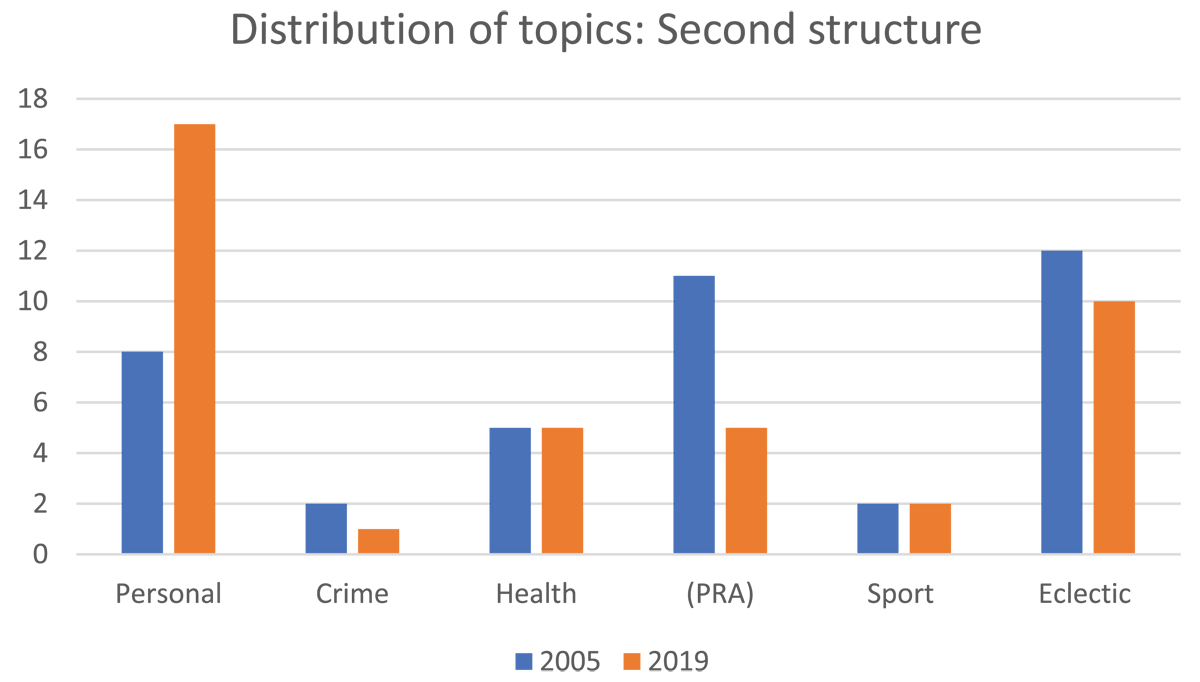
Figure 2
The second structure.
This increase in personal topics was also found when checking the topic weights, using the $theta function to get a rough measure of topic dominance per text. A 60% increase in number of texts having a topic in the personal category as its dominant topic was found between the two years. Bearing in mind that several topics may be present in one text, this still suggests an interesting shift in framing. The specific weights can be found in the Appendix.
This second structuring produces two interesting elements. The first is that the qualitative choices with regards to the structuring of the topics matter a great deal, and that a fruitful method for achieving a useful structure can come about inductively, after a careful analysis of the meaning present in each topic and its subsequent articles. The second interesting element is that the magnitude of change itself lends credence to the notion that this shift is most likely not solely confined to the two years themselves. This is corroborated by discovering that the new Personal category was made up by topics taken from all other categories, not just the ones found in Crime or Health. Still, as a note of caution, it’s worth adding that the increasing ‘personal’ trend found in this study mainly serves as an exploratory finding that can function as a theoretical jumping-off point. Further empirical research that includes the years between 2005 and 2019 is needed to definitively verify the ‘personal’ shift as a trend in the general discourse.
5.3 The Personal topics
In addition to this ‘personal’ shift, another trend was noticeable within the Personal category itself. Some of the articles had a positively slanted framing, where the persons with disabilities were described as proactive and strong, even heroic at times. The majority of the articles, however, posit a person with disabilities as someone tragic, a victim of circumstance or the cruelty of the world itself. A pattern of ‘heroic’/‘tragic’ emerged, one that is thoroughly familiar from disability history (Norden, 1994; Oliver and Barnes, 2012). We subsequently used this dualistic framework in order to analyze and structure the individual Personal topics in both years.
The result showed a perhaps surprising increase in topics with a ‘heroic’ framing in 2019, as compared with 2005. In all, the ‘heroic’ topics comprised 12.5% of topics in 2005 and 29.4% in 2019. Although the absolute number of ‘tragic’ topics remained largest in both years, a 16.9% increase of ‘heroic’ topics is noticeable between them. This measurable increase may point to a change in the general discourse, where more people are placed in this positive archetype of disabilities. We will return to the issue of the potential consequences of such a change.
5.4 Value, production and being
In the overall research project, two driving questions have emerged. In the age of human rights and inclusion, are all disabled people deemed includable, or only certain subgroups? And if inclusion is only directed at certain subgroups, what are the preconditions of inclusion? An analysis of the internal logic of the ‘heroic’ personal category shed some light on these questions.
It has been theorized that in public, the achievements of disabled people are framed as ‘inspiration’ for an audience of non-disabled persons (Haller and Preston, 2016). Rather than an offering disabled people a chance at self-expression, societal participation, and exerting social agency, this framing constitutes a trap: a stereotypical category of ‘good disabled citizens,’ which comes with strong normative constraints. Furthermore, the people that are slotted into this category all share an important trait; they are able to produce something the general population values (Varul, 2010). In disability studies, this dynamic has variously been referred to as able-nationalism (Mitchell and Snyder, 2015), or as a privileging of the able-disabled (Titchkosky, 2007).
This production perspective is reflected in the articles that together form what can be called ‘heroic’ topics. Many of these focus on the Paralympics and disabled athletes. These articles generally laud how the disabled person is able to produce an impressive athletic result in spite of their disability—an overcoming. For example, several articles mention the deaf tennis player Lee-Duck Hee, whose victory in the ATP tour, it is stressed, is accomplished despite his disability. On one reading this is a fair point, since the achievements of Paralympic athletes are often impressive. On the other hand, a Paralympic athlete is by definition disabled, raising the issue of why and on what grounds any particular disability becomes thematically salient.
Moreover, we note that four out of the five ‘heroic’ topics in 2019 are comprise of articles about disabled people in sports, constituting the vast majority. Taken together, the privileging of a particular kind of physical achievement by disabled people, and a pattern of valorizing participation in the labor economy in the remaining material, we see considerable support for Mitchell and Snyder’s ablenationalist thesis. It is as physical and productive performers who demonstrate an individual, heroic overcoming of individual, physiological constraints, that disabled people are most welcome in public discourse. Comparably, stories about Haran, Bihonelgne (both from topic nr. 22:2019) and Aasland (topic nr. 3:2005), suggest that their societal value is predicated on the ability to produce labor.
When disabled people are given monikers such as ‘fighters’ that perform impressively ‘in spite of’ their disability, structural critique becomes beside the point. Furthermore, the staging of the struggle becomes more salient than real outcomes. This applies, too, in the case of a disabled politician, Torstein Lerhol, who made a bid for local office in 2019; coverage focused less on his platform or his eventual loss but on the positive implications of the fact that he was able to participate at all (topic nr. 22:2019).
The heroic-productive relationship discussed here is contrasted by the pattern inherent in the ‘tragic’ topics. It should be noted that these are the majority of topics in both years, and feature stories of crime, neglect and abuse of power. The disabled people described in these articles are defined by their inaction. The fact that they exist constitutes the precondition for tragedy. In the case of the political scandal, the victimized disabled asylum seekers are newsworthy for what was done to them (topic nr. 5, 19 and 32:2019). Interestingly, not even in a case in which a disabled person committed a crime is the disabled person framed as a subject; the article focuses on the fact that he will not be put in prison because of the risk that he will be preyed upon by non-disabled inmates (topic nr. 38:2005). In our material, the hero/victim binary appears particularly stark.
6. Concluding Remarks
On a first reading, the discourse we examined appears to contain few significant changes from 2005 to 2019. Disability is a marginal topic in the media. Disability rights as such are not extensively covered. Victim stories do indeed recur, and there is marginal change resulting from the increased salience of disability rights discourse. In fact, it turns out to be perfectly possible for victim discourse to align with disability rights discourse. Rights violations can be presented as individual tragedies in a way that is nearly fatalistic: this is simply how it is.
These findings resonate with the lack of socioeconomic improvement found in other studies carried out within the overall project. Labor market participation and to a lesser extent educational levels remain relatively static over a generation (Gugushvili et al., 2023). Other research within the project indicates that the socio-economic impact of rights laws in Norway and in the other Nordic countries, has been minimal, with only a slight improvement in democratic participation as measured by voting (Gugushvili and Grue, 2025). Perceptions of disability discrimination are largely unchanged; this is a European-wide trend.
However, there are in fact several important findings from our study of representation of disabled people in Norwegian news media discourse. First, we see confirmation that to the extent that being a subject in national newspapers constitute representation, disabled people are highly marginalized. Although we did not expect the number of articles about, or written by, disabled people to be a large part of the total corpus, that fact that only 1,767 articles (0.4%) of all articles published in both years were relevant to this study was still surprisingly few, given that disabled people represent upwards of 16% of the population (WHO, 2011).
Second, despite superficial appearances that the situation was unchanged between 2005 and 2019, our secondary analysis demonstrated a shift toward the personal in representation. An increase in articles that did not just mention disabled people in passing with regards to certain themes, but actually engaged with personal stories of oppression, triumph or their idiosyncrasies was measurable between the two years. On this point, it is important to point out that this shift is not definitively proven by our research. More data and analysis of the years between 2005 and 2019 is needed to confirm that this shift is not a localized phenomenon specific to these two years. Interpretation of this finding must also, as we have signaled, be carried out with many caveats. First, the increase in such texts is small in absolute terms. Second, it may be due to an increase toward such discourse in general, as the media has become more concerned with driving direct engagement, and more likely to prioritize stories that have a clearly defined individual protagonist who invites narrative engagement, though not necessarily identification (Busselle and Bilandzic, 2009). The shift found in this exploratory study does, however, work as a theoretical jump-off point for further research to test.
Building on this preliminary finding, though, we see a dichotomous framing of people with disabilities within the articles that constitutes the ‘personal’ topics in both years. A clear pattern is observed in the positive framing of stories about disabled people that produce outcomes valued by the general public (political and labor market participation, athletic achievements). The value they produce guarantees that they are described as ‘heroes’ or ‘fighters’ that are deserving of respect and admiration. This framing is then mirrored by the negative framing in the articles about disabled people that do not produce, but simply exist, and are, since these stories almost always either describe or feature a ‘victim’ of circumstance, abuse or neglect, inevitably victimized. These articles emphasis the tragic nature of disability, and how the people ‘afflicted’ are objects of sympathy.
In this ‘production/being’ dichotomy of framing the discourse, it is hard to discern which groups are genuinely more included than the other. The articles in the ‘heroic’ topics may appear less stereotypical, but when analyzed further it becomes clear that they objectify to a similar degree as the articles in the ‘tragic’ topics. The star athlete that is described as an example of grit, determination and strength has her individuality removed in the process. She ceases to be a subject and becomes a venerable object of inspiration. This is exemplified in the articles that recount the exploits of Paralympian Birgit Skarstein (topic nr. 26 and 33:2019). In the few articles written by disabled people themselves, they use the opportunity to point out how this ‘heroic/tragic,’ ‘production/being’ dichotomy dehumanizes their lived experience (topic nr. 33:2019).
Consequently, we believe that the shift in framing that appears to have happened between 2005 and 2019 serves to reinforce, rather than ameliorate, those mechanisms that exclude and marginalize disabled people. A society that frames a group in two ways, as supposed to one, is arguably a favorable development. However, when one framing denies agency and the other entails harmful normative expectations, it is worth asking what, if anything, has been gained.
Returning to the question of normative assessment, it can be argued that an increase in positive representation may be a good thing—a counterbalance to the historical trend in disability representation has been heavily skewed toward victimhood. Ultimately, we are in two minds. The increased prominence of disability ‘success stories’ arguably makes such subject positions more easily available to disabled people in general, but it can also be argued that such texts come with problematic normative expectations.
Here, we are not only critical of the potential reinforcement of a hero/victim binary division. It is also worth noting that a neoliberal discourse of disabled people as unexploited resources can be discerned in other sources, including government-associated ones (Grue and Alnes, 2023). Here, disabled people are presented as potentially productive workers whose positive portrayal is contingent on their ability to perform at the same level as non-disabled people—eliding many of the socio-political factors that produce disablement. In this view, individual-centered discourse is very much a double-edged sword.
Being centered on a relatively small linguistic community, this article should be considered a pilot project. It indicates a somewhat greater diversity in the representation of disabled people than before, reflecting perhaps the inclusion of disability in the broad discourse of diversity. However, if the publication of such stories remains contingent on a disabled person having achieved something—contrary to expectations for the group with which they are identified, has anything really changed?
This prompts the final question for discussion, which is what an alternative form of representation—one that truly moves beyond the victim/hero paradigm—might look like. It is possible, certainly, to envision a form of media discourse in which disability becomes a more ‘unmarked’ part of the linguistic landscape. A relevant example can be found in the newspaper Aftenposten, which in recent years (though after the time period delimited in this article) has begun to publish restaurant reviews in which information about wheelchair accessibility (or the lack of accessibility) is consistently included. Here, disability-related information is not presented on the condition that something exceptional or newsworthy is being discussed, but on a par with other kinds of information that is relevant for a broad swathe of customers.
Such a discourse would represent disability as a salient characteristic of the social world—along with people’s age or gender, but also with structural societal features. It might make disability less remarkable, inviting more flexible, and possibly less stigmatizing subject positions. The present article, however, does not document the prevalence of such a discourse.
Additional File
The additional file for this article can be found as follows:
Competing Interests
The authors have no competing interests to declare.