
Introduction
This article analyzes the performative acts of individuals with cerebral palsy (CP) in a world that often views disability through a lens of deficit. Research has highlighted that people with CP often face stigma, stereotypes, and othering in various social contexts, including support-seeking (Read et al. 2015) and at work (Mik-Meyer 2016). Foundational work in disability studies has drawn attention to how structural barriers uphold the marginalization of disabled people (Barnes 2019; Oliver 2013). Thomas’s (2004) concept of psycho-emotional disablism highlights how oppression operates not only on a macro-level of societal structures but also interpersonally and on emotional levels. Building on these frameworks, critical disability studies describe disability as a culturally and politically embedded identity with the potential to disrupt normative social orders (Goodley et al. 2019). Disability studies have shown how individuals with disabilities are frequently positioned as deviant or ‘other’, reinforcing societal hierarchies rooted in ableism (Murdick et al. 2004; Loja et al. 2012). Concepts such as ‘disability spread’ (Murdick et al. 2004) and the ‘non-disabled gaze’ (Loja et al., 2012) expose how normative assumptions tend to reduce disabled people to stereotypes. In response, disabled people engage in practices of resistance through strategies such as passing, concealment, and identity reclamation (Wechuli 2024; McRuer 2018; Read et al. 2015), though such efforts are often unrecognized by the non-disabled majority (Johansson and Vinthagen 2016).
Building on existing research that highlights the agency of stigmatized individuals (Thoits 2011; Link and Phelan 2001), this article is informed by the scholarship of critical disability studies, which positions disability not just as an object of social analysis but also as a ‘subject’ that confronts the social order of things (Goodley et al. 2017). Shifting the focus from a strictly medicalized perspective, this article examines the social and emotional work carried out by disabled individuals to navigate societal perceptions and envision alternative futures. The primary question guiding this exploration is: How do participants with CP performatively seek to decompose compulsory able-bodiedness? The article draws on Robert McRuer’s (2004; 2006) theoretical framework, particularly his concepts of compulsory able-bodiedness—the culturally enforced expectation to be able-bodied—and decomposition, a term used to analyze how participants actively resist this normative expectation through performative acts, as formulated by Judith Butler (2006). This article analyzes the embodied and performative dimensions of navigating social life.
The empirical data for this article is drawn from qualitative interviews and focus groups, which offer rich insights into participants’ navigation in norms of able-bodiedness. The article finds that participants engage in performative acts through 1) signaling worth and competence, 2) taking up space in unexpected ways, 3) using humor, 4) managing emotions, and 5) creating spaces for self-affirmation. Drawing upon the theoretical framework of McRuer (2004), it is possible to position the small performative acts of decomposition observed in the participants within a larger sociological conversation about how marginalized groups push back against dominant narratives and envision future horizons.
The title of this article reflects the article’s focus on how normative and compulsive ideas of a ‘normal’, able-bodied body are gradually challenged. Drawing on McRuer’s concept of compulsory able-bodiedness and theories of decomposition, the article examines how individuals with CP engage in performative acts that slowly undo and decompose the societal expectations of able-bodiedness—not through abrupt disruption, but through embodied, everyday practices. This article contributes theoretically by introducing and elaborating on McRuer’s (2004) concept of critical decomposition in the context of Scandinavian disability research. Through case material on adults with CP, the article shows how individuals seek to challenge able-bodied compulsion yet often face constraints due to the lack of collective and systemic support. Critical decomposition theory thus points to the need for more collective, sustained engagement. The article contributes to the field of critical disability studies and micro-sociology by adding empirical depth to how people in marginalized positions seek to push back at normative expectations and mechanisms of exclusion.
Literature on Disability Stigma and Resistance
In this section, I will reflect on the literature surrounding stigma and stigma resistance, and explore how engaging with these ideas leads to a critical disability perspective—one that challenges and ultimately seeks to deconstruct the normative expection that all bodies are, or should be, able-bodied.
Stigmatization is a term that describes how people’s identities can be devalued (Goffman 1963). Stigmatization can be based on perceived deviations from physical, character-related, or social standards, which discredit the individual in the eyes of others. Critical to stigmatization is the process of ‘othering’, through which specific individuals or groups are labeled as ‘different’ from those who are understood as ‘normal’ (Link and Phelan 2001). Distinctions between ‘us’ and ‘them’ become exaggerated (Weis 1995) and imbued with the evaluative meanings of ‘superior’ and ‘inferior’ (Link and Phelan 2001). Stigmatizing traits quickly connect through culture to other negative characteristics (Link and Phelan 2001). In Goffman’s words, the identity is ‘spoiled’ in the presence of stigma.
Importantly, stigmatized individuals themselves are aware of how they are (or might be) perceived by others based on their characteristics. In the book Stigma: Notes on the Management of Spoiled Identity, Goffman (1963) describes how this awareness burdens stigmatized individuals, who must manage their identities in social interactions. For example, by concealing invisible stigma, individuals might be able to avoid negative responses. If stigma cannot be concealed, individuals may use various other impression management techniques to control how others perceive them. Grounded in this understanding of stigma, othering, and impression management, this article explores how participants with CP attempt to resist the stigma through performative acts.
More specific work in disability studies provides additional background for the present work by articulating what is at stake as individuals with disabilities navigate social life. Murdick et al. (2004) highlight that individuals with disabilities are frequently perceived as ‘different’, ‘outcasts’, or ‘the other’ (310) and in need of correction (Loja et al. 2012). This is referred to as ‘the non-disabled gaze’ (193), which creates a hierarchy of bodily traits that assigns status and power in ways that invalidate non-normative bodies (ibid.). Scully (2010) adds that society tends to view disability in binary terms, categorizing individuals as either disabled or not, further accentuating perceived differences to normative standards. Finally, Murdick et al. (2004) state that the concept of ‘disability spread’ describes the tendency to generalize from perceived disability to make a broader set of assumptions about individuals. Together, these processes underscore societal ableism (Brown and Ramlackhan 2022), the system of prevailing beliefs and practices that idealize fully functional, normal, and independent bodies and marginalize those who do not fit this standard (Campbell 2012).
People with disabilities resist stigma in their everyday lives by managing the visibility of their impairment, a practice known as ‘passing’ (Wechuli 2024), avoiding stigma (Corrigan et al. 2010), and concealing the stigmatized trait (Simi and Furell 2009). Everyday life resistance can also involve performative resistance, such as exaggerating stereotypes (Rios 2011), reclaiming degrading words on disability, such as ‘crip’ (McRuer 2018), creating ‘oppositional identities’ (Scotch 2009), and using personal and/or collective identity strategies (Read et al. 2015). However, non-disabled people often fail to recognize these social strategies and resistance to stigma (Johansson and Vinthagen 2016).
As Warner (2000) discussed, Goffman’s work focuses on the fear of stigma, which compels individuals to conform to societal norms and avoid being labeled deviant. This creates societal pressure to embrace ‘normality’. According to Karlsson and Rydström (2023). McRuer builds on this by challenging the concept of ‘normality’, particularly within the context of able-bodiedness. McRuer (2004) argues that the societal system of compulsory able-bodiedness enforces normality as an illusion of choice, masking a rigid structure that leaves no real alternatives. Where Goffman highlights the consequences of stigmatization and stigma management, McRuer more explicitly calls for a critique of these norms. Together, their insights locate the tension between the pursuit of normality and the need to dismantle its oppressive structures.
Building on the established bodies of stigma and resistance literature, I draw upon McRuer’s work (2004; 2006) that offers a lens on how society enforces able-bodied norms as an implicit standard and how disabled people navigate these norms performatively.
Performatively Decomposing Compulsory Able-Bodiedness
Building on queer scholarship, the American queer-crip theorist Robert McRuer (2004) shows how normativity (heteronormativity as well as able-bodiedness) is presented as natural and ideal but, at the same time, depends on the exclusion of queer and disabled bodies. McRuer (2006) describes able-bodiedness as a compulsory identity that people are pushed to conform to. He frames compulsory able-bodiedness as a societal “composition” that individuals regardless of disability navigate. McRuer writes:
Able-bodiedness, in many ways even more than hetero sexuality, is experienced by most able-bodied people as simply natural. Despite (or because of) the vast institutional network that exists to compose a viable finished product, the production process that would demonstrate that able-bodiedness is a cultural and historical construct cannot be acknowledged: all the world may be an inaccessible stage that able-bodiedness has constructed for its own performance, but the performance has been so naturalized that the actors do not realize that they are working with costumes and props (2004, 52).
McRuer argues that able-bodiedness is often seen as ‘natural’; however, this ‘naturalness’ hides that able-bodiedness, the normalized, universalized human way, is a product of cultural and historical processes. This perspective aligns with Butler’s (2006) writings on performativity, which argue that identity is not a static essence but rather continually enacted through discursive practices. These acts shape and reinforce gender norms, but they also provide opportunities for resistance.
McRuer’s (2004) concept of critical decomposition extends the notion of resistance against compulsory able-bodiedness. Drawing on David Halperin’s idea of queerness as the ‘opening of a social space’ for the formation of varied identities and relationships, McRuer describes critical de-composition as a process that acknowledges diverse, fluid, and complex corporealities, positioning them as alternatives to the monolithic conception of the able-bodied, ‘normal’ body. For McRuer, critical decomposition is not just about rejecting dominant identities but about creating new possibilities for identities, spaces, and bodies:
I argue for the desirability of a loss of composure since it is only in such a state that heteronormativity might be questioned or resisted, and that new (queer/disabled) identities and communities might be imagined (McRuer 2004).
McRuer (2004) emphasizes that while disabled people may not fit within the rigid frameworks of able-bodiedness, mere non-conformity is insufficient to disrupt the power dynamics and societal perceptions that uphold such norms. McRuer argues that for critical de-composition to occur, it requires collective, active resistance and a reimagining of social dynamics, which is a point I will return to in the discussion of this article.
While Butler’s (2006) theory of performativity focuses on how subjects are constituted through repeated discursive acts, critical decomposition foregrounds how these acts unfold within structures shaped by compulsory able-bodiedness. It shifts the emphasis from individual identity formation to the systemic unmaking of normative structures through collective and embodied critique. Rather than viewing performativity solely as a means of reproducing or subverting norms, critical decomposition insists on the necessity of dismantling the frameworks (composition) that render some bodies legible and others marginal.
The aim of this article is to apply the theoretical framework of McRuer (2004) to explore how the participants performatively seek to decompose compulsory able-bodiedness. In applying ideas of decomposition to the acts of individuals with CP, I do not suggest that these individual performative acts alone are enough to overturn the deeply entrenched norms surrounding able-bodiedness (Butler 2006). Rather, my focus is on the everyday life negotiations, rejections, and subversions of normative expectations that the participants engage in.
Having outlined the theoretical concepts that underpin this study, the following section will discuss the methods used to gather empirical data, exploring how these theoretical ideas were operationalized.
Research Design
This article encompasses 24 individual interviews and three focus groups, each comprising three to six participants with CP, collected between 2021 and 2022. As a person with CP myself, I found it relevant to explore how individuals subtly challenge norms of able-bodiedness using performative acts, and especially shedding light on this often invisible and lonesome work.
The sampling criteria included adults aged 18 to 65 with varying degrees of CP. I aimed to recruit participants from diverse educational backgrounds, ethnicities, genders, geographical locations, and ages to gain a comprehensive insight into varied everyday life experiences.
Self-selection bias is a concern in this study (Robinson et al., 2023), since the participants who responded to a Facebook post in the initial recruitment process were likely younger individuals, often women from resourceful backgrounds. To mitigate this bias, I made efforts to recruit men and non-gender-conforming people, as well as people over 40 with CP. I also visited residential facilities to recruit participants that were less resourceful when it comes to educational backgrounds. These steps aimed to provide a varied group of participants, even though the challenge of self-selection bias might not be fully eliminated (ibid.).
Methods
I used a semi-structured interview guide to investigate interactional encounters in the everyday lives of people with CP, allowing me to delve into participants’ stories, opinions, and perspectives. The individual interviews were carried out in person and lasted around one hour. I explored participants’ personal experiences with questions like, ‘What should others learn from your experiences of living with CP?’. In the focus groups, also in person, lasting around two hours, the focus shifted to social dynamics and discussions, asking questions like, ‘What barriers and challenges do you face daily? You are welcome to discuss with each other’. Through the focus groups, informants provided insights into their experiences of navigating social life and their strategies for navigating the stigma many of the participants experience. Some of these acts were visible manifestations in the world, while others were more subtle. Some participants articulated the performative strategies they actively and deliberately employ, while others emerged through my interpretations. It is also possible that some performative acts went unrecognized by the informants, leading them to omit discussing these aspects. Some participants felt awkward talking about their strategies to navigate social life. One participant expressed, ‘I would like you to mention this in a way that doesn’t make me seem like a huge jerk with hidden intentions’. While I interpreted his actions as resistance, he felt embarrassed about navigating the world strategically. I took care to involve participants directly in the interpretation of their stories, particularly given the sensitive nature of discussing stigma. For example, this one participant expressed feelings of embarrassment about the strategies he used to manage stigma. In response, I acknowledged his perspective and shared my interpretation of these actions as forms of navigation and resistance towards the expectations he encountered. I furthermore asked whether he recognized himself in that interpretation. This kind of in-situ, dialogic validation and interpretation during the interview provided a participatory and potentially ethical way to engage with emotionally charged content, ensuring that my interpretations aligned with the participants’ own perspectives.
Participant profile
Participants with CP had varying motor impairments, ranging from complete independence to needing assistance with daily tasks. Their abilities varied from walking unaided to using crutches, walkers, or manual and electric wheelchairs, with or without headrests. Communication techniques also varied across participants, with some using verbal speech and others employing technological aids for communication. All the participants are Danish, with a few having another ethnic background. The participants also varied in terms of education, work life, and living conditions. Some live independently or with fragmented support, others live independently supported by personal assistants, and some live in residential care facilities.
Ethical concerns
This study was conducted in compliance with the ethical guidelines of the University of Copenhagen and following national data protection legislation. The processing of personal data for this research project was formally approved by the Faculty of Social Sciences, University of Copenhagen. All participants gave written informed consent prior to interviews and focus groups, and the empirical data were anonymized. The study complies with the General Data Protection Regulation (EU) and institutional ethical guidelines.
I have aimed to conduct all interviews without interference from external parties, such as caregivers, parents, or partners, to maintain the integrity of the interview process. This approach aimed to ensure that the participants could express themselves and share their perspectives without external pressures from family and assistants.
Analytical strategy
To explore the diverse ways in which participants performatively resist stigma, I employed thematic coding to identify both convergences and divergences within the empirical material. The coding process was facilitated using NVivo, enabling systematic engagement with the interview data. To maintain clarity and transparency in the analysis, I adopted specific conventions: ellipses (‘…’) denote pauses in speech, square brackets (‘[…]’) indicate omitted text, and parenthetical notes such as ‘(laughs)’ capture significant non-verbal expressions.
The coding process was characterized by a continuous interplay between theoretical frameworks on stigma and resistance and the emergent themes derived from the interviews. Initially, I did not anticipate drawing on Robert McRuer’s (2004) concept of ‘decomposition’. My original intention, rooted in a sociological perspective, was to examine how individuals with CP navigate and manage stigmatization in social interactions. Consequently, the first round of coding was informed by classical theories of stigma and stigma management (Goffman 1963). I focused on coding sequences where participants explicitly described experiences of stigma and their responses to them, paying particular attention to emotional and interactional cues such as shame, discomfort, embarrassment, diminished self-confidence, anger, and frustration. These reactions offered insight into how participants negotiated, resisted, or responded to stigmatizing encounters. This phase of analysis led to the development of five thematic codes, capturing ways in which the participants navigate stigma:
Signaling: using visual or verbal cues to communicate competence or identity.
Taking up space: asserting presence in social or physical environments.
Humor: using a sense of humor to diffuse tension or challenge stereotypes.
Emotion management: regulating affective responses.
Self-acceptance: embracing one’s embodied identity as a form of resistance.
Upon revisiting these codes, it became evident that the participants’ approaches to stigma extended beyond individual stigma management. Crucially, these practices did not merely reflect an effort to avoid or mitigate stigmatization; they also enacted a subtle critique of the normative structures of able-bodiedness that produce and sustain stigma. At this point, McRuer’s (2004) theory of critical decomposition was introduced to analyze the empirical data, which I will now move on to.
Analysis: Decomposing Compulsory Able-Bodiedness
In the first section, I will present the everyday life stigma based on compulsory able-bodiedness as background knowledge. In the second section I will analyze how participants performatively seek to decompose compulsory able-bodiedness.
Background analysis: Navigating compulsory able-bodiedness
Study participants emphasize that their experiences of living with CP are shaped not only by physical challenges but also by the perceptions and attitudes of others. Elin expresses her experience with being positioned outside the norm:
People are extremely busy categorizing me into the position of “the other” because it is completely strange if we are the same and work together on equal terms. Moreover, I do not know if it is because people immediately think that it devalues their abilities that I can do the same as them.
Elin describes being labeled as ‘the disabled one’ in contrast to ‘the normal ones’. She notes how non-disabled people focus on her limitations rather than her equality. This reflects McRuer’s (2004) concept of compulsory able-bodiedness, where her disability positions her as outside the norm, less valued compared to those who conform to the ideal of able-bodiedness. Charlie also shares experiences of how people sometimes approach him:
So, it is a lot about how people approach me at parties, which can be a barrier. It is about being seen as something exotic. One time, I was at a party, sitting and talking to a medical student who said: “Well, Charlie, I find you interesting in a medical way”. And then I was like: “Okay, cool. Or what?” Well, it is also because you are sweet enough, but it’s also in a medical way.
Charlie’s reference to being seen as ‘something exotic’, where disability is not only pathologized but also made to seem inspiring or exotic. In this case, exoticization is like a backhanded compliment, where Charlie might be viewed as interesting or unique, but primarily because he deviates from social norms. This connects well with McRuer’s (2004; 2006) concept of compulsory able-bodiedness, which not only reinforces the notion that being able-bodied is desirable but also renders disability as an ‘other’, something to be explained, pitied, or, as in Charlie’s case, exoticized. The interaction reflects an underlying power dynamic, where the medical student assumes a position of authority or expertise over Charlie by focusing on his person in a ‘medical way’, which reinforces the broader social hierarchy where people with disabilities are often placed in a subordinate position (Loja et al. 2012). In contrast, able-bodied individuals (especially in the medical field) are positioned as the ones who understand, define, or control the narratives around disability (Fisher and Goodley 2007; Zaks 2023). Furthermore, by framing his interest in Charlie as ‘medical’, the student subtly asserts dominance over the conversation, placing Charlie in a passive role where he is being evaluated.
Several of the participants describe the experience of being talked to as if they’re children and how non-disabled people sometimes assume a lack of intellectual capabilities based on the participants’ appearance. Andrea articulates an example of this:
For example, at a conference last year. Ten people came up to me afterward and said, “Wow, you are really good at expressing yourself.” Well, what did you expect? I thought to myself. That’s prejudice about a disabled person: “Wow, she can actually say two coherent sentences, can’t she?”
This kind of benevolent ableism, where people with disabilities are overly praised for doing things that are considered routine for others, reinforces stigma by positioning disability as inherently limiting and framing people with disabilities as needing special recognition for ordinary achievements (Nario-Redmond et al. 2019). Benevolent ableism operates within the framework of McRuer’s (2006) compulsory able-bodiedness, where over-recognition reinforces the idea that able-bodiedness is the standard, ‘unmarked’, and that disability is a deviation that must be overly compensated for. Instead of being seen as a professional or an individual in her own right, Andrea is first seen through her disability and secondarily judged on her performance or skills. In that regard, Alex explains being talked to with ‘baby language’ with comments to his assistants such as, ‘It’s great that you take him out’, which positions him as someone who requires charity rather than as an equal member of public society. Participants encounter stereotypical responses in various aspects of their social life, such as dating and pursuing education. Hannah, for example, explains, ‘If I want to go on a date with someone, people can say, “Wow, it’s so brave of you to dive into it.” And I’m like, well, what else should I do?’. Hannah, Barbara, and Robert, all members of the focus group, further discuss the lack of nuance in how non-disabled people perceive people with disability, for example, the idea that people with disability might be sad all the time. Hannah further explains how people tend to see her in unnuanced ways as ‘totally cool’ or they ‘feel very sorry’ for her, with no in-between.
This section explored various forms of encounters with compulsory able-bodiedness experienced by the participants. The following section examines how participants seek to decompose compulsory able-bodiedness, using different forms of performative acts.
Performatively decomposing compulsory ablebodiedness
In this subsection, I analyze five key mechanisms the participants undertake to decompose compulsory able-bodiedness through performative acts: signaling, space-taking, humor, emotion management, and self-affirmation.
Signaling
Signaling refers to the actions or communications participants use to convey their skills, knowledge, or social status to others, thereby counteracting potential negative stereotypes. Participants strive to preemptively establish their credibility and counteract preconceived notions about their (lack of) abilities. Magnus uses small, discrete actions to assert authority and competence in a new academic environment:
I think I have my bad habits. I carry my car keys visibly. I may be a bit focused on showing my knowledge during initial lectures. I have always known how the new internet works and helped others. I know where we are supposed to be on campus for the next class. You know, small terrible things that, for me, strengthen my authority.
The choice to carry car keys visibly can be interpreted as a performative assertion of autonomy and agency directed towards undermining the negative assumptions others in the environment are perceived to have. Through this act, Magnus signals to others that he is in control and has the means to navigate independently. In this case, Magnus presents his actions as an active choice to assert his identity as a competent student. The visibility of his keys acts as a form of embodied authority, allowing him to stake a claim to his place within the academic community. Another way of preemptively performing disability is Isabella, who wears red lipstick as a discrete way to resist stigma:
So, in high school, I walked with a crutch on one side. And then I decided (laughs a little), just before I started high school, that I would wear red lipstick daily. Because it was a way to choose that I could be the girl with the red lips and not the one with a crutch or a disability, it was a way to choose how others would refer to me. And I actually experienced that it worked because people referred to me as “the girl with the red lipstick” (laughs a little). And I think that’s much, much, much cooler than being “the disabled girl”. So, it’s definitely a way to take more control over how others see you. But I would definitely say that I… I’m a vain person, and I absolutely feel that I need to compensate for ugly assistive devices (laughs) by wearing nicer clothes or looking a certain way. That’s how I feel.
In the quote, Isabella seeks to take control over how others view her. Rather than allowing the crutch or her disability to frame how others perceive her, she consciously performs another identity by using makeup and fashion—tools that are traditionally linked to femininity and aesthetic appeal. Isabella thus resists performing her identity according to stereotypes of being disabled, which often involves being seen as vulnerable, dependent, or pitiable.
In these cases, while participants assert their competence and beauty, they simultaneously reinforce the idea that disability is undesirable or needs to be ‘compensated for’. Isabella’s choice to be ‘the girl with the red lipstick’ rather than ‘the girl with the crutch’ highlights a preference for able-bodied standards of appearance rather than wholly embracing disability on its own terms. Actions like using keys or lipstick to draw attention away from one’s disability might disturb assumptions about disability stereotypes, but they may also reveal internalized ableism (Campbell 2009). Instead of challenging the validity of compulsory able-bodiedness, participants often attempt to manage stigmatizing encounters by adopting a conventionally valued trait, as Goffman (1963) has discussed. This strategy of performing disability within an abled-bodied framework rather than decomposing compulsory able-bodiedness more fundamentally might be empowering on one level, as it allows participants to exert control over how they are perceived. However, it might also be restrictive because it relies on normative standards, as it involves negotiating the tension between asserting control over one’s identity while also conforming to able-bodied norms. This leads us to an exploration of how the participants take up space when they navigate compulsory able-bodiedness.
Taking up space
Taking up space encompasses both physical and social dimensions, where the participants assert their presence within different contexts. One example of this is Alex’s method of nudging shop assistants to address him directly instead of speaking to him through his personal helper:
I try to tell the helper if I need help in a clothing store or something, I tell the helper, “You just stay at the back of the store”, or if it’s a mall, “Well, you just stay out in the hallway”, because then the shop assistant has to deal with me.
Alex insists that shop assistants directly address him, eliminating situations where people talk about him or speak over his head. By actively taking on the role of a customer rather than accepting indirect communication, Alex challenges the social script around disability stereotypes. This can be interpreted as a counter-performance to the pity-based stigma and infantilization, as described in the first section. Alex not only manages social stigma but also works to normalize his presence as a customer. Alex uses his physical presence to disrupt ableist discourse that renders disabled bodies passive or invisible, as discussed by McRuer (2006).
Another example of taking space comes from Isack, who challenges internalized beliefs that dictate how he should behave or position himself in space with his wheelchair, which takes up space:
Sometimes I try to tell myself […] I don’t have to wait for everyone to pass by so I can come out as the last person. I don’t have to take for granted that I must somehow stand behind the line or suppress myself; it’s been a bit about embracing it; it’s embracing my disability; it’s both embracing my disability but also saying it’s okay for it to be there.
Isack’s realization that he does not have to ‘wait for everyone to pass by’ or ‘stand behind the line’ signifies a conscious decision to reject self-suppression. By choosing to step forward rather than lingering in the background, he is resisting the internalized stigma that suggests his disability should be hidden or minimized. This act of stepping forward can be interpreted as a performative assertion of his right to occupy space and be visible, which might be an act of decomposing compulsory able-bodiedness. Instead of viewing disability as something to hide or be ashamed of, Isack is recontextualizing it as an integral part of his identity. Drawing inspiration from minority movements, such as the LGBTQ+ pride movement, some participants consider forming a similar movement based on disability pride:
I don’t know; maybe somehow we should make a Pride like LGBTQ does and say: hello, we’re here too, and we come in so many different forms, and we don’t need to fit into a box, but this is how we are, and we have the right to be here.
Proposing a public declaration of existence and visibility involves embodying and expressing identities that challenge normativity. In Butler’s framework, identity performance in public spaces (like Pride parades) might challenge or disturb norms that traditionally keep non-normative identities marginalized or invisible (Butler 1993, 21). At the heart of both Butler’s (2006) and McRuer’s (2004) arguments is the idea that compulsory norms cannot simply be subverted at will; these hegemonic norms compel everyone to conform. However, despite this, in the empirical data I observe instances where the participants seek to challenge these norms and create spaces and futures where alternative corporealities are accepted and celebrated. With this in mind, we now turn to how participants use humor to navigate the norms and pressures of compulsory able-bodiedness.
Humor
The material contains examples of participants using humor to challenge stereotypes, diffuse negative perceptions, and resist stigma. One example is Barbara, who inspires others in a focus group interview to use humor to navigate stigma. This is Barbara’s response to Hannah’s frustration around others’ reactions to her CP:
Hannah: When you tell people, “Well, I have CP” or “I’m a spastic”, the first thing they think of is those catastrophic scenarios like you have the worst of the worst, and you can’t do anything, and you need help with everything. And I sit here feeling like a very normal person.
Barbara: I usually say to people when I meet them that CP stands for “Charming People”.
(all participants laugh)
Hannah: (laughs) I think I will adopt that one!
Barbara continues: Others have to fight for it. You have it by nature.
Hannah: Yeah, cool. Yeah, that’s a really good one (laughs).
All: Yeah! (laughs).
The shared laughter and agreement between Barbara, Hannah, and Robert in the focus group illustrate a mutual embrace of this new humorous identity, creating a sense of union. The use of humor in this context helps mitigate the seriousness often associated with disability, allowing the participants to assert their identity in an empowering and defiant way. Isack describes another example of using humor:
I felt like I was getting a bit sad because I almost couldn’t see myself in my own story anymore, since I had told it so much to people. But then it was really nice to take a break from it. For example, I did this culture café: How to Treat a Disabled Person 101. We would get up on stage and do this weird play about all sorts of things, like how to hold the door for a disabled person, and we had some fun with it. I just thought it was fun to make fun of it.
To break away from this repetitive cycle of sharing his story of living with CP, where he often found himself recounting the same narrative over and over, Isack engaged in a creative project, where he and a non-disabled friend performed a playful and slightly absurd skit about interactions with disabled people in front of an audience. By staging exaggerated or humorous scenarios, like ‘how to hold a door for a disabled person’, the performance highlights the awkwardness, misunderstandings, or overcompensations that often occur. This act of performing disability on stage serves as a form of resistance to compulsory able-bodiedness in several ways. Using humor, Isack invited the audience to reflect on societal attitudes toward disability. Instead of being the recipient of well-meaning but often misguided treatment, Isack takes control over how his stories and experiences are presented, which allows him to challenge stereotypes and misconceptions but also open a social space for the formation of new ways of being understood, as discussed by McRuer (2004). With this in mind, we now turn to how participants emotionally navigate the norms and pressures of compulsory able-bodiedness.
Emotion management
Another example of performative acts that are used to resist compulsory ablebodiedness is managing emotions. Elin describes how being happy is sometimes a persona she takes on:
In a way, I sometimes take on that persona: “Just be happy”. The happy one. Because then you’re not as much of a hassle. There are three disability personas: happy, funny, and angry. And in a way, we all end up in one of those categories. At some point in our lives. Because that’s what’s easiest: either we’re the happy, the funny, the class clown, or we become angry and bitter about life. Because that’s what others expect us to do. It’s what others project onto us. It’s something social again. “Oh, it’s so good that you’re happy”. It’s also a way to make Mom and Dad happy that I’m happy. Since they are so sad, they had me. Or, well, it’s not something I’ve been told every day, but it’s something you can sense from time to time. So, at least, I can compensate by being happy. A happy person. Or happy about life. Or grateful. Oh, gratitude.
In this part, Elin shows how being happy can be a performative act that serves to resist being seen as burdensome or problematic. Happiness, in this case, becomes a form of emotional management, a way to cope with the discomfort of others and alleviate the guilt or sadness that parents or society might struggle with regarding disability. This happiness is not always entirely genuine but a way to maintain harmony in social situations. In essence, this form of ‘emotional management’ reflects how compulsory able-bodiedness enforces certain behaviors and appearances to align with societal comfort, shaping disability as an ‘exception’ that needs to be mitigated emotionally rather than a valid and ‘normal’ state of being. Moreover, Elin talks about the difficulty of allowing herself to be angry as she explains:
And I’ve had to spend a lot of energy getting a little angry. And thinking it was okay to get angry. And I think it was okay that I didn’t say no when people – because I often thought I couldn’t allow myself to get angry, because: “they’re doing so much”.
While anger can be a powerful form of resistance, it can also risk becoming another stereotype—the ‘bitter or angry disabled person’—which is something Elin wants to avoid. This dilemma shows that navigating compulsory able-bodiedness while being disabled is a delicate balance. Both happiness and anger are responses to Elin, but each emotion comes with its own risk of being further stigmatized. This brings us to consider how participants navigate the emotional demands imposed by compulsory able-bodiedness by embracing their embodied identity as a form of resistance.
Self-affirmation
Moving further, other forms of performative acts concern the participant’s self-affirmation. Frida comes with an example of how she is pushing back against internalized stigma that may have been imposed on her or that she has adopted by asserting her capability and worthiness:
I think that it was first after I moved out [from parents] and became my own person, or whatever you want to call it, [I] realized how important it was for me to fight against the perception that I couldn’t do the same things and wasn’t as worthy.
Frida’s act of recognizing degrading perceptions and asserting her worth is, as I interpret it, a form of performative act of resistance to the rigid norms of able-bodiedness through self-affirmation. The act of ‘fighting’ against negative perceptions embodies the idea that resistance is a form of performance that can influence how one is perceived. By consciously challenging these perceptions, Frida is not just reacting to stigma; she is actively reshaping her identity, starting with her self-understanding. This aligns with McRuer’s argument that resistance to normativity is not merely destructive but also constructive, and from this perspective, it is possible to ‘open’ a space for different ways of being with disability (McRuer 2004, 47). Some participants describe a desire for an alternative way of understanding and talking about disability. Isack explains that discovering this ‘other language’ allows him to understand his disability in new ways.
I have been to many meetings with doctors where a lot of things went over my head, but there have been all these negotiations between my parents and the doctor about when I should undergo surgery and what should happen to me, and it was not something I could do anything about, and I don’t know if I was old enough either. And then I just wanted to find another language, and I found out that there was another language, and in that way, I could resist, and resist in a different way than resisting my disability; it was really nice to break out (Isack).
Finding an ‘other language’ gives Isack a sense of liberation, helping him cognitively break free from the constraints he felt during those meetings at doctors’ appointments. I interpret this description as breaking free or ‘coming out’ (Brewer 2018) from a constrained identity, which creates new possibilities for identity and self-expression. Aligning with this, McRuer (2004) suggests that it is in moments of disruption or vulnerability, when individuals ‘lose composure’, that the norms of able-bodiedness can be questioned and subverted (50). Another way of performatively decomposing norms around able-bodiedness is the commitment to embrace disability identity rather than hiding it. Joanna explains this.
I think a lot about how disability is my activism. I have realized over the past few years that discrimination still exists, even though many people do not recognize that we are still discriminated against as disabled people; at least, I feel that way. So I started to think that now I must stand by my disability and my identity as a disabled person.
Joanna’s statement represents a conscious choice to ‘stand by her disability’, indicating that she is taking control of her narrative; by choosing to define herself as disabled, Joanna claims authority over her identity. By internalizing a positive self-image and standing firm in her identity, Joanna builds up an outlook from which she can perform her disability identity in new ways. In this way, participants ‘speak back’ to the compulsion of able-bodied norms by embracing disability and trying to create space for diverse ways of living and being.
Discussion
The analysis of performative acts to decompose compulsory able-bodiedness sheds light on the complex identity management, stigma resistance, and critical decomposition the participants undertake in their daily life. Recognizing the emotional and social labor involved in decomposing compulsory ablebodiedness is key to understanding the broader lived experiences of people with CP. Dahl and Monrad (2025) have found that the emotional and social dimensions of living with CP are often overlooked in favor of physical interventions aimed at improving quality of life. This tendency reflects a broader pattern within disability support systems, where the focus remains on bodily function rather than lived experience, including social and emotional dimensions (ibid.). Carol Thomas (2004) offers a critical corrective to this by highlighting that emotional and social aspects of disability are not peripheral but central. According to Thomas, these dimensions are precisely where the impacts of social oppression are most acutely felt and simultaneously where the capacity for resistance, meaning-making, and identity formation emerges. Her perspective thus underscores the need to attend to the socio-emotional realities of disabled people not as secondary but as vital to understanding both their challenges and their agency.
The participants often described themselves as being almost perpetually ‘on stage’ (similar to Goffman’s concept of the front stage), where they must constantly contend with ‘the non-disabled gaze’ (Loja et al. 2012). This dynamic is evident in various contexts, such as during medical examinations or when receiving assistance, for instance, climbing stairs, using the restroom, eating, or simply walking or rolling down the street. In this sense, the performative work undertaken by individuals with CP may differ from other embodied experiences depending on visibility.
Building on the work of McRuer (2006), I interpret that the participants in this article, using different performative acts, are trying to carve out new opportunities for themselves within a rigid framework of able-bodied norms, which is illustrated in Figure 1.
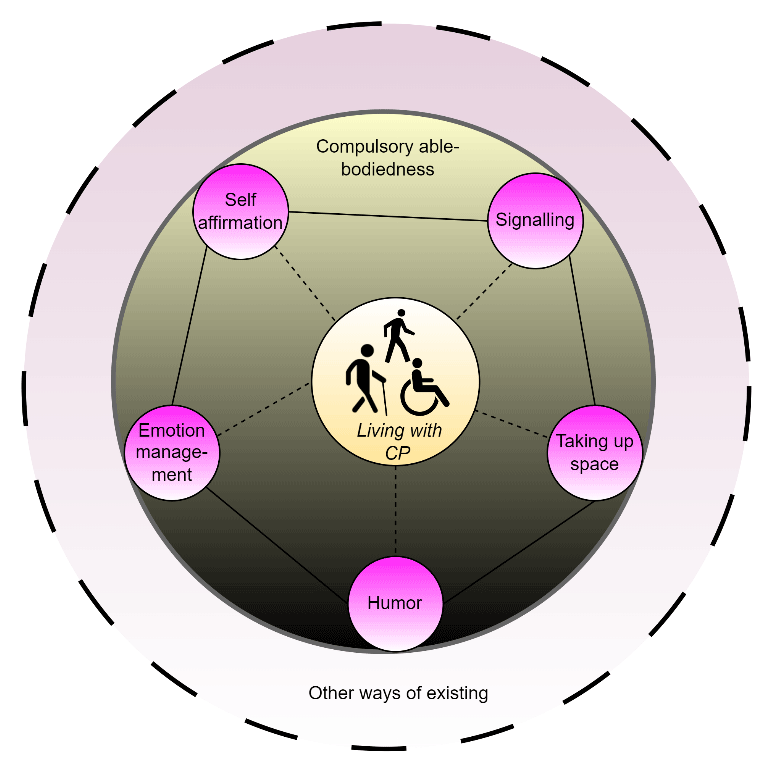
Figure 1
Individuals with CP negotiating norms around able-bodieness.
The figure illustrates how individuals with CP navigate able-bodied norms within the constraints of compulsory able-bodiedness. At its core, it represents participants with CP, surrounded by a gray ring that symbolizes the pervasive influence of hegemonic able-bodiedness, as McRuer (2006) described. This gray ring symbolizes both a barrier and a field of negotiation and reflects the constraints of the dominant norms of able-bodiedness. The five performative strategies—signaling, taking up space, humor, emotion management, and self-affirmation—connect to the individual, interacting within this boundary or field of negotiation. The strategies highlight how participants engage within a rigid framework of able-bodiedness as they seek to reshape and expand these boundaries beyond its compulsion.
Different types of resistance that are at play
The resistance expressed through performativity in this article—such as applying lipstick, waving keys, and repositioning oneself—targets various dimensions of stigma and can be meaningfully situated within existing disability studies literature on stigma management and resistance. These small yet intentional acts of using lipstick and showing car keys might reflect what Wechuli (2024) terms ‘passing’, where individuals manage the visibility of their impairment in order to reduce social penalties. Similarly, strategies like concealment (Simi and Furell 2009) and avoidance (Corrigan et al. 2010) are evident in how participants subtly redirect attention or manage impressions in social encounters. However, I would argue that these performances also move beyond concealment and into the domain of resistance. For example, Isabella’s gesture of applying lipstick can be read not merely as a way of conforming to normative femininity, but as a defiant response to aesthetic stereotypes surrounding disability, asserting, ‘I can be pretty’. Magnus’s act of waving keys challenges assumptions about independence and competence, effectively countering the disability spread (Murdick et al. 2004), which generalizes disability into broader presumptions of incapacity. Isack and Alex go further by occupying public space in a way that asserts a fundamental right to exist outside of the normative metrics of beauty or productivity. Their actions resonate with Scotch’s (2009) concept of ‘oppositional identities’, in which disabled people reject dominant value systems and instead affirm their presence on their own terms. In this sense, their performativity is not about fitting in but about actively deconstructing the composition of compulsory able-bodiedness. These acts echo McRuer’s (2018) work on reclaiming language and identity, in which disabled individuals reframe or exaggerate stigmatized traits as a form of counter-performance. Together, these practices show how stigma resistance is enacted not only through strategic concealment or adaptation but also through embodied, everyday performances that challenge the very norms that render disabled people marginal. These findings build on and extend the literature by illustrating how individual acts of performativity—often overlooked—might serve as sites of resistance.
Invisible work
Resistance is often associated with visible protests or confrontations, where disabled individuals are typically absent (Beasley 2020). In this study, resistance is found in participants’ performative assertion of their presence, identity, and rights, but within rigid frameworks of compulsory able-bodiedess (Campbell 2012) and primarily carried out by the participants individually. This performative resistance can be seen as ‘invisible work’ (Daniels 1987), similar to the emotional labor of managing others’ expectations or the work disabled people do to gain social legitimacy in neoliberal economies (Grue 2024). This extra layer of resistance demands energy and emotional investment yet remains unrecognized and undervalued, potentially contributing to the psycho-emotional disablism faced by individuals with CP (Thomas 2004). This leads us to a discussion of how acts of resistance often manifest at the individual level.
Individual everyday life resistance
Although the performative acts identified in the empirical material can be seen as resistance to able-bodied norms, they are largely enacted by individuals alone. This aligns with Johansson and Vinthagen’s (2016) observation that everyday acts of resistance by people with disabilities are often unrecognized and invisible, especially to the non-disabled majority. Without the visibility or validation that comes from collective action or shared discourse, these personal performative acts may be interpreted as coping mechanisms rather than as intentional forms of social critique (Koskinen 2022). Research shows that disabled individuals engage in everyday forms of resistance in various ways. For example, some choose to refrain from using assistive devices in order to ‘pass’ as non-disabled (Bäckman 2024). Others express resistance by critically engaging with gendered ableism and the intersecting norms surrounding both gender and disability (Timander and Möller 2018). In this way, resistance among disabled people frequently takes the form of individualized, everyday acts that tend to be overlooked or undervalued in broader social and political discourses. This echoes Scotch (2009), who emphasizes the potential of collectivity in stigma management.
The individualized resistance seen in empirical data lacks the structural reinforcement that broader movements can provide. As such, while these acts challenge the normative compulsion of able-bodiedness in situ, they risk remaining invisible within the dominant social framework that upholds ableist norms (Campbell 2012; Brown and Ramlackhan 2022). This brings attention to the need for collective and transformative efforts to dismantle the exclusion of disabled people.
Beyond the individual: The need for collective action
McRuer (2004) emphasizes that critical de-composition involves not only challenging normative frameworks but also engaging in collective efforts to dismantle the dominant systems through ‘earth-wide networks of connections’ (as he refers to Haraway 2013). Learning from the everyday acts of the participants suggests that supporting people with disabilities requires more than simple inclusion within existing societal structures shaped by compulsory able-bodiedness. As McRuer (2004) argues, able-bodiedness operates as a normative composition—so naturalized that it becomes invisible—yet it is maintained through cultural, institutional, and discursive practices. Rather than merely adjusting existing frameworks, there is a need to fundamentally expand and critique them, leaving space for alternative modes of embodiment and existence. This article offers a contribution to ongoing conversations about how individual acts might gain transformative potential when affirmed, politicized, and connected through community, collectively imagining and enacting alternative modes of being that challenge the cultural and institutional dominance of hegemonic able-bodiedness.
This shift might involve collectively and at institutional levels interrogating how able-bodied norms produce and marginalize disability through what Loja et al. (2012) describe as the ‘non-disabled gaze’, which hierarchically organizes bodies and invalidates non-normative ways of existing in the world. It also requires dismantling binary understandings of the ‘normal’ as opposed to the ‘disabled’, as Scully (2010) describes, in favor of recognizing bodily variation as part of being human. Moreover, the concept of ‘disability spread’ (Murdick et al. 2004), where one aspect of disability is generalized to assume deficiency, must be challenged fundamentally. Reconceptualizing disability not as marginal but as central to understanding the very construction of normativity aligns with McRuer’s (2004, 68) call to view disability as a critical vantage point from which we can understand how all bodies are ‘caught up in and even produced by’ the demands of able-bodiedness. This approach resists the pathologization of difference and instead affirms the political and epistemic value of disabled experience. Envisioning such a future, as McRuer (2004, 69) writes, involves imagining a world ‘populated by multiple and de-composing bodies’, a horizon that challenges compulsory able-bodiedness by embracing bodily diversity not as an exception, but as a foundation for rethinking social life itself.
Grounded in the empirical insights of this article, the following recommendations aim to inform institutional change across sectors, such as civil society, education, employment, and healthcare.
Policy recommendations
Reconceptualize inclusion not as a matter of helping disabled people adapt to existing norms, but as a call to restructure those norms themselves. This requires a critical reflection on what is culturally considered a full and correct presence and a shift toward institutional practices that are flexible, diverse, and inclusive by design.
Train institutional actors, such as educators, employers, health professionals, and administrators, to identify and challenge ableist assumptions embedded in routine practices. Even well-intentioned actions can unintentionally reproduce exclusion. Disability awareness training, co-designed with disabled people, might illuminate how everyday norms and expectations create barriers and feelings of not being a fully legitimate member of social and institutional life.
Reposition disability as a valuable and generative standpoint, rather than a marginal or exceptional condition. This means foregrounding the knowledge and lived experience of disabled people in institutional decision-making and treating disability not as a deficit to be managed or problem-solved but as a critical resource for imagining more just and inclusive futures.
Conclusion
This article examines how individuals with cerebral palsy (CP) navigate and, to some extent, seek to decompose compulsory able-bodiedness using performative acts in a Danish context. By engaging in performative acts such as signaling competence, occupying space, emotion management, humor, and self-affirmation, I analyze how participants assert their presence within a society structured around able-bodied compulsion. However, individuals often carry out these performative acts alone, highlighting the emotional, social, and physical toll of continuous negotiation. While disabled people’s efforts to navigate hegemonic norms are were analyzed, transformation might require collective action at many different levels of society that affirm disability as a vital aspect of society and social life, thus enabling people with diverse corporealities to thrive within a reimagined social order. This analysis invites further reflection on how embodied, performative everyday life practices of resistance carried out by people who are sidelined or marginalized in society might be supported, politicized, and connected in ways that contribute to broader processes of social change.
Acknowledgements
I am deeply grateful to the participants who generously shared their experiences. Your contributions have been invaluable to this article, and I hope your stories, insights, and words will leave a lasting imprint on the world.
Competing Interests
The author has no competing interests to declare.