
Introduction
People with intellectual disabilities living in group homes usually depend on the support of others to have a meaningful and active life (Bailey, Doody, and Lyons 2016). Previous studies have drawn attention to the crucial role of managers in such homes (Bigby, Bould, and Beadle-Brown 2017; Bould et al. 2016; Deveau and McGill 2016). The way managers organise daily support may have an impact on residents’ opportunities to be involved and participate in daily activities and everyday life (Berlin Hallrup, Kumlien, and Carlson 2019). Studies have demonstrated that leadership can influence several outcomes for people with intellectual disabilities. These range from increased participation in domestic tasks to empowering support by the staff (Beadle-Brown, Bigby, and Bould 2015; Mansell and Beadle-Brown 2012). One approach to changing managers’ effectiveness in enabling their staff to support better outcomes for people with intellectual disabilities is through training them to become frontline practice leaders. Frontline Practice Leadership (FPL) focuses on the outcomes for each person with an intellectual disability in everything they do, and has been associated with better quality of staff performance (Beadle-Brown, Bigby, and Bould 2015; Bigby and Beadle-Brown 2018).
Active Support and Frontline Practice Leadership
FPL is usually employed in combination with Active Support, which is a well-known staff practice in group homes, primarily for people with moderate to severe intellectual disabilities (Mansell and Beadle-Brown 2012). Active Support is an enabling staff approach that focuses on engagement in any activity or interaction with other people in a way that is meaningful for each person (Mansell and Beadle-Brown 2012). Active Support practice has four main essentials that can be viewed as reminders for support workers about how to support each person in a group home: Every moment has potential (everyday situations are opportunities to involve each person in an activity), Graded assistance to ensure success (adjusting support so that each person can be engaged in an activity), Maximising choice and control (providing many opportunities to choose different activities and involvement in different sequences so that the person can experience control) and Little and often (supporting each person to experience new things by breaking the activities down into smaller steps) (Mansell and Beadle-Brown 2012). Active Support was originally developed by researchers working to support the development of community care in the UK (e.g. Mansell et al. 1982). Later work led by Mansell (e.g. Mansell et al. 2005) and Felce (e.g. Jones et al. 1999) produced training materials and evaluated the approach. The current implementation of Active Support in this study followed the Australian version developed at Living with Disability Research Centre at La Trobe University (Bigby and Humphreys 2023). The training for the staff consists of a mix of online video modules and practical assignments, as well as feedback sessions in real situations in group homes (see Bigby and Humphreys 2023).
Active Support has proved to be an effective staff practice in group homes (Flynn et al. 2018; Stancliffe et al. 2008; van Herwaarden et al. 2025). Bould et al. (2016) showed that the presence of a practice leader can facilitate the implementation and that it increases the levels of engagement and active support. Whereas previous research has shown that Active Support can be difficult to sustain over time in services (Beadle-Brown et al. 2014; Mansell, Beadle-Brown, and Bigby 2013), one way to overcome this is to introduce FPL into the services (Beadle-Brown et al. 2014; Bigby et al. 2020). Frontline practice leaders are usually first-line managers who actively supervise, observe and give feedback to the support workers (Bigby and Humphreys 2023). Practice leaders receive training in special workshops in addition to the Active Support training. The practice leader has five main tasks: 1) To facilitate team meetings 2) To assign and organise staff support 3) To observe, provide feedback and instruct the staff 4) To focus the staff’s attention on various quality of life factors and 5) To supervise support workers (Bigby and Humphreys 2023). The aim is to be a role model for how tasks should be carried out.
Important organisational management features are senior managers who strongly support FPL in the group homes and managers with good management skills (Bigby et al. 2020). Notably, the implementation of FPL as part of the daily social work becomes crucial to be able to both insert Active Support in everyday situations as well as to maintain the practice over time. Bould et al. (2016) also concluded that for a practice leader to be trustworthy, they need to be seen as being able to work in everyday support themselves.
Implementation of new work methods
Researchers are calling for a scaling up of effective practices in human services, particularly in social work (Odom, Hall, and Suhrheinrich 2020). Successful implementation of evidence-based interventions presumes a staff culture that chooses to get involved, especially at the management level, which can encourage and support the implementation of evidence-based practice (Bäck et al. 2019). In addition, due to staff shortages and budget cutbacks, initiatives that foster job attractiveness, such as distributed leadership shared by team members, have gained attention in Swedish disability care organisations (Hasselgren, Dellve, and Gillberg 2021). In that sense, the role of FPL may need to be adjusted to the Swedish disability care organisations to create an environment that encourages experienced support workers to stay in the disability field, create opportunities to progress and get more responsibilities and mandate. Therefore, it is unknown whether the role as a practice leader is better suited for experienced senior staff members or first-line managers in the Swedish context.
The support services for people with intellectual disabilities in Sweden are organised under the Act concerning Support and Services for Persons with Certain Functional Impairments [LSS] (SFS 1993:387). The two most common types of supported accommodation for people with intellectual disabilities or autism are housing with special services and group homes. These usually consist of small flats situated around common areas with staff available at all times (The National Board of Health and Welfare 2018). Group homes are small, in line with national recommendations that they should accommodate 3–5 people with intellectual disabilities or autism, but no more than six people (The National Board of Health and Welfare 2002).
There is usually one first-line manager for each group home, yet sometimes, managers are responsible for several group homes, which may impact the possibility of being part of everyday practice and service delivery. The first-line managers usually have a university degree in social work or equivalent. However, training in how to organise support in group homes and acting as a role model, which are included in FPL, are not usually part of the degree in social work. Consequently, educating managers how to work according to FPL may have the potential to fill a knowledge gap.
This research article on the effect of FPL training is part of a larger intervention project about Active Support and FPL in four Swedish group homes. The effects of Active Support according to the service users’ perspective have been explored in a previous article. It showed that Active Support improved the emotional support, opportunities for exercising choice and control, and engagement in activities one year after the staff received training (Aspling, Svärd, and Tideman 2024). Additionally, the longitudinal effects in improved quality of support based on observations are explored in a forthcoming article. The aim of this study is therefore to examine the two-year effect of FPL in four Swedish group homes. Two research questions guided the study: 1) What was the effect of implementing FPL in Swedish group homes? 2) Were any adaptations necessary for the Swedish context?
Method
Study design
This is a longitudinal two-year study based on observations in group homes and semi-structured interviews with managers.
The implementation of Active Support and FPL
The research was carried out in four group homes that all implemented Active Support and FPL. Staff training took place at different time points, step by step, in a tailored non-randomised stepped-wedge design (see for example Hu and Hoover 2016), where one group home received training at a time and was followed over two years. Whereas randomisation may be considered the gold standard, this was not optional for the group homes and a non-randomised design was therefore chosen. The project began in 2020 and lasted until 2024, when the last group home had been followed for two years. In 2020–2021, Covid-19 became a pandemic. There were no lockdowns in Swedish group homes but there were national recommendations to keep a distance from others, to be observant of symptoms and to reduce social gatherings (The Public Health Agency of Sweden 2024). Therefore, special cautions were in place during data collection. Observations were conducted from a distance, and if any participant had been in contact with persons contracting the virus or if anyone displayed symptoms of Covid-19, the observations were rescheduled. In one group home (C), this happened at baseline and no baseline measurement for practice leadership was possible.
The Active Support introduction for the staff and managers used training material from the Australian resource website (see Bigby and Humphreys 2023). The author was trained in Active Support and FPL by researchers from La Trobe University (see Bigby and Humphreys 2023). After completing the training, the author introduced Active Support and FPL into the four group homes in three steps. Firstly, all the staff and managers participated in a two-day workshop about Active Support. Secondly, after approximately three months, three managers were trained in FPL using the online material, as well as in practical situations (for information about FPL training, see Bigby and Humphreys 2024a). They had no prior training in Active Support or FPL. After the FPL training, the practice leaders did the first feedback sessions together with the author to practice how to conduct observations. Thirdly, after approximately one year, two experienced senior support workers (in group homes B and D) and a new manager (in group homes A and C) were trained in FPL, after which they replaced the managers as practice leaders in the four group homes. See Figure 1 for a timeline of the research conducted for the present study.
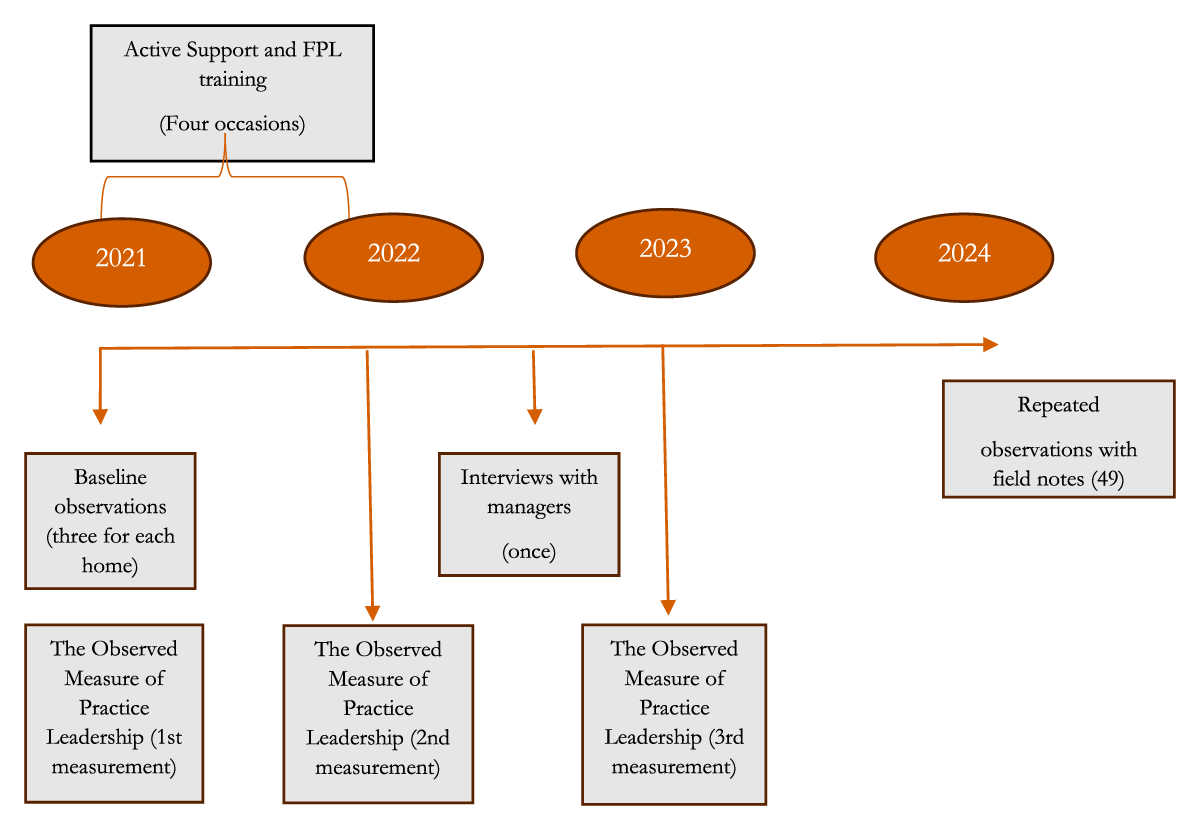
Figure 1
The timeline for three methods of measurement: 1) The Observed Measure of Practice Leadership (three times) 2) Observations with field notes (49 times) and 3) interviews with managers (once).
Participants and settings
This study included three managers and 28 support workers at four group homes from two organisations. Two of the managers were responsible for one group home each (Manager 1 and Manager 2, respectively) and one manager was responsible for two (Manager 3). However, Manager 2 was also responsible for two other group homes that were not a part of this study. The group homes were situated in residential areas and were of similar size, with 5–6 flats in each. They had not been open for longer than two years. Consequently, group home C only had four persons with intellectual disabilities living there during the observations, whereas the others had six residents. All group homes were self-selected as they showed an interest to participate in the project. The author had no pre-existing relationship with the group homes prior to the project. The educational background of the staff varied, ranging from upper secondary school qualifications in social care (most common) to bachelor’s degrees in social work or education. Each group home had one person employed as a ‘stödpedagog’ (translated to ‘senior support’ worker in this article). This is a new, two-year part-time qualification (or one year full-time) from Higher Vocational Education (The National Board of Health and Welfare 2021). The three managers had bachelor’s degrees in social work.
Observations
Observations were carried out on weekday afternoons between 4 and 6 pm over two years in the four group homes. Of the 49 observations, 12 (three at each group home) were conducted before the intervention to obtain baseline measurements and to be able to examine the pre- and post-intervention results. The rest of the observations were conducted in each group home respectively: 12 observations in group home A, eight observations in group home B, seven observations in group home C and 10 observations in group home D. There were a different number of observations since they occurred at different time points and opportunities to conduct observations were impacted by other circumstances in the group homes (such as outdoor activities, holidays etc). When few service users were present, the observations were rescheduled.
The observations of the staff were usually conducted in the common spaces in the group homes or in the individual apartments if the service user consented to be observed and only if the door was open. The observations were planned, and the staff were told to carry on as usual. They did not seek specifically to implement aspects of practice leadership. The author made all the observations and observed the support worker and service users’ interactions. Two tools were used to record and document observations: the Engagement in Meaningful Activity and Relationships—observation notes and reflections form (i.e. field notes that were completed after all observations) and the Observed Measure of Practice Leadership (Beadle-Brown, Bigby, and Bould 2015) (completed for each home on three occasions).
The Observed Measure of Practice Leadership
The Observed Measure of Practice Leadership (Beadle-Brown, Bigby, and Bould 2015) was used as an observational tool to examine five aspects of FPL: 1) Allocating and organising the staff to support service users in a way that fulfils the needs of service users, 2) Coaching the staff to provide better support by observing how the staff support service users, 3) Improving the quality of support delivered by each member of the staff in a regular one-to-one supervision, 4) Constantly reviewing the support to enable people to engage in meaningful activity so relationships can be improved, 5) The manager/house supervisor focuses on the quality of life of service users and how well the staff support this.
The tool was translated into Swedish. The measure was completed by the researcher on three occasions: (1) when visiting the group homes before training, (2) one year after the implementation of Active Support and (3) two years after the implementation of Active Support. It was used to assess the performance after an observation, a short conversation with the staff and managers on priorities about support and staff allocation, and a review of the written material. The rating ranges on a five-point scale, where 1 was the lowest score on performance and 5 was the highest. A score of 1 point means very weak (approaches non-existent, could do a much better job than this), 2 means weak (poor performance, could be improved), 3 means mixed (some good points but weak points too), 4 means good (many strong points, consistent good performance) and 5 means excellent (outstanding, hard to do better than this). The reliability of the measure has been examined by Beadle-Brown, Bigby, and Bould (2015) with an average Kappa value of 0.63 across the five domains. The internal consistency is considered high with Cronbach’s alpha = 0.925 (Beadle-Brown, Bigby, and Bould 2015).
Observational field notes
The field notes recorded the presence of practice leadership and visual signs of practice leadership (such as visible written instructions about Active Support practice in staff rooms, having Active Support on the agenda in team meetings, and signs of conducting supervision and feedback sessions). The observational field notes were documented using the Engagement in Meaningful Activity and Relationships—observation notes and reflections form (Mansell and Beadle-Brown 2005). One of the topics examines practice leadership: ‘Examples of practice leadership (assessment of visual signs or presence of FPL)’.
Interviews with managers
Semi-structured interviews with three managers were conducted approximately one year after training. All questions in the interviews were adopted and translated from Frontline Practice Leadership Interview Questions (see Beadle-Brown, Bigby, and Bould 2015). The interviews should preferably be conducted after each observation, but in this project, the interviews with managers were held on a separate occasion to avoid interference with the everyday service in the group home. The interview guide consisted of 11 questions about multiple aspects of leadership, such as how the manager supervises the staff, how to be a role model, what the main priorities of a manager are, how to provide feedback or instruct the staff, what the main tasks are when managing a group home, the support worker role, flexibility in the schedule, etc. The questions were translated from English to Swedish by the author, and another researcher checked the translation for accuracy. The interviews were recorded and transcribed by the author, and all personal details and names were removed to avoid identification. The length of the interviews ranged between 37–56 minutes.
Analysis
The results from the observations were analysed after the intervention ended in 2024 so that the author was unaware of the results during the intervention, which could have impacted the behaviour towards the staff, resulting in bias to skew results towards more positive ones. The scores from the Observed Measure of Practice Leadership were calculated and compared to assess whether any progress had been made between the three occasions (before training, after one year and after two years of follow-up after Active Support and FPL training). The total score was calculated according to Beadle-Brown, Bigby, and Bould (2015), with a score between 1–5 calculated for each of the six topics. The total overall score for all topics could range between 5 (minimum) and 25 (maximum), with a higher score indicating a better performance and a lower score indicating a poorer performance. A score of 25 shows that the performance was excellent across all five domains.
Inductive content analysis (Graneheim, Lindgren, and Lundman 2017) was used for analysing the material qualitatively from both interviews and the field notes. It was used to grasp the meaning of the content and to develop codes and themes from the interviews. Categories and themes were identified by creating groups of meaning-associated units in the margins. The author read and re-read the interviews several times to organise the data by moving on to the process of inductive content analysis of open coding, creating categories and abstraction (Elo and Kyngäs 2008). The following categories were created from the codes: Previous experience, Tasks, Being a role model, Perception of observations and providing feedback, Practice leadership and The support worker role. Patterns were identified from the different categories to create three themes based on the latent overall meaning and to create a sense of the whole: codes from the categories Previous experience, Tasks and Being a role model formed the overall theme of Being the leader. Codes from Perceptions of observations and providing feedback formed the theme of Being an observer and supervisor at the same time, and the codes from the categories of Practice leadership and The support worker role shaped the theme If one had more time. The field notes were screened by the author to examine any changes in FPL over time and categories of signs of practice leadership were created for baseline, year 1 and year 2. For example, the categories showed whether the practice leader had been working alongside the support workers during the observation or whether they participated in conversations with service users or whether the practice leader had been absent or present at the site.
Ethical considerations
Information about the research project, the purpose of the research and the material used in the article was given before the project commenced. Both written and verbal information about the research project were given at one meeting with the staff and managers and at another meeting with service users, their family members or proxies. Before the study began, information was given once more about how to decline participation, that it was completely voluntary, and that one could withdraw at any time during the project. Both verbal and written consent was obtained. To ensure confidentiality, the managers are described as Manager 1, Manager 2, and Manager 3 in the interview transcriptions. Information about the group home or location was removed from the transcripts. This research project was reviewed and approved by the Ethics Review Authority in Sweden with dnr 2020-03155.
Results
The findings are based on data from the Observed Measure of Practice Leadership, field notes from observations and interviews with managers.
The results from the Observed Measure of Practice Leadership
The Observed Measure of Practice Leadership (Beadle-Brown, Bigby, and Bould 2015) was completed by the researcher at three time points. See Table 1 for an overview of the overall and mean score for each group home. The results indicate that the total score for three group homes increased from baseline measurement to year 1 and year 2. The improvement in total score from baseline to year 1 and 2 was highest in group homes A and D. The increase in the score varied between the group homes, and there was no consistent pattern. For example, the total scores for group homes C and D were slightly lower in year 2 than in year 1, which suggests that the FPL had levelled off.
Table 1
The total score (mean score) of the Observed Measure of Practice Leadership (Beadle-Brown, Bigby, and Bould 2015) in the four group homes at baseline, year 1, and year 2. The minimum overall score was 5 and the maximum overall score was 25 points. AS = Active support * = No data was collected at this time point due to restrictions because of the Covid-19 pandemic.
| BEFORE AS TRAINING | +1 yr | +2 yr | |
|---|---|---|---|
| Group home A | 12 (2.4) | 19 (3.8) | 19 (3.8) |
| Group home B | 8 (1.6) | 12 (2.4) | 13 (2.6) |
| Group home C | * | 17 (3.4) | 14 (2.8) |
| Group home D | 10 (2.0) | 19 (3.8) | 18 (3.6) |
The five domains in FPL all improved during the intervention. Notably, the baseline results are based on three group homes, since group home C was not measured at baseline. For an overview of the mean value for each subgroup, see Figure 2.
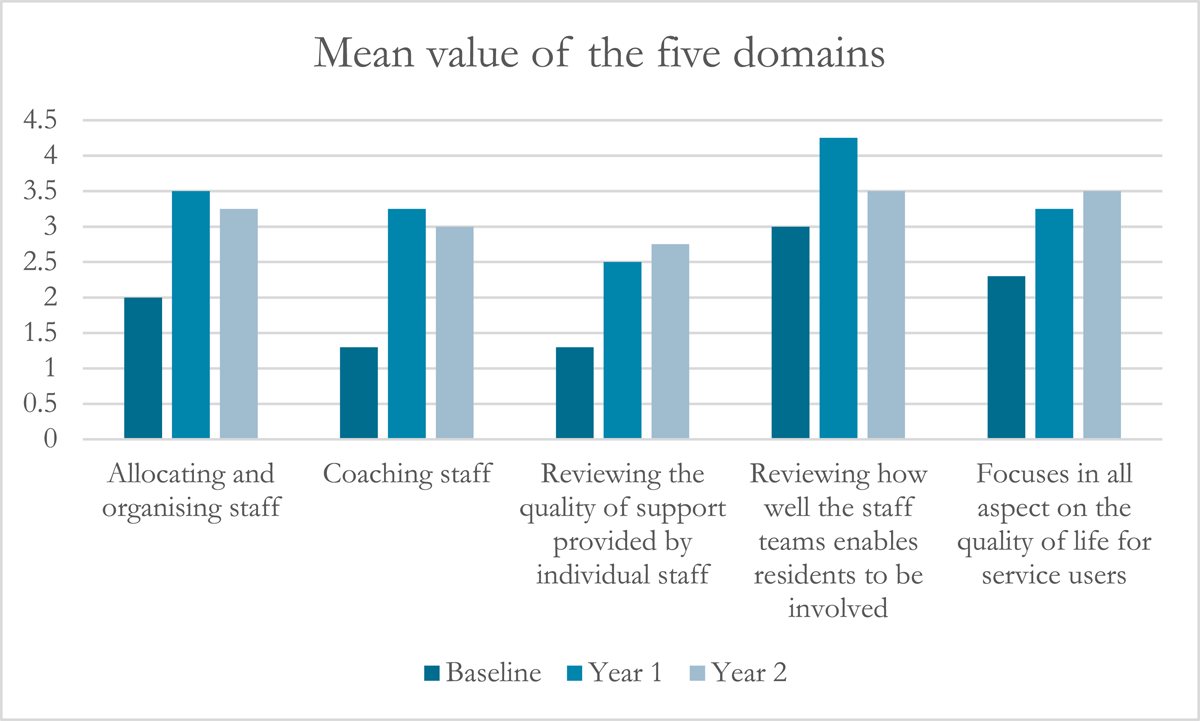
Figure 2
Mean value for the group homes across the five domains of the Observed Measure of Practice Leadership, measured at baseline before training, at year 1 and at year 2.
Field notes
A total of 49 field notes from observations in the four group homes were analysed to examine the presence of a practice leader. Of those observations, 12 baseline observations were conducted. Before the intervention, there were few indications that leaders were involved in everyday routines, that is, managing the group homes according to the five aspects of FPL. Of these 12 initial baseline observations, only two in group home A indicated the presence of the manager, and only one field note demonstrated a management style that can be viewed as FPL. This includes being a leader who is present, participates in daily work, and provides feedback.
Another 37 observations were carried out after Active Support and FPL was introduced (for an overview, see Figure 3). The field notes demonstrated that a leader was more present in year 1, with 33% rather than 17%, but the substantial improvement of a present leader was mainly seen in year 2 (69%). This improvement was mostly seen in year 2 in group homes B and D, which had senior support workers conducting observations and being practice leaders. Also, signs of Active Support were seen in the day-to-day folders and administrative work. An introductory folder for newly hired temporary staff was created by the managers to introduce Active Support to them.
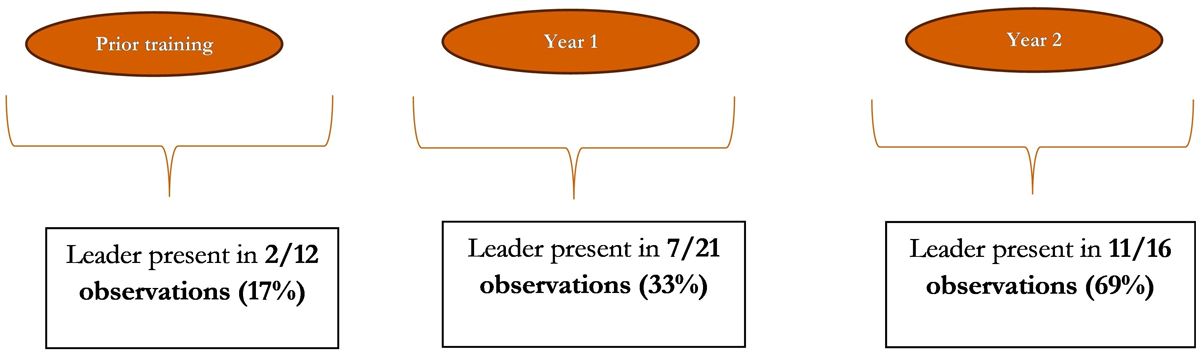
Figure 3
The presence of a Practice Leader in four group homes (found in field notes), divided into three time points (prior to training, year 1 after training and year 2 after training).
It was common for the first observations, carried out initially with the trainer, to be followed by a short discussion with the trainer. One field note for group home A demonstrated the presence of FPL and a discussion following the observation:
The manager observed the staff and provided individual feedback. More open-ended questions [when providing feedback] may be considered in the future but it is a learning experience. The manager enjoyed providing feedback afterwards and thought it went better than expected. In the autumn, the manager is planning to observe all staff and provide feedback.
However, there were also signs of the absence of FPL. One field note from group home D in year 1 demonstrated the absence as follows: ‘The practice leader was supposed to supervise and give feedback in the afternoon but had changed shift and forgotten about it.’
Examples of there being an active practice leader were found mainly after a senior support worker or new manager had been trained in FPL. Visual signs of practice leadership were found in group home D in year 2 during observation. The observer wrote:
The practice leader was present during the whole shift and was working with service users. The practice leader has already conducted six observations and provided feedback to other staff.
Interviews with managers
The interviews with managers were conducted one year after training and generated the following themes: Being the leader, Being an observer and supervisor at the same time, and If one had more time.
Being the leader
The first theme, Being the leader, concerns managers’ main responsibilities after training. In interviews, their views on their management role were in line with the principles of FPL. When reflecting upon their role as a manager, two managers stressed the importance of tasks such as administrative work, budget and working with the staff to improve overall performance, while another manager stressed the importance of supervising the staff to focus on the quality of life for service users. Manager 3 described many different aspects of the managerial position, such as employing new staff, staying in contact with stakeholders and family members, prioritising safety and responsibility for budget and finances.
Manager 1 explained that the management position was like being the leader of an organisation and highlighted leadership skills as important in being a manager:
My responsibility is to make them [staff] cooperate well. To allow them to grow in their positions and work together. At the same time, I am the link between what comes from senior management in the organisation and down to the group home, and the other way around. There are agreements and policies that require us to work in a certain way. //I see myself as a team leader who is leading the team. But not being part of the daily work. Because I really don’t. But I can be part of coaching and supporting them [staff].
Manager 2 described the most essential responsibility as providing a good quality of life for people with intellectual disabilities. This view was in line with FPL:
Overall, the group home should ensure a good life. That is the most central aspect. And to do that, we need to follow the regulations reflected in law, agreements that may not involve the service users directly, but we still need to do it. And to provide good support, the staff’s working environment needs to be decent. And the financial situation needs to be stable.
All managers highlighted the laws and regulations and their role in following and making sure that these were met. The managers also commented that the organisation usually had organisational objectives which they were working towards. They stressed that clearly written regulations were important to ensure good living conditions. The managers reflected on their own role in providing a sustainable working environment where each person could learn individually as well as be a team member.
Being an observer and supervisor at the same time
One aspect of FPL is conducting observations and providing feedback sessions for support workers. The managers all had a positive view of the feedback sessions but had no previous experience of conducting either observations or feedback sessions. However, they had differing views about who should perform them. Manager 2 suggested that any suitable person in the team could conduct the feedback sessions.
Manager 3 reflected on the different experience of conducting observations in those two homes:
They [observations] are very enjoyable and interesting. We’ve reflected upon different aspects of situations and I’ve noticed differences. In the first group home, they were like ‘Yes! We haven’t had much time for reflection before.’ And then the observations have been a great help in the sense that I’ve become aware of more aspects of support work. And the next step has been to continue working on it. We haven’t had time yet, but I hope we will in the near future. In the second group home, I had different responses from staff. Some have been defensive, or explained things. That’s been interesting too. That we’ve had a discussion about support. Everything from ‘I understand’ to feelings of awkwardness at being observed by the manager. All aspects.
However, Manager 2 believed the managerial role remained equivalent after the training and suggested that someone else could conduct the observations and feedback sessions:
And observing staff, that’s difficult when you’re managing several group homes. It’s hard to achieve when you’re already fully booked. Then I believe it’s better to delegate it to someone who can observe more and learn how to conduct observations, and it becomes part of their role. It’s just hard when you’re more than a certain number of staff and you’re managing group homes located in different parts of the city.
Only Manager 3 was regularly providing feedback sessions according to the FPL training. Manager 1 and Manager 2 suggested that senior support workers could learn to become practice leaders and conduct feedback sessions. After the interviews with the managers, the implementation process was adjusted to accommodate their opinions, and two experienced senior support workers were trained to become practice leaders instead of two of the managers. Only one manager, who had scheduled time to work with Active Support, remained responsible for practice leadership.
If one had more time
All three managers described the lack of time as an obstacle to providing practice leadership. They agreed that all aspects of practice leadership were valuable for them and for feeling in control but saw time as both a facilitator and a barrier. Manager 3 explained:
And then the practice-based leadership. In the best of worlds, you really wish there was a lot more time for that. Because I’ve felt it now, imagine if you could work more like that. Imagine if you could work more evenings. // I think it’s great. But it’s kind of an organisational issue.
Manager 2 also said that issues that cannot wait usually have to be prioritised. If there were issues which had to be dealt with instantly, then the more long-term ones—like improving quality in the group homes—had to wait. There were too many tasks requiring immediate action and others were therefore delayed. Manager 1 also felt that having the responsibility for more than two group homes was an obstacle. Manager 2 had recently taken over another group home and was thus in charge of three.
There’s a difference between three and two [group homes]. It’s very noticeable. With two, you can do a little more qualitative work and think more about what goals we should have and reach. That all the pieces should fit together. With three, it’s … Then you have to prioritise things.
All three managers struggled to combine their administrative work with tasks that focused on everyday support, no matter how many or how few group homes they were responsible for.
Discussion
The aim of this study was to examine the two-year effect of FPL training in four Swedish group homes. Two research questions were examined: 1) What was the effect of implementing FPL in Swedish group homes? 2) Were any adaptations necessary for the Swedish context?
The findings demonstrate a positive effect of FPL training. Practice leaders were more present in the daily support in the group homes after training, and the practice leaders conducted observations with feedback sessions to the support workers to improve the quality of support.
Equally, observations of and interviews with managers demonstrated that important features of FPL had been implemented. The improvement across the five domains in the Observed Measure of Practice Leadership (Beadle-Brown, Bigby, and Bould 2015) was substantial from baseline to year 1 in three group homes measured, and in year 2 for all four group homes, where it remained on the same level or slightly declined. However, improvements across the four group homes were seen particularly in the domains of Reviewing the quality of support provided by individual staff and Focuses in all aspects on the quality of life for service users. These are the two domains which didn’t decline at year 2 and continued to be improved. These results can be compared with a recent, larger study about FPL in Australia by Bigby and Humphreys (2024b). Their study of 12 participating organisations and FPL showed a substantial increase in the Observed Measure of Practice Leadership between 2013 and 2018, but a decline in scores between 2018 and 2022. They concluded that these results demonstrate the precarious role of practice leadership in organisations, and that improvements may decline (Bigby and Humphreys 2024b). The findings in the present study suggest that improvements did not substantially decline in the second year, which suggests that even after two years, the positive effect of the training could still be found in the four participating group homes. However, to be able to fully compare our results with the study by Bigby and Humphreys (2024b), there is a need to follow up the results after a longer period (preferably five or 10 years).
All the managers emphasised in the interviews that the observations and feedback sessions were important to improve the quality of practice and overall team performance. The feedback sessions were new for the managers, and they had no previous experience of anything similar. The observations and feedback sessions allowed all support workers to analyse situations with a leader and discuss how to develop performance. These findings are in line with previous research into managers’ views about good practice (Deveau and McGill 2016). In Deveau and McGill’s work (2016), managers stressed the importance of observing individual staff members along with service users to improve overall staff performance. In the present study, the managers emphasised the importance of providing feedback as well as discussing support for people with intellectual disabilities at team meetings. These results are also in line with the FPL model, in which team meetings are an important part of supervising and improving support for people with intellectual disabilities.
The process of implementing new practices demands both adaptation and fidelity (see von Thiele Schwarz et al. 2019). The same online training was used as in the original version from Australia, and every attempt was made to implement training in a manner consistent with the Australian version (for training modules, see Bigby and Humphreys 2023; Bigby and Humphreys 2024a). The author is not aware of any deviation. However, the interviews with the managers revealed an important adaptation of the FPL. Two managers discussed their difficulty in providing feedback regularly and raised issues such as obstacles preventing them from being involved in everyday activities, having many competing tasks such as administrative duties, and difficulty being present when one is responsible for two group homes located in different geographical areas. The managers further suggested that an experienced senior support worker may become a practice leader. After their suggestions, two senior support workers were trained in FPL, along with a new manager during the second year. They were encouraged to observe and facilitate feedback sessions. The field notes also showed that this adaptation improved the occurrence of feedback sessions during year 2, and that the senior support workers conducted more observations of the staff than the managers during year 1.
Research from implementation science indicates that adaptations are sometimes necessary in a new environment. Lengnick-Hall et al. (2020) demonstrate that there is no ideal level of adaptation to achieve sustainability, but that adaptation is rather a vibrant and contextually steered process. In this study, one of the five aspects of practice leadership was modified (i.e. observe, provide feedback and instruct the staff). Observations could be delegated to senior support workers, whereas other aspects were performed by managers. This might reflect a potential for distributed leadership within the Swedish context (see Hasselgren, Dellve, and Gillberg 2021).
The role of the frontline practice leader
According to the field notes, the presence of a practice leader improved in year 2. This was when the senior support workers received training in FPL in group homes B and D. One reason for this improvement may be that senior support workers already work closely with everyday support in Swedish group homes and are more involved in the day-to-day practices than managers. In the field notes, the senior support workers stressed the importance of being present on site to conduct observations, be a role model and supervise staff. These findings are supported by research from Australia, which describes the importance of being present in the group home. In Bigby et al.’s work (2020, 280), one feature of predicting good Active Support is the closeness of a practice leader: ‘FPL functions reside with staff who are close to the everyday management and running of the service. They work alongside staff and have both formal and incidental opportunities for observation, modelling and coaching.’
The practice leader role may be more easily carried out by senior support workers, or managers with responsibility for fewer group homes who already work in a supervisory and pedagogical capacity. Senior support workers are tasked with improving the quality of support and supervising support workers (The National Board of Health and Welfare 2021). However, the individual’s ability to perform tasks, show engagement and have the skills to become a practice leader is more important than any formal requirements or a specific educational background.
Strengths and limitations
One strength of this study is the longitudinal design with two years of follow-up. This is clearly superior to a cross-sectional design that might have missed potential decreases in effect in the long term. Another strength is the triangulation of data, such as interviews with managers, observational field notes and the Observed Measure of Practice Leadership (Beadle-Brown, Bigby, and Bould 2015). This range of methods makes it possible to examine both the subjective experience of managers and the observational results.
Nevertheless, some limitations need to be addressed. Firstly, the researcher who organised and trained the staff was the same person who collected the data, which can be considered both a strength and a limitation. It allowed the research project to be followed by the same researcher through the whole process, and the staff and people with intellectual disabilities became familiar with the researcher. This created a friendly atmosphere, and the presence of the researcher created minimal disturbance of routines. However, having the same researcher collecting the data and initiating the intervention could introduce bias. To limit this likelihood, all data was analysed after the intervention ended. Another limitation of the study is that the Covid-19 pandemic made it difficult to collect data during baseline, which resulted in baseline data not being collected in one group home. This was not the case in the other homes, which were examined at different time points. Also, the longitudinal effect may be influenced by the change in practice leaders during the first year. The results might have been different if the same practice leaders were followed for two years. Thirdly, the observations may have been vulnerable to biases because the participants might have altered their behaviour since they knew that they were being observed. Paradis and Sutkin (2017) suggest that researchers should invest in interpersonal relationships to ease the effects of altered behaviour. In this study, the researcher became familiar with the participants to minimise the risk that the presence of an observer may have on the behaviour of those being observed. Furthermore, no psychometric assessment of the Swedish version of the Observed Measure of Practice Leadership was possible in this study, since only one researcher was trained in FPL and could examine the five domains across the measure. Furthermore, in future studies, the experiences of people with intellectual disabilities when introducing FPL in services will need to be explored further. This could make a valuable contribution to the research field and to explore, through the voices of people with intellectual disabilities, how the managers’ role impacts the lives of people with intellectual disabilities.
Conclusion
Interviews, observational notes and the Observed Measure of Practice Leadership (Beadle-Brown, Bigby, and Bould 2015) demonstrate that the training resulted in FPL increasing. However, the results are not entirely positive; they demonstrate the difficulty in always having a leader on site. The current study also indicates that after the training, observations of the staff allowed them to discuss and reflect upon their support routines and organise them in line with the model. This was considered valuable by both the staff and managers. The results also suggest that some adaptations of practice leadership tasks, especially observations and feedback sessions, can benefit the intervention by maintaining Active Support skills and helping staff to stay focused on Active Support and to improve support. Observations can be successfully carried out by a senior support worker as an alternative to a manager with too heavy a workload. This was an exploratory study and more research in a Swedish setting is needed to follow up these first results.
Acknowledgements
I would like to thank all support workers and managers who have generously participated in this study.
Competing Interests
The author has no competing interests to declare.