
1. Introduction
In the context of a changing global landscape, organizations face the challenge of balancing their objectives, the responsibilities of social actors, and the needs of employees. Uncertainty about the future, increasing pressure to adapt to new realities, and economic slowdown affect both organizations and employees. Recently, social policymakers have become increasingly vocal in their calls for mobilizing, including, and empowering the workforce across various demographic and ability groups. Their focus is on psychosocial well-being, social inclusion, and sustainably achieving organizational goals.
Embracing diversity helps align with diverse customer needs and promotes innovative work processes. Additionally, it presents cultural challenges that inclusive leadership (IL) can help mitigate (Shah et al. 2022). While existing literature recognizes the important role of organizational inclusion and its benefits for both employees and organizations, little attention has been given to understanding its impact on included employees. It remains uncertain whether a sense of inclusion relates to an individual’s perception of their significance in the workplace.
Both IL and work mattering (WM) are emerging research topics in social psychology and organizational management that have separately demonstrated similar social functioning and benefits. The construct of ‘mattering’ was introduced by Morris Rosenberg and B. Claire McCullough (1981) after discovering the social element of adolescent self-esteem, and has subsequently been explored in different populations and settings (Bierman et al. 2024; Paradisi, Matera, and Nerini 2024; Etherson et al. 2024; Mahamid et al. 2024; Bahl et al. 2023). In terms of managerial implications, mattering has been addressed in the literature as one of the aspects of work that is important to employees (Pychyl et al. 2022; Mohamed et al. 2022; Bonhag and Upenieks 2023; Thornton 2024), without linking it to any leadership style.
Mattering is acknowledged as a crucial concept, intricately linked to an individual’s sense of self-esteem and life’s purpose (Paradisi, Matera, and Nerini 2024). As emphasized by Ellington (2023) and Flett (2022), mattering plays a fundamental role in fulfilling the human need for uniqueness, self-esteem, and identity. The idea of mattering reinforces the significance of individuality by delivering social recognition and affirmation, which are indispensable for upholding a stable self-concept (Ellington 2023; Flett 2024). Moreover, it contributes significantly to inclusion by recognizing and reciprocating social connections between individuals (Prilleltensky 2020), fostering gender equity (Lombard and Cheryan 2023) and belonging (Thijm 2023), especially in remote work or educational settings. These effects may enhance inclusive practices by empowering employees with disabilities in diverse and inclusive settings (Shah et al. 2022).
To explore mattering in organizational contexts, it was deemed purposeful to turn to relational leadership styles such as IL, which aims to create an environment where all employees feel valued, respected, and included. Prior research highlights the positive effects of organizational inclusion and mattering on employee well-being, motivation, creativity, job satisfaction, and results.
The literature on IL highlights its potential to enhance psychological safety and empower individuals to voice their opinions (AlMunthiri et al. 2024; Zeng, Zhao, and Zhao 2020), reduce workplace bullying (Shafaei et al. 2024), and foster innovative work behavior (Bao 2024). However, the perception of inclusion and mattering—particularly among employees with disabilities—remains underexplored. Little is known about how IL can shape these perceptions in disability-diverse workplaces. To address this gap, the present study investigates the impact of IL behavior on perceived WM among employees with disabilities. It also explores the reciprocal dynamics between IL and WM within disability-diverse organizational settings. This objective is supported by findings from AlMulhim and Mohammed (2023), who identified dignity at work—conceptually linked to WM—as a mediator between IL and innovative work behavior, one of IL’s key organizational benefits (Bao 2024; Lee and Seo 2024; Tian and Zhang 2020; Gupta et al. 2022; AlMulhim and Mohammed 2023; Li and Tang 2022).
This study is grounded in the social model of disability, which conceptualizes disability as the result of structural and attitudinal barriers rather than individual impairment (Oliver, 1990). In organizational contexts, this perspective emphasizes the systemic role of workplace design, human resources (HR) policies, and leadership practices in enabling or constraining participation. Recent empirical research supports this view (e. g., Korkmaz et al. 2022; Liu et al. 2024; Zhu et al. 2025), showing that IL can mitigate perceived disability stigma and enhance employee well-being through mechanisms such as recognition, inclusion, and empowerment. Building on these insights, the present study examines the reciprocal relationship between IL and WM among employees with disabilities.
Data were collected through a survey of employees with disabilities in Lithuania (N = 239). Statistical analysis using IBM SPSS Statistics for Windows, Version 23.0 (IBM Corp. 2015) included the Mann-Whitney U test, the Kruskal-Wallis test with Bonferroni correction, and regression analysis to assess the effects of IL and demographic variables on perceptions of WM.
2. The Concept of Mattering
Originally conceptualized as ‘direct reciprocal of significance’ by Rosenberg and McCullough (1981), mattering articulates the human need to feel significant to other people (Flett, Khan, and Su 2019). Mattering has interpersonal and social dimensions that differ slightly across personal and organizational contexts.
2.1 General mattering
General mattering captures interpersonal and societal dimensions of significance in personal environments. Interpersonal mattering refers to the perception of one’s significance to important people in one’s life (family, partner(s), close friends), while societal mattering reflects one’s perceived value and influence within society, including the belief in one’s ability to effect change (Rosenberg and McCullough 1981; Prilleltensky 2020; Schmidt et al. 2020). Based on reciprocity (i.e., feeling valued and giving value), mattering can be fully experienced through interaction with others (Prilleltensky 2020). Sufficient levels of mattering are linked to various psychosocial benefits such as enhanced self-esteem and positive self-perceptions (Besser et al. 2022), greater stress resilience, and reduced levels of depression and anxiety (Giangrasso et al. 2022). It also offers protection against mental health issues and loneliness (Flett and Heisel 2021; Bierman et al. 2023; McComb et al. 2020) while supporting recovery and well-being, particularly among vulnerable groups (Matera, Meringolo, and Reino 2021; Bahl et al. 2023). Conversely, insufficient mattering, or anti-mattering, has been associated with lower life satisfaction, emotional regulation difficulties, stress, distress (Giangrasso et al. 2022), loneliness (McComb et al. 2020), self-criticism, and depression (Flett, Khan, and Su 2019), thereby hindering individuals’ ability to socialize, work, and thrive.
2.2 Work mattering
Jung and Heppner (2017) observed an important additional dimension of mattering in organizational settings: next to the interpersonal dimension of mattering (IWM) towards colleagues and supervisors, societal mattering at work (SWM) is observed through the perceived importance of one’s work towards the broader community. This expanded the understanding of mattering by showing that individuals at work extend their SWM to the results of their work. Contrary to general mattering focusing primarily on interpersonal significance, WM aims to evaluate both interpersonal and societal levels of mattering perceptions, which facilitate the measurement of employee well-being through the lens of mattering.
Positive effects of WM have been confirmed in multiple studies involving individuals and organizations. Organizational research has shown the influence of mattering on various aspects of employee well-being and engagement. Mohamed et al. (2022) and Jung and Heppner (2017) emphasized the connection between IWM and SWM, along with factors like work engagement, work meaning, job satisfaction, and positive effect. Additionally, Haizlip et al. (2020) found that mattering reduces burnout risk and increases engagement at work, perceptions of meaningfulness, and social support from colleagues. Mattering may boost job satisfaction, dedication, and engagement, thereby supporting employees’ psychological well-being and strengthening organizational commitment (Prihadi, Chang, and Lyann 2021). Dadfar, Lester, and Sanadgol (2021) discovered that mattering can lower social isolation, improve peer communication, and foster a sense of belonging. Moreover, mattering can mediate between social relationships at work and psychological distress, thereby enhancing mental health and stress resilience (Bonhag and Upenieks 2023; Flett, Long, and Carreiro 2022), which is especially important during times of uncertainty and change, from adolescence through life transitions to vulnerability.
2.3 Mattering across demographics
Despite the universality and adaptability of mattering, numerous studies have examined differences in mattering perceptions and effects across demographic groups, with age, gender, education levels, and job position being most widely investigated. The impact of mattering has demonstrated disparate effects across demographic groups in both personal and organizational settings.
According to Rosenberg and McCullough (1981, 179–180), the need for mattering increases during teenage years and with increasing age. After retirement, the perceived loss of mattering often stems from others no longer depending on the individual. A study by Pearlin and LeBlanc (2009) found a stronger mourning-induced loss of mattering across older, female, lower-income, and lower-educated respondents. The loss of mattering negatively affected their self-esteem and mastery levels, which are important to self-esteem. In line with the expected decrease of mattering after retirement, the loss was mitigated by the social support of family and friends and by socialization. Mattering has shown a protective effect against stress and allostatic load. Taylor, McFarland, and Carr (2019) found that this effect increases with age, thus protecting older workers from health risks.
A representative longitudinal study by Taylor and Turner (2001) examined the working population aged 18–55 in Toronto, providing insights into disparities of general mattering across genders. Women, respondents with higher levels of education, and in a romantic relationship were more likely to feel higher levels of mattering, while age and marital status did not show any influence. Higher female perceptions of mattering were more positively impacted by higher education and negatively by work-family conflicts, while men’s mattering was more positively influenced by romantic relationships and having children, and negatively by stressful relationships. Age was positively correlated with autonomy and more responsibilities, whereas various responsibilities and flexible working conditions resulted in higher mattering. Similarly, Scarpa, Zopluoglu, and Prilleltensky (2022) reported that higher incomes, advanced degrees, and employment were most consistently associated with higher mattering in the US sample. The research of Jung and Heppner (2017) showed mattering in work environments to be more correlated with job characteristics and position than with gender and age, which corresponds to the results of Bonhag and Froese (2022), who found differences in female mattering to be rather small, and more pronounced when it came to subjective social class, employment, parenthood, worship attendance, and political party affiliation. Women gain mattering from interpersonal attachments in terms of romantic relationships, parenthood, friendships, and closeness to family, whereas men’s sense of mattering is significantly impacted by broader social and civic factors.
Despite numerous evidence of the protective and healing effects of mattering in educational (Flett, Long, and Carreiro 2022; Etherson et al. 2024; Besser et al. 2022; McComb et al. 2020; Mohamed et al. 2022) as well as clinical and counseling settings (Pernice et al. 2017; Bahl et al. 2023; Marco et al. 2022) to date, little interest has been shown in the differences in mattering across populations with disabilities. A study of people living with HIV and those with disability by Matera, Meringolo, and Reino (2021) confirmed mattering and social connections to have a positive impact on minority groups’ welfare. However, scant focus has been placed on the integration of vulnerable employees into communities or organizational settings, and the corresponding effect on their sense of mattering at work. Furthermore, studies to date have been conducted across many countries (mostly Canada and the US, as well as Spain, Italy, Israel, and Egypt) but the central and northern parts of Europe have received a paucity of scientific interest in this field. The present research aims to widen the research geography and demographics, thus expanding scientific understanding of mattering in inclusive organizational settings.
3. A Concept of Inclusive Leadership
With the growing diversity of societies and work tasks, an inclusive culture is becoming increasingly relevant. The need to include diverse people in organizations, enabling them to participate fully in their teams, is one of the goals of IL. This leadership style responds to the need for organizations to care for their people while simultaneously unlocking the potential to turn individual differences into sustainable organizational strength and success.
IL is associated with Nembhard and Edmondson (2006), who defined it as ‘words and deeds by a leader or leaders that indicate an invitation and appreciation for others’ contributions’ (ibid, 947). A central feature of IL is leader inclusiveness—their active efforts to include others in discussions and decisions, particularly those whose voices might otherwise go unheard. This involves directly inviting, acknowledging, and valuing diverse input, especially from less-represented team members. IL is primarily directed toward creating psychological safety in the workplace, both in highly competitive, fast-paced environments such as hospitals and in contexts involving marginalized employee groups. A psychologically safe environment empowers individuals by validating their opinions and input, reducing status-related barriers (Zeng, Zhao, and Zhao 2020), enhancing engagement, courage, and self-efficacy.
IL builds upon Optimal Distinctiveness Theory (ODT) by Brewer (1991), which posits that individuals seek both belonging within a social group and the ability to maintain their uniqueness. In this inclusion model, leaders see followers’ differences not as threats but as individual strengths that enhance the group. By enabling authenticity and reducing perceived threats, IL supports individuals’ freedom to be themselves, thus fostering psychological safety. This, in turn, allows people to contribute to the group through their distinct perspectives and qualities.
Hierarchical individualistic leadership styles can hinder inclusive practices. Emphasizing individual achievement and competition often creates exclusive environments where employees feel pressured to conform and hesitate to express their views or innovate. Research shows that even when employees are encouraged to speak up, they may remain reluctant to challenge authority (Nembhard and Edmondson 2006; Randel et al. 2018). To foster an inclusive culture, leaders must value followers’ uniqueness while cultivating a shared sense of belonging (Randel et al. 2018). Demonstrating openness, accessibility, and availability encourages employees to voice ideas and express their needs. In such psychologically safe environments, individuals are empowered to offer perspectives different from their leaders’ without fear of negative consequences (Carmeli, Reiter-Palmon, and Ziv 2010).
Tailored to include, respect, and empower minority groups, IL supports social responsibility, environmental, social, and governance (ESG) goals, and compliance with social policy, while also offering various organizational benefits. Research increasingly links IL to greater knowledge sharing and enhanced creative and innovative behaviors (AlMunthiri et al. 2024; Gupta et al. 2022; Çetinkaya and Yeşilada 2022), often through the mediating role of psychological safety (Lee and Seo 2024; Carmeli, Reiter-Palmon, and Ziv 2010; Javed et al. 2019). IL has also been associated with reduced workplace bullying and improved employee self-esteem (Shafaei et al. 2024). Inclusive and safe work environments facilitate organizational learning (Lundqvist et al. 2023; Nembhard and Edmondson 2006) and collaborative problem-solving, fostering continuous improvement and process excellence. They also contribute to a stronger sense of ownership and thriving at work (Zeng, Zhao, and Zhao 2020), increased commitment and engagement (Choi, Tran, and Park 2015; Shah et al. 2022), and improved retention (Kuknor and Bhattacharya 2022; Hanh Tran and Choi 2019).
Despite the increasing body of scholarly literature addressing the principles, challenges, and advantages associated with IL for diverse minority groups, individuals with disabilities and other vulnerable populations continue to be predominantly neglected. These groups warrant greater scholarly attention, not only due to persistent employment gaps and the relevance of inclusion frameworks embedded in social policy, but also because of the civic responsibility to ensure that their voices are heard in workplaces and society. Existing theoretical reviews of workplace disability inclusion rarely examine its impact on those included. Most research to date has focused on comparing the implementation and outcomes of inclusion across sectors and organizational types. This study seeks to address this gap by examining how IL and socio-demographic factors shape the sense of mattering among employees with disabilities.
4. Methods
4.1 Participants and procedure
The sample was selected using purposive sampling. The criteria for inclusion in the sample were threefold: the respondent must be of working age, have a job (not unemployed), and have a manager-subordinate relationship (i.e., have a manager or have subordinates, or both). To ensure that all Lithuanian individuals with disabilities could participate in the study regardless of age or field of activity, we distributed the invitation and the link to the questionnaire to disability associations listed on the official registry of organizations. We also searched for respondents on the professional social network LinkedIn. This approach allowed us to reach potential respondents and organizational environments characterized by highly educated employees, workforce diversity, varied job roles, a focus on social inclusion, and availability of blended or remote work options. Finally, 239 respondents met the criteria and completed the questionnaires. Official statistics indicate that about 30 per cent of people with disabilities of working age in Lithuania were employed during the research period. Considering gender imbalance in the sample, it should be noted that in social studies relying on voluntary participation, women tend to participate more actively than men (Smith 2008).
The sample distribution by socio-demographic characteristics is presented in Table 1.
Table 1
Socio-demographic characteristics of the respondents.
| VARIABLE | N | % | |
|---|---|---|---|
| Gender | Male | 63 | 26 |
| Female | 176 | 74 | |
| Age | <35 | 78 | 33 |
| 35–54 | 110 | 46 | |
| >54 | 51 | 21 | |
| Job tenure | <1 | 42 | 17 |
| 1–3 | 64 | 27 | |
| 4–6 | 35 | 15 | |
| 7–9 | 11 | 5 | |
| >9 | 87 | 36 | |
| Position | Managerial | 39 | 16 |
| Non-managerial | 200 | 84 | |
| Disability type | Autism spectrum disorder | 2 | 1 |
| Mobility impairments | 29 | 12 | |
| Sensory processing disorders | 4 | 2 | |
| Speech and language disorders | 3 | 1 | |
| Hearing impairments | 7 | 3 | |
| Cognitive impairments | 2 | 1 | |
| Mental disorders | 16 | 6 | |
| Visual impairments | 83 | 35 | |
| Not specified | 93 | 39 | |
| Total | 239 | 100 | |
The age range has been split into three distinct groups to investigate whether varying mattering and IL perceptions may have been shaped by Lithuania’s particular historical background during the careers of the respondents. The country regained its independence from the former Soviet Union only in 1990. Respectively, it was deemed purposeful to analyze differences between three age groups. The first group included Lithuanians born in the last 34 years, who were raised and educated promoting European values and have developed their entire working career in independent Lithuania. The second group included those aged 35–54, who have experienced employment in both Soviet and independent periods. The third group consisted of those 55 years or older, whose values were shaped by the Soviet era, including their acceptance of or opposition to Soviet ideology and its specific attitudes towards employees, their gender, age, abilities and characteristics, position, and manager.
4.2 Measures
The responses were collected using an 18-item questionnaire that is used to collect depersonalized demographic data and measurements of research variables. The responses were gathered between October 26, 2023, and January 26, 2024. Preceding data collection, participants were informed about the purpose of the survey, their right to discontinue responding at any time, and the depersonalized aggregated use of data for the study.
The respondents completed the online questionnaire by rating their agreement with the items using a 5-point Likert scale (1–Not at all, 2–A little, 3–Somewhat, 4–Moderately, 5–Very much).
4.3 Work mattering
WM, consisting of societal (SWM) and interpersonal (IWM) dimensions (perceived societal impact of one’s work and one’s mattering toward colleagues, respectively) was measured using the work mattering scale (WMS) developed and validated by Jung and Heppner (2017). Positively phrased items such as ‘I feel my work meets a societal need’ for SWM and ‘My coworkers/colleagues appreciate my support and help’ for IWM were rated using a 5-point scale to measure perceptions of one’s work impact on society and interpersonal mattering towards colleagues at work. The WMS has been used in recent studies (Mohamed et al. 2022; Haizlip et al. 2020) directed in organizational settings.
4.4 Inclusive leadership
IL was measured using the scale developed and verified by Carmeli, Reiter-Palmon, and Ziv (2010). It is aimed to assess employees’ perceptions of three inclusive behavioral dimensions of their direct supervisors, that is, openness (‘My manager is open to hearing new ideas’), availability (‘My manager is available for consultation on problems’), and accessibility (‘My manager encourages me to access him/her on emerging issues’). Items were rated using the 5-point scale. This scale has been used in numerous organizational studies (Choi, Tran, and Park 2015; Katsaros 2022; AlMunthiri et al. 2024; Çetinkaya and Yeşilada 2022).
5. Results
To determine significant variations in the perception of mattering based on gender and position group, the Mann-Whitney U test was conducted. This assessment is utilized to contrast differences between two separate sets of data when the variable being measured is either in ordinal form or continuous but does not follow a normal distribution. To examine the differences in mattering evaluation among different age and job tenure groups, we conducted a Kruskal-Wallis test with the Bonferroni correction. Subsequently, a Dunn-Bonferroni post hoc analysis was performed to identify significant differences between pairs of groups. To investigate the potential relationship between IL and mattering along with its dimensions, a Spearman correlation analysis was carried out. Finally, we conducted a linear regression analysis to determine if IL could predict mattering among individuals with disabilities. The research model is shown in Figure 1.
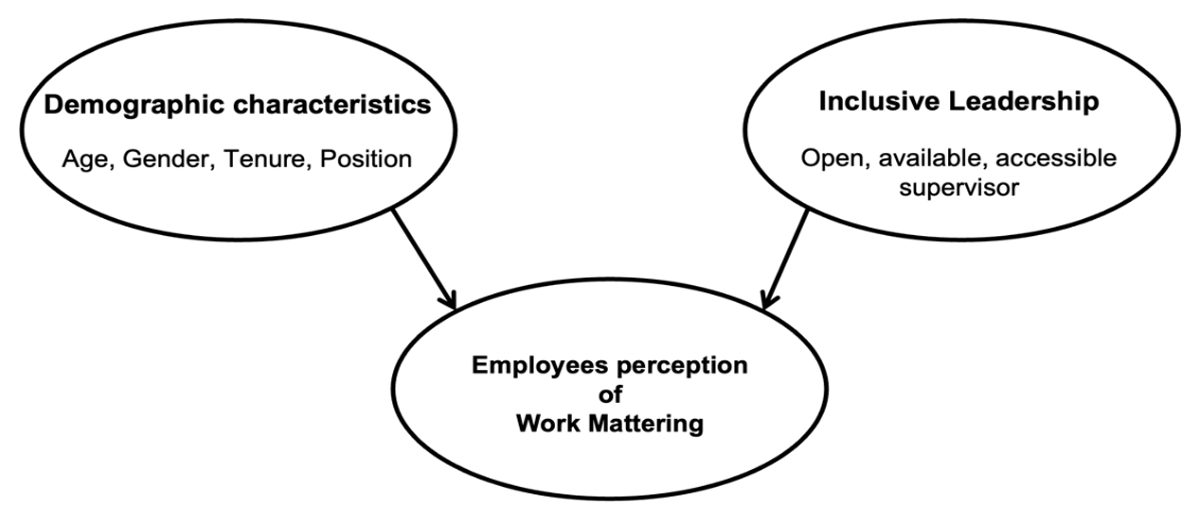
Figure 1
Research model.
Source: developed by the authors.
5.1 Relationship between IL and WM
The analysis of the survey results was conducted starting with the correlation analysis used to examine the relationship between IL and WM. The results of the correlation analysis confirmed statistically significant positive reciprocal relationships between variables. IL was most strongly correlated with IWM (0.536), followed by SWM (0.351) (Table 2).
Table 2
Correlations between IL and mattering dimensions.
| VARIABLE | SWM | IWM |
|---|---|---|
| IL | 0.351** | 0.536** |
[i] ** p < 0.01.
To further examine the predictive role of IL on WM, linear regression analyses were conducted to infer causality between IL and WM perceptions and evaluate the supportive effect of IL on mattering perception at work. A model of IL predicting individual WM dimensions has shown different predictive impacts of IL on SWM and IWM (Table 3).
Table 3
Linear regression analysis predicting WM.
| PREDICTOR | Β | P | T | R2adj | WM DIMENSION |
|---|---|---|---|---|---|
| IL | 0.317 | <0.001 | 5.134 | 0.097 | SWM |
| 0.530 | <0.001 | 9.618 | 0.278 | IWM |
[i] β —estimated value of standardized regression coefficient (Beta); R2adj—adjusted R-squared (coefficient of determination); p—significance level.
It appeared that IL explains 9.7% of the variance in SWM (F(237) = 26.453, p < 0.001) (Table 3) and 27.8% of the variance in IWM (F(237) = 92.512, p < 0.001).
Summarizing the above, our assumptions have been validated through correlation and regression analyses showing that the perceptions of mattering among employees with disabilities can be partially impacted by a suitable relational management approach, that is, IL. The results supported the argument that IL can enhance employee perception that they and their work matter. Given the attention of IL on fostering uniqueness and belonging, the research results infer mattering as an additional effect of managerial inclusivity on employees.
5.2 Demographical differences
To evaluate potential demographic differences in mattering perceptions, a Mann-Whitney U test was used to determine significant variations in the perception of mattering based on demographical characteristics, that is, gender, tenure, age, and work position.
5.3 Gender
The analysis by gender revealed higher SWM and IWM perceptions in some aspects (p < 0.05) by female employees. Female respondents perceived that their work influenced people’s lives, and they also received feedback from people that their work influenced their lives. Lastly, female employees reported appreciation from their colleagues for their ideas, suggestions, support, and help (Table 4).
Table 4
Gender differences in WM perceptions.
| ITEM | GENDER | N | MEAN RANK | MANN-WHITNEY U | p |
|---|---|---|---|---|---|
| People say that my work influenced their life | Male | 63 | 101.08 | 4352.000 | 0.009 |
| Female | 176 | 126.77 | |||
| My work influences people’s lives | Male | 63 | 99.09 | 4226.500 | 0.004 |
| Female | 176 | 121.49 | |||
| My coworkers/colleagues value my ideas and suggestions | Male | 63 | 104.06 | 4540.000 | 0.028 |
| Female | 176 | 125.70 | |||
| My coworkers/colleagues appreciate my support and help | Male | 63 | 92.66 | 3821.500 | 0.001 |
| Female | 176 | 129.79 |
5.4 Tenure
Further analysis was conducted to evaluate statistically significant differences in mattering perceptions based on work experience. Employees who had worked at their current company for four to six years were more likely to believe that their colleagues would be disappointed if they left, compared to those who had been with the company for ten years or more (Table 5).
5.5 Age groups
The next step of demographic analysis was evaluating mattering perceptions among three age groups of the respondents. Age was found to significantly impact SWM, which was found to increase with age. The youngest respondents reported lower perceptions that their work had societal value than both older groups (p = 0.012, p = 0.032) and that their work aligned with societal goals (p = 0.004). The youngest group received less feedback on their work influence on people’s life (p = 0.007, p = 0.001), and had weaker perceptions of general influence of their work on people’s lives (p = 0.027, p = 0.003) (Table 6).
Table 6
WM perceptions across age groups.
| ITEM | AGE GROUP | N | MEAN RANK | χ2 | p |
|---|---|---|---|---|---|
| I feel that society values the work I do | <35 | 78 | 100.48 | 10.053 | 0.007 |
| 35–54 | 110 | 128.73 | |||
| >54 | 51 | 131.03 | |||
| I feel my work meets a societal goal | <35 | 78 | 97.40 | 13.911 | 0.001 |
| 35–54 | 110 | 128.86 | |||
| >54 | 51 | 135.45 | |||
| People say that my work influenced their life | <35 | 78 | 96.58 | 15.555 | 0.000 |
| 35–54 | 110 | 126.85 | |||
| >54 | 51 | 141.06 | |||
| My work influences people’s lives | <35 | 78 | 106.68 | 11.339 | 0.003 |
| 35–54 | 110 | 117.02 | |||
| >54 | 51 | 146.80 |
5.6 Gender differences among age groups
A deeper analysis was performed to examine differences in WM perceptions by different age groups and genders. Females reported stronger SWM if they felt their work influenced people’s lives. However, the most significant differences were observed in IWM: females had stronger perceptions of IWM than males in nearly all aspects. Female employees felt they mattered to their colleagues and perceived that their colleagues valued their input and appreciated their support more than male employees (Table 7).
Table 7
WM perceptions by gender in the 35–54 years age group.
| ITEM | GENDER | N | MEAN RANK | MANN-WHITNEY U | p |
|---|---|---|---|---|---|
| People say that my work influenced their life | Male | 34 | 41.01 | 799.500 | 0.001 |
| Female | 76 | 61.98 | |||
| My work influences people’s lives | Male | 34 | 39.44 | 746.000 | 0.000 |
| Female | 76 | 62.68 | |||
| I feel like I matter to my colleagues/coworkers | Male | 34 | 46.78 | 995.500 | 0.048 |
| Female | 76 | 59.40 | |||
| My coworkers/colleagues value my ideas and suggestions | Male | 34 | 41.46 | 814.500 | 0.001 |
| Female | 76 | 61.78 | |||
| My boss/supervisor would be disappointed if they knew that I may leave my job | Male | 34 | 46.25 | 977.500 | 0.036 |
| Female | 76 | 59.64 | |||
| My coworkers/colleagues appreciate my support and help | Male | 34 | 38.81 | 724.500 | 0.000 |
| Female | 76 | 62.97 |
5.7 Differences by work position
As indicated in the literature, work specifics and position may also affect employee mattering perceptions. Our analysis revealed that managers tend to report higher IWM. They perceived that their colleagues and bosses would be disappointed if they left, and that coworkers appreciate their support and ideas. This effect is not similarly relevant in SWM, where managerial and non-managerial respondents perceive similar levels of WM (Table 8).
Table 8
Different interpersonal mattering perceptions among managers and non-managers.
| ITEM | POSITION | N | MEAN RANK | MANN-WHITNEY U | p |
|---|---|---|---|---|---|
| My coworkers/colleagues would be disappointed if they knew that I may leave my job | Managerial | 39 | 149.17 | 2762.500 | 0.003 |
| Non-managerial | 200 | 114.31 | |||
| I feel like I matter to my colleagues/coworkers | Managerial | 39 | 151.26 | 2681.000 | 0.001 |
| Non-managerial | 200 | 113.91 | |||
| My coworkers/colleagues value my ideas and suggestions | Managerial | 39 | 154.35 | 2560.500 | 0.000 |
| Non-managerial | 200 | 113.30 | |||
| My boss/supervisor would be disappointed if they knew that I may leave my job | Managerial | 39 | 146.23 | 2877.000 | 0.008 |
| Non-managerial | 200 | 114.89 | |||
| My coworkers/colleagues appreciate my support and help | Managerial | 39 | 140.08 | 3177.000 | 0.040 |
| Non-managerial | 200 | 116.09 |
In summary, our study demonstrates that perceptions of SWM are influenced by the age and gender of the respondents. SWM is higher among females and respondents over the age of 35. Females aged 35–54 tend to have a higher sense of SWM compared to males in the same age group. Also, the perception of the IWM varies according to position, tenure, and gender. In general, females tend to perceive IWM as more important than males. This trend is particularly notable among females aged 35–54 in comparison to males in the same age bracket. Regarding tenure, the medium length of service (4–6 years) is associated with a heightened sense of IWM, whereas a service length exceeding 10 years is associated with a reduction in this type of WM. Finally, a managerial work position is related to a higher perception of IWM when compared with a non-managerial role. The findings of the study are presented in graphical form in the Model of Employee Mattering through IL (Figure 2).
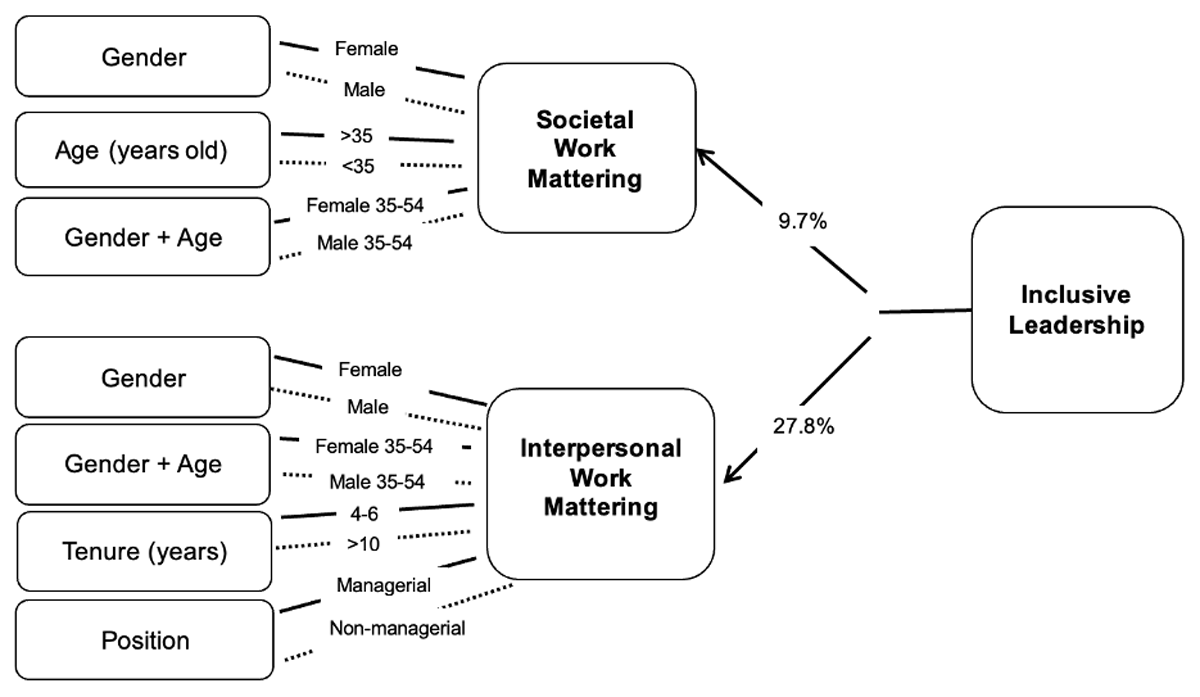
Figure 2
Model of employee mattering through IL.
Source: Developed by the authors.
 Demographic characteristic increasing WM perceptions.
 Demographic characteristic decreasing WM perceptions.
To summarize, the study results confirmed an assumption regarding the predictive power of IL on perceptions of WM. IL has a clear influence on both WM dimensions, with the most significant impact being on IWM. The results of different WM perceptions by demographic factors suggest that different aspects of mattering may result in different perceptions based on gender, age, tenure, and work position.
6. Conclusions and Discussion
Our study confirmed the connections between perceptions of WM and the inclusiveness of the work environment. Inclusive leadership behavior was found to boost perceptions of WM, and conversely, higher levels of WM increased perceptions of IL. Additionally, regression analysis showed that IL could significantly predict the variance in both dimensions of WM, especially IWM. This suggests that inclusive leaders play a vital role in strengthening the sense of importance of employees with disabilities, particularly regarding how they perceive their importance to colleagues.
The analysis of individual characteristics has revealed different patterns of WM perceptions across various demographics. Regarding the SWM, younger respondents tend to assign less social value and importance to their work compared to older individuals—this trend is evident, with the youngest reporting a lower perception of all aspects of WM. It might possibly be because younger individuals tend to be more mobile in their careers, seek self-fulfillment, and explore different roles until they find one that provides fulfillment and meaning. However, further research is needed to uncover the underlying causes of this phenomenon.
Our investigation revealed that gender impacts both SWM and IWM, with females indicating elevated levels in both aspects. Females perceive their work as having a greater impact on the lives of others (SWM), whereas males report receiving less recognition for their contributions, recommendations, and assistance (IWM). These gender disparities become more pronounced during midlife: males aged 35–54 report significantly lower levels of SWM and IWM than females in the same age group. In contrast, younger people (up to the age of 35) show no significant gender differences in perceptions of mattering. Notably, the IWM gap widens further in midlife, as males feel increasingly unappreciated by co-workers and supervisors. Similar patterns in general mattering were reported by Taylor and Turner (2001) and Bonhag and Froese (2022), who found that female mattering tends to be shaped by interpersonal factors, while male-perceived significance is linked to broader civic and social factors.
Regarding tenure, our findings show that years of service impact WM, particularly IWM. Employees with average tenure exhibit elevated IWM levels, whereas those with extended tenure demonstrate diminished levels. This pattern underscores the need for tailored motivational strategies to support both early-career and long-serving employees in maintaining emotional well-being and career engagement.
Finally, job position also affected perceived mattering. Managers reported higher levels of IWM, likely due to a stronger sense of their importance to colleagues than non-managerial employees. This trend was consistent across nearly all aspects of IWM. Similar results were found by Scarpa, Zopluoglu, and Prilleltensky (2022), who linked higher mattering to higher income, autonomy, and responsibility. In contrast, our demographic findings diverge from those of Jung and Heppner (2017), who reported no significant differences in WM across age, gender, and work positions. Future research could explore mediating factors that explain these discrepancies.
In summary, this study offers new insights into how WM varies among employees with disabilities. Our research may assist organizations and people with disabilities in acknowledging the role of mattering in psychosocial wellness and the capability of IL to enhance it.
6.1 Theoretical implications
This study advances theoretical understanding by reinforcing a systemic view of organizational functioning in the context of disability inclusion. The reciprocal relationship between IL and WM highlights how leadership behaviors and employees’ sense of significance mutually reinforce each other. The findings position mattering as a key psychological mechanism within inclusion-oriented frameworks, linked to engagement, organizational identification, and inclusive workplace dynamics.
6.2 Practical and managerial implications
From a practical standpoint, the study emphasizes the value of fostering IL and recognizing employee significance as part of everyday organizational practice. Promoting visibility and psychological inclusion can strengthen leadership effectiveness and support fairer work environments for employees with disabilities. By focusing on IL and WM, this study advances disability inclusion research and reflects the legal and ethical commitments to non-discrimination and equal opportunity outlined in both international (CRPD,1 EU Directive 2000/78/EC2) and national (Lithuanian Social Integration Law3) frameworks.
7. Limitations and Future Directions
There are a few factors that can influence the reproducibility of research findings. Although the size of the study sample of employees with disabilities was in line with the demographics, thus ensuring the statistical validity of the results, the present study focused exclusively on employed individuals of working age. Consequently, the generalizability of the findings to the wider population of individuals with disabilities—including those unemployed or retired—may be constrained. Additionally, the study had a relatively limited number of participants from managerial positions compared to non-managerial employees, which may have an impact on the accuracy of the results regarding differences between these two groups. Finally, the gender imbalance among the participants—with a greater number of female than male respondents—may influence the conclusions regarding gender differences in the population. On the other hand, the greater activity of female participants in the survey may be indicative of a greater focus on work-related matters. Further research is required to confirm or refute this assumption.
From a methodological standpoint, the cross-sectional quantitative design limited the depth of understanding of participants’ lived experiences. While the statistical approach offered broad insights, the study could have benefited from a mixed methods design. In particular, the inclusion of free attitude interviews or key informant interviews with employees and managers might have uncovered nuanced perceptions of IL and WM, as well as the social and cultural dynamics surrounding them. Future research should consider integrating qualitative methods to deepen interpretation and provide richer contextual insights.
Theoretically, the study provides initial evidence of a potential reciprocal relationship between IL and employees’ sense of mattering. This dynamic interplay warrants further exploration, especially through longitudinal or experimental designs. Future studies could expand on this by investigating how perceptions of mattering might not only be influenced by leadership behavior but also shape leaders’ inclusive behaviors over time.
Future research could consider the role of potential mediators and moderators in this relationship. Constructs such as psychological safety, organizational culture, perceived organizational support, or employee voice may serve as important mechanisms that either amplify or buffer the effects of IL on WM and related outcomes. Understanding these pathways would contribute to a more comprehensive theoretical model and inform targeted organizational interventions.
Notes
Competing Interests
The authors have no competing interests to declare.
Author Contributions
Agota Giedrė Raišienė and Justina Budreikaitė made substantial contributions to data collection, analysis, and interpretation of the research findings. Violeta Rapuano contributed to data analysis and interpretation. All authors contributed to the writing of the manuscript and have read and approved its final version.