
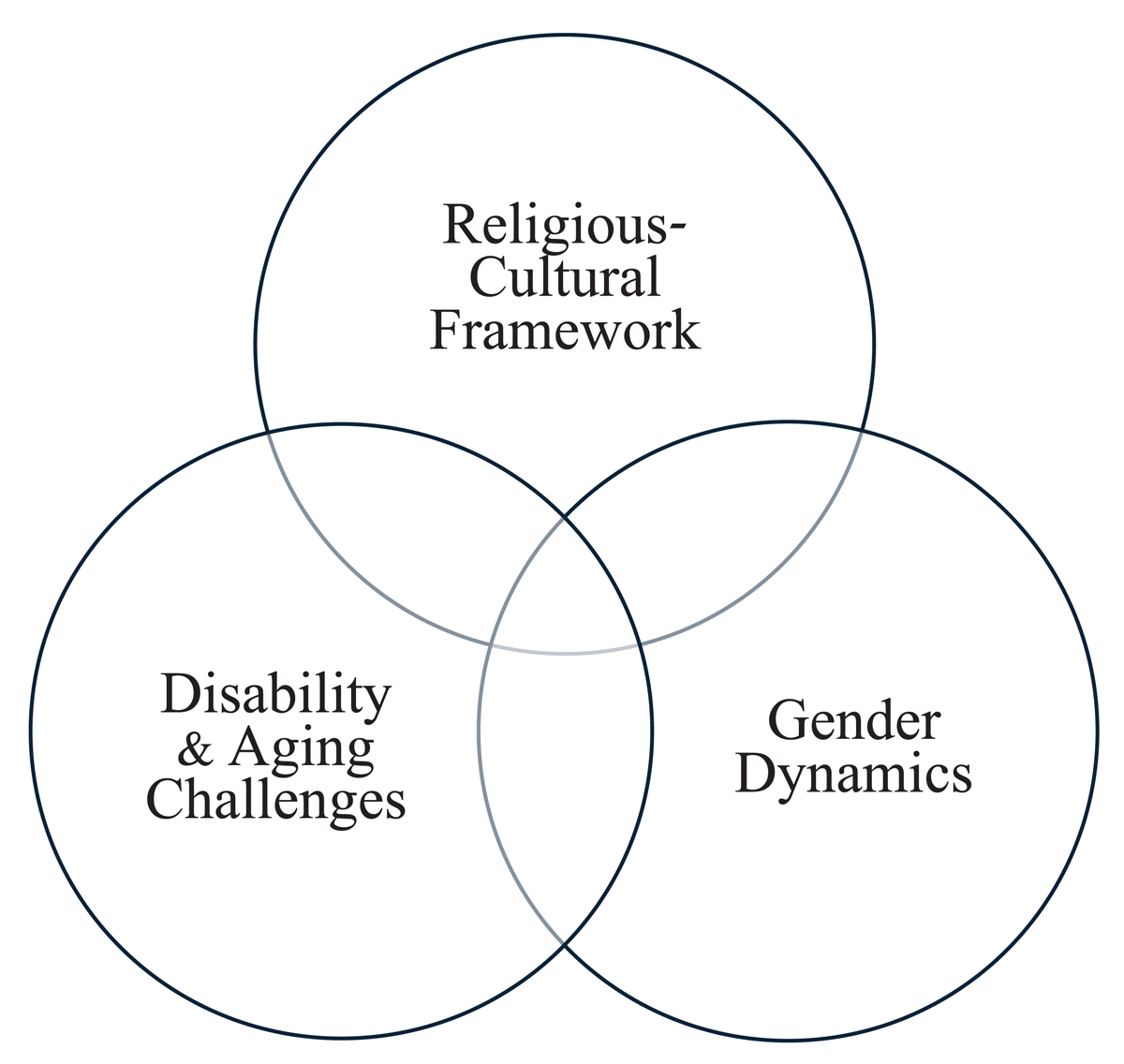
Figure 1
Venn Diagram representing components of the Integrative Model of Family Care.
Table 1
Characteristics of participating families (N = 16).
| COMMUNITY | CAREGIVER | AGE | CARE RECIPIENT AGE | DISABILITY TYPE |
|---|---|---|---|---|
| Haredi | Mother-Shifra | 75 | 54 | Severe CP + Moderate IDD |
| Haredi | Mother-Dorit | 70 | 45 | Moderate IDD + Hemiplegia |
| Haredi | Mother-Rachel | 78 | 47 | Severe Autism + Moderate IDD |
| Haredi | Mother-Miriam | 78 | 47 | Severe IDD |
| Haredi | Sister-Nechama | 56 | 50 | Moderate IDD |
| Haredi | Brother-Netanel | 34 | 54 | Moderate Autism + Mild IDD |
| Haredi | Sister-Sarah | 48 | 47 | Moderate IDD |
| Haredi | Sister-Chaya | 48 | 47 | Mild IDD |
| Haredi Avg | Parents: 75.3 | Siblings: 46.5 | 48.9 | |
| Muslim | Mother-Walaa | 65 | 43 | Moderate IDD |
| Muslim | Mother-Amira | 76 | 41 | Severe CP + Severe IDD |
| Muslim | Mother-Samira | 76 | 46 | Moderate IDD |
| Muslim | Mother-Fatima | 76 | 44 | Severe Autism + Moderate IDD |
| Muslim | Sister-Yasmin | 57 | 40 | Mild IDD |
| Muslim | Sister-Limor | 68 | 59 | Moderate IDD |
| Muslim | Brother-Omar | 36 | 42 | Mild IDD |
| Muslim | Sister-Noor | 36 | 41 | Moderate IDD + Hemiplegia |
| Muslim Avg | Parents: 73.3 | Siblings: 49.3 | 44.5 |
Table 2
Themes, Subcategories, and Representative Examples of Intimate Care in Faith-Based Communities.
| THEME | SUBCATEGORIES | REPRESENTATIVE EXAMPLES | NUMBER OF MEANING UNITS | EXPLANATION |
|---|---|---|---|---|
| Theme 1: Intimate Care as Preservation of Family Honor | Family unity | ‘Caring for him reflects the respect we give to our parents.’ | 11 | Demonstrates the importance of shared responsibility within the family. |
| Respecting parents | ‘This is what being a family is all about.’ | 11 | Highlights the cultural norm of honoring and prioritizing parents. | |
| Preserving dignity | ‘Even in the smallest details, we maintain dignity.’ | 12 | Reflects the cultural and moral value of treating individuals with respect. | |
| Modesty | ‘I didn’t see this being done modestly.’ | 8 | Addresses how modest behavior is tied to preserving family honor. | |
| Theme 2: Intimate Care as an Act of Religious Kindness | Religious duty | ‘This act is done with devotion and faith.’ | 13 | Shows how caregiving is perceived as fulfilling a religious obligation. |
| Fulfilling religious commandments | ‘It’s both a mitzvah and a way to show kindness.’ | 13 | Links caregiving to specific religious practices and values. | |
| Connecting with God | ‘Through this, I feel closer to the divine.’ | 10 | Demonstrates the spiritual connection fostered through caregiving. | |
| Internal appreciation | ‘It feels like angelic work, motivated by belief.’ | 9 | Reflects the inner sense of fulfillment and purpose through faith-based caregiving. | |
| Theme 3: Intimate Care as a Means for Self-Improvement | Personal growth | ‘Caring for him is to make me more sensitive, a kind of prayer.’ | 12 | Highlights how caregiving fosters emotional sensitivity and spiritual development. |
| Faith and resilience | ‘You can despair, and it won’t help you. However, you can see it as a true test of faith.’ | 10 | Shows how individuals use caregiving as a way to build resilience. | |
| Acceptance of others | ‘My role is to expand the circle of containment and acceptance of the other and the different.’ | 8 | Reflects how caregiving encourages inclusion and acceptance of diversity. |