
Background
The quest for independent living has been an integral part of the disability rights movement from its inception (Zames Fleischer and Zames 2011). For disabled persons, independent living means being able to live life on one’s own terms in the community with the necessary support (Morris 2004). However, disabled persons can be overprotected (Sanders 2006), making it more difficult for them to live an independent life and be included within their communities. They experience struggles to get involved in continuing education, employment and leisure activities, with limited opportunities to socialise with others and gain social skills.
Many persons with intellectual disabilities experience overprotection within their family environment. Alesi and Pepi (2017) explain that family overprotection experienced by persons with intellectual disabilities can arise from misleading conceptions about these individuals. These misconceptions may result from the prejudice that the label intellectual disability brings with it. Jacinto et al. (2021) found that some family members were aware that their overprotective attitude acts as a barrier to their relatives when it comes to participating in physical activities.
As mentioned by Hutchinson and Sandvin (2019), those who live in institutions also experience overprotection and a lack of opportunities to make decisions. The authors describe how some persons with intellectual disabilities ended up living in an institution because of overprotection, without any say in the decision of where to live. Moreover, persons with intellectual disabilities living within an institution also lack freedom of choice in everyday decisions, such as choosing what to eat, what to drink and at what time to sleep, as found by van der Meulen, Hermsen and Embregts (2018).
To participate in cultural life, recreation, leisure and sport is a way to support persons with intellectual disabilities with their social inclusion and it is also the right of every disabled person as per article 30 of the UNCRPD (2006). However, Merrells, Buchanan and Waters (2018) write that persons with intellectual disabilities encounter limited opportunities to participate in social activities, which makes them more vulnerable to experiencing social isolation. Tilly (2019) mentions that persons with intellectual disabilities are often denied the opportunity to social participation because of primary caregivers’ overprotection. Furthermore, Schleien et al. (2014) explain that primary caregivers tend to stop persons with intellectual disabilities from participating in social activities, as they may have concerns about their safety and well-being.
Within the Maltese context, the social participation of persons with intellectual disabilities is often impacted by parental overprotection (Vella and Xuereb 2021). Callus, Bonello and Micallef (2022) argue that, most of the time, persons with intellectual disabilities depend on others’ decisions and are held back from doing things they like, as the people they depend on may fear that they may get hurt. Therefore, they end up overprotecting them. Callus et al. (2019) found that many parents of persons with intellectual disabilities prefer that their adult children go to activities within a sheltered environment, so that they have their mind at rest about their safety. They also found that, with the right support services, overprotection can be avoided. This finding resonates with the results of our research, which is now presented.
Methodology
This research explored the lived experience of persons with intellectual disabilities and their primary caregivers in Malta in relation to independent living and overprotection. The research questions were:
How do persons with intellectual disability experience protection and overprotection in their lives?
What is the related experience of primary caregivers of a person with intellectual disability?
The methodology behind this research was Interpretative Phenomenological Approach (IPA). IPA is interested in analysing the lived experience of individuals, how they make sense of it and how this lived experience impacts their lives. IPA is founded on a double hermeneutic approach (Smith, Flowers and Larkin 2022), which considers the way that research participants understand and interpret their own lived experience and the way it is then interpreted by the researchers. Therefore, this research represents an intertwining of the lived experience of the participants as they presented it and the interpretation from our perspective as researchers through an inductive analysis of the data. Furthermore, this research is also broadly based on emancipatory disability research principles, which is as explained by Klein and Milner (2019), are in parallel with IPA, as they give ways and means for disabled persons to make their voice heard about their life experiences.
The research was originally carried out for Abner’s dissertation, which was supervised by Anne-Marie (Barbara 2023). Abner carried out and transcribed the interviews and processed the data, with the guidance of Anne-Marie. The data analysis and discussion were then revisited by both authors for the purpose of writing this article.
The research focussed on four persons with intellectual disabilities in order to analyse their situation in depth. Ethical approval was given by the University of Malta Research Ethics Committee. Participants were recruited through purposeful sampling via gatekeepers who disseminated the information letter. Those interested contacted Abner and provided their informed consent to participate in the research. The participants were four persons with intellectual disabilities, two male and two female, and their primary caregivers, who all happened to be their mothers. Further information about the participants is provided in Table 1. Pseudonyms are used and potentially identifying information is not disclosed.
Table 1
Participants.
| NAME (AGE) | PARENT (AGE) | LIVING WITH | DAYTIME ACTIVITY | EVENING/WEEKEND ACTIVITIES | USE OF DEVICES |
|---|---|---|---|---|---|
| Reuben (26) | Gillian (59) | Parents and siblings | Work | Going out with friends Special Olympics training | Mobile: Unsupervised (to communicate with others and to listen to music) Computer: Unsupervised (for browsing) |
| Philip (26) | Mary (59) | Parents and siblings | Day Centre | Staying home with parents or going out with parents | Mobile: Unsupervised (uses mobile to call his parents and relatives and to listen to music) Computer and tablet: Does not own one |
| Nicole (21) | Katie (54) | Parents and siblings | Day Centre | Staying at home or going to support groups | Mobile: Forbidden to use it Tablet: Mostly unsupervised (to listen to music) |
| Jana (19) | Josephine (55) | Parents and siblings | Work and School | Special Olympics training Going out with friends | Mobile: Unsupervised (to communicate with others and to listen to music) Computer: Unsupervised (for school and for leisure time) |
Semi-structured interviews were conducted through two interview schedules, one for the persons with intellectual disabilities and one for their primary caregivers. The persons with intellectual disability were asked if they gave their consent for their mothers to speak about them. They all agreed to this. A debriefing session was also held after each interview in which participants were asked about their interview experience. No harmful experiences were reported by the participants.
Verbatim transcripts from these interviews were created. Participants had the opportunity to check the transcripts and make changes. The transcripts of the mothers and two of the participants with intellectual disabilities were sent by email. For the other two participants with intellectual disability, who could not read, Abner met and read them the transcript, making sure they understood it by checking with them several times to make any necessary changes.
All transcripts were analysed individually and exploratory noting was done. The direct quotations that stood out the most from the interview transcripts were singled out. This helped in eliciting the overarching themes and subthemes from the data, which are presented and discussed in the next section.
Findings and Analysis
The participants are presented in Table 1.
Table 1 indicates Reuben and Jana have similar life circumstances as do Philip and Nicole. The overarching themes elicited from the data demonstrated clear patterns of the effect of promoting empowerment for Reuben and Jana and creating overprotection for Philip and Nicole. On the one hand, Jana and Reuben have many opportunities to experience independent living through being employed and having an active social life. These opportunities have enabled them to further develop their independent living skills and, in turn, empower themselves further. On the other hand, Philip and Nicole live sheltered lives and do not enjoy many opportunities to develop skills related to independent living. This situation entrenches their experience of overprotection.
Consequently, the overarching theme of empowerment is related to Jana and Reuben’s situation and the overarching theme of overprotection is related to Philip and Nicole’s. The sub-themes elicited for each of these overarching themes are presented in Figures 1 and 2. The sub-themes mirror each other, thus showing how the different factors can lead to either independent living or overprotection. The arrows in these figures reflect the way in which the different factors affect each other.
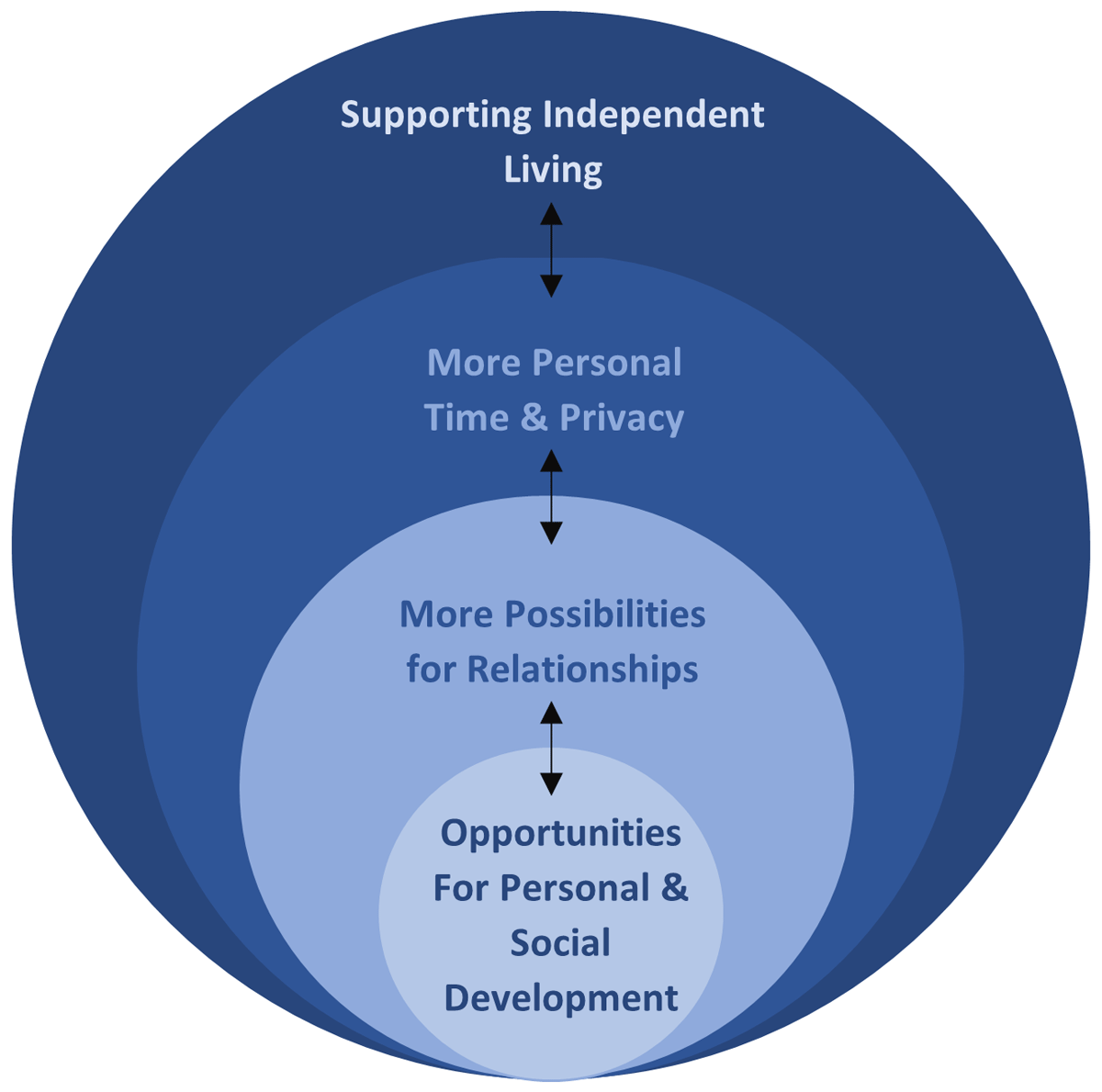
Figure 1
Experiencing independent living.
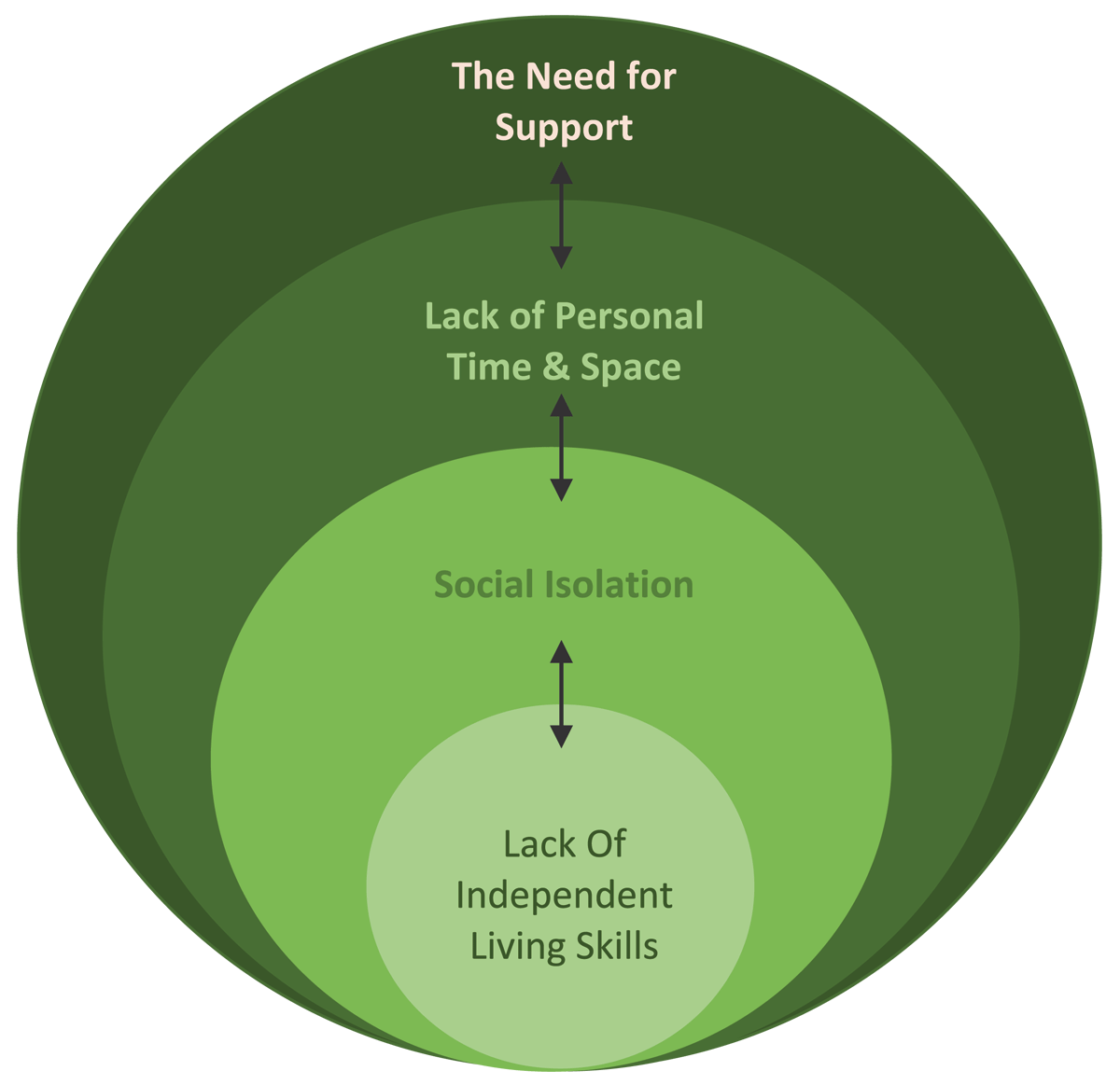
Figure 2
Experiencing overprotection.
Experiencing Independent Living
Figure 1 presents the first overarching theme, the experience of independent living. The three sub-themes, starting from opportunities for personal and social development and moving to more possibilities of relationships and more freedom and privacy. Having these opportunities does not mean that Reuben and Jana do not receive any support. The role of support in their lives is discussed in the last part of this theme.
Opportunities for personal and social development
Jana and Reuben, the participants who have opportunities to actively develop their independent living skills, attended a post-secondary vocational college. The continuation of their educational experience helped them to learn more, gain employability skills and socialise with other peers of their age outside college hours. Moreover, going to college served as another opportunity for them to develop other skills, for example, to use the bus on their own.
Thanks to further education, Reuben and Jana also found it easier to enter the world of work (Ryan et al. 2019). Employment, in turn, has provided them with opportunities for further skills development and financial independence (Shogren et al. 2015). Additionally, while at work, they have the opportunity to meet and socialise with workmates (Garrels and Sigstad 2021).
Furthermore, both participants have an active social life outside of work. Reuben plays a sport with Special Olympics and participates in activities organised by a disability organisation for a group of young people. Jana is also with Special Olympics, as an athlete and a committee member/trainer. In this role, Jana assists other athletes, coaches and also parents of disabled persons within the organisation. Being members of organisations which work specifically with persons with intellectual disability means that, at certain times, Reuben and Jana are in a relatively sheltered environment. That said, this membership promotes their personal development. They explained how they are closely involved with their particular groups and organisations and how important these are for them. Through Special Olympics, both participants have the opportunity to meet with their friends.
Jana – Yes, two. Either at school or at the Special Olympics.
Reuben: I have friends that are really close to my heart. They treat me like family. I have friends from Special Olympics, from Equal Partners as well, from the Down Syndrome Association and I also have friends from my locality as well. Even on the from my place of work.
These activities are an integral part of Jana and Reuben’s lives. Through them, they continue to develop their skills, gain new ones and enjoy different opportunities.
More possibilities for relationships
The various activities that Reuben and Jana engage in also enable them to develop different types of relationships, at home and outside it, in mainstream and in disability-specific environments.
Gillian, Reuben’s mother, and Josephine, Jana’s mother, and the rest of their families, have played a crucial role in this process. During their interviews, both mothers mentioned several times the importance of their children gaining independent living skills and living independently as much as possible.
Josephine: Alone. Before, we used to give her a lift and we would stay there. We kept doing this until she was sixteen or seventeen. However, lately we have started empowering her to start going out by herself. We showed her how and now she is going out on her own.
Gillian: I would like him to learn how to drive a car, so that he does not depend on me anymore.
Abner: So you would like that he become more independent?
Gillian: Exaclty. Owning your own car will make you more independent.
The empowerment that Jana and Reuben received, especially from their mothers, was a facilitating tool that helped them in their independent living experience. For example, both ensured that their children learnt how to catch a bus to travel on their own. Jana picked up the skill from her mother and, for the latter, it is enough that she knows where Jana is going. Reuben was taught how to use the bus through a structured programme.
Mill, Mayes and McConnell (2010) found that empowerment is important for persons with intellectual disabilities to reach their goals. In fact, Reuben and Jana were not told how to live their life, but instead were empowered to become as independent as possible, whilst getting opportunities to explore life on their own. The enabling factors in their lives reinforce each other. Being empowered served to facilitate their educational, employment and sport experiences. These experiences, then, further promoted their empowerment.
Additionally, in their interviews, Jana and Reuben came across as having emotional and psychological maturity. Immordino-Yang, Darling-Hammond and Krone (2019) also observed that having the possibility to engage in social relationships and leading an active social life can lead to individuals achieving such maturity. Reuben expressed his determination by stating that he wants to get promoted at work, whilst Jana expressed her assertiveness by stating that she does not trust easily and that she wants to get to know people well before trusting them. Furthermore, their parents were also aware of their determination and assertiveness. For example, Josephine made reference to a particular episode Jana experienced at work and how she dealt with it:
There was this particular episode, where Jana was left working on her own. Even though her colleagues were supposed to assist her. However, she stood her ground. And I felt so proud of her.
Gillian said that when Reuben was determined to go out for a barbecue with his friends, he caught a bus on his own from one side to the other of the island.
I did not show him how to arrive at Mosta. He went all alone. He went to Valletta, and he knew which bus he had to take to meet his friends. His father called him to check if everything was fine, however, Reuben told him that there was no need to call him as he knew what he had to do.
Another important aspect in the lives of Jana and Reuben worthy of note is their experience of intimate relationships. Both mothers spoke comfortably about their respective child’s relationships.
Being assertive and determined means that Jana and Reuben can actively engage in meaningful relationships. These relationships, in turn, serve them to have a sense of belonging in the different groups of persons they interact with. As explained by Carter, Biggs and Blustein (2016), it is of utmost importance for persons with intellectual disability to feel this sense of belonging in order to move away from the risk of being marginalised. Reuben and Jana can also exercise their autonomy, which is a very important aspect in the experience of independent living (Neuman and Reiter 2017).
More personal time and privacy
Other important dimensions to independent living include having time on one’s own and having one’s privacy respected. Both Jana and Reuben have such opportunities. Reuben spends time alone at home when the other family members are out. At home, Reuben also has space to demonstrate his independent skills. His mother described how once she accompanied her daughter to a hospital appointment and Reuben was alone in the house and got hungry. Instead of waiting for someone to return and cook for him, Reuben decided to boil water and cook pasta for himself. His mother explained how she was very sceptical about Reuben’s cooking skills and she was also afraid that he might get hurt. However, he completed this task successfully. Jana also has the opportunity to experience freedom and has her own personal space as demonstrated below. Thus, both of them have opportunities to spend time as they would like to both at home and to meet freely with their peers or go on a date.
Garolera, Díaz and Noell (2021) assert that one of the barriers for persons with intellectual disabilities to have friendships is a lack of privacy. In the case of Reuben and Jana, having space and time on their own can be correlated with their opportunities to engage in meaningful relationships outside the family on their own terms. Jana’s mother, Josephine, recounted that when her daughter was younger, they used to accompany her when meeting her friends. However, as she grew older, they started to let her go out on her own, thus treating her as the adult that she is. In the case of Reuben, although he meets friends in activities organised by disability organisations, as noted in the quotation above.
Reuben spoke about doing activities with his friends – such as parties and going to the beach – on his own, although there is a ‘coach’ taking care of the group. It seems that, for him, being able to engage in leisure activities away from the family gives him the free space and time that he needs. Moreover, the fact that he uses the buses on his own and spends time on his own at home provides him with further freedom.
Enjoying personal time and privacy does not only promote opportunities for independent living, but also to engage in meaningful relationships with others. Fulford and Cobigo (2018) explained that it is very important for every individual to experience meaningful relationships, as it helps in enhancing their self-confidence. Reuben and Jana have a good level of emotional and psychological maturity, good self-confidence and know what they want to achieve in life. This maturity is further enhanced through the opportunities that they have to spend time doing their own things and have their own space.
Once again, we see the positive effects of independent living. The factors that contribute to opportunities for Jana and Reuben to experience independent living are not only related to the skills they have developed, their jobs and sport activities. They are also related to the relationships with other people that they have developed through these activities and, crucially, to the opportunities they have to enjoy time and space on their own and to engage in leisure activities with their friends. Through these latter opportunities, they have more possibilities to engage in meaningful relationships with others. These relationships are of utmost importance for them, as they contribute to their social participation and their wellbeing and provide them with support from their peers.
Supported independent living
Having freedom to live one’s own life and to exercise autonomy and enjoy independent living is not contradictory to receiving support. The complementarity of these two dimensions can be seen in Jana and Reuben’s life. It shows the importance of understanding independent living as Morris (2004) and other disabled activists have long defined it, as discussed above.
For Reuben and Jana, the support received is not provided in terms of direct assistance in carrying out activities of daily living, such as getting dressed or taking care of personal hygiene. Support is provided in decision-making processes and parents keeping an eye on their young adults with intellectual disability. In this regard, Reuben is more directly supported than Jana. He mostly attends activities organised by disability organisations and meets his friends there.
There was an incident at Reuben’s workplace where, due to a particular skin condition that he has, he put his hand inside his own shirt, which, one his colleagues interpreted this gesture as sexual harassment and reported him. His superiors called his mother about this. She explained to them that this was something normal for Reuben to do and everything was settled. However, his mother also noted that, although his superiors had received a report of misconduct by Reuben, they did not seek information from Reuben himself as they would have done with other workers, but instead they chose to call her.
Jana, on her part, goes out on her own and only needs to tell her mother where she is going to be.
Josephine: To show her that she does not need to lie to us. We would not yell at her. Just for the sake of doing so, even with her brother, I tell him, tell me that you are going to be at a specific place. So if something happens, I will know where to find you.
However, this does not mean that Reuben enjoys a lesser degree of self-determination than Jana. He exercises his autonomy through doing a job that he loves and engaging in sport and leisure activities that he enjoys. He also willingly contributes to the housework and, as with the pasta incident, he shows that he has more skills than he is sometimes given credit for. Support can thus promote independent living and should not be seen as contradictory to it. These findings echo those presented by Callus et al. (2019) who observed the role of parental support in the lives of persons with intellectual disability who are not overprotected.
Through good two-way communication between Jana and Reuben and their respective mothers, Jana and Reuben were able to receive decision-making skills from their mothers. Through supported decision-making, Reuben and Jana have gained independent living skills and were able to decide for themselves and make good decisions. Their mothers play an important role in all this, as Reuben and Jana are not treated as children, but are given guidance where necessary. For example, Reuben used to stay awake on his mobile and, because of this, he started struggling to wake up in the morning for work. Therefore, his mother told him to stop using his mobile phone when going to sleep so that he would be able to wake up on time for work. During the day, Reuben still uses his mobile on his own to communicate with his peers and also to order food online and to manage his finances through internet banking.
Hence, through supported decision-making, Reuben and Jana have gained adequate skills which facilitate their experience of independent living. Hence, they are able to decide for themselves, but are still provided with support if they need it. If this was not the case, Reuben and Jana would have likely remained dependent on others. As explained by Shogren et al. (2017), lack of supported decision-making would limit the opportunities of persons with intellectual disabilities to learn how to take decisions for themselves and leave them dependent on others to decide on their behalf.
The discussion of the findings so far has shown how independent living is promoted on both a social and a personal level. Attending post-secondary education, being in employment, practising a sport and engaging in leisure activities with their friends have enabled Jana and Reuben to enjoy an independent life, to continue developing their personal and social skills and to enjoy different types of relationships. Having a private space and time on one’s own have been shown to be another important dimension to independent living. Furthermore, the discussion showed how leading an independent life does not entail a complete absence of support. It entails, rather, the provision of support that promotes autonomy.
All this shows us how one thing led to another and made it easier for Jana and Reuben to experience independent living. Hence, a positive effect is quite evident. Since Reuben and Jana have the possibility to experience independent living, they have an active social life, which has facilitated the possibility for them to engage in meaningful relationships with others, whilst also being able to engage in intimate relationships. Hence, this shows us that both Jana and Reuben could experience freedom and having their privacy being respected, as well as to freely express themselves in many aspects of life. A different effect can be seen in the lives of the two participants who lead more overprotected lives, as discussed in the next section.
Experiencing Overprotection
The intertwining and reinforcement of different factors were also identified in the lives of the two participants with intellectual disability, Philip and Nicole. As seen above, their lives are much more limited than those of Jana and Reuben. They have few opportunities to learn independent living skills and to experience independent living, remaining more dependent on their parents. Furthermore, Nicole and Philip also have very limited opportunities to integrate with others and are quite socially isolated. They spend a lot of their time in a contained environment, either with their family or under the supervision of their support workers. These two participants can therefore be seen as leading overprotected lives. As noted by Buhagiar and Azzopardi Lane (2022) and Callus et al. (2019), overprotection is a barrier for persons with intellectual disability to experience independent living. As shown in Figure 2, the three sub-themes identified for the overarching theme of experiencing overprotection are lack of independent living skills, social isolation and lack of personal time and space. The provision of support services, for Philip and Nicole and also for their parents, as a way out of overprotection is discussed at the end of this section.
Lack of independent living skills
The interviews with Nicole and Philip depict of two significantly sheltered lives. Both attend a day centre and then spend most of the rest of their time with their family. At the day centre, Nicole would like to have more opportunities to experience independent living, as seen in this exchange:
Nicole – ‘There were times when I tried with my friends from the day centre. I would ask them let us go shopping. But…’
Abner – ‘But what?’
Nicole – ‘I cannot. I would like to try shopping.’
Abner – ‘So you would like to go out shopping on your own?’
Nicole – ‘Yes’
Going to and from home is also sheltered for these two persons. Nicole attends a group run by a disability organisation and is given a lift by her mother to and from the place where meetings are held. Philip was asked about using public transport:
Philip – No I do not use public transport alone because of other cars
Abner – So you never catch a bus on your own?
Philip – No, because I am afraid that the bus will get involved in an accident and I will get hurt.
Philip also stated that ‘I go out with my mother’ and would like to continue to do so.
Katie, Nicole’s mother, and Mary, Philip’s mother, themselves spoke about the limitations experienced by their adult children with intellectual disability. Both of them attributed these limitations to a lack of adequate support services for their children to experience independent living.
Mary recounted how her son has a medical condition which requires constant supervision. Hence, she stated that when Philip is not at home, he is supervised by the support workers at the day centre. At home, he is under the supervision of either herself or his father. She added:
I would like for Philip to have more opportunities to go out. I would like that if he requires some assistance, there will be someone available to assist him with his disability so that he can become more independent.
On her part, Katie also expressed the wish for her daughter Nicole to have more independent living skills. One of the skills that she identified was for Nicole to use the bus on her own. Katie stated that Nicole had a few sessions to learn this skills, but they were too few since she needs a lot of repetition to learn a new task. She herself tried to teach this skill to Nicole but it did not work out:
She doesn’t want to work with me. Because, for example, I used to tell her ‘let’s do this, let’s try it this way’ but she quarrels with me. She didn’t let me help her. She works better with someone else.
This situation shows clearly how the provision of support services would enable Nicole and her parents to break the cycle of overprotection. Katie also said that Nicole also has dyspraxia and social anxiety. Additionally, there was a time when she had depression and hardly ever left the house. This situation was exacerbated by the Covid pandemic. Eventually, Nicole started attending a day centre and then the activities of a disability organisation.
Prior to this time, she had started attending a post-secondary vocational college to develop her independent living and employability skills. But she did not want to continue attending and would constantly phone her mother to come and pick her up and take her home. The reciprocal effect of one factor on another can be seen from Nicole’s experience of mental health difficulties. Gilmore and Cuskelly (2014) explain that persons with intellectual disabilities who experience social isolation and loneliness are more likely to experience mental health difficulties. Mental health difficulties and being overprotected ended up feeding into and reinforcing each other.
The discussion so far shows that the experience of overprotection was not something that was deliberately imposed on Nicole and Philip. It happened despite efforts from their parents for them to become more independent and for a lack of adequate support services. In fact, both Mary and Katie expressed the wish for their son and daughter, respectively, to have more support and to have more options of how to spend their time. They both saw the fact that Philip and Nicole spend a lot of time with their them and/or their fathers as problematic and they would like them to gain more independence.
Katie – Things that she can do on her own. Not from an educational aspect. Not intelligent, but I would like her to become more independent, that is the correct word not intelligent, independent. That she is capable to be more independent.
Mary: What I would wish to see is for him to have more opportunities to go out, and since he requires support, there would be the facility of having someone available to help him due to his condition.
Since both of them have other conditions besides having an intellectual disability, they have additional support needs. The lack of adequate support, from outside the family circle, that tends to these needs has limited their lives. They are being held back from experiencing independent living as they spend most of their time with their parents or at the day centre. When they venture outside the home for other activities, there is always someone keeping a watchful eye on them. There is an element of fear impinging on Nicole and Philip’s daily lives. Katie explained that she fears that Nicole does not have the necessary skills to be out on her own, while Mary said that she would not dare let him go out on his own, due to his medical condition and his lack of independent skills. Their mothers’ fear of danger and possible harm compounds the overprotection that Philip and Nicole experience (Sanders 2006).
It can be said that lack of support services has fostered the experience of overprotection, with very limited opportunities for both of them to learn independent living skills. Because of this lack, they have remained highly dependent on their parents. As McKenzie and McConkey (2016) argue, parental fear can lead to the social isolation of persons with intellectual disability.
Social isolation
While Philip and Nicole are not totally socially isolated, the possibilities they have for social interaction are very limited. Opportunities to interact with people who are not members of their families are largely restricted to the day centre.
Nicole interacts with other persons with intellectual disability who attend the same disability organisation. Philip also goes out with his girlfriend and her mother. However, since neither Philip nor Nicole use public transport on their own, they are always accompanied by someone they know when they travel from one place to another. They have supervised transport to attend the day centre and their parents give them lifts for everything else. This situation means that they have limited opportunities to build friendships with others more freely (Merrells, Buchanan and Waters 2019).
Apart from this, Nicole and Philip also experience social isolation through restrictions in the use of communication tools, especially the mobile phone. Philip uses his phone to call his mother if she is working in the evening, to watch videos on YouTube and to go on Facebook. Neither he nor his mother, said whether he uses it to contact anyone else, either by phoning or, for example, through Facebook. Nicole said she used to be on Facebook and was in contact with a number of people through it. However, she deleted her Facebook account because she was bullied. She has a tablet which she uses to find songs to sing to. She also plays The Sims on her PlayStation. She used to have a mobile but Katie said that she kept ringing up her neighbour and sending her emojis. Her use of the mobile is now very much restricted.
Therefore, Philip and Nicole live in a constrained environment not only in terms of the limited range of physical spaces they frequent and the direct supervision they have in these spaces. There are also constraints in the amount and type of interactions they have in the virtual world. The tablet and mobile phone, devices that offer possibilities for interacting with others online, are only used by both of them for solitary activities, such as watching videos and singing songs. Other free time activities are also solitary, such as watching television or playing on the PlayStation.
This situation of social isolation and social exclusion is reflected in other research, including that by Black and Kammes (2019) and Mitter, Ali and Scior (2019). The factors that have contributed to creating this situation are themselves reinforced by the very same situation. Likewise, a lack of support services which are appropriate for Nicole and Philip’s impairment-related needs is correlated with lack of opportunities to develop independent living skills and to go out and interact with other people autonomously. Instead, they experience the constant supervision that is usually associated with children, rather than adults, which restricts their opportunities to develop relationships (Pownall, Wilson and Jahoda 2020). This lack of opportunities, in turn, restricts the scope for them to develop independent living skills.
Lack of personal time and space
Given their experience of social isolation, Philip and Nicole have surprisingly little scope for enjoying personal space and time. First of all, they only have time and space to themselves at home. They do not go out on their own at all. As mentioned earlier, when it comes to meeting his girlfriend, Philip said ‘we do not meet alone. Her mother will be there with us’.
Nicole’s experience is similar when she meets up with her friends. She stated: ‘There will be the teachers present’.
Secondly, even when they are left to their own devices, there is still someone keeping watch, even if at some distance. Katie said that, when Nicole is on her tablet,
I keep an eye on what she’s doing. She’s on her own for most of the time, because I don’t want to be checking on what she’s doing all the time. But I still know, because I hear her.
Nicole and Philip are thus both at risk of being treated as eternal children in their adulthood, in line with the findings by Azzopardi Lane, Cambridge and Murphy (2019). However, unlike most children, they do not have much scope for personal growth and for becoming less dependent on others in their everyday lives as they grow up and become more mature. Being under the constant supervision of their parents or support workers undermines the possibility for such growth. Moreover, the time spent in supervised activities – including going out with his girlfriend in Philip’s case – does not seem to be oriented to enable either Philip or Nicole to develop their autonomy or to engage freely in relationships that they establish for themselves.
The lack of privacy further compounds this situation. Even when they appear to be able to carry out activities of their own choosing, they can only do so with considerable limitations. Spending their free time using electronic devices for different types of solitary activities seems to be more a default position taken for want of something better to do. Katie even speaks of allowing Nicole to use the tablet but not the mobile. The only choice that Nicole is referred to as making is preferring the tablet to the laptop.
The need for support
For Philip and Nicole, the lack of support services can be said to have given rise to the factors that have been discussed through the three sub-themes related to experiencing overprotection.
Nicole and Philip need to develop their independent living skills, a need which is also identified by their mothers. Given that they have additional needs, aside from the ones related to having an intellectual disability, they require individualised support to be able to develop these skills to their fullest potential. Williams et al. (2010) found that providing good support for persons with intellectual disability entails listening to the person being supported, giving them space to express their views and finding ways in which to gauge the preferences of persons who cannot communicate easily. Furthermore, those who provide good support give advice without imposing their will on the person they are supporting. If Philip and Nicole are provided with this type of support, they would be able to develop independent living skills at a practical level and also in terms of having more opportunities to make choices and decisions for themselves.
Support can also help Nicole and Philip avoid social isolation and exclusion. For example, even if, for some reason, they do not manage to use public transport on their own, being provided with support to go to places of their own choice and to meet persons they choose to spend time with would also promote their independent living, as observed by Witsø and Hauger (2020). In turn, this would enable them to avoid overprotection and being overly dependent on their parents. In the interviews, Katie and Mary emerged as important points of reference for Nicole and Philip. As long as they remain dependent and attached to their mothers, they are likely to struggle to experience independent living.
Therefore, the support that they receive should be geared towards promoting their independent living skills and autonomy. It should also enable them to move out of their highly structured and supervised lives and to have space and time they can call their own and in which they can make their own choices and act on them, even if they need support to do so.
Overprotection does not arise suddenly or as a direct result of one specific action. Rather, it comes about as a result of various factors which together create restrictions in the lives of persons with intellectual disability. These persons and their families cannot be expected to have the resources to be able to overcome these restrictions on their own. Like Philip and Nicole, without the right external support, persons with intellectual disability end up lacking independent living skills, being socially isolated, lacking personal space. As a result, they remain overly dependent on their parents who have to compensate for the gap left by inadequate support services.
Limitations of the Study
Using a qualitative research method enables an in-depth investigation of the lives of persons with intellectual disabilities, albeit of a very limited sample. Qualitative research is very time-consuming (Thompson 2023). Furthermore, only mothers were willing to participate. Therefore, the perspectives of the fathers is not included. Finally, this study focuses on persons with intellectual disabilities. However, overprotection is also a reality for persons with other types of disabilities (Shinnick 2014; Weng 2023).
Conclusion
In this research, there is a clear pattern where persons with intellectual disabilities with relatively fewer support needs and supportive parents had many opportunities to be independent and have an active social life. Those persons with relatively more support needs lacked the support services required and were living overprotected lives with limited opportunities.
The effects discussed above operate according to social arrangements which can be changed to promote independent living and avoid overprotection. The arrangement which is likely to have the most positive effect is that the family has a good support system. The families who participated in this research where independence is promoted have a good support system and the persons with intellectual disability do not have high support needs. The families where there is overprotection need services that promote the independence of the persons with intellectual disability, while attending to their support needs. The parents themselves observed the need for such support services. These should address the needs of both persons with intellectual disability and their primary caregivers to ensure that there is continuity in promoting independence within and outside the home.
Competing Interests
The authors have no competing interests to declare.