
Introduction
Many OECD countries face challenges as they seek to sustain a social care sector that provides high-quality support and is financially viable. There is a great deal of debate around how best to resource social care and the role of the state versus the individual in providing funding (see, for example, Roland et al. 2022). Our focus here is on two other key areas of contention: how best to structure the framework for social care and who is best placed to deliver it. Debates coalesce around the role of centrally provided services versus locally devolved providers, as well as the role of nonstatutory agencies, the third sector, and cash payment models in the delivery of care. In this paper, we use Scotland as a case study to explore and unpack these debates and the conflicts and contradictions for governments in reforming social care. It contrasts the shift towards personalised services promoted across many countries with calls for a more centralised care service. Over the past decade, there have been a series of major reforms to the Scottish social care system, each of which has sought to transform its structure and ethos of provision. In 2013, legislation for self-directed support (SDS) reflected a global push towards personalisation. Grounded in a rights-based discourse and the ethos of the Independent Living Movement, the Social Care (Self-directed Support [SDS]) (Scotland) Act 2013 aimed at radically reformed service that offered informed choice and control to users across a range of service options (Scottish Government 2013). Yet over a decade after its implementation, there has been little change in the delivery of social care, and access to it has been reduced significantly as a result of acute spending cuts (Pearson et al. 2023). Two years after the implementation of SDS, the Scottish government introduced legislation that aimed to integrate health and social care, and formalise joint working between the two sectors. While there is some evidence that this has resulted in some improvement in health outcomes (Alonso et al. 2022), it has also resulted in the dominance of health in the new system (Pearson & Watson 2018). Partly in response to this, the Scottish government instigated the Feeley Review to examine how best to redesign services (Scottish Government 2021a). This set out three key recommendations: (1) the establishment of a National Care Service (NCS), (2) a reframing of the discourse surrounding social care, and (3) the use of human rights as a framework for the delivery of care.
This article draws on a series of interviews and focus groups, conducted with 30 key personnel working across Scottish social care, to examine these debates. Discussion begins by setting out the challenges for governments in delivering social care. In many countries, a form of compulsory social insurance is used to ensure reasonable access to support over the life course. This contrasts with each of the UK nations, where social care funding is organised through a mixture of local taxation, funding from central government, individual means-testing, and self-funding. While many social care systems have been decentralised over the past two decades, with local care markets developing as integral parts of personalisation policies, there are examples emerging, both in Finland and Australia—and now Scotland—towards more centralised support.
The era of personalisation, from the mid-2000s, was framed around the language of choice, control, and co-production, with ‘the public sector and citizens working together in equal and reciprocal fashion’ (Scottish Government 2014: 60). Yet austerity, the pandemic, and the low political status of social care across the devolved UK nations (Needham & Hall 2022) has resulted in increasingly fragmented support, with limited capacity to implement these values. Policies like SDS in Scotland and the National Disability Insurance Scheme (NDIS) in Australia were heralded as much needed vehicles to promote social inclusion and rights for disabled people (Baines & Young 2020), yet there remains an implementation gap.
This article examines these issues through three key themes: Firstly, by exploring the problems with SDS implementation and its failure to transform social care in Scotland and to challenge the hegemony of services delivered through local authorities. Secondly, looking at the disconnect between the different interest groups, we argue that for social care to operate effectively, it needs co-production across the sectors to be done in a meaningful way. Thirdly, we turn our attention to the promotion of a (re)newed discourse of human rights in the new Scottish legislation and to a call for a more centralised approach. While these concepts are welcomed across the sectors, there remain questions as to what they mean in practice and how they differ from successive discourse shifts in social care legislation over the last 30 years. We begin by setting out the challenges for governments in delivering social care.
Delivering Social Care and the Challenges for Governments
Debates around whether social care is best delivered through a centralised or decentralised structure have featured prominently in recent years (Jansen et al. 2021). Localised frameworks have often been adopted as the basis for personalisation schemes and promoted to facilitate self-determination (Earle & Boucher 2021). France, Germany, and Japan each allocate support through local government, and the Netherlands has more recently moved to decentralise part of its social care system, with municipalities taking up the responsibility for key aspects of home care (Roland et al. 2022). However, decentralised systems can encourage fragmentation (Sogstad et al. 2020), leading governments to explore alternative systems. Finland, for example, has made a series of structural changes to social care over the past 50 years and has experienced a cycle of decentralisation and recentralisation. During the 1970s and 1980s, social care was developed as part of a broader centralised welfare state. The decentralisation of services was introduced in the mid-1990s, until emerging regional inequalities led to pressure for policy change in the early 2000s (Kröger 2011). This culminated in a move back to a more centralised health and social care system in 2020, with a shift from the 311 municipalities to 18 regional governments. This was introduced on the expectation that reform would lead to a reduction in welfare spending and disability services (Katsui 2018). Reform was also based on the premise of increased personalisation in social care and the introduction of a more diverse network of service providers in local areas. In Australia, a different approach has been taken, where the establishment of the NDIS has seen a shift in funding from the local state to a centralised national pool which distributes money to eligible individuals to purchase services from local providers (Olney & Dickinson 2019). While the funding of care is centralised, the federal government aims to have minimal operational input in the delivery of care, relying on the markets to address social care needs (van Toorn 2022).
The current framework for social care across the UK was set out in the early 1990s, as part of a wider push to decentralise key areas of social policy and develop local quasi-markets (Le Grand & Bartlett, 1993), and has led to an increasing divergence in service provision. Underpinned by a rhetoric of empowerment and involvement—supported by a long-term campaign for direct payments by the disability movement and a promotion of care markets (Pearson 2000)—it was envisaged that disabled people would have more choice, control, and ultimately, independence. Despite these changes, social care continues to be criticised for failing to deliver high-quality and appropriate services for those who rely on them (Pearson 2019; Needham et al. 2022). The focus for reform is largely structural, with key issues around funding ignored.
By the early 2000s, each of the now devolved UK nations had embedded personalisation into their respective social care policies and established a distinct approach. The Care Act 2014 in England set in place the role of personal budgets and the goal that 85 per cent of services would be purchased from private or third-party sectors. This ensured the development of diverse local care markets (Pearson et al. 2020). By contrast, Scotland, Wales, and Northern Ireland have been far more resistant to the marketisation of social care, although a diverse provider base has emerged. In Wales, for example, current social care policy is moving towards a renegotiation of the relationship between the citizen and the state to being one of joint enterprise, rather than a quasi-commercial one (Tennant 2022). Social care services across the UK are amongst the most privatised and fragmented in OECD countries (Pollok et al. 2020).
Scotland’s adoption of personalisation was formalised through the Social Care (Self-directed Support [SDS]) (Scotland) Act 2013. Framed in a rights-based approach and drawing on the language of Independent Living (Morris 2004), this set in place four different options for SDS (see Table 1). Option 1 is a direct payment; option 2 offers the user a selection of support arranged through the local authority or another agency on their behalf; option 3 is support organized and provided by the local authority; and option 4 is a mixture of all these options (Scottish Government 2014). Promoted as ‘transformational’ (Scottish Government 2013), SDS implementation has not only encountered significant problems but has left the broad pattern of social care provision unchanged (Pearson & Ridley 2017). Provision of support remains dominated by local authorities, with direct payments and third sector options marginalised (Pearson et al. 2018). Two years after its inception, the Scottish government introduced another swathe of new legislation to integrate health and social care. The Public Bodies (Joint Working) (Scotland) Act 2014 developed new structures for integrated services as of April 2016. For many in the frontline of SDS implementation, this further reorganisation—coming so soon after SDS—led to a sense of policy overload, with many working in social care, specifically, feeling overshadowed by health in the new structure (Pearson & Watson 2019). The devastation brought by the pandemic exposed core weaknesses in social care provision across the UK—its underfunding and its marginalised position with respect to health (Pearson et al. 2023)—highlighting the need for reform.
Table 1
Options for Self-directed Support.
| OPTION TYPE | DESCRIPTOR |
|---|---|
| Option 1 | Direct payment |
| Option 2 | Support organised through the third sector |
| Option 3 | Support organised through local authorities |
| Option 4 | Mixture of above |
In recognition of the challenges faced by social care in Scotland, in 2020, the Scottish government set up the Independent Review of Adult Social Care led by Derek Feeley (the ‘Feeley Review’) (Scottish Government 2021a). In contrast to England, where discussion has been dominated by resourcing, the Feeley Review recognised that while funding was an important issue affecting social care, it needed to pay much greater attention to structure, rights and reframing the discourse surrounding social care. The Review concluded that the Scottish government’s social care policies were good but that they were let down by poor implementation. Feeley argued that the way to close this implementation gap was through the adoption of a human rights–based approach to social care and the establishment of a National Care Service (NCS).
The promotion of human rights has become a key discourse in policy development in Scotland. The Scottish Government argues that a human rights–based approach (HRBA)
is about giving people a greater opportunity to participate in shaping the laws, policies and practices that impact on their human rights; increasing the ability of those with the responsibility for fulfilling rights to recognise and respect those rights; and making sure they can be held to account. (Scottish Government 2021b)
The Feeley Report reflects this, arguing that encapsulating social care within human rights ensures that an individual’s dignity is respected and that care is guided by the principles of autonomy and equality. The concept is, however, not really explained or unpacked in any detail; it is almost taken as a given. This is perhaps not surprising, given that SDS is described by the Scottish Government as grounded in an HRBA (Scottish Government 2013).
Although a NCS is a policy innovation new to Scotland, it was first promoted by the UK Labour government over a decade earlier (Department of Health 2009). Labour argued that the new system should be ‘fair, simple and affordable for everyone, underpinned by national rights and entitlements but personalised to individual needs’ (Department of Health 2009: 9). The attraction of an NCS draws on the appeal of the broadly state-financed and organised UK National Health Service, which remains free at the point of use and governed by the same standards of care. By contrast, Scotland’s highly localised and privatised structure of social care with no central point of access has enabled acute variation in care costs and standards across local authorities.
The main focus of the Scottish legislation for an NCS is to transfer social care responsibility from local authorities to a new national service (Scottish Government 2022). This again mirrors policy in Australia, where NDIS has seen a shift in social care funding from the local state to a single pool held at federal level (Olney & Dickinson 2019). It is argued that this will ‘improve the quality and consistency of social services in Scotland’ (Scottish Government 2022: 1). However, Hummell et al. (2022) highlight the challenges for service providers required to collaborate in a more fragmented and marketised system. They outline the organisational problems of enhancing personalisation and collaboration in a system that simultaneously creates more fragmentation between services. At this critical stage in social care reform, we decided to gauge the views of those in the key sectors involved in this process. The findings from this work are set out in the remainder of this article.
Methodology
This study was designed to examine the views of key personnel working across Scottish social care at a time when the Scottish government was considering new options for reform; namely, the introduction of a new NCS. Ethical approval for the study was obtained from the College of Social Sciences Ethics Committee, University of Glasgow.
From January to May 2022, a series of five online focus groups and six semi-structured interviews were conducted with 24 participants: 6 frontline social workers and a representative from each of 6 organisations of disabled people (DPOs—where majority control lies with disabled people) and 12 other organisations involved in the care sector, including third sector, private sector, Integrated Joint Boards, and other nonstatutory bodies. We have amalgamated the latter group to Care Sector Organisations (CSOs) to ensure anonymity. This was supplemented by an additional six online interviews for those unable to attend the focus groups. The sample was selected to ensure representation from the range of interest groups directly involved in the planning and provision of SDS in Scotland’s social care system. The focus groups lasted between 60 and 90 minutes, and interviews ranged between 40 and 60 minutes. We asked the participants to comment on the data set out in Figure 1 and used this as the basis of our discussion. These were collated from findings derived from Freedom of Information (FOI) requests, to all 32 Scottish local authorities, which we have sent out annually between 2015 and 2021, asking: What are the total numbers of users currently receiving SDS for each of the four options? We then asked respondents to comment on a series of social care planning scenarios, including the framework for a new NCS, the NDIS in Australia, and Norway’s Uloba scheme. These are set out in more detail in the discussion section. We also discussed our analysis with policy personnel from the Scottish government, which helped triangulate our findings.
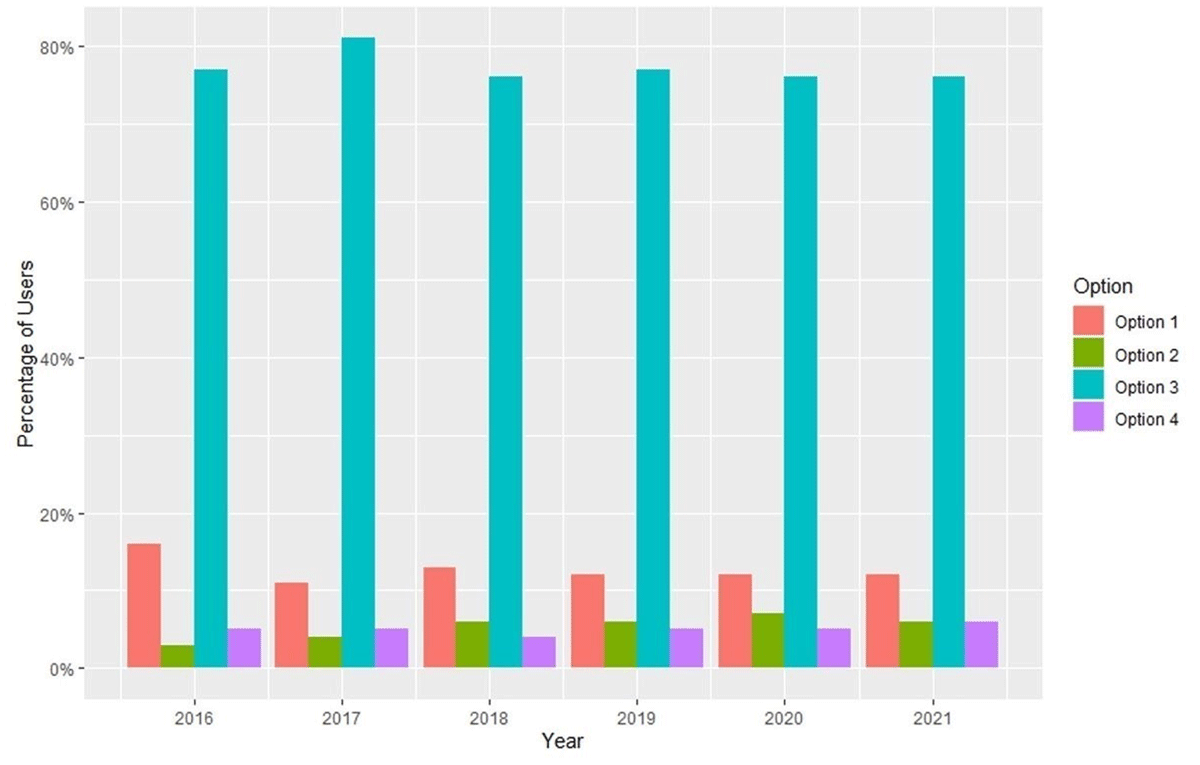
Figure 1
Proportion of SDS Users by Option for Councils 2015–2021.
Invitations to participate in the focus groups interviews were emailed out to named personnel working in the key sectors listed above across Scotland. This request was supplemented by a targeted invitation on Twitter (now X) to any social work personnel interested in discussing their experiences working in SDS. This is a technique Leighton et al. (2021) refer to as ‘using snowball sampling via social media’. All interviews were transcribed for subsequent analysis. The transcripts were read by the members of the research team and independently coded using NVIVO according to standard qualitative research methods (Bryman 2015). The research team met to discuss findings and to draw out the key themes. On completion of the analysis, the project team considered the key findings, and it was felt that ‘thematic data saturation’ (Guest et al. 2020) had been reached—that is, the point at which no more new patterns or themes were emerging from the data collected and collection therefore stops.
SDS and the Implementation Gap
SDS is the foundation for social care delivery across Scotland, and we were interested to see how it was viewed by frontline personnel, eight years after its implementation and at a time when government was shifting towards a new policy structure. This issue was addressed directly with respondents, initially by showing them the FOI data on the uptake of SDS options over a six-year period (see Figure 1).
These data indicated that there has been very little change in the way social care has been delivered since the introduction of SDS. Option 3—care organised and provided by local authorities—remains dominant, and other options, including direct payments, are marginal. Many of those we spoke to were unsurprised by this lack of change but still felt that the underlying policy framework for SDS was good, one respondent stating that it was ‘probably the most progressive piece of social care legislation in Europe’ (CSO5). People located the problem with its implementation:
We’ve got a massive implementation gap between what’s in the really good policy and the SDS legislation … [It] has got pretty much the definition of independent living, it’s got dignity, respect, choice and control—and none of these things are happening in reality. (DPO5)
The problems of implementation were due to issues around awareness, resources, and capacity. The social workers we spoke to shared this view but revealed wider problems in the sector for those working in frontline practice who ‘were not wanting to give up power’ (SW1). These concerns are common across the literature (Pearson et al. 2018).
Contrary to the policy focus on co-production (Scottish Government 2014) we were told that users were not seen as active participants in the process and ‘just don’t know what SDS is …’ (CSO3). They were rarely made aware of the options available to them or their potential:
Most of the people in the [option 3] column will have no idea that they’re SDS users, because that’s not what they’ve chosen … They won’t necessarily know that there are any other options, because it would never have been put to them … They’ve just been referred into a contract … without any further discussion. (CSO1a)
Both our FOI and qualitative data show option 3 as the default option for the delivery of care, or as one respondent called it, ‘the only game in town’ (CSO8). Partly because of resources, SDS was, according to one respondent, a ‘fiscally dominated, stringent reassessment process which is about saving money, not changing lives.’ (CSO4). Option 3 was perceived as the easiest approach to securing services, and one that demanded the least resources from both sides. The social workers told us that most users only engaged with social care at a time of crisis and were looking for the quickest solution—directly provided services were seen as the simplest outcome. This had been reinforced by tightening of eligibility criteria.
In [local authority] they’re only supporting people with critical needs, so how can that be conducive to SDS, if people who actually need any other support, if their needs are not deemed to be critical they’re not even going through the process? (DPO2)
Participants from the third sector and social work felt that option 1 was not popular because it was perceived as being too demanding for the user. For the DPOs, however, option 1 remained the optimum service model. This is unpacked in more detail in the next section. Option 2 was often seen as being too complicated to administer and not easily integrated with other services. This has established silos which failed to work with each other:
[In option 2], there were issues around contracts and commissioning type issues with partnerships [local authorities], even debating with their legal teams how they could be legally supported … So that really seemed to be even more complex than Option 1 or Option 3. (CSO5)
Once allocated an option 3 package, a user was very unlikely to change to any of the alternatives. For DPOs, the exclusion of option 1 as a mainstream choice was particularly frustrating:
I think the simple fact is people are just not being told about Option 1 and … not being offered it. To even call it an option any more seems a bit false because it’s not. Our experience is that people get an assessment of their needs, they’re told what they can get and they basically are … shuffled into option 3 because that’s … what they’re going to get. (DPO1)
Even when social workers tried to introduce choice, structural issues curtailed their options, and entitlement was ‘built around gatekeeping, and not in terms of choice and control.’ (CSO 5). This appeared to contradict the ethos of the SDS legislation:
It’s like, ‘well, we don’t have a budget for that, so therefore you can’t consider Option 1’. Or ‘you can go on a waiting list for Option 1 till money becomes available’. Whereas my understanding … was actually what you would be doing was releasing funds from embedded services so that money was available if somebody were to choose Option 1. (SW2)
Service users faced similar barriers when they tried to access option 1:
We know people who have applied for Option 1 and there are just no staff available … I know somebody who was offered a care home as an alternative to option 1. Not even the other options were considered because of the lack of availability of support staff. (DPO1)
In some areas we were told that Option 1 was simply not available: ‘I mentioned Option 1. [my line manager] says, “oh, that’s not available here … We do Option 3 and sometimes Option 2” ’ (SW2). Social workers talked about the bureaucracy that surrounded Option 1:
The document I had to send out to them … it’s a hundred-page document, or 104, one hundred and four pages of document that they have to read. That alone would put anybody off. (SW3)
Option 3 also remained dominant because of the lack of option 2 alternatives. This was particularly the case in communities outside the main Scottish cities. The failure to secure option 2 as a mainstream alternative was seen as a missed opportunity by many working in the third sector (including both DPOs and organisations working on behalf of disabled people):
It’s been really disappointing, because [option 2] was going to be the mainstream where a lot of people would get [SDS} and it would have given people a lot more choice about their day to day support … they would have chosen their provider. They wouldn’t have had to manage their budget, but they would have had more say about how [it] was spent. (CSO 1a)
For some of the social workers, there had been an expectation that the third sector would ‘step up and offer more services. But that had not happened’ (SW5). This absence of service choice was therefore viewed as a ‘huge issue’ (SW4) across sectors, with different interpretations as to where responsibility remained:
Option 2 is astonishing really. If SDS had been fully delivered I would have expected to see [it] as the highest number. People who wanted more choice and control but not the responsibility of being an employer, that is the option … It has gone up a little but that is entirely dependant … on the culture of the local authority and their resource available to be able to support people on an ongoing basis. (CSO6)
The failure to utilise the SDS options more widely across the social care system reflected a more profound disconnect between the sectors. The next section explores this issue in more detail.
Policy Breakdown and the Disconnect between Social Care Sectors
We found that each of the three main interest groups (DPOs, CSOs, and frontline social workers) were profoundly disconnected from each other in terms of what constituted effective social support as they envisaged it. There was no common vision for social care in Scotland, and while all supported the ethos of the Feeley Review, each sector interpreted its key aims differently. Legislation for SDS and the Feeley Review both draw strongly on the notion of co-production in policy development. However, our findings revealed minimal engagement with co-production between service providers and agencies, and this had led to limited policy ownership and shared understandings across social care.
For DPOs, option 1 was seen as the best route to good social support, a view not shared by either of the other sectors. While they both endorsed the use of option 1, they felt that its use would always be marginal. DPOs had limited enthusiasm for option 2—mainly because of dominance of larger CSOs as service providers. Despite the possibility to develop option 2 services through the SDS legislation, this was seen as a barrier for expansion of DPO services and reform of the sector:
Service providers … like the ones that actually provide the day services and day centres … have so much influence in all of [the] processes, which is absolutely ridiculous. They get so much funding, they compete with us for funding on small projects, big projects, but they also tender for huge services, so they’ve got so much influence within local authorities … It’s no wonder that social workers automatically steer someone to attending a [large disability charity run] day centre or [another large disability charities]. (DPO3)
This reflected broader tensions over power, who has control over SDS, and where money is allocated.
Across the range of CSOs we spoke to, there was less focus on option 1 and, instead, a general disappointment at the failure to secure growth in option 2 services and reduce reliance on option 3. As detailed earlier, this was seen as a missed opportunity. There was a lot of tension between the third sector providers and the local authorities:
Our experience is that COSLA [body representing local authorities in Scotland] in particular, and individual local authorities in general, are absolute obstacles to progress. I’ve sat in meetings these last two years, that have made my hair stand on end … the … desire to cling on to any kind of power, control, money, and to starve providers, because they all think that we’re on the make. (CSO1a)
By contrast, there was less concern about the different options available amongst the social workers we spoke to, although we were told that policy implementation varied greatly according to local authority (SW3). For social workers the key issue was how they could fulfil their statutory duties without exceeding budgetary limits.
To help improve the delivery and the outcomes of social care in Scotland and tackle the problem of implementing SDS, the Feeley Report made several proposals. These included incorporating human rights and the establishment of an NCS. To improve social care, it is argued that we need to shift the paradigm to one underpinned by human rights and change the structures, through the development of an NCS, to provide a framework for the provision of care. It is to a discussion of these two ideas that this paper now turns.
In Search of a Human Rights Approach in Social Care
The articulation of a human rights–based approach (HRBA) to social care in the Feeley Review was generally well received as a framework to achieve specific goals:
If you accept a rights-based approach as embedding key human rights, [like] the UN Convention on the Rights of the Child, the rights of disabled persons [UN CRPD] … I would hope that has the potential to more concretely prioritise the perspectives and preferences of the individuals accessing services. I’m not sure it will but I would hope that it should. (CSO3)
As discussed earlier, Feeley offered only an abstract appraisal of human rights, with limited reference to the UN CRPD. There was no clear framework as to what the indicators of human rights in a new NCS would look like, nor was there a clear pathway given as to how to develop them. For our respondents, an HRBA would enable ‘choice, individual control, personal autonomy and the flexibility to change’ (CSO4). These were the indicators they felt are central to good social care and would allow them to challenge the fiscally dominated approach currently in operation through SDS. When we asked people to articulate what an HRBA would look like, it was often hard to distinguish their definition from the values that underpin SDS and its ethos of informed choice, coproduction, autonomy, and control:
[HRBAs] try to ensure that people who required or needed support were aware of what they were entitled to, were aware of what good support … should look like. They were designed to try to empower people to then make those demands and assert those entitlements and to equip and enable people to do so. They were designed in order to try to hold service providers and commissioners to account for their contribution towards the delivery of those standards and … to enable scrutiny bodies to measure against their delivery. (CSO9)
A rights-based discourse is well established in Scottish social policy (Hosie & Lamb 2013) and it is not surprising that when trying to explain what such an approach would look like in practice, the language of SDS and personalisation was drawn upon. While there was a broad consensus amongst respondents in support of the concept of an HRBA to care, there was concern as to how this would be actualised:
It’s absolutely right that that’s how a social care system is based, it should be rights-based … There’s nothing better than setting in law and basing it on human rights but you then have to find a way to work from that almost theoretical approach down into some very usable, practical ways of implementing those rights. (CSO6)
The lack of clarity when articulating the practical implications of a shift to rights-based care was shared by many of the respondents. When we asked them to explain what this would look like in practice and how it would affect social care, many struggled to define it:
You can understand from a policy formation point of view why that is an attractive route to go down because it is something that everybody can sign up to … None of us really know what it is that we’re signing up to. And nobody’s going to argue … (CSO2)
There appeared to be a real problem, not only with practically articulating what an HRBA would achieve over and above current provision, but with implementing it. One respondent told us, ‘I don’t think Scottish Government has a clue what that means, or how that happens in practice’ (CSO1b).
Another key concern was the issue of redress if rights were not met. There is currently no process for individuals to challenge decisions on the provision of care through an independent agency. All appeals remain within the local authority, and this was seen by many as a problem:
When we spoke to the previous director of social work, his actual comment was, ‘we’d love to be able to deliver human rights [here] but we just can’t afford it’. So, that’s where we’re starting from. (DPO1)
Given that the discourse of human rights is well established in Scottish policy, the major policy shift suggested by Feeley is not in the philosophy or funding stream; rather, it is through the establishment of an NCS to oversee care in Scotland. It is to a discussion of this that this paper now turns.
The Recentralisation of Social Care: A New National Care Service
Across all sectors, respondents welcomed Feeley’s recognition of the key role of social care and the potential it affords disabled people to live active lives in the community. An NCS, many argued, would be better able to ensure that SDS was implemented as intended and social care was guided by ‘national principles, national standards and national accountability’ (CSO1). Respondents talked about how it would ensure that best practice was delivered nationally and how learning would be shared across the system. They also liked the emphasis it placed on autonomy, choice, and control, and its potential to ensure uniformity of access across the country, removing the post-code lottery. Participants felt that a national body would be better placed to promote social care and ensure it remained high on the policy agenda:
It’s much easier for a national body to fight for funding from Scottish Government than it is for local authorities … who then have to make decisions about how they spend that money. (DPO1)
Many talked about what they saw as the failure of the current model and were highly critical of local authorities and their perceived inability to secure better funding for social care, particularly for the DPOs:
I suppose one of things we were strongly in favour of a NCS was to take that element away, that power and control away from local authorities. (DPO4)
The policy articulated by the Feeley Review was seen as ambitious and well intentioned. However subsequent developments had led to concern about policy direction, and some felt that it was losing its potential to implement change:
They’re not ambitious, they’re not about transformational change, they’re not about choice for individuals … [or] the radical changes needed for social care. (CSO1)
There was also a common fear about the domination of health in the new service, and proposals to include Community Health in the NCS were seen as further evidence for this claim, as one social worker told us: ‘Now they’ve [NCS has] brought in primary care, it’s the end of social work’ (SW2). The NCS comes after a series of high-level policy reorganisations and, in particular, health and social care integration, whence many referred to the way health has come to dominate the service:
The stripping away of the distinctiveness of social care is its replacement with an understanding of care which is health dominated which has to do with a clinical, medicalised, transactional and functional approach to care. (CSO4)
There was also concern that the planning for NCS was eroding the existing rights-based framework for social care in Scotland:
If you were genuinely talking about empowerment, control, choice, people first, services working around them and services responding, then actually building from the values … the basics of SDS would be a powerful starting place for the NCS … [But] I think there is a tension there in terms of bringing the two together, and … a potential risk that social work and social care will become led by health. (CSO5)
Trying to deliver SDS via a centrally run service, through a diverse, locally provided structure was seen as difficult to achieve. As one of the CSOs remarked:
I don’t see how they fit together … How you can have an NCS, and then locally provided, locally controlled services … It’s two diverse worlds. (CSO3)
While acknowledging that an NCS would still need to operate within local social care markets, it was unclear how the different SDS options—and particularly option 1—could work effectively:
There’s a difference between an NCS, and a nationalised care service. So, we’re not talking about a nationalised care service, where everything is delivered directly by the state, we still have a marketplace of providers that people can choose from … They will operate within a national framework of accountability and standards. So your national framework around PA employers, for example, they would have to be employed under certain conditions. (CSO1)
The issue of voice and power was also raised by the DPOs, as were the tensions that were emerging between them and public sector bodies who currently support and deliver services provided through local authorities:
We’re … seeing that COSLA is … muscling in there as well with their thoughts … With service providers sometimes those huge conglomerate voices are heard more than DPOs. There’s few and far between DPOs in Scotland as it is, and we’re not able to sort of speak up against those much larger voices. (DPO3)
The current emphasis on the development of an NCS has been seen as a shift away from a focus on outcomes:
They’re focusing on system change, which is what they did with health and social care integration, and it’s going to be system change that takes precedence over outcomes. (CSO5)
Considering these concerns, respondents questioned whether the establishment of an NCS would in and of itself help to tackle the implementation gap:
The whole thing has become a fixation on process rather than outcome … It’s all about … local authorities haven’t been delivering—which is true and I wouldn’t disagree with that—so let’s take it away from local authorities and put different structures in place. Without necessarily talking about why and what would be different by doing that and how those same mistakes aren’t just going to be replicated within just different institutions, called different things and slightly further away from where people are. (CSO2)
As can be seen from these data, there remained many contradictory statements in our respondents’ comments. The Feeley Review was generally widely supported, the problem lies with its implementation and another major restructuring of social care in Scotland, particularly coming on top of the problems imposed by the pandemic. One social worker commented that it ‘it filled her with dread’ (SW 1).
Discussion and Concluding Comments
It is now well established that SDS has not secured the change it was set out to achieve in the delivery of social care in Scotland, and this has preempted a renewed focus on restructuring (Audit Scotland 2022). As many of our research participants stated, the original SDS legislation was seen as progressive and tapped into a broader enthusiasm for personalisation and a rights-based approach to social care. This has not been matched with transformative delivery. Feeley rightly identified the implementation gap, and our findings explored this further. Rather than creating an integrated service, where users can freely move between options as their support needs change, it has produced a rigid system of social care silos. Our analysis would suggest that this is partly the result of chronic underfunding, but there are also other factors in play. These include the disconnect between social work, DPOs, and CSOs, as each sector seeks to promote a particular vision of SDS. There remains a critical power imbalance between sectors; in particular, DPOs feel excluded from the system. The crisis management that currently underpins Scotland’s social care delivery system has reinforced these silos, and as long as option 3 (support organised and provided through local authorities) remains the easiest means to deliver urgent support, SDS is unlikely to secure its aims. The Feeley Review’s proposals to tackle the implementation gap does not really engage with these issues, focussing instead on the establishment of a new centralised service and an HRBA to social care.
The development of a national body for the delivery of social care reflects broader discussions across OECD countries. In essence, the NCS will become a national commissioner of social care, accountable directly to the Scottish government, with services designed and delivered locally. While a centralised service will potentially secure a higher profile for social care and create a level playing field across the country, it is debatable whether it will tackle the social care silos. Proposals for the new NCS envisage a system where control is centralised but social care delivery and design remains local. It is clear that the key sectors in the provision of social care have different outcomes and indicators of success, and the problems associated with a fragmented service, as highlighted by Sogstad et al. (2020) and Hummell et al. (2022), remain. It is hard to see how a centralised service will tackle this.
Other countries have successfully promoted a more fluid network of service options which override these sectoral divisions. In Norway, for example, service users have the option of organising personal assistance themselves (as a direct payment—option 1) or through a user-led cooperative—Uloba or private company—which coordinates support on their behalf (similar to option 2). Like DPOs in Scotland and the wider UK, Uloba has been developed through the principles of the Independent Living Movement. However, it differs in its reach as an integral service provider and advocacy support, and has grown in size and scope, as user-controlled personal assistance has become more popular (Askheim 2019). This has resulted in an increasing proportion of disabled people in Norway choosing a cooperative or private company as the employer of their personal assistants. While Wales has shown some interest in care cooperatives (Tennant 2022), there appears to be little appetite in Scotland from either the government, the third sector, or the DPOs for such a shift.
Australia has also seen a more diverse provider market emerge through the implementation of NDIS. This has shifted the oversight of social care from a state function to a federal responsibility. The main area of change has been from agency management (the equivalent of option 3, support organised through local authorities, in Scotland) to plan management (Scotland’s option 2, where a selection of support arranged through the local authority or other agency can be purchased on an individual’s behalf), with an increase from 45 per cent to 58 per cent (NDIS 2022). Self-management (option 1, a direct payment) remains stable, but with significantly higher uptake than in Scotland, at 30 per cent, and agency management (option 3) has decreased from 24 to 12 per cent over a two-year period (2020–2022). However, the overtly market-orientated approach of NDIS does not fit well within the wider Scottish agenda and its approach to public service reform.
In addition to the development of an NCS, the Feeley Review suggests that reform can be achieved by placing the rights, needs, and preferences of service users at the centre of the process. The purpose of the Human Rights Act 1998 was to assist public bodies in improving services. Writing in 2005, Butler stated that despite the provisions set out in the 1998 Act, the policy has not made much impact across key public services, including social care. In terms of policy, SDS adopts an HRBA, and it is difficult to see how current proposals will transform this further. SDS is nearly ten years old, yet there remains limited understanding of the relevance human rights play in service provision. Evidence would suggest that vulnerable and marginalised people continue to experience breaches of their human rights without redress. There appears to be little change from 2005, when Butler argued that most public authorities were struggling to implement a proactive human rights strategy and to achieve any changes in practice (2005: 7). There remain issues around redress—without redress it is hard to see how a rights-based approach can impact on the delivery of care.
As Scotland moves into a new era of social care, it is important to reflect on the framework of legislation in place and the plans for a new structure through the NCS, but also to understand how best this can be resourced. To achieve sustainable high-quality integrated social care requires long-term commitment and investment in social care organisations (Billings 2013). The focus on discourse change—through the shift in the way social care is framed and, specifically, to an HRBA—and structural change—through the introduction of an NCS—represents only a partial solution. At the heart of the proposals is a pledge to ‘shift the paradigm, strengthen the foundations and redesign the system’ (Scottish Government 2021a). While this places a discourse of human rights at the forefront of a new social care policy, it is reminiscent of earlier discourse shifts in social care which have seen terms like ‘empowerment’ (Jack 1995) in the 1990s and ‘co-production’ in the 2010s (Hunter and Ritchie 2007) promoted through policy reform. These policy discourses have secured support from across the political spectrum, yet none of the resultant social care systems have been underpinned with a framework for redress and investment. Without this type of structural backing, it is difficult to see how transformative change can be secured. Questions remain around what exactly an HRBA means and how it will differ from the existing rights-based structures that underpin SDS.
Funding information
This research was funded by the University of Glasgow’s ESRC Impact Acceleration Account—award number: IAA317035-01.
Competing Interests
The authors have no competing interests to declare.