
Introduction
The differential access to, and participation in, academia for disabled researchers has been reported in recent decades. The numbers of disabled doctoral researchers and academics remains disproportionately small (Advance HE 2021, Evans et al. 2023). The ‘pipeline’ into academia, typically through doctoral studies, demonstrates the significant challenge disabled researchers face. There is a limited body of literature that has explored the barriers for disabled students to Higher Education (HE) noting physical and virtual/digital barriers (DSUK 2023; Merchant et al. 2020), a lack of quality support while studying, relevant to the student’s individual needs, and lack of support provided in a timely manner (Chattaway 2019; DSUK 2023; Evans et al. 2023). Previous research has noted significant issues with students’ engagement with formal processes, which require disclosing disability to access services (Spier & Natalier 2023), and students’ fears around the possible impacts of disclosure of their disability (Lister, Coughlan & Owen 2020). However, there is relatively little written about the actual experiences of disabled students studying at doctoral level.
This paper reports on a project undertaken at a university in the United Kingdom (UK). Taking a critical disability studies lens, we argue that universities are implicitly organised around the needs of ‘non-disabled’, ‘normative’ (Spier & Natalier 2023) students, which implicitly perpetuates disadvantage and stigma. In many countries formal university systems expect students to identify as disabled in order to access support.
In our study we investigated the lived experiences of disabled students who have been able to enter doctoral studies. We explore, using a mixed method design, how students with disabilities, long-term health conditions and/or additional study needs who are currently studying for a doctoral degree, a PhD, or another form of doctorate (such as a Professional or Practice Based Doctorate), experience university structures, policies, and support. The aim is to understand their perceptions and the barriers and enablers in systems and cultures to help us consider more inclusive university environments.
Literature Review
Data from the UK, the USA, and elsewhere demonstrates the disproportionately low numbers of people with disabilities, and long-term health conditions, as students in HE and as academics in universities (Järkestig Berggren et el. 2016). In the UK the government’s Higher Education Statistics Agency (HESA) data from 2003/04 to 2021/22 shows an increase in the number of students and academics who identify formally within university documenting systems as disabled. However, the number of disabled doctoral students staying in academia remains small. As Brown & Leigh (2018) ask in the title of their paper, exploring ableism in academia, ‘where are the disabled and ill academics?’
There is a growing body of literature exploring access and participation of disabled students in universities. However little research has, to date, focused on students’ experiences of doctoral studies (Briscoe-Palmer & Mattocks 2016, Collins 2015; Spier & Natalier 2023). For example, a recent systematic review of more than 400 papers noted that research on disability inclusion in higher education is predominantly focused on undergraduate students with only two per cent addressing the experiences of postgraduate students with disabilities (Evans et al. 2023).
It is important to acknowledge differences between various forms of disabilities, health conditions and neurodivergence, to highlight different challenges within ableist university systems. Physically inaccessible campuses, research laboratory environments, fieldwork facilities, and lecture theatres pose challenges to students, particularly with physical and mobility issues (Chiarella & Vurro 2020; Hannam-Swain 2018), and in many circumstances adjustments remain unavailable, ineffective, or irrelevant (Spier & Natalier 2023). There are also particular elements of doctoral studies that can be challenging, particularly for some neurodiverse students, for example, in the UK, the required social performance in viva voce examinations (Chown et al. 2015).
Informed by critical disability studies, we have intentionally brought together intersecting experiences in our work, since many people experience a range of conditions that span across disabilities, health conditions, and additional study needs. We share Brown and Leigh’s (2018: 986) view that ‘illness and disability should not be entirely separated’ because of the collectively experienced discrimination, ableism, and stigma. Hence, whilst lived experience and activism often stress unique aspects of experiences of disabilities and health conditions, there are common experiences of ableism, discrimination, and stigma (Brown & Leigh 2018).
We are drawing on inclusive definitions of disability and long-term health conditions to include neurodiversity, mental ill-health, energy limiting and intermittent conditions. The term ‘additional study needs’ is used to enable visibility and recognition of experiences that require additional support (in an ableist, normative education system) such as those experienced by some neurodivergent scholars who may not identify themselves as ‘disabled’. For issues of space, we will be referring to ‘disability’ in this wide sense of encompassing a range of individual circumstances that have been commonly identified as ‘disabling’.
Identifying as a disabled student
In many countries there are formal systems of recording students as ‘disabled’ which enables them to access particular sources of support. Researchers have noted how the language universities use related to disability can impact on student engagement affecting how likely a student is to disclose a disability, to seek support or adjustments to adapt study to their needs or apply for disability support mechanisms (Lister et al 2020). Lister et al. (2020) found that this was particularly evident for students with dyslexia or other specific learning difficulties and those with mental health conditions who reported discomfort with the label ‘disabled’, preferring instead the term ‘additional study needs’.
Students may disclose a disability to formal university systems for complex reasons including wanting to be visible as a disabled student, but also to access resources that are not available without formal registration as a ‘disabled student’ (Weedon & Riddell 2009). The processes required to disclose disabilities and access support can have ‘profoundly negative impacts on students’ stress, attainment, and perceptions of institutions’ (Lister et al. 2020: 97; see also Pearson & Boskovich 2019; Collins 2015). The process and accompanying language is often experienced as difficult and shameful (Lingsom 2008).
Spier and Natalier’s critique (2023: 1379, 1367) of ‘reasonable adjustments’ in their (Australian) university context argues powerfully that disabled students are not passive beneficiaries of a university’s support but need to be ‘adjustment makers’ (page 1379) to get the support they need. They argue that ‘ableism reshapes the meaning and impact of reasonable adjustments. Furthermore, as described by Brown (2018: 987) the notion of disclosure is in itself problematic and constitutes ‘an act of self-preservation, information control and impression management and thus identity work’ (see alsoThomas 2007).
Doctoral programmes and supervisors’ role
Doctoral programmes are characterised by independent research activities in collaboration with usually one or two supervisors. The requirements of doctoral programmes can be particularly difficult to access for disabled students, in contrast with a taught master’s or even an undergraduate programme. Specific factors include the high workloads, academic expectations inherent in undertaking a doctorate, and crucial relationships with supervisors (Collins 2015; Vitae 2020). In previous research the importance of the supervisory relationship for doctoral students has been noted (DSUK 2023; Parker-Hay 2020). Students reported that, even if they had a positive relationship with their supervisors, many feared that disclosing anxiety or other mental health issues would reflect poorly on their perceived ability to complete their doctorate or adversely affect their career prospects (Vitae 2020). The quality of the relationships between supervisors and their doctoral students can impact significantly on both the wellbeing of the student and on the successful completion of their doctorate (Guccione 2018, van Rooiji, Fokkens-Bruinsma & Jansen 2021).
Academic culture as ableist
Academic culture is particularly problematic for researchers with disabilities who are unable to meet the ‘corporeal standard’ (Campbell 2009). Academia is premised on an assumption of non-disabled bodies that have the ability to work full-time in a culture which rewards, perfectionism, productivity, and excellence (Brewer 2022; Brown 2018). The expectations of the academy, exacerbate the ‘disconnect between academic culture and disability’ (Pearson & Boskovich 2019: 2) and are centred around the problematic and complex nature of disclosure and identity.
Hofstra et al. (2020) report the persistence of the ‘diversity-innovation paradox’ whereby, despite more scientific innovations being generated by individuals from underrepresented groups, their contributions are significantly more likely to be minimised or discounted by the majority group members in their field. It is unsurprising then that Dolmage (2017: 3) describes the relationship between academia and disability as one where ‘disability has always been constructed as the inverse or opposite of higher education’.
Whilst there is some existing research that has examined disabled doctoral students’ experiences, for example, of supervision (Collins 2015), what is currently missing are in-depth studies of the lived experiences of postgraduate students with disabilities to inform understanding of the social and structural barriers within universities. The study aims to explore the experiences of disabled doctoral students in their doctoral studies, including their perceptions of wider culture and environmental circumstances impacting on their experiences.
Methodology
The research was undertaken by a team of researchers with lived experience of a range of disabilities, long-term health conditions and additional study needs.
The project is a mixed methods design, consisting of:
An online survey.
One-to-one interviews.
Online survey
The survey was designed by the research team and hosted on a Microsoft Forms platform following advice from a specialist accessibility and usability evaluation team in the university. Microsoft Forms was chosen because it is screen reader accessible and includes a ‘immersive reader’ feature so the survey could be read aloud. In addition, participants could alter the presentation of the survey by applying different coloured overlays, change the focus to a reduced amount of text to reduce visual crowding and mitigate potential overwhelm. Respondents were invited to contact a named member of the research team if they required any additional alternative formats.
In total 40 of doctoral students from a British university completed the online survey, a response rate of 39.36% of students formally registered as disabled at the institution. Sixty-two per cent of participants were studying part-time. Five of the 40 had changed mode of study since they began their studies.
Seven students were self-funded and two were partially funded, 10 students were granted a fee waiver and the rest (21) where fully funded by the faculty or a Research Council (government research funding in the UK).
From the 40 survey responses, students collectively reported the following disabilities:
| ‘A combination of disabilities’ | 20 students |
| Physical disabilities including long term health conditions | 5 students |
| Mental health condition | 4 students |
| Autism and other neurodiversities | 3 students |
| Fluctuating or intermittent conditions | 3 students |
| Additional study needs | 2 students |
| Progressive or degenerative disabilities | 2 students |
| ‘Other’ (not specified) | 1 student |
Responses from these participants are identified by S (for Survey) and number (individual participant number), for example S12.
One-to-one interview
At the end of the survey, respondents were able to provide their contact details if they wanted to volunteer to take part in a one-to-one interview with a member of the research team. Nineteen students consented to be contacted for interviews. Of the 19, the team selected 12 volunteers to invite for interview. The selection process was designed to capture a wide diversity of disabilities, long-term health conditions, and additional study needs. Participants were given a choice of interview time (i.e., morning, afternoon, or evening) on either a weekday or weekend to best accommodate individual needs. Of the 12 invited to interview, eight students were interviewed and four of those students were unable to take part due to illness or holidays. Table 1 shows anonymised characteristics of the participants interviewed.
Table 1
Self-Identified characteristics of PGR students interviewed.
| PARTICIPANT (PSEUDONYMS) | DISABILITY/LONG TERM CONDITION/ADDITIONAL STUDY NEEDS | GENDER |
|---|---|---|
| P1 – Olivia | Physical disability/Fluctuating or intermittent condition/Long term condition | Female |
| P2 – Lily | Mental health condition/Autism/Neurodiversity/Fluctuating or intermittent condition/Long term condition | Female |
| P3 – Guida | Autism/Neurodiversity | Female |
| P4 – Hannah | Autism/Neurodiversity/Additional study needs | Female |
| P5 – Joshua | Additional study needs | Male |
| P6 – Naomi | Physical disability/Long term conditions | Female |
| P7 – Milly | Mental health condition | Female |
| P8 – Angus | Physical disability/Other health conditions | Male |
The interviews were undertaken by a member of the research team who is a graduate from the university’s doctoral programme, who identifies as a disabled researcher but is not a supervisor. Transcription was completed by a professional transcription service with a confidentiality agreement in place. Participants who took part in the interview were given a gift voucher as a thank-you for taking part in the project.
Ethical approach
A ’favourable opinion’ to undertake the research was granted by the university’s Human Research Ethics Committee (HREC/4318/O’Dell) and approval from the university’s Student Research Project Panel.
All participants were provided with information about the project in advance of providing the link to the survey. It was made clear that their contribution would be anonymous and no personally identifying information would be kept. This includes information about particular health conditions or combinations of conditions that may identify a particular participant. Participants were made aware that they could withdraw at any point until the data was anonymised and analysed. Consent forms were also provided for both research instruments. Information about support for doctoral studies, mental health, disability support, and other relevant issues were also provided to all participants.
Data analysis
The research team used Braun and Clarke’s (2022) reflexive thematic analysis to analyse the qualitative data. The interviews were transcribed verbatim. Two of the team analysed two transcripts independently and then compared thematic coding. The findings at this stage were shared with the rest of the team for further discussion. The remaining five transcripts were analysed by a member of the team with lived experience of disability and living with a long-term health condition. Once this stage was completed open comments from the survey were also analysed. Survey responses were analysed using descriptive statistics to supplement the qualitative analysis.
Themes were discussed with the wider team as they were developed and refined.
The data analysis generated in three key themes with various subthemes:
Diversity in student disability identity:
identity positionalities
disclosure of disability
emotional responses
The impact of supervisors’ attitudes:
positive impact
negative impact
Institutional context:
barriers to study
enablers to study.
Discussion of findings
Theme 1. Diversity in student disability identity
Identity positionalities
In our study, students articulated different positionalities regarding their identity as a disabled doctoral student: identifying as a disability activist, in the process of discovering their identify as a disabled student and rejecting an identity as a disabled student.
Participants who were ‘activists’, talked about being open in identifying as disabled and disclosing their condition/s to others. Angus explained during interview, ‘It’s easy. I’m disabled’. Activists embraced shared conceptualisations of disabled identities and disclosed them openly as illustrated by Milly:
I have no problems with whatever terminology is used. I’m happy to identify as somebody who’s disabled. […] I’m probably unusual in the fact that I actually have a very strong identity with having bipolar disorder and I happily talk about my bipolar disorder publicly. So, I’ve talked at university conferences about my bipolar disorder, and I’ve talked at national conferences about my research where I mentioned my bipolar disorder. So, I’m probably unusual. (Milly)
Similar to Milly, Lily also drew on an identity as a disabled person and a political commitment to this:
I’m a big-time disability activist. Absolutely identify as disabled as an identity and as a political grouping. Personally, I like to use identity-first language. So, I’m a disabled person. I’m an Autistic person. Unfortunately, ADHD doesn’t lend itself very well to that, so I tend to say with ADHD just because the, grammatically. (Lily)
A second positionality drawn on by participants is characterised by being attentive to emergent or developing aspects of their identity as a disabled student. For example, Guida was in a process of understanding how her disability has been shaped by circumstances, particularly living through the Covid-19 pandemic:
I haven’t been diagnosed officially here, I don’t know how I identify or feel about it. So if I will say something I will say like, not sure, I will say like they are difficulties to learn, but I’m not sure how to categorise it […] So, I’m in that transition of accepting things, I would say. (Guida)
The third positionality consisted of those who did not identify formally, fully, or partially as disabled. The survey revealed various reasons; for some, they associated disability with more complex health and severe conditions than those they experienced, and others reported a discomfort in identifying themselves in common definitions of disability. This was also evident in interviews, for example, Naomi (P6) spoke about not identifying as disabled and not wanting to ask for help even when friends suggested that she may need additional support from their supervisors. However, whilst rejecting an identity as a disabled student she went through the Disability Support Agency assessment process (DSA), in case she needed help in the future:
just filled in the form […] I certainly do not identify with being disabled or being called disabled in any way, shape or form. […] in fact, I didn’t fill in the DSA stuff, I just filled in the form and registered it. […] I was literally filling the form in, letting them know, letting them know I didn’t require any help, but that if I did require any help that I would ask for it. (Naomi)
For Naomi, having a health condition meant that she worked hard to not to stand out as different. Other students did not identify as disabled because they were managing well with only intermittent difficulty:
So, I guess the language around disability, around the legal definition has a more substantive impact on your ability to do everyday activities and I’m not comfortable with that for myself, that doesn’t feel like that’s quite the thing. When I then think about it, sometimes it does, but it’s not every day and it’s not all the time and I can get on perfectly well because I have strategies to managing to cope… (Olivia)
Yeah, it is something I’ve thought about before (self-identifying as disabled), I’ve not really thought about what I’d prefer it to be called, but I guess I don’t always consider it, I don’t know, I think it’s definitely probably a bit of a stigma around it. Certainly, even in my own mind I think of disabilities as more physical ailments or things that might limit, yeah, your ability to live in normal life, I suppose. If someone was to ask me, I wouldn’t say I was disabled, but yeah maybe that I had additional study needs, yeah, I suppose that’s probably a good way of saying it. (Joshua)
Joshua, in the excerpt above, reflects that although he does not identify as disabled, he recognises the stigma that is present in normative views of disability.
These students are resisting formal identification as a disabled student which would would bring a visibility that they do not want or feel they need. However, this meant that they worked harder, progressed slower and submitted work they aren’t happy with in order to meet a deadline:
I’ve often turned in work that I’m not happy with, and I’m perhaps proceeding slower than perhaps I would have wanted to. You know, I would have liked to have handed in maybe Easter at the latest just past, but I’m only just now getting down to doing a decent draft of my discussion chapter, so I’m not where I want to be, and that’s probably partly down to the emotional toll that my work takes on me. (S17)
These perceptions of what constitutes a ‘disabled student’ reflects current identity disability conceptualisations that seem to be grounded on stigma and negative perceptions of disability, even for those students who draw on an activist identity. There are also different ideas about disability drawn on in students’ accounts, often assuming that it means ‘outside normality’, something mostly visible and physical (Spier and Natalier 2023). These variations in identity forming were critical for students’ decisions about whether to disclose needs for additional study support since they would formally constitute a label as a ‘disabled student’ in university support systems.
Disclosure of disability
The second subtheme relating to disability identity focusses on the disclosure of disability. In the UK, where this project was undertaken, to access support at university, students are required to formally disclose their disability. How, and when, a student identifies can impact on the support they receive (material support such as access to voice activated systems and financial support such as disabled student allowance). It can also impact on the support students receive from supervisors.
Survey responses suggested that more than half of the participants (n = 26) had fully disclosed their disabilities formally or informally. The main reasons for disclosing were to ensure that support was in place and to ensure the support of their supervisors. Part-time students were more likely to have registered their disability compared to full-time students (73.9% in contrast to 13.3%). Hence many students, particularly full-time students, were not disclosing disabilities to the university.
Where a student had disclosed their disability to the university, the majority of students, had done so early in the application process (n = 15) or at registration (n = 6). Other points of disclosure where at formal examinations, i.e. while preparing for upgrade/transfer after their initial year (n = 7) and in preparation for their viva examination (n = 3).
Nineteen respondents to the survey reported that they had formally declared their disabilities and were officially registered with the disability unit, 14 have declared partially; 6 are not sure if they are officially registered with the disability support services and 1 student has not responded to this question. When students were asked the reasons for not disclosing their disability, they mainly identified a concern about being discriminated against and sensitivity around the type of disability. This was evident in the interview data, where the two main reasons for not disclosing were cultural differences (for Guida who described herself as autistic and neurodiverse) and fear:
I think this was very difficult for me, it could be a cultural barrier as well because I didn’t want to tell them, I couldn’t really tell them because nobody said this to me in […], you just don’t do it, you don’t share these problems or struggles with your superiors or your boss because it means that you cannot do your work, right. (Guida)
‘they’re [supervisors] not going to know unless I tell them. […] But it was scary, it was a really scary thing to do.’ (Lily)
Identifying as a disabled student in university systems involves being aware of the assessment process. In many UK universities, including the one this project was undertaken in, this involves completing a form and submit this to the disability team to assess support needs. It is clear from students’ accounts that they feel ambivalence and discomfort in engaging with the process.
Emotional responses
A third subtheme relating to students’ identity was emotional work needed to manage doctoral study. In addition to the emotional work in navigating university systems to disclose disability (as discussed above) there is also emotional work in managing the expectations of an ableist programme of study. This includes managing uncertainty about some health conditions, the impact of doing intermittent work (within the context of programmes that embed the corporeal standard’ (Campbell 2009) of consistent full-time engagement, reluctance to received special treatment, and a combination of trauma, shame and guilt linked to external perceptions of disability.
For example, Angus describes planning for the doctoral project to be finished in time but the uncertainty about this, ‘Not so far. I’m hoping that I won’t have to [study break] because as I say I’m working towards 2028, but I’ve no idea how my health’s going to be, yeah.’
Students described ways in which their doctoral programme was structured and the impact on them in not being able to meet these requirements. For example, a survey respondent (S29) discusses practical arrangements:
I find it frustrating that I have to declare my dyslexia and ask for slides for every individual event – as a module student my tutor was aware and automatically provided everything I needed. I feel there is a lack of understanding of my disability – for example being expected to attend intensive back-to-back sessions at residential weekends which I find very tiring. (S29).
This is also illustrated by survey respondent S4 and the ways in which they study and the emotional impact on them:
My multiple disability and chronic illnesses are very personal and variable. Disclosure involves some discussion of matters that people routinely don’t want to hear about and responses to even the basic physical disability are inconsistent. Some staff are hostile. There is a presenteeism culture and suspicion from some. […] I get distracted. I have burnouts where I can’t study at all, its all too much. i need regular breaks. (S4).
The emotional work and particularly the ambiguous emotions of shame and guilt, have been powerfully documented, for example by feminist writers such as Thomas (2007). The effects of words or actions of university systems and individual non-disabled people when interacting with disabled students can be profound as described in this theme and noted earlier in interactions with supervisors.
Theme 2. The impact of supervisors’ attitudes
A key element of studying for a doctorate is students’ relationship with their supervisors who are the academics guiding their research projects. Disabled students in Collins’ (2015: 595) research suggested that a good supervisory relationship includes good communication, willingness to listen, and flexibility, with the need for, ‘support at particular times and with specific things’ rather than an assumption that they will always need additional help.
The survey suggested that students were generally comfortable with their supervisors and felt that they act as advocates. It also showed that part-time students reported a more positive relationship than full-time students. However, students were not certain that supervisors fully understood the effects of their disabilities and fully understand their issues. In the survey, supervisors were more positively rated when working with students with physical disabilities and additional study needs, but less positively rated by students with mental health issues.
Students’ responses regarding the impact of supervisors’ attitudes towards their disabled identities could be classified, on the one hand, as positive: proactive, knowledgeable, supportive, or a combination of some of these, and on the other hand as negative, including avoiding discussions about disability or additional support needs.
Positive impact of supervisors
Responses to the survey regarding supervisors were mostly positive. Eighty-five per cent of students agreed or strongly agreed that their supervisor was happy to advocate for any reasonable adjustments they needed. Also 63.5% of respondents considered that their supervisor had a good understanding of how their disability was affecting them.
In his interview, Joshua discussed how one of his supervisors’ previous experiences with students with dyslexia, impacted on the support he received:
‘So I imagine they’re aware of some of the support, and they were one of the people that approached me and said make sure it’s on your student profile. […] And they said would you like us to explore what’s available to you? So yeah I think that they probably have done a bit in the past.’ (Joshua)
Students, such as Joshua, considered that supervisors with some knowledge of disability helps supervisors normalise asking questions about any support needs. For instance, Milly and Olivia noted that their supervisors’ research expertise in mental health and disability research also provided insight into issues that disabled students may face.
In addition to normalising conversations about the need for additional support and understanding of issues relevant to the student, students also discussed instances where their supervisors helped them by identifying resources and support within complicated university systems, advocating on behalf of their student to provide suitable working space and examination arrangements. For instance, Angus explained how supervisors advised on arranging examinations online rather than in person, and Olivia’s supervisor identified that she needed a dedicated workspace. Open responses to the survey highlighted that the attitude students found particularly helpful in relation to their disability was being sympathetic and being able to listen. They also valued not being judged, being supported talking through issues, and being helped with suitable arrangements and advice.
Negative impact of supervisors
A doctorate is a new way of studying for most students, relying on independent work – unlike taught programmes where there is a known syllabus. The unknown expectations of a doctorate caused students to worry about the level of guidance they could ask their supervisors for. For instance, Joshua (who positioned himself as rejecting a formal disability identity) did not seem to bring this up with supervisors:
I do feel like it would be useful to have some more guidance. But then I realise that a lot of it is down to me in terms of, that’s what a PhD is, in terms of you’re looking through to find out what experiments you should be doing and stuff like that. So, yeah, it’s hard to know what level of help to expect from your supervisors. (Joshua)
Similarly, Guida (who positioned herself as in a discovery phase about her disability identity) found that while her supervisors were sympathetic, neither she nor them were explicitly addressing what she may be experiencing and what could be put in place to support her doctoral studies:
I have the feeling that, I’m not sure because I don’t want to ask them, I don’t want to be direct with them and ask them these questions, but it’s either they haven’t been or received any training about how to handle these situations or they want to avoid focusing on the topic during our meetings and so we talk about, briefly about it and then we go to the next point. I don’t think they are not interested because I don’t feel they are ignoring it, but I just simply don’t feel like we have had that talk in which they explicitly tell me oh I know that you struggle to do this, this and that so let’s try to accommodate this, this and this to address these challenges. […] So, I think that makes me feel like I’m not sure, I don’t think they don’t care, but I don’t feel like it’s acknowledged, it’s just there. So, I don’t know […] So that makes me not want to have that conversation with them yet until I’m more sure [sic] that that is the actual situation. And if it’s not that (diagnosis of ADHD) anyways I’m still struggling, but if it’s not that then what is it then? (Guida)
From survey responses, some students indicated that they felt their supervisors were not comfortable discussing their needs (10%) and others were not sure the extent to which they were comfortable (12.5%).
In their responses to the survey, 20% of students felt their supervisors were not well-informed about issues affecting them. Students noted that problems in communicating with the supervisors would be helped if supervisors were better trained and more proactive with regards to disability and discussion of possible support needs.
An important issue at the time of the study was the impact of the pandemic on students’ studies. Responses to the survey showed that full-time students perceived a far more negative effect of the Covid-19 pandemic on their studies than part-time students.
The impact was particularly evident for students who started their projects during the pandemic when they were unable to meet their supervisors in person and worked together at a distance:
I think this is another probably interesting thing about the pandemic and how that affected our communications with our supervisors and how it affected that developmental I guess rapport or relationships between students and supervisors because we only met online, and every time we met online was I guess the environment felt strictly like a meeting. I couldn’t really have the opportunity to have a relationship with them, it was just bullet points and let’s go through this and questions and that’s it, I couldn’t really. So, I’ve seen many people with other supervisors in person now and I feel they look more like colleagues or friends kind of, but I don’t feel that close with them. (Guida)
The key aspect of this subtheme relates to communication between students and their supervisors. Survey responses indicated that 20% of students did not feel comfortable approaching their supervisors to discuss issues related with their disability, similarly Guida (in the excerpt above) notes the need for the talk: ‘I just simply don’t feel like we have had that talk’, in which, in order to enable a better relationship with supervisors, she (and others) feels the need to disclose aspects of themselves. In our project this was particularly evident for neurodivergent students, as illustrated by Guida and, below, Lily:
it just feels like the communication doesn’t always gel perfectly. It’s not so much something that they’re doing, I think it’s just, it feels like – are you familiar with the double empathy problem in autism? […] So it kind of feels a bit like that. A bit like sometimes when you’re talking to neurotypical people and you’re just not quite both talking the same language, and because there’s a power gap between me and the supervisor, it sometimes feels like her telling me off. And sometimes I’ve got to bite my tongue a bit and go away and talk to someone else and think about it, what she said, what I said, what was meant, what happened there. But it’s not a big thing. (Lily)
This is similar to previous research that has suggested that a lack of disability awareness may require the disabled person to do a good deal of ‘emotion work’ in an attempt to alleviate a potentially awkward or difficult social situation. As such it become an attempt to avoid exclusion and facilitate inclusion (Thomas 2007).
Theme 3. Institutional culture
The third theme relates to students’ experiences of the impact of the institutional culture to their doctoral study. Two subthemes were identified: barriers to their doctoral study, and enablers. These subthemes are closely linked to students’ positionality regarding their disability/ies (theme 1) and supervisors’ attitudes and understanding of disability (theme 2).
Barriers to study
Institutional barriers highlighted in the students’ data include demands on students’ time, the degree of clarity in navigating processes, and administrative burden. Responses to the survey suggested that over a third of students felt that the support the university provides; never (21.1%) or rarely (13.2%) helped them. One student described the situation of as ‘it is an uphill battle to get things done’.
In the UK it is common for doctoral programmes to have a time limit, this can be a maximum time of registration and, for funded students, a maximum period of funded time. The expectation is that students’ study at a standard pace required for either full time or part time study consistently over their registered period. However, as many students in the project suggest, progress can be slow and variable due to their disability, health condition, or additional study need. Only about 10% of survey respondents felt that they were able to produce work of an acceptable quality within expected deadlines. The problem of time was a clear theme within the interviews. Students reported that they needed to work at a pace not consistent with the requirements of their doctoral programme:
I’m sitting at the computer for a long time I have to take a break, and the problem then is when I go back, I forget what I was doing, so that takes me a while picking up where I’d left off then. […] So, it causes me issues remembering where I was or how to pick up again on things. (Angus)
The pressure of normative time schedules affects students’ confidence and some full-time students felt that they needed to change to part-time study to accommodate their needs. The survey suggested that students living with physical disabilities were more likely to be studying part-time than other disabled students. There is not such a big differential across the other forms of disability. This group of students living with physical or intermittent disabilities were more confident about not missing deadlines, while there was significant concern among those with mental health issues.
Only about a quarter of full-time students who completed the survey had any confidence that they would complete in the allocated time, compared with about three quarters for part-time students.
I feel that I won’t have enough time to complete it on time. And that’s why I feel like changing to part time was maybe more suitable right now for me. Part time I feel more confident probably, […] right now I don’t feel confident at all if I continue full time, I don’t feel confident at all, I just feel like I won’t be able to, I can’t. (Guida)
Survey data also highlights difficulty navigating complex university systems and being unclear on expectations and process. Forty-three per cent of survey respondents agreed or strongly agreed that they were disadvantaged by the rules and 76% agreed or strongly agreed that they were treated less favourably than non-disabled students (76%). For example, Olivia in her interview explained:
what I’ve found is that there often is that flexibility when you begin, when you just, no really I can’t make this work, but it’s not advertised in any way, so I’m quite literal, so I read the regulations and go, well it doesn’t say anything about doing anything flexible in the regulations so you probably can’t. I’ll talk to someone and go well it’s a shame that you can’t and they’ll go, oh well we probably can if we just talk to whoever, whoever and it becomes a bit, but then it feels like you’re asking for special treatment rather than and it’s because oh well it’s because my [pastoral tutor] happens to be the […] and so they can talk to whoever and go oh yes can we get this sorted for me and that’s great, but can’t we get it sorted for […] as well or whoever. (Olivia)
The additional labour of being disabled whilst studying for a PhD has been noted by previous research, for example, Hannam-Swain (2018). Survey participants suggested that the Disability Support offered is not helpful and can create additional workload, that it seems geared towards specific types of support, and that it does not provide support at doctoral level. Structural disability may feature in their day-to-day experience of living with disability on occasion, but it has been argued that it is the experience of psycho-emotional disablism which may play the greater part and have the most influence in their daily lives (Thomas 2007).
Enablers to study
Despite the barriers mentioned, the majority of students agreed (47.5%) or strongly agreed (22.5%) to have experienced an inclusive place to work and study. Most students also agreed or strongly agreed that the institution was addressing barriers to access and participation.
As discussed in theme two, supervisors’ understanding could play an important role in helping students progress and in managing the institutional demands:
I had planned to do some data analysis at the beginning of the year, and I just couldn’t do it. There was no way my brain was going to get around it. And they [supervisors] were fine with that. They discussed through the issue I needed to do, they’ve been fine about the fact that I knew what I could do and when. They were very accepting of that. So, they were very, very flexible. (Milly)
Students in our project also described instances where they were able to access the support they needed:
Everyone I have spoken to has been friendly and helpful. If I have need support then I haven’t been afraid to ask for it and I have felt that the staff have tried very hard indeed to help. (Angus)
As PGR research student I have experienced no problems with the organisational culture … I have always been listened to in the events that I have participated in and have felt part of the team. (Naomi)
Summary of themes
Figure 1 below presents an overview of our findings and the connections between the student, their supervisors and the institution. It is also important to note the role of wider society – environmental circumstances. In the time that this study was undertaken a significant environmental consideration was the Covid-19 pandemic. This framed the experiences of students, supervisors, and universities. However environmental circumstances include many other issues that frame the experiences of disabled students including societal attitudes to disability, productivity, and education.
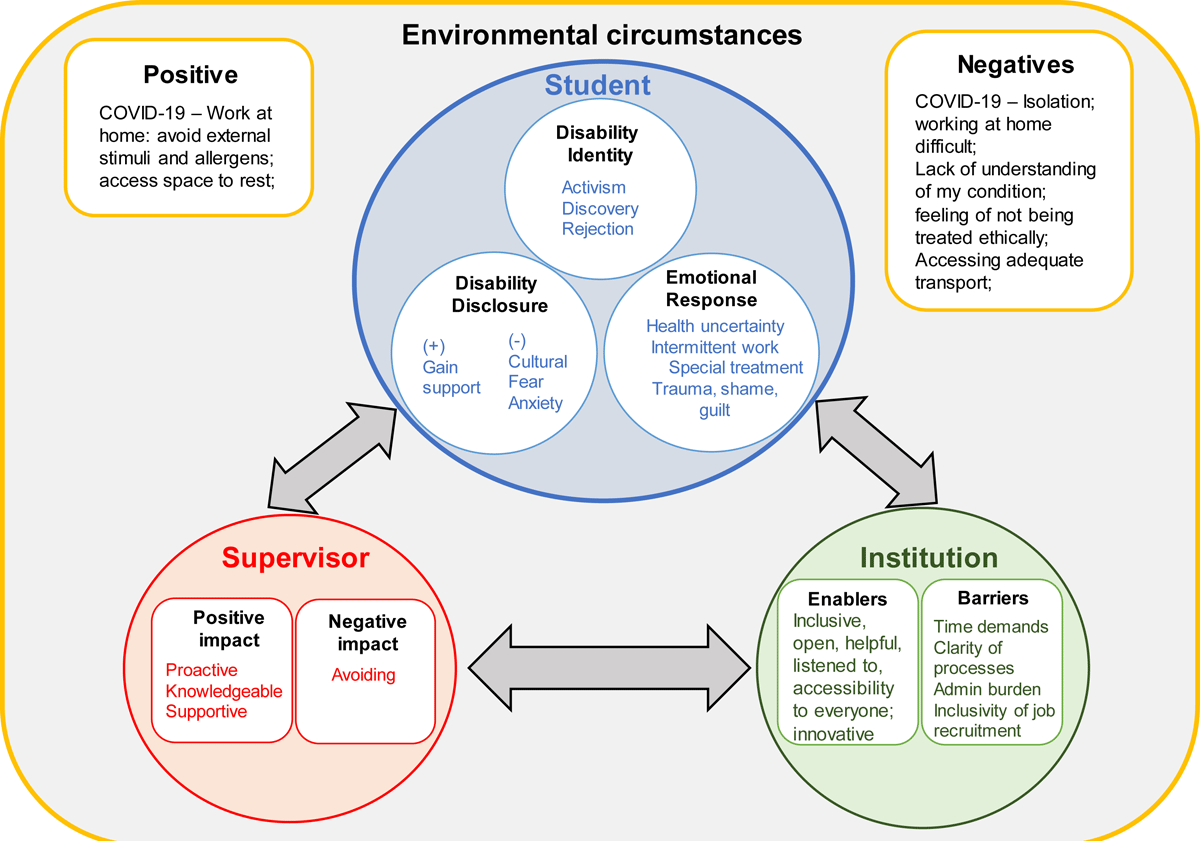
Figure 1
Summary of themes and subthemes on disabled students’ experiences.
Environmental circumstances also frame the institutions in which disabled doctoral students are studying. Universities in the UK are public institutions that are funded and structured in particular ways that impact indirectly and, in some cases, directly on disabled students. Indirectly, the ‘problem of time’ for disabled doctorate students is often linked to universities’ funding arrangements for doctoral studies which set maximum funding commitments for doctoral study. Whilst there is some concession within external funding arrangements, we argue that these are often insufficient for disabled doctoral students particularly those with intermittent conditions where students cannot simply work at a lower (consistent) pace but need a different approach to their studies that enables intermittent engagement as required.
Conclusions
The data presented provides a rich and complex picture of the experiences of disabled doctoral students at a university in the UK. Our research and that of others such as Collins (2015) demonstrates the importance of supervisory relationship and the identity/emotional work disabled students perform to ensure that the supervisory relationship functions for them. At their best, supervisors were reported to pre-empt university requirements and act as advocates for their students. However, students in our project also described experiences of supervisors who were seen as part of the ableist cultures operating within a university.
It is important to note, for future research, that there are likely to be differences between students’ experiences dependent on discipline and wider institutional factors. This builds on the work of Van Rooiji, Fokkens-Bruinsma, and Jansen (2021) who noted departmental and institutional factors as factors in drop-out rates for doctoral students.
Our approach to accessing disabled doctoral students, in which we adopted a broad and self-identifying definition of disability meant that we were able to hear from many students who have not declared themselves as ‘disabled’ within formal university systems but who identify (in some way) as such. This has provided a unique insight to the challenges, barriers and opportunities afforded to these students. It is evident that stigma, fear, and experiences (or fear of) differential treatment were common in students’ accounts.
In order to equitably support doctoral students in their studies and equip them to progress into academia and wider research, cultures need to change. It is clear from some of the students’ accounts that when the institutional culture is flexible and supportive, they are able to thrive. However, this is not the experience of all students.
Change is needed to support more flexible approaches to doctoral studies to enable intermittent and variable engagement due to disabilities and/or health conditions. To do so challenges the notion of the ‘corporeal standard’ (Campbell 2009) of researchers and would lead to a different approach to understanding progression through a doctoral programme. It is clear that disabled doctoral students and researchers throughout their careers make a significant contribution to research findings and communities (DSUK 2023). Currently this is often as a result of significant emotional and identity work by the researchers themselves in attempting to work within environments that do not meet their needs.
Data Accessibility Statement
The data that support the findings of this study are available from the corresponding author (GOC) upon reasonable request.
Acknowledgements
Thanks must go to the participants who made the project possible through their generosity, as well as the reviewers for their feedback on an earlier draft of the paper.
Funding Information
This project was funded by an Open University pan-university scholarship fund.
Competing Interests
The authors have no competing interests to declare.
Author Information
Gráinne O’Connor is a consultant researcher who obtained her PhD from The Open University. She lives with an acquired long-term health condition.
Lindsay O’Dell is the director of the Graduate School at The Open University.
Inma Alvarez is the Director of Postgraduate Studies in the Faculty of Wellbeing, Education and Language Studies.
Nicoleta Tipi is the director of research degrees in the Faculty of Business and Law at the Open University.
Helen Bowes-Catton is Academic Co-Lead for Postgraduate Training at the Open University Graduate School.
Rachael Luck is an inclusive design researcher in the Design Group at the Open University.