
1. Introduction
The United Nations Convention on the Rights of Persons with Disabilities (UNCRPD)1 represents a ‘paradigm shift’ towards a human rights model of disability (Degener 2017). This is reflected in its emphasis on the participation of persons with disabilities, which is viewed as a natural continuation of the involvement of the international disability rights movement during the Convention’s negotiations (Trömel 2009; Sabatello and Schulze 2013). The European Union (EU) and all its 27 Member States are Parties to the UNCRPD (OHCHR n.d.).
The UNCRPD establishes a double-track control on its national and international monitoring, which is meant to be complementary (Manca 2017, 592). Article 33 UNCRPD creates a tri-partite structure among the government, independent mechanisms2 and civil society in a country for national implementation and monitoring. The Committee on the Rights of Persons with Disabilities (UNCRPD Committee), the Convention’s international monitoring body, undertakes a crucial monitoring task – the State reporting procedure, which requires States to submit implementation reports periodically for consideration (Ferrajolo 2017). The Committee defines an organisation of persons with disabilities (OPD) as a specific type of civil society organisation ‘organised, led and controlled by persons with disabilities’ (CRPD 2018, para. 12.a). OPDs from European countries have considered submitting alternative reports3 to the State reporting procedure a crucial task following the UNCRPD’s adoption (Waldschmidt et al. 2017).
The research presented in this article examines the extent to which domestic OPDs have effectively participated in the UNCRPD State reporting procedure in three countries – Hungary, Denmark and France. It focuses on the legal scope of ‘full and effective participation’ of persons with disabilities, as stipulated in Articles 4(3) and 33 UNCRPD, in the context of monitoring the Convention at the national and UN levels. Based on discussions of qualitative data, the findings may have broader implications for the disability movement and other stakeholders involved in the UNCRPD monitoring in other EU Member States.
This article consists of six sections. The second section discusses the research methods adopted in this research. The third section provides a legal analysis of the UNCRPD and its Committee’s rules, which form the legal basis for evaluating the effective participation of OPDs in activities related to the UNCRPD monitoring. The fourth part presents and analyses the findings of three case studies, organised chronologically according to the order of the UNCRPD Committee’s initial review. Following a discussion in the fifth section on the level of participation of OPDs in the case studies and contributing factors that affect their effective participation, the final part concludes the article.
2. Methodology
The current research draws on legal doctrinal and qualitative research methods. Data is drawn from 84 documents obtained from the UN database (OHCHR n.d.) and 26 intensive interviews with 33 informants with working experience in six types of organisations (see Table 1).
Table 1
Interview informants.
| INFORMANTS | DENMARK | FRANCE | HUNGARY | OTHER |
|---|---|---|---|---|
| Disability organisations (including OPDs)4 | 2 interviews, n = 3 (include 1 group interview) | 5 interviews, n = 8 (include 2 group interviews) | 2 interviews, n = 3 (include 1 group interview) | |
| Government administration | 1 interview | 2 interviews | ||
| National human rights bodies | 3 interviews | 2 interviews | ||
| NGOs | 2 interviews | |||
| European and International OPDs | 2 interviews | |||
| UNCRPD Committee and the Secretariat | 5 interviews, n = 7 (include 1 group interview) | |||
| Total participants | N = 6 | N = 11 | N = 7 | N = 9 |
A constructivist grounded theory-based approach is employed to guide the data collection and analysis (Charmaz 2014). Data was collected in three stages between 2020 and 2022. Documents were analysed to understand their drafting processes and functions, together with content analysis. Intensive interviews were conducted using a combination of snowball and theoretical sampling techniques to select informants with relevant experience and knowledge (Palinkas et al. 2015). The interviews involved gentle-guided conversation to explore the informants’ experiences regarding the research topic. Twenty-four interviews were conducted virtually and two in person, all in English, lasting between 30 and 120 minutes. Group interviews were carried out with individuals who work in the same organisation, as initiated by the informants. Ethical approval was obtained prior to data collection, and all interviewees provided voluntary consent for recording and data usage.
Interview recordings were transcribed, and a code name was assigned to each informant to protect the confidentiality of their identity. Documents and interview transcripts were coded or analysed concurrently and comparatively throughout the research. Computer-assisted qualitative data analysis software was used for coding, which consisted of two rounds, initial and focus coding.
Based on literature and expert consultations, Denmark, France, and Hungary were selected as case studies among EU Member States for their active disability movements in the UNCRPD reporting processes. The author also considered a balanced geographical representation of EU countries, the year a country is reviewed, each country’s economic, political and human rights systems, and practical restraints. The case studies aim to present how different political and social factors, as well as the contexts of human rights and disability studies, could affect the implementation of the UNCRPD in a country and its OPDs’ participation in monitoring the Convention.
The research method selection and data collection were substantially affected by the COVID-19 pandemic, making it challenging to interview government officials and diplomats in person as planned. Attempts to arrange remote interviews were unsuccessful, which is evidenced by the absence of Danish government officials in the interviews. To address these limitations, more informants from other backgrounds were included, and the findings were compared with published studies. This research covers data related to monitoring the UNCRPD until 2022.
3. The Legal Framework
Articles 4(3) and 33(3) UNCRPD provide the legal basis and obligations for States to involve OPDs in the implementation and monitoring of the Convention (Caughey and Liu 2021; CRPD 2018; Manca 2017). Article 33 also sets out the national institutions for OPDs’ participation, which should be ‘read and understood as supplementing Article 4(3)’ (CRPD 2018, para. 34). Scholars argue that the human rights model of disability contains a participatory nature, under its principle of inclusive equality, to ensure equal opportunities and equal results for persons with disabilities (Degener and de Castro 2022; Ferri and Broderick 2019).
3.1. The scope of effective participation in monitoring the UNCRPD
Article 4(3) imposes a general obligation for States to ‘closely consult with and actively involve persons with disabilities’, throughout the Convention’s national implementation and decision-making processes on ‘issues relating to persons with disabilities’. This duty to consult is considered ‘one of the expressions’ of the Convention’s general objective and principle of the ‘full and effective participation’ of persons with disabilities in Articles 1 and 3 UNCRPD (Virtanen 2018, 167). However, the vague wording of Article 4(3) provides no easily measurable legal criterion for ‘close consultation and active involvement’. At least, its interpretation should align with the context, purpose, and principles of the UNCRPD, when assessing how the minimum standards for the full and effective participation of persons with disabilities in related issues have been met.
From the outset, consultations should be conducted and regulated through formal consultation mechanisms or procedures, indicating that the consultation practices are permanent, not ad hoc, and aim to achieve genuine dialogue and agreement with participants (Andrea Broderick 2018; CRPD 2018; UNHRC 2016; Virtanen 2018). Specifically, Article 4(3) stipulates that consultations should be conducted through the OPDs of persons (children) with disabilities (CRPD 2018). OPDs are considered an application of the ‘right to self-representation’ of persons with disabilities, as emphasised in the negotiations of the UNCRPD (Ad Hoc Committee 2004; CRPD 2018; UNGA 1994b, r. 18.1). When conducting consultations, it is important to differentiate between the opinions of OPDs and other civil society organisations, as public authorities are recommended to ‘give due consideration and priority’ to OPDs when ‘addressing issues directly related to persons with disabilities’ (CRPD 2018, para. 48). Read in conjunction with Articles 33 to 36 UNCPRD, these issues encompass the national and international monitoring of the Convention, including the duty to consult when preparing the State report under the reporting procedure. The right to participate in Article 4(3) is considered a ‘civil and political right’ and an obligation of ‘immediate application’ (CRPD 2018, paras 28–29). Consequently, OPDs should be respected and protected from ‘intimidation, harassment and reprisals’ (para. 94).
Article 4(3) is linked to positive obligations under Article 29 (b) UNCPRD, which obliges States to ‘promote actively an environment’ where persons with disabilities can form and join OPDs (Della Fina 2017; Plessis and Njau 2018). The UN highlights the importance of funding and support, such as capacity building, to enable the establishment and sustainability of OPDs, while ensuring their independence and autonomy (CRPD 2018; UNHRC 2016).
In line with the inclusive equality principle, accessibility (Article 9) and reasonable accommodation (Articles 2 and 5) measures should be provided to ensure the participation of persons with disabilities with access to ‘all the spaces of public decision-making, on an equal basis with others’ (CRPD 2018, para. 15). A diverse range of OPDs should be involved in decision-making processes, with an emphasis on those representing women (Article 6), children (Article 7), and underrepresented groups, such as persons with psychosocial and intellectual disabilities (CRPD 2018).
Article 33(3) UNCRPD extends the State obligation to fully involve OPDs in the ‘monitoring process’ defined in Article 33(2) (Aichele 2018). Article 33 requires States to create focal points and an optional coordination mechanism within government for the Convention’s national implementation (para. 1); and a national monitoring framework, including independent mechanisms (para. 2). States should consider the Paris Principles and the existing National Human Rights Institutions (NHRIs), when establishing such a mechanism (De Beco and Hoefmans 2013; MDAC 2011; UNGA 1994a).5 The national monitoring framework should be comprised of mechanisms independent of governmental bodies to avoid conflict of interest (CRPD 2016a; MDAC 2011). Studies show that the EU Member States often designate NHRIs and equality bodies as independent mechanisms (Caughey and Liu 2021; OHCHR ROE 2011). In practice, these national implementation and monitoring mechanisms are crucial in facilitating or ensuring the participation of OPDs in related decision-making processes under their separate UNCRPD mandates (Aichele 2018; UN 2007). This includes their potential role in contributing to the State reporting procedure, such as facilitating report preparation and follow-up activities (Caughey 2021; De Beco and Hoefmans 2013). Scholars also emphasise the importance of involving OPDs in data collection and dissemination, as well as ensuring accessibility to relevant statistics in accordance with Article 31 UNCRPD in monitoring activities (Bickenbach 2011; Manca 2017).
In conclusion, Articles 4(3) and 33(3) UNCRPD envisage three sets of obligations to ensure the effective participation of OPDs in its monitoring processes. Firstly, States should implement procedural measures to:
– Define OPDs;
– establish formal procedures for consultations and an adequate national monitoring framework;
– consult with and involve OPDs in relevant decision-making and monitoring processes; and
– respect and protect OPDs from intimidation and harassment.
Secondly, States should implement measures to ensure the equal and diverse participation of persons with disabilities, including promoting an environment for OPDs to develop (effective participation measures). Thirdly, States should ensure that OPDs and other stakeholders have access to information to conduct monitoring activities (effective monitoring measures). The participation of OPDs should not be tokenistic, and relevant State obligations are extensive, aiming to promote partnership, delegated power, and citizen control of persons with disabilities in public decision-making (CRPD 2018; UNHRC 2016). According to Della Fina (2017), the international disability rights movement’s participation in the UNCRPD negotiations has demonstrated that the principles of participation and inclusion in the Convention are achievable and beneficial.
3.2. The state reporting procedure and participation rules
Articles 35 and 36 UNCRPD provide the legal basis for the Convention’s State reporting procedure, which is governed by a set of rules and guidelines after modifications over the years (CRPD 2009; 2016c; 2016b; 2011b). The current State reporting cycle has four stages (see Table 2). The cycle begins with submitting the initial State Report within two years of a country’s UNCRPD ratification. On this basis, a list of issues is compiled by a pre-sessional working group, which allows the State under review to provide written replies. After that, a constructive dialogue between the Committee and the State will take place during the Committee’s plenary session to consider the State report and adopt concluding observations. The Concluding Observations is a non-binding UN document which entails the Committee’s concerns and recommendations regarding the reviewed country’s UNCRPD implementation. The Committee may request States to provide follow-up information. Subsequent reporting is technically scheduled every four years after the previous report, starting with the Committee’s pre-session.
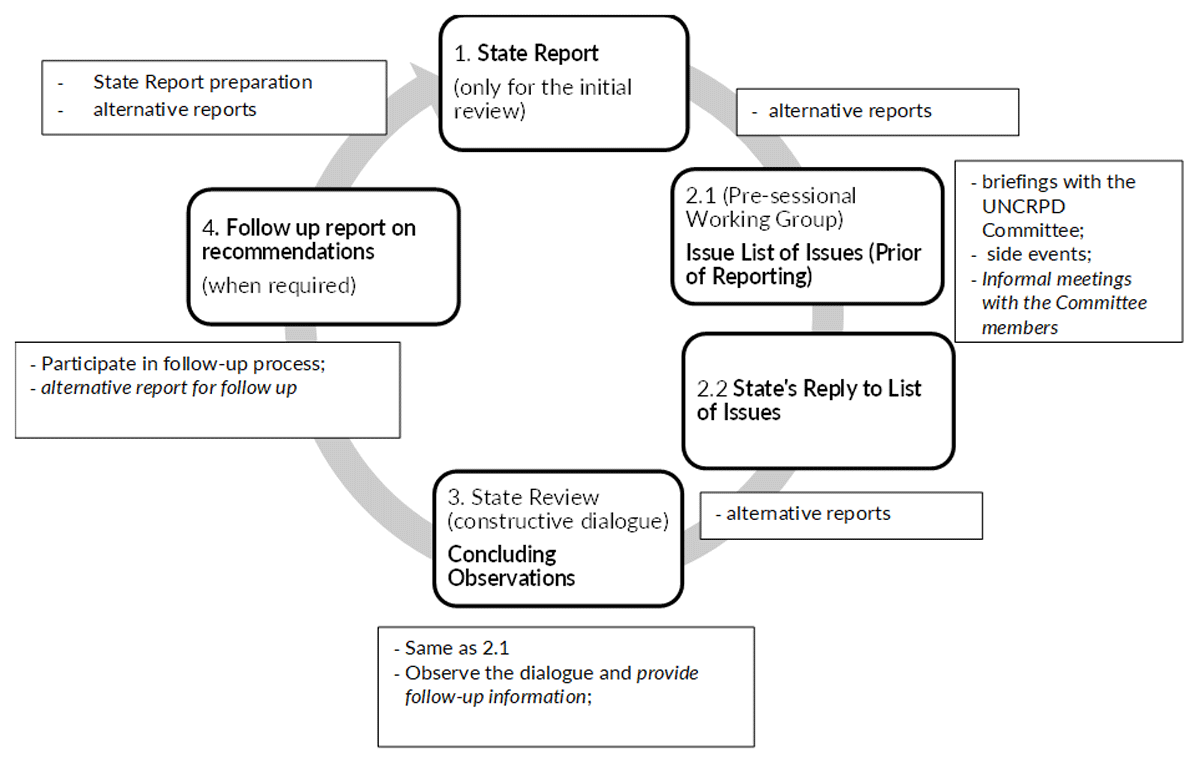
Table 2
OPDs participation in a State reporting cycle (informal practice in italics).
As one of the ‘competent bodies’ under Articles 38(a) and 36(5) UNCRPD, the Committee welcomes and invites OPDs to contribute to its mandate alongside other civil society organisations, NHRIs, and independent mechanisms under Article 33(2) for national monitoring (CRPD 2014; CRPD 2016b). OPDs are granted several participation rights (see Table 2), including submitting written information and meeting with the Committee members during the Committee sessions (IDA 2010). In line with Article 4(3) UNCRPD, the Committee emphasises the principles of inclusion, diversity, and equality in OPDs’ participation in relevant activities (CRPD 2016b). The Committee provides detailed instructions to ensure OPDs’ timely and appropriate contributions, and particularly values their input. The only other competent body that receives such priority is likely the aforementioned independent mechanisms and ‘Paris Principles-compliant’ NHRIs (CRPD 2016a, para. 17).
4. Three Case Studies
This section presents findings from three individual case studies of Hungary, Denmark, and France. It first examines the State’s implementation of Articles 33 and 4(3) UNCRPD in relation to the international monitoring of the Convention. It also illustrates the experience of OPDs and their general impact on the reporting procedure, by examining how these OPDs have influenced the UNCRPD Committee to consider and use their contributions. The findings in this section are based on the interviews conducted by the author, unless otherwise specified in the references.
4.1. Hungary
Hungary ratified the UNCRPD in 2007, and it has been reviewed twice under the State reporting procedure, in 2012 and 2022, respectively.
The formerly known Ministry of National Resources was appointed as the government focal point, and later joined by the Inter-ministerial Committee on Disability as the coordination mechanism under Article 33(1) (CRPD 2011a; 2019). The focal point prepared Hungary’s State reports in both reporting exercises, with the assistance of the coordination mechanism in the latest reporting cycle.
The National Council on Disability (OFT)6 was designated as the independent monitoring mechanism (IM) under Article 33(2). This pre-UNCRPD body was established as a national disability advisory body with representatives from selected NGOs and governmental bodies, and the latter group left following the Committee’s concluding observations (CRPD 2012; 2019). However, the OFT was still chaired and operated by the government focal point (CRPD 2019).
Meanwhile, the OFT continued to serve as a national disability advisory body (CRPD 2011a; 2019). However, it has been criticised for seldom involving grassroots OPDs and becoming tokenistic, losing its former function as a bridge between OPDs and the government. The UNCRPD Committee (2022) has found Hungarian OPDs lack substantive participation in the OFT and other advisory and monitoring bodies established after the initial State reporting procedure, as these mechanisms lack independence and provide no access to information. Similarly, consultations with Hungarian civil society during the State report preparation in both cycles were reported ad hoc and informal.
The number of alternative reports submitted to the UNCRPD Committee during Hungary’s second reporting increased, but overall participation from OPDs seemed less coordinated than the initial reporting (see Table 3).
Table 3
Alternative Reports on Hungary.
| REPORTING CYCLE | TOTAL | IM | NHRI | OPD |
|---|---|---|---|---|
| Initial (2010–2012) | 2 | 0 | 0 | 2 |
| SECOND & THIRD (2017–2022) | 10 | 0 | 2 | 3 |
The Hungarian Disability Caucus (Caucus) submitted two alternative reports to the UNCRPD Committee during initial reporting. The Caucus consisted of national umbrella OPDs, disability organisations and human rights organisations, all with extensive experience in disability rights advocacy (Hungarian Disability Caucus 2010). Many participating organisations are also members of the OFT, including the national council of disabled people – FESZT.7 OPDs led the report drafting with support from human rights NGOs, and the Caucus delegates attended the pre-session in Geneva, with self and international funding. The Caucus was praised for its collaborative approach, as one informant said,
We tried to achieve an agreement concerning all the important statements, or recommendations, which we included in the shadow report. […] That was how the International Disability Caucus works, and we wanted to follow this process. (Interview with N25 in 2021)
Some former Caucus members participated in the subsequent reporting processes through several smaller coalitions and attended the pre-session in Geneva (2017) coordinated by the FESZT. When the constructive dialogue occurred in 2022, only a few OPDs and NGOs openly contributed to the session through written submissions and virtual participation. Informants interviewed inside and outside of Hungary indicated that Hungarian civil society participation was hampered by concerns about possible government retaliation, such as cuts in state funding, for their UN participation or collaborating with foreign civil society organisations. The UNCRPD Committee has repeatedly urged Hungary to prohibit reprisals for disability rights advocacy (CRPD 2020b; 2022). Some OPD representatives encountered difficulties due to the lack of official translated Hungarian and accessible versions of relevant UNCRPD Committee documents and had minimal access to data and information. Since few OPDs contributed to the review session, they had a stressful experience deciding which priorities to report on.
Those who attended the pre-sessions in person reported more positive experiences than those who attended virtually. The informants praised their experience during the informal bilateral meetings with the UNCRPD Committee members, especially those with the country rapporteurs in charge of Hungary’s reports. However, informants found the virtual sessions perplexing and inaccessible for some participants, particularly those with disabilities who have struggled with the format and strict time limits of the briefing meetings.8
The interviews also revealed that Hungarian OPDs’ participation received extensive support from European and international OPDs, including the European Disability Forum (EDF) and the International Disability Alliance (IDA). These organisations provided OPDs training and assistance in the process of report writing and their participation in the UNCRPD (pre)sessions.
Interview findings suggest that Hungarian OPDs had an impact on both State reporting cycles. The UNCRPD Committee found input from Hungarian civil society, including OPDs, was helpful and informative in formulating issues and recommendations. Many core issues highlighted by civil society were reflected in concluding observations. These claims were supported by document analysis results, which compared relevant UN documents with the alternative reports for similarity in wording (see Appendix). The Committee’s initial concluding observations addressed several pressing issues raised in the Caucus’ reports and in-person advocacy regarding the OFT’s compliance with UNCRPD, legal capacity and guardianship (Article 12) and the right to vote (Article 29). The informants found the aforementioned informal meetings were most beneficial, as an OPD representative explained,
Because […] in our (briefing) session, you cannot give a full picture or good argument for every single issue. But if you go to different CRPD committee members and explain them in detail. They (would) have the time to ask questions and respond. (Interview with D7 in 2020)
The research findings indicate that OPDs in Hungary played a leading role in UNCRPD State reporting procedures in collaboration with other civil society organisations. Overall, their participation at the UN level was meaningful and impactful, yet it is becoming increasingly challenging in Hungary. Hungary did not fulfil the obligations stipulated in Articles 4(3) and 33 UNCRPD, creating barriers for OPDs to access necessary funding and information for monitoring tasks. This non-compliance issue reflects that legal and political changes have been made in Hungary that weakened the country’s human rights culture, including restrictions on civil society (Szabô and Márkus 2016; UNHRC 2022). It is also apparent that the Hungarian NHRI has had limited involvement and impact in the State reporting.
4.2. Denmark
In 2009, the Kingdom of Denmark ratified the UNCRPD, which also extends to its two self-governed territories, Greenland and the Faroe Islands. Denmark was initially reviewed under the State reporting procedure in 2014.
The national implementation mechanism under Article 33(1) comprises a government focal point, the former Ministry of Social Affairs, and an inter-ministerial committee as the coordination mechanism (CRPD 2013). These two bodies are responsible for the State report under the reporting procedure (Jørgensen 2015). Greenland and the Faroe Islands have gradually established similar mechanisms (CRPD 2013; 2020a). The NHRI and equality body – the Danish Institute for Human Rights (DIHR), leads the national monitoring framework under Article 33(2) and its monitoring tasks, with the involvement of the Danish Disability Counsel (national disability advisory body), and the Danish Parliamentary Ombudsman (Liisberg 2013). The Faroe Islands have been recommended to establish a monitoring mechanism (CRPD 2013).
Interviews suggested open and regular communication and cooperation between the OPDs, the government and the DIHR. Similarly, informants outside Denmark reported that good communication was observed between the disability movement, the State delegation, and various stakeholders during the reporting and UN sessions. Danish OPDs, mainly its national council of disabled people – the Disabled People’s Organisation Denmark (DPOD), and the DIHR, have extensive experience in disability rights advocacy (Liisberg 2013). The DPOD has also been involved in the DIHR’s Board and its advisory body (DIHR 2023). The DIHR was reported to be ‘respectful [of] and supportive’ in their collaborations with OPDs.
The initial State report drafting involved several Danish OPDs, the DIHR, and ministries, but it received criticism for its insufficient and tokenistic consultation approach (Liisberg 2013). However, an OPD representative suggested that separate reports from the State and civil society should be allowed to reflect their differing positions.
Five alternative reports were submitted under the State reporting procedure (see Table 4). The Danish OPDs were well-organised. Two reports from the Danish civil society coalition were led by the DPOD, which included around 38 member and non-member OPDs and civil society organisations (DPOD 2013; 2014). After an unprecedented collaboration, OPDs in the Faroe Islands provided one report. However, no OPDs in Greenland could contribute despite efforts made to engage them. The alternative reporting was co-funded by the focal point and the DPOD, and the latter assembled a delegation with its members for two UNCRPD (pre)sessions. The briefings with the Committee were organised in an inclusive and democratic manner, as an informant recalled:
We made sure that all members of the delegations were to present a part of the full presentation, and […] they were not to present the part of the presentation about their own disability group. […] (It is) to also show (to the Committee) that […] it is from all of us about all of us, and we share this situation and we respect and consider other people’s issues and needs […]. (Interview with D22 in 2021)
The informant further described the participation experiences as a good practice for mobilising the disability movement and various partners, and only regretted the limited presence of voices of women with disabilities in the reports. With IDA’s assistance, the delegation met informally with the country rapporteurs and other selected Committee members to discuss specific issues within each member’s expertise. Compared to other European OPDs, the Danish OPDs required relatively little support from international OPDs during the country’s reporting process.
The research findings indicate that Danish OPDs and the DIHR had an equal impact on the country’s initial reporting processes. The UNCRPD Committee’s initial concluding observations reflected several prioritised concerns and recommendations raised by the OPDs, such as the lack of cross-sectoral non-discrimination law on disability (Article 5), forced psychiatric treatment of children with disabilities (Article 7), the right to vote of a person under guardianship (Article 29), and supporting OPDs in Greenland (Articles 1–4). Similarities were also identified when comparing different documents (see Appendix).
Danish civil society organisations coordinated their involvement in the UNCRPD State reporting through the leading national council of disabled people. OPDs in Denmark participated effectively in national and international monitoring processes, except for those in Greenland and the Faroe Islands. This could be attributed to Denmark’s largely adherence to its obligations under Articles 4(3) and 33, and its robust democracy and human rights culture. The disability movement and relevant stakeholders should also consider including more OPDs representing intersectional and marginalised groups in future consultation and monitoring activities.
4.3. France
France ratified the UNCRPD in 2010 and was recently reviewed by the UNCRPD Committee virtually in 2021.
The Secretary of State in charge of Persons with Disabilities (the government focal point) and the Inter-ministerial Committee for Disability (the coordination mechanism) are appointed under Article 33(1) (CRPD 2017). The focal point’s office has been under the Prime Minister, while the inter-ministerial committee coordinates between the government, civil society, and independent mechanisms under Article 33(2) – the Defender of Rights (DDD)9 (UNHRC 2019). The equality body DDD also oversees a Monitoring Committee comprised of representatives of four other existing bodies: the NHRI – the National Consultative Commission on Human Rights, the National Consultative Council of Persons with Disabilities (CNCPH),10 the French Council of Persons with Disabilities on European Issues (CFHE),11 and the Controller General of Detention Facilities (CRPD 2017; 2020c). The UNCRPD Committee has recommended increased funding and resources for the independent mechanism, an issue echoed in the interviews (CRPD 2021).
CNCPH is the national disability advisory body that involves OPDs in issues related to the Convention, with the majority of seats held by persons with disabilities in 2017 (CRPD 2017). It includes representatives from parliament, local governments, associations and organisations representing persons with disabilities, and other civil society actors. The CFHE – the national council of disabled people – is an active member chairing a committee on UNCRPD monitoring within the CNCPH.
The UNCRPD Committee has noted that France ‘conflate(s) associations of service providers and managers with organisations of persons with disabilities’, as both groups have the same legal status and are commonly referred to as ‘disability associations’ (2021, para. 9). The issue of representation has caused tensions within the disability movement. Some OPDs or independent organisations expressed concerns about working with umbrella disability associations, including the CFHE and the CNCNPH, and refused to ‘federate within an organisation where the majority is not persons with disabilities’ (interview with D33 in 2022). Smaller self-advocacy OPDs have faced long-term frustration for being unable to participate in CRPD-related consultations, due to the lack of membership in these major associations. The few OPDs that have joined these associations and bodies might experience rejection from other peers for giving legitimacy to the latter. All the organisations were reported to lack independent and sufficient funding. Smaller OPDs rarely have stable funding for operating costs and often refuse state funding to maintain their independence. On the other hand, the CFHE and the CNCPH did not receive sufficient funding for their mandate under the UNCRPD. Consequently, they rely on resources from their member associations, the majority of which are government funded.
The UNCRPD Committee (2021) has recommended that France revise the legal definition of OPDs and involve diverse OPDs in consultations and monitoring processes. Interview informants suggested that the CFHE and CNCPH were not closely involved in consultations because they were often last-minute, and participants’ opinions were not prioritised.
French civil society’s participation in the country’s initial reporting was considered unique compared to other European countries due to a lack of coordination and obvious conflict of interests within the national disability movement. Contributions from OPDs and civil society organisations increased significantly as the procedure progressed (see Table 5). Some smaller OPDs only became unaware of the reporting procedure after learning about it from peers who participated in the pre-session. Informants suggested that the French government did not hold any consultations for the State report.
Table 5
Alternative reports on France.
| REPORTING CYCLE (2016–2021) | TOTAL | IM | NHRI | OPD |
|---|---|---|---|---|
| Pre-session (2019) | 8 | 1 | 1 | 6 |
| Review session (2021) | 23 | 1 | 1 | 11 |
Most alternative reports were contributed by individual French OPDs (19, including one representing students with disabilities) and the Monitoring Committee bodies.12 Informants argued that the CFHE’s alternative reporting process was undemocratic, which discouraged its members from contributing. Although there were suggestions of government interference, the CFHE report was reportedly not well-received by the administration.
A small OPD coalition attended the pre-session in Geneva, while more OPDs participated in the virtual review session. The Monitoring Committee delegation attended both sessions for briefings. All informants discussed their informal meetings with the UNCRPD Committee members to provide additional information and clarify their questions. OPD representatives complimented the Committee members, especially the country rapporteurs, for being fair, receptive, accessible, and accommodating, while expressing strong disappointment that service provider and manager organisations were treated as OPDs during the briefings.
OPD representatives, particularly self-advocates, discussed challenges such as report writing difficulties, insufficient funding and support for their participation in the UNCRPD (pre)sessions, and time constraints during briefings. For neurodiverse persons, delivering oral statements on time was described as ‘extremely difficult (at the level of the) Olympic Games’ (interview with D37 in 2022). Nevertheless, the informant emphasised that the struggles were mitigated by ‘a lot of goodwill, patience, and kindness’ from the Committee and its Secretariat. Additionally, informants highlighted the support from national, European and international disability communities, including training, funding, knowledge sharing, and assistance throughout their participation process.
Interview findings suggest that OPDs made substantial contributions to the UNCRPD Committee’s consideration of France’s initial State report, highlighting issues such as the institutionalisation and the authentic representation of persons with disabilities in decision-making. The references to autistic persons (20) and persons with psychosocial disabilities (22) in the concluding observations were attributed to the active participation of OPDs. A former UNCRPD Committee member recalled that,
[…] there was never so much attention on autism issue before the review of France. […] (T)here are quite a lot of mentions of autistic persons in the concluding observations […]. It is due to (the) intensive communication and the reports that were submitted by the organisation of the autistic persons to the Committee. (Interview with U41 in 2022)
The Committee also noted that the information submitted by the national umbrella disability associations was influenced by their members and did not address critical issues such as the institutionalisation of persons with disabilities. Informants from OPDs, disability associations, and national human rights bodies claimed their contributions were reflected in the UN documents, which are supported by the results of document analysis (see Appendix).
French OPDs, particularly self-advocates, were active and impactful in the reporting procedure at the UN level. However, their relevant national participation was lacking as France failed to fulfil its obligations under Articles 4(3) and 33 UNCRPD. This may be related to the country’s weak tradition of disability rights advocacy and policies, despite the seeming ambition to implement the UNCRPD with the involvement of many high-level national (human rights) bodies (Thompson 2017; Baudot 2018). Nonetheless, French OPDs set a positive example by strategically using the UNCRPD monitoring to expand the movement and create participation spaces.
5. Discussion: Effective Participation and Contributing Factors
The case studies illustrate the similarities and differences between State practice and OPDs’ experience in each UNCRPD State reporting process in Hungary, Denmark and France. OPDs from the three countries were active and influential in the CRPD State reporting procedure, demonstrating dedication, tactfulness and a strong connection with the European and international disability movement, as in the movement in the UNCRPD’s negotiations. Participation in the State reporting procedure provides an opportunity for OPDs to gain support from broader human rights advocacy and reinforce solidarity within the disability movement.
In the legal analysis, the UNCRPD offers a framework to ensure the effective participation of OPDs in decision-making and monitoring processes. Among the three countries, Denmark fulfilled most of the relevant UNCRPD obligations, and Danish OPDs encountered the fewest difficulties in their State reporting exercises. This showcases that well-resourced OPDs are more efficient in dealing with the UN human rights mechanism. However, neither country has fully implemented their obligations under Articles 33 and 4(3) UNCRPD, nor have the OPDs participated in the State reporting in conformity with the Convention. Like other EU countries, the three countries have established national mechanisms and involve OPDs through designated advisory bodies and national OPDs, such as the national council of disabled people (FRA 2014; OHCHR ROE 2011). These mechanisms were crucial in each country’s UNCRPD State reporting exercises. Competent national human rights bodies and independent mechanisms mandated under Article 33(2) are valuable partners in supporting the effective participation of OPDs in monitoring the UNCRPD, as in the case of Denmark.
The implementation of obligations and measures related to effective participation and monitoring was problematic, particularly in the case of Hungary and France. One theme that emerged from the case studies was the need for an enabling domestic environment for the development of OPDs. The participation of OPDs representing women and children was also rarely visible in this research. In the UN system, the main barrier to the effective participation of persons with disabilities existed in the inadequate provisions of accessibility and reasonable accommodation during the UN sessions. These issues posed the most challenges for grassroots and self-advocate OPDs, as national umbrella OPDs are often the main contributors to the State reporting and are more resourceful (Petri, Beadle-Brown, and Bradshaw 2021)
6. Conclusion
This article has examined the legal scope of the effective participation of persons with disabilities in the international monitoring of the UNCRPD and the participation of OPDs in the Convention’s State reporting procedure in three EU Member States. The research has demonstrated that the normative framework outlined in Articles 4(3) and 33 UNCRPD provides the necessary measures and mechanisms for OPDs to participate effectively in decision-making and monitoring processes related to the Convention.
The disability movement in Hungary, Denmark and France has significantly influenced each country’s reporting process at the UN level. However, the States and the UN system need to make additional efforts to implement the UNCRPD and ensure the effective participation of OPDs accordingly, which includes involving historically marginalised disability communities. OPDs from other EU countries could benefit from the lessons learnt in the case studies and strengthen their collaboration with the regional and international disability movement, other civil society actors and national human rights bodies when participating in human rights monitoring at both national and UN levels.
Additional File
The additional file for this article can be found as follows:
Appendix
Results of document analysis of the relationship between alternative reports and UN documents for the State reporting processes. DOI: https://doi.org/10.16993/sjdr.1055.s1
Notes
[1] Convention on the Rights of Persons with Disabilities, adopted 13 December 2006, entered into force 3 May 2008 2515 UNTS 3.
[4] Disability organisations also include organisation ‘for’ persons with disabilities. OPDs in this research were mostly self-identified by participated informants.
[5] NHRIs are state-mandated independent bodies to promote and protect human rights within a country. The non-legally binding Paris Principles provide basic guidelines for NHRIs regarding their competence, responsibilities, compositions, and working methods.
[7] In Hungarian: Fogyatékos Emberek Szervezeteinek Tanácsa. There is one national council of disabled people from each EU Member States, see definition in (EDF 2022).
[8] OPD coalitions on average have 5 minutes to present oral statement, while single organisations have 3 minutes.
Ethics and Consent
The research received approval from the Ethical Review Committee of Inner-City Faculties at Maastricht University (ref. no. ERCIC_180_26_02_2020).
Acknowledgements
The author wishes to thank Claudia Coveney and the reviewers for their valuable comments on the draft, as well as the following organisations for their participation in the research: 100% handinamique (France), Advocacy France, Alliance Autiste (France), CFHE, Controller General of Detention Facilities (France), Coordination Handicap Autonomie (France), DIHR, DPOD, Danish Parliamentary Ombudsman, EDF, FESZT, HANDI-SOCIAL (France), IDA, and Mozgáskorlátozottak Egyesületeinek Országos Szövetsége (Hungary).
Funding Information
This research is a part of the author’s PhD research funded under the European Union’s Horizon 2020 research and innovation programme under the Marie Skłodowska-Curie grant agreement No 814249.
Competing Interests
The author has no competing interests to declare.