
Introduction
The identification of acquired disabilities in the Organisation for Economic Co-operation and Development (OECD) countries and the impact on employment outcome has not been adequately researched. It is estimated that approximately 80% of people living with a disability within the OECD countries would have acquired the disability after birth (Jones et al. 2014; OECD 2010). Additionally, the terms ‘acquired disabilities’ and ‘chronic health conditions’ are generally used interchangeably in disability studies, clinical and welfare practice. A clear distinction in definitions and a clarity in terminology is necessary to inform both disability studies and practice, particularly in the interest of closing the gap between the participation rate in employment for individuals living with a disability.
In most OECD countries since the 1990s, the participation rate of people with a disability in the workforce has remained constantly around 30% lower than those without (Bezyak et al. 2018; Blanck & Adya 2017; Barnes & Mercer 2005; Zana et al. 2023). This is despite increased anti-discrimination legislations, modern technology, and recent flexible employment arrangements in these countries (Brongers et al. 2020; Zana et al. 2023). Traditionally, disability studies have focused on entry into employment for people with mostly congenital disabilities and the return-to-work of those rehabilitated after an illness or injury. Research discussing the identification and factors contributing to people with disabilities exiting employment remains scarce. Consequently, the proposition of ensuring people with acquired disabilities gain re-entry into employment remains a challenge until the factors contributing to employment termination are adequately understood.
Research has highlighted an increase in people who once held employment seeking disability pension or welfare services (Barnes 2012; Geisen et al. 2019; Jones et al. 2014; Pihlajamäki et al. 2019; Soldatic et al. 2017). Attempts have been made to curb the inflow of individuals claiming a disability pension, particularly in Australia and the United Kingdom where a two-tiered assessment is used to determine both the degree of restriction and the resultant capacity to work (Barnes 2012; Jones et al. 2014; Soldatic et al. 2017). However, it is unclear whether limiting access to a disability pension is an accurate measure of an individual’s capacity to return to the workforce in the hours designated.
Understanding acquired disabilities in the light of participation, particularly in open employment, is critical because work is posited as central to health (Bezyak et al. 2018; Chan et al. 2010; Milner et al. 2020), economic independence (Mbengi et al. 2018; Tagaki 2016), social inclusion (Cregan, Kulik & Bainbridge 2017; Załuska et al. 2020; Barnes 2012), and other social factors pertaining to a meaningful adult life including membership, identity and other psychosocial factors (Kuiper, Bakker & van der Klink 2016; Milner et al. 2014).
Traditionally, policy has focused on providing people with disabilities accessibility and government subsidies (Angelov & Eliason 2018; Anema & Sligar 2010; Hogan et al. 2012; Copeland et al. 2010) while these represent significant social inclusion strategies, they sideline the needs of those with less visible and less understood acquired disabilities. Resultantly, the notion of the ideal worker in job descriptions continue to reproduce as unfit to work, individuals whose reduced work capacity is the result of acquired disabilities (Foster & Wass 2012; Jammaers, Zanoni & Hardonk 2016; Zanoni 2011). Additionally, the attitude of stakeholder groups remains an impediment to full inclusion of people with acquired disabilities into the workplace due to this knowledge gap.
This review aimed to establish what is already known about acquired disabilities in the literature. The focus was placed on policy, disability models, and employment outcomes of people with a disability. The findings of this review highlight the gaps in knowledge about acquired disabilities and provide a guide for future research.
Aligning the objectives and questions
This scoping review was guided by the following questions:
What are the characteristics of acquired disabilities that enable the definition, and alignment to models of disability?
How are these characteristics of acquired disabilities identified in OECD countries’ policy and research?
The review aimed to meet three objectives in assessing the potential size and scope of available research and literature on the identification of acquired disabilities in OECD countries. These are:
To report on the literature on acquired disabilities, identification, characteristics, and definitions within the OECD countries.
To extract the research evidence on the models of disability guiding research, policy, and employer perceptions.
To synthesise the results and analyse the gaps.
Developing and aligning the inclusion criteria with the objectives and research question
The scoping review followed the Population, Concept, Context (PCC) framework (Arksey & O’Malley 2005; Levac, Colquhoun & O’Brien 2010). The PCC framework is a guide to construct clear objectives and the inclusion criteria of a scoping review. In this review, it guided the keywords, subject, and index terms used in the search criteria of the literature.
Population (P)
The review focused on the identification of acquired disabilities in OECD countries. Emerging evidence shows that around 80% of people with a disability acquired the condition after birth (Jones et al. 2014; OECD 2010). This representation of the acquired disability population justifies this review, as understanding the characteristic of this cohort is a necessary contribution to the extant quest to reduce the participation gap between those with disability and those without.
Concept (C)
The core concept of this review is the identification of acquired disabilities in disability models, policy, and research. The conceptualisation of this scoping review is framed within the characteristics of acquired disability that impact on employment outcomes. Measuring sustainable employment requires an investigation on the reasons, not only at the entry point of employment, but also why people with acquired disability exit the workforce.
Context (C)
The context of this review centres on the identification of the impact of acquired disabilities on employment participation in OECD countries. To lay a foundation for this framework, relevant literature on the identification, characteristics, and definition of acquired disability were selected.
Method
A scoping review was undertaken to identify and analyse the knowledge and gaps in the literature about the identification of acquired disabilities in OECD countries. A scoping review method was chosen for its ability to produce a rigorous synthesis of the evidence (Levac, Colquhoun & O’Brien 2010), capacity to identify research gaps (Arksey & O’Malley 2005) and to provide a descriptive overview of the literature (Levac, Colquhoun & O’Brien 2010; Peters et al. 2015).
An initial search of literature on ProQuest Central was conducted on the 10th of September 2022. This search was undertaken to test keywords within titles, abstracts, and index terms used in subjects and the thesaurus. Using the outcomes of the initial search, a second search was conducted on the 16th of April 2023. This involved applying the keywords and search terms across four databases: The JSTOR, ProQuest One Academic, and Sage Journals Online. These databases were chosen for their coverage of sociology, social science, and social policy literature. The inclusion and exclusion criteria were guided by the PCC criteria discussed above. The literature selected was limited to:
Full-text peer-reviewed articles discussing acquired disability and/or chronic/conditions and injuries causing disability,
Published in and/or on OECD countries,
Included disability models, definitions, or identification of acquired disabilities,
Published in the English language,
Published between 1990 and April 2023.
The exclusion criterion was guided by the following:
Congenital disability and/or chronic medical conditions discussed outside the context of disability,
All other countries outside the OECD,
Disability models not applied in OECD countries,
Books, reports, abstracts, conference papers, literature reviews.
The year of 1990 was selected as the point of departure as this is the period that, arguably, saw the social model of disability move from academia to practice, thus changing how disability was viewed in the OECD countries (Barnes 2012; Barnes & Mercer 2005). Only English language publications were selected. The Boolean logic and operators were applied against search terms, subjects, and keywords with both ‘exact phrases’ and/or abridged search terms used. Advice was sought with both the university librarian and research supervisors to determine appropriate search terms. Terms that returned varying results between databases were: ‘disability’, ‘disabilities’, ‘disabled’, ‘disablement’, ‘impairment’, ‘impairments’, ‘model’ and ‘models’. These were searched using either the exact phrase or abridged terms as follows: Disab* AND Acquired AND Model* AND Defin* AND Participation AND *OECD.
Search and selection of scoping reviews
The results of the second search conducted on the 16th of April 2023 are shown in the PRISMA Flow Diagram in Figure 1. After irrelevant and duplicate publications were removed, 209 titles were extracted into both Endnote and Rayyan for further screening. A blinded screening of the titles and abstracts was completed by all authors and conflicts resolved through discussion and team consensus. Full text screening was completed for 52 studies, of which nine were removed as they were pages from textbooks, editorials, or out of the scope of the research question. A total of 43 studies were included for data extraction.
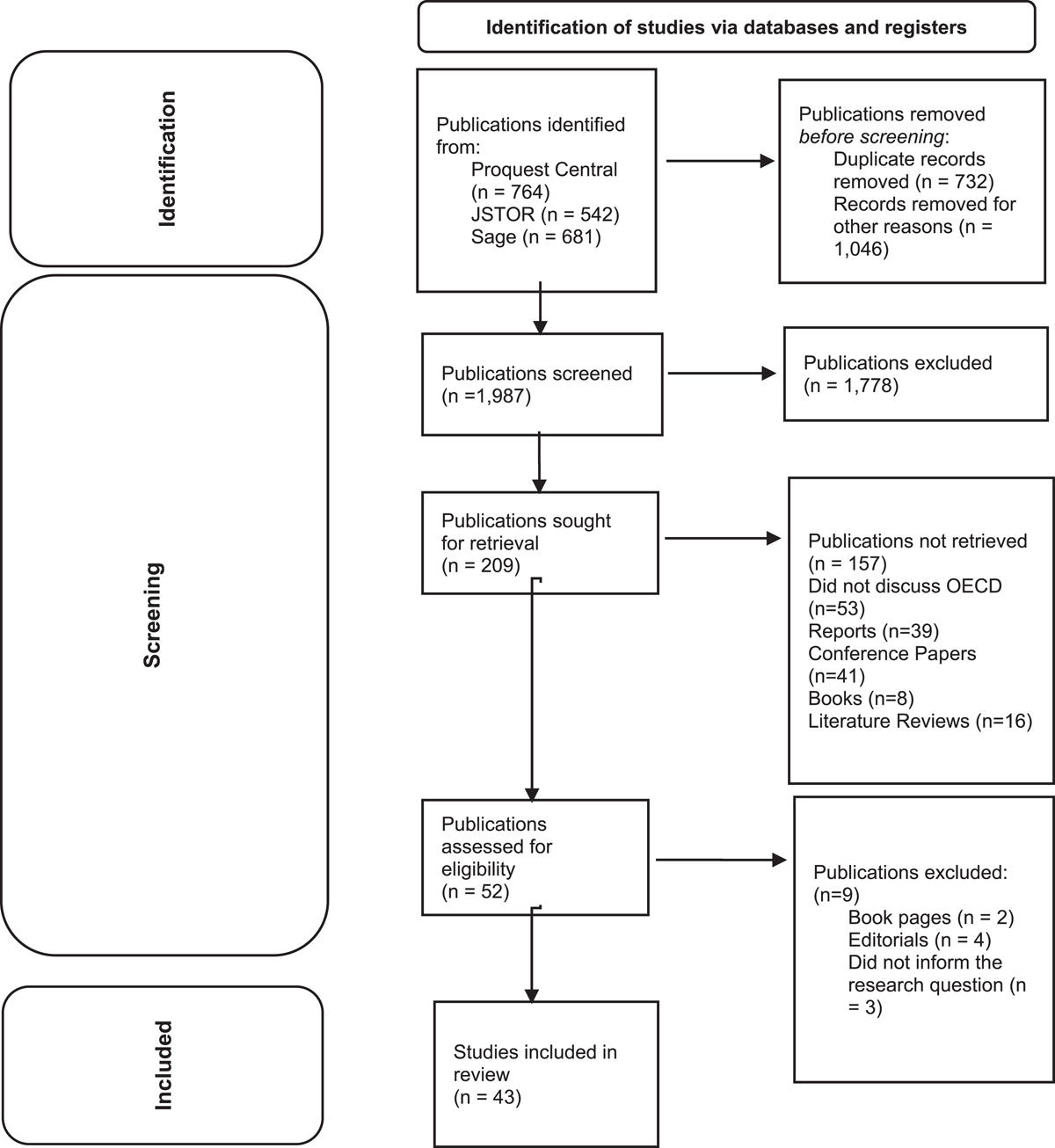
Figure 1
The PRISMA flow diagram.
Source: (Page et al. 2021).
Approach to evidence searching, selection, extraction, and charting
The selected publications were recorded and charted according to how they informed the research question, with an emphasis on whether they identified and/or defined ‘acquired disability’ including models, policy, characteristics, and attitudes of employers. The grouping is shown in Table 1. Charting the included literature.
Table 1
Charting the included literature.
| AUTHOR/COUNTRY | INFORMED THE RESEARCH QUESTION | IDENTIFIED ACQUIRED DISABILITY | PROVIDED A DEFINITION OF ACQUIRED DISABILITY | DISCUSSED DISABILITY MODELS |
|---|---|---|---|---|
| Ameri et al. (2018) – USA | ✔ | ✖ | ✖ | ✖ |
| Anema & Sligar (2010) – USA | ✔ | ✖ | ✖ | ✖ |
| Angelov and Eliason (2018) – Sweden | ✔ | ✖ | ✖ | ✖ |
| Bengtsson and Gupta (2017) – Denmark | ✔ | ✖ | ✖ | ✖ |
| Bezyak et al. (2018) – USA | ✔ | ✔ | ✖ | ✖ |
| Bogart, Rosa & Slepian (2019) – USA | ✔ | ✔ | ✖ | ✔ |
| Breen (2017) – Canada | ✔ | ✔ | ✖ | ✔ |
| Brongers et al. (2020) – Netherlands | ✔ | ✔ | ✖ | ✖ |
| Chan et al. (2010) – USA | ✔ | ✖ | ✖ | ✔ |
| Copeland et al. (2010) – USA | ✔ | ✖ | ✖ | ✖ |
| Cregan, Kulik & Bainbridge (2017) – Australia | ✔ | ✔ | ✖ | ✖ |
| Draper et al. (2011) – USA | ✔ | ✖ | ✖ | ✖ |
| Fevre et al. (2013) – UK | ✔ | ✖ | ✖ | ✔ |
| Finger et al. (2011) – Switzerland | ✔ | ✖ | ✖ | ✔ |
| Foster & Wass (2012) – UK | ✔ | ✖ | ✖ | ✖ |
| Lopez-Frutos & Castello (2015) – Spain | ✔ | ✔ | ✖ | ✖ |
| Geisen et al. (2019) – Switzerland, Australia, Canada and China | ✔ | ✔ | ✖ | ✖ |
| Glässel et al (2012) – Switzerland | ✔ | ✔ | ✖ | ✔ |
| Harel-Katz & Carmeli (2019) – Israel | ✔ | ✔ | ✔ | ✔ |
| Hemphill & Kulik (2016) – Australia | ✔ | ✖ | ✖ | ✖ |
| Hogan et al. (2012) – Australia | ✔ | ✖ | ✖ | ✖ |
| Jammaers & Zanoni (2021) – Belgium | ✔ | ✔ | ✖ | ✖ |
| Jammaers, Zanoni & Hardonk (2016) – Belgium | ✔ | ✖ | ✖ | ✖ |
| Jones & Sloane (2010) – UK | ✔ | ✖ | ✖ | ✖ |
| Jones & Wass (2013) – UK | ✔ | ✖ | ✖ | ✔ |
| Jones et al. (2014) – UK | ✔ | ✔ | ✖ | ✔ |
| Kaye, Jans, Jones (2011) – USA | ✔ | ✖ | ✖ | ✖ |
| Kuiper, Bakker, Van der Klink (2016) – The Netherlands | ✔ | ✔ | ✖ | ✖ |
| Kuznetsova & Bento (2018) – Norway | ✔ | ✔ | ✖ | ✖ |
| Madden et al. (2020) – Australia | ✔ | ✖ | ✖ | ✔ |
| Mbengi et al. (2018) – Belgium | ✔ | ✔ | ✖ | ✖ |
| Milner et al. (2014) – Australia | ✔ | ✖ | ✖ | ✔ |
| Milner et al. (2020) – Australia | ✔ | ✖ | ✖ | ✔ |
| Pihlajamäki et al. (2019) – Finland | ✔ | ✔ | ✖ | ✖ |
| Richards and Sang (2019) – UK | ✔ | ✖ | ✖ | ✖ |
| Schur et al. (2017) – USA | ✔ | ✖ | ✖ | ✖ |
| Selander & Buys (2010) – Sweden | ✔ | ✔ | ✖ | ✖ |
| Soldatic (2017) – Australia | ✔ | ✖ | ✖ | ✖ |
| Tagaki (2016) – Japan | ✔ | ✔ | ✖ | ✖ |
| Wilber et al. (2002) – USA | ✔ | ✔ | ✖ | ✖ |
| Załuska et al. (2020) – Poland | ✔ | ✖ | ✖ | ✔ |
Results
The aim of the review was to scope the literature that identified ‘acquired disabilities’ in the OECD countries, with an emphasis on definitions, disability models, policy, and employers’ hiring behaviours. From the 43 studies, this scoping review identified six themes or factors that are relevant to the identification of acquired disabilities and employment: i) definition, ii) employers’ hiring behaviours, iii) disability models, iv) policy, v) supports, and vi) skill matching.
Definitions of acquired disability
The Organisation for Economic Cooperation and Development (OECD) working paper (2010) was chosen to set the background and definition of ‘acquired disability’ as the OECD is the universal peak body for these countries. According to the paper, ‘acquired disability’ is a disability developed after birth that affects a person’s ability to perform certain activities such as attending work. The definition includes chronic illness, injuries, and mental health as underlying causes. According to the OECD (2010) report, up to 90% of people claiming disability benefit for the first time do so after a period of sickness absenteeism. Only about 2% of individuals with a reduced work capacity who receive the disability benefit return into the labour force.
This definition is employed by various peak bodies in OECD countries. For instance, in Australia, the Bureau of Statistics (ABS 2020) states that around 80% of people living with a disability in Australia would have acquired it after birth. In Ireland, around 70% of individuals with acquired disabilities within the working age group of 20–64 would have acquired it after the age of 16 (OECD 2010). Overall, there’s a resounding indication that a significant representation of acquired disabilities develops during the working age of individuals, thus impacting on employment outcomes.
This review sought to synthesize literature that align the definition of acquired disability to that outlined by the OECD. Overall, none of the articles reviewed provides an adequate definition, but instead, mostly describes acquired disabilities within the context in which they were written. For example, Bogart et al (2019) focus mainly on the comparison between the stigma on people with congenital disabilities against the stigma on those with acquired disabilities. Tagaki (2016) discusses acquired disabilities within the context of physical impairment resulting from injury and/or illness without providing a definition. Many other articles attempt to either define, or at least to describe the impact or characteristics of an acquired disabilities in various contextual ways. The question remains, what are the parameters of an acquired disability? Does every chronic illness or injury results in acquired disability? Is acquired disability the impairment or the consequence of it?
Of the 43 papers reviewed, 12 referred to the characteristics of acquired disabilities (Bogart, Rosa & Slepian 2019; Cregan, Kulik & Bainbridge 2017; Draper et al. 2011; Harel-Katz & Carmeli 2019; Jones et al. 2014; Kuiper, Bakker & van der Klink 2016; Kuznetsova & Bento 2018; Mbengi et al. 2018; Pihlajamäki et al. 2019; Selander & Buys 2010; Tagaki 2016; Wilber et al. 2002). However, only one paper provided a specific definition of ‘acquired disability’ (Harel-Katz & Carmeli 2019). According to Harel-Katz and Carmeli (2019), an acquired disability occurs after an accident, illness, or development of a health condition.
Of those that referred to the characteristics of acquired disability in the description, multiple identifications emerged. Three articles suggested that an acquired disability is a long-term condition that has an onset at a later stage in an individual’s life and results in restricting functionality and activity (Cregan, Kulik & Bainbridge 2017; Jones et al. 2014; Kuznetsova & Bento 2018). A further six papers referred to acquired disabilities as a chronic disease, illness, or impairment that impacts on an individual’s functioning at work (Draper et al. 2011; Kuiper, Bakker & van der Klink 2016; Pihlajamäki et al. 2019; Mbengi et al. 2018; Selander & Buys 2010; Wilber et al. 2002).
A small number of papers made the reference to acquired disability in relation to work (Kuiper, Bakker & van der Klink 2016), daily activity (Kuznetsova & Bento 2018), and the basis to receive a disability pension (Kuznetsova & Bento 2018). Acquired disability was also discussed as a causal factor for workplace injuries (Kuiper, Bakker & van der Klink 2016) or as a factor impacting on functioning (Draper et al. 2011; Kuiper, Bakker & van der Klink 2016). Other characteristics discussed applied to both acquired and congenital disability, including discrimination (Draper et al. 2011), social inclusion (Bengtsson, Datta Gupta & Federici 2017), social construction (Breen 2017; Cregan, Kulik & Bainbridge 2017), and ableism (Jammaers & Zanoni 2021). One research placed a timeline on when a chronic health condition becomes a disability at six months or more (Cregan, Kulik & Bainbridge 2017).
There has not been a clear distinction between the medical condition causing the disability and the disability itself. For example, Kuiper, Bakker & van der Klink (2016) and Draper et al. (2011) include ‘chronic illness’ in their reference of disability but do not clarify where the illness ends, and the disability begins. This lack of clear separation between the disability and the underlying condition could explain some misunderstandings about it in the workplace.
On the other hand, extant literature has been clear on the difference between acquired and congenital disabilities, especially around the characteristics and the categorization of the dispositions of disability (Bogart, Rosa & Slepian 2019; Tagaki 2016; Wilber et al. 2002). In a Japanese study, Tagaki (2016) found that people with an acquired disability took longer to adjust to living with their new condition than those with a congenital disability. The study also found that those with an acquired disability switched between the disability and non-disability aspects of self, often trying to convince themselves that the disability was temporary even when the outlook suggested otherwise. The author points out that participants in their study tended to encounter additional secondary problems such as those linked to bodily functioning, psychosocial issues, and activities of daily living even after they had accepted their acquired disability.
The notion of secondary conditions as a contributing factor to participation is also echoed by Wilber et al. (2002), who point out that the health status of an individual with a disability could be exacerbated by additional conditions along with their primary disability. Furthermore, other researchers have found that acquired disabilities were less essentialized by community members, employers and co-workers, resulting in people with acquired disabilities feeling blamed for their conditions (Bogart, Rosa & Slepian 2019). This assertion by Bogart, Rosa & Slepian (2019) suggest that people with acquired disabilities may receive less support in the workplace than those with congenital disabilities due to their condition considered less essential. The authors also point that acquired disabilities are often invisible. Additionally, individuals with an acquired disability were found to have a lower disability self-concept and hence a weakened satisfaction with life than those with congenital disabilities (Bogart, Rosa & Slepian 2019).
Employer attitude and hiring behaviour
Perception and attitude towards acquired disabilities are not discussed widely in the literature. A total of 13 articles discussed perceptions and attitude towards disability (Ameri et al. 2018; Bogart, Rosa & Slepian 2019; Breen 2017; Chan et al. 2010; Copeland et al. 2010; Draper et al. 2011; Fevre et al. 2013; Geisen et al. 2019; Hemphill & Kulik 2016; Jammaers, Zanoni & Hardonk 2016; Kaye, Jans & Jones 2011; Kuiper, Bakker & van der Klink 2016; Tagaki 2016). These included, cost of accommodation (Kaye, Jans & Jones 2011), loss of productivity through illness related absenteeism (Geisen et al. 2019; Jammaers, Zanoni & Hardonk 2016; Kuiper, Bakker & van der Klink 2016), co-workers finding working with people with a disability stressful, or perceiving that workers with a disability received preferential treatment (Hemphill & Kulik 2016), as well as workers with a disability feeling obliged to constantly defend their impairment and prove their productivity capacity (Jammaers, Zanoni & Hardonk 2016).
However, only four were specific to acquired disability (Bogart, Rosa & Slepian 2019; Tagaki 2016; Jammaers & Zanoni 2021; Jammaers, Zanoni & Hardonk 2016; Kaye, Jans & Jones 2011). According to Tagaki (2016) employees with acquired disabilities alternated their identities between having a disability and not having a disability, resulting in these employees rarely declaring their disabilities to employers. It is argued that the attempt to avoid the representations and constructions associated with a disability is as disabling as the underlying medical condition or impairment (Jammaers, Zanoni & Hardonk 2016; Kaye, Jans & Jones 2011; Jammaers & Zanoni 2021). According to Jammaers and colleagues (2016), the discursive constructions have a contradictory impact on employees with an acquired disability as they are constructed for what they cannot do; while, at the same time they are hired for what they can do. This results in employees with acquired disabilities presenting themselves as the able-bodied ideal worker binding them to hide their deteriorated capacities (Kaye, Jans & Jones 2011), or to accept tainted identities in order to retain employment (Jammaers & Zanoni 2021).
The negative influence of language in the construction of inferior self-identity among workers with a disability including a sense of unemployability is said to cause a stigma around acquired disability, resulting in the non-disclosure (Jammaers & Zanoni 2021; Madden et al. 2020). According to Madden et al. (2020), the non-disclosure may also be influenced by workers with acquired disabilities not finding the relevance of their disability to the role.
Apart from the factors influencing non-disclosure, stigma is said to affect those who disclose their disabilities. Results from two studies show that employers lacked awareness of how to deal with workers with an acquired disability in the workplace (Kaye, Jans & Jones 2011; Richards & Sang 2019). In both studies fear of liability and loss of productivity were evident. According to Richards and Sang (2019), employees with an acquired disability benefit less even if they remain in long-term employment because employers lack awareness of how to support employees with an acquired disability.
Two research papers cite a conflict between the employer’s expressed willing to employ workers with acquired disabilities and their actual hiring behaviours. In the field experiments conducted in the USA (Ameri et al. 2018; Schur, Kruse & Blanck 2013), employers were hesitant to hire individuals who had disclosed a disability regardless of their experience in the advertised job (Ameri et al. 2018; Schur et al. 2017). This was independent of the type of disability but was more concentrated among individuals with an acquired disability who had the most professional experience (Ameri et al. 2018). This finding contradicts other studies that link appropriate education with employment opportunities (Bengtsson, Datta Gupta & Federici 2017; Kuznetsova & Bento 2018; Lopez-Frutos & Castello 2015). These conflicting findings regarding the role of education in positive employment outcomes for people with disability show, not only that the role of education is both less understood, but also highlight that education and training interventions have been less successful than assumed.
Other factors impacting on employment outcomes of people with acquired disabilities that emerge from the review include the perceived aspect of disability as a threat to the identity of co-workers, resulting in workplace bullying (Fevre et al. 2013), or avoidance (Bogart, Rosa & Slepian 2019). According to Bogart et al. (2019), acquired disability remind fellow workmates that they could also, possibly acquire a disability leading to avoidance and blame. The authors point out that this is the reason fellow workmates would ask intrusive questions about how the disability was acquired, or whether all precautions were taken.
Models of disability
While it appears that the International Classification of Functioning, Health, and Disability (ICF) is employed as the operational model in all OECD countries represented in the literature; significant research centres around the social model of disability (for instance, Barnes 2012; Foster & Wass 2012; Jones & Wass 2013 and many others).
The ICF model claims that it takes a biopsychosocial approach combining both the medical and social models (Bogart, Rosa & Slepian 2019; Finger et al. 2011; Glässel et al. 2012). However, there are some fundamental differences between the social and medical models that are portrayed in the reviewed literature that appear irreconcilable. The most basic distinction lies in the models’ conflicting claims that make merging them together problematic. On one hand, the social model makes a distinction between impairment and disability (Jones et al. 2014; Jones & Wass 2013; Chan et al. 2010; Fevre et al. 2013), arguing that people with an impairment are disabled by the environment (Chan et al. 2010, Jones & Wass 2013, Jones et al. 2014). One example of a disabling environment identified in the studies is the workplace (Fevre et al. 2013). On the other hand, the medical model makes no distinction between impairment and disability, primarily focusing on treatment and rehabilitation in the attempt to adjust the individual to the environment (Fevre et al. 2013; Jones et al. 2014; Jones & Wass 2013).
Despite these irreconcilable differences, some researchers find the ICF model compatible with different disability models, and claim it is suitable for integrating the diverse perspectives that allow for a holistic view of functioning for those undergoing vocational rehabilitation (Finger et al. 2011; Harel-Katz & Carmeli 2019; Milner et al. 2014). According to Harel-Katz and Carmeli (2019), the ICF framework offers a standardized language to describe functioning or disability. However, the ICF model uses the term ‘people living with a disability’ suggesting the interaction between functioning and environmental factors (Foster & Wass 2012; Angeloni 2013). Contrary, the social model, which is claimed to be incorporated in the ICF, prefers ‘disabled persons’ as the description suggesting that only the environment is disabling, for instance, in Foster and Wass (2012) and Jones and Wass (2013).
Disability is portrayed as socially constructed from environmental barriers (Bogart, Rosa & Slepian 2019; Jones & Wass 2013; Tagaki 2016). Notably, the rehabilitation researchers emphasized the need to consider contextual and environmental factors to understand chronic conditions across cultures (Bogart, Rosa & Slepian 2019; Chan et al. 2010; Tagaki 2016). Contrary, Breen (2017) argues that care must be taken to evaluate models for their effectiveness in application instead of their ideological claims (Breen 2017).
Workplace policy and practices
From a policy standpoint, the onus is mostly placed on employers to ensure workplace practices are inclusive of those with acquired disabilities (Foster & Wass 2012; Geisen et al. 2019; Richards & Sang 2019). This includes workplace adjustments and the duty of employers to facilitate changes (Foster & Wass 2012; Geisen et al. 2019; Richards & Sang 2019). However, Foster and Wass (2012) and Richard and Sang (2019) find a discrepancy in the interpretation of what is a reasonable workplace adjustment and assert that the discrepancy results in employers justifying refusal to requests especially around invisible acquired disabilities and mental health. The logic of employers refusing adjustments, no matter how justifiable, is seen as in direct conflict with expert medical opinion (Foster & Wass 2012). According to Foster and Wass (2012), formal policies aimed at addressing injustices in the workplaces are either misunderstood or merely present to meet compliance obligations. For example, a large organization could hire a person with a disability only to meet a quota prescribed in the Equal Employment Opportunities legislation and therefore only consider the visible congenital disabilities.
Some OECD countries, including Switzerland have begun to promote a healthy workforce with a focus on employment retention aimed at maintaining the workforce, facilitating the return-to-work process, and preventing the outflow from paid work to disability pensions (Geisen et al. 2019). According to Geisen et al. (2019), there is a positive return on investment when social policy and organizational practice support employees in jeopardy of losing employment due to an acquired disability to keep their current jobs.
Supports for workers with acquired disabilities
Nine articles discuss the benefit of in-work aids and subsidies to employment retention (Anema & Sligar 2010; Angelov & Eliason 2018; Bengtsson, Datta Gupta & Federici 2017; Bezyak et al. 2018; Fevre et al. 2013; Finger et al. 2011; Geisen et al. 2019; Glässel et al. 2012; Hemphill & Kulik 2016). Three of these discuss interventions in specific OECD countries (Angelov & Eliason 2018; Bengtsson, Datta Gupta & Federici 2017; Geisen et al. 2019). In a study on the Swedish labour market, Angelov & Eliaso (2018) found that participants in subsidized employment had a larger participation rate, suggesting that non-subsidized employment was not realistic in some cases. Similarly, Bengtssonet al. (2017) found a correlation between Danish wage subsidy programs and workplace adaptions for sick-listed workers, and their ability to sustain employment.
Workplace adaption and the role of disability employment services and vocational rehabilitation is discussed in three studies (Finger et al. 2011, Glässel et al. 2012, Fevre et al. 2013). Fevre et al. (2013) associate workplace ill-treatment of people with an acquired disability to the nature of the workplace rather than attitude of employers and co-workers. The authors cite the lack of reasonable adjustments as linked to performance and absenteeism that often leads to humiliation as well as drawing attention to special treatment.
However, Załuska et al. (2020), argue that improvements in accessibility including technological assistance have not increased the participation rate due to the perceptions of employers. Załuska et al. (2020), also note that participants with an acquired disability are an additional cost to organizations through medical related absenteeism and reduced productivity. The authors posit the solution on vocational rehabilitation.
The issue of qualified support is raised in three articles (Fevre et al. 2013; Finger et al. 2011; Glässel et al. 2012). According to Finger et al. (2011), educated and informed knowledge is required to foster specified rehabilitation goals, interventions, and advocacy for acquired conditions. This is also echoed by Glässel et al. (2012), who link the rehabilitation goals to return-to-work and integration. Similarly, Anema, and Sligar (2010) lament the low utilization of vocational counselling services in the workplace.
The roles of vocational rehabilitation and disability employment services is positioned in the literature as that of matching people with an acquired disability to the right jobs (Bezyak et al., 2018), information conduits educating both employers and people with a disability about available wage subsidies and in-work supports (Hemphill & Kulik 2016), establishing realistic employer expectations (Chan et al. 2010), and employment retention (Glässel et al. 2012). However, Hemphill and Kulik (2016) lament that despite individualized support for workers with a disability, their participation rate remains 30% lower than those without a disability. The authors cite employers’ negative attitude towards workers with a disability as well as inaccurate information about acquired disabilities and supports.
Knowledge-based disability management interventions suggest that these strategies must not be based on assumptions about the causes of sickness absence (Chan et al. 2010; Selander & Buys 2010). Instead, it has been suggested that interventions must rely on targeted research to understand the problems of concern (Breen 2017; Chan et al. 2010; Selander & Buys 2010), including the roles of employers, health services, and support groups in the lives of workers coping with an acquired disability (Selander & Buys 2010).
Skills, training, and education
The discussion around skills matching, acquired disability and the right jobs is scarce in the extant literature. However, the limited coverage in the existing literature on generic disability includes skills mismatch (Jones et al. 2014; Jones & Sloane 2010), the existence of multiple disadvantages and secondary conditions (Tagaki 2016; Wilber et al. 2002), unreported disabilities (Foster & Wass 2012), and a problem centred approach that is mostly compensatory to separate conditions (Brongers et al. 2020).
Overeducation is associated with the reduction in job satisfaction, and over-skilling is linked to the wage gap dissatisfaction (Brongers, 2020; Jones et al. 2014; Bengtsson, Datta Gupta & Federici 2017). Notably, vocational training and education are associated with the likelihood of employment for people with congenital disability more than it is for acquired disabilities (Brongers, 2020; Jones et al. 2014). This includes the ability to use assistive technology as well as additional paid help (Bengtsson, Datta Gupta & Federici 2017).
According to Brongers (2020), education intervention for people with a disability need to focus on their strengths, capitalizing on personal and social resources for intervention. Very few researchers have sought to understand the role of employer attitude in the limited success of education and training interventions (Ameri et al. 2018; Schur et al. 2017). According to Schur (2017), the attitude of management and co-workers make the workplace experiences for people with acquired disabilities more challenging even for those who become employed or remain employed.
While there is consensus on the empirical finding that it is rare to find educated people with a disability matched with the right jobs, there is marked differences in the explanations. Overall, the literature cites impairment as limiting the pool of jobs a person with a disability can apply for, thus reducing their opportunities, or making some workers with a disability opt for lesser roles or pay penalties (Kuznetsova & Bento 2018; Lopez-Frutos & Castello 2015; Schur, Kruse & Blanck 2013). According to Kuznetsova and Bento (2018), disability can either be a source of discrimination or a cause of differences in productivity. The authors add that acquired disabilities can limit work productivity and increase disability-related absences from work.
Discussion
As noted above one of the major problems is defining acquired disability. While it is defined as occurring after birth (Harel-Katz & Carmeli 2019), the causation and timing are debated. For example Harel-Katz and Carmeli (2019), indicate it results from an accident, illness, or development of a health condition, while other scholars restrict the definition to timing and functioning (Cregan, Kulik & Bainbridge 2017; Jones et al. 2014; Kuznetsova & Bento 2018), or simply the capacity to work, or lack thereof (Draper et al. 2011; Kuiper, Bakker & van der Klink 2016; Pihlajamäki et al. 2019; Mbengi et al. 2018; Selander & Buys 2010; Wilber et al. 2002). Further to this, a clear distinction between chronic illness and acquired disability is not evident, although there are clear definitions separating it out from congenital disabilities (Bogart, Rosa & Slepian 2019; Tagaki 2016; Wilber et al. 2002).
The situation for people with an acquired disability can be viewed from the perspective of their employer, or from the ideas the individual has of their own capacity to sustain work. As noted, research on the attitude of employers to people with an acquired disabilities suggest that given the individual is not fully defined by their disability they are blamed for their condition (Bogart, Rosa & Slepian 2019). This finding is significant as the research shows that employer and employee perceptions of the disability impact on working relationships. This is most readily evident in discrepancies and ambiguities in hiring behaviour (Ameri et al. 2018; Kaye, Jans & Jones 2011; Schur et al. 2017).
Individuals with an acquired disability may also attempt to pass as an able-bodied worker (Jammaers, Zanoni & Hardonk 2016; Kaye, Jans & Jones 2011; Jammaers & Zanoni 2021). The impact on this self-worth of the individual is significant with them internalising the stigma believing that they are less productive, and in many cases, not disclosing their condition to their employer or co-workers (Jammaers & Zanoni 2021), which in some cases leads to ill-treatment (Fevre et al. 2013). Further to this, those with an acquired disability are presumed to take longer to adjust to their disability, and to have a lower self-concept because of the need to transition (Bogart, Rosa & Slepian 2019). As discussed in this review, it is often assumed the condition has been brought on by their own behaviour (Bogart, Rosa & Slepian 2019), and this may result in individuals having to endure more discrimination and stigma than those with a congenital disability.
Given these universal issues, it is worth summarising the disability models that guide employment policy in OECD member countries. Once again there appears to be contradictions with most countries claiming to employ the ICF, but in practice action a social model to the exclusion of medical consideration (Bogart, Rosa & Slepian 2019; Finger et al. 2011; Glässel et al. 2012). However, given people with an acquired disability may hide their impairment, it is difficult to find environmental solutions or to provide rehabilitation. Such a situation makes it difficult for employers to instigate policy-directed modifications in the workplace or to interpret what is required, or what is reasonable (Foster & Wass 2012; Geisen et al. 2019; Richards & Sang 2019).
As several researchers have demonstrated this does not prevent employers from installing in-work aids, although it would appear little occurs unless there is a robust policy of financial subsidised employment (Anema and Sligar 2010; Angelov and Eliason 2018; Bengtsson, Datta Gupta, and Federici 2017; Bezyak et al. 2018; Fevre et al. 2013; Finger et al. 2011; Geisen et al. 2019; Glässel et al. 2012; Hemphill and Kulik 2016). Despite the advances in technology, assistive devices do not appear to have increased retention of those with an acquired disability (Załuska et al. 2020), but it does point to a gap in educated supports where the individual is matched to the right job with ongoing support (Fevre et al. 2013; Finger et al. 2011; Glässel et al. 2012).
Education is also a factor in employment outcomes of both the individual and the employer (Brongers 2020; to Schur 2017). Given the dearth of appropriate education, people with an acquired disability are rarely matched to the right job (Kuznetsova and Bento 2018; Lopez-Frutos and Castello 2015; Schur, Kruse, and Blanck 2013). This is a surprising result given the many decades that anti-discrimination policy has been in place in most OECD countries.
Limitation of this Review
The literature reviewed here only represents 16 countries. This is half of the total number of OECD member countries. This limited representation could be explained because the search criteria only sought publications in English. Secondly, the lack of a clear definition makes it difficult to fully articulate the identification of acquired disabilities, as some authors may have referred to them as chronic health conditions resulting in their exclusion from this study. The boundary between a chronic illness and an acquired disability remains blurred.
Conclusion
This review indicates that the definition of acquired disability is not clear within the literature. Moreover, the definition of disability remains contentious. This makes it difficult for a disability study to have a unified use of language, conceptualisation of research, and a model that can effectively guide policy and practice. Without a model that can be replicated into practice, there is very little guidance available for employers and policymakers.
This scoping review identified two theoretical frameworks within disability studies. One framework, mostly comprising of vocational rehabilitation scholars, position disability within the ICF model. While ICF is the model adapted in OECD countries as discussed in this review, it assumes disability is static by calculating capacity against body functioning and the environment. Moreover, the model attempts to combine the feature of the incompatible medical and social models together. The medical and social models are incompatible due to their positioning of impairment and disability as well as their differing claims of causal factors of disability.
The other perspective, comprising mostly of sociologists apply the social model in their conceptualisation of research even though policy and practice have moved onto the ICF. The social model application is problematic because it tends to sideline acquired disability in its distinction of impairment from disability. This positioning downplays the role of medical attributes in acquired disabilities.
There is very limited literature on the identification of acquired disability. This suggests that more research is required to study the characteristics of acquired disability, especially in employment participation. Employment participation is an area of concern as work gives meaning to adult life and social membership. Without understanding the characteristics of acquired disability in participation, the goal to correct misconception, attitude, and employment outcomes will remain far-fetched. Future research needs to explore the characteristics of acquired disability in participation to inform disability studies, policy, and practice. This is necessary to craft an inclusive definition and to foster a practical model to improve participation and guide employers about work-related disabilities. Thus far, the definition and models of disability have remained diverse.
Notes
[1] OECD countries: Austria, Australia, Belgium, Canada, Chile, Colombia, Costa Rica, Czech Republic, Denmark, Estonia, Finland, France, Germany, Greece, Hungary, Iceland, Ireland, Israel, Italy, Japan, Korea, Latvia, Lithuania, Luxembourg, Mexico, the Netherlands, New Zealand, Norway, Poland, Portugal, Slovak Republic, Slovenia, Spain, Sweden, Switzerland, Turkey, the United Kingdom and the United States.
Funding Information
The first author’s Research Higher Degree is supported under the Commonwealth Government’s Research Training Program/Research Training Scheme, and the financial support provided by the Australian Government is greatly acknowledged.
Competing Interests
The authors have no competing interests to declare.
Author Information
Mr Alan Zana is a PhD research student with an interest in disability employment especially around acquired disabilities and closing the employment participation gap. He has a background in social change, development, and training.
Professor Willis is a health sociologist with an interest in working time and rationed care for health professionals. She has published on missed care in nursing and nurse navigators and is first editor of the textbook Understanding the Australian Healthcare system.
Dr Samantha Fien is an Early Career Researcher who has an interest in healthy ageing, particularly in the rural and regional areas.
Dr Ashlyn Sahay leads the Health Workforce Academy and has an interest in developing the health workforce and service delivery models particularly in the rural and regional areas.