
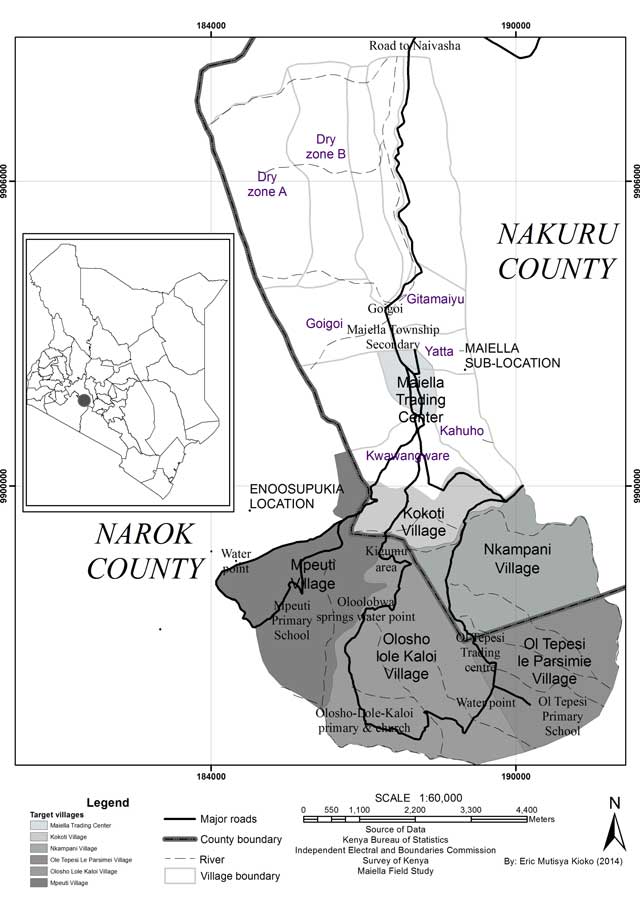
Figure 1
Study villages: Nkampani, Maiella Trading Centre, and Kokoti (Maiella Sub-Location); Mpeuti, Olosho lole Kaloi and Oltepesi le Parsimei (Enoosupukia Location).
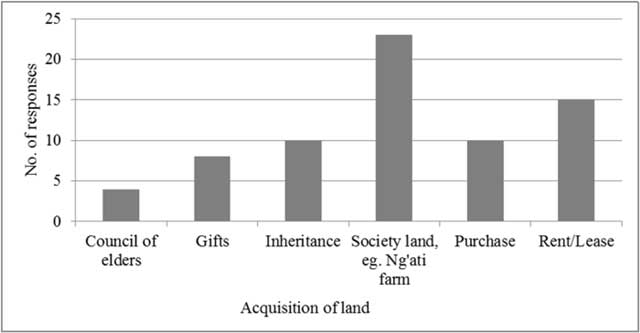
Figure 2
Acquisition of land in the early 20th century in Maiella and Enoosupukia.
Table 1
Overview over conflicts and violence in Maiella and Enoosupukia: 1970–2014.
| Year | Explanation and Type of Conflict | Timeframe | Organisers and Perpetrators | Impact on Cross-cutting Ties |
|---|---|---|---|---|
| 1968-early 1970s | Land-related conflicts: struggle over control of Ng’ati farm between Kikuyu Ng’ati farmers and Keekonyokie Maasai of Nkampani village—destruction/burning of houses and crop fields, and killing of cattle at the boundary of the disputed area. | Retaliatory attacks lasting between a few hours to days. | – Retaliation between morans and Kikuyu men for damages caused. – No mention of politicians instigating the conflict. | – Markets in Maiella and Suswa still shared. – No reports of divorce or separation in interethnic intermarriages. – Cooperative land use at Enoosupukia continued. |
| Mid-1970s and 1980s | Land-related tensions: land tenure reforms were a major contributor. Enoosupukia and Maiella were shifting from community/group/trust ownership to private property. Intra- and inter-community struggles over rights of tenure. | 1977–1980s. | – Impacts of multiparty politics already beginning to take shape against migrant Kikuyu. | – No violence reported. – Boundaries negotiated peacefully despite adverse political campaigns. – Intermarriage and cooperative land use persisted. – Markets uninterrupted. |
| 1991–1993 | Political and land-related conflicts and violence: multi-party (Majimbo) politics along ethnic lines were a main driver of violence. However, restoration of Enoosupukia forest was offered as the main reason for evicting Kikuyu farmers who were blamed for its destruction. (See also Anderson & Lochery, 2008; Anderson, 2007; Klopp, 2001). | – Conflicts between 1991 and 1992. – Violence in October 1993 lasting for about 3–7 days. – Forceful evictions of Kikuyu farmers from Enoosupukia in late 1993 and 1994. – Over 20 Kikuyu lives lost; unaccounted number of Maasai killed by Kikuyu fighters. | – Local politicians with a grassroots core of organisers. – Police and game wardens deployed to assist in the eviction. – Hundreds of Maasai morans from outside Enoosupukia ‘poured’ into the area by government trucks. – Some rogue local actors wanted to repossess the lands already transferred to Kikuyu farmers. (See Klopp, 2001: 164; Hornsby, 2012: 548; Human Rights’ Watch 1993). | – Several schools and Enoosupukia shopping center destroyed. – Eviction of Kikuyu and Kikuyu-friendly Maasai/Dorobo from Enoosupukia. – Narok/Nakuru borders impassable for fear of retaliations, crippling access to markets, hospital and public transport at Maiella. – Some Kikuyu in-laws living with Maasai family protected. – Food crops and livestock of some evicted Kikuyu tenants protected by their landlords. – Some Maasai landowners offered security to their Kikuyu clients at the time of harvesting of their crops. |
| 2007/2008 to 2014 | – Tensions in Maiella and Enoosupukia following the 2007/8 post-election violence, especially in Kenya’s Rift Valley. – Peaceful coexistence and resolution of land-related disputes through Local Peace Committees and courts from 2008–2014. | – No violence was reported in the study area in 2007/2008. | – Rumours had it that unknown Maasai bandits threatened to cause mayhem in Maiella for selfish gains—this did not materialise. | – During the post-election violence of 2007/8 many Kikuyu and Maasai opted to remain indoors while others converged at Maiella Centre to follow the post-election violence on television. – Normal operations continued in the markets and fields, albeit with caution due to the potential for spread of violence to the study area. – Land rentals and intermarriages increased. |
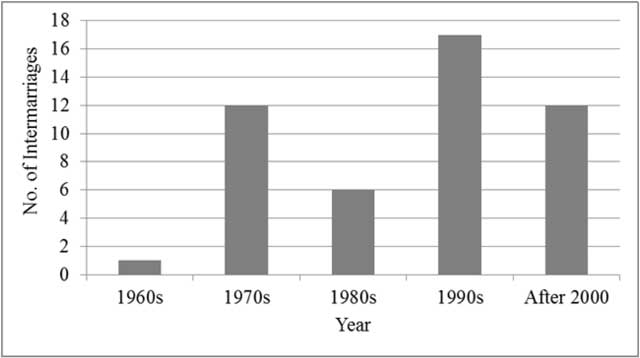
Figure 3
Distribution of intermarriages over the last 50 years.
Table 2
Number of intermarriages and mixed identities.
| Village | Kikuyu Women Married by Maasai | Children with Mixed Identity |
|---|---|---|
| Nkampani | 18 | 104 |
| Olosho lole Kaloi | 11 | 70 |
| Mpeuti (including Kigumu) | 19 | 94 |
| Total | 48 | 268 |
Table 3
Geographic (village) origins of Kikuyu women married among the Maasai.
| Village | Place of origin | ||||||||||
|---|---|---|---|---|---|---|---|---|---|---|---|
| Kiambu | Kitale | Naivasha | Meru | Murang’a | Nakuru | Narok | Ngong | Nyahuruhu | Nyeri | TOTAL | |
| Nkampani | 1 | 0 | 3 | 0 | 2 | 1 | 8 | 1 | 2 | 0 | 18 |
| Olosho lole Kaloi | 0 | 3 | 4 | 0 | 3 | 0 | 0 | 0 | 0 | 1 | 11 |
| Mpeuti/Kigumu | 5 | 0 | 8 | 1 | 0 | 0 | 4 | 0 | 0 | 1 | 19 |
| TOTAL | 6 | 3 | 15 | 1 | 5 | 1 | 12 | 1 | 2 | 2 | 48 |
Table 4
Biographical notes of Kikuyu women marrying Maasai husbands.
| Kikuyu woman married by Maasai man | Origin | How the couple met |
|---|---|---|
| Informant 1 | Muranga | My parents moved from Muranga to Enoosupukia in the 1960s looking for a place to cultivate. They became friends with my husband’s parents (Maasai) and lived as neighbours. To cement their friendship I was given for marriage to this Maasai family in 1978. Since then we have lived as friends and in-laws. I am the only wife in this household and I have 9 children. |
| Informant 2 | Kitale | My father is the former head teacher of Olosho primary school. He bought land in this village and moved his family there. I grew up in the new village and got married in 1993. I am the first wife, with 8 children. My husband’s second wife is Maasai. |
| Informant 3 | Nyeri | I was born in Nyeri. My mother maintained a friendship with a Kikuyu woman who was a neighbour in Nyeri before she was married among the Maasai. When I came of age for marriage the woman asked my mother to have me marry her son. I was married by the son in 1978. I am the only wife, with 7 children. |
| Informant 4 | Muranga | My parents migrated from Muranga to Enoosupukia in search of farmland in the 1970s. At Enoosupukia, our family became friends with the family of Tima Kaloi (Maasai). In 1993 we were evicted from Enoosupukia. We rented a house in Maiella and lived there. However, friendship between the two families continued and was strengthened when my father gave me over to the son of Tima for marriage in 2001. I have 5 children. |
| Informant 5 | Naivasha (Ndabibi) | My parents moved from Ndabibi in Naivasha to Enoosupukia to farm. We were evicted from Enoosupukia during the 1993 violence and went back home to Ndabibi. I met my husband (Maasai) in Ndabibi when he was grazing livestock. We got married in 2010 and have 2 children. |
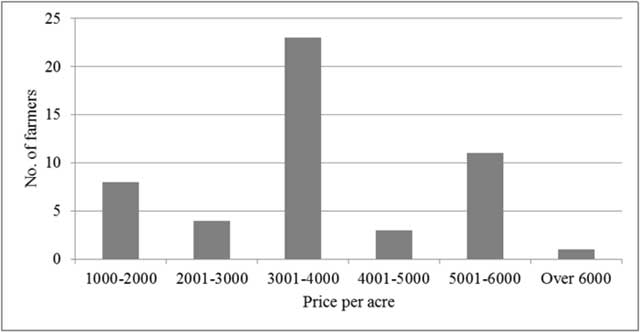
Figure 4
Pricing of rental land per acre per annum.