
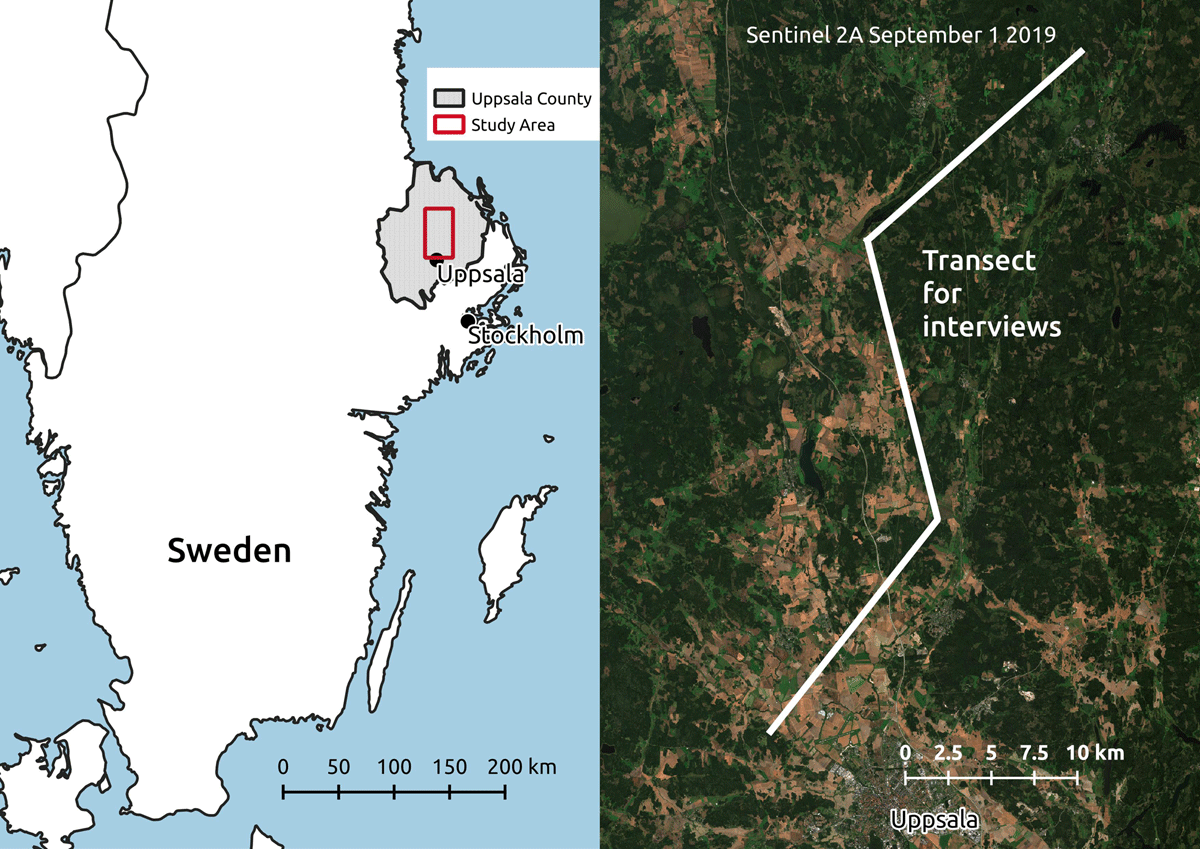
Figure 1
Map of case study area.
Table 1
Farming logic categories.
| FARM LOGIC CATEGORIES | DESCRIPTION |
|---|---|
| I) Production vanguards | These are relatively large specialized farms (both conventional and organic) that are run as family-owned businesses with some employees. The farms have a high turnover, i.e., high costs for inputs that provide high yields of crops and animal products. Producers have deep knowledge of plant breeding and animal husbandry. They strive to optimize and streamline their farms in order to achieve good profitability in order to primarily create the conditions to support their family from the farm’s production, at a level that corresponds to what wage work can generate. However, farms specialised on grain cropping often combine agriculture with other incomes. The logic of this category is directed at increasing high production levels. |
| II) Landscape stewards | Farms with primarily family farm labour and which have a clear identity as food producers. This group, unlike the previous group, often has a pronounced economic rationality based on less intensive production, which results in lower harvest/yield from the land and animals (low input/low output) compared to production vanguards. They argue, however, that such a production system yields an equally good net return as the previous group, because they take less financial risks, use less inputs and thereby have lower costs. They have a strong commitment as a stewards of the landscape and the agricultural heritage of the family. The logic of this category can be characaterized as stewardship of the farm and the local farming landscape. |
| III) Environment vanguards | A group of farmers who see themselves as landscape caretakers and who see it as their task to develop new, more sustainable production systems. In this group, farmers are less driven by profitability and more by a strong commitment to the environment, and agriculture is seen as a platform for realizing ideas about a good life. Capital from other activities is brought into the farm, while the farming itself can have negative or zero economic results. Here the logic is characterized by a commitment to enviroinmental protection, as more important than production efficiency. |
Table 2
Farming logic categories, number of interviews, and farm management.
| IDEAL FARMING LOGIC CATEGORIES | NO. OF FARMS | FARM SIZES (HA) | KIND OF FARM BUSINESSES | LAND TENURE ARRANGEMENTS | LAND USES |
|---|---|---|---|---|---|
| I) Production vanguards | 5 | 200–800 | 3 specialised conventional grain farms, 1 organic grain farm with some livestock. 1 organic dairy farm. All have employees working in the farm and the other business activities. | 3 farms rent all or main part of their land from Uppsala University Foundation. 2 own part of their land and lease remaining land areas from other private land owners. | For the conventional grain croppers basically all land is arable land. The organic grain cropper has 20% of the land as grass. The organic milk farm produces grass on crop land for their dairy cows, and have additional grazing areas used for younger animals. |
| II) Landscape stewards | 9 | 90–200 | 6 conventional and 2 organic farms. 6 have mixed farms with grain and livestock (4 meat and 2 dairy). Family farm business combined with forestry, and off-farm employment and incomes. | All farms own some farm land. Additionally, they all lease land from neighbours (but not the Foundation). | Manage a mix of arable land and natural grazing areas (naturbetesmarker), meadows, flooded areas for fodder collection or grazing (strandängar), hey fields (slåtteräng). |
| III) Environment vanguards | 3 | 8–180 | 3 organic farms; produce both grain and mixed livestock. On all farms the farm work is combined with off-farm employment and incomes. | Manage a mix of owned and leased land. | Same as above |