
Introduction
‘The protected rune stones and grave fields are monuments over death; but the meadows are living legacies of our ancestor’s work and daily life, during millennia. Are not meadows as worthy of protection as the graves?’
This quote is from a book written by the Swedish botanist and poet Sten Selander, ‘Det levande landskapet i Sverige’ (The Living Landscape in Sweden), published in 1955. Selander was much engaged in the nature conservation movement in Sweden, and argued that cultural landscapes were neglected in comparison with ‘wilderness’. The quote also reflects that rune stones and graves have received far more attention in studies of Swedish pre-history, than how land was managed and used for people’s livelihood. In this review, I will examine, using a variety of information, the question of origin and development of that particular kind of living legacy Selander cared so much for, the meadows.
In everyday language, meadows may refer to many different types of open grassland, rich in flowers. However, for the purpose of this paper, meadows have a more restricted meaning. By meadows is henceforth meant grass (i.e. graminoid, including sedges) and/or herb-dominated land, with or without a sparse cover of trees and shrubs, which historically were managed for production of livestock fodder, hay. This review focuses on meadows in Sweden, but the review and the conclusions may well be valid elsewhere, particularly throughout northwestern Europe, although the details differ. In Sweden and in many other parts of northwestern Europe, a couple of centuries back in time, livestock fodder was not, as today, produced on arable fields, but on meadows. Based on written descriptions from the last few centuries, many meadows were more or less open (e.g. Ekstam, Aronsson and Forshed, 1988), but in many regions, particularly in southern and eastern Sweden, meadows often had a sparse cover of trees and shrubs, interspersed with mosaics of open areas (e.g. Palmgren, 1916; Almquist, 1930; Sjöbeck, 1933, 1966; Slotte, 2001). In such ‘wooded meadows’ (Figure 1) also leaf hay (leaves and twigs) from pollarded or coppiced trees and shrubs were harvested (e.g. Hæggström, 1983, 1998; Slotte, 2001), along with ordinary grass hay (which also included herbs). In present-day terminology, meadows are ‘semi-natural grasslands’, a broad term that also includes land used for grazing. ‘Semi-natural’ refers to the fact that these grasslands are mainly composed of species from the native species pool for the region. The feed is not sown, and the soil has not, or to only a limited extent, been subject to plowing or fertilization.
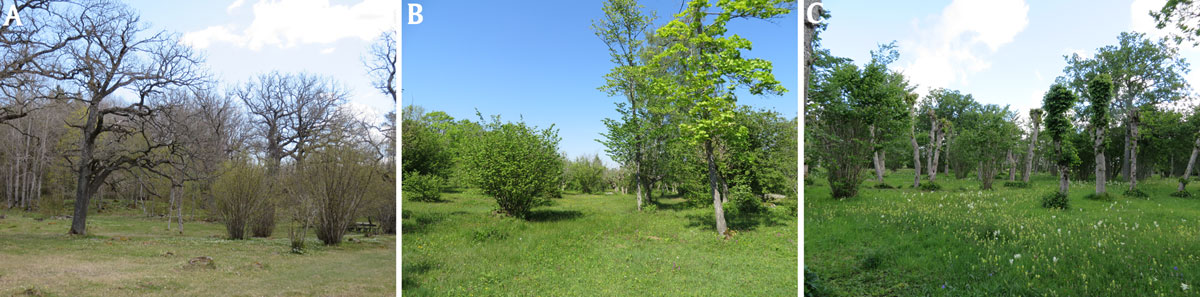
Figure 1
Three still managed wooded meadows. (A) Häverö, in the province of Uppland, Sweden; (B) Nåtö, in the Åland archipelago, Finland; (C) Alvena, on the island of Gotland, Sweden. Photographs by the author.
Semi-natural grasslands with a long history of management are currently recognized as hotspots for biodiversity (e.g. Emanuelsson, 2009; Eriksson and Cousins, 2014; Eriksson et al., 2015; Plieninger et al., 2015; Lennartsson et al., 2016). The processes behind how human management resulted in this accumulation of species in semi-natural grassland have been treated in detail elsewhere (cf. Eriksson, 2013, 2016; Eriksson and Cousins, 2014), and are beyond the scope of this review; the focus here is on the origin and development of the meadow management, per se.
Today, and largely due to the agricultural policy of the European Union (Common Agricultural Policy, CAP), many semi-natural grasslands are subsidized for maintaining management, mostly grazing, which is by far the most common current management regime, even though many semi-natural grasslands were meadows previously (e.g. Veen et al., 2009; Eriksson and Cousins, 2014). In the modern society, flower-rich meadows are appreciated for their beauty. The hard labor associated with managing meadows is gone. Nowadays meadows (perhaps especially wooded meadows) are land used for leisure, visited by botanists, entomologist, bird-watchers, or people having a picnic. Meadows that are still managed in an old-fashioned way constitute examples of what today is called ‘biocultural heritage’ (e.g. Lennartsson et al., 2018), and may be economically important locally (e.g. Lennartsson et al., 2016).
From the viewpoint of this review, however, meadows are part of an agricultural production system. In pre-industrial agricultural landscapes, meadows covered large areas. In Sweden, cadastral maps made between the 17th- to the middle 19th-centuries show that meadows often dominated the infield areas (Swedish: inägor). Infields (Widgren, 2012a; Berglund et al., 2014, Eriksson and Arnell, 2017) here refer to the enclosed land surrounding settlements, where herbivory from wild herbivores and livestock was prevented (or, for livestock, kept under strict control). It has been estimated that meadows covered from 25–40% of the infield area in agricultural plains in southern Sweden (e.g. Olsson, 1991) to more than 60%, sometimes almost 80%, further north, i.e. a much greater share than crop fields (e.g. Cousins, 2001; Dahlström, 2006; Gustafsson, 2006). It is likely that the fraction meadows was even higher earlier in history (e.g., Widgren, 1983; Ericsson and Strucke, 2008: 60). The large areas of meadows reflect the strong dependence of livestock for the livelihood of people. Meadow management was also directly linked to production of crops, due to the use of manure to fertilize fields. The use of managed meadows for production of livestock fodder implies that nutrients were transferred from plant biomass, not directly accessible as a food resource for humans, via livestock manure, to crops, ultimately feeding the human population (e.g., Krausmann, 2004; Lennartsson et al., 2016). Thus, in addition to other products, such as meat, milk, wool, and the use of draft animals, livestock (mostly cattle) were utilized as vehicles for nutrient transfer. As such, this system can be seen as part of the ‘Secondary Products Revolution’ (Sherratt, 1983, 1997), i.e. products exploited from livestock without slaughtering them (e.g., Marciniak, 2011). Emanuelsson (2009) calculated that the introduction of systematic use of manure on crop fields may have more than doubled the resource base for the human population. Thus, crop fields were dependent on meadows for their supply of nutrients. Over time, and unless the meadows were associated with temporary flooding (from rivers, along lakes or seashores, or on mires) this led to meadows being depleted of nutrients. As infield meadows on dry ground were less likely to benefit from nutrient supply from temporary flooding or running waters, the nutrient depletion were counteracted by other means. For example, incorporating trees and shrubs made meadows more sustainable (due to mobilization of nutrient pools deeper in the soil), small temporary manured crop fields were established within the meadow area, and livestock were allowed to graze and deliver manure after hay harvest (e.g., Ekstam, Aronsson and Forshed, 1988).
In addition to infield meadows, hay was also harvested from meadows, particularly wetlands, located in the ‘outlying land’, that is, land beyond the borders of the infields. These outlying meadows were important as well, particularly in forest regions (e.g., Segerström and Emanuelsson, 2002; Elveland, 2015). Outlying meadows are considered below, but the primary focus of this review is on infield meadows. These meadows could be wet, moist or dry, depending on their location in relation to water. Infield meadows were part of domesticated landscapes (e.g., Widgren, 2012b); they were deliberately constructed for (almost) sustainable production of livestock fodder, which, in addition to all other products utilized from livestock, enabled a transfer of nutrients to crop fields, in turn making these (almost) sustainable.
The objective of this paper is to try answering the questions when and why infield meadows developed. The question ‘when?’ is straightforward, in principle. In case there is undisputable and dated material evidence for infield meadows, we might be able to establish when meadows first appeared. As will be evident below, however, this is not as simple as it may seem. The question ‘why?’ is more complex. However, before describing what is meant by the ‘why?’ question and the approach for this investigation, it is useful to briefly summarize previous suggestions on the origin of managed meadows.
Previous suggestions on the origin of meadows
The question of origin of meadows has been treated by many authors, but usually only as a part of discussions of other related issues, for example permanent fields, house constructions, or indoor housing of livestock. As most suggestions on the origin of meadows revolve around the idea that meadows were needed because livestock were kept indoors (they were ‘stalled’, and therefore people needed to provide them with feed), it is useful to start by summarizing suggestions on why livestock were stalled in the first place.
A common explanation, especially in older literature (e.g. Berglund et al., 1991; Tesch, 1991; Ekstam, Aronsson and Forshed, 1988) is that stalling in Sweden was introduced because climate became colder and wetter. This idea goes back to the discovery in the late 19th and early 20th century that a major shift in climate seemed to have occurred in the beginning of the first millennium BC. This climate change marks the transition from the Sub-Boreal to the Sub-Atlantic phases of the Holocene (e.g. Dark, 2006; Wanner et al., 2008). As remarked by Widgren (2012a: 130): ‘… many writers (…) had taken for granted (…) that this climate deterioration had radically transformed conditions for agriculture, leading to increased sedentary settlement and the introduction of indoor cattle stalling’ (i.e., which ‘forced’ people to create managed meadows).
However, several authors have suggested that stalling was introduced for other reasons than climate change (e.g. Myrdal, 1984, 1998; Olausson, 1998; Pedersen and Widgren, 2011). Zimmermann (1999) listed a number of advantages with stalling, in addition to protection from cold and wet climate. These include factors related to: (i) increased efficiency of using available plant biomass, i.e. the surplus of summer’s biomass, (ii) prevention of damage to forests and grasslands during the winter season, (iii) increased security (e.g. from cattle-raiding), and (iv) increased efficiency of production of milk and manure. Particularly the last advantages, increasing efficiency of milk and manure production, are commonly suggested as an explanation for stalling of livestock (e.g. Bakels, 1997; Petersson, 2011; Bogaard et al., 2013).
A common theme is also that stalling was associated with an intensification of livestock production, but at the expense of an increased workload for people (e.g. Myrdal, 1998). Thus, instead of looking for a simple cause behind stalling, Myrdal (1984) advocated that stalling was a component of a general societal change reflecting a need for a transformation of agricultural production. Building on this idea, Pedersen and Widgren (2011) and Widgren (2012a) suggested that stalling was part of a technological and social complex that spread from central Europe to Scandinavia in the late Bronze Age and early Iron Age, i.e. around 1000 to 400 BC (See Table 1, for time periods used in this review). This complex was established independently of climate change, and was in part driven by a need for an increased efficiency of milk and manure production, the latter enabling an intensification of agriculture by creation of permanent crop fields. This explanation is congruent with (but not necessarily equivalent to) the idea that the carrying capacity of the Bronze Age agricultural system had been reached, promoting various means to increase production (e.g. Kristiansen, 1998; Earle and Kristiansen, 2010 a, b; Welinder, 2011), thus stimulating a spread of innovations from the south. According to Kristiansen (1998, page 306 ff.) the predominance of free-ranging cattle herds during the Bronze Age (e.g. Petersson, 2006; Holst and Rasmussen, 2013) had degraded land, and a new technology with meadows, stalling of cattle, production of manure and fertilization of crop fields initiated a period of expansion and intensification of agriculture.
Table 1
A summary of approximate time periods, relevant for Sweden, and referred to in the text.
| Neolithic | 3900–1800 BC |
| Bronze Age | 1800–500 BC |
| Iron Age | 500 BC–AD 1050 |
| Pre-Roman Iron Age | 500 BC–AD |
| Roman Iron Age | AD–AD 400 |
| Vendel Period | AD 550–790 |
| Viking Period | AD 790–1050 |
All suggestions mentioned so far are based on what we may call, in a modern sense, ‘rational’ reasons for introducing stalling of livestock and fodder production on meadows. A somewhat deviating idea was suggested by Årlin (1999), who argued that stalling of animals reflected changing relationships between humans and animals. She argued that, during the Bronze Age, livestock started to become regarded as integrated members of the family household. Thus, keeping livestock indoors would reflect that livestock was associated with a growing value, not only as a resource, but also ideologically and spiritually. In a similar way, Armstrong Oma (2013) suggested that indoor stalling reflected that animals were seen as producers rather than products, blurring the borders between humans and animals. As animals were highly valued, they should be taken care of, and they should be protected.
Theoretical concepts and approach
Two ways of understanding the question ‘why?’
The question why meadows developed may be understood as a search for the ‘rationale’ behind people’s creation of infields meadows, i.e. we assume that this was a goal-directed process, based on intentional choices and decisions by people. As noted above, several of the suggested explanations are based on the idea that people behaved ‘rationally’ and were goal-directed. This could be as a response to an external factor (e.g. climate change, or degradation of landscapes) or to an internal factor (e.g. changing relationships to animals, or population pressure), and, as a response to these factors, people figured out clever solutions. These solutions included protecting animals indoors, for example increasing the efficiency of milk production, or securing supply of manure for use on crop fields, in turn aimed at the goal to produced more crops. To reach these goals stalling of livestock was required, and in order to achieve this, people created infield meadows. In addition, these explanations require people to act with foresight. Creation of meadows takes some time, and the advantages of the coupling among meadows-stalling-manure-permanent fields would not be manifested immediately.
An alternative way to understand the ‘why?’ question is as a search for a ‘causal mechanism’ (e.g. Leuridan and Froeyman, 2012), in a broad sense also including changes that do not assume human intentionality. Possibly, people were not intentionally goal-directed, but a series of small steps and changes nevertheless led to a new production system that was successful in being capable of supporting people’s livelihood. Perhaps it worked better, for example by its capacity to support a growing population, than the one it replaced, but this is not a necessity. It may have been established for other reasons, for example that it conferred status. However, if we assume that it was better in the sense that its capacity to support people increased in comparison with previous systems, the new system can be seen as ‘adaptive’. This understanding of the ‘why?’ question corresponds to how it is usually handled in evolutionary biology (e.g. Mayr, 1997). For example, a mechanism (natural selection) leads to evolution of features that eventually become adaptive under certain conditions. This process is not goal-directed. It simply happens, given that there is variation in features, that some of the features are associated with some advantage, and that there is a mechanism for transfer of information of the features over time, in this case knowledge of management (e.g. Danchin, 2013). An additional twist is that one should make a distinction between why a feature originates in the first place, and its ultimate function. A common biological example is that bird’s feathers may originally have evolved for their role in thermoregulation, but later their function was changed to be used for flying, and for courtship displays. Such features have been termed ‘exaptations’ (Gould and Vrba, 1982).
The approach
In this review, the origin and development of meadows will be placed in the context of entanglement theory (Hodder, 2012). This theory is based on the idea that there are different forms of relationships between humans and things (Hodder also elaborates on relationships humans-humans and things-things). Humans and things may depend on each other in two different ways, termed ‘dependence’ and ‘dependency’. Dependence is allowing and enabling, while dependency is limiting and constraining. These can be seen as alternative forms of relationships, based on how the relationship is viewed. For example, the relationship between stalling and infield meadows may be seen as dependence (infield meadows enabled people to keep their livestock indoors), or dependency (keeping livestock indoors forced people to create infield meadows). More important, however, is that Hodder (2012) viewed these relationships as developing over time, so that dependence ultimately leads to dependency. Thus, a relationship that was initially allowing and enabling transforms into a constraining dependency. People ‘get stuck’, for example in a specific management system (e.g. Fuller, Allaby and Stevens, 2010). Furthermore, dependency may imply that more labor is needed (thus making it problematic to view the new management as better). As remarked by Hodder (2018: 169), with reference to Quercus dominated parkland in Anatolia used for livestock grazing, coppicing and pollarding: ‘… humans were drawn into relationships with things (in this case trees and woodlands) that required yet further human input.’ A dependency may ultimately be a starting point for a new phase of dependence, for example initiated due to an innovation enabling the use of a new resource or an increased efficiency in resource use. Over time, the dialectic between dependence and dependency drives the process and generates change.
For infield meadows, it seemed as a reasonable starting point that they are embedded in a complex of interactions (Eriksson and Arnell, 2017). The interactors include both aspects of culture, things (sensu Hodder), and the environment. Although we cannot a priori rule out a simple causation behind development of infield meadows, an analysis must identify and account for all aspects of culture, things and environment, considered relevant. Furthermore, as entanglement theory is based on reciprocal causation unfolding over time, it is essential to establish a chronology of the different components which are integrated in developing managed infield meadows.
Thus, the first step was to identify different components of infield meadow management, and to establish a chronology for these components. A second step was to interpret their internal relationships, and reach a conclusion on when infield meadows appeared. The final step was to use the information with the aim to suggest a hypothesis for why infield meadows developed. This unavoidably necessitated some speculation. As remarked by Oosthuizen (2016: 180), in a study of agricultural landscapes in Anglo-Saxon England: ‘…we construct explanatory models from fragmentary, more or less opaque evidence refracted through the complexities of time, place, and process’. This surely holds for the present review as well.
Components of infield meadow management
Eight different components of infield meadow management were selected (Table 2). The selection was guided by the criterion that each component should be clearly related to infield meadow management, as a precondition (harvesting fodder), as suggested ‘drivers’ (stalling livestock, milk production, use of manure, crops and permanent fields), or as being necessary for conducting meadow management (fencing systems, tools). The final component (settlements and land ownership) has been suggested as associated with infield meadows, but could be considered either as a contributing driver or as a consequence of fodder production on meadows. More explanation is given in the sections below. Each section ends with one or a few tentative conclusions that will be used later when the information is synthesized.
Table 2
The components associated with infield meadows which are examined and discussed in the text.
| Harvesting fodder |
| Stalling livestock |
| Milk production |
| Use of manure |
| Crops and permanent fields |
| Fencing systems |
| Tools |
| Settlements and land ownership |
Harvesting fodder
Collection of resources from the environment has of course been essential for people since the dawn of the human species. Several scholars suggest that deliberate management of the resource base occurred already during the Mesolithic, and not only regarding game hunting, but also affecting vegetation (e.g. Rowley-Conwy and Layton, 2011; Smith, 2011; Warren et al., 2014). However, what is in focus here is the specific procedure of harvesting livestock fodder, i.e. collecting resources in order to provide livestock with feed, instead of just herding them on grazing grounds. Infield meadows are deliberately constructed for that purpose, but it is possible that harvesting of fodder may have been done long before people constructed meadows, for example to provide additional feed to free-ranging livestock. In the literature, this is a quite common opinion. Zimmerman (1999) proposed that feeding cattle with leaves and twigs is older than both forest grazing and hay-making. Welinder (2011) suggested that pollarding and coppicing occurred already during the Neolithic (from c. 3900 BC in Sweden), and the same suggestion was made by Iversen (1973), Hæggström (1983), Berglund et al. (1991) and Emanuelsson (2009). Haas, Karg and Rasmussen (1998) found evidence for twig pollarding from the Neolithic in the Alps, and Göransson (2014) found evidence for coppicing from a Swedish Neolithic site. This would mean that the system described by Slotte (2001), i.e. collection of leaves and twigs as fodder, that was still common in Sweden during the 19th century, at that time would be about 6,000 years old. However, some studies suggest that leaves and twigs were not initially a major component of livestock fodder during early Neolithic. Noe-Nygaard, Price and Hede (2005) and Gron and Rowley-Conwy (2017) concluded that cattle diet during early Neolithic in Scandinavia differed from wild herbivores; cattle were mostly feeding in open environments, i.e. not mainly from browsing.
Also ‘graminoid hay’ (i.e. from herbs, grasses and sedges) may have been collected. Based on various indirect evidence, for example the utility of stone tools such a pruning knives and bronze sickles, Gaillard et al. (1994) suggested that hay harvesting may have been practiced already during the Bronze Age, and possibly even the late Neolithic. For example, wetlands in the vicinity of settlements may have been harvested, despite the availability of only inefficient tools (e.g. Myrdal, 1998; Petersson, 2006; Göthberg, 2008).
Based on results from pollen analyses, it is beyond doubt that a general opening of the forested landscapes occurred during the Neolithic (e.g. Berglund, 1991; Berglund et al., 2008; Welinder, 2011). A part of this opening is related to the elm decline, most likely caused by a combination of human impact and the Dutch elm disease (e.g. Parker et al., 2002; Grosvenor et al., 2017). Forests were cleared, fields were used for growing crops, and large areas were (most likely) used for grazing. Pollen analyses also detect periods of agricultural expansion and regression, as reflected in landscape openness, and species composition and richness (e.g. Lagerås, 1996; Berglund et al., 2008; Åkesson et al., 2015; Roberts et al., 2018). For example, there is much evidence suggesting that there was a general expansion of agriculture during the early part of the first millennium BC (e.g. Tesch, 1991; Gaillard et al., 1994; Petersson, 2006; Pedersen and Widgren, 2011; Berglund et al., 2014; Mehl and Hjelle, 2015), i.e. during the period when several authors place the origin of meadow management. Recent studies made around Old Uppsala suggest a continuous increase of grasslands from the late Bronze Age onwards, culminating between AD 400 and AD 900 (Bergman, Ekblom and Magnell, 2018).
While conclusions of vegetation openness, and the use of crops, can be inferred convincingly from pollen analyses, it is more complicated to distinguish between grazing and mowing (meadow management). A critical question is whether land used for management of meadows produce a ‘pollen spectrum’ different from livestock grazing. Since flowering takes place before hay harvest, one might expect that meadow management results in an increased production of grass and sedge pollen in comparison with grazing management (e.g. Groenman-van Wateringe, 1993; Segerström and Emanuelsson, 2002). However, this inference is not very convincing. Such a pollen spectrum may as well result from abandonment of grazing or patchily variable impact of grazing, irrespective of meadow management. In such case, grasses and sedges would also flower abundantly, patchily or temporarily. Another approach is to compare modern and fossil pollen spectra for inferring pre-historic management (Gaillard et al., 1994). However, although there are small but detectable differences in modern pollen spectra from meadows and pastures (Hjelle, 1999), the studies using this approach have indicated that it is difficult to distinguish among pre-historic mowing, pollarding and grazing (Gaillard et al., 1994; Hjelle, 1998). Several authors even suggest that it is not possible to draw any robust conclusion about grazing versus mowing based on pollen (e.g. Groenman-van Wateringe, 1993; Hicks and Birks, 1996). The same problem holds for the suggestion made by Iversen (1973) and Widgren (1983) that decline in alder and a synchronous increase in species associated with open moist habitat during the Iron Age indicated that alder swamps had been transformed to moist meadows. Although it may seem likely that alder was indeed removed for this purpose, the pollen data does not distinguish between open ground used for mowing or grazing.
Tentative conclusions: (i) Procedures for harvesting fodder for livestock were most likely understood and to some extent used already in the Neolithic. (ii) An expansion of agriculture was initiated during the first millennium BC, i.e. the period when several authors place the origin of meadow management. (iii) Reconstructions of vegetation based on pollen analysis do not provide convincing evidence on the timing of origin of managed meadows.
Stalling livestock
When agriculture arrived to Europe, and eventually reached Scandinavia (around 3900 BC) domesticated livestock was part of this new production system (e.g. McClure, 2015). While goat and sheep were probably the first domesticated animals in the Near East, cattle coming later (Zeder, 2011; McClure, 2013), in the north European Neolithic, cattle were the most abundant livestock (e.g. McClure, 2015; Gron and Rowley-Conwy, 2017). During the Bronze Age, the importance of sheep increased, although cattle still dominated (Vretemark, 2010). This continued during the Iron Age. The extensive excavations conducted in association with building a motorway through the province of Uppland (Figure 2), revealed that cattle dominated over sheep and goats at the majority of Iron Age settlements (Göthberg, 2008). From the eighth century AD, pigs became increasingly common (e.g. Pedersen and Widgren, 2011).
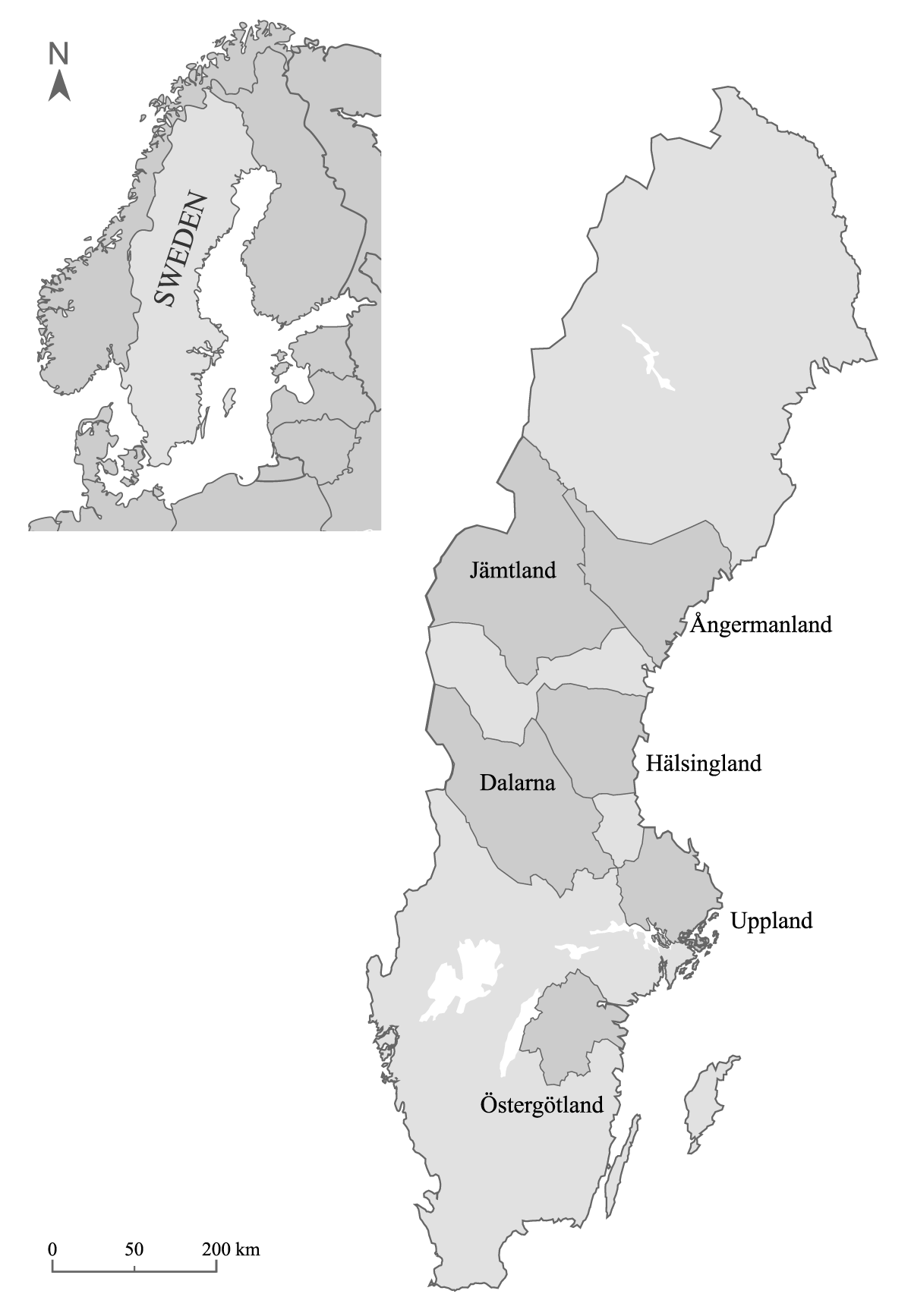
Figure 2
Map of Sweden, showing the location of provinces mentioned in the text.
Domesticated animals were initially not kept in houses (e.g. Hodder, 1990; Zeder, 2009; Mattes 2010). When people in northwestern Europe first started to house livestock indoors is poorly known. In a review of older literature, Myrdal (1984) concluded that cattle-sheds (byres) probably existed already during the Neolithic, but that they first became common along the coasts of present-day Netherlands in the Bronze Age. According to Myrdal (1984), byres occurred across continental Europe and in southern Scandinavia during the centuries around AD.
Stalling is often associated with a change in house construction that occurred during the Bronze Age, from two-aisled to three-aisled houses. The latter are interpreted as indicating that a part of the house was used to house cattle (e.g. Fokkens, 1999; Armstrong Oma, 2013). Assuming that this interpretation is correct, the earliest evidence for stalling is from northern continental Europe 1800–1500 BC (e.g. Arnoldussen and Fontijn, 2006). Stalling would then have arrived to Scandinavia a few centuries later (Pedersen and Widgren, 2011). The association between three-aisled houses and stalling is not uncontroversial, however, and some authors question whether house construction per se can be used to infer stalling (e.g. Olausson 1998; Barker 1999). According to Sørensen (2010), there are just a few indisputable cases of stalling from the Danish Bronze Age. For Sweden, Olausson (1999) concluded that stalling was indeed introduced during the Bronze Age, but he remarks that among 176 investigated house remains only 37 had a documented inner wall, indicating that the house was used for both people and livestock.
There are convincing evidence that longhouses from the south Scandinavian Iron Age included a part used for housing livestock (Grabowski and Linderholm, 2014), and Herschend (2009) argued that stalling appeared in southernmost Sweden during Pre-Roman Iron Age (Table 1). Somewhat further north, in southeastern Sweden (provinces of Östergötland and Uppland; Figure 2), Göthberg (2000, 2008) and Petersson (2006, 2011) suggested that livestock were only occasionally housed indoors during this time. Thus, outdoor grazing the year round would still have been the most common strategy for livestock management, although livestock possibly to some extent had access to indoor housing. Cattle byres appear later, the centuries after AD, when separate buildings, outhouses, were built, among which some probably were used as byres (Göthberg, 2000, 2008). The same trend was found for the province of Östergötland (Petersson, 2006, 2011), although not all farms were associated with evidence of byres. In contrast, for northern Sweden (the provinces Hälsingland and Ångermanland; Figure 2) archaeobotanical evidence suggests that stalling cattle inside houses appeared around AD 200–500 (Viklund, 1998a, b).
Tentative conclusions: (i) It is likely that stalling (i.e. the ‘idea’ that livestock could be housed indoors) existed already during the Bronze Age, perhaps even in the Neolithic, although stalling may not have been common in Sweden until much later, perhaps not until the first centuries AD. (ii) Based on evidence from house construction, stalling appeared first in northern continental Europe, and then moved northwards, i.e. opposite to what we should expect if harsher winters were the main driver behind stalling. (iii) In Sweden, there seems to be regional variation regarding when stalling of livestock started.
Milk production
The use of milk products was a part of early agriculture in the Near East during the seventh millennium BC (Evershed et al., 2008), and evidence for an intensification of dairying dates back to the Neolithic (Sherratt, 1997, pp. 184 ff.; Gerbault et al., 2013). For Europe, the earliest dating for use of milk products lie near the time when farming arrived in their respective region, indicating that dairying was an integrated part of subsistence early in the Neolithic (Gerbault et al., 2013); it was a part of the ‘farming package’ arriving to Europe. Cheese may have been the first product consumed by adults, before adult lactase persistence became predominant (Gerbault et al., 2011, 2013). Cheese making occurred in northern Europe by the sixth millennium BC (Salque et al., 2013), and in Sweden it goes back to the first farmers around 3900 BC (Isaksson and Hallgren, 2012; Gron et al., 2015), probably arriving with the immigrants bringing agriculture to this region (Rowley-Conwy, 2011; Gron and Rowley-Conwy, 2017). Gron et al. (2015) even suggested that the first farmers in Sweden manipulated cattle to produce calving and lactation throughout the year.
A tentative conclusion is that the use of milk products and an understanding of both the importance of and the means to increase milk production was present already in the Neolithic, when agriculture arrived to Scandinavia.
Use of manure
As discussed by Smith (2011), it is likely that people already during the early phases of plant domestication understood the beneficial impact of fertilization, for example for production of edible fruits and root crops. As remarked by Lagerås and Regnell (1999), the positive effects of manuring are so obvious that this must have been known since the Neolithic. Indeed, manure was used for fertilizing fields already during the Neolithic (Bakels, 1997; Styring et al., 2017), also in Scandinavia (e.g. Robinson, 2003; Gron et al., 2017). Bogaard et al. (2013) concluded that manuring, like milk production, was part of the ‘farming package’ originating in western Asia, and that early farmers across Europe used livestock manure to enhance crop yields. However, it is likely that the use of manure was limited for a long time. Recent studies from Denmark suggest that manuring intensity was generally low during the late Bronze Age and Pre-Roman Iron Age in the first millennium BC (Nielsen et al., 2019).
A tentative conclusion (similar to the one for milk production) is that an understanding of the importance of, and the means to collect manure to fertilize fields was present already during the Neolithic. The intensity of manuring may have remained low until the early Iron Age.
Crops and permanent fields
There is much literature on crops used in early agriculture in Scandinavia (e.g. Grabowski, 2011). For the purpose of this review, however, a focus is on whether the used crops may be informative for an intensification of manuring of fields, as this is one suggested driver behind stalling of livestock.
The main crops used in Scandinavia until the late Bronze Age were emmer and spelt wheat, and nude barley (Grabowski, 2011; Pedersen and Widgren 2011). In the late Bronze Age (early first millennium BC), hulled barley increased, and this has been understood in the context of an intensification of manuring (e.g. Viklund, 1998a; Vretemark, 2010). According to Gustafsson (1998) the increase of hulled barley (and nitrophilous weeds) at this time reflected that manuring had become more efficient, since nitrogen-rich soils are a prerequisite for hulled barley to produce acceptable yields. However, Grabowski (2013) presented a different scenario for Denmark, where the shift from nude to hulled barley occurred around AD, despite evidence for manuring from the fifth century BC. Thus, the relationship between manuring and hulled barley may not be straightforward (Grabowski, 2014). Hulled barley maintained being a dominant crop for a long time. In the landscape around Gamla Uppsala, hulled barley was the dominating crop throughout the Iron Age (Bergman, Ekblom and Magnell, 2017).
Pedersen and Widgren (2011) interpreted the increased use of hulled barley as indicating an intensification of agriculture, with manured permanent fields tilled by wooden ards; the earliest evidence for permanent (‘Celtic’) fields in Scandinavia is from the first millennium BC. In order to have fields permanently located at the same sites, intensive manuring would have been necessary. However, recent studies from Denmark (Nielsen and Dalsgaard, 2017; Nielsen et al., 2019) suggest that although the area used for Celtic fields expanded in the late Bronze Age, it seems as they were not used intensively. Seen in a macroscale, the field system was permanent, but there was dynamics in the use of individual fields. These fields were manured, but not to any large extent. The availability of manure was probably limited, and many fields at any time were left fallow and possibly grazed. Although this represents an expansion of agriculture, ‘extensification’ may, at least initially, be a more adequate describing term than ‘intensification’ (Nielsen et al., 2019).
A tentative conclusion is that permanent field systems appeared in the late Bronze Age and early Iron Age, the first millennium BC. This was associated with a change in the preferred dominating crops. Considering the evidence from Denmark, these field systems were initially not used intensively for crops. Manuring may thus have been limited initially, but is likely to have increased over time.
Fencing systems
‘Fence’ is here used in the general meaning as a structure, irrespective of material, used to control movement of livestock in the landscape (cf. Langton, 2014). A key feature of managed infield meadows is that these must be fenced, in order to prevent grazing by cattle and other livestock before the hay harvest. Crop fields must also be protected from grazing. Based on what is described above regarding manipulation of cattle reproduction, and the necessity of protecting crop fields from grazing, it may seem reasonable that the use of fences for fencing in, or fencing out livestock was present among the earliest farmers in Scandinavia. However, as the fields were few and small, perhaps herders were sufficient to prevent livestock from grazing on the fields. As fences were probably initially made of wood they leave few traces in the archaeological record and it is thus likely that the occurrence of fencing systems is underestimated. Fencing systems from the Bronze Age are described from the UK (Fyfe et al., 2008). Eklund (2008) reviewed evidence for wooden fences from Sweden, mainly from the Iron Age, but also some examples from the Bronze Age.
In a series of papers (e.g. Løvschal, 2014a, b; Løvschal and Holst, 2014) it was suggested that along with the increasingly exploited landscape during late Bronze Age and early Iron Age, there was a change in the mindset of people, promoting development of various boundaries. These were manifested as fences, but also as for example earthen banks along fields. This new mindset would then not only promote establishing fencing systems, for various purposes, for example fencing in or fencing out livestock, but also ultimately promote the perception of land ownership (see the section ‘Settlement and land ownership’, below). From the third century BC, the structure of the boundary system changed. The number of fences increased drastically, and these became more associated with the settlement sites (Løvschal, 2014a), perhaps also indicating that the intensity of field management had increased.
More permanent fencing systems, stone walls, are common in some regions of southeastern Sweden (Ericsson and Strucke, 2008; Pedersen and Widgren, 2011). Based on such stone walls, which also include cattle paths, Widgren (1983) suggested that they represent a new system of land use that had been introduced, with permanent settlements and a separation of infields and outlying land. Widgren (1983) suggested that these stone walls date from the first centuries AD, but Petersson (2006, 2011) argued that they may be of a later date, and that Widgren’s conclusions should be treated with caution. However, a detailed examination of stone wall systems in the regions around the lake Mälaren in southeastern Sweden (Ericsson and Strucke, 2008) concluded that these stone walls are typically from AD 100–600. Ericsson and Strucke (2008) also suggested that raising of stone walls as fencing system may have been promoted by lack of wood; otherwise, and with access to wood material, wooden fencing systems were preferred. Stone walls would thus have been prevalent in landscapes where agricultural intensification had caused deficiency of wood.
A tentative conclusion, based on the reasonable assumption that the utility of fences is obvious, is that fences to some extent may have been used by the earliest farmers in Scandinavia. It is possible, however, that a common use of fences was established much later, from the late Bronze Age, in association with an increasing perception of the importance of boundaries. Early fences were wooden, and probably quite transient. Permanent fences, stone walls, did not come into use until the first centuries AD, and only in some regions.
Tools
In order to harvest fodder in any significant amount, appropriate tools are needed. Before the availability of metals (copper, bronze and iron) all such tools must have been made by stone, mainly flint. Obviously, people were able to harvest crops using stone tools during the Neolithic. As reviewed above, it is also likely that fodder, i.e. leaves, twigs, perhaps grasses, sedges and herbs, to some extent was harvested already among the first farmers in Scandinavia. This fodder may have been harvested in the surroundings of settlements where livestock also grazed. But a critical question is which tools are needed in order to make it meaningful to deliberately construct and manage infield meadows.
Several authors have remarked that before scythes made by iron were invented, it is not likely that mowing of meadows could have been feasible (e.g. Myrdal, 1982; Olausson, 1998; Lagerås and Regnell, 1999; Widgren, 1999; Göthberg, 2000: 241). Gaillard et al. (1994), in contrast, suggested that bronze sickles, or pruning knives made by flint, which are known from late Neolithic, may have been used to harvest hay. Wyszomirski (1979) summarized evidence on pruning knives from southern Scandinavia, and concluded that they probably should be dated to late Bronze Age. Based on a detailed investigation of the flint surfaces of the knives, he concluded that these knives were multifunctional tools, used to handle all kinds of material, for example wood, bone and skin, but possibly also used as sickles for crop harvest.
According to Myrdal (2011), scythes and sickles were the first iron tools in Sweden, appearing before and around the first century AD. However, in summarizing evidence of early iron tools (probably dated to the early part of the first millennium BC), Hjärthner-Holdar (1993) concluded that iron was initially mostly used for reparation of bronze items, including some cutting tools such as knives. No scythes were documented. At this time, the early first millennium BC, also wooden ards appeared, possibly associated with the introduction of permanent fields (Pedersen and Widgren, 2011). Finds of iron sickles and iron leaf knives appear between 200 BC and AD 200, whereas short scythes made by iron, and hay-rakes appear somewhat later (AD 200–400) (Pedersen and Widgren, 2011). Refinements of tools, e.g. iron ard-shares and long-bladed scythes appeared later, from the middle first millennium AD (Myrdal, 2011; Pedersen and Widgren, 2011).
Tentative conclusions: (i) Tools used for harvesting crops have been in use since the Neolithic. (ii) Pruning knives made by flint, and bronze sickles may have been used to harvest fodder during the Bronze Age. (iii) Iron tools such as sickles and leaf knives appear around the first centuries BC, while tools clearly related to managed meadows (scythes, hay rakes) appear some centuries later. (iv) Refinement of scythes occurred around the middle first millennium AD.
Settlements and land ownership
The construction and management of infield meadows imply an investment of labor at specific locations and that a distinction is made between the area close to settlements, where fields and meadows were enclosed and protected from uncontrolled grazing by livestock, and the outlying land used for grazing and collection of resources. Thus, when this land use was introduced, settlements would have become more spatially stable, that is, located at the same place over many generations. Furthermore, as remarked by Hodder (2018), when people invest labor into material objects, it is likely that this investment promotes ownership of these objects. When people started investing a lot of labor in permanent fields and infield meadows, it would seem reasonable that this promoted a perception by farmers to consider this land, their part of the domesticated landscape, as belonging to them.
In his overview of the early Iron Age in southern Scandinavia, Herschend (2009) described the typical Pre-Roman Iron Age (Table 1) settlement as a one-house farm, probably inhabited by a nuclear family. The house was divided into two equally sized parts, one for people and one for livestock, and in-between was the entrance room. During Pre-Roman Iron Age, houses were used only for one generation, and then moved. In contrast, during the following centuries, successive generations of houses were built at the same spot. Thus, there was a transition from ‘floating’ to spatially ‘fixed’ landscapes (cf. Grabowski, 2014: 25).
The question of spatial continuity of settlements is complex. Settlements might have been spatially stable already during the Neolithic and Bronze Age (e.g. Borna-Ahlkvist, 2002; Hannon et al., 2008; Artursson, Earle and Brown, 2016). The extensive excavations in the province of Uppland (Figure 2) (Göthberg, 2008) suggest that many settlements have a continuity from the late Bronze Age until the first centuries AD, i.e. across the time for the transition from spatially floating to fixed landscape suggested by Herschend (2009). The major change in settlement pattern in Uppland was that the number and also the concentration of settlements increased. This increase occurred in two phases, 800–400 BC and AD–AD 300. Also large farms appear, indicating a more stratified society. In a study from the province of Östergötland (Figure 2), Petersson (2006) also concluded that there was a general continuity of settlement locations, from the late Bronze Age to the middle of the first millennium AD – to the time described as the transition between early and late Iron Age. As in Uppland, there was an increase in the number of settlements in early Iron Age, and indications of a more stratified society (Petersson, 2011).
Thus, it is clear that there was an expansion of settlements during the early Iron Age. Was this associated with changing perceptions of land ownership (‘landed property’)? Without written sources, it is difficult to find direct evidence relevant to answer this question. Ownership is a complex concept. Generally, property determines exclusive rights to things, and distinctions should be made between ‘private’ and ‘institutional’ property, and between ‘moveable property’ (such as a knife) and ‘landed property’, which is set in space (Earle, 2000). ‘Commons’ is also a form a property, utilized by a group, and with rules for individual’s use of the property, through agreements, means to resolve conflicts, oral traditions or customs to record the rights (e.g. Adler, 1996, Oosthuizen, 2013; Lindholm, Sandström and Ekman, 2013). Furthermore, property requires means for its protection, i.e. ‘laws’ or customs, and this implies that property is not only a tangible object, but rather a conceptual expectation (Smith and Reynolds, 2013).
It has been suggested that a general idea of land ownership emerged along with agriculture (e.g. North and Thomas, 1977; Earle, 2004; Zeder, 2011; Bowles and Choi, 2013; Gallagher, Shennan and Thomas, 2015). However, although groups of people during the Neolithic probably claimed right to territories, expressed by monuments such as megaliths and grave mounds (e.g. Brink, 2013; Artursson, Earle and Brown, 2016), these rights may not have been assigned to individuals (e.g. Earle, 2004). Along with the emergence of a more stratified society during the Bronze Age, it is likely that chieftains controlled land, and in a sense were ‘land owners’ (e.g. Earle, 2004; Artursson, 2010; Earle and Kristiansen, 2010a, b).
For the Iron Age, several authors have suggested an association between an increased perception of private (i.e. property belonging to individuals or families) land ownership and intensification of agriculture, permanent fields, stalling of livestock and social stratification (e.g. Earle, 2000; Herschend, 2009; Pedersen and Widgren, 2011). Herschend (2009) also mentioned the likely influence on perceptions of private land ownership from the Roman Empire. This is in line with the idea that people outside the Roman Empire gained status not only by obtaining Roman goods but also by imitating customs. For example, Halsall (2007) remarked that boundary fences marking out private land started to become common north of the Roman Empire during the third century AD, and that this may have been under the influence from the Romans.
Most discussions of land ownership during the Scandinavian Iron Age revolve around the concept of ‘odal’. The underlying idea is that customs regarding property must involve the aspect of transfer of property across generations, i.e. inheritance of property (e.g. Earle, 2000). Odal refers to inherited landed property of a family, and is generally regarded as an important component of the ‘late Iron Age mentality’ also relevant for the conception of ‘free men’ (Zachrisson, 1994, 2017). Odal probably functioned as a kind of legal system even before any laws were written down. There is some variation, but according to later written sources, odal typically implied that if anyone could claim that a piece of land had been in their family’s possession for five previous generations (sometimes fewer), the family had the property rights (odal rights) for that land. Zachrisson (1994, 2017) gives several examples of rune stone texts mentioning that someone owned a farm, or a village, and these runic inscriptions can be read as manifestations of odal rights.
How old are these traditions? Unfortunately, there are only vague indications that may be useful to say something about this. Some authors suggest that information from written sources such as rune stones or the Old Norse texts may reflect traditions that were established many centuries earlier. For example, Hedeager (2011) argued that Old Norse myths have their roots in the early Iron Age at least back to around AD 400, and Gräslund and Price (2012) suggested that the Old Norse myth of the ‘Fimbulwinter’ reflects a memory of a climate crisis during the sixth century AD (Büntgen et al., 2016). Zachrisson (2017: 128) suggested that ‘… the concept odal is old and connected to inherited land. In Midsweden it can be set in a Late Roman Iron Age context, intimately connected with the farm burial grounds of ancient and prosperous farms that remained in use (…) up to the Late Viking Age…’. Furthermore, Zachrisson (2017) remarked that the word ‘odal’ occurs in several Germanic languages, e.g. Old High German, Old Saxon, Old Anglo-Saxon, and Old Norse, suggesting an age predating the split of these languages. When this happened is poorly known. A conservative estimate may be the first centuries BC, as suggested by a phylogenetic analysis of Indo-European languages (Gray, Atkinson and Greenhill, 2011). One should note, however, that a common existence of a word does not imply that the meaning of that word was the same in different languages.
Even though the odal tradition thus may extend back to the early Iron Age, some authors suggest that it was not until the middle first millennium AD when it became important to visibly demonstrate the odal, that is that the farm had been in the possession of the family many generations back in time. During this time, a restructuring of settlement patterns occurred (e.g. Göthberg, 2008), and large monumental burial mounds were created (e.g. Zachrisson, 2011). This re-structuring was possibly associated with a crisis due to climate deterioration following large volcanic eruptions in AD 536 and the following years (Löwenborg, 2012; Büntgen et al., 2016). Customs such as re-use of graves and erections of grave mounds, which started around this time, would then reflect the importance of making the odal visible (e.g. Zachrisson, 2011, 2017; Hållans Stenholm, 2012). Thus, the odal may have existed as a mentality earlier, but it was not until the middle first millennium AD, the early Vendel Period, and the following Viking Period when the odal rights became visible in the landscape, and eventually written down on rune stones and in the Old Norse literature.
Tentative conclusions: (i) In southernmost Sweden around the first centuries BC, there was a change in settlement structure towards a spatial stabilization, but this pattern is not evident further north in Sweden, in the provinces of Östergötland and Uppland, where settlements were generally spatially stable already during the first millennium BC. (ii) During the early Iron Age there was an expansion of the number of settlements. Thus, the settlement density increased. (iii) Combining the trend towards increasing settlement density and stratification of farm sizes with the inferences based on interpretations of the odal tradition suggests that land ownership relating to individuals and families possibly became an established social norm at least from the first centuries AD.
Synthesis of the chronology of components: When did managed infield meadows originate?
Acknowledging that the timing of the components of meadow management in each case are uncertain, a reasonable conclusion is nevertheless that their appearance is distributed over a very long time, from the Neolithic to the first centuries AD. If the tentative conclusions above are correct, fodder harvest, production of milk, and use of manure most likely were part of the early farming systems in Scandinavia. Fencing systems may also be that old, but it is more likely that they were developed extensively from the late Bronze Age. Stalling of livestock is likely to have been practiced to some extent at least since the Bronze Age. Establishment of permanent field systems, with hulled barley as a dominating crop, began during the early part of the first millennium BC, although it is likely that individual fields were not initially used permanently. An intensification of agriculture, and an increased use of manure may have developed later. From the first centuries BC and continuing through the first centuries AD, there was an increase in number and density of settlements in southeastern Sweden. Generally, these settlements had a continuity over many generations; they were located at the same site over time. Differences in farm size indicate an increasing social stratification. Tools specifically adapted for hay harvest (scythes, hay rakes) appear in the first centuries AD, and the same holds for permanent fencing systems (stone walls) in some regions, suggesting that a distinction was established between infields and outlying land. Although the evidence is vague, the perception of private (family) land ownership was probably established at this time as well.
This summary suggests that infield meadows, viewed as a ‘complete’ system, deliberately constructed and managed for the purpose of producing fodder, appeared during the first centuries AD, or slightly earlier. However, several of the elements necessary for a rationale to construct meadows were in place long before meadows appeared. The expansion of agriculture in the beginning of the first millennium BC (as suggested by several lines of evidence), happened many centuries before the establishment of infield meadows. Hence, the development of meadows was a drawn-out process. Most likely, people had collected fodder to feed livestock for a long time before the construction of meadows. This fodder was not only from leaves and twigs but also probably from wetlands close to settlements. Stalling commenced before the construction of meadows, and interestingly, since outdoor grazing systems may have been common in southeastern Sweden even during the first centuries AD, it is possible that constructed meadows may in some regions appear without livestock being stalled. Extensive extra feeding of livestock may have been associated with outdoor grazing. Thus, as suggested by Myrdal (1998), stalling and construction of infield meadows may be partly decoupled.
Accordingly, this review does not support the proposal of a ‘technological and social complex’, arriving from the south, as this hypothesis would require that several of the components (stalling, permanent fields, meadows) appeared more or less simultaneously. Although the innovations related to an intensification of agriculture may well have spread from the south, it is unlikely that a fully coherent complex of innovations, including managed meadows, was imported simultaneously to Sweden.
Climate change as a driver behind development of managed meadows
Before addressing ‘why?’ managed meadows developed, according to the two meanings of this question described above, a few remarks should be made on previous suggestions focusing on climate as a driver behind development of meadows.
There is unequivocal evidence that climate became colder and wetter in the beginning of the first millennium BC (e.g. Van Geel, Buurman and Waterbolk, 1996; Barber, Chambers and Maddy, 2003; Langdon, Barber and Hughes, 2003; Dark, 2006; Wanner et al., 2008, 2011). However, there are several reasons to question whether this change in climate had strong effects on society in general, and on the development of stalling and meadows in particular.
Firstly, there has been a lot of variation in climate, both before and after this period (e.g. Meese et al., 1994; Büntgen et al., 2011; Wanner et al., 2011). According to Wanner et al. (2011) a cooling period occurred approximately between 1300 and 500 BC, but Scandinavia seems not to have been strongly affected; Wanner et al. (2011) actually found indications of positive temperature anomalies for Scandinavia during this period, i.e. climate warming. In addition, despite the trend towards lower average temperatures during the first millennium BC, the summer and winter temperatures did not seem to have been extreme (Mauri et al., 2015).
Secondly, as reviewed above, stalling is likely to have commenced before this period of climate change, and evidence suggests that infield meadow management developed later, during the first centuries AD, when, in fact, climate was relatively warm (Stewart, Larocque-Tobler and Grosjean, 2011; Luterbacher et al., 2016; Ljungqvist, 2017).
Thirdly, although there are examples where climate change may have drastic effects on societies (e.g. Cook et al., 2010; Zhang et al., 2011; Büntgen et al., 2016; Ljungqvist, 2017), the coupling between climate and societal change during the first millennium BC has been considered weak (e.g. Berglund, 2003; Magny et al., 2009). For example, Dark (2006) found a general pattern of land-use continuity in Britain across the period of climate change in the early first millennium BC. There are some exceptions, however, but only referring to abandonment of marginal areas (e.g. Van Geel, Buurman and Waterbolk, 1996; Amesbury et al., 2008; Turney et al., 2016).
Thus, there is not much evidence supporting the view that climate deterioration during late Bronze Age and early Iron Age was a driver behind stalling of livestock, and that this ‘forced’ people to collect winter fodder, in turn forcing development of meadow management. This conclusion is in line with the questioning of climate as a driver behind changes in agricultural production systems (e.g. Myrdal, 1984, 1998; Pedersen and Widgren, 2011; Widgren, 2012a).
Iron as a key to development of managed meadows
As remarked above, several authors have suggested that it is not likely that mowing of meadows would have been feasible before iron tools were available (Myrdal, 1982; Lagerås and Regnell, 1999; Widgren, 1999; Göthberg, 2000, 2008). The conclusion above was that constructed meadows indeed appeared at a time when iron was available for using tools. In order to avoid the pitfall of circularity, it should be noted that several lines of evidence suggest that meadow management appeared at this time, even disregarding scythes made of iron.
Although bronze was used for practical working tools such as knives, axes and sickles, bronze was largely used for prestige goods, e.g. jewellery, items used in rituals and for weapons, and bronze was strongly associated with the elite (e.g. Earle et al., 2015). It has long been held that the introduction of iron production implied a kind of ‘democratization’, making metal more generally available for use as tools. As stated by Childe (1936: 36): ‘Iron ores are widely distributed. As soon as they could be smelted economically, anyone could afford iron tools’. The raw material for iron occurred locally, so when techniques for iron production developed, the need for long-distance import of the metal that had been of such importance for Bronze Age societies declined (Childe, 1936; Kristiansen and Larsson, 2005; Hjärthner-Holdar et al., 2018).
Due to the obvious asset of iron tools for management of infield meadows, a critical question is when iron production reached a stage when it was sufficient to provide people in general with metal products. In Sweden, small-scale iron production commenced already during the late Bronze Age, in the same context as small-scale bronze casting (Hjärthner-Holdar, 1993; National Atlas of Sweden, 2011). A recent overview of early iron production in Sweden (Hjärthner-Holdar et al., 2018) suggests the following: around 500 BC, iron metallurgy throughout Europe had reached a technical level for iron production on a larger scale; in Sweden, local bronze smelters adopted the new technology via knowledge exchange (cf. the metal trading described in Earle et al., 2015); over time, iron technology was developed locally, for example the technique to use lake and bog ore; the production sites were located close to the raw material. Furthermore, Hjärthner-Holdar et al. (2018) suggested that although some surplus production of iron in Sweden may have occurred as early as the eighth century BC, a more significant expansion took place during 500–300 BC. This would lead us close to the timing of the origin of managed infield meadows, accepting a gap of a few centuries before proper iron tools were sufficiently common to be observed in material remains documented by archaeologists. Innovation spread typically follows a S-shaped adoption curve (Henrich, 2001), and given that society at this time may not have been as integrated as during the preceding Bronze Age, it would have taken some time before new innovations became commonplace. Furthermore, Myrdal (1982) makes the interesting remark that initially iron was used to produce sickles and scythes, i.e. implements which were essential for harvest of crops and hay and where the advantage of implements made of iron was greatest. Later, around the middle first millennium AD, when iron production had increased further, other improvements such as iron ard-shares were introduced. These demanded much larger supplies of iron, both due to their size, but also due to the much higher wear during plowing (Karlsson, 2015), necessitating access to replacement material.
A tentative suggestion is that the introduction of iron as a commodity available to ‘anyone’ (cf. Childe, 1936) during the first centuries BC made it possible to exploit meadows, deliberately constructed for the purpose of producing livestock fodder. A few centuries later this innovation had spread and become commonly used. While the advantage of having livestock stalled or supplied with extra feed in outdoor grazing systems may have been understood for ages, the means of using this method was constrained by the lack of proper tools for production of sufficient amount of fodder. In the following section, this hypothesis is explored further.
Synthesis: Why were managed infield meadows developed?
The essential feature of managed meadows is that these allow production of livestock fodder, for part of the year replacing the need for having livestock grazing and browsing in the surroundings of settlements. For modern people this may seem as a natural thing to do, but from a background where livestock were free-ranging and fed by themselves by grazing and browsing, investing labor into collecting feed for the animals must be seen as a ‘leap’ in the mindset of people. Feeding livestock could be achieved if these were held within small enclosures where they were supplied with feed. Fodder must then be collected and stored. As reviewed above, several advantages would follow: increased efficiency of using available plant biomass, i.e. the surplus of summer’s biomass; prevention of damage to forests and grasslands during the winter season; and increased efficiency of production of milk and manure. In addition, keeping animals under control within enclosures would make it easier to control and secure livestock reproduction. Stalling would add some more advantages: increased security (from cattle-raiding), and protection of livestock from adverse weather conditions. However, for stalling, we must acknowledge that the very idea of having animals in the living quarters of humans may initially have been beyond people’s imagination. Stalling therefore appeared later. Perhaps the initial reason for stalling had nothing to do with the advantages mentioned above, but instead reflected a changing relationship between humans and animals. Unfortunately, there is no way to distinguish between these alternatives.
Assuming that the coupling between manure and crop harvest indeed was understood, it seems reasonable that farmers strived to increase production of manure. The idea of establishing permanent fields, i.e. compensating for the depletion of nutrients by increasing manuring, would then not seem so far-fetched. It is hardly more labor-intensive to have permanent fields instead of temporary fields, if sufficient amount of manure is available. But achieving this would demand increasing fodder production, and this in turn means increase in labor, even with proper tools. This was a constraint.
Thus, the agricultural system during late Bronze Age and early Iron Age was probably trapped in a network of dependencies (sensu Hodder, 2012) and people were forced to invest more and more labor into producing their necessary resources. Welinder (2011) described a situation where an ever-increasing population used a landscape where more forests were cleared, but also where soils became increasingly more depleted: ‘… agriculture settled into a vicious circle’ (Welinder, 2011: 43). These changes may, according to Welinder, have been a rationale for people to start thinking and acting in new ways. Innovations were the result. Permanent fields may have been such an innovation, but if nutrients for crops were a constraint, more effort needed to be invested into collecting fodder (to feed livestock for manure production) using tools not very well-adapted for this purpose. Perhaps the methods of collecting livestock fodder was sufficient to bring about the initial need for increased manure production effectuated by stalling livestock. The extensive, but not so intensively manured Celtic fields in Denmark (Nielsen et al., 2019), where most fields were left fallow, may illustrate this situation. Furthermore, if the human population increased and the exploitation of forests (leaves and twigs) for fodder therefore also increased – that is, if there were forests available to exploit – the distance to the resource pool (forests) would eventually increase. Transport became more laborious. Here, a description of ‘over-exploitation’ may be appropriate, but not necessarily as an initial driver, but as an effect of the reciprocal interaction between population and resource availability. If production necessary for people’s livelihood increases, then population also increases, and thus the exploitation. Accordingly, the increased demand for resources could be seen as an effect of increased production, as well as a driver. Population and production are inter-linked in a reciprocal causation.
In order to break this network of constraining dependencies, further innovation was necessary. Such innovations may, however, not be intentional, goal-seeking solutions to a perceived ‘problem’. They may come from elsewhere. The discovery of iron production provided such a solution, although probably no one envisaged this when it happened. As summarized above, this innovation, after having been introduced in Sweden during the late Bronze Age (Hjärther-Holdar et al., 2018), led to iron becoming generally available many centuries later, during the first centuries BC.
Iron provided material for appropriate tools for hay harvest, and stimulated innovations regarding tools. The constraining network of dependencies were replaced by ‘allowing’ dependences; meadows placed in infields alongside permanent crop fields, and deliberately managed for production of fodder, allowed increased manure production, and increased crop yields. There was a need to make a clearer distinction of the area within the farm (infields) and those outside the farm (outlying land) where livestock grazing took place. Investments were made in enclosures and cattle paths, at least in some regions made by stone. Perhaps the very idea of families owning their land appeared as a consequence of the large investment of labor at, and within, a limited piece of land. The new production system relieved farmers from the previous constraints, and allowed an expansion of agriculture during the centuries before and after AD, as was described by Petersson (2006) and Göthberg (2008).
However, meadow management is very laborious (e.g. Hæggström 1983, 1998), and over time the new system changed into a new set of constraining dependencies, now based on management of meadows; the amount of hay setting the limit for the number of livestock a farm may hold. But even though the network of dependencies may ultimately have been a constraint for the agricultural system, this does not invalidate that the system indeed was ‘adaptive’. After all, the basic structure of infield management, with meadows and crop fields, existed in Sweden until the 19th and early 20th centuries (Eriksson and Cousins, 2014; Eriksson and Arnell, 2017). Here follow two tentative examples illustrating that the system has been adaptive, and also may have included new phases of ‘allowing’ dependences.
The first example concerns the agricultural colonization of the vast forested northern parts of Sweden. Viklund (1998a) described settlements in northern Sweden (provinces of Hälsingland and Ångermanland; Figure 2) dated to AD 200–500, where livestock were stalled in houses shared by people, and archaeobotanical evidence strongly suggested that the livestock were fed by fodder produced on meadows. In this part of Sweden, the winters are too cold for outdoor grazing wintertime. Furthermore, Viklund (1998a) remarked that an efficient production of manure would be a prerequisite for establishing agriculture in these regions. From approximately the fifth century AD there was an expansion of agriculture also into the inland forests in central and northern Sweden. The driver behind this colonization may have been the potential to exploit resources that could be traded to more densely populated central regions, for example in western Norway or southeastern Sweden. From AD 400–500, there was an expansion of iron production, for example in the provinces of Dalarna (Hyenstrand, 1974) and Jämtland (Magnusson, 1986), located in the mostly forest inland of Scandinavia (Figure 2). Later, tar became another important product in the trade from the forests (Hennius, 2018).
Based on studies suggesting that agriculture was established during the Iron Age at remote sites in the forested inland (e.g. Emanuelsson, et al., 2003; Karlsson, Emanuelsson and Segerström, 2010), Lindholm, Sandström and Ekman (2013) suggested that a ‘field-and-meadow system’ with permanent fields, forest grazing, hay-making on mires, and shielings was adaptive for the conditions of the marginal lands of the forests. The colonizers were likely to have brought with them the basics of these agricultural practices. The relationship between fodder production on meadows, stalling of livestock, and production of manure to be used on the fields, would, for the colonizers, be the very basis for their livelihood when colonizing the forested inland. Initially, forest grazing in pine and spruce forests would have been meager, and, besides, further north and more distant from the coasts, the winters were harder. In these regions, the most productive areas for fodder production would be wetlands, mires dominated by sedges. Although the evidence is weak (as mentioned above, it is difficult to detect hay-making based on pollen samples), some studies indicate that hay-making on mires commenced at least from around the sixth century AD (Emanuelsson et al., 2003).
It is noteworthy that hay-making on mires was an essential component of agriculture in forested regions, especially in northern Sweden, until the beginning of the 20th century. Elveland (2015) reviewed meadow management on wetlands in northern Sweden, and gave an illustrative example of the amount of labor invested in this management. It was estimated that 35–40 hectares of low productive wetland meadow would be needed for keeping five cows (of the race used in northern Sweden in early 20th century) over the winter; a smaller area was required if the meadows were productive, either naturally or due to the use of artificial dams. It was estimated that it would take one person six days to harvest one hectare. This means that the harvest, assuming it occurred during one month, would require a work force of up to eight persons. Even though the use of more productive meadows would reduce the work load, this example shows that the production system initially allowing colonization of northern forests for agriculture ultimately became a constraint, not eliminated until fodder production was made on fields, using artificial fertilizers and tractors driven by fossil fuels.
The second example is related to climate change. A severe climate crisis most likely occurred during the sixth century AD as a result of large volcanic eruptions in AD 536, 540 and 547, and it continued throughout a period until c. AD 660, the ‘Late Antique Little Ice Age’ (Büntgen et al., 2016). It is believed that sunlight and temperatures declined during several consecutive summers, and this would have had drastically negative impact on crop yields. This crisis influenced settlement structure (many farms were abandoned or re-located), and it may have promoted an increasingly stratified society (Zachrisson, 2011; Löwenborg, 2012). Agriculture based on livestock, which potentially can be fed on leaves and twigs, even summertime, would have been more resilient. Farms with access to wooded meadows would certainly have had improved chances of persisting through such a crisis. A second period of climate deterioration occurred during the ‘Little Ice Age’, approximately between AD 1300–1900 (Moberg et al., 2005; Wanner et al., 2011; Ljungqvist, 2017). During the coldest periods, people’s chances of survival are likely to have increased significantly due to an agricultural system based on livestock that was stalled, and supplied with leaf and twig fodder.
Thus, although a cold climate was rejected as a mechanism behind the origin and establishment of managed meadows, this does not invalidate that an agricultural production system based on stalling of livestock fed by fodder produced on meadows is indeed favorable if climate deteriorates, or for colonization of regions characterized by cold winters. Thus, this agricultural production system became an ‘exaptation’.
Summary and concluding remarks
This review concludes that people most likely long knew the basics of the advantages of feeding livestock and the means to achieve this – that is, collect additional fodder, keep livestock in close quarters (eventually indoors) and collect and distribute manure on crop fields. But it was not until iron became generally available during the centuries around AD that constructed and managed meadows emerged, close to farms, and enclosed to control grazing.
Managed infield meadows then played an essential role for agriculture in Sweden from the Iron Age until (almost) modern times, driven both by intentional, goal-directed solutions to problems, and non-intentional features that may have originated for totally other reasons. Periods when agricultural production was constrained and people were ‘stuck’ in networks of interactions were interspersed with periods where innovations temporarily provided the basis for agricultural expansion and intensification. The introduction of iron production is the prime example of innovation as it provided the basis for construction and management of meadows. In addition to promote an intensification of agriculture, the meadow-based livestock production (the ‘field-and-meadow system’) allowed and promoted colonization of northern Sweden, further enhancing iron production, thus further promoting agricultural intensification. Moreover, feeding livestock with grass and leaf hay from meadows increased the chances of survival through periods of climate deterioration, for example the crisis during the middle first millennium AD, and the ‘Little Ice Age’. Despite several innovations, both technological and with regard to management (e.g. Elveland, 2015, concerning wet meadows), the meadow-based livestock production itself ultimately became a constraint, until ‘modernization’ of fodder production on fields (plowed, sown, fertilized) made meadows obsolete. The origin and development of managed meadows, and in fact also their ultimate demise, thus fits into a process driven by a dialectics between dependence and dependency (Hodder, 2012).
The landscape that emanated from the construction of infields, with managed meadows and crop fields, enclosed from the outlying land, formed the very basis of the domesticated landscape in Sweden for almost 2,000 years. It served to provide the basis for people’s livelihood until agriculture was modernized by artificial fertilizers and fossil fuel, and forestry became an industry. As the Iron Age landscape is still manifested in location of farms, villages, and place-names, it provides us with an interpretative identity, and biological remains of this landscape are still valued and appreciated in the modern society. The exceptional species-richness of meadows, their aesthetic values, and their role as cultural heritage, are today the main rationale for preserving them. However, as these remains largely have lost their original functions, new mechanisms are currently determining their fate, and their characteristics (e.g. Eriksson, 2016). Placed in this context, one can only agree with Sten Selander: ‘Are not meadows as worthy of protection as the graves?’
Acknowledgements
I am grateful to M. Arnell, J. Ehrlén, K.-J. Lindholm, M. Widgren, T. Zachrisson and two anonymous reviewers for comments on the manuscript, and to F. C. Ljungqvist for advice regarding literature on pre-historic climate change. This paper is a contribution from the project ‘Contesting marginality: The boreal forest of inland Scandinavia and the worlds outside, AD–1500 AD’ supported by the Swedish Research Council (VR 2017-01483).
Competing Interests
The author has no competing interests to declare.