
Introduction
The cities thus become the centre of all public life, yet at the same time, they also become the gathering place of all that not only fails to benefit our health but is, in fact, utterly harmful. With each passing day, the unbearable and health-corrupting fumes from sewers grow more oppressive, the choking smoke from numerous factories thickens, and the fine yet exceedingly pernicious dust upon the streets – despite the most diligent sprinkling and sweeping – ceaselessly renews itself. We struggle to breathe in this dense air and long, if only for a moment, to escape the miasma surrounding us. We hasten beyond the city’s gates, yearning to refresh ourselves in God’s nature and to inhale the pure, fragrant air. How freely do we breathe when we may linger beneath the spreading linden tree, by the murmuring brook, or in the shade of a youthful grove, granting our lungs a taste of that precious ‘ozone”’! How thoroughly do we revive when, freed from all cares, all strivings and longings, removed from the din of the city, we have spent but a brief time in nature! Do not whole crowds of people hasten daily, or at least on the day of rest, beyond the city’s confines? And why do they do so? Surely, it is the necessity of self-preservation that compels them. Were it otherwise, how could we explain the great multitude of tourists flocking to mountainous and naturally beautiful regions as soon as the sun begins to warm these landscapes with its golden rays? Why do these city dwellers flee to such ‘desolate’ places when, from every side, the city offers them amusements and pleasures, delights and gaieties in abundance?
The passage above vividly illustrates a 19th-century perspective on the stark contrast between the adverse effects of life in industrialised urban centres and the restorative power of being in nature. Although it does not explicitly name the region, it comes from the introduction to what is likely the first Czech-language guidebook to the Bohemian Forest, situating it within a broader phenomenon that shaped the perception of such landscapes. By the late 19th century, as tourism became more established in the region, its peripheral status shaped its appeal. This raises broader questions about how peripheries were constructed and imagined within the emerging culture of leisure travel. Looking at the Bohemian Forest in this context offers an opportunity to consider how such regions were framed as desirable destinations and what this reveals about the dynamics between tourism, landscape, and notions of remoteness in an era of industrial and urban transformation – an interplay that, in Central Europe, was further shaped by nationalist aspirations and identity politics.
The air pollution in industrial cities and its effect on human health and well-being in the 19th century is well researched, especially in the case of Britain (Stradling and Thorsheim 1999; Hanlon 2015; Bailey, Hatton and Inwood 2018). Rapid industrialisation led to significant changes to infrastructure as well as society – urbanisation and marked changes in forms of dwelling, development of railways and other forms of transport of goods and people, and new ways of organising time. With these changes, leisure travel – originally largely the privilege of upper-class young men who undertook so-called Grand Tours, scientists, and adventurous individuals – spread en masse to other segments of the population (Barton 2011). Domestic British tourism then led, in particular, to establishing seaside resorts as a phenomenon that soon spread to other parts of the world (Walton 2005).
Many modern denominators – industrialisation, urbanisation, railway development, the establishment of leisure time, and, indeed, air pollution and stress factors of the urban lifestyle – can also be found in the Central European region, albeit later than in Britain. While for higher classes, the spas (Butz 2021) and, in some cases, coastal areas (Baskar, 2010) of the Habsburg monarchy, offered refuge from day-to-day life in the metropolis, middle (Pezda 2025, 83) and, to some extent also working classes sought respite in the countryside and mountain areas. One of the lesser-known tourist destinations was the Bohemian Forest – a wooded region in the southwest of the Kingdom of Bohemia (Figure 1).
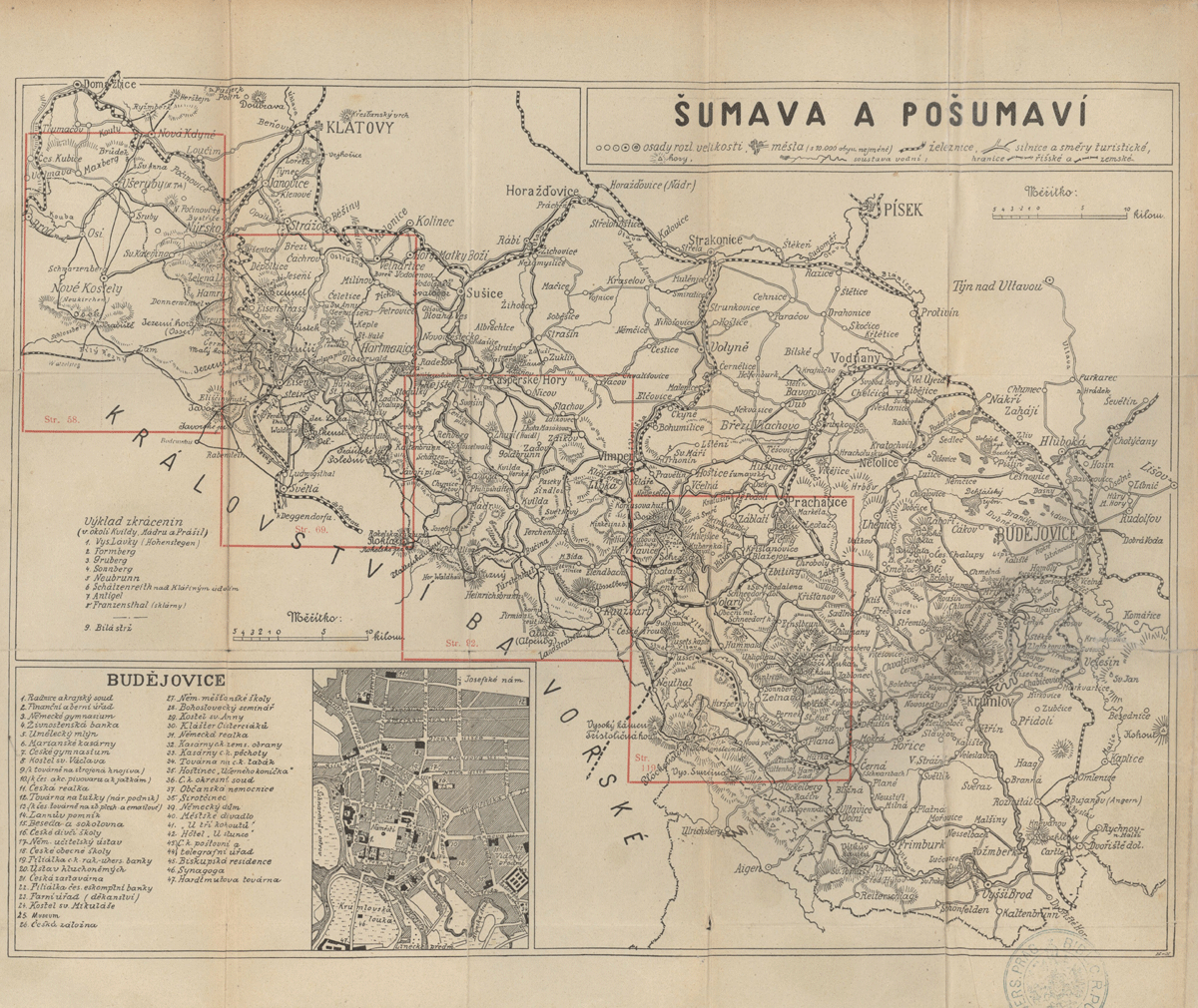
Figure 1
Map of the Bohemian Forest (Kafka, 1904). Source of reproduction: The National Digital Library, The National Library of the Czech Republic. https://ndk.cz/view/uuid:a5649720-c4f6-11e5-b93e-005056827e52?page=uuid:15e64ff0-28d1-11e6-a344-5ef3fc9ae867.
The region lies on the western border of the Bohemian lands, which was drawn by a treaty between Bohemian Queen and Archduchess of Austria, Maria Theresa, and Maximilian III Joseph, Duke of Bavaria, in 1764. Its forested, mountainous landscape, proximity to the state border and underdeveloped transport networks made it unsuitable for large-scale industries. Apart from household farming, most economic activity in the region consisted of logging and wood processing, with related industries such as glassmaking and papermaking. The Bohemian Forest thus fulfilled many of the characteristics typically associated with peripheral regions in both economic and geographic terms.
Yet, as Pugh and Dubois (2021) point out, peripheries should not be seen as static and disadvantaged spaces. Recent research has shown that peripheral regions may generate their own forms of innovation and resilience, in which local actors compensate for the absence of agglomeration or institutional density. Moreover, as they argue, there are cores and peripheries within peripheries – an insight that is particularly relevant for tourism, as this study intends to demonstrate. In this sense, peripherality is not a fixed condition but a relational configuration, shaped through overlapping spatial, economic, and symbolic hierarchies, much in line with Kühn’s (2014) view of peripherality as both a structure and a process.
The opening quote highlights the essential centre-periphery relationship in the context of tourism – destinations of certain types of tourism, i.e. hiking and nature-based tourism, might lie on the economic periphery, yet it is precisely the lack of the undesirable features of industrial centres, such as air pollution, dust, and everyday stress, that make the area attractive. Seen from a different perspective, tourism capitalises on the very features that define economic peripheries. The factors—most importantly landscape features—that limit industrial and urban development of the regions make some of them desirable destinations, as Christaller (1964, 96) argues. While these landscapes, typically (but not limited to) mountain areas, might be unsuitable for different types of economic exploitation by modern society, they possess, as Lapointe (2024, 3) referring to, as Christaller puts it, ‘“natural” capital’ that allow economic utilisation through tourism.
This relationship between urban centres and rural retreats was later conceptualised by Turner and Ash (1975) as the ‘pleasure periphery’—a term describing how inhabitants of industrial and densely populated regions seek leisure and restoration in remote, less-developed areas. Subsequent scholars (e.g. Müller and Jansson 2006) have shown that such pleasure peripheries emerge where natural landscapes are commodified as sites of recreation, restructuring local economies toward service-oriented, tourism-driven development. While the concept was formulated in the context of post-war tourism, its roots can be traced to the 19th century, when the expansion of railway networks and the rise of middle-class leisure enabled similar patterns of travel and perception.
The topic of the study also resonates with present-day Europe, where the resurgence of populism and new forms of nationalist activism have again made questions of identity, belonging, and the representation of ‘peripheries’ politically charged. While the late Habsburg context differed fundamentally from today’s conditions—marked at the time by the rise of national movements that ultimately led to the creation of modern nation states, and by an industrial economy very different from today’s post-industrial and supranational setting—both periods reveal how spatial and cultural margins can become symbolically mobilised in broader struggles over national identity and political legitimacy. Situating the history of the Bohemian Forest within this perspective underscores the continued societal relevance of examining how peripheral regions are imagined, represented, and instrumentalised.
Aim, methodology and sources
The aim of the article is to explore how tourism, in the case of the Bohemian Forest before World War I, instrumentalises peripherality by actively engaging with and transforming the region’s peripheral status, instead of simply reflecting it, as part of the process of making it a desirable destination. In this context, the word ‘tourism’ refers primarily to the activities and discourses generated by organised associations, writers of travel guides and related media texts, and the early tourism infrastructure—rather than to the tourism industry in a narrow economic sense—focusing on how these actors framed and promoted the region as a destination. Special attention is paid to how the ethnically ambiguous character of its population became a resource mobilised in this transformation. The intention is not to provide a comprehensive list of the processes of transformation but rather to highlight, through several examples, which factors contributed to this reinterpretation of the region. The article adopts a case study approach, treating the Bohemian Forest as a peripheral region of tourism development while also examining selected localities—such as the subregion of Chodsko and surroundings of the mountain Špičák—as more specific examples of how touristic activities were enacted on the ground. The study focuses on Czech tourism and its nationalist framing at the turn of the 19th and 20th centuries.
The analysis draws primarily on contemporary Czech-language sources, including a tourist magazine Časopis turistů and periodical press such as Národní listy, and Plzeňské listy, as well as several Czech guidebooks (e.g. Cimrhanzl 1878; Bašta 1909; Vilímek 1905). These materials reflect how the Czech Tourist Club and related organisations mobilised tourism for national purposes. For comparative purposes, selected German-language sources such as Willkomm (1878) and Führer durch den Böhmerwald (1888) are also considered, illustrating the interlinked Czech and German perspectives on the Bohemian Forest. The selection includes materials that represent various institutional and spatial levels of activity: publications of the Czech Tourist Club (which had its headquarters in Prague, where its central magazine Časopis turistů was also published, but regional branches in many Bohemian towns); the Czech nationalist organisation Národní jednota pošumavská (which was regionally focused on the Bohemian Forest but was founded in Prague) and its German predecessor Deutscher Böhmerwaldbund (again focused on the broader region but founded in one of the regional centres, České Budějovice/Budweis); articles from the regional and national press; and locally oriented guidebooks. This combination makes it possible to trace how representations of the Bohemian Forest circulated between central and local contexts.
The majority of the texts originated within the period between the late 1870s and 1914, with a few examples from the interwar period to illustrate the continuation of some phenomena despite extensive changes in the social and political order following the collapse of the Habsburg Empire. The sources were selected for their relevance to the discourse of tourism and national identity rather than for quantitative representativeness, aiming to capture the diversity of voices participating in the construction of the region’s image.
This study primarily focuses on sources from the ethnically Czech context, which, when necessary for comparison, are supplemented by German-language sources from the Bohemian lands. While this text focuses on Czech tourism and its links to Czech national activism, it is important to note that the Czech and German (Bohemian) nationalist efforts were intertwined and mirrored each other to a certain degree. This interrelationship has already been extensively examined in the scholarship on the aforementioned concept of national indifference (Zahra 2010), including studies that focus directly on this region (King 2002; Judson 2007). The present article therefore concentrates specifically on Czech attempts to instrumentalise peripherality within the milieu of tourism.
The analysis of these textual sources is informed by a content-analytical (Krippendorff 2019) and discourse-analytical (Jørgensen Winther and Phillips 2002) approach, focusing on how language and imagery construct and circulate ideas of peripherality, national belonging, and landscape. In this sense, language and visual references are viewed not merely as descriptions but as means of shaping meanings and hierarchies—through comparisons, metaphors and narrative contrasts that define what is central and what is peripheral. The study examines how meanings are produced and contested within texts from the touristic milieu, and how these discursive patterns reflect broader socio-political relations in the late Habsburg context. The study followed an abductive process, moving between theoretical frameworks and empirical material in order to identify recurring discursive patterns. These patterns provided the basis for the three analytical sections—titled Framing the Landscape, Supporting the Nation, and Occupying Space—that reflect distinct yet interconnected ways in which tourism discourse contributed to transforming the region’s peripheral status.
The corpus largely represents the perspectives of urban middle-class journalists, authors of travel guides, and members of tourist and nationalist associations, while local inhabitants appear only indirectly through these portrayals. This imbalance reflects the hierarchical structure of the discourse and shows how ideas about the periphery were shaped by central actors engaged in nationalist activism. The chosen discourse-analytical approach makes it possible to trace how tourism texts served as tools of symbolic and political mobilisation, linking representations of nature to ideas of national belonging. Compared with thematic or narrative analysis, this method highlights the ideological and relational dimensions of language but is less suited to exploring individual perspectives or motivations. Its main limitation, however, lies in the reliance on mediated textual representations: such sources cannot provide direct insight into how local inhabitants themselves perceived these processes, the presence of visitors, or the effects of nationalising efforts on their everyday practices and attitudes, as well as, to a certain extent, how the media representations were perceived by the tourists themselves.
The focus on discourse also provides a link to the following theoretical discussion, which approaches peripherality as something constructed and negotiated rather than fixed in space. The concept of the periphery, as addressed in this article, is examined through the interplay between two complementary theoretical positions. The first is Walter Christaller’s classical theory of central places, whose later work (1964) also considered the spatial organisation of tourism and recreation. In his framework, peripheral regions are structurally subordinate to central areas—economically weaker, less connected, and primarily defined by their geographical distance from urban cores—yet are often attractive to tourists as a counterpoint to urban life. Lapointe (2024) develops a relational understanding of peripherality, emphasising that it emerges not simply from distance or marginality, but through Deleuzian processes of deterritorialisation and reterritorialisation that reshape meanings and practices within tourism. Christaller provides a structural lens on accessibility and spatial hierarchies, while Lapointe highlights the symbolic and processual dimensions of peripherality.
The article contributes to these theoretical debates by offering a historical case study that illustrates how such processes operated in the early stages of tourism development. It draws on recent debates on the concept of peripherality, which emphasise its fluid and relational character rather than a fixed spatial category (Kühn 2014; Pugh and Dubois 2021). Taking into consideration research focusing on tourism on the periphery (Christaller 1964; Turner and Ash 1975; Müller and Jansson 2006; Hall et al. 2013; Lapointe 2024) and on tourism and borders (Timothy 1995, 1998; Wachowiak 2016; Timothy and Gelbman 2022; Holubec 2024a, 2024b), the article uses the example of the region and period to outline a few possible ways in which the peripheral status was instrumentalised to stimulate public interest in the border region and its recreational use in the past. The analysis is further informed by the concept of the tourist gaze (Urry 1990; Urry and Larsen 2011), which emphasises that tourists selectively focus on features perceived as out of the ordinary, guided by expectations and representations in media and guidebooks, as well as further studies on tourist imaginaries (Månsson et al. 2020; Widholm 2024).
In doing so, the article also situates also itself within broader historiographic debates on nationalism and identity formation in the late Habsburg Empire. Scholarship has shown how ethnically mixed regions were sites for national activists to mobilise the population prone to national indifference (Judson 2007; Zahra 2008; King 2002). This study engages with these perspectives by examining how Czech tourist discourses transformed the Bohemian Forest as an economically peripheral landscape into a symbolic frontier of national belonging.
Framing the Landscape
Recent scholarship (Urry and Larsen 2011; Kirillova 2023) proves that aesthetic perception is essential to the tourist experience. Both the consumption and the production of images, allusions and similes are essential in tourist discourse, and they also play a significant role in constructing spatial hierarchies (Kolářová 2024). One way touristic perception constructs its spatial hierarchies is through comparisons with other destinations. The first Czech guidebook to the Bohemian Forest draws parallels to the Giant Mountains, the Central Bohemian Uplands, and the Bohemian Switzerland, positioning the region within a broader landscape of well-known Bohemian natural attractions (Cimrhanzl, 1878, unnumbered preface). A locally published guide to the Špičák area reinforces this idea, asserting that the Bohemian Forest combines the defining qualities of these regions—the wildness of the Giant Mountains, the picturesqueness of Bohemian Switzerland, the beauty of the Central Bohemian Uplands, and the historic character of old castles across Bohemia (K. 1899, 3). Other Czech guidebooks also use the comparison to the Giant Mountains and the Bohemian Switzerland (Bašta 1909, 5) or just the Giant Mountains (Vilímkův průvodce ca. 1905, 1).
The perception of the Bohemian Forest as both marginal and exceptional is also reflected in one of the very first guidebooks to the region, written by Moritz Willkomm (1878), who observed that, despite its vastness, the area had attracted fewer travellers than other mountainous landscapes of Germany and Austria since 1860. He argues that this lack of visitors is undeserved, as ‘the Bohemian Forest is in no way inferior to them in terms of scenic charm, historical memories, and ethnographic interest, and surpasses all, including even the Alpine regions, in the splendour and originality of its woodlands’ (Willkomm 1878, III). However, later nationalist interpretations sought to redefine the region’s place within competing spatial imaginaries. A guidebook by a German nationalist organisation, published a decade after Willkomm’s account, on the contrary, emphasises the distinction between the Bohemian Forest and the Alps (Führer durch den Böhmerwald, 1888, unnumbered preface).
This shifting discourse illustrates how narratives of tourist literature continuously reshape perceptions of peripheral regions, either integrating them into broader frameworks of familiar destinations or reinforcing their uniqueness. From that point of view, the Bohemian Forest occupies a somewhat peripheral position within the touristic landscape imaginaries. The peripherality of the Bohemian Forest is produced through the comparison to other regions with more developed tourism infrastructure, which is, however, not explicitly mentioned, apart from in a guidebook by Moritz Willkomm. What is highlighted are the characteristic features of each region. In the case of the Bohemian Forest, especially its woodlands are considered a defining attribute of the region. As for the comparison, the descriptions either differentiate or—in most cases—attempt to liken the Bohemian Forest to other touristic destinations by underscoring the presence of their features in this region as well. Both of these strategies aim to make the region more desirable—emphasising differences is meant to underscore unique qualities not found elsewhere, while likening it to other places attracts attention by appealing to the readers’ sense of familiarity.
This process of comparison with other mountain ranges, especially the Alps, as the blueprint of European mountain tourism (Tissot 2011) is, of course, neither new nor unique to this region. If we look at the Giant Mountains as an example, we can find numerous comparisons to the Alps already in travelogues and literary works from the second half of the 18th and first half of the 19th century—a time when tourist, scientific and artistic interest in the Alps was already well established, but in the case of other Central European mountain ranges was still in its infancy. As Stibral and Faktorová show in their study on the aesthetic discovery of the Giant Mountains, these comparisons tended to recede in the late 19th century, giving way to autochthonous, nationally motivated depictions (Stibral and Faktorová 2021, 270).
Although in this respect, the development in the Bohemian Forest may seem somewhat delayed compared to the Giant Mountains, nationalistic motives can also be followed in the comparisons mentioned above. While Czech publications use only the Bohemian mountain ranges (including those in ethnically contested territories) for comparison, the German-language ones use the Alps (or other mountain areas in Germany and Austria) as the benchmark. Further, ethicised landscape descriptions can be found in guidebooks published by nationalist defensive associations (Schutzvereine). A guide published by the Czech organisation, Národní jednota pošumavská (The National Union of the Lower Bohemian Forest), after underscoring the importance of the region for Czech tourists due to its history, tradition, and border location, brings the national idea directly to the comparison: ‘The Bohemian Forest, with its character, calm and quiet appearance, is closer to us than the Giant Mountains and Bohemian Switzerland’ (Bašta, 1909, 5). This corresponds to the contemporary Czechs’ auto-stereotypes of the national character, which—as Slavic—is peaceful, moderate, and avoids extremes (Macura 2015, 232).
This guidebook, published in 1909, has its rival predecessor in a guidebook Führer durch den Böhmerwald (österreichische und bairische Antheile) und das deutsche Südböhmen (Guide through the Bohemian Forest (Austrian and Bavarian Parts) and the German South Bohemia), published by Deutscher Böhmerwaldbund (The German Union for the Bohemian Forest) in České Budějovice (Figure 2) in 1888. The preface compares the region to other mountains of Central Europe in general (mentioning that the Bohemian Forest is distinguished among them by the magnitude and glory of its forests) and to the Alps (‘Indeed, the dizzying heights and the picturesque peaks and horns of the Alps are absent, yet the solemn majesty of the resin-scented forests of fir and spruce gladdens the heart of the wanderer’). However, the ethicising primarily concerns the local population, not the landscape—the landscape descriptions are followed by the portrayal of locals, Wäldler (a derivative of the German word Wald, meaning forest), as people who have maintained the German language and customs on the German-Slavic border for centuries, also highlighting their welcoming attitude towards German tourists (Führer durch den Böhmerwald, 1888, unnumbered preface).
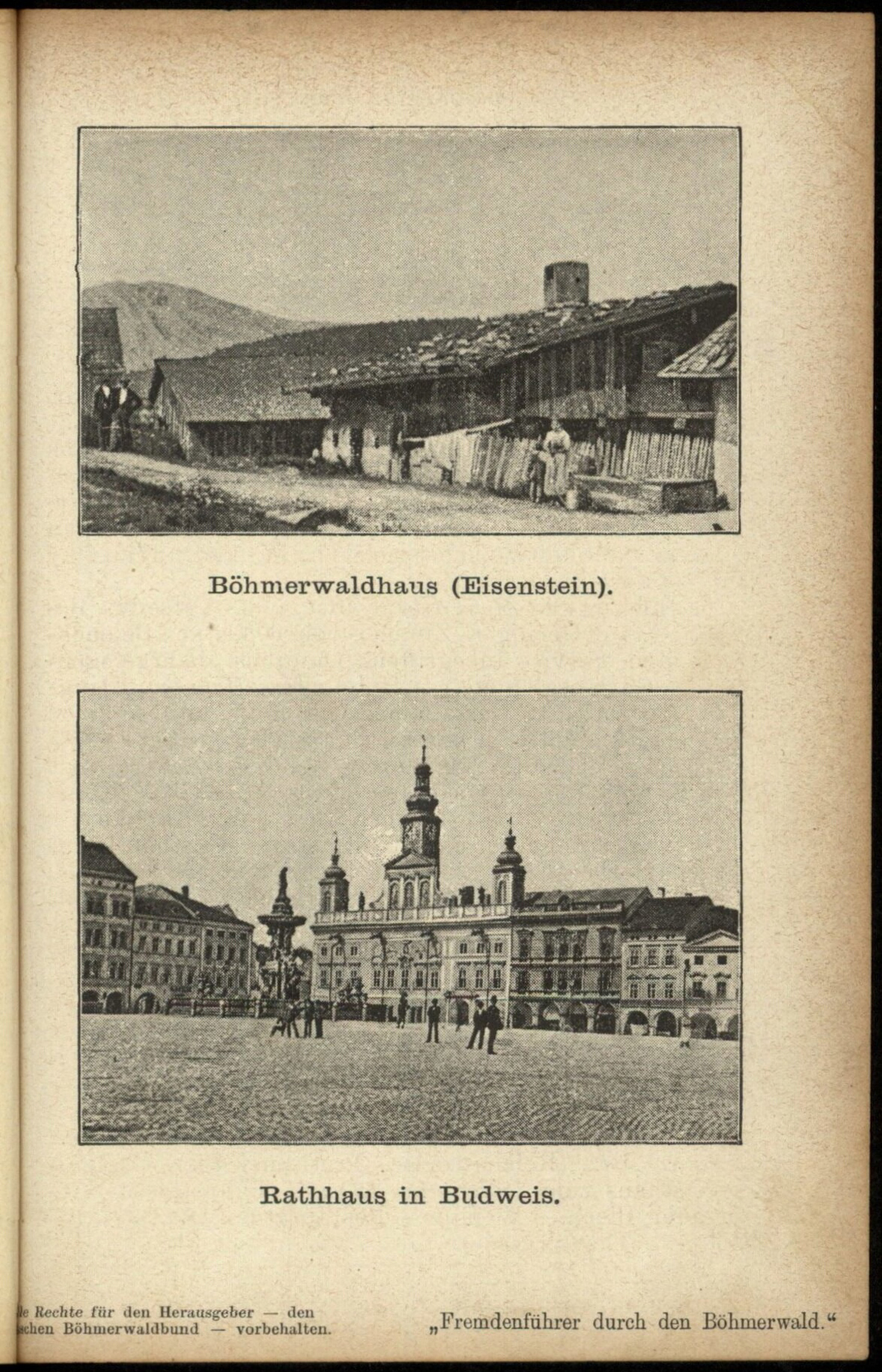
Figure 2
The contrast between folk architecture in Železná Ruda (Eisenstein) in the Bohemian Forest and town hall of České Budějovice (Budweis) as a regional centre and recommended starting point for trips (Führer durch den Böhmerwald, 1888, 346). Source of reproduction: The National Digital Library, The National Library of the Czech Republic. https://ndk.cz/view/uuid:f6f6a150-2fe8-11de-b4fc-000d606f5dc6?page=uuid:ed048b30-13f6-11e7-981b-005056825209.
Historian Pieter M. Judson points out how these types of organisations adapted tourist literature to ‘inscribe the natural landscape with a specifically national character’. Judson further indicates that:
this new effort helped the reader locate the particular moral qualities of a landscape that lent it a national identity. The nationalist guide provided the traveller with a key to interpret what he or she saw, with a lens for understanding the deeper historical and national significance of the view. Since it brought together ideas about landscape, nature, history, language, and authenticity, tourism offered tantalising possibilities to the nationalist who wanted to delineate the territorial boundaries of a nation and to make those boundaries visible to others. (Judson, 2007, 145)
The emphasis placed on the usage of the nationally correct guidebooks is clearly visible in a notice from the daily news section of the Czech daily newspaper Národní listy (The National Paper) from 20th August 1908. It laments that while tourism in the Bohemian Forest is booming, most Czech tourists still ‘have in hand a German guidebook, published either by the Böhmerwaldbund or by the Köhler’s publishing house in Dresden’ and are unaware of the Czech guidebook by Národní jednota pošumavská. ‘So long as we lacked our own exemplary Průvodce, the purchase of German Reiseführer was understandable; but today, to buy them is an act of national indifference, worthy of reproach’ (Národní listy, 1908, p. 3). Using a tourist guidebook was therefore not just a utilitarian way of finding one’s way around the landscape—it was an act of signing up for a national community and its values.
Supporting the Nation
National aspects were strong motives for tourism development on the margins. As Judson (2007) underscores, national activists on the language frontiers of the Habsburg empire soon realised that tourism—both on the symbolic level and as a form of economic activity—could be utilised to promote a nationalist agenda. The era of the rise of non-alpine tourism in Central Europe coincides with the time of growing demands for national self-determination within the state. The boom of tourist and hiking associations in the 1870s and 1880s was affected not only by general lifestyle changes and the preceding popularity of alpinism that allowed tourism to flourish but also by an unprecedented environment that saw the emergence of a vast number of associations of all kinds, driven by structural social transformations as well as political and nationalist activism.
To finance their activities, collections among members and sympathisers were common among these associations and constituted a significant source of their income. The fundraising was mainly connected to a specific goal—in the case of tourist associations, often the construction of huts and lookout towers (Pelc 2009; Holubec 2024a). It is possible to argue that the intention behind the collections was not only to finance the ventures themselves but, more importantly, to mobilise the general public for the greater goals. In the Habsburg monarchy’s multi-ethnic conditions, most of these goals were motivated by nationalism. The development of tourist infrastructure, especially in the ethnically contested areas, represented a symbolic occupation of space (Holubec 2024a, 2024b). So did the tourist activities themselves—both Czech and German nationalist defensive associations and, to a significant extent, tourist associations encouraged especially students to travel to these areas, not only for individual educational and recreational purposes but also to ‘fulfil our obligations to the entire nation’, as a Czech guide for student travel from 1897 puts it (Kurz 1897). The tourist associations also operated an extensive network of hostels to allow students and older schoolchildren to travel cheaply.
The persuasion to travel was not the only effort of the tourist associations to utilise youngsters for nationalistic purposes. The Czech Tourist Club also organised winter collections for youth in Chodsko, a region in the northern part of the Bohemian Forest. This region was of great symbolic significance for national identity. In the Middle Ages, the local inhabitants enjoyed numerous privileges related to their task to guard and defend the Bohemian border with the Upper Palatinate. The Chods, as symbolic defenders against the Germans, became a frequent literary subject in the late 19th century—Czech authors writing in the spirit of romantic nationalism, such as Alois Jirásek (Figure 3), Božena Němcová, and Eliška Krásnohorská have dedicated their works, which still belong to the Czech literary canon, to them (Maur 1984; 2006, 175–197). At that time, the region was located not only on the country’s border (though the significance of Chods as its guardians declined due to several social and political factors already in the early modern period) but was also significantly on the language border (Figure 4) between predominantly Czech and predominantly German-speaking areas of Bohemia. The symbolic value of the border region, the possibility to combine tourist cultural activities including sightseeing and encounters with the locals and their folklore and traditions with hiking and later also skiing, contributed to the popularity of the region as a tourist destination as did its accessibility by train from the capital of Bohemia and from the local industrialised centre, Pilsen. Similar to the Grand Tour, in which travellers had journeyed from economic centres to economic peripheries perceived as the cradle and core of European culture (Lapointe 2024, 2), Chodsko can be considered an economic periphery, yet one that was regarded as a stronghold and centre of Czech national culture. In this sense, peripherality was not only economic but also discursively constructed in nationalist terms, with Czech-speaking inhabitants portrayed simultaneously as heroic border guards of the nation and as vulnerable to the ever-present threat of denationalisation.
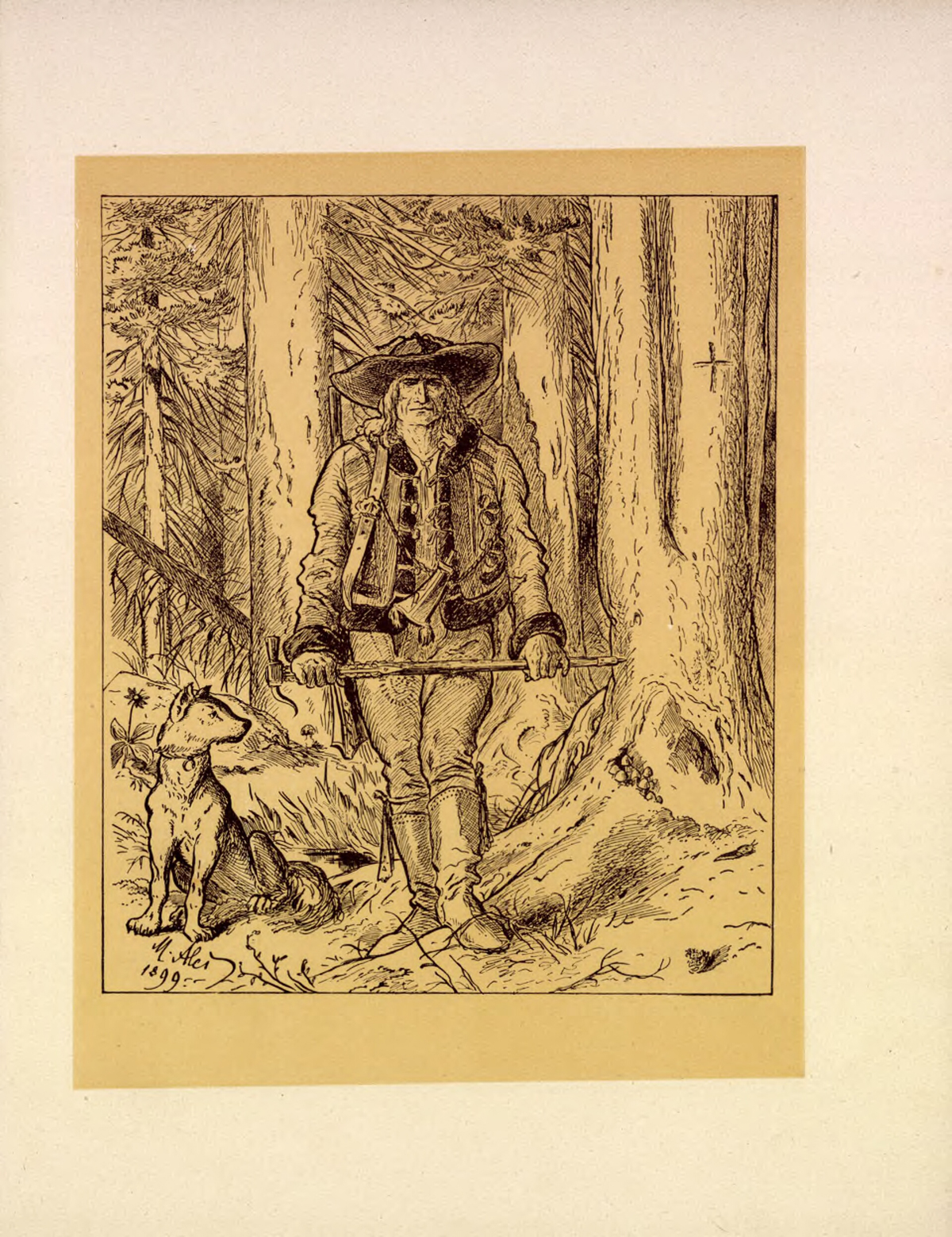
Figure 3
Portrait of a Chod in a traditional attire as a border guardian – illustration by Mikoláš Aleš for Jirásek’s historical novel Psohlavci: historický obraz. Source of reproduction: The National Digital Library, The National Library of the Czech Republic. https://ndk.cz/view/uuid:4642a9f0-fe7c-11e2-beb8-005056827e51?page=uuid:79a4b280-dbd2-11e5-a2f0-005056822549.
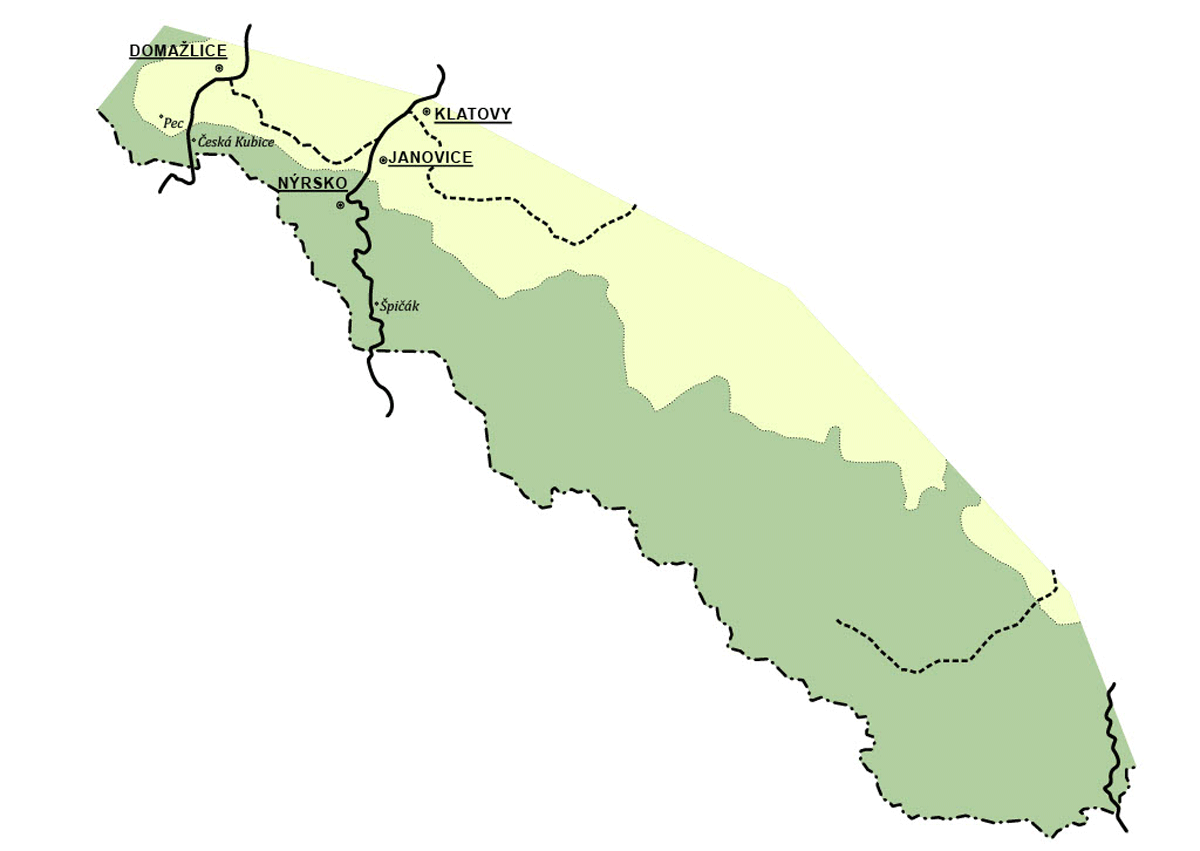
Figure 4
The approximate area of the Bohemian Forest at the end of the 19th century. The yellow areas are predominantly Czechspeaking, while the green areas are predominantly German-speaking – based on ‘Železniční a silniční mapa království Českého, obsahující veškerá města, městysy a místa průmyslová’ (Railway and Road Map of the Kingdom of Bohemia, including all towns, market towns, and industrial places) (1884). Author’s archive.
The local branch of the Czech Tourist Club was one of the oldest and most active, even hosting the general congress of the Club in 1897. In the same year, they opened a hut on the top of the mountain Čerchov and a stone lookout tower in 1905 (preceded by a simple wooden one built in 1894). To finance these projects, the local branch launched collections among locals and tourists coming to the area (Časopis turistů 1897, p. 21). While most of the collections for these kinds of endeavours were organised by local branches of the Club, there were few exceptions, such as the aforementioned collection of money, clothes, school supplies, and clothes was organised by the main office in Prague, although in collaboration with the local branch in Domažlice.
The call for donations, published in Časopis turistů in November 1896, was signed by the president and the secretary of the Czech Tourist Club. It appeals to the tourists to recall the moments they experienced during their summer trips to the mountains and, because ‘the true tourist doesn’t know repose’, to use the wintertime for further activity regarding the mountain regions: ‘Let us remember the poor Czech youth, whose smiling, healthy faces we encountered step by step during the summer. For most of them, winter is a harsh guest. They lack clothing, footwear, and other necessities. Let each of us contribute a gift to help adorn the Christmas tree for our little, impoverished mountain dwellers!’ (Pasovský and Valenta 1896).
The text thus connects the local inhabitants with the landscape and—by describing them as Czechs and as ‘ours’—uses a national and somewhat paternalist attitude to build the connection between the more economically developed centre and the underdeveloped periphery. The call for donations also underscores that being a tourist does not mean merely hiking or visiting remarkable places. It is also a mission, a role that carries a social responsibility.
The report about the ‘Christmas Tree of the Czech Tourist Club 1896’ in the villages Pec and Česká Kubice was published in the first issue of the 1897 volume of Časopis turistů. It was written by Max Duffek, a secretary of the Domažlice branch of the Club and—not incidentally—also an active member of the Czech national activist organisation Národní jednota pošumavská. He emphasises that these villages are located in the region of the Chods and the local inhabitants, primarily the families of woodcutters, live in dire conditions. He also writes that German immigrant glass cutters petitioned the Schulverein (the German national-activist organisation for support of setting up new schools in Cisleithania, see also Zahra 2008, and Zvánovec 2020, 2021) for the establishment of a German school in Pec, ‘not only for [their] children but also for the Czech children of Pec’. To prevent this, a branch of the Czech-language school from the nearby larger village of Trhanov was established in Pec. It was precisely this new Czech school in Pec where Christmas gifts from the collection were distributed to local children. A similar event took place the following day in Česká Kubice.
The text also underscores the personal involvement of the Club’s president, Vratislav Pasovský, who ‘undeterred by lousy weather, snowstorms, and the Christmas holidays—which everyone surely prefers to spend with their family—travelled to the aforementioned villages to attend the celebrations that were made possible thanks to his efforts’. Apart from him and people from the local branch of the club, the local teachers and priests also helped to organise the event—in their speeches for the children and the parents, they appealed for them to ‘express their gratitude through kindness and willingness to assist tourists and summer visitors who come to their beautiful region’ (Duffek 1897, 22–23). That again accentuates the link between tourists from the centre and locals from the periphery the collection was trying to establish.
Notably, the connection between Prague as an urban centre and Czech children from the Bohemian Forest was also reinforced through travel in the opposite direction—the aforementioned Národní jednota pošumavská organised excursions for schoolchildren from the so-called endangered regions to Prague (see also Judson 2007, 152). Several such trips took place in 1897 as well (Vondráček 1934, 488). Significantly, these initiatives persisted even after the establishment of the independent—yet still multiethnic—Czechoslovak Republic in 1918 (Vondráček 1934, 494).
The dire social and economic situation of local inhabitants of the Bohemian Forest—and its worsening in winter—and its connection to tourism can be found in an article Šumava v zimě (The Bohemian Forest in Winter) in a national conservative newspaper Čech (The Czech), published in April 1895. The author, Antonín Hosínský, writes:
Silence now reigns over the Bohemian Forest. In summer, however, it is quite lively; tourists of all kinds, of all ages and social classes, roam the woods of the Bohemian Forest, wandering in their shade, searching for a view over the landscape from the forested heights. But in winter, the Bohemian Forest rests.
He argues that the economic situation of locals, who, for the most part, are forced to seek their livelihood in the forest, is more critical than ever following the extraction of the forest after a storm and bark beetle outbreak in 1872 (Hosínský 1895).
The bark beetle outbreak and the subsequent period of extensive logging during and after it are perceived as defining for the region in numerous journalistic and literary works from the late 19th century. In tourism-related literature, the events are described as unprecedented and novel and seem to stand out from the ‘natural’ cyclical temporality of landscape changes due to their severe impact on the local economy and society (Kolářová 2024). Seasonal forest workers from another part of the Habsburg Empire were invited to help with the sudden increase in logging. This period has been likened to a ‘gold rush’, with some articles and literary works pointing out that the sudden prosperity brought to the local population by the proceeds of working in the forest had a negative moral impact (Stibral, Faktorová and Hořejší 2025, 13). The temporary local economic boom was followed by a decline that led many locals to seek seasonal work in other areas of the Habsburg monarchy or Germany (Sa. 1910) or even to emigrate to America.
That is also a tangible motive in Hosínský’s article. He portrays the locals as hardworking, religious and devout people who are often forced to look for (seasonal) work elsewhere. He describes them as Czech—or even ‘of Old Czech character’ (staročeské povahy)—at the end of the text, arguing that sometimes they die abroad and their families do not even know their burial place (Hosínský 1895). However, this portrayal of the local hardship was not confined to Czech national conservatives or the period before World War I. The media figure of local destitution in the Bohemian Forest also found a voice in the German-speaking social democratic journalist Wenzel Jaksch, who included the region in his series of social reportages from the borderlands, published in the partisan newspaper Sozialdemokrat (The Social Democrat) (Jaksch 2018).
Occupying Space
While in some regards, the impact of the bark beetle outbreak on the local population was ambivalent at best, it is possible to argue that it made the region more accessible to tourism. Not only did the region become more widely known, but the need to transport large quantities of harvested timber quickly accelerated the financially and technically demanding construction of the previously planned railway line to connect Plzeň/Pilsen and Bavaria. The entire route from Plzeň/Pilsen to Železná Ruda/Markt Eisenstein on the Bohemian-Bavarian border was completed in October 1877. Transport infrastructure is an important precondition for the development of tourism—if not mass tourism, then at least on a scale larger than that of individual tourism. In the late 19th century, the railway represented the key means of transport for tourists in the region (Figure 5). That is easily provable by looking at the guidebooks of that era, as they often structure their recommendations around railway lines and stations, which serve as natural starting points for excursions (e.g. Möchel, 1878; Cimrhanzl, 1878; Führer durch den Böhmerwald, 1888; and Vilímkův průvodce Šumavou, 1905). Many guidebooks and trip recommendations in Časopis turistů explicitly mention railway connections and frequently include train schedules, allowing tourists to plan their trips accordingly. The accessibility of destinations by train played a crucial role in travel itineraries, as visitors relied on the railway to efficiently reach key points of interest.
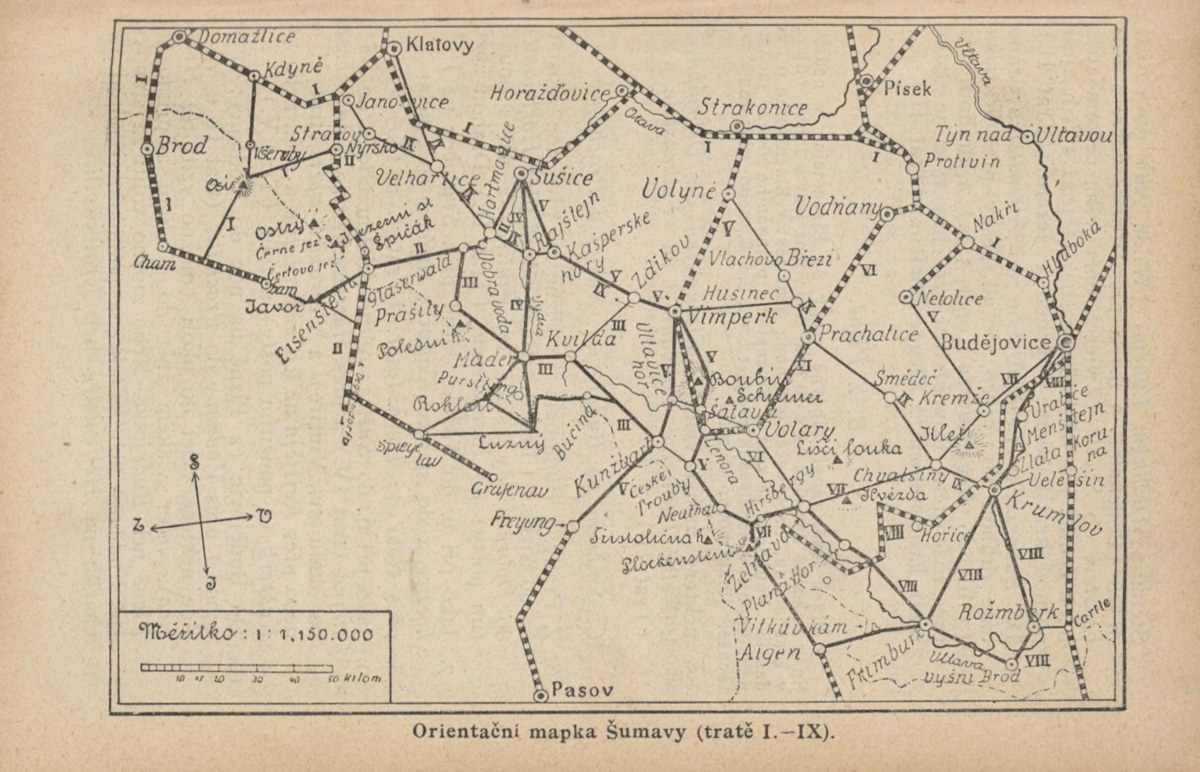
Figure 5
Orientation map of the Bohemian Forest with railway routes (Kafka, 1904, 23). Source of reproduction: The National Digital Library, The National Library of the Czech Republic. https://ndk.cz/view/uuid:a5649720-c4f6-11e5-b93e-005056827e52?page=uuid:0ab6d910-28d1-11e6-a344-5ef3fc9ae867.
The Czech Tourist Club (KČT) played a significant role in supporting railway-based tourism by arranging discounts for its members. These benefits made the membership more appealing, the train travel more affordable, and encouraged participation in organised tourism activities, such as excursions (Velký výlet na Šumavu, 1893). Similarly, the tourist associations also supported special sports and tourist trains. The first special winter ‘sports train’ from Plzeň/Pilsen to Železná Ruda/Markt Eisenstein, running on Sundays and public holidays, was dispatched in 1907 (Plzeňské listy, 1907). It was intended explicitly for Špičák, a mountain near Eisenstein in the middle of the Bohemian Forest, which, together with Čerchov up north in Chodsko, was one of the regional centres of winter tourism in the pre-war period. Since 1909 at the latest, ski races were held on Špičák (Plzeňské listy 1909). In the following year, the races also gained international participation and special categories for women, juniors and seniors (Plzeňské listy 1910). After the First World War, in 1922, Špičák was even the venue for the Skiing Championship of the Czechoslovak Republic (Scheiner 1922).
The example of Špičák as a regional destination illustrates that seasonality also plays a vital role in the relationship between the centre and periphery, especially in tourism-dependent regions. During the winter season, places like Špičák temporarily become centres of economic and social activity, attracting visitors and concentrating services. However, once the season ends, they return to their peripheral status, with a decline in tourist numbers and economic activity. This cyclical nature of tourism influenced local infrastructure, seasonal employment and the daily life of local communities. Climate, phenology of vegetation, agriculture and policies and customs (such as public holidays) are among the main factors influencing the seasonality of landscape-focused tourism, especially in Central Europe (Bender, Schumacher, and Stein, 2007, pp. 185–189).
Nevertheless, Špičák’s significance as a centre extended beyond its seasonal role. It also played an essential part as a hub for ethnically Czech tourism to the region. In 1880, a former canteen for workers who had constructed the tunnel under Špičák was transformed into an inn named Prokop after its innkeeper. This establishment’s manager, familiarly known as ‘Father Prokop’ (e.g. Plzeňský obzor, 1908), became such a legendary figure that when he passed away in 1914, even the Prague-based Národní listy published his obituary on the title page. The author of the obituary, Czech chemist and sport promoter Bohuslav Brauner, summarised his own trips to Špičák during his student years and later during the birth of winter tourism, citing the beginnings and everyday life of the guesthouse, as well as the nationalist attitudes of ‘Father Prokop’:
Visitors to Špičák have often inquired of me how it came to pass that Father Prokop made this beautiful, once unknown corner of the German-speaking region in the Kingdom of Bohemia accessible to us, both in winter and in summer, where we have ever enjoyed our time? A man of extraordinary character was required—tenacious, conscious of his goal, and unafraid of struggle, be it against nature or against a national adversary.
(Brauner 1914) writes, describing the innkeeper rather as a sort of vanguard of both tourism and the nation rather than as a mere hospitality entrepreneur.
As evident from this obituary and from other reviews and recommendations in Czech tourist guidebooks, the Prokop Inn developed into a key hub for ethnically Czech tourism. In 1899, it even financed the publication of its own tourist guidebook—an unprecedented endeavour at the time among Czech- or German-speaking establishments in the region. Another prominent destination for Czech national tourism was the Krásnohorská Inn in Česká Kubice, named after the writer Eliška Krásnohorská, who devoted attention to the area—particularly Chodsko—in her collection Ze Šumavy (From the Bohemian Forest).
Just as transport infrastructure creates new hierarchies of places, in the 19th century, it was primarily the railway that ensured rapid and easy accessibility to the region from industrial centres and led to the emergence of smaller tourist hubs, particularly around major train stations. Accommodation establishments similarly established local centres around them. As seen in the case of Špičák, in the age of national activism around the linguistic border, ethnic affiliation and a self-proclaimed role as a national outpost were prominently highlighted in contemporary discourse as criteria of attractiveness, at times overshadowing practical aspects such as the number of beds, the quality of cuisine, or proximity to landscape landmarks. The significance of ethnic affiliation did not disappear even after the fall of the Habsburg monarchy, in fact, the ethnically mixed borderlands were still an important discursive battlefield for nationalist defensive associations (Haslinger 2010, 358–383). A travel guide from the interwar period, published in 1922 and reissued in 1926 and 1931 by the Czechoslovak Tourist Club, includes a list of inns offering accommodations, where, in addition to the number of rooms and beds, information is provided on whether the staff speaks Czech, German, or, less frequently, both languages (Šumava: stručný popis, 1922). Although the national and political conditions of interwar Czechoslovakia differed from those of the Habsburg era, with Czechs now holding the dominant position, the ethnic diversity of certain regions continued to play a significant role in tourism.
Conclusion
As stated at the outset, the aim of this article has been to explore how tourism instrumentalised and transformed the peripheral status of the Bohemian Forest in the late 19th and early 20th centuries. Approaching the topic through a case study of the Bohemian Forest and selected localities Špičák and Chodsko, the article has examined how processes of tourism development operated simultaneously at regional and local scales. In doing so, the study has shown that peripherality was not a passive condition but an actively constructed quality that both shaped and was reshaped by emerging forms of tourism.
The region’s peripheral status proved to be an important factor in guiding its tourism development. Especially in nature-based tourism and other landscape-oriented practices such as skiing, peripherality itself became a source of attraction, as similar areas offered an escape from the undesirable features of industrial cities. These landscapes—and, importantly, also their inhabitants—represented a realm of difference for urban tourists, allowing the appropriation of remote mountain forests and impoverished local populations for both leisure and political purposes. The findings of this case study thus confirm that concepts developed for understanding tourism in peripheral regions (Christaller 1964) and pleasure peripheries (Turner and Ash 1975, Müller and Jansson 2006) are applicable not only to the post-war and contemporary context in which they were formulated but also to the emerging modern tourism of the late 19th and early 20th centuries.
Tourist media and associations used several ways of instrumentalising peripherality in the process of making the Bohemian Forest into a destination. Firstly, aesthetics and the tourist gaze (Urry and Larsen, 2011) played an essential role. The gaze was directed to features perceived as out of the ordinary, producing pleasures anticipated through imagination and reinforced by media, literature, and especially guidebooks. In the Bohemian Forest, tourist media focused attention on landscapes, framing them as sites for visual and symbolic consumption. This structured attention—separating tourists’ experience from everyday life—illustrates how peripherality could be commodified for the leisure of urban middle-class visitors. The tourist literature emphasised comparisons to other regions where tourism was already more developed and could, therefore, be perceived as centres within the context of tourist discourse. These associations were based on the aesthetic qualities of the landscapes rather than practical features such as transport accessibility, distance from centres or the state of tourist infrastructure. The descriptions either highlight distinctions or seek to draw parallels between the Bohemian Forest and other mountain regions by emphasising the existence of comparable characteristics in this region. Both strategies are meant to promote the region—whether by underscoring its uniqueness or by appealing to the sense of familiarity. The forest is regarded as the most defining feature of the area.
Secondly, there is a socio-economic inequality between the educated middle-class urban population who visit the region as tourists and the locals who worked in agriculture or small-scale light industry and whose daily life was strongly influenced by seasonal natural conditions. Apart from media representations, this disparity was evident in the charitable collections for children in Chodsko, conducted by the main office of the Czech Tourist Club in Prague. The collection was not a mere philanthropic enterprise but was also meant to increase solidarity, based on belonging to the national community between urban middle-class tourists and the local working-class population—to symbolically reinforce the connection between the Czechs in the crownland’s capital and the Czechs living near the language border, as well as to establish a positive image of tourists and seasonal guests among the locals.
Thirdly, the role of infrastructure in a centre-periphery relationship cannot be overlooked. In the case of tourism at the turn of the 19th and 20th centuries, two forms of infrastructure played a particularly significant role—the railway and inns. Both contributed to the emergence of new spatial hierarchies and the development of local centres in peripheral areas illustrating the notion of ‘cores and peripheries within cores and peripheries’ discussed by Pugh and Dubois (2021, 271), where peripheral regions can generate localised centres and hierarchies despite their overall marginal status. These hierarchies were not only spatial, they also had their temporal dimension—while most of the region’s landmarks were visited during the summer season, winter tourism, primarily skiing, was concentrated only in specific areas of the territory.
These three examples seem to have some similar underlying elements, especially one common denominator—the national activist function of tourism. At the end of the 19th century, the national conflict between Czechs and Germans in the Bohemian lands was escalating. As a region that lay not only on the state border with Germany and interstate border between Bohemia and Upper Austria but also on the Czech-German linguistic frontier within Bohemia, the Bohemian Forest was marked by pronounced ethnic ambiguity, which significantly shaped the early development of its tourism. These dynamics cannot be understood in isolation: Czech and German nationalist projects in the region often mirrored and responded to each other, making their antagonism also a form of mutual co-construction. The relationship between the centres such as Prague and Pilsen and the Bohemian Forest as a peripheral region is not only shaped by its developmental potential but is further intensified by its position along both state and linguistic borders, which serve to reinforce and activate these dynamics. Just as tourism has been instrumentalised for the purposes of national activism, the peripheral status of the region has, in turn, been leveraged through tourism—these processes are interconnected.
But even in the case of activism on behalf of the nation, the region was not merely a blank canvas for projection. The Czech Tourist Club, as well as other producers of tourism-related media, actively participated in constructing representations of the landscape—whether these reflected direct personal experiences or served to inform the expectations of prospective visitors, whose first impressions of the region were often mediated by such texts. This process was shaped not only by external narratives but also by the evolving centre-periphery relationship. The Bohemian Forest, its landscape and its inhabitants were neither passive recipients of imposed meanings nor fully autonomous actors. The functional dynamic between central representations and local responses can be seen as a form of resilience strategy. Infrastructural developments, symbolic framings, and aesthetic associations enabled the region to flexibly adapt to shifting cultural and political contexts, such as the rise of tourism and the growing importance of national identification, as well as outcomes of rapid landscape and societal changes, as seen in the example of the bark beetle outbreak. At the same time, the perspectives discussed here are largely mediated through sources produced by tourist entrepreneurs, nationalist organisations, and the regional press, rather than through direct voices of local inhabitants. This limitation underlines the importance of further research on how such imaginaries were received, negotiated, or contested in everyday life.
Taken together, the findings of this case study allow for an integration of both structuralist and relational theories in understanding the relationship between tourism and peripherality. While Walter Christaller’s (1964) model provides a framework for understanding how infrastructure and spatial hierarchies structure access and visibility within tourism development, as seen in the example of the railway, it only partially accounts for the symbolic processes. Dominic Lapointe’s (2024) relational view of peripherality offers a useful counterpoint, highlighting how peripheral regions undergo cycles of deterritorialisation and reterritorialisation. That can be demonstrated using the case of Chodsko, as its status as an economic periphery was redefined into a symbolic centre of national identity, making it a strategic site for charitable campaigns. By applying these theories and the concept of periphery-centre relations in general, the study complements historical research of Pieter M. Judson (2007), who also focuses on the region of the Bohemian Forest but refers to other activities and other sublocalities and to the concept of frontiers, rather than peripheries.
Building on these reflections, this case study suggests that the instrumentalisation of peripherality through tourism-related media intertwines imaginaries with social relations: Imaginaries reflect existing social dynamics while simultaneously feeding back into their transformation. Further research should investigate more closely how touristification reshapes social relations in peripheral contexts—particularly how tourism hybridises connections between centres and peripheries in some respects while reinforcing their polarisation in others, and how it alters local social dynamics. Equally important would be to explore more systematically how local inhabitants perceived these processes, including the presence of visitors and the impact of nationalising efforts on everyday practices and attitudes.
Notes
Competing Interests
The author has no competing interests to declare.