
1. Introduction
A long history of colonial and post-independence forest administration concentrated authority over forests in the state, displacing local communities who had traditionally governed these landscapes (Guha 1983; Pouchepadass 1990; Scott 1989). This centralized mode of rule—described as forest government (Art and Visseren-Hamdkers 2012)—created a belief that only state forest agencies, with their ‘scientific and technical’ expertise, were capable of managing forests. This perception endured even as deforestation and degradation increased (FAO 2010). Over time, pressures from local movements and NGOs pushed several countries toward participatory forest management (Agrawal, Chhatre and Hardin 2008). India followed a similar trajectory, culminating in the Scheduled Tribes and Other Traditional Forest Dwellers (Recognition of Forest Rights) Act, 2006 (FRA), a landmark law aimed at restoring community governance and management rights.
Globally, forest landscapes are marked by overlapping claims of authority and tensions between state institutions and local communities (Furumo et al. 2024; Liu and Ravenscroft 2021). India’s attempts at decentralization exhibit similar struggles (Reddy et al. 2011; Springate-Baginski, Sarin and Reddy 2013). The forest department has consistently resisted such reforms, whether through the Panchayat (Extension to Scheduled Areas) Act, 1996 (PESA) or the Joint Forest Management (JFM) programme of 1999. Although PESA constitutionally recognizes decentralized governance in Schedule V areas, several states—despite lacking legal authority—attempted to dilute its provisions (Sarin et al. 2003). JFM, though framed as participatory, was widely criticized for enabling bureaucratic co-option (Lélé 1998). The FRA, despite its transformative intent, has encountered similar resistance, ranging from overt bureaucratic conflict to subtle strategies of reinterpretation (Bijoy 2022; Hebbar 2022; Kashwan 2017; Kutty et al. 2019; Kutty and Menon 2025; Sarin and Springate-Baginski 2010). Analyses show how environmental decision-making becomes a tool of political and bureaucratic control (Sen and Pattanaik 2019), how power asymmetries marginalize local communities (Kashwan 2013), and how implementation failures reflect deeper political-ecology dynamics of state power (Sen 2021). Others document the environment ministry’s active resistance to FRA implementation (Bijoy 2022) or the forest department’s use of legal gaps to preserve authority (Dash 2011).
The environment ministry and state forest departments are highly centralized, hierarchical, and stable bureaucracies whose power is reinforced by control over revenue-generating land, quasi-judicial authority, and exclusive technical knowledge (Springate-Baginski et al. 2008). Acknowledging the risks of entrusting such an institution with implementation, the FRA assigned primary responsibility to the Tribal Welfare Department (TWD) (Springate-Baginski et al. 2008). Authority to recognize community forest rights rests with multi-department committees composed of officials from the revenue, forest, and tribal welfare departments, along with elected local representatives. These bodies were expected to ensure collaborative governance. Yet implementation outcomes have fallen far short of expectations; progress on community forest rights remains limited (CFR-LA 2016).
Against this backdrop, this paper examines how state actors deploy historical narratives and legal interpretations to consolidate authority within multi-department governance structures. It highlights how power is negotiated in legally plural settings—an issue common across forested and Indigenous territories globally. The analysis shows how progressive legal reforms may be undermined by fragmented governance and selective implementation (Wibowo et al. 2012). It argues that integrating local history and related legal frameworks into bureaucratic training is essential for equitable forest governance.
1.1 Role of the bureaucracy in the implementation of CFRs
Scholarship identifies several determinants of successful community forest rights (CFR) implementation, including collective action by Gram Sabhas, NGO support, leadership by community institutions, bureaucratic behavior, and multi-actor collaboration (Gupta, Lele and Sahu 2020; Kohli and Kuriakose 2025; Kutty et al. 2019; Kutty and Menon 2025; Sahu 2020). Few studies, however, analyze the roles of departments other than the forest department (Kutty and Menon 2025; Sahu 2020; Sahu, Dash and Dubey 2017). Sahu (2020) illustrates that the Vidarbha region’s leadership in CFR recognition stems partly from proactive engagement by departments not directly assigned responsibility under the FRA. In particular, initiatives by the Tribal Welfare Department—through institutions supporting both claim recognition and post-recognition governance—significantly influence outcomes. Despite these insights, scholarship has largely overlooked inter-departmental dynamics among the three main implementing agencies. To better understand how multi-department committees function amid power asymmetries, we draw on policy-implementation literature.
1.2 Ambiguity and conflict in policy implementation
Traditional assumptions that implementers clearly understand policymakers’ expectations are misplaced. Policy implementation is a complex, layered political process (Kgwete 2021). Conflicts emerge when actors depend on each other for outcomes but pursue divergent departmental goals (Hordern 2015; Matland 1995). These conflicts may arise over what needs to be achieved or how it should be achieved (Matland 1995, p. 156), and they may also surface when actors see no benefit in implementing a policy (Hordern 2015, p. 6).
Ambiguity stems from unclear responsibilities, limited expertise, or complex local conditions (Matland 1995, p. 158). Such ambiguity increases misunderstandings and implementation failures (Matland 1995, p. 158). Importantly, ambiguity and conflict are intertwined. Matland (1995) argues that some ambiguity can reduce conflict, since overly clear goals may make actors feel threatened and resist implementation. Coleman et al. (2021, p. 289) clarify this by distinguishing conflicts arising from discretionary interpretation from those rooted in contradictory objectives. This distinction helps determine whether actors are exercising discretion or grappling with legal conflicts. In ambiguous and conflict-prone settings such as the FRA (Fleischman 2012), implementers generate their own interpretations. Kgwete (2021) therefore stresses the need to examine how actors negotiate, interpret, and transmit information, because multi-departmental decision-making is shaped by bureaucratic politics, bargaining, and coercion (Kgwete 2021, p. 45; Matland 1995, p. 156).
1.3 Sensemaking and sensegiving in policy implementation
Sensemaking—comprising information seeking, meaning ascription, and action (Carmel 2019, p. 25; Thomas et al. 1993; Weick 1995a)—explains how bureaucrats interpret policy intent and anticipate behavioral change (Kgwete 2021, p. 4). Implementing radical policy reforms requires bureaucrats to acquire new knowledge, adjust to shifting power relations, and adapt operational practices shaped by departmental priorities and local contexts (Choo 2002; Coleman et al. 2021; Kutty and Menon 2025). Ambiguity accompanying radical reforms triggers sensemaking because it destabilizes established authority (Schildt, Mantere and Cornelissen 2020). Actors rely on past experiences to construct plausible meanings (Weick 1995b), and in multi-actor settings, competing interpretations must be negotiated—making power central to sensemaking (Kgwete 2021). Governance thus involves both meaning-making and the actions guided by those meanings (Carmel 2019, p. 25).
Sensegiving complements these processes by referring to efforts to shape others’ interpretations (Gioia and Chittipeddi 1991). When actors fail to develop shared meanings, a ‘sensemaking gap’ emerges, prompting strategic sensegiving to influence decisions (Maitlis and Lawrence 2007). In multi-agency committees, powerful actors deploy sensegiving to steer interpretation and limit alternative views.
The sensemaking–sensegiving framework is well suited for analyzing policy implementation rooted in negotiation, interpretation, and language (Sandberg and Tsoukas 2020). Applying this framework to the FRA shifts attention from compliance to the historical and power-laden contexts shaping implementation (Spillane, Reiser and Reimer 2002). In a setting marked by ambiguity and entrenched power asymmetries, sensemaking and sensegiving reveal how progressive laws may be diluted or selectively implemented. Examining these processes helps identify institutional weaknesses and offers insights for aligning implementation with the FRA’s transformative goals.
2. Analytical Framework
Power operates in both episodic and systemic forms (Clegg 2012; Fleming and Spicer 2014; Schildt, Mantere and Cornelissen 2020). Episodic power refers to deliberate, agential actions through which individuals exert influence, such as coercion or manipulation (Fleming and Spicer 2014). Systemic power, by contrast, emerges from an actor’s embedded position within social, political, or economic structures (Schildt, Mantere and Cornelissen 2020). It shapes behavior subtly, through institutionalized identities, norms, and knowledge systems (Clegg 2006; Lukes 2021). Power can therefore restrict action but can also be enabling—particularly through sensegiving, whereby actors guide others’ interpretations and meaning-making (Schildt, Mantere and Cornelissen 2020).
Sensemaking itself is highly susceptible to both episodic power events and ongoing systemic power relations. External forces influence what actors view as plausible, and thereby how much attention and effort they invest in interpretation (Weick 1995b). Schildt et al. (2020) identified two key dimensions through which variations in sensemaking can be analyzed. First, actors differ in the degree of conscious attention given to assessing whether their interpretations—or the links they draw between observations, beliefs, and actions—actually make sense. Second, they vary in their interpretive stance, either remaining committed to initial impressions or adopting a provisional stance open to revising earlier beliefs. These dimensions—conscious versus pre-conscious attention and committed versus provisional stance—form the basis for four ideal types of sensemaking: Automatic, Algorithmic, Improvisational, and Reflective (see Table 1).
Table 1
Ideal type sensemaking processes.
| COMMITTED PROCESSING | PROVISIONAL PROCESSING | |
|---|---|---|
| Pre-conscious processing | Automatic processing | Improvisational processing |
| Conscious processing | Algorithmic processing | Reflective processing |
[i] Adapted from Schildt, Mantere and Cornelissen 2020.
Automatic sensemaking (committed + pre-conscious) occurs when individuals interpret situations intuitively by linking new cues to past experiences with little conscious effort (Atanasiu, Wickert and Khapova 2023; Bingham and Eisenhardt 2011). Algorithmic sensemaking (committed + conscious) involves deliberate attention guided by established interpretive routines or narratives functioning as ‘algorithms’ (Whittle, Vaara and Maitlis 2023). Improvisational sensemaking (provisional + pre-conscious) describes spontaneous cue selection similar to improvisation in music, where actors shift fluidly among cues without sustained deliberation (Humphreys, Ucbasaran and Lockett 2012). Reflective sensemaking (provisional + conscious) is the most empowering, involving careful consideration of competing interpretations and linking observations to past experience and future possibilities to generate deeper understanding (Kemppainen and Uusitalo 2022; Schildt, Mantere and Cornelissen 2020).
While these classifications focus on how systemic power influences sensemaking, Schildt et al. (2020) also analyze how episodic power interacts with these processes through sensegiving. Their model identifies four forms of episodic power corresponding to the four types of sensemaking: Suppressive, Authoritative, Inspirational, and Expansive (See Table 2).
Table 2
Forms of episodic power associated with the ideal-type forms of sensemaking.
| INDUCE COMMITTED PROCESSING | INDUCE PROVISIONAL PROCESSING | |
|---|---|---|
| Induce pre-conscious processing | Suppressive sensegiving | Inspirational sensegiving |
| Induce conscious processing | Authoritative sensegiving | Expansive sensegiving |
[i] Adapted from Schildt, Mantere and Cornelissen 2020.
Sensegiving styles on the left of this typology—suppressive and authoritative—seek to narrow meaning-making by limiting interpretive flexibility. Suppressive sensegiving induces committed, pre-conscious processing by stifling alternative views and requiring recipients to adopt the sensegiver’s interpretation. A strict teacher who discourages questioning exemplifies this form. Authoritative sensegiving, by contrast, induces committed, conscious processing through persuasive narratives that downplay contradictions and reinforce existing power structures (Vaara and Whittle 2022). Authoritarian regimes that maintain the status quo through controlled discourse represent this mode of influence.
On the right side of the spectrum, sensegiving expands interpretive possibilities. Inspirational sensegiving induces provisional, pre-conscious processing by motivating individuals to rethink established beliefs—similar to students who revisit their assumptions after being inspired by role models (Maitlis and Lawrence 2007). Expansive sensegiving, the most empowering form, encourages provisional, conscious processing by exposing actors to diverse viewpoints and stimulating critical reflection (Schildt, Mantere and Cornelissen 2020). It fosters reflexivity, embraces doubt, and encourages richer and broader interpretations. Unlike authoritative sensegiving, which seeks to minimize uncertainty, expansive sensegiving increases doubt in generative ways, prompting deeper questioning of entrenched assumptions.
Importantly, episodic power is not exercised solely by dominant actors. Weaker actors also wield episodic power through resistance, reinterpretation, or counter-sensegiving (Maitlis and Lawrence 2007). Thus, interactions between systemic and episodic power continuously shape sensemaking and sensegiving processes, influencing whether actors reproduce existing structures or cultivate alternative interpretations that challenge dominant power relations.
3. Setting the Context
3.1 History of land use in Nagarhole
Before British state consolidation in the 19th century, the forests that now form Nagarhole National Park were communal village lands used for grazing, timber, fuelwood, and shifting cultivation (Griffiths and Colchester 2000; Lewis 1897). Jenu Kurubas, a particularly vulnerable tribal group (PVTGs)1 of Karnataka, whose traditional occupation is honey collection, lived deep within the forest until the 20th century, while other Adivasi groups moved between forest and farmland or interacted with fringe villages (Kudva 2001). Shifting cultivation, hunting, and gathering sustained these communities until colonial authorities banned shifting cultivation in 1860. Many Adivasis were pushed into bonded labor, later permitted to practice limited kumri cultivation at forest department–designated plantation sites (Mahanty 2003).
With the transition from production forestry to conservation in 1972 and the gradual expansion of the protected area (Table 3), Adivasis faced intensified dispossession (Mahanty 2003). The area became a wildlife sanctuary in 1955, upgraded to a National Park in 1983, and declared a Tiger Reserve in 2003; the entire park was notified as a core zone in 2007 with a buffer added in 2012. The wildlife wing of the Karnataka Forest Department now administers the park. Nagarhole’s forests—shaped by commercial logging and prone to fires—have also become a major wildlife tourism destination, but the park remains a site of sustained conflict between Adivasis and the forest department.
Table 3
Chronology of the expansion of Nagarhole National Park.
| SR. NO. | STATUS OF THE FOREST | DISTRICT | AREA CONSTITUTING THE RESERVE (APPROX. IN sq. km.) | DATE |
|---|---|---|---|---|
| 1. | Reserved Forests | Kodagu | 290 | 1894 |
| 2. | State Forests | Mysuru | 355 | 1896–1907 |
| 3. | Wildlife Sanctuary | Kodagu | 284 | 1955 |
| 4. | Intent to Notify as National Park | Mysuru and Kodagu | 572 | 1975 |
| 5. | National Park | Mysuru and Kodagu | 572 | 1983 |
| 6. | Tiger Reserve | Mysuru and Kodagu | 643 | 2003 |
| 7. | Tiger Reserve | Mysuru and Kodagu | 850 | 2012 |
[i] Source: (Government of Karnataka 2019; Lal et al. 1994; Mahanty 2003).
Under the Wildlife Protection Act (WLPA), 1972, human habitation inside national parks is prohibited and residents are to be compensated and relocated. Yet, in the mid-1970s, Adivasis were forcibly evicted without compensation (Assadi 2014; Griffiths and Colchester 2000; Mathews 2005). Displaced households argue that demarcation of the park stripped them of customary rights without redress (Mathews 2005; Young, Makoni and Boehmer-Christiansen 2001). A report by the Mysore Divisional Commissioner2 confirmed that 1,100 families, including non-tribals, had been displaced since 1972, and highlighted major procedural violations, including denial of opportunities to appeal (Assadi 2006). The report also noted that 3,700 early evictees had been denied the compensation later allotted to those displaced after 1999. As conservation hardened, the forest department systematically ignored Adivasi land rights and sought their removal from the forest (Mahanty 2003; Mathews 2005). Many Adivasis fell into bonded labor (jita) until NGOs mobilized them in the 1980s to demand rights (Kudva 2001; Mathews 2005). Currently, around 1,800 Adivasi families reside within the park (Assadi 2014), whose forest rights remain only on paper.
Forest access, relatively lenient until 1992, was completely restricted after stricter WLPA enforcement in 1994, triggering protests for re-entry and self-governance [Interview: Shrikanth, NGO leader, Hunsur 2021]. In 1999, relocation with compensation began (Assadi 2006). At the same time, the Global Environment Facility–funded India Ecodevelopment Project was introduced, ostensibly for community support but used by the forest department to pressure Adivasis to leave, including through coercion (Fanari 2019; Mathews 2005). They were excluded from relocation planning and project implementation (Cheria et al. 1997; Mathews 2005; Young, Makoni and Boehmer-Christiansen 2001). Meanwhile, the department encouraged tourism and even attempted to permit a luxury resort in the core area—a move successfully opposed in court in 1997.
In 1999–2000, Adivasis filed a public interest litigation seeking compensation for earlier evictions. A court-appointed committee found 1,738 families residing in the forest—more than the department’s estimate—and only 562 compensated (Assadi 2014). Despite court directions, the government has not acted on the findings. Today, Nagarhole and Bandipur remain major wildlife tourism hubs generating substantial revenue (Prasher 2024).
4. Study Site and Methods
This case study examines Adivasi relocations and forest rights claims under the Forest Rights Act (FRA) in the Rajiv Gandhi Tiger Reserve (Nagarhole National Park) in Karnataka, India. Although the park spans Kodagu and Mysuru districts, the analysis focuses on Mysuru, where most of the reserve is located.
The forests are home to several Adivasi communities, including Jenu Kurubas, Betta Kurubas, Yeravas, Soligas, and Paniyas. Jenu Kurubas, the largest and most vulnerable group, traditionally gathered honey but now rely on wage labor in Kodagu’s coffee estates and minor forest product sales (Demps et al. 2012). Betta Kurubas, known for bamboo craft skills, historically lived alongside the Jenu Kurubas. Yeravas, expert fishers and cultivators, reside separately (Kujur, Sahu and Nayak 2022). Non-Adivasi groups, such as Valmiki Bedars, occupy the southern fringes near Kerala, practicing settled agriculture. Historically maintained as mercenaries by regional rulers (Nayaka 2010), Bedars today coexist with Kerala migrants engaged in farming and small-scale trade.
Fieldwork was conducted between July 2019 and May 2021 (See Figure 1). The first author carried out semi-structured interviews with a range of stakeholders, including twelve bureaucrats from the forest, tribal welfare and revenue departments, four community leaders, and five heads of tribal rights organizations. All interviews were recorded with informed consent; some participants agreed to speak only on the condition of anonymity. The study formed part of the first author’s doctoral research and received institutional ethics approval (IRB/ACA/0002/RK/06/2018; dated 19 June 2018).
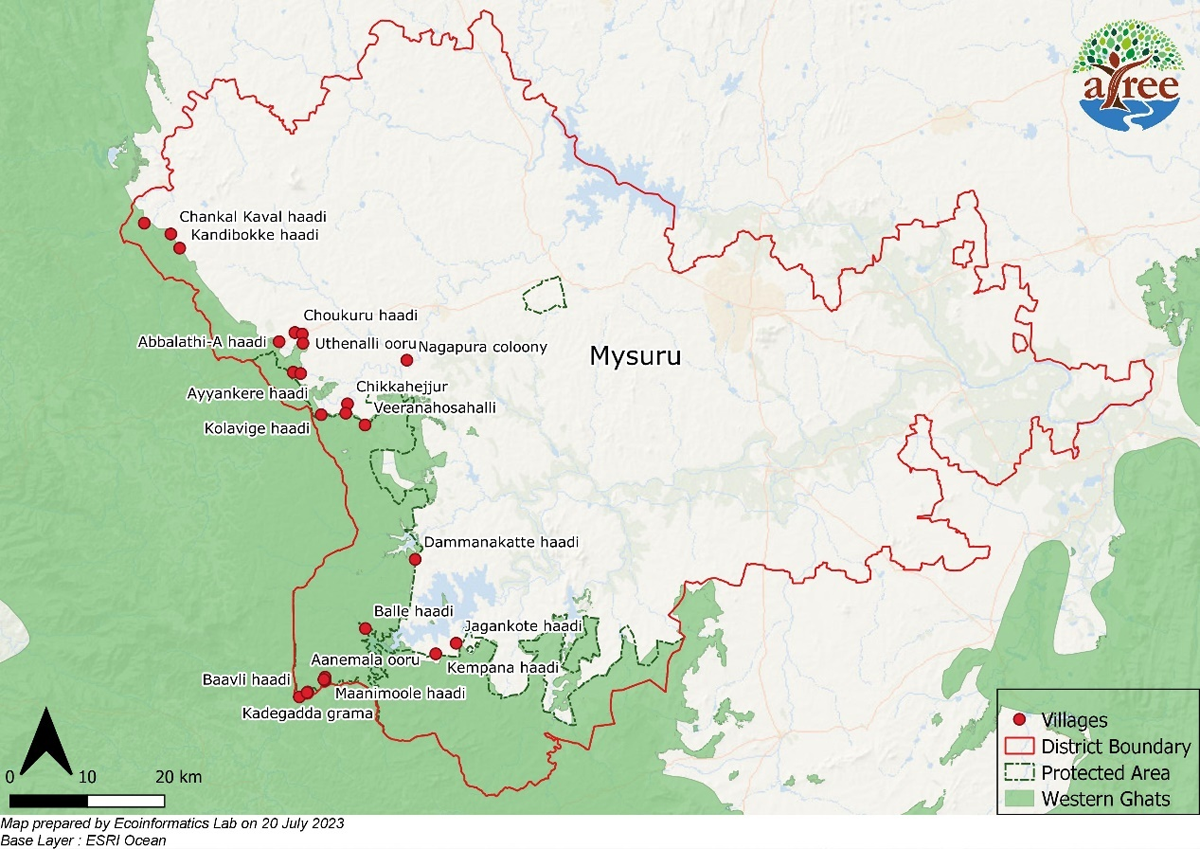
Figure 1
Map of Mysuru district showing study sites in and near Nagarhole National Park.
Additionally, minutes of 124 committee meetings (2008–2022), obtained from tribal department officials, were reviewed. Interviews and meeting records were translated from Kannada to English and arranged chronologically to reconstruct key events. Secondary data from NGO reports, published research, and news articles provided historical context. All materials were analyzed using critical discourse analysis to trace evolving narratives around relocation, conservation, and Adivasi rights.
5. The FRA and its Ambiguities
5.1 What does the FRA say on governance?
Section 3(1)(i) of the Forest Rights Act (FRA) recognizes the rights of traditional forest-dwelling communities to ‘protect, regenerate, conserve, or manage’ forests they have historically sustained. Section 5 further empowers these communities to safeguard forests, biodiversity, and ecologically sensitive areas through community forest management committees responsible for the sustainable governance of Community Forest Resource (CFR) areas. This model enables communities to use traditional ecological knowledge alongside scientific management practices (Tatpati and Ajit 2017), marking an expected shift in India’s forest governance toward participatory and livelihood-secure approaches (Desor 2013).
Section 4(2) stipulates that modification or resettlement of forest rights in protected areas is permissible only when state agencies conclusively demonstrate that coexistence between humans and wildlife is impossible. Even then, resettlement requires comprehensive rehabilitation measures ensuring alternative livelihoods. The FRA’s unusually detailed preamble outlines the history of dispossession and the Act’s corrective purpose—an uncommon feature in post-independence legislation. The law recognizes and legitimizes pre-existing customary rights (Wani 2012), acknowledging that earlier development and conservation interventions often caused forced displacement and insecure tenure. Gupta (2021) argues that wildlife conservation projects should therefore be understood as ‘development projects’ whose socio-ecological impacts must be evaluated like any other initiative involving significant landscape modification.
Section 2(a) defines ‘community forest resource’ as customary forestlands within a village’s traditional boundaries, encompassing reserved, protected, and unclassed forests, as well as sanctuaries and national parks. Even displaced villages may claim ancestral forests if residents demonstrate occupation as of 13 December 2005 or prove illegal eviction prior to that date (Wani 2012). Rule 13(2) specifies the admissible evidence for CFR claims, including NTFP collection zones, sacred groves, irrigation systems, burial grounds, and archival documents predating forest classification. Rule 6(b) mandates that sub-division level committees ensure Gram Sabhas receive necessary documents and maps; district-level committees must provide additional support to vulnerable tribal groups.
To process and recognize forest rights, the FRA establishes a four-tier institutional mechanism. Gram Sabhas hold primary authority and constitute Forest Rights Committees (FRCs) under Rule 3(1) to initiate, verify, and approve claims before forwarding them to the sub-division level committee (SDLC). State-level monitoring committees, headed by the chief secretary and comprising senior officials and Scheduled Tribe representatives, oversee compliance across each state. SDLCs, comprising revenue, forest, and tribal welfare officials and three panchayat members from forest-dwelling communities, examine and forward claims to district-level committees (DLCs), which have final approval authority. Tribal welfare officers serve as member-secretaries to both SDLCs and DLCs. State-level monitoring committees, headed by the chief secretary and comprising senior officials and Scheduled Tribe representatives, oversee compliance across each state.
5.2 Ambiguity leading to misinterpretations in the FRA
Under the FRA Rules, SDLCs—through tribal welfare officers—must conduct awareness programs on community rights, while forest officials are required to assist Gram Sabhas by providing all necessary information on traditional forest use. Rule 13 specifies the historical and administrative evidence admissible in supporting claims. The process begins with Gram Sabhas, whose FRCs conduct verification jointly with forest and revenue staff. Verified claims with boundary maps are approved by the Gram Sabha and forwarded to SDLCs and then DLCs, which finalize maps, issue titles, and ensure their incorporation into official records. Even though the Ministry of Tribal Affairs (MoTA) has issued numerous clarifications, bureaucrats across states repeatedly describe the FRA as ‘ambiguous.’ These ambiguities, they argue, have resulted in varied interpretations (Das 2019), and recurring conflicts within decision-making committees (Kutty and Menon 2025). Scholars similarly note that interpretational clarity has been effectively delegated to implementing agencies (Das 2019, p. 7), enabling what Sarin (2010) warns is the Forest Department’s ‘extraconstitutional’ interpretational freedom.
While our aim is not to list every ambiguity in the Act, we highlight selected examples to illustrate how unclear legal provisions enable divergent interpretations, and how officials leverage authority to reinforce their interpretations through sensegiving. In our study site, these ambiguities correspond to distinct sensemaking or sensegiving behaviors. For example, although the FRA clearly recognizes cultivation by forest-dwelling communities, it does not specify whether such cultivation must be claimed individually or collectively. Some officials insist on rigid readings and demand that claimants accept their interpretation of the Act—what we describe as suppressive sensegiving. Others acknowledge the procedural gap and adopt flexible, solution-oriented interpretations—improvisational sensemaking.
5.2.1 Ambiguities in definitions
Ambiguity surrounding the term forest has long plagued Indian forest governance. Neither the Indian Forest Act (1927) nor related laws define the term. Attempts have drawn on dictionary meanings, forest functions, legal judgements, or Forest Survey of India classifications (Vasudeva 2016). The FRA defines forestland broadly, but forests under the revenue department—though ecologically similar—are often excluded because they are not legally classified as forest land. Scholars differ on whether the FRA applies only to legally designated forest areas (Sarin 2010, p. 118), and forest and revenue departments frequently dispute ownership, a conflict that remains unresolved (see Sarin 2014, p. 102).
Ambiguity in the definition of village adds further complexity. Sections 2(g) and 2(p) outline several types of villages and Gram Sabhas eligible to form FRCs, but the Act does not specify how Gram Sabha composition should differ across these categories. Consequently, most states implement the FRA at the gram panchayat level rather than at the village or hamlet level (Das 2019, p. 7; Reddy et al. 2011; field observations). Since gram panchayats often span many villages, Gram Sabha meetings become difficult to convene, suffer from low attendance, and weaken the institution intended to be foundational to the FRA. Larger panchayats also struggle to account for local complexities and entrenched power imbalances (Kutty et al. 2019, pp. 452–453).
The term forest dependent is also inconsistently interpreted. Forest departments often exclude households with supplementary income sources, or those residing outside forest boundaries. Yet Adivasi livelihoods are multi-stranded: combining agriculture, plantation labor, seasonal forest work, and NTFP collection (Lélé and Rao 1996). MoTA (2015) clarifies that forest dwellers are entitled to a dignified standard of living, not merely subsistence. Nevertheless, interpretations vary widely—from rigid, algorithmic readings to flexible, improvisational ones—depending on how officials use systemic and episodic power. Forest officials often argue that tribals near protected areas neither live on nor depend upon forest land, while tribal welfare officials argue that NTFP collection, sacred site visits, and seasonal use patterns constitute legitimate dependence.
The FRA also confronts potential conflicts related to rights within protected areas through provisions for Critical Wildlife Habitats (CWHs). Since CWHs are unprecedented in Indian governance, the meaning of inviolate areas remains contested. Improvisational interpretations understand inviolate to mean areas where no irreversible ecological damage or actual threat to wildlife exists, permitting coexistence after necessary modification of rights (Lele et al. 2020, p. 5). Algorithmic interpretations, often used by forest departments, equate inviolate with complete human exclusion, frequently without empirical evidence of threat. Improvisational readings emphasize ‘no irreversible damage,’ while rigid readings focus solely on ‘no human presence.’
5.2.2 Ambiguities from conflicting laws
Colonial forest legislation presumed non-coexistence between people and wildlife (Mukherjee 2009), whereas the FRA explicitly acknowledges community roles in conservation. Reconciling these contradictory worldviews is difficult. Activities that are criminalized under the Indian Forest Act, 1927 (IFA), such as NTFP collection, are protected under the FRA (Kodiveri 2018, p. 27). As one official explained, implementation becomes ‘messy’ due to conflicting objectives across the IFA, WLPA, JFM, Forest Conservation Act, 1980 (FCA), and FRA and because Supreme Court rulings sometimes contradict MoTA guidelines.
5.2.3 Ambiguities in process
Even when legal provisions are clarified, India’s ecological and cultural diversity makes implementation complex. Ground-level situations often force officials to rely on selective cues, prompting provisional interpretations among other bureaucrats. An example is the recognition of cultivation rights. Section 3(1)(a) recognizes community or individual cultivation, but Form A, the claim form, only records individual claims, while Form B excludes Section 3(1)(a). This gap enables forest officials to assert that collective cultivation is not legally permitted (suppressive sensegiving), while tribal welfare officials argue that Form A may still be used to record community cultivation (improvisational sensemaking).
6. Findings and Discussion
Legal ambiguities create opportunities for varied forms of sensemaking and sensegiving, with outcomes shaped by the relative power of actors involved. Sensemaking largely reflects systemic power—structural authority, institutional position, and embedded bureaucratic norms—while sensegiving relies on episodic power exercised in specific interactions. All actors implement both processes, though with differing capacities and effects.
As discussed in Section 2, actors vary in the degree of conscious attention they devote to interpreting the law. Where bureaucrats rely on intuition, we classify this as automatic sensemaking; when they draw on well-established administrative narratives, it becomes algorithmic sensemaking. When they selectively use situational cues, we term it improvisational sensemaking, and when they deliberately consider alternative interpretations, we identify reflective sensemaking.
Sensegiving arises when actors attempt to shape others’ interpretations. Suppressive and authoritative sensegiving aims to reduce interpretive doubt. Authoritative sensegiving persuades recipients through narratives and discourse, while suppressive sensegiving relies on legal citations and precedents to foreclose alternatives. Inspirational and expansive sensegiving, in contrast, seek to increase interpretive breadth—either by encouraging recipients to question established approaches or by embracing novel ones. This section examines how the forest and tribal welfare departments—key interpretive actors under the FRA—deploy these categories of sensemaking and sensegiving, and how each responds to the other.
6.1 Sensemaking and sensegiving by the forest department
6.1.1 Refusal to recognize changed power equations
The FRA’s radical premise is that Gram Sabhas determine the nature and extent of forest rights. This challenges entrenched top-down administrative practices, which explains why forest bureaucrats continue to treat FRA implementation as a state-led process—an outcome of automatic and algorithmic sensemaking—evident in continued use of terms such as ‘granting rights.’
Despite the FRA clearly laying out a Gram Sabha–centered verification process, forest officers routinely attempt to reinsert themselves as primary authorities. For example, an Assistant Conservator of Forests directed that Form B claims be submitted first to jurisdictional forest officers before SDLC discussions (SDLC minutes, 10 Feb 2011). Such assertions go largely uncontested because other bureaucrats, conditioned by hierarchical administrative norms, accept top-down roles as natural. Even when individual officers adopt reflective sensemaking, systemic power inhibits translation into expansive sensegiving. A DCF acknowledged the reality of historical injustice but noted that acting on this understanding could invite departmental sanction: ‘Yes, I agree that historical injustice happened. If I go ahead and …. grant their rights, tomorrow they [higher forest officials] will suspend me’ (DCF, Mysuru, Mar 2021).
Thus, algorithmic sensemaking reinforced by departmental hierarchy prevents meaningfully reformist implementation.
6.1.2 Discourse of forest destruction
Fear of losing control over forests or concerns about alleged encroachment lead officials to view Gram Sabha claims with suspicion. Forest-destruction narratives, mobilized through episodic power, justify denial of community rights and are reinforced by the systemic power of departmental identity.
Officials frequently emphasize risks to wildlife or dwindling NTFPs to contest claims.
‘Evicted Adivasis have lost knowledge of practices to co-exist with; how can we ensure they maintain such ways and avoid harming wildlife again??’ (Deputy Conservator of Forest (DCF), Mysuru, Mar 2021).
The ACF told the committee that NTFPs have sharply declined and are now absent, and opposed granting community rights, citing summer fire risks, theft, and potential harm to local wildlife in the broader forest landscape (SDLC meeting, 10th Feb 2011, Hunsuru).
These claims, even when unsubstantiated, operate as authoritative sensegiving, shaping committee decisions.
6.1.3 Reliance on other laws
Forest officers regularly cite the WLPA to resist FRA implementation in core zones, despite Section 13 of the FRA giving it overriding validity. A DCF invoked WLPA provisions to question FRA applicability in Nagarhole, dismissing the tribal welfare department’s references to ministerial clarifications (DLC minutes, 24 Dec 2009). Such selective legal referencing constitutes suppressive sensegiving: using legal-bureaucratic authority to foreclose interpretive alternatives. Officials further argue that rights were already settled under earlier forest laws, implying that new claims are fraudulent. This narrative ignores the FRA’s own acknowledgement of historical failure to record rights.3
‘Reserve Forests are managed under Section 17, where rights were settled under the Karnataka Forest Act, 1963, a part of the Indian Forest Act, 1927. The forest settlement officer informs the local community about permitted activities. Once concessions are granted, they are for life. So, where is the question of claiming rights now?’ (DCF, Working Plan, Mysuru Mar 2021)
6.1.4 Discourse of tribal welfare
Forest officers also justify rejecting claims by appealing to tribal welfare concerns—an instance of improvisational sensemaking framed to align with contemporary rights discourse: ‘We are not denying Adivasis basic facilities like health, education, and housing. They seek rehabilitation, not a return to the forest, and we are providing that’ (ACF, Wildlife Division, Nagarhole, March 2021).
However, Adivasi communities consistently report harassment, crop destruction, and delays in rights recognition, contradicting the welfare narrative. Complaints from haadis (adivasi hamlets) prompted the SDLC to order joint surveys (SDLC minutes, 14 Jan 2015), demonstrating limits of forest officials’ episodic power in domains where they lack systemic authority.
6.1.5 Convoluting histories
Forest officials claim willingness to recognize rights of those residing inside the park but reject claims of evicted settlements, requiring evidence that communities often lack due to the department’s control over historical records. They assert that rights were settled during park notification in the 1970s and relocations in the 1990s, contradicting independent findings that evictions were improperly carried out (Bhasker n.d., as cited in Assadi 2006). They view forest dependence narrowly as economic, overlooking social, cultural, and affective bonds (Kutty, forthcoming). When confronted with the FRA’s intent to address historical injustice, officers distort historical facts: ‘During the monarchy, these game reserves belonged to the Maharaj of Mysore … hence the issue of people’s rights may not have been considered’ (DCF, Mysuru, Mar 2021).
Because the forest department controls most land-use records, its algorithmic sensemaking, i.e., prioritizing official documentation over collective memory, becomes authoritative sensegiving, influencing other state agencies. Officials also introduce new ‘rules’ such as requiring department-issued identity cards for NTFP collection or insisting on sale through LAMPS, none of which have legal basis in the FRA. These mechanisms help retain departmental control over community livelihoods, reflecting algorithmic sensemaking and authoritative sensegiving. These practices exploit procedural ambiguities in the post-recognition phase of FRA implementation. The FRA clearly empowers Gram Sabhas to manage community forests and determine NTFP sale processes; the forest department’s interventions exceed its legal mandate.
6.2 Sensemaking and sensegiving by the tribal welfare department
The tribal welfare department, originally created to promote tribal upliftment through schemes on employment, agriculture, health, and education, was never trained to address the fundamental cause of tribal marginalization—their alienation from forests (Basha 2017; Rupavath 2009; Rupavath 2019). A review by the Andhra Pradesh tribal welfare department in 1963 (Rao 1963), reveals an inability to grasp this core issue and a belief that ‘integration’ of tribals into mainstream society, rather than restoration of rights, as the solution. One of the radical shifts introduced by the FRA was its attempt to correct this, requiring tribal welfare officials to transition from a welfarist approach to an empowering, rights-based one (Kutty and Menon 2025).
Sensemaking within the tribal welfare department can be categorized as active or passive. Active sensemaking involves officials consciously developing new interpretations of the FRA and of their own institutional role, requiring significant shifts in departmental functioning. Passive sensemaking occurs when officials follow forest department interpretations due to structural disincentives, as described by Kutty and Menon (2025).
6.2.1 Active sensemaking
One example of active sensemaking is seen when ambiguity around the term ‘forest’ led the tribal welfare department of Karnataka to develop a provisional definition of forest land for FRA implementation. The Mysuru district-level committee minutes (24 December 2009) show officials deliberating on how to interpret various forest categories, such as classified, endangered, private, protected, reserve forests, and sanctuaries, thereby engaging reflectively with legal ambiguity. Similarly, confusion over Section 3(1)(e), concerning habitat and habitation rights of PVTGs, has prompted reflective interpretations. In the case of the Jenu Kurubas of Nagarhole, many were relocated to areas outside the Park that now constitute their habitation, while their customary ‘habitat’ falls inside the National Park. A district tribal welfare officer interpreted this to mean that the community may reside near forest fringes while continuing traditional honey collection inside the Park. This interpretation aligns with understandings of livelihood that include cultural and social repertoires (Hebinck and Bourdillon 2001), as Jenu Kurubas continue visiting ancestral sites within the Park for rituals and festivals.
Reflective sensemaking enables officials to counter authoritative sensegiving by the forest department. When such episodic power is exercised, it leads to expansive sensegiving, as seen in a sub-division level committee meeting (13 January 2012, Hunsur), where a taluk tribal welfare officer argued that refusing community rights violated Section 3(1)(a–m) of the FRA. Tribal welfare officials familiar with forest governance histories often adopt this reflective approach. One district officer explained that the FRA merely recognizes existing rights rather than distributing new land—an important clarification, since many government officials and Adivasis mistakenly assume it is a land distribution law (Interview, ex-DTWO, Mysuru, May 2022).
6.2.2 Passive sensemaking
Conversely, several officials interpret their role as purely procedural, limiting themselves to forming Forest Rights Committees (FRCs), collating claims, and forwarding them to the revenue department. Decisions, they believe, lie with the forest department: ‘We are only coordinators… verifying documents lies with the forest department’ (Taluk Social Welfare Officer, Hunsur, March 2021). Such passive sensemaking often results in the uncritical acceptance of forest department interpretations, or ‘automatic sensemaking,’ which maintains bureaucratic hierarchies.
6.3 Response to sensegiving by the forest department
The tribal welfare and revenue departments respond to forest department sensegiving in three ways: (1) by accepting it unquestioningly; (2) by rejecting it and independently interpreting ambiguities (reflective sensemaking); or (3) by adopting a compromise, selecting cues that allow them to balance power dynamics (improvisational sensemaking). Their failure to challenge dominant interpretations often reinforces existing power structures. For instance, officials rarely question how Adivasis, who were historically denied access to forests and forced into wage labor or settled agriculture, can now be disqualified for not being ‘forest dependent,’ even though the FRA was specifically enacted to remedy this injustice. As one official noted, evicted communities ‘have been converted to peasants and labourers’ (District tribal welfare officer, March 2021). Improvisational sensemaking is evident when committees adopt middle-ground positions. In a SDLC meeting, after the ACF claimed CFRs in Reserve Forests and National Parks were impossible, the committee allowed Gram Sabhas access to minor forest produce but ignored governance rights and let ACFs issue identity cards (SDLC meeting minutes, 2 April 2011, Hunsur). This concession accommodated both sides but upheld forest department authority, sidestepping the FRA’s mandate that Gram Sabhas govern community forests through their committees [Rule 4(e)].
Reflective sensemaking requires time, legal capacity, and contextual knowledge—resources often lacking within state bureaucracies. Short tenures and workload pressures further incentivize reliance on forest department interpretations. Without systemic power or adequate training, tribal welfare officials struggle with legal ambiguities and local histories, limiting the transformative potential of the FRA.
6.4 Response of civil society to sensegiving by the forest department
In contrast, civil society4 actors draw upon lived experience—as evictees, laborers, or rights advocates—to engage in reflective sensemaking. Their interpretations challenge bureaucratic sensegiving, foregrounding historical injustices. A tribal rights leader from Hunsur (Interview, March 2021) argued that Jenu Kurubas’ habitat rights include forest areas used for food, social, and cultural needs, and criticized their denial based on relocation or lack of cultivation—criteria misaligned with their actual forest-based livelihoods.
Community sensemaking can be automatic (connecting present interpretations with past experiences of injustice), or algorithmic (involving deliberate use of legal and historical knowledge) to counter forest department narratives. When officials argue that forest-fringe hamlets are ineligible for CFRs, community representatives present evidence of long-term NTFP collection and sales to LAMPS, engaging in counter-authoritative sensegiving (SDLC meeting, 16 December 2015, Hunsur). Civil society members also challenge bureaucratic failures, such as committees not providing legally required information to claimants. These interventions constitute inspirational sensegiving, indicating an exercise of episodic power to expose systemic shortcomings. During an SDLC meeting on 20 October 2014 (Hunsur), a tribal leader emphasized that FRA allows claims in national parks and reserve forests and demanded that FRCs receive necessary information before joint surveys.
After receiving CFR titles, communities continue to challenge forest department authority over management. By citing legal provisions such as Rule 4(e) of the FRA, they advance alternative interpretations of governance roles. For instance, the LAMPS president argued that FRCs should issue minor forest produce permits (SDLC meeting minutes, 17 February 2014, Hunsur), demonstrating reflective sensemaking that connects legal knowledge to future collective action.
6.5 Forest Department’s resistance to decentralization
Resistance by the environment and forest ministry to devolve power is evident in its attempts to define ownership over forest resources merely as ‘the right to net revenue’ rather than control (Sarin 2010). Sarin further documents how the MoEF successfully diluted JPC recommendations that would have made Gram Sabhas the final authority in forest governance. The department’s reluctance is reflected in its preparation of relocation plans for protected areas even before guidelines for declaring critical wildlife habitats were issued. Such resistance stems from a training culture that emphasizes control rather than participatory governance (Fleischman 2014; Hannam 2000). Community governance of tiger habitats may also threaten informal revenue streams within the department (Fleischman 2012).
6.6 Influence of episodic and systemic power
When interpretive disagreements arise, forest officials deploy delaying tactics, such as repeatedly seeking clarifications on the FRA’s applicability in protected areas despite multiple MoTA clarifications, to reinforce their systemic power. This systemic power also emboldens officials to demand documentary proof of past evictions from claimants, even though the law requires the state to assist Gram Sabhas in accessing relevant records. Given that most eviction records are held by the forest department, the burden of proof lies with them, not with displaced Adivasis. Yet officials rely on historical narratives asserting that all rights were settled when colonial administrations notified forests as state property, and contemporary narratives categorizing forest residents as encroachers. Even after CFR titles are issued, forest officials introduce new requirements, such as department-issued identity cards for forest access, to maintain administrative control, contradicting the FRA’s recognition of Gram Sabha authority.
Over time, as the implications of the FRA became clearer, the forest department intensified authoritative sensegiving to preserve decision-making power. Regan (1984) observed similar tendencies in personnel information policy implementation in the US and UK (Matland 1995). Forest officials narrow the law’s scope by arguing that evicted Adivasis are no longer forest-dependent and that granting rights in tiger reserves will increase conflict—positions that contradict MoTA guidelines, which affirm that forest dependence applies collectively and does not require exclusive forest-based livelihoods. Such authoritative sensegiving is enabled by systemic power rooted in organizational identity, training, and monopolistic access to information (Schildt, Mantere and Cornelissen 2020).
Weaker departments’ expansive sensegiving is countered by forest officials’ algorithmic sensemaking, shaped by institutional training that positions them as guardians of forests. As the FRA is widely perceived as a ‘forest’ issue, the forest department’s interpretations are granted epistemic authority, especially by revenue officials heading committees. In contrast, tribal welfare officials, lacking comparable systemic power, struggle to assert alternative interpretations. Addressing this imbalance requires structural strengthening of the tribal welfare department (Kutty and Menon 2025).
Sensegiving is more successful when backed by structural power. While the forest department’s narratives on forest governance are widely accepted, their attempts to speak on tribal welfare are rejected by tribal welfare officials and community representatives. Conflicts in interpretation are common in policy implementation due to legal ambiguities; however, it is the way actors make sense and give meaning, not ambiguity itself, that generates conflict (Matland 1995). When actors perceive threats to their authority, they restrict policy implementation to maintain control.
6.7 Piecemeal policy making
Conflicts in interpretation are common in policy implementation due to legal ambiguities; however, it is the way actors make sense and give meaning, not ambiguity itself, that generates conflict (Matland 1995). When actors perceive threats to their authority, they restrict policy implementation to maintain control.
Policy reforms that introduce radical laws without aligning supporting legislation create confusion and undermine implementation. New policies are filtered through old bureaucratic structures, yielding outcomes inconsistent with their transformative intent. The FRA’s preamble acknowledges historical injustice inflicted during forest reservation processes. Decision-makers, therefore, should assess historical injustice relative to when forests were first notified as state forests, not when they were later declared national parks. This requires reflective sensemaking, which current bureaucratic structures inhibit.
6.8 Perceptions of history/historical injustice
Forest officials rely on colonial notifications to claim that all rights were settled before forests were notified as state property. Yet these notifications largely ignored the rights of Adivasis, labelled ‘primitive jungle tribes,’ likely because colonial interests centered on timber extraction, while Adivasis relied on forests for subsistence. This historical oversight has not informed contemporary governance, enabling forest officials to assert that new claims constitute encroachment.
6.9 Significance of training in sensemaking
Correcting entrenched top-down implementation requires retraining. Institutionalized algorithmic sensemaking can be reshaped through revised training that incorporates historical contexts of forest governance and the intent of the FRA. Evidence of such transformation emerged in Chamarajanagara district, where a forest officer described how revamped FRA training shifted his understanding of Adivasi rights.
‘A training session shifted our antagonism as a faculty member clarified why forest dwellers deserve rights. “How could tribals present their interests to British officials?” he asked. “Even educated people struggle with legal language, so illiterate tribals stood no chance. The government is correcting this exclusion now, and you must grant every valid claim”’ (DCF, BRT Tiger Reserve, Chamarajanagara, April 2022).
Similarly, reconstituting Karnataka’s tribal welfare department in 2013, along with specialized training, empowered officials to assertively support Gram Sabhas and challenge misinformation. Earlier, being subsumed under the social welfare department diluted their mandate and continuity. Dedicated training has fostered stronger ownership of the FRA’s objectives (Taluk Tribal Welfare officer, Mar 2022).
Sensemaking occurs at individual, collective, and discursive levels (Brown, Colville and Pye 2015). Forest officers’ algorithmic sensemaking is reinforced through institutional training, mandates, and implicit sanctions, strengthening systemic power. Sensegiving follows, shaping the interpretations of weaker actors. For collaborative governance to succeed, all departments must share a common understanding of the FRA, supported by standardized training.
Edelman (2020) shows that legal ambiguity enables actors to construct meanings aligned with institutional interests, paralleling how sensegiving shapes law implementation. Because policy implementation has the potential to reconstruct the policy itself (Kgwete 2021), sensemaking within institutions may either enhance or undermine policy intentions.
7. Conclusion
This study examined contested pasts, ambiguous presents, and uncertain futures to address how power operates within multi-department settings implementing a radical policy. Adivasis challenge dominant narratives of forest dependence and residence as they assert citizenship rights. For the forest department—long the monopoly holder in forest governance—reluctance to share decision-making power shapes these narratives. The tribal welfare department, a comparatively new actor, occasionally contests the forest department’s interpretations of the law. These ‘occasions’ reflect limited knowledge of local and legal histories, while the interpretive conflicts stem from legal ambiguities.
The study’s central aim was to analyze how departments and their actors wield or resist power through sensemaking and sensegiving in an ambiguous policy context. We find that episodic power, expressed through sensegiving, is more effective when backed by systemic power. Implementing radical policies requires reflective sensemaking and expansive sensegiving by actors supported by systemic power. This becomes feasible when structural power inequalities in multi-department bodies are addressed and when all relevant departments receive uniform, regular training that incorporates local forest governance histories. While legal ambiguities allow multiple forms of sensemaking, piecemeal policymaking undermines radical governance reforms. Our findings echo existing scholarship on the FRA by underscoring the urgent need for systematic training of officials, whose bureaucratic culture favors algorithmic sensemaking because it requires less time and energy. Algorithmic sensemaking also compensates for weaknesses in episodic power, reinforcing systemic authority. Uniform training reduces ambiguities and multiple interpretations, helping level power disparities by ensuring equal access to governance histories.
These insights highlight the need for policymakers to consider interconnected laws when reforming governance and to address structural disparities among implementing departments. Incorporating local histories in training can reduce such disparities, as information and institutional identity shape systemic power. Our findings contribute to debates on environmental justice, legal pluralism, and the governance of complex social-ecological systems. The study faced constraints, including limited participation from key forest officials, restricted archival access, and the inability to observe informal bureaucratic interactions. Future research could examine the influence of political actors and interest groups on reform outcomes. In conclusion, environmental conflicts are conceptual struggles over land, resources, and governance. Understanding the politics of sensemaking and sensegiving is essential for revealing diverse environmental perspectives and challenging dominant narratives.
Notes
[4] A category of sub-groups among India’s Scheduled Tribes who are identified as the most disadvantaged due to extreme socio-economic backwardness, isolation, and fragile livelihoods.
Ethics and Consent
This research was conducted as part of RK’s doctoral thesis for which she received a research ethics approval by the Institutional Review Board of ATREE under certificate number IRB/ACA/0002/RK/06/2018 dated 19th June 2018.
Acknowledgements
We sincerely appreciate those bureaucrats in Bengaluru (Bangalore) city and in the districts of Mysuru (Mysore) and Chamarajanagara who agreed to be interviewed, for their cooperation, time, support, and patience for being part of this study. Many thanks to Aparna Chintamani and Hema Prasanna, Harisha R.P., Nagaraja Shetty, Nataraja Viswanath, Arogya Mary, Govind Vardhan, Nakul Heble and Manu Krishnamurthy for their hard work in translating the documents. We thank Ganesh Shinde from Ecoinformatics Lab, ATREE, for preparing the study site map. Finally, we are grateful to the two anonymous reviewers and the editors of this journal whose feedback substantially improved this paper. Some of their specific comments were incorporated.
Competing Interests
The authors have no competing interests to declare.
Author Contributions
RK conceived and designed the research with guidance from SS; RK collected and analyzed the data and led the writing of the manuscript; SS gave inputs to the manuscript and reviewed it. Both authors contributed critical, intellectual content to the research and gave final approval of the version to be published.