
Introduction
‘We used to go to the hills while the Sudras1 of our village cultivated’ (Eedamma, an Adivasi-Chenchu2 woman of Sarlapally, aged approximately 70, describing the livelihoods of their village people).
‘We wished for land. Nothing else’ (Sailu, a Dalit Scheduled Caste3 farmer of Vatvarlapally, aged approximately 70, came with his father as a young boy and settled in the forest village).
‘Those days, I have married off 7–8 Chenchus. Their mothers, my sisters who were widowed, used to work in my fields and feed on the provisions that I provided and raise their kids. Now, they have all passed away. Were they there, they would say to their sons, “My brother had fed us; if he had not been there, we would not have survived. How would you have gotten married? How would you get wives?” Now, everything has changed’ (Gopiaha, a backward caste4 Golla farmer of Sarlapally, aged approximately 80, settled in Sarlapally village by selling his goat herd, expressing unease regarding the changing relations between castes and tribes in the village).
The above vignettes are from the mixed-caste core area5 villages of Amrabad Tiger Reserve (ATR),6 situated in the Nallamala hill ranges of the Eastern Ghats in Telangana, India, where Adivasi-Chenchus, the ‘native’ tribes7 of the region, live alongside ‘outsiders’,8 a mix of different settler castes, including Forward (OC), Backward (BC), and Scheduled Castes (SCs) and Scheduled Tribes (STs). This contrasts with the popularly depicted image of Nallamala as the abode of the foraging tribe, the Chenchus, who live in isolation and subsist on forest resources. Vast swathes of cotton and corn fields fenced with used sarees stand testimony to the prominence of agricultural livelihoods in the region and the transformation of its once-foraging economy.
The State employs popular narratives in its development planning for the once-isolated and exclusive Chenchu hamlets that have transformed into mixed-caste agrarian villages with intricate societal and economic interdependencies among different communities. For instance, narratives like ‘Chenchus are primarily subsistence-oriented, food gathering and hunting community’ (field interview with the Forest Range Officer of the Forest Department (FD) 2017) and ‘Chenchus historically had no interactions with the outside world and outsiders exploit the naïve Chenchus and take away their livelihoods’ (field interviews with the officer of Integrated Tribal Development Agency (ITDA)9 2017, 2018) are most commonly employed in State’s planning for Chenchu upliftment and in other terms of engagement with the Chenchus. The adherence to this ideology of geographical isolation, shyness of contact with outsiders and the need to regulate the interactions of STs with others is evident in the criteria employed in categorising a community as ST and in the creation of Scheduled V areas with special governance measures to safeguard the interests of STs (Xaxa 2008). The state and media employ and rely on standard and populist portrayals of the Chenchus. Many news articles romanticise their existence by relying on and perpetuating their existing essentialist portrayals. News coverage with titles like ‘navyata erugani vana jeevanam’ (forest living that does not know modernity) (Namaste Telangana 9 August 2017) and ‘adavullo vuntunna amaayakulu ayina chenchulu’ (naïve Chenchus who are living in the forest) (Sakshi 23 February 2017) are indicative of essentialist deployments by the media.
Most Chenchu hamlets, except for ten hamlets,10 have transformed into mixed-caste agrarian villages, altering the livelihood dependencies of communities residing in the reserve. However, the continued existence of essentialist portrayals and their active deployment by various actors poses a curious yet relevant question regarding the factual and historical correctness of those essentialisms. Further, the context of conservation governance imposing community-targeted, selective, yet restrictive measures on cultivation and planning to relocate select groups of people (non-tribal outsiders) seeking support from the governance measures that institutionalised essentialisms11 raises questions regarding the politics and purposes of essentialisms and their deployments. This study focuses on ATR in Telangana State, South India, to address these questions. In answering these questions, we (a) explore the social history of the region to understand and illustrate the disjuncture between the existing narratives regarding the Chenchus, their livelihoods, outsiders and the Nallamala forests from the historical realities and (b) demonstrate the consequences of essentialisms and their deployment pertaining to conservation governance by examining the Scheduled Tribes and Other Traditional Forest Dwellers (Recognition of Forest Rights) Act, 2006, also known as the Forest Rights Act (FRA), its implementation and outcomes.
Two streams of literature on agrarian frontiers in forested hills and studies that problematised the deployment of and reliance on essentialisms regarding indigenous people in the governance measures (Baviskar 1997; Baviskar 1999; Baviskar 2013; Corbridge 1998; Walker 2004; Walker 2001; Li 2002; Moore 2005; Shah 2007; Anthias and Sarah 2015; Guha 2016) are drawn upon to understand the links between frontier dynamics, essentialisms, and conservation governance. ‘Agricultural frontier’, a concept developed by Münster (2017), helps understand the multiple ways of migration and settlement in the forested landscape and the agricultural transformation that ensued. ‘Ethno-environmental fix’, a concept developed by Anthias and Sarah (2015) to analyse the institutionalising of the global support for indigenous land rights in the context of neoliberal economic reforms, is drawn upon to understand the politics of conservation governance’s reliance on interventions that are built on de-historicised and essentialist portrayals. Menon and Karthik (2019) theorised the FRA, a landmark piece of legislation constituted to recognise the rights of the forest-dwelling communities, as an ethno-environmental fix; their study is instructive in analysing the outcomes of interactions between institutionalised essentialisms and conservation governance. This study argues that long-standing essentialist portrayals of Chenchus and their interactions with outsiders are ahistorical. It demonstrates how the protection regime12 actively relies on an ethno-environmental fix that was partly assembled on the grounds of de-historicised and essentialised portrayals of indigenous communities and their realities. This study contends that discounting the agricultural transformation in the region, ignoring outsiders and their multiple histories of arrival and settlement, imposing selective restrictions on different groups of people and planning for creating people-less Protected Areas (PA) by the protection regime becomes a possibility by relying and working on the limitations of an ethno-environmental fix.
The rest of this paper is organised as follows. Section 1 presents the literature drawn to analyse the socio-economic transformations in the forested hills through the migration and settlement of outsiders seeking agrarian livelihoods as well as the role of and reliance on institutions built (partly) on essentialisms in the context of environmental governance. Section 2 presents the region’s social history and popular portrayals of Chenchus and outsiders and discusses the disjuncture between the essentialised portrayals and historical realities. Section 3 demonstrates and discusses the reliance of the protection regime on the essentialised portrayals by analysing its reliance on FRA, and Section 4 concludes the study.
Forested Hills and the Agrarian Transformation
Only a few studies critically and comparatively discussed the changing economy and polity in forested hills, focusing on the changing histories and identities of forest dwellers or indigenous people, especially with the changing livelihoods and dependence on natural resources, markets, and the State (Baviskar 1999; Li 2005; Guha 2016; Budhaditya 2016; Shah et al. 2017). Fewer studies explored the agrarian transformations in the forested hills (Agrawal and Sivaramakrishnan 2000; Krishnan 2009; Varghese 2009; Li 2014b; Münster 2017; Oommen 2019). Some examined the interactions between forest-dwelling tribes and agriculturalists, or lowlanders, and some with migrants who have settled in their landscapes (Li 2014b; Li 2005; Benbabaali 2016; Thirumali 2006; Budhaditya 2016). Few studies examined the migration and settlement of outsiders in the forested hills, focusing on the histories and different motivations of migration and agrarian transformation that ensued (Münster 2017; Krishnan 2009; Li 2014b; Varghese 2009; Oommen 2019). These studies are instructive in understanding and analysing the reasons and processes of transformation and the kind of relations that emerged between different communities in the forested hills of ATR.
Münster (2017, p. 99), studying the agroecological transformations in Wayanad, Kerala, theorised migration and the settlement of migrants as an agricultural frontier; a ‘temporal-spatial-ecological conjuncture in which imaginaries and utopias of available lands, new beginnings, and hopes of amassing a fortune fuel dynamics of land grabs, crop booms, and eventually, busts’. Employing Münster’s conceptualisation of the agrarian frontier, this study analysed the historical exchanges between native tribes and outsiders and the migration and settlement of outsiders.
Essentialisms and Governance
Critical studies have interrogated and demonstrated the centrality of assumptions and essentialisms regarding indigenous people in shaping governance measures for their welfare and upliftment as well as the limits of such interventions in achieving the set goals (Baviskar 1999; Walker 2001; Walker 2004; Li 2002; Li 2010). Two such interventions are (1) creating indigenous territories as bounded spaces of ethnic differences and (2) tribal development planning based on a culturally defined and claimed tribal identity, which manifests as measures of positive discrimination to select communities, differentiating the citizenship. Such interventions based on essentialisms are common across the world. Governance built on the essentialised notions of indigenous people was studied as a ‘fix’ to the various mandates of the state (Corbridge 1998; Moore 2005; Li 2010).
Studies on ‘neoliberal natures’ (Castree 2008; Bakker 2010) questioned the deployment of essentialisms in the context of conservation governance by locating these actions in governmental ‘countermovements’—a concept developed by Polanyi (2001) to refer to protective measures against destruction by the market. Anthias and Sarah (2015) draw upon countermovements to argue that issuing collective land rights to indigenous communities is an ‘ethno-environmental fix’ by the neoliberal governance regime. They define ethno-environmental fix not as a rigid set of policy interventions to govern but as a term that ‘refers to the emergence, alongside neoliberal economic reform, of a spectrum of governance approaches that sought to synergise protection of vulnerable populations and highly-valued natures from the destructive effects of markets’ (Anthias and Sarah 2015, p. 1). They further argue that the ethno-environmental fix is not a real solution to any of the concerns that it is supposed to address yet seeks to gain legitimacy for the neoliberal model of development while also producing spaces for radical demands or other such articulations, depending on regional contexts. We draw upon these studies that problematise governance’s reliance on essentialist portrayals to analyse and understand the purpose and consequences of such a reliance in a PA.
The Study: Methods And Field
ATR is a part of the Nagarjuna Sagar Srisailam Tiger Reserve, India’s earliest and largest tiger reserve, established in 1983. After the separation of the Southern states of Andhra Pradesh and Telangana in India, the reserve in the Telangana region was named ATR. ATR is the second-largest tiger reserve in the country in terms of its core area. It is located on the Amrabad Plateau of the Nallamala Eastern Ghats hill range at the confluence of the Krishna River and Eastern Ghats (Figure 1). The highest ranges of the plateau reach ‘heights of more than 2800 feet and extend for about 18 miles over rolling hills and then drop steeply to the level of river Krishna, about 600 feet above the sea’ (Fürer-Haimendorf 1943, p. 9). The Amrabad Plateau falls into two distinct elevation zones: an upper plateau at higher elevations (above 700 ft) and a lower plateau at the foothills, sloping towards the Krishna River.
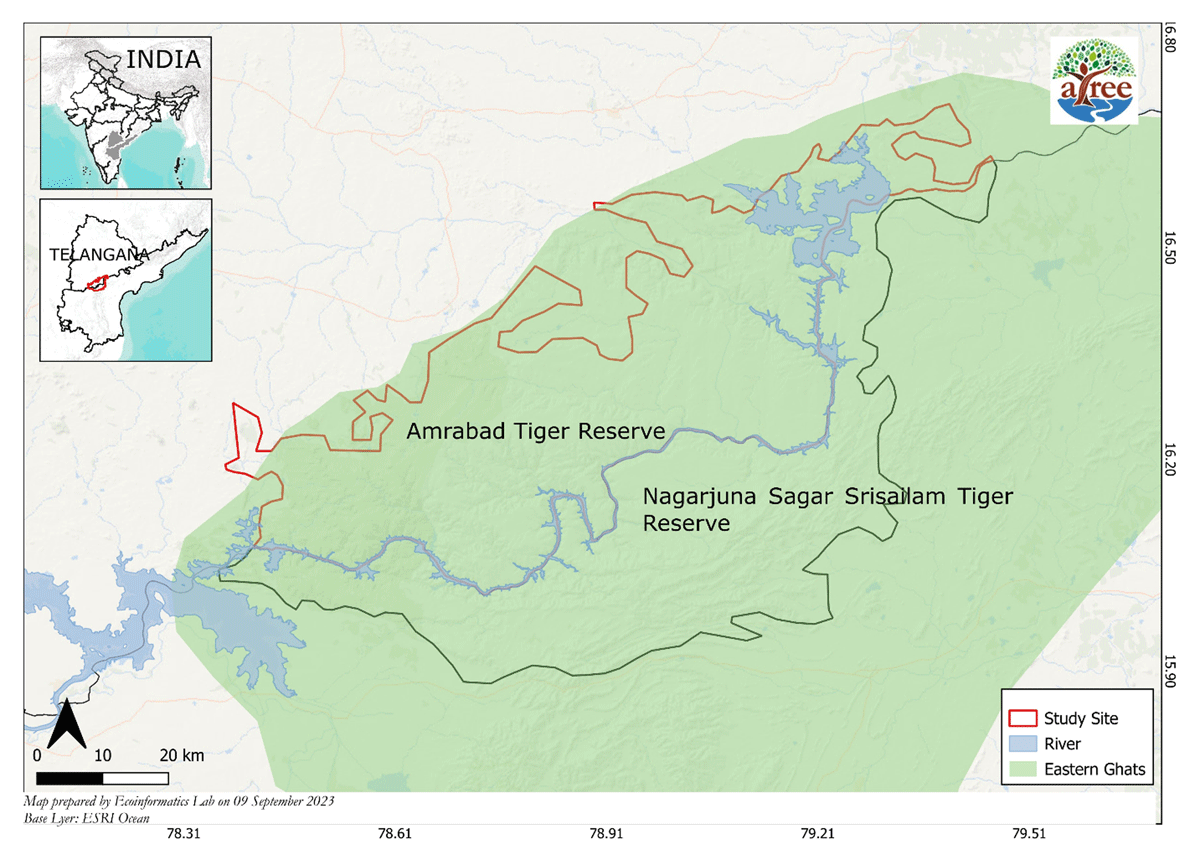
Figure 1
Amrabad and Nagarjuna Sagar Srisailam Tiger Reserves in the Eastern Ghats.
Source: Ecoinformatics Lab, ATREE.
The study was conducted in two mixed-caste core area villages on the upper plateau, Vatvarlapalle and Sarlapally, located at an elevation of approximately 800 m (Figure 2). Vatvarlapalle is a major centre of economic and political activity, while Sarlapally serves as a satellite village, relying on Vatvarlapalle for its basic needs, such as health, education and markets.
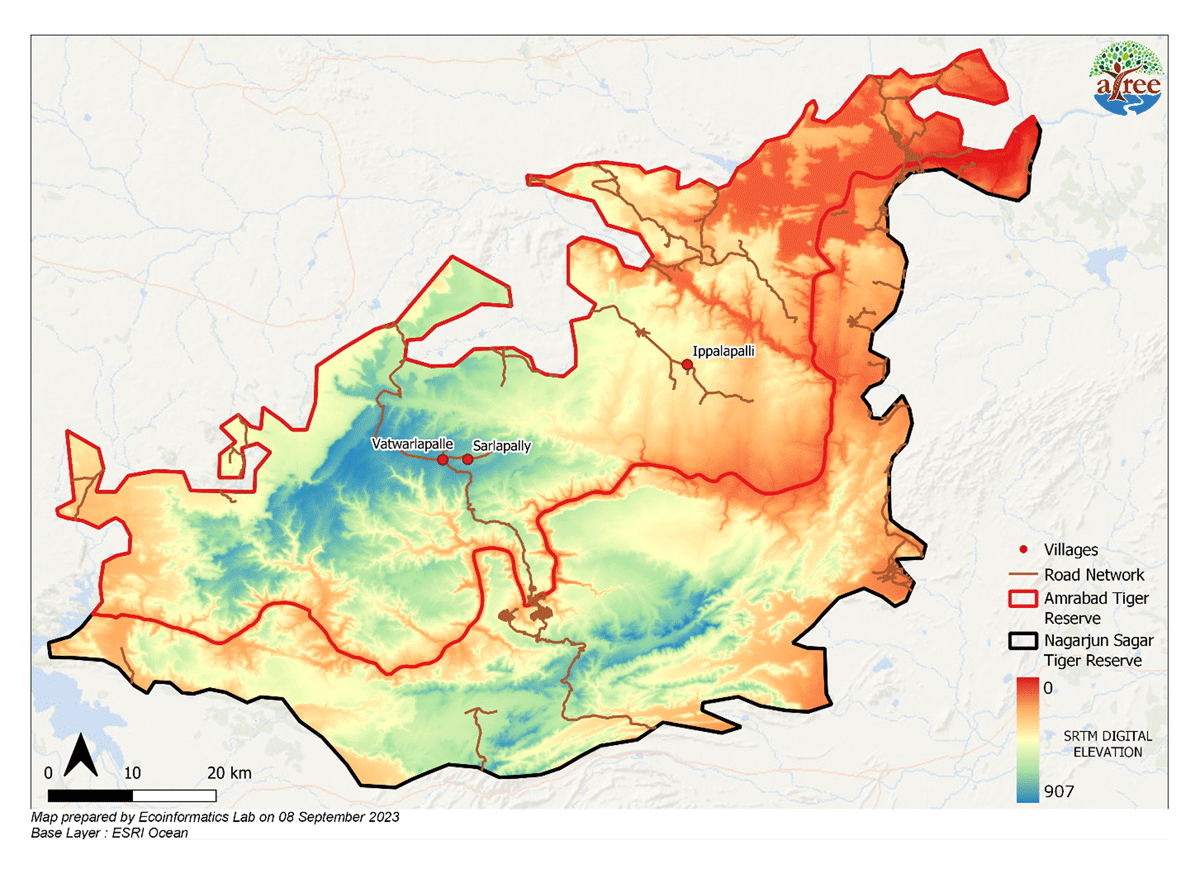
Figure 2
Study villages and elevation map of the Amrabad and Nagarjuna Sagar Srisailam Tiger Reserves in the Eastern Ghats.
Source: Ecoinformatics Lab, ATREE.
The Indian Constitution has designated areas with high tribal populations as Schedule V areas to safeguard the interests of Scheduled Tribes (ST) through special governance mechanisms. Vatvarlapalle and Sarlapally, along with other hamlets and villages of the upper plateau, are such scheduled villages. However, the land relations in these villages are mainly shaped by the socio-economically lower castes who have migrated from the region: Backwards Castes (BC), Scheduled Castes (SC), and STs. The Lambadas, initially classified as a BC caste and later as STs in 1976, also settled in Vatvarlapally. Since 1976, Lambadas, the numerically largest tribal group that constitutes approximately 64% of the total tribal population of Telangana (which consists of thirty-two different tribal groups, Hanumantha Rao, 2014), and the native Chenchus have come together under the same administrative category (ST). Chenchus are sub-classified under the ST category as Particularly Vulnerable Tribal Groups (PVTGs), highlighting their vulnerability and development disparities compared to other STs. BC-Golla, a community traditionally associated with rearing cattle, and Vadderas, with masonry, are the large caste groups in both villages. Other BCs,13 like Padmashali, Mudiraju, Rajaka, Kuruma, Kummari, and Jangama, and SCs belonging to the Mala and Madiga subgroups have settled in the region. All the outsider castes have settled in the study villages by clearing forests and cultivating those lands.
Apart from the Chenchus, the rest of the communities were considered locally and administratively as ‘outsiders’ until the Lambadas were categorised as STs. With Lambadas becoming STs and them actively making it their identity marker, only non-tribals14 belonging to OC, BC and SC castes were called ‘outsiders’.
The FRA is a rights-based legislation enacted to recognise the rights of forest-dwelling communities—their rights to live and cultivate in forestlands and use community resources for subsistence livelihoods. This legislation was implemented for the first time in the villages and hamlets of ATR between 2010 and 2011 and has conferred Individual Forest Rights (IFR) titles to the STs only (Chenchus of Sarlapally and Lambadas in Vatvarlapally). This intervention, by legitimising the lands of STs and excluding those of non-tribals, has further entrenched the grouping of all non-tribals as outsiders. However, the Chenchus and non-tribals contest Lambada’s positioning and identity claims of being STs and consistently refer to them as outsiders. Chenchus claim Adivasi (indigenous) identity to distinguish them from the other ST community (Lambadas).
The population and household estimates of the two villages are as follows: Vatvarlapalle has 371 households (Chenchus, 5%; Lambadas, 25%; non-tribals, 70% [SC, 58%; BC, 33%; OC & Minorities, 9%]) and Sarlapally has 150 households (Chenchus, 43%; non-tribals, 56% [SC, 13%; BC, 87%]) (Local Census 2017).
This study is primarily based on narrative analyses, oral histories, focus group discussions (FGDs), and semi-structured interviews. Oral histories were collected from two core area villages between 2017 and 2018. Oral histories that highlight individual experiences and life courses in understanding the social history of the region (Peša 2020) are relevant to this study, as these are unavailable in the archives and could help construct an inclusive history of the heterogeneous groups of people who are often ignored in standard anthropological studies of colonial and post-colonial histories. We used oral histories to reconstruct the lives of migrants from different castes and tribes and extract life stories. The open-ended questions of the method generate data on the economic conditions of migrants in their native villages and their struggles in the new landscapes. Twelve detailed oral histories were recorded with residents aged approximately 70 years, who were either part of the migrated families or had experienced firsthand outsiders migrating to and settling in the hamlets. Additionally, thirty-five semi-structured interviews were conducted with villagers and forest and tribal welfare officials. Three FGDs with non-tribal outsiders were conducted in both villages regarding village relocation. Semi-structured interviews and FGDs were used to collect contemporary information regarding livelihood restrictions and relocation efforts.
The respondents for oral histories, interviews and FGDs were selected using targeted snowball sampling techniques. All interviews were conducted in Telugu, the local language, and then recorded, transcribed and analysed using qualitative coding. Telugu is the first author’s mother tongue, and it helped overcome any language constraints. We have ensured representation from all broader caste groups in the villages: the Adivasi-Chenchus, Lambadas, Dalits, Muslims, BC, and OC communities, along with representation from the forest and tribal welfare departments. Participants were informed of the study and its objectives, and verbal consent was obtained before conducting and recording the interviews. During FGDs, villagers insisted that the names of their villages and castes be made public. The names of the villages and castes of the respondents are represented as they are, but the respondents’ identities are anonymised.
Additionally, we drew on secondary literature sources, including anthropological works, reports of British officials and the Nizam15 administration, along with books, monographs, and articles in academic journals. The work of Austrian ethnologist Fürer-Haimendorf (1943; 1982) on the Chenchus of the Amrabad Plateau from the time before India’s independence, spanning over approximately 50 years (1930–1980), serves as a primary source of secondary data for this research.
A vernacular newspaper with high circulation, Sakshi, has a special edition to cover the news and issues of the Amrabad Mandal,16 under which the upper Amrabad Plateau and the core areas of ATR are located; we followed it for a year between 2017 and 2018 to collect narratives on Chenchus, their issues, and their interactions with other caste groups.
Chenchus, Outsiders and Interactions – A Social History
Outsiders belonging to different ‘service castes’—historically associated with specific roles in village society and considered lower in the hierarchical caste system—arrived and settled in the Chenchu landscape at various times. From Chenchus’ historic, seasonal and fleeting interactions with outsiders to outsiders calling it their home, the story has continuity and a play of different dynamics. Below, we present the social history of exchanges, drivers of migration and settlement of outsiders, evolved livelihoods and socioeconomic transformations shaped by outsiders’ settlement.
Historical Context of Exchanges and Outsider Migration to Forest Villages -Between the late 18th century and the early 20th century
a) Historic exchanges of Chenchus before the actual migration and settlement of outsiders: The Chenchus of the Amrabad region were exposed to invasions by kingdoms dating back to the later decades of the 18th century, not as receivers of war-related atrocities but as beneficiaries because of the stationing of large soldier outposts. For instance, tanks and wells were dug up in the region to meet the soldiers’ water requirements. Fürer-Haimendorf (1943) referred to such moves as ‘occupation by the plains people’. Thurston (1909) documented a barter system among the Chenchus and their interactions with merchants from outside dating back to the late 19th and early 20th centuries (Thurston 1909). Fürer-Haimendorf (1943) observed that although the Chenchus of the Amrabad Plateau were hunters and food gatherers with minimal grain requirements, they had barter trade arrangements for generations to meet grain requirements and procure necessary tools, such as knives, axes, and arrows. He documented the Chenchus’ monetary transactions and their increased dependence on the cash economy by the 1940s, when FD entirely administered the plateau.
Activities such as cattle rearing, allowing graziers from the plains to graze their cattle near their habitations, renting bulls, collecting and selling minor forest produce at the Government Depots, working as guides to the pilgrims who walk through the forest to reach the Srisailam temple located across the Krishna river in the State of Andhra, working in the FDs nurseries, and their coupe cutting and forest protection activities are listed by Fürer-Haimendorf (1943), Raghaviah (1969), and Thurston (1909) as activities that helped Chenchus earn significant cash wages to the extent that they no longer gathered wild plants and forest produce for consumption except for sale. With increased cash-based transactions, demand for foreign goods such as cloth, grains, and tools rose so much that the Chenchus of the plateau also began to fall into debt. Thurston (1909) reported that administrators considered the debts incurred by the Chenchus to be the major reason for the exploitation of forest resources, especially timber. Providing monetary advances to liquidate their debt was a measure considered by colonial administrators to prevent logging. Thus, by the time India became independent from colonial rule and even before the outsiders had migrated and settled in their landscape, the Chenchus were exposed to the monetary economy and had developed interactions with and dependencies on the market.
b) Feudal Telangana and Radical Activism - Early decades of the 20th century: Dora, or landlord, and his ‘Gadi’, or fort-based administration, were characteristic of Nizam’s rule in Telangana during the early to mid-decades of the 20th century. Dora’s Gadi symbolises slavery, oppression and cruelty. Every other caste in the village had to offer goods and services to Dora without compensation. Landless SCs were tied lifelong to landlords’ fields and houses as enslaved people (Prasad 2015). Even the landed forward castes of Telangana were eager to escape the feudal lords’ authority, especially those from dry lands and rain shadow areas, where the feudal action impact was harsher (Sundarayya and Chattopadhyaya 1972; Benbabaali 2016). Feudal exactions, especially vetti,17 a type of bonded labour, were characteristic of this region (Balagopal 1983). Land grabs under multiple rules, such as non-payment of taxes, refusal to offer services such as vetti, and non-payment of fines imposed by the landlord for an alleged misdemeanour, triggered the armed peasant revolt in the 1940s. During this period, peasants, under the leadership of communists (with the slogan ‘land to the tiller’), took up the mass struggle against the oppressive rule of Dora and Nizam (Sundarayya and Chattopadhyaya 1972). Fighting on the ground were the Nizam’s police, Razakars,18 the army of the Indian Union, and the armed peasants, each for a different purpose. Peasants continued their fight against feudal rule even after the Indian Army took over Hyderabad in 1948, defeating the Nizam and his private army. Thus, the 1940s were a turbulent period for Telangana.
Villages around Amrabad were terrorised by Razakars and later, with the communists and Indian army coming into the villages. Peddiaha, a Dalit farmer one of the initial settlers of Vatvarlapalle, narrates an incident when a communist leader caught him enquiring about the Dora of his native village and if the ‘Chowkidar’19 was harassing people. A day after his encounter with the leader, the Chowkidar was shot dead by communists who sang songs glorifying the killing of the landlords. The following days were hellish for the entire village, claims my respondent, because the government and police officials used to visit the village, often saying, ‘You killed our sir; we will avenge’.
Although the peasant movement subsided and armed guerrillas retreated in the early 1950s, Telangana remained a hotspot for radical reformist thought and action. Naxals20 emerged after the Naxalbari and Srikakulam movements21 of the mid-to-late 1960s, with their presence in the villages (under different labels and belonging to different ideological groups) until the early 2000s (Jakobsen 2016; Ravikanti 1995). Their overbearing presence in the Nallamala landscape prevented FD officials or the local police from entering freely and exercising their authority (interviews in Vatvarlapally 2017). From the tumultuous 1940s until the early 2000s, poor farmers, especially those from the BC and SC castes (who were landless or rendered landless), began prospecting for land on the hills. The outsiders belonging to the BC and SC communities fled from the oppressive rule in their native villages, mainly hoping to claim and own land in the ATR landscape under the protection of radicals, who were lenient towards the landless people’s actions to own land.
c) Feudal-caste villages - Early to late-20th century: While landlords sitting in judgements and imposing fines on the alleged transgressions of villagers are characteristic features of feudal Telangana, this practice of exercising oppressive domination continued into the post-feudal period through caste networks. Forward-caste farmers seeking to escape exploitation by the landlords emulated similar relationships in new settings where there were no landlords. For instance, the arrival and settlement of forward-caste farmers in Ippalapalle, a former Chenchu hamlet located in the core area of the plains of the Amrabad Plateau, forced the Chenchus of the hamlet to migrate to other forest villages to avoid the exploitative practices of forward-caste farmers. Anjaiah, a Chenchu oral history respondent who had to escape from Ippalapalle and settle in Vatvarlapalle, said that even a simple change in their attire, like wearing a white shirt or bordered dhoti, a dress worn generally by people belonging to a higher social status in the village, would immediately draw the attention and ire of Patwari Patel.22 A worker would come to take the Chenchus to the Patwari, who would punish them for their wrongdoing, saying, ‘Why can’t you see? Have you become a landlord and started wearing a bordered dhoti?’ ‘When will the Reddys (a forward caste community to which the Patwari Patels of this region largely belong) let us be?’ questions the Chenchu farmer.
Surprisingly, even the Chenchus practiced ‘untouchability’.23 The Chenchu respondent, who was subject to forward-caste wrath, said, ‘We never let a Mala (a person belonging to the SC sub-sect) stand before our house; even if he comes, we sprinkle water after he leaves. We pour water from a distance if we have to give them water’. Untouchability, combined with other means of economic exploitation, like bonded labour, historically remained the burden of SCs living in agricultural villages. The Chenchus of the plains and SCs from nearby villages wanted to flee from the economic exploitation and violent enforcement of social order, which was the setting of villages at large. Though Chenchus of mixed-caste agrarian villages also started to show some signs of mainland villages’ caste order, especially towards SCs, it remained a superficial and symbolic act which did not impede the SCs’ desire to make land in the Chenchu hamlets. The SCs intended to counter untouchability and economic exploitation in their native villages by clearing forests and owning land in the upper plateau villages of Vatvarlapalle and Sarlapally, which had available land and a limited forward caste presence.
Drivers and pathways of migration to upper plateau villages of Vatvarlapalle and Sarlapally (1940s to the early 2000s)
The colonial and post-colonial States designed administrative schemes to develop the Chenchus and their agriculture. A ‘Social Service Department’ established in 1946 by the Nizam government to implement tribal-centric policies brought and settled 18 SC Mala families to teach Chenchus agriculture24 (Fürer-Haimendorf 1982). The Chenchus and Malas were allotted land and draught animals and allowed to make the otherwise forest lands laden with trees, bushes, and rocks into cultivable lands. This activity was called ‘bhoomulu kottukotam’, meaning felling trees and making cultivable lands. Similarly, Chenchus in Sarlapally were encouraged to undertake agriculture, with land and draught animals allotted. Agricultural development for Chenchus continued to be a state plan, as outlined in the ‘Perspective Plan For Development of Chenchus’ (1976). However, Fürer-Haimendorf (1982) reported a shift in Chenchu-outsider interactions: the Chenchus leased their lands to outsiders once state support, such as farm cattle, ceased. This mid-20th-century agricultural planning for Chenchu development, as documented by Fürer-Haimendorf (1982), facilitated outsider migration into these core area villages. The Chenchus’ inability to sustain cultivation and the availability of their land for lease attracted the BC and Lambada families, especially those familiar with the landscape through seasonal herding activities.
The availability of work for wages with the State’s infrastructure development activities, locally called ‘road work’,25 an umbrella term for various activities, including forest and Srisailam dam work, further attracted the landless poor of the nearby agrarian villages. Construction works for the Srisailam Dam spanned over two decades, starting in 1963, and offered many landless and socio-economically backward communities an exit by providing work with wages. Families thus arrived, looking for wages, and settled after completing their work, owing to the availability of Chenchu land. State-sponsored land-making for the agricultural development of Chenchus in the initial stages of outsider migration, followed by the availability of wage work and cultivation of Chenchu’s land, helped in the continued migration and settlement of outsiders. Outsiders, especially those reeling under the oppressive relations in their native agrarian villages, found migration and settlement in the upper plateau villages of Vatvarlapalle and Sarlapally, an exit that could offer them the possibility to break free of oppression.
The agrarian class relations in the feudal villages of Telangana were highly exploitative. ‘Jeetham’,26 a form of labour arrangement at the households of landed forward-caste farmers, is indicative of the oppression that the landless poor were facing in Telangana. A ‘jeetham’ labourer must work in the field and attend to household chores, receiving a measure of grain by the end of the day and a pair of clothes and footwear every year. This labour is strenuous, requiring one to work for 365 days a year. Those employed for ‘jeetham’ recounted instances when they did not go to work—they were beaten, and their wives were asked to clean the cow shed and premises. The landless poor of the agrarian villages wanted to break free from such exploitative economic relations. A Dalit-Madiga oral history respondent from Vatvarlapalle, Venkateswarlu, said:
My father and most of the Madigas from our village worked for Jeetham at Dora’s household. It was difficult to have enough food for the family during this time. We arrived when the road was in operation. I was a young boy when we, four siblings, came along with my father. This roadwork became an escape route for most people.
This constant search by oppressed castes and tribes to break away from exploitative relations directed them towards clearing forests and cultivating lands with the presence of radical elements in the landscape.
Naxal activism impacted the lives of BCs and SCs in this region and across the forests of Telangana (Reddy and Kumar 2010). Their presence significantly influenced outsiders to settle in new villages. Whether the outsiders came to these villages under the pretext of employment, seasonal herding or to take Chenchu land for lease and cultivation, they found leads and support in clearing the forest with the radicals’ presence. Many outsiders recounted how the Naxal presence guarded them from FD and helped them clear the land. Gopiaha, a respondent belonging to the BC-Golla community, narrated his experiences with the Naxal group:
I am from Amrabad. My mother and father died when I was young. I worked for Jeetham with a family, looking after their cattle, for 20 years. I worked very hard. With the passing away of the family head, I had to leave them for good. I had nothing to call for on my own. There used to be annalu (Naxals) here, and I knew of this forest from before when I used to bring the herds here during the cropping season. I sold my share of the livestock and looked for land. The land is good here. Annalu suggested where to make land and assured us they would take care of it. We wished for land, nothing else.
The search for land by the landless people and their ultimate success in owning land with Naxal help furthered outsider migration. The settlers who started cultivation soon required carpenters and blacksmiths to develop agricultural tools. Consequently, they convinced and brought families from these castes to settle in their villages. Dargamma, a Madiga woman from Sarlapally, narrated their story of arrival from the nearby town of Padara.
We came with a 20-day-old girl in our hands. My husband used to dig wells in Padara. One Golla farmer brought him, saying that there was good digging work. Initially, he decided to do this. Later, he brought us here and made the land. Seeing us live, three other families moved. They were our relatives. My daughters, who married in different villages, later came with their families and settled in the village. In those days, there was no rain, and crops were not doing well. We had good rains here, and our crops were giving good harvests, so they came here.
This migration eventually received state support through revenue reforms and the granting of titles to new lands brought under cultivation. In Vatvarlapalle, revenue titles for cultivated land were issued in the 1960s and again in 1985 by de-notifying the forest (interviews with the villagers in Vatvarlapalle 2017). This encouraged further migration and settlement of outsiders. Several merchants with little capital arrived after the dam’s completion and the establishment of regular public transport. They set up small shops or eateries, catering to the needs of government officers, contractors, labourers and the local population (field interviews in Vatvarlapalle 2017).
Migration and settlement of outsiders stopped in Vatvarlapalle in the late 1980s but continued in Sarlapally until the end of the 20th century. However, clearing forests for cultivation continued until the early to mid-2000s, mainly by those who had settled by then—especially those who could employ labourers to clear the lands and bribe the local forest officers and Naxals (oral history with Saradamma, a forward caste woman farmer, wife of a government officer, Vatvarlapalle 2018).
Contemporary livelihoods and interdependencies between the Chenchus and outsiders living in the villages - 2000s onwards
With radical groups contesting the State and claiming their domination over the region (Ravikanti 1995; Chand 2015; Jakobsen 2016), FD officials could not exert their authority or control the rampant conversion of forest land to agricultural land until the early 2000s, despite the region being designated as a tiger reserve in 1983 (interviews with Amrabad and Lingal division forest rangers 2017). With the active presence of radical groups and the clearing of forests by outsiders, previously uncultivated land became cultivable. Clearing forests, claiming ownership, and securing titles have intricately linked the once-food-gathering economy of villages to relationships involving land, labour and capital. Thus, ATR has historically served as an agrarian frontier, settling outsiders by allowing them to clear the forests and pursue agrarian livelihoods.
Agriculture has become the primary source of livelihood in this landscape. Most BC and SC families that migrated to the Chenchu hamlets abandoned their initial caste-based occupations and adopted agriculture as their primary occupation. While some Chenchu families also adopted farming, most depended on leasing their land to cultivators or working as agricultural labourers. Lambadas, forward castes, and other religious minorities, who initially came through state employment or enterprises, transitioned to agriculture. Cotton has become the primary crop in these villages. Cotton farmers of Vatvarlapalle and Sarlapally employ wage labourers from outside who arrive and stay in the village during the cotton-picking season.
Merchant caste families, initially selling provisions, have evolved into agricultural produce dealers and financers. Those who ventured into small businesses and prospered from cultivation expanded into various enterprises, such as selling groceries, milling food grains, establishing water filtration units, producing and selling arrack, lending money as financiers, and sometimes taking over the land of defaulters. The availability of financial support to the farmers by the local financers has become an essential aspect of sustaining cultivation in the villages (field observations and interviews with the villagers 2017 and 2018). Thus, once isolated and exclusive, Chenchu hamlets have transformed into mixed-caste agrarian villages with intricate societal and economic interdependencies.
Essentialist Portrayals - Historically Inaccurate, Conceals Reality
Since Fürer-Haimendorf’s (1943) pioneering study on the Chenchus of the upper Plateau, essentialist portrayals and representations following Haimendorf’s description of the category ‘Jungle Chenchus’27 were actively relied upon by administrators, development practitioners, academics, and society at large to describe all Chenchus, irrespective of where they lived—forests or village plains. The media’s reporting on the Chenchus and their issues often employs such essentialised portrayals. Some common and popular portrayals in the media are ‘adavi lo mamekamaina Chenchu jaati’ (Chenchu who is a part of the forests) and ‘swecha jeevanam’ (freedom as a way of living) (Sakshi 21 May 2017); ‘adavi biddalu’ (children of the forest) (Sakshi 15 May 2017); ‘Chenchulanu Kaapadukundaam’ (let us protect Chenchus) (Sakshi 10 August 2017).
Essentialisms regarding Chenchus, emphasising aspects of isolation, minimal or no interactions with the outside world and subsistence-oriented foraging, as well as portraying outsiders as scheming and appropriative migrants, are historically inaccurate in the context of once exclusive foraging and subsistence-based Chenchu hamlets that have been transformed into mixed-caste agrarian villages. The fact that this transformation occurred in the context of increasing Chenchu interactions with the outside world and that the region served as a frontier land for the landless poor from lower socio-economic backgrounds further underlines the historical inaccuracy of essentialist portrayals. These findings align with other studies of historical anthropology and environmental history, which accentuate the importance of challenging portrayals of foragers and indigenous people as simple, secluded, and subsistence-based forest dwellers (Morrison 2002; Baviskar 2013; Li 2014a; Prasad 2003; Damodaran 2006; Gupta and Basu 2012). Further, the essentialisation of the Chenchus and their livelihoods, as well as the continued reliance of various actors on these essentialisms, has obscured the historical interactions of the Chenchus with the outside world, the migration and settlement of outsider castes, and the resultant agrarian transformations in the villages.
De-historicized, essentialist portrayals - A background for ‘fixes’ and differentiated citizenship
Historically, the post-colonial welfare state continued to rely on traditional culturalist conceptions as a basis for administering tribal communities living in forested hills (Shah 2007; Xaxa 2008; Li 2010). The reliance of development- and welfare-oriented states on essentialisms in their planning is evident in the special laws made in the interest of STs. The Scheduled Area governance, with measures to prevent the transfer of lands of STs by non-tribals, is the most important among such legislations. Although this legislation is essential to prevent tribal land alienation, it also implies that non-tribal people are primarily responsible not only for appropriating the tribal land but also for their economic backwardness. However, in these parts of Scheduled Areas, the two study villages in particular, the lands are cleared and cultivated using one’s own labour and partly through the support and interventions of the state, by the socio-economically weaker castes of the region, unlike in other Scheduled Areas where the forward-caste, large landowners employ their power and influence to appropriate the tribal land and hold on to huge land acreage (Balagopal 2007). Thus, the context of some Scheduled Areas, with histories of settlement by lower socio-economic caste groups who cleared forests using their own labour, is blanketed in popular portrayals and sidelined owing to the structural consolidation of those essentialisms through state actions. Li (2010) refers to the colonial practices of dividing the population into those who need protection and those who would compete in the market by relying on cultural differences and essentialised portrayals as ‘racialised paternalism’. She further argues that these differences set the groundwork for institutionalising legal measures to prevent the transfer of tribal lands to non-tribals, making usury illegal and fixing interest rates.
Corbridge (1998) refers to the beliefs that tribes live in bounded spaces, equitably sharing access to land and forests and with a continued commitment to communal and subsistence-oriented life as the ‘ideology of tribal economy and society’. Moore (2005) conceptualised these ideology-based legal restrictions as an ‘ethnic spatial fix’ which has ‘bounded and tribalised’ the populations further but could not stop the dispossession of tribal lands. This observation holds true in the Scheduled areas of Andhra and Telangana, where the dispossession of tribal land continues unabated (GoAP 1995; Rao 2014; Hanumantha Rao 2014).
In sum, although the development planning based on essentialised portrayals and ideology of tribal economy and society, especially the Scheduled Area governance, has been projected as selectively restrictive practices in favour of the Chenchus and other Scheduled Tribes (STs) and against other communities, it has not obstructed the pursuit of agrarian livelihoods by different communities in the Amrabad plateau. Spaces were created by settling outsiders to teach agriculture to Chenchus and accommodate the agrarian interests of outsider castes by the occasional offering of revenue titles to some of the lands that were cleared and cultivated. But the context of conservation governance and its reliance on these historically inaccurate essentialist portrayals have set in a different set of dynamics that prevent people’s access to land selectively, the prime livelihood resource, especially after the elimination of the threat of radicals28 from the region (early 2000s) and selective implementation of FRA in 2010–2011.
In the context of intricate relations between the locals and outsiders and outsiders eventually becoming local cultivators, FD began to impose selective restrictions on non-tribal cultivation in the designated forest lands and planned for their relocation. Next, we describe and discuss how the essentialised portrayals and their consolidation through governance measures play out with regard to the protection regime.
Ethno-environmental fix in a tiger reserve
FD of the tiger reserve relies both directly and indirectly on the essential portrayal of Chenchus in numerous instances. Here, we will analyse and discuss the reliance of the protection regime on the outcomes of implementing FRA, 2006. It is one of the most recent and important pieces of legislation in the region, formulated and implemented relying on the assumptions and cultural associations of tribals and Other Traditional Forest Dwellers (OTFDs) (Kodiveri 2016; Gopalakrishnan 2017).
Drawing from Anthias and Sarah’s (2015) study, Menon and Karthik (2019) analysed Adivasis and their presumed affinity with the ideology of rootedness in a place and symbiotic relations with nature and FRA that stresses and brings to the fore the supremacy of such an ideology as a possible ethno-environmental fix. Drawing from those studies, we take up the position that FRA is an ethno-environmental fix.29 Here, we focus on the limitations in the implementation of FRA and the social outcomes that they lead to in order to understand the politics of de-historicised essentialisms and their structural consolidation through governance measures.
Implementing FRA in Telangana has several limitations (Gopalakrishnan 2017; Trinadharao 2021). Although FRA recognises a cluster of individual and collective forest rights, it was partially and selectively implemented in Telangana as an individual land title distribution programme meant only for tribals and with great interference and opposition from the FD (Gopalakrishnan 2017; Trinadharao 2021). It was implemented hurriedly and without the participation of the potential claimants of the rights. Most Chenchus in the study villages and from across the tiger reserve claim that the IFR titles were distributed to them without their involvement (field interviews 2017 and 2018). Chenchus also expressed many concerns and questions regarding their revenue lands being issued with IFR titles and assigning them to their customarily held lands that they rely on for seasonal forest produce collection and not cultivation. Further, the non-tribals treat it as an act meant only for STs (field interviews 2017). In the multi-caste agrarian villages of Vatvarlapalle and Sarlapally, some of the STs’ lands under cultivation (of both the Adivasi-Chenchus and outsider-STs, Lambadas) were recognised and granted IFR titles, and the forest lands under cultivation by all non-tribals were left unrecognised. Non-tribals question the government’s partiality in granting titles to Lambadas, some of whom had arrived and cleared lands much later after they or their community members had settled in the village (FGD with SC-Malas in Vatvarlapally 2017). Government officials, however, maintain, ‘Let us first finish with the STs. Then we can think of others’ (interview with ITDA officer 2017).
Those were the important limitations that emerged in the region after the first phase implementation of FRA between 2010 and 2011. FD quickly acted on the limitations in implementing FRA and the on-ground reality that the FRA could not attend to. FD started to impose restrictions on cultivating lands without titles, particularly on non-titled lands of all non-tribals (individual interviews with non-tribal farmers from both villages conducted in 2017 and 2018). With this, non-tribal-outsider farmers faced sudden restrictions on cultivating the lands they had historically cultivated, irrespective of when they had cleared and cultivated those lands. Simultaneously, STs, both Adivasi-Chenchus and outsider-STs (Lambadas), were spared from those sudden restrictions.
The operationalisation of FRA and its limitations have created an opportunity for the FD to wrest control over land that was historically contested by warring forces—the State and radicals—and brought under the control of different communities; forest land was cleared and brought under cultivation by different communities that have settled alongside the Chenchus. Further, in continuation of the selective restrictions on cultivation, forest officials made multiple attempts to selectively relocate villagers from the tiger reserve. Although the relocation of villages from ATR had not yet materialised, FD planned to voluntarily relocate non-tribals rather than villages/hamlets (interviews and FGDs with villagers 2017 and 2018). This selective relocation of non-tribals from the core areas, an otherwise discriminatory and unjust practice, was normalised and accepted by communities (field notes and FGD in Vatvarlapally and Sarlapally 2017). This acceptance is primarily owing to the sudden imposition of restrictions on cultivation in their non-titled lands. The offer of selective relocation in the context of the increased conflicts around ‘illegitimate’ lands of ineligible non-tribal outsiders has thus emerged as an acceptable and prospective exit strategy offered by FD (interviews with non-tribals of Vatvarlapalle and Sarlapally who were active in previous rounds of relocation planning in the villages by FD and its affiliate NGO). Studies analysing the nature of voluntariness and the processes that lead to the ‘voluntary relocation’ from protected areas have similarly highlighted the systemic unleashing of restrictive measures by the FD on local livelihoods before the actual relocation process (Lasgorceix and Kothari 2009; Rai et al. 2019; Mahalwal and Kabra 2023).
Acting on the limitations of FRA implementation, the FD could attempt to legitimately control non-tribal outsiders, curtail their agrarian livelihoods and even relocate them. Thus, achieving peopleless PAs, the goal of the fortress model of conservation, seems plausible in the PAs that have a history of migration and settlement of outsiders and agrarian transformation of forested hills by relying on ethno-environmental fixes rather than relying exclusively on coercive measures.
Selective restrictions on the cultivation of non-tribals in the forest lands under their occupation became a possibility through a combination of forces,30 the most important being FRA and its partial implementation. Apart from the inherent evidentiary bias of FRA against OTFDs, who must produce evidence of residence and dependence on forests for three generations (75 years), its partial implementation targeting only STs and associated restrictions on cultivation by the FD are normalised owing to the historic existence of the institutionalised practices of ethnic spatial fixing and schemes dividing citizenship in the form of Scheduled Area governance. Anthias and Sarah (2015) made similar observations and analyses.
Anthias and Sarah (2015) showed how the ethno-environmental fix in the form of granting land rights to indigenous people in Bolivia has not necessarily led to the creation of neoliberal spaces that directly support the neoliberal models of conservation but has directed the indigenous towards articulation of radical demands. In ATR, however, the limitations of implementing the fix are quickly acted upon by the FD to regain and retain its control over land and, in making peopleless PAs, a ground suitable for expanding the scope of market-based instruments for nature conservation, which Igoe and Brockington (2007) define as neoliberal conservation.
The changing power dynamics and relations of subordination in the study villages speak to the argument of Menon and Karthik (2019) that conservation brings to life the questions of belonging and attempts to include and exclude people from the hill landscapes by relying on the ethno-environmental fix. In the mixed-caste agrarian villages of ATR, the non-tribal outsiders and their agrarian activities are least acknowledged and systematically disengaged. In such a context, continuing cultivation in the lands they have cleared or having a legitimate title or recognition to their agricultural land are the only proofs that establish the non-tribal outsiders’ association with the region. Thus, non-tribal outsiders—especially those who do not have any revenue land and rely only on forest lands, including all non-tribals from Sarlapally and the weaker BC and SC communities in Vatvarlapally— face an increased burden of losing their only of belonging to the village and to the region: cultivation on their lands.
Apart from increasing the non-tribals’ insecurities, the FRA implementation and subsequent actions of the FD are shaping the power relations within the villages. With the eligibility of numerically and economically stronger outsider STs (Lambadas) to claim rights to the lands and the default ineligibility of outsider non-tribals to claim the same, the power imbalances are sharp. Relations of power are shaped not only based on economic positioning but also based on the status of legitimacy in belonging to the village.
In the study villages of ATR, belonging has become the central contestation. With only a few non-tribals having legitimate entry routes of settlement, most see that contesting their illegitimate status and proving their belonging to the region is a losing battle. And increasingly so with the rise in the restrictions they face. When non-tribal leaders sought legal help from a lawyer who takes up cases of marginalised people, he questioned, ‘Why do you live in a Scheduled Area? If a relocation package is offered, it is an opportunity. It would be wise to take it and leave’ (interview with the leader ‘agency vyatirekha udyamam’ (anti-agency movement).31 Lambadas are securing titles to the lands and availing the benefits of positive discrimination measures (reservations in particular) while non-tribals are facing obstacles to continue their livelihoods. Hence, the attention is redirected towards the preferential bias of the State, causing inter-community conflicts. These developments could further strengthen and aid the protection regime in achieving its mandate of creating inviolate spaces but at the cost of marginalising the historically discriminated castes who struggled to escape their oppression in the frontier lands that ATR once served and in turning the landscape into a violent zone.
Conclusion
In this paper, we demonstrate the politics of essentialist deployments in the context of conservation governance. First, we illustrate varied histories of migration by multiple communities belonging to lower socio-economic backgrounds, seeking land and agrarian livelihoods. We demonstrate the de-historicised and essentialist nature of existing portrayals. Second, we demonstrate the FD’s reliance on the limitations of FRA, a governance intervention assembled based on assumptions and essentialisms regarding indigenous people and theorised as an ethno-environmental fix. We thereby argue that the fixes and the limitations in the governance through such fixes serve the goals of the protection regime. Furthermore, these fixes aid in entrenching FD’s authority in the region where historically its authority was challenged. Third, we indicate that the outcomes that emerged with FD’s reliance on FRA reflected on the ground as selective exclusion of non-tribals and preferential bias in favour of STs. This drives the attention towards the inter-community differences and away from the oppressive role of FD. Thus, reliance on interventions that have institutionalised essentialist portrayals (ethno-environmental fixes) helps retain the legitimacy of the protection regime while achieving its goal of peopleless PAs.
By elaborating the outcomes of institutionalised essentialist portrayals in the context of conservation, we hope to have raised questions about the less visible ways of control and domination by the protection regime its increased legitimacy in spite of exclusionary and socially unjust practices. Also, the probable causes of inter-community conflicts in areas with discriminative and selective governance measures, heavy contestations over resources and limited livelihood options. This study contributes to the literature on ethno-environmental fixes in understanding the politics of those practices that do not necessarily cater to the profit-driven market models of neoliberalisation.
Data Accessibility Statement
The data is not accessible due to privacy restrictions.
Notes
[1] Sudra is one of the four folds (Varnas) of the caste system of the Hindu social order. It is the lowest among the four varnas and refers to all castes belonging to the working classes, including artisans and peasants. The current-day administrative caste categories of Other Backward Castes (OBCs) and Backward Castes (BCs), listed in the Constitution of India, typically encompass the castes of the Sudra fold. Some Forward Castes (OCs), the land-owning peasant castes, also come under the Sudra fold. However, the category Sudra does not include the ‘untouchable’ communities of the hierarchical caste system of India.
[2] Adivasi, a Sanskrit word meaning ‘the original inhabitant’, refers to the Scheduled Tribes of India. However, lately, Adivasi identity has been actively claimed by some ST groups, especially those who are rooted in a particular place or region, primarily forested hills, and those included in the Schedule when the Constitution of India first came into force in 1950, to distinguish them from other ST groups included in the Schedule later. Chenchus, the native tribes of the region, identify themselves as Adivasis, an identity that distinguishes them from the other Scheduled Tribe group, the Lambadas. Chenchus consider the Lambadas as outsiders, appropriating their opportunities and resources by manipulating authorities to place them under the same administrative category as Chenchus, the Scheduled Tribes. This study uses the term ‘Adivasi’ to distinguish Chenchus from other Scheduled Tribes, the Lambadas, whom the Chenchus refer to as outsiders.
[3] The ‘Untouchable’ castes excluded from the fourfold classification of the Varna system have identified and asserted themselves as Dalits. Some Dalits are constitutionally and administratively categorised as Scheduled Castes and are given reservations as positive discrimination measures.
[4] In India, castes were administratively and constitutionally categorised as forward, backward, Scheduled Castes and Tribes. It is common to refer to a caste as a lower or a backward caste, mainly owing to this categorisation and because of the entrenched hierarchical social status in the Hindu social order.
[5] Indian tiger reserves are demarcated for management into core and buffer areas. ‘Core areas have the legal status of a national park or a sanctuary, whereas the buffer or peripheral areas are a mix of forest and non-forest land, managed as a multiple-use area’ (Amrabad Tiger Reserve, 2021).
[6] Tiger and elephant reserves, conservation and community reserves, national parks, and wildlife sanctuaries constitute India’s PAs. Although conservation encompasses many other strategies apart from protection through protected area creation, we use the terms interchangeably in the text, for there is increasing emphasis on the conservation efforts in India towards creating enclosed or fortress-based models of protection that are state-driven or state-supported.
[7] Although the word tribe or tribal is a colonial designation often implying ‘uncivilised’ or ‘primitive’ people, it is a commonly used term in India. The acceptance of the term tribal in India is most likely because of the constitutional recognition of tribes as Scheduled Tribes (STs) to whom reservations are allotted as a form of the State’s positive discriminative measures. Tribes/Tribals, adivasis, and Indigenous are three related terms with different trajectories of timing and purpose of their usage. However, they are used interchangeably in general and in this study.
[8] With regard to ATR, the term ‘outsider’ is used by the Chenchus to refer to all communities that have arrived from outside and settled along with them in their hamlets. However, with the granting of Scheduled Tribe (ST) status to one of the outsider communities, the Lambadas, and their availing of all the affirmative actions meant for STs, reservations in particular, alongside the Chenchus, the word ‘outsider’ came to mean on the ground as only non-tribal castes.
[9] The nodal agency responsible for the development and other concerns of Scheduled Tribes in Scheduled areas.
[10] There still are exclusive Chenchu hamlets in the tiger reserve (approximately ten in number, with the Chenchu population less than 100 (local census, 2017)), with relatively fewer numbers compared to the overall Chenchu population. Here, Chenchus depend on foraging as one of the main livelihood activities, along with government work for wages. They are cordoned by the FD with a locked gate and a base camp with a group of forest watchers keeping a 24/7 vigil and regulating the movement of people (both outsiders and the residents). From this point, the FD offers its prestigious eco-tourism project, the ‘tiger safari’.
[11] There are numerous direct and indirect ways through which both the state and Chenchus employ and rely on essentialisms. However, for this study, we analyse one of the most important interventions of the state, which has internalised the essentialist assumptions and has a significant impact on the livelihoods and continued existence of communities within the tiger reserve.
[12] We used conservation or protection governance and protection regime interchangeably in this study. We meant to imply both governance and regime as a set of actors, institutions and ideologies involved in the protection. Though conservation governance encompasses a number of legislations, we will only engage with select legislations like Scheduled Area and FRA, for they are the ones that directly employ or rely on the essentialist assumptions.
[13] The category BC in these villages covers a range of what are considered service castes: Rajaka (washermen), Padmashaali (weavers), Kammari (blacksmiths), Kummari (potters), Kuruba (shepherds), Mangali (barbers), Golla/Yadava (cowherds), Mudiraju/Tenugollu (fishermen), Jangama, Kapu and Vaddera (stone cutters or masons). Although BCs identify themselves as BCs, they find it unnecessary to disclose their particular caste. Hence, the list of BC castes presented here is not exhaustive.
[15] The ruling dynasty of Hyderabad State lasted from the beginning of the 18th century to the middle of the 20th century.
[17] Vetti is a form of slavery/bonded labour/feudal exaction prevalent in the villages of feudal Telangana, where all the service castes have to offer services free of cost to the Dora/landlord, and Dalits or a person from a Dalit household is obligated to work generation after generation only for the landlord.
[18] Nizams’ paramilitary volunteer force deployed to maintain Muslim rule, resisting integration into the Indian Union and terrorising Hindus.
[19] Chowkidar is a local or village guard from Nizam and British rule. He works as an informer to the police or the State and also acts as police himself, policing and making locals obey him.
[20] Naxals are members of a far-left-leaning, armed radical group that originated in 1967 in West Bengal, India.
[21] Naxalbari and Srikakulam movements were armed peasant uprisings from the mid-1960s to the early 1970s in the states of West Bengal and Andhra Pradesh, respectively.
[22] A local officer, most often a forward-caste person, appointed to look into all village matters.
[23] A social practice of discrimination against one section of caste groups, the Dalits. It is a typical feature of the Indian caste system.
[24] Some, if not all, Chenchus were historically practising cultivation in small plots, with a digging stick and only for self-consumption. But ‘plough agriculture’ or any cultivation that requires tilling is considered and professed by experts as the right form of agriculture for Chenchu development.
[25] Roads were laid inside the forest during different time periods. Once the forest was opened to extract timber, some roads emerged for wheeled traffic to ply. Later, an even more sturdy and elaborate network of roads emerged to transport construction materials and labourers to work at the Srisailam reservoir and dam sites.
[26] A form of labour arrangement where the labourer stays with the employer for one year, attending to all assigned chores. This is not bonded labour in the sense that it is not a lifetime or across-generations commitment but an annual one.
[27] Amrabad plateau, where ATR is situated, is geographically and administratively categorised into two zones – upper plateau and lower plains. The upper plateau reaches an average elevation of 700 m and above, and the lower plains average 200 m. Haimendorf followed this geological distinction and categorised Chenchus living in the plains along with the farmers as village Chenchus and those living in the higher ranges, which he considered as ‘pure forest’, as ‘Jungle Chenchus’. Although he has studied Chenchus living in the villages on the lower plains, along with other caste groups, his focus was mainly to compare the difference in living conditions between Chenchus of the jungle and villages and less on the kind of interactions between Chenchus and others. Through this comparison, he concluded that Chenchus who live in the jungle with minimal outsider interaction are better placed, in terms of standard of living, than those Chenchus who are exploited at the hands of farmers of the plains.
[28] The years 2004 and 2005 are considered crucial and significant by the State, as most of the top rebel leaders were killed, and the government claimed that Andhra Pradesh was free of radicals.
[29] The logic of neoliberalism and its mandate of extractive development through marketisation is not clearly and uniformly laid out across all the PAs in India. There is a growing ecotourism activity, a jungle safari, in ATR, which is slowly attempting to expand. Further, the fact that the institutional reform of FRA was constituted at the national level at the time of the development of neoliberal models of governance at the national and global levels makes the concept of ethno-environmental fix a relevant tool.
Ethics and Consent
The institution the authors are affiliated with did not require formal ethics clearance when the research was conducted during 2016–2018. However, since this work is part of the first author’s PhD research, her Doctoral Advisory Committee approved the study and methods. Necessary steps were taken to maintain ethical standards in conducting research involving human subjects. Participants were provided information about the study and its objectives, and their verbal consent was obtained before conducting and recording the interviews. The villagers’ consent to publish the names of their villages was obtained. The castes and caste-based life histories of migration and settlement are purposefully collected for this study of social history, and approval from each caste group is sought.
Acknowledgements
We thank the anonymous reviewers and the journal editors for their careful reading and constructive feedback. Their feedback has helped us to strengthen our arguments. We thank the Telangana State Forest Department for permitting us to conduct the research in the core areas of the tiger reserve. We would also like to thank Telangana State Archives & Research Institute, Tribal Cultural Research & Training Institute, and Central Library, Ashoknagar, Hyderabad, for allowing access to the archived reports, books and newspapers. We are grateful to the research participants and villagers, without whose cooperation and trust this research wouldn’t have been possible. We thank Editage [https://www.editage.com/] for editing and reviewing this manuscript for the English language. We thank ATREE for institutional support.
Competing Interests
The authors have no competing interests to declare.
Author Contributions
The first author conceived and designed the study, collected and analysed the data and led the drafting of the manuscript. The second author contributed to the conception of the work, provided critical intellectual content to the drafts and gave final approval of the version to be published.