
Introduction
Swedish labour market reforms have over the last couple of decades focused more on immigrants’ employability. The centre-right Alliance in the 2006 Swedish general election campaign outlined a new labour market policy paradigm that focused on what they called ‘the work line’ (arbetslinjen) (Allians för Sverige, 2006; Ennerberg, 2017; Reinfeldt, 2006). This policy mainly aimed at making it cheaper to hire staff and creating stronger incentives to work (Ennerberg, 2022; Wikström & Ahnlund, 2018). In December 2010, the centre-right Alliance government introduced the so-called ‘establishment reform’ (Prop. 2009/10:60). Previously, municipalities had been responsible for integrating newly arrived immigrants, but with the establishment reform (Prop. 2009/10:60), the Public Employment Service inherited the main responsibility. The reform contained a package of measures, but it had a stronger focus on work and included Swedish for Immigrants (SFI) in parallel with labour market training and work experience. As Ennerberg (2017) points out, the establishment reform was in line with the labour market policy the centre-right Alliance outlined already in the 2006 election campaign, which aimed to increase work incentives particularly for groups seen as ‘vulnerable’ in, or excluded from, the labour market. When the Social Democratic government launched a new reform in 2015 (Regeringen, 2015), it was in many ways a continuation of the Alliance’s ‘work line’ and the establishment reform of 2010. Through this new reform, state grants could provide for vocationally oriented secondary adult education (vocational adult education) that is combined with SFI or with education in Swedish as a second language at basic level. In January 2017, the Combination Education was placed within the framework of regional vocational adult education (SFS 2016:937; Skolverket, 2022a).
The Combination Education addresses multiple policy areas – education, labour market, integration, regional development and gender equality. Its goal is to accelerate immigrants’ entry into the workforce by combining Swedish language instruction with vocational training at the upper secondary level. The multiple possible programmes under the umbrella of the Combination Education target professions with local labour shortages and are often run by municipalities, although outsourcing occurs. The education is also open to students from different municipalities. The students typically come from SFI, which consists of three different study paths (1, 2 and 3) and four different levels (A, B, C and D). The study paths are based on educational background and indicate which entry-level and rate of progression are appropriate (Skolverket, 2025). In the Combination Education, language requirements vary by vocation, but most students must have completed SFI levels A–C; some programmes accept lower proficiency, while others demand higher (Prop. 2021/22:1, p. 126; Sandwall, 2022).
Neoliberal inspired policy generally places more interest and effort on incentives than on recruitment. However, for a sustainable work life, several studies point out the need for career management skills among the newly arrived immigrants (e.g. Hertzberg, 2017; Yakushko et al., 2008). Newly arrived immigrants lack the tacit knowledge that most native-borns possess about how work life and the labour market work in Sweden, what different professions entail, or whether to choose an education or profession. One step in developing newly arrived immigrants’ ability to make decisions about their future is to offer general career guidance and counselling (CGC) through career learning activities alongside their language studies. The general CGC must be integrated into teaching, and for this to succeed, it requires cooperation between career counsellors, teachers and coordinators (Sundelin, 2022). Interestingly, CGC has no specific mandate within the Swedish Combination Education, although it is included in the adult education regulation, which states that the home municipality is obligated to ensure that individuals intending to begin education at the basic or adapted level are offered career guidance and counselling (SFS 2010:800; SFS 2011:1108; SFS 2021:745; SOU 2019:4, p.106).
To our knowledge, there is a lack of research on career learning activities in adult education in general and in training for newly arrived immigrants in particular. In fact, we know very little about how career guidance and counselling is organised and managed for these groups in Sweden. In this article, we aim to investigate how newly arrived immigrants’ career learning is implemented and organised in an education reform that focuses on activation policy. We chose to study the Combination Education as a case, exploring the following research questions:
How is CGC governed and managed in the Combination Education?
When and why is CGC needed in the Combination Education?
Weak governance of career learning activities
Knowledge of educational pathways, occupations, the labour market and working life is central to students’ career learning. Activities designed to impart such knowledge are primarily part of general CGC and require collaboration among school staff to be effective (SOU, 2019). One of their main objectives is to develop career management skills (CMS). In key European Union policy documents, CMS are conceptualised as a multidimensional set of competences encompassing personal management, learning management and career management. These competences aim to enable individuals to effectively manage transitions in an increasingly dynamic labour market (European Lifelong Guidance Policy Network, 2015). In line with the European Union’s vision of lifelong learning, member states variably work with career learning activities to support students in future career transitions (Sultana, 2012, 2013).
General CGC has long been a challenge in the Swedish educational system. The elementary school curriculum from 1980 (Lgr 80) highlighted the concept of school-to-work transition and described the general CGC as a pedagogical activity, which has since been included in subsequent curricula. However, the governing documents never stated how it should be implemented or what resources would be set aside for the implementation (Lovén, 2015). Research consistently points to the weak governance of CGC in Sweden. For instance, career counsellors are often granted substantial professional autonomy but little organisational support, and the practice is characterised by limited steering and external evaluation (Nilsson & Hertzberg, 2022). At the municipal level, the absence of clear guidelines and systematic management further contributes to the infrequent follow-up and evaluation of career learning activities (Olofsson et al., 2017). Rosvall and Eshagbeigi-Hosseini (2023) argue that the broad formulation of Sweden’s national guidelines for career learning leads to unclear content and implementation. A Nordic comparison shows substantial differences in how career education and guidance are regulated and designed in compulsory education (Einarsdottir et al., 2023): compared with Finland, Norway and Denmark, Sweden has weaker legislative and curricular anchoring, which means career education is rarely offered as a systematic educational strategy.
In addition to lack of clear guidelines, the weak implementation of CGC activities is attributed to teachers. Eriksson et al. (2022) found that teachers do not take an active role in career guidance. The teachers ‘find it difficult to integrate future-oriented elements into their teaching’ (p. 5). Further, the teachers point out the lack of goals in the school’s governing documents when it comes to integrating study and career counselling into their teaching. Andersson and Antonsson (2020) investigated how cooperation between teachers and counsellors works in practice and conclude that the responsibility for career counselling usually falls to the counsellor, although it should be ‘the responsibility of the entire school’. They claim that ‘other staff groups often have vague ideas about what the subject entails’ (p.3). They identified several factors that influence the possibility to cooperate – obvious ones such as commitment, knowledge and time as well fundamental ones such as clear guidelines, developed work materials and management support (Andersson & Antonsson, 2020).
Career counsellors also face challenges when implementing CGC activities in the Swedish context. In two articles, Andersson and Muhrman (Andersson & Muhrman, 2024; Muhrman & Andersson, 2024) describe the complex nature of working as a career counsellor within adult education. The complexity is shaped by several challenges: One challenge concerns the tension that can arise in counselling sessions between the ethical guidelines of counsellors, the demands of the labour market and, occasionally, the governmental requirements to meet with a counsellor. Another challenge is guiding a highly heterogeneous group of students within an extremely flexible education system structured around courses. The authors also highlight the lack of governing documents, which results in career guidance being organised very differently across various municipalities.
Modelling combination education using programme theory
Programme theory has primarily been used in the field of evaluation (Fred, 2013), but the concept can also be used as a method of analysis. Leonard Bickman (1987) is often credited with an early definition, describing it as a ‘plausible and sensible model of how a programme is supposed to work’ (p. 5). Programme theory seeks to avoid various forms of ‘black box reasoning’, which focus on efforts and results rather than the process. Instead, it aims to investigate, in a structured way, which parts have contributed to success (or failure) and why these parts have been successful (or not) (e.g. Fred, 2013; Rogers, 2008). According to Davidoff et al. (2015), programme theories offer a ‘small theory’ for each intervention, making them specific to the programme under investigation. The starting point is often to construct a conceptual model (see e.g. Embley & Thalheim, 2011) – a programme logic – for the specific intervention. Accordingly, programme logics are empirically driven conceptual models.
In this study, the starting point was the process of how the Combination Education is supposed to work in a purely organisational sense. This imagined process was drawn up in a programme logic (a conceptual model) depicting how the purpose relates to the resources to be used (and which are available) in the process, what is intended to come out of the process and what long-term societal effects it aims to have. Clarifying the programme logic – what the entire chain looks like – makes it easier to see how the various parts fit together and, not least, how they should fit together and where the weak links are.
Method
This study was commissioned by the Swedish National Agency for Education (SNAE) aimed at investigating how regions, municipalities, education providers, and adult education institutions organise and conduct career guidance within Combination Education programmes. This commission was part of a larger project named Combination Education SFI (Kombinationsutbildning SFI), which included five regions in Sweden and two reference regions. SNAE serves as a national authority with a coordinating and overarching mandate to lead development initiatives and propose necessary regulatory changes. Throughout the project, SNAE and the participating higher education institutions conducted a mapping of municipal efforts related to Combination Education programmes. Malmö University’s assignment was to investigate and analyse the role of CGC within Combination Education programmes through a qualitative mapping study. The project was divided into two sub-studies. The first study focused broadly on mapping how career guidance was adapted to the Combination Education format (Skolverket, 2021). The second study was an in-depth study based on the previous results. Specific issues the second study sought to investigate were how career guidance could provide support within Combination Education programmes; how collaboration and joint planning could be facilitated among career counsellors, teachers, and other relevant stakeholders; and which organisational conditions were necessary to enable CGC as a shared responsibility across the entire school within the framework of Combination Education programmes (Skolverket, 2022b).
Informants for the first study were recruited with the support of the project leaders in each participating region. In total, 29 informants were interviewed across 22 different municipalities. All 29 informants were career counsellors working in adult education. In line with the principles of good research practice formulated by the Swedish Research Council (2017), the informants received the interview guide and information about the project from SNAE by e-mail prior to participation and provided informed consent. The interviews were conducted in Swedish via Zoom, audio-recorded and subsequently transcribed using Microsoft Word. In the next stage of the analysis, we sorted and coded the data using content analysis. The analysis was thematically organised according to the questions outlined in the interview guide. All quotations presented in this article are the authors’ own translations.
Data for the first study were collected during the autumn of 2021. The interviews explored how the career counsellors worked with guidance for the target group, when guidance efforts were relevant, how the career counsellors perceived the students’ study ambitions and what improvement measures they believed were needed to develop guidance efforts for the target group. The study identified a need to clarify and delineate the career guidance mandate within the Combination Education, to further develop general CGC practices within the organisations and to strengthen both internal and external collaboration (Axelsson & Håkansson, 2022). Accordingly, the first study findings pointed to the need for a more in-depth investigation of general CGC to better understand how municipalities work with career guidance and CMS in relation to students enrolled in Combination Education programmes.
In consultation with the SNAE, five new municipalities that were not part of the first study were chosen to participate in the second study. The new municipalities were chosen to ensure a variation in size, type of vocational education and geographical placement. The second study aimed to investigate how collaboration worked between career counsellors, teachers and other functions central to the Combination Education and in what way the CGC was organised before, during and after the education.
During the autumn of 2022, data were collected from all five municipalities through interviews with operational managers, principals, teachers, career counsellors and, in some cases, internship coordinators. The organisation of career guidance and the collaboration between professional roles in guidance-related activities were examined using three interview guides: one for the teachers, one for the career counsellors and one for principals and educational coordinators. The interview questions were structured around two main themes: collaboration in general career guidance and the organisation of career guidance. Under these two headings, the interview questions were adapted to suit the respective professional groups. A total of 31 interviews were conducted. Of the interviewees, seven held leadership positions, nine were counsellors, twelve were teachers, and three occupied other roles. The interviews varied in length, from 45 to 60 minutes.
Using content analysis, we categorised the empirical data from the interviews in a matrix comprising five subcategories to clarify similarities and differences as well as possible patterns (Larsen, 2019). The categories were collaboration between career counsellors and teachers, organisational conditions, governance of career guidance, policy documents and general career guidance. Subsequently, the material was organised in relation to the study’s two research questions and analysed under three thematic headings: organisational conditions, opportunities for CGC and CMS and collaboration between career counsellors and teachers.
Methodological concerns
Some scholars view policies and political initiatives and reforms, specifically when it comes to migrants’ integration, as socially constructed and represent a discourse of the imagined problem (e.g. Bauer, 2023). For example, Bacchi’s (e.g. Bacchi & Goodwin, 2016) starting point in her theoretical approach ‘What’s the problem represented to be’ is that the way a problem is described and its proposed solution unveil the societal discourses behind the problem. Therefore, this study sought to explore the presuppositions, limits and effects of general career guidance in the Combination Education. We are aware that policies are social constructs, but our study does not seek to explore the discourses. We take the education reform Combination Education as a given and do not evaluate it per se; instead, we try to understand how career learning is, and can be, addressed in this reform.
As the SNAE commissioned us to investigate the organisation of CGC in Combination Education, we began by analysing municipal policy documents. These documents provided some insight into how guidance services were structured across different institutions. However, to gain a deeper understanding of how collaboration functioned in practice, we conducted a qualitative study involving site visits and interviews with professionals in the field. By interviewing teachers, career counsellors and administrative representatives, we obtained diverse perspectives and a more nuanced understanding of the opportunities and challenges associated with collaboration in general career guidance.
Results
From the collected data, we developed a programme logic of the Combination Education. With the programme logic as a starting point, we conducted a content analysis to investigate the central turning points identified in the logic. For this, we used three thematic headings: organisational conditions, opportunities for CGC and CMS and collaboration between career counsellors and teachers.
The programme logic of Combination Education
The programme logic for the Combination Education was developed based on the information obtained in the initial study (Axelsson & Håkansson, 2022), in which we mapped the roles and responsibilities of career counsellors within Combination Education programmes. The programme logic enabled us to identify key turning points within the educational pathway where students are particularly in need of career-guidance-related support. The concept of turning points is derived from Hodkinson and Sparkes’ (1997) career theory, Careership. Students enrolled in Combination Education programmes experience various types of transitions at different stages, and the programme logic – grounded in our empirical data – clarifies when and where these transitions occur. Given the varied approaches to the implementation of the Combination Education across the country, the establishment of a standardised and shared framework became necessary.
During the second interview round (the second study), we used the programme logic of Combination Education as a discussion tool. The interviews began with open-ended questions about the informants’ roles and organisations. At the end, the informants reflected on the programme logic model, helping us validate our understanding and correct any misconceptions.
The programme logic modelled here has two levels (see Figure 1). The organisational level is based on an input/output model where the starting point is the education’s stated ‘purpose’: to get more newly arrived immigrants into work and to make working life sustainable. Sustainability can be seen from two perspectives: the individual and the structural. The individual perspective suggests that those who have been educated strengthen their position on the labour market. In the structural perspective, the educations offsets shortages in certain occupations (as the education programmes particularly ensure training in areas where there is a demand on the labour market).
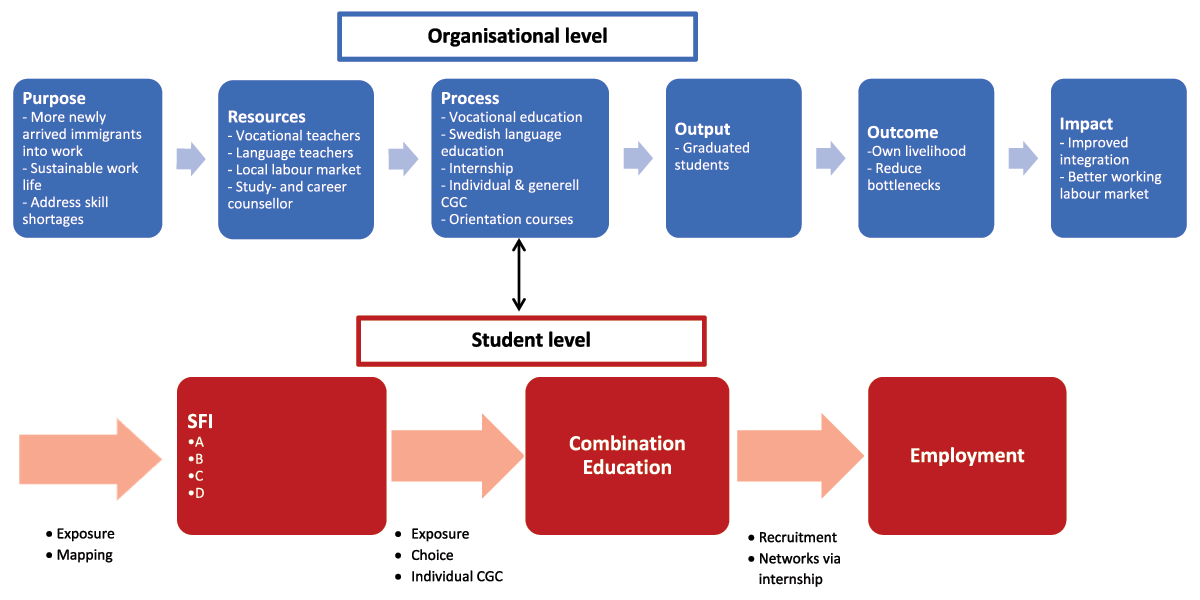
Figure 1
The programme logic model of Combination Education for labour market integration.
The available ‘resources’ are the vocational teachers within the municipality. Based on what we have seen, combination training courses are being offered in occupations where training is already provided in the municipality. Other resources include language teachers, career counsellors, and the local labour market, which is an important collaboration partner. The ‘process’ refers to the parts constituting the Combination Education: vocational education, Swedish language education, internship, individual and general CGC, and orientation courses. What is supposed to come out of the education, the ‘output’, are graduates. The result, the ‘outcome’, is graduates getting their own livelihood and bottlenecks in the local labour market being reduced as the labour supply in the shortage occupations increases (more skilled persons in the profession). The ‘impact’ on society is improved integration and a functioning local labour market.
For the student, the programme logic operates somewhat differently. The model describes a pathway in which students progress from SFI to the Combination Education and subsequently to employment within their trained profession. It emphasises ‘turning points’ in the students’ journey (represented by arrows) associated with specific activities that support their progression to the next stage. The first turning point occurs before SFI begins, when a needs assessment (mapping) is carried out to identify the student’s language level and previous educational background; this turning point does not directly relate to the Combination Education. After SFI but before Combination Education, the students encounter a second turning point where they should be exposed to different possible educational paths to be able to make an informed and well-considered choice. For the transition from the Combination Education to work (the third turning point), a recruitment process becomes central. Recruitment often takes place through the networks the students establish during their internships. Thus, the internship functions not only as a learning opportunity but also as an important recruitment channel. The student pathway is primarily linked to the ‘process’ component at the organisational level (illustrated by an arrow between the student strand and the ‘process’ box in the model). This connection highlights that participants experience the programme through the core process components, including vocational education, Swedish language education, internships, career guidance and counselling, and orientation courses.
The central turning points identified in the Combination Education programme logic model are the second transition from SFI studies to the Combination Education and the third transition from the Combination Education to the labour market. This is how it should work, in theory. However, not all students go from the Combination Education to work in practice. Some of them end up unemployed after the education, and some drop out before the education is completed. There is no quantitative data on the national level of the drop-out rate, and its causes vary for example, the education may be too difficult for some students (alternatively, the pedagogy may not be adapted to the student). Another reason for dropping out is that the student gets employed, either within the professional field in which the student is training or outside it.
Organisational conditions
The integration of vocational training with basic-level instruction in Swedish as a second language is a well-established and widely implemented model across the municipalities we visited. Nevertheless, the organisational structures of these programmes differ considerably, reflecting a broad spectrum of approaches – ranging from conventional to highly innovative. The organisational choices made by education providers significantly influence how the education is delivered, as evident in the following examples. One municipality has organised these programmes in an educational association (utbildningsförbund) that includes two other municipalities. The association is not part of the municipality’s organisation but collaborates with it around adult education and upper secondary school. An executive board, on behalf of politicians, makes decisions about the association’s educational activities, so the decisions are not made in the three municipalities’ education administrations. Another municipality has outsourced a large part of the activities, both vocational training and SFI, to private educational companies. A third municipality has developed its own model for the Combination Education.
Based on the programme logic underpinning the organisational structure of the Combination Education, the components of purpose, output, outcome and impact tend to follow similar patterns. However, what primarily distinguishes the municipalities from one another are the resources and the process. A notable example of how resources and processes – specifically in the form of career guidance and CMS – are utilised differently can be observed in the municipality that has outsourced its Combination Education programmes to an external education provider. In this case, students attend SFI courses with one provider and receive the vocational component of the Combination Education from a separate external actor.
In most of the municipalities we visited, the career counsellor has some form of job description that is approved (at least) by his or her direct manager. However, steering documents pertaining to CGC that have been formally adopted by the municipality are rare. The municipalities have extensive possibilities to design the organisational structure of the Combination Education themselves. Several interviewed counsellors stated that the CGC has space and liberty of action, which they perceived positively. There is a lack of government control; that is, the state does not require municipalities to provide a CGC plan or dictate how career guidance should be implemented or followed up.
Of the five municipalities we visited, only one municipality had a CGC plan for adult education. The operations manager in one of the municipalities criticised the lack of municipal strategy documents:
That, I would probably say that is a shortcoming because we have… If we take the School Act and everything that regulates CGC and that. There is a lot we would need to do, so the answer is no, we have focused far too little on CGC. (Municipal Operations Manager, Study 2)
Another informant noted that, with a clear plan, counselling efforts can already guide the planning of the training instead of being added afterwards to already existing training programmes. However, there are good examples of effective career guidance without a CGC plan. In some cases, the general CGC is placed as a separate course, such as an orientation course, or incorporated into other parts of the education. One municipality we visited had an ambitious professional introduction in SFI, where extensive general career guidance was also available. On the other hand, without a clear plan, there is a risk that the educational path becomes too long, which can cause the students to lose motivation for the final goal.
Opportunities for CGC and CMS
In many municipalities, the admission process to the Combination Education has been digitalised, which has had an impact on newly arrived immigrants’ study and career choices. Due to the digitised application process, not all prospective students meet with a career counsellor before making their educational choice. The limited knowledge about the labour market to which the chosen education leads and the absence of a counselling session sometimes results in incorrect choices, which in turn increase the drop-out rate.
It becomes pretty clear when someone says, ‘Yes, but I thought I was in restaurant training. When are we going to be in the kitchen cooking?’ ‘Yes, but this is a different education.’ Somewhere you have to catch this, to sort of clarify, because it was easier earlier when all the counsellors met the students before, well, in the actual application process. (Principal, Study 2)
The quote shows the importance of providing clear and accurate information and offering career guidance to process the information in order to make a well-founded study and career choice. In the transition from SFI to vocational education (i.e. the second turning point), students require the competence to choose, that is, they need to have CMS. They need to know what profession the education is geared towards and what that profession entails. In some municipalities, the Combination Education currently has a deficiency in career guidance prior to educational path choice. In the larger and more decentralised organisations we visited, governance appeared more difficult.
Many municipalities work with orientation courses that may be studied before, parallel to or as a track within the Combination Education. Some orientation courses contain elements of CMS, often guided by career counsellors. For example, in one municipality, the preparatory orientation course includes group guidance with a career counsellor one hour a week. The course itself contains elements about the education system, stress and planning, decision-making skills, personal values, and self-awareness, while the group guidance focuses on increasing students’ CMS. Offering students a preparatory orientation course with career guidance before the transition from SFI to Combination Education (i.e. the second turning point) is a good example of how education providers can work to increase students’ opportunities to make an informed choice of their study and career.
Orientation courses that take place parallel to or as a track within the Combination Education prepare students for the third turning point. However, the career counsellor is not normally involved in these courses; elements that deal with the work environment and working conditions are handled by the vocational education teachers. Involving career counsellors in orientation courses that are directly connected to the vocational education would increase their opportunities to collaborate with teachers and improve the general career guidance, thereby strengthening the students’ CMS before the transition to working life (i.e. the third turning point).
In sum, general CGC is conducted in different ways in the municipalities we visited and does not always take place within the Combination Education. Several actors may be involved in the general career guidance work, but rarely in a united action with the career counsellor.
Collaboration between Career Counsellors and Teachers
For students at basic SFI who have not yet started a Combination Education, some informants described how career counsellors together with language teachers work with various aspects of the labour market in a more practical form, for example, by arranging study visits to workplaces. However, the primary contribution that career counsellors make within SFI is of an informative nature: career counsellors frequently visit SFI classes to inform students about the educational opportunities offered in adult education and the Swedish education system, including student finance. Many of the interviewed counsellors described the students’ great need for knowledge about how Swedish society and the Swedish labour market work. Individual counselling sessions often took a long time, and the focus of the conversation often shifted from career guidance to finances, family, childcare, and other aspects in life that would significantly affect studies.
I think the challenge is to broaden perspectives. The students do not have the whole picture of what the professions or the different professions entail. I notice that there is a great need for information when it comes to both knowledge about working life and the education system. They want to know a lot, but you don’t know where to start. There are so many parts that they want to know something about. (Study and Career Counsellor, Study 1)
Only in one of the investigated municipalities do career counsellors and teachers work collaboratively on general CGC. This collaboration is not organised or structured in the organisation but has arisen based on the employees’ own initiative. Both teachers and counsellors view the collaboration as positive, and both parties gain from the counsellors regularly returning to the class to develop students’ CMS. By working together, teachers and career counsellors provide students with knowledge about the labour market, facilitate their integration and hopefully prepare them for an easier transition in the programme logic’s third turning point, from education to work.
In some municipalities, the Combination Education entails beneficial collaborations that have developed between counsellors, teachers and other educational staff involving other aspects that general CGC. The informants emphasised the importance of maintaining close contact with teachers concerning students at risk of not meeting the educational goals for passing.
We have a different way of working when we work in the Combination Education. We see that it requires more time. We have not developed a model for this. […] This is entirely based on the individual’s need for career guidance, but we have been involved in various follow-ups. […] We would like to get involved early in this process so that you do not stand in June and have an F in many upper secondary school courses. […] Having close contact with the educators is very important. (Study and Career Counsellor, Study 1)
Through continuous follow-ups on students who are at risk of failing in their education, career counsellors together with other educational staff can systematically work to bridge the third turning point, the transition from education to working life.
Several informants reported that students require labour market knowledge, information about available educational and career choices and support in the decision-making process. Ensuring students receive this knowledge and support necessitates increased collaboration in career guidance initiatives. Despite this recognised need for collaboration – and, in some cases, the expressed frustration regarding the organisation of career guidance services – many municipalities lacked a concrete organisational plan for how such collaboration could be effectively integrated into existing practices.
Discussion
The aim of the Combination Education is to shorten the path for newly arrived immigrants to the Swedish labour market. In this, the reform follows ‘the work line’, the labour market policy paradigm outlined by the Alliance government around 2006 (Allians för Sverige, 2006; Reinfeldt, 2006).
The absence of governing documents at both state and municipal level suggests that CGC has not been a priority for decision makers. Both Nilsson and Hertzberg (2022) and Olofsson et al. (2017) claim that municipalities often lack clear CGC guidelines and management. Further, previous research has shown that the Combination Education is not the only education overlooked by decision makers and steering documents. Several studies have concluded that Swedish national guidelines for career learning are very general (Rosvall & Eshagbeigi-Hosseini, 2023), and follow-ups and evaluation of career learning activities are rare. Sweden also has a weaker anchoring of career education in the legislation and the curriculum compared to other Nordic countries (Einarsdottir et al., 2023). Given the absence of clear national guidelines, it is not surprising that such directives are also lacking at the municipal level. The situation appears to be similar in the context of adult education. Research on CGC within Swedish adult education remains limited, but two recent studies have examined this educational form (Andersson & Muhrman, 2024; Muhrman & Andersson, 2024). Notably, both studies underscore the absence of governing documents.
In this article, we raised two research questions: (1) How is CGC governed and managed in the Combination Education? (2) When and why is CGC needed in the Combination Education? Concerning the first question the absence of governing documents suggests that CGC has low priority among municipal decision makers. The organisational models of the Combination Education differ from one municipality to another; there seem to be as many organisational models as there are municipalities. This may derive from the lack of national guidelines when it comes to the governance and management of CGC, leaving the organisation of CGC to the local level and explaining the big variation of solutions. Of course, different municipalities have different preconditions, which may be an argument for autonomy. On the other hand, the students have common needs for CGC, which may be an argument for equivalence.
Due to the lack of governing documents for career guidance, counsellors in some municipalities have developed their own models in close collaboration with teachers and other school staff to support students in different ways during their studies in the Combination Education. Career counsellors often have considerable autonomy in shaping their work (Nilsson & Hertzberg, 2022), and their professional competence includes the ability to adapt career guidance to individual needs. However, having a significant amount of freedom without clear direction can counteract its purpose and instead create difficulties for career counsellors in prioritising their tasks. Moreover, when governing politicians and administrative management do not show interest in CGC-related matters, career learning risks becoming marginalised. Given the extensive needs of the target group, it would have been advantageous for both students and counsellors to have clearer organisational conditions. In particular, the municipal management of CGC would benefit from a CGC plan – an overall plan for career guidance decided by the education board or equivalent. The plan could advantageously be broken down into activities for training and operations.
When it comes to the second research question, we have, through our programme logic model, shown that there are three turning points. The first is the transition into SFI where a needs assessment (mapping) is carried out to identify the student’s language level and previous educational background. This turning point is not directly linked to Combination Education. The second is the transition from SFI to the Combination Education. In such a transition, students need CMS (i.e. the competence to choose a suitable career). Students must know to which profession the education leads and what that profession entails. Hopefully, the majority of the students in the various Combination Education programmes end up in the programmes they want, but there are examples from our interviews where this is not the case. One reason for this mismatch could be that the application process in many municipalities has become fully digitalised. As a result, applications to the education programmes are now often submitted without the student having had a guidance session, which in some cases leads to the student lacking knowledge about the content of the education or the occupational field it targets. Another way to prepare students for choosing an education path is to arrange orientation courses with career guidance elements, which seems to be a fruitful arena for teachers and career counsellors to collaborate.
The third turning point is the transition from the Combination Education to working life. The aim of the education is for individuals to enter working life faster. Through the general CGC and the possibility do develop personal CMS, the students’ knowledge of the labour market increases, as well as their awareness about issues that often belong to tacit knowledge, for example, how to behave in a workplace. Such outcomes require increased collaboration between teachers and career counsellors. Facilitating such collaboration necessitates support from leadership in enhancing mutual understanding of each party’s competencies and allocating time for planning and implementing joint activities and developing work materials (Andersson & Antonsson, 2020).
We argue that increased knowledge about the labour market has effects at both the individual and structural levels. On an individual level, it leads to a sustainable working life in the sense that the individual’s competence to choose is expanded, enabling them to rationally choose a profession and a workplace. By making an informed choice, the individual decreases the probability of quitting or being exploited. At a structural level, increased labour market knowledge facilitates more efficient matching and, in turn, enhances labour market efficiency. According to our findings, general CGC has more to offer within the Combination Education and can be further developed.
The results from our study confirm previous research indicating unclear governance and organisation of career guidance and counselling within the Swedish education system. The absence of national policy documents gives municipalities significant autonomy in determining how CGC is prioritised at the local level. While there is a valid argument for tailoring services to local conditions, we contend that students’ need for CGC is not dependent on a local context. A Swedish national framework for CGC would strengthen its role within the education system and ensure both individualised and general support for students navigating educational and vocational choices.
Limitations
This study has several limitations that should be acknowledged. Regarding methodological limitations, the interviews do not include the students in Combination Education. We do not know their views on the CGC offered to them. Further, only five municipalities were investigated in depth. From this small sample it is difficult to draw general conclusions on the total population of municipalities in Sweden. The choice of method was motivated by the width and heterogeneity of implementation approaches of the Combination Education among municipalities; they necessitated a qualitative study with study visits and in-depth interviews of different professional groups at different levels in the organisation. In addition, the use of programme theory had its limitations. Theoretically, programme theory does not allow for the analysis of policy problem representations (e.g. Bacchi & Goodwin, 2016), nor does it support claims about causal effects or programme effectiveness. Instead, we chose it because we aimed to examine how the Combination Education is intended to function and how career guidance is organised in practice; these aspects can be operationalised through a programme logic model focusing on processes, assumptions and organisational turning points, where career guidance and career management skills become particularly salient. Nevertheless, further research is needed when on CGC in adult education in general and in Combination Education in particular.
Acknowledgements
This article is an off-spring of two research assignments for the Swedish National Agency for Education 2021–2023 (Skolverkets dnr 2.7.4-2021:1061 och dnr 2.7.4-2022:377). We are grateful for comments by participants at Malmö Work Science Meeting in Malmö, NorNET in Turku 2023, and anonymous reviewers on a previous version of this article. We would also like to thank Jasmin Salih for the language editing.
Author Contributions
The authors have jointly contributed to all aspects of the work.