
Introduction
Educational trajectories – understood here simply as the patterns of a career – are dependent on structural factors, such as social class and immigrant origin (Banks et al., 1992), and historical context (Hodkinson & Sparkes, 1997). Simultaneously, individual actions are shaped through interpersonal influences: home and school environments are the most important arenas for the interpersonal influence that shapes adolescents’ future life choices (Rosenqvist, 2018). Trajectories from one level of an education system to another and from education to work, “are structured by socio-economic factors and institutional structures of formal education, while at the same time, they are appropriated by individuals in their biographical constructions” (Walther et. al., 2015, p. 351; see also Varjo, Kalalahti & Jahnukainen, 2020).
Giddens’s (1984) structuration theory is a renowned analytical tool with which to scrutinise structure/agency dichotomy. It emphasises the analysis of both structure and agency, without giving primacy to either: neither micro- nor macro-focused analysis alone is sufficient. The various emphases on structure and agency are also visible in following models of decision-making on education.
Paton (2007) distinguishes between three models of decision-making on education: The first model is based on individualised economic/instrumental rationality. It draws on classical economics, evaluation of risks, investments and profits linked to educational decision-making, and the theory of rational choice (see Boudon, 1974; Breen & Goldthorpe, 1997). Second, structural models outline educational decision-making and its various outcomes as consequences of institutional, economic, and cultural factors that individuals are generally unable to influence. From this perspective, educational inequality is reproduced through the distribution of economic, cultural, and social capital (Bourdieu & Passeron, 1977; Furlong & Cartmel, 1997). The third group of Paton’s (2007) modelling consists of hybrid models, emphasising that educational decision-making is not purely individual or structural as such, but combines elements from the previous two models. According to hybrid models, educational decision-making is an ongoing biographical process that takes place in a particular socio-historical context, as part of its cultural patterns of normality, social networks, and institutional structures.
Hodkinson and Sparkes’ (1997) careership theory, is a prime example of a hybrid model of educational decision-making, emphasising both structures and agency. It recognises that policymaking on career guidance is typically based on the idea that career decisions are made by an individual of their own free will and in a rational way. Nevertheless, at the same time, it emphasises the deterministic nature of socially structured decision-making, as in many sociological theories (see Bourdieu & Passeron, 1977). The limitations bounding the decision-making processes are imposed by the person and their position but especially by the context within which they exist. According to previous research, social and ethnic background, power, and inequalities are examples of factors that have an impact on these processes (Vilhjálmsdóttir & Arnkelsson, 2013; Stebleton & Jehangir, 2020).
According to Barley (1989), career scripts are “plans for recurrent patterns of actions that define, in observable terms, the essence of actors’ roles” (p. 53). Drawing on this idea, careers can be thought of as temporally extended scripts that take place in a given context. Laudel, Bielick and Gläser (2019) emphasise scripts as interpretive schemes that describe careers, and, hence, as a specific factor that contributes to the explanation of career decisions. As McCrory (2022) exemplifies, the relationship between the agency and structure is often undefined in the career scripts, although this relationship is most promising for the recognition of inequalities and promoting social justice. Socially-just comprehension of guidance requires the recognition of social contexts but also the recognition of the ways in which agency is implicated in the social practices (McCrory, 2022).
The aim of this paper is to contribute theoretically and empirically to the qualitative body of knowledge on the career scripts of young people in Finland, and to the educational trajectories associated with various actantial positions. Actantial analysis offers a novel and undiscovered way to portray in practice the ways in which they are simultaneously built on structural, interpersonal, and intrapersonal factors. Drawing from the actantial approach Kalalahti and Varjo (2022) analysed the ways in which young people position themselves in the horizons for actions that are visible to them.
Greimas’ (1983a) actantial model not only provides a scheme for constructing power relations among actants but also offers tools for the study of types of actions and events and their sequential order in narratives on career scripts within a given context. In practical terms, our analysis consisted of assigning elements of the action being described to the actantial categories by focusing two research questions: (1) Which actors are included in the actantial structures of narratives on career scripts? (2) What are the common features of actantial structures on career scripts? The data were drawn from two consecutive sets of interviews with students (n = 31) in Finland: first, at the end of their nine-year compulsory education at the age of 15, and second, three years later when (most of them) were finalising their upper secondary education.
Finnish education system
Our theoretical approach is based on the firm idea that national education systems provide structures within which young people make pragmatically rational decisions (Hodkinson & Sparkes, 1997). Drawing on Roberts (2009), we presume that instead of lack of aspiration or other individual qualities, the sources of inequalities and imbalances in systems of education and work can be found in the frames within which different groups of young people are supposed to act reflexively and draw up career scripts considered to be ‘right and suitable’ for them.
Within this study the students devised career scripts determined by the Finnish education system. After nine years of comprehensive education, students apply for entry to general upper-secondary schools (lukio) or vocational upper-secondary institutions (ammatillinen oppilaitos). Students apply for entry to upper-secondary schools during the ninth grade via a general joint application (yhteisvalinta) (Varjo et al., 2019; Kalalahti, 2019). Almost all young people participate in the joint application, since unemployed young people under 25 without vocational qualifications are obliged to apply for a study place (KELA, 2022). Both upper secondary tracks last for three years, and successful completion provides access to tertiary education. Drawing on Giddens (1991, p. 112), the admission to upper secondary education is an example of a fateful moment in one’s life course: “those when individuals are called on to take decisions that are particularly consequential for their ambitions, or more generally for their future lives”.
Tertiary education in Finland has a dual structure, provided by universities (yliopisto) and universities of applied sciences (ammattikorkeakoulu) (MoEC, 2022). Yet only a small proportion of students from vocational upper-secondary institutions continues studying in higher education. As Kettunen and Prokkola (2021) emphasised, the choices for upper secondary education largely determine educational attainment. The follow-up period of this study covered both upper secondary and post-secondary choices.
Theoretical perspective
Greimas (1983b) argues that the aim of structural semantics is to capture the underlying meaning or the ‘meaningful whole’ of a narrative. The meaning of the narrative can be sought in the structures that appear in the narrative scheme. His theory on the actantial structures is a theoretical tool to scrutinise agency within given structural frames. The model is influenced by Propp’s (1968) structural analysis of basic elements of Russian folk tales. In the actantial model, an action is divided into six components, actants. Actantial analysis consists of assigning each component of the action to the actantial classes (Greimas, 1983b; Greimas & Courtés, 1982).
In Greimas’ actantial model, there are six actants that form three oppositions: sender vs. receiver, subject vs. object and helper vs. Opponent (Greimas, 1983b; Greimas & Courtés, 1982). The actantial positions can be performed by multiple actors in the manifested discourse. A collective actant combines individual actors that have a common form of doing or being. These individual actors can either successively substitute for one another or be simultaneous members of a group that have something in common, and thus form a collective actant (Greimas & Courtés, 1982).
The sender is the element requesting the establishment of the junction between subject and object, whereas the receiver is the element for which the quest is being undertaken. The sender (e.g., TV show [Interviewee 209]) is the one who communicates to the receiver (e.g., family [Interviewee 15]), and that usually coincides with the subject and the set of values at stake. The sender is often posited in a distant or “transcendent” universe, whereas the receiver exists in an “immanent” universe (Greimas & Courtés, 1982, p. 294).
In the actantial structure the principal relation is the relationship between the subject and the object of value. The subject (e.g., the young person) is what is directed towards an object (e.g., studying political science at university [Interviewee 176]). The subject-object relation produces the doing, the narrative programmes that constitute the discourse through the trajectories. The helper (e.g., homeroom teacher [Interviewee 285]) assists in achieving the desired junction between the subject and object; the opponent hinders the same (e.g., lack of peaceful study space [Interviewee 447]).
As illustrated in Figure 1, the actantial oppositions (sender vs. receiver, subject vs. object and helper vs. opponent) generate three types of relations: axis of knowledge, constituted by communication between sender and receiver; axis of desire, which is felt by the subject for the object and axis of power, realised through the struggle between the helper and the opponent (Greimas, 1983b). It is important to note that all actors and their relationships can be organised into three categories that affect educational decision-making and educational transitions: they can be intrapersonal, understood as individual qualities, interpersonal, based on communication and negotiations, and structural related wider societal context.
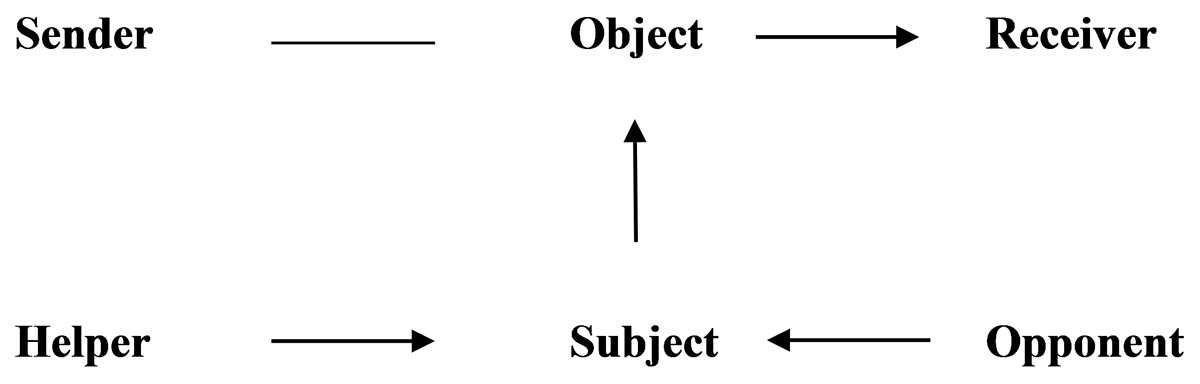
Figure 1
The actantial model represented as a square (Greimas, 1983b).
Research Setting
This paper contributes empirically and theoretically to the qualitative body of knowledge on career scripts. We have sketched the actantial structures with the actantial model, which schematically portrays the functions and roles actors perform in a narrative of interviews of Finnish young people. In practical terms, our analysis consisted of assigning elements of the action being described to the actantial categories by focusing two research questions: (1) Which actors are included in the actantial structures of narratives on career scripts? (2) What are the common features of actantial structures on career scripts?
The data were comprised of 31 follow-up interviews. The cases were selected from the longitudinal study entitled ‘Transitions and Educational Trajectories of Immigrant Youth’ (see e.g., Kalalahti et al., 2017; Kalalahti & Varjo, 2022). In this project, 445 young people from eight lower secondary schools located in major urban municipalities in Finland were surveyed (follow-up surveys) over the three years to the end of upper secondary education. The data were collected as a selective sample (Palinkas et al., 2015). The aim of the base sampling was to include students from a range of socio-economic families. Hence, the sampling was targeted at (a) schools with relatively high proportions of immigrant-origin students but (b) representing socio-economic composition in terms of parental education level. All 9th graders of each school were invited to participate in the study, and the number of schools was increased until the sample was large enough for group-sensitive analysis (Heckathorn, 1997).
Of the participants, 31 were selected for the additional follow-up interviews targeted at students studying in several educational tracks (general upper secondary education, vocational education and training or preparatory teaching) and for students of different genders and family backgrounds. They were interviewed twice, and these 62 interviews comprise the data for this article. The first round of interviews was conducted at schools during the final year of comprehensive school (approximately 15 years of age) and the second round was conducted mainly at schools, cafeterias, libraries or by phone during the final year of the upper secondary education (approximately 17–18 years of age). Of the 31 informants, 18 were from migrant families, and 13 were from native families; 25 studied in general classes and six in special education; there were 19 girls and 12 boys; within the follow-up period, 25 were studying in general upper secondary education, seven in vocational education and training and two were not studying.
Interviews were conducted by the research team members (researchers and assistants) and analysed for this article by the authors. The thematic interviews were openly advancing dialogue covering the themes of schooling, decision-making processes, life courses and future envisions. Both sets of interview data (1st and 2nd round) were analysed independently; hence the actantial structure of each informant’s career script was constructed twice. Individual actantial structures were layered in two general structures, portraying the variety of the structures in two phases (final years of comprehensive and upper secondary education).
The final stage of analysis was undertaken by analysing the variety of the actants and their intertwinement from the general actantial structures, strengthening the interpretation of the collective dimension of the scripts. During the final stage, the interpretations were evaluated and verified by both authors to ensure the reliability of the research. The mode of presentation of the empirical results follows the types of relations generated by the actantial oppositions: axes of knowledge, desire and power (Greimas, 1983b).
The research project followed the ethical guidelines established by the Ethical Review Board in the Humanities and Social and Behavioural Sciences at the University of Helsinki. The research design did not require an ethical review according to the guidelines of the Finnish National Board on Research Integrity. Overall research permission was obtained from the municipalities and schools. Consent letters for the interviews were obtained from the pupils and their guardians. Participation was voluntary, and the students could end their participation at any time. We did not name or identify the schools, the neighbourhoods, or the pupils.
Empirical Results
The Axis of Knowledge: Rationalities of Educational Decision-Making
The axis of knowledge, constituted by communication between a sender and a receiver, brings the first actantial opposition to our analysis. From our data we asked: Who or what is the driving force behind the activity? For whose benefit is the activity directed? As an example, one of our interviewees described how an idea based on a certain TV show became the sender-actor in her narrative:
A: I watched this police reality show on TV. Then I realised that want to be a police officer myself. It was also said there that especially female police officers with practical nurse training are highly appreciated. (Interviewee 209)
The most typical sender – the element requesting the establishment of the junction between subject and object – in the ninth-grade narratives on educational trajectories was the sheer fact that the nine-year comprehensive education was soon to be over and the next step in one’s educational path should be taken in the form of the general joint application. The general joint application in most cases was seen as an inevitable structural necessity: every ninth grader was expected to choose something.
The second sender-actant category draws from interpersonal or intrapersonal factors, such as positive feedback from the work practice programme, or individual preferences on curriculum, ambitions and ideas. In contrast to the structural necessity of the general joint application and interpersonal or intrapersonal experiences and ideas, all other senders were sporadic. On top of those, previous educational choices (certain foreign languages, for instance), pursuit of upward social mobility, middle-class lifestyle and family expectations were articulated as sender-actors.
The receiver-actant is the element for which the quest for reaching the object is being undertaken. In this case, only two actor categories emerged: the young person him/herself or the family (or given family member, such as the mother). Overall, the vast majority of the informants set themselves as the receiver, thus the communication from the sender, which forms the object, was targeted solely at the individual youth. In some cases, the family was set as the actantial position of the receiver: the interviewees spoke either themselves as a member of the family-collective or about their tight relationship with one family member, in most cases the mother.
In the following quotation, an interviewee describes how the entire family is seen as a receiver-actor benefiting from the accomplishment of the mission:
A: I will be aiming high in my studying. At university, I want to study entrepreneurship. My whole family has completed general [academic] upper secondary school. I want to follow in their footsteps. (Interviewee 15)
The second round of interviews for the same young people was conducted three years later, when most of them were in the final year of their upper secondary education, either vocational or general. At the age of approximately 18, the driving forces came from a wider range of directions than they had three years earlier: the number sender-actors had increased. However, the most typical sender was still the fact that now their upper secondary education was soon to be over, and it was expected that important decisions on subsequent education and/or employment would be made. In practical terms, the next step on one’s educational path should be taken either by participating in the general joint application – or finding a job for oneself. The second set of interviews was rich with narratives about how the final year of secondary education symbols the end of a certain life phase, shaped by intrapersonal, interpersonal, and structural factors: how the new life phase typically requires moving out of the childhood home, in many cases to a new town to start tertiary education – and into a more self-sufficient life.
The second notable sender-actor consists of elements emphasising strict structural necessities in one’s life: the need to earn a living, to get a job, to get an education, which was completely missing from the first-round interviews. The compulsion is perceived as binding – there is no way to avoid or escape these realities. The narrative has a distinctive future orientation, the compulsion concerns things that will/should/might happen in the future. Jointly, the sender-actors at the end of upper secondary education and necessities of life cover most of the narratives.
A: If I don’t get a job, I can’t live on my own, because I don’t have enough money. Then I had to return my mother’s place, but don’t want to. (Interviewee 97)
The third sender-actor consists of narratives on finding one’s own potential and interest during upper secondary education. It is important to note that this happens within the realm of the formal education system and shares both intrapersonal and interpersonal elements. Characteristically, the general upper secondary students found a certain subject that set their direction towards tertiary education. On-the-job learning periods crystallised vocational upper secondary students’ thoughts about their prospects concerning employment and/or additional education.
The fourth sender-actor consists of narratives on pursuing a certain lifestyle or life course. It has two distinctive variants: either a quest for a middle-class career, typically involving university education and high professional status; or generally a good life, including family and related material issues (house, car, etc.), made possible by education and steady employment.
When contrasted with the earlier interviews, the same two conceivable receiver-actor categories emerged as in first actantial analysis: the young person him/herself or the family (or given member of the family, such as the mother). Most of the informants set themselves in the position of the receiver, again.
The Axis of Desire: The Quest of Education, Employment and a Good Life
The most dynamic actantial opposition is the axis of desire, which is felt by the subject for the object (Greimas, 1983b). That is, the most vital plot in the narratives on career scripts is built around the effort (or no effort) the subject takes to reach the object. The object-actors are the goals subject tries to reach:
A: I have thought about studying political science at university. Abroad. Scotland. There’s Aberdeen and Edinburgh. Glasgow also, but it’s quite difficult to get accepted there. (Interviewee 179)
The range of desired objects, constituted by communication between sender and receiver, was extensive and scattered. In broad terms, some of the career scripts were more short-range and vaguer than others – the distance between the subject and desired (yet indefinite) object was short, in most cases it involved only transition to undefined and uncertain general upper secondary studies. Still, some the object-actors were more deliberated. These narratives portrayed typically the auxiliary objectives, such as vocational or general upper secondary qualification, as an enabler for a good life and employment.
The subject-actant was simple to define in our interview data by asking which types of actors are viewed as the subjects pursuing the object. Most of the informants set themselves in the position of the subject-actant in the ninth-grade interviews. This confirms the findings from previous research emphasising youth in Finland as independent and self-centred choosers in their educational trajectories (Holmberg et al., 2018; Niemi & Mietola, 2016). The peers and their opinions were interpersonally not articulated as being significant in this respect. Also, the role of the parents was described in a distant manner. Symptomatically, they were informed about where the youths had decided to apply, and then they just accepted the educational trajectory already chosen. An example of the typical intrapersonal subject-actor from the data:
A: I don’t want to go to a school which I don’t like myself. It would be pointless to go there. (Interviewee 421)
As with the axis of knowledge, some families – or certain members of the family (typically the mother) – were often narrated in conjunction with the youth as the subject. This gave intimate domestic relations an active role in the process of setting destinations and taking suitable choices interpersonally. Typically, the familial extended subject-actor discussed preferences, negotiated, searched information and explored jointly the options available (see also Mäkelä & Kalalahti, 2020).
Three years later, the range of desired object-categories was still extensive, and the objects were still unclear and indistinct in many cases. Nevertheless, the objects related to (higher) education were more explicit than the ones concerning career or employment; strictly career related objectives were rare in the data in the first place.
A good life made possible by employment or education and a higher education degree were the two major object-categories, which covered most of the narratives. First, having a good life made possible by employment or education typically contains visions on immaterial issues, such as family life and personal well-being or more material subjects, such as a pleasant house or an expensive car. Within this actant-category, the relation between subjects and objects remains distant and indefinite at the age of approximately 18. Second, higher education degree consists of an idea about graduation from a certain university or a university of applied sciences programme. In this case, the object was more explicit and clearly defined. Due to the relatively short and explicitly articulated distance between subject and object, the time frame was short. In many narratives, graduating from higher education was articulated as the main goal of the career script. Additionally, a certain (vocational) career, indefinite higher education in general and military service were described as objects in a sporadic manner.
Most of the informants at the end of upper secondary education still set themselves in the position of the subject-actant. The chosen object was desired for individual reasons, based on interpersonal ambitions and/or abilities. For instance, peers and their opinions were not articulated as being significant at all. Nevertheless, some of them still described the whole family or a certain member of the family (typically the mother) in conjunction with the youth as the subject. This gave intimate domestic relations an active interpersonal role in the process of setting destinations and taking suitable choices – and now, evidently a long-lasting one.
The Axis of Power: Helpers and Opponents
The axis of power is realised through the struggle between the helper and the opponent. The helper assists in achieving the desired junction between the subject and object, whereas the opponent hinders the same (Greimas, 1983b; Greimas & Courtés, 1982). An example from the interview data demonstrates how the support received from the school, works interpersonally as a helper-actor:
A: My homeroom teacher helped me a lot. She told me all about different occupations and schools long before the joint application. When I said that I had decided to apply for the social and health sector, she was, like, this is a good choice for you. (Interviewee 285)
Whereas, opponent-actors are complicating the pursuit of the mission, as an example:
Q: Can you do your homework in peace when you are at home? You have younger siblings…?
A: No, no. I must go to the library if I want to concentrate on my studying. (Interviewee 447)
Most notably, the axis of power consists of a wide variety of actors. Generally, the helper-actors could be categorised as positive intrapersonal qualities (success at school, knowledge, effort, for instance), social network (parents, relatives, friends, teachers, counsellors), or more structural forms of institutionalised support (social work, school, guidance).
Besides positive intrapersonal qualities, and following the interpretation of the previous axes, some informants had a wide range of significant others described as helper-actors. Besides parents and relatives, siblings were constantly mentioned as helpers. The importance of support from the school was emphasised in some interviews, which explicitly specified the student counsellor or at least one of their teachers as the helper-actors in their narratives as protective factor. Arguably, actors at school have been able to help them to encounter the education system (see also Salikutluk, 2016; Fernández-Reino, 2016).
When contrasted with helpers, the overall number of opponent-actors was lower. Most informants did not mention any actors as hindering them in achieving the desired junction between the subject and object. Still, some distinctive opponent-actors emerged. The first category consisted of difficulties in schooling, such as previous problems in learning or some other aspect of schoolwork, which were articulated as obstacles in achieving the education desired – diagnosed as a severe need for special support or articulated just as intrapersonal worries about one’s capacity to cope with studying or a lack of commitment to education in general.
Second, lack of appropriate institutionalised support at school, such as shortcomings in career guidance, was sometimes described as having had a negative impact on prospects. Moreover, unfavourable structural factors (such as obscure admission criteria, strict language requirements or distant location of preferred educational institutions) were sporadically mentioned as opponents in the quest for the desired type of education. It is important to note that intrapersonal qualities and support (or lack of) could work both as helpers and opponents, depending on their actantial position. Typically, social relationships are limited to an actantial position of helper; and vice versa, as structural factors to a position of opponent.
Three years later, the actantial structure wasn’t significantly different. The first category of helper-actors included, again, intrapersonal quantities, such as commitment to educational choices already made (individual selection of courses, specialisations or foreign languages in upper secondary education); and/or belief in one’s own resources, such as being able to learn.
The second helper category contained a variety of forms of support which was received from school. The contribution from a helper typically consists of support in career choice questions or other life course issues, yet the career guidance counsellors were much less frequently mentioned than they had been three years before. Moreover, certain teachers (as helper-actors) functioned as couriers for certain subjects or specialisations that will be important in the future. In this case, the process of finding one’s areas of interests emerged interpersonally, in contrast to the first helper-actor category.
The third category of helper-actors refers to social relationships (including parents, siblings and now also partners) as a continuation of the situation three years earlier. Yet, their function was the same: to advise and support with choices on education and employment, especially in situations that were identified as being stressful.
The opponent-actors fell into a considerable number of categories. They generally outnumbered the opponents reported three years before. They were distributed across a variety of categories resembling the situation three years earlier. The first consisted of narratives on problems in schooling, described as having too few intrapersonal capabilities regarding certain subjects or a general lack of commitment to studying or indecisiveness in undertaking further education. Second, the lacking also concerned the appropriate institutionalised support (special support measures or career guidance, for instance). Third, there were also structural flaws in access to higher education, such as bureaucracy-related issues or excessive competition that ruled out some potential options. Fourth, in some cases, domestic conditions, such as the need to work or help at home, or the lack of space at home, were reported as lowering educational achievement. One of our interviewees criticised the career guidance and counselling sessions as follows:
A: They take place only in one period. So, there are not that much of them. – – Mostly the career counsellor talks about things, and we just sit and listen. That’s all. – – We have had some individual session as well. I didn’t find them very useful. (Interviewee 59)
This time, most of the interviewees described opponents. The opponents were generally more present in the narratives in two ways: First, a considerable number of them discussed the issues preventing them from reaching their envisioned goals. Second, opponents seemed to be concentrated: it was quite common for informants to report more than one opponent.
Discussion
Hodkinson and Sparkes (1997) argued that career scripts involve practical rationality, perceived as a series of routines and turning points. According to the careership theory, routines could be described as everyday experiences that led to and had an effect on the decisions made at turning points. However, career scripts are not solely intrapersonal, they happened in a certain social context and in interaction with others. Instead of emphasising either structural factors or intrapersonal or interpersonal elements, actantial analysis is a vehicle through which to investigate patterns of activity within a given social context rigorously and comprehensively. The analysis reveals the ways in which people, issues and circumstances alike could be integral components of the narratives on career scripts. Simultaneously, the actantial structure as an entity becomes important: without each actant, the narrative would be imperfect.
Our analysis indicates that in the axis of knowledge, constituted by communication between the sender and the receiver, first, the structural fact that current education is almost over, and everyone is expected to take the next step and, second, intrapersonal experiences or individual preferences emerged as major sender-actors. Both senders were built on a linear comprehension of life course and education as a taken-for-granted vehicle for employment and a good life. In the case of receiver-actant, the pattern was that either the young person or their family were described as receivers. It is noteworthy that wider and more abstract potential receivers – the common good or society, for instance – were not articulated at all.
In the axis of desire, felt by the subject for the object, in terms of Walther et al. (2015), some of the objects were destinations, such as a particular profession, a higher education degree or a good life, made possible by employment or education. Typically, they had a distinctive future orientation and involved deliberation. Others were mere choices between vocational or general upper secondary options without any comprehensive script. Again, the realm of objects was quite narrow, it included mainly issues that concerned or would be made possible by education and employment. Most of the informants set themselves solely in the position of the subject-actant, yet some described their families as being subjects. In this respect, the dual pattern resembled the case of receiver-actant.
In the axis of power, realised through the struggle between the helper and the opponent, the helper-actors were categorised, first, as positive intrapersonal qualities, such as success at school, knowledge and effort; second, structural forms of institutionalised support, like social work, support from school by student counsellors; or, third, interpersonal, including parents, relatives and friends. In ninth grade, most informants identified no opponent-actors to hinder them in achieving the desired junction between the subject and object. Yet, schooling difficulties, and the lack of institutionalised support could also work as opponents, depending on their actantial position. In all, in addition to the schooling difficulties and the lack of institutionalised support, domestic conditions, such as the need to work or help at home, or the lack of space at home were reported as factors that lowered educational achievement.
Evidently, general joint selection systems, at both lower and upper secondary levels, emphasise the position of individual and independent chooser. This type of subject-actor is commonly understood as being self-regulated, making choices based on only a minimal amount of ‘official’ information (career counselling, websites etc.) or interpersonal communication, but simultaneously possessing a considerable amount of cultural capital in the Finnish education system. The individual and independent chooser is also a self-absorbed chooser, the quest for object is mainly taken for the sake of subject-actor. In this position, a young person is set as the subject-actor with a few helpers and opponents, which are mostly built on intrapersonal competencies and aims.
The longitudinal data also enable the analysis of the temporal dimension of the actantial structures. In three-years’ time, the biggest change in actantial structures takes place at the axis of power, especially with opponents. At the age of approximately 18, most of the interviewees described opponents hindering them from the envisioned object; it was even quite common to report more than one opponent. When contrasted to the constellation of career scripts at the end of lower secondary education, the same young people at the end of their upper secondary education saw generally their career scripts more bounded and uncertain due to a wide variety of structural, intrapersonal, and interpersonal factors.
According to Laudel et al. (2019), when making career decisions in particular situations, actors position themselves in career scripts and decide about the next career move from the perspective of a sequence of moves leading to career progress. Actantial analysis offers a measure to illustrate the ways in which individual agency can be analysed in connection to its social context. Actantial structures are linking career scripts (understood here as more individual interpretive schemes) and wider social structures. Moreover, the analysis emphasis that actantial structures can change even in the course of three years.
Finally, we will raise two conclusions for the guidance policies. First, we conclude that the increase in bounding factors during the upper secondary education calls for more attention, especially since the guidance counsellor’s role became less visible in the scripts. The young people, analysed here as individual and independent choosers, would need much more holistic guidance policies at the end of the upper secondary education.
Second, we conclude, that better understanding on the link between structures and agency is vital for the recognition of inequalities and promoting social justice through career development (McCrory, 2022). The multidimensionality of the actantial structure reveals how complex the power relations actions are. More comprehensive understanding of the actantial structure indicates the movement towards more collective dimensions of career development. This includes the idea of agentic collective actions, which offers better ways to understand the contexts of careering (Hooley, 2022).
Funding Information
The authors disclosed receipt of the following financial support for the research, authorship and/or publication of this article: This work was supported by the Academy of Finland (grant numbers 275324 and 277814).
Competing Interests
The authors have no competing interests to declare.