
Introduction
When the first Master of Career Guidance (MACG) in Norway was realised in 2014, it consolidated fragmented courses and plans and set the tone for further development in the subject area. The goal of the program was to qualify career guidance professionals for diverse functions in a variety of sectors (DAMWAD, 2012; Neary, 2016). The qualifications of career advisors have long been the subject of debate in Norway (Andreassen et al., 2019; NOU 2016:7) and Europe (e.g. CEDEFOP, 2009; Schiersmann et al., 2016).
The purpose of this investigation was to gain knowledge of the processes that led to the realisation of MACG. The aim of the research was to investigate how policy processes, understood as the influences, interactions between main actors, and events led to the realisation of the Master program.
In this article, we define The Ministry of Education and Research (ME&R), Vox (the Norwegian Agency for Lifelong Learning), Buskerud and Vestfold University College (BVUC) and Lillehammer University College (LUC) as the main actors in the development of the master’s programme. The two university colleges that developed the program had their academic preferences and sources of inspiration. The governing bodies’ main ambition was to professionalise career guidance services.
Although not included as the main actors in this article, there was a pronounced need to enhance competence in career guidance in the field of practice that pushed the development forward. Further, DAMVAD Analytics, a consultancy company, contributed with an analysis of courses in career guidance in Norway and advised future improvement of the organisation of courses in career guidance (DAMWAD, 2012).
Our research questions are as follows:
How did policy processes interact in the establishment of the master’s programme in career guidance?
What was the rationality behind the actors’ plans, ideas, strategies, actions, and cooperation?
Why did the actors succeed, despite tensions between them, in completing the first master’s programme in career guidance in Norway?
MACG in the context of evolving professionalisation of career guidance in Europe
There has been an expansion in career guidance services in many European countries over the last two decades (Nilsson & Hertzberg, 2022, p. 8). The Council of the European Union has been an initiator of increasing the provision of career guidance and counselling (CGC) services. By soft governance they have implemented a coherent and holistic guidance system accessible throughout the lifespan (e.g. Bengtsson, 2011, 2015a, 2015b, 2016; Kjærgård, 2013).
A series of studies enquire the governance of career guidance and how individuals’ career management is constructed within EU policy (e.g. Bengtsson, 2011, 2015a, 2015b, 2016; Kjærgård, 2013). The studies use Foucault’s concept of governmentality (Foucault, 1991) in their analysis and show how career guidance is expressed as a regulating mechanism between the needs of society and the freedom of the individual to choose education and employment. We lack knowledge of how EU policy has influenced the reform of educational programs in career guidance in Norway.
There is a variety of preconditions for choosing topics in educational courses in career guidance among countries and national providers (DAMWAD, 2012; Niles & Karajic, 2008; Patton, 2002). Quality assurance occurs with reference to national standards, local requirements, or in combination (Hiebert & Neault, 2014). Despite differences among countries and communities in their weighting of topics, there is a growing consensus among providers of educational courses on topics to teach and skills to train (Niles, 2014; Pinto, 2012). Attention is paid to career theory, career assessment, career counselling, job search skills, evidence-based practice, and relevant policy.
The educational programmes in CGC are structured in diverse ways among countries (Andreassen et al., 2019). There are some studies on professionalism in CGC (e.g. Neary & Hutchinson, 2009; O’Reilly et al., 2020), but there is a lack of empirical studies on the structure of educational programmes and their effects on the professionalisation of CGC (Weber et al., 2018).
Three discursive expressions
The actors express their rationality when they discuss the tension between their viewpoints (Hiebert & Neault, 2014). Such tensions can be positively and negatively charged. Our focus has been on how the tensions did influence the establishment of MACG. To discuss the tensions, we apply a typology of three discursive expressions (Sultana, 2018):
The technocratic discourse is primarily concerned with social efficiency.
The humanistic discourse focuses on a humanist view in which individual personal growth is crucial.
The emancipatory discourse emphasises how people take a critical questioning and investigative approach to how prevailing social conditions influence their own and others’ life rather than tacitly adapting. The investigations aim to provide knowledge about liberating and oppressive mechanisms conditioned by markets, economics, politics, social rights, culture, class, gender, ethnicity, sexual orientation, and disabilities. The knowledge is used in combating systemic oppression, domination, and discrimination.
Methods
Empirical data
Our primary sources are research reports, agendas, case presentations and minutes of meetings between key actors that significantly impacted the process, letters of award from the Ministry of Education and Research and applications for accreditation of MACG (see Table 1: The corpus of documents). The secondary sources are the participants’ experiences as these convey perceptions of reality based on the individuals’ distinctive function, position, and organisational affiliation. They also contributed points of view that added, deepened, and moderated the information in the primary sources.
Identifying structural relationships
Elder-Vass (2010, p. 69) describes a method for identifying structural relations in a social system. We have used this method to analyse influences, interactions and events that led to the realisation of MACG. The first step in the method identified types of units (organisations and actors) that influenced the creation of MACG. The second step identified the parts of each type of entity and the relationships between them, which were necessary to establish a collaboration on MACG. The third step identified the special characteristics that each type of unit had to contribute to the establishment of a master’s degree in career guidance. The fourth step identified how each unit with its special characteristics, contributed to the establishment of a master’s degree in career guidance. The fifth step identified key historical conditions for the units’ interest in creating MACG. The sixth step identified sociocultural conditions for maintaining and developing a collaboration between the units, and the seventh step identified how the units, with their characteristics, influenced each other to cause the events that can explain the establishment of MACG.
The researchers were actors representing BVUC and LUC in establishing MA Career Guidance. They finished the functions as actors in October 2014. The functions as collaborating researchers began in the spring 2021. The strength of the combined functions lies in the possibility to interpret events from inside out as well as outside in. The researchers had inside knowledge of incidents and contexts that led to the actors’ decisions during the becoming of MAGC. In retrospect, they were able to investigate what happened from a meta-perspective. A possible weakness is biased interpretations of events. To counteract a biased view, the researchers compared information about processes and events from different perspectives such as actors, the relationship between actors, processes in and between situations, and organisational and societal contexts. The comparisons highlighted conformity and tensions between actors.
The analysis method
The analysis method is a combination of historical method and reflexive thematic analysis. The historical method ‘… attempts to systematically recapture the complex nuances, the people, meanings, events, and even ideas of the past that have influenced and shaped the present’ (Lune & Berg, 2017, p. 305). The systematics of the method are safeguarded through a five-step reflexive thematic analysis (Braun & Clarke, 2006, 2021): 1) Reading of primary sources whilst making reflective notes; 2) Systematic coding of data in order to identify structural relationships in the establishment of MACG as a social system; 3) Explore potential themes on the basis of the codes and reflective notes; 4) Develop and critically examine themes that can explain the mechanisms behind the establishment of MACG; 5) Precisely define integrity in and complementarity between the themes. The next section presents the analysis of different influences, interactions and events that led to the realisation of MACG (RQ1).
Interactions between political processes
The political processes were expressed in assessments that led to 1) the establishment of The National Unit for Career Guidance (NUCG), 2) a report on the offer and quality of education in career guidance, 3) NUCG ‘s follow-up of the report where the goal was a MA degree in career guidance, 4) the collaboration between NUCG and the university colleges on development of the MA degree in career guidance, 5) allocation of funds for the MA degree, and 6) the development of the MA degree in career guidance. (To view the events and processes along a timeline, see Figure 1).
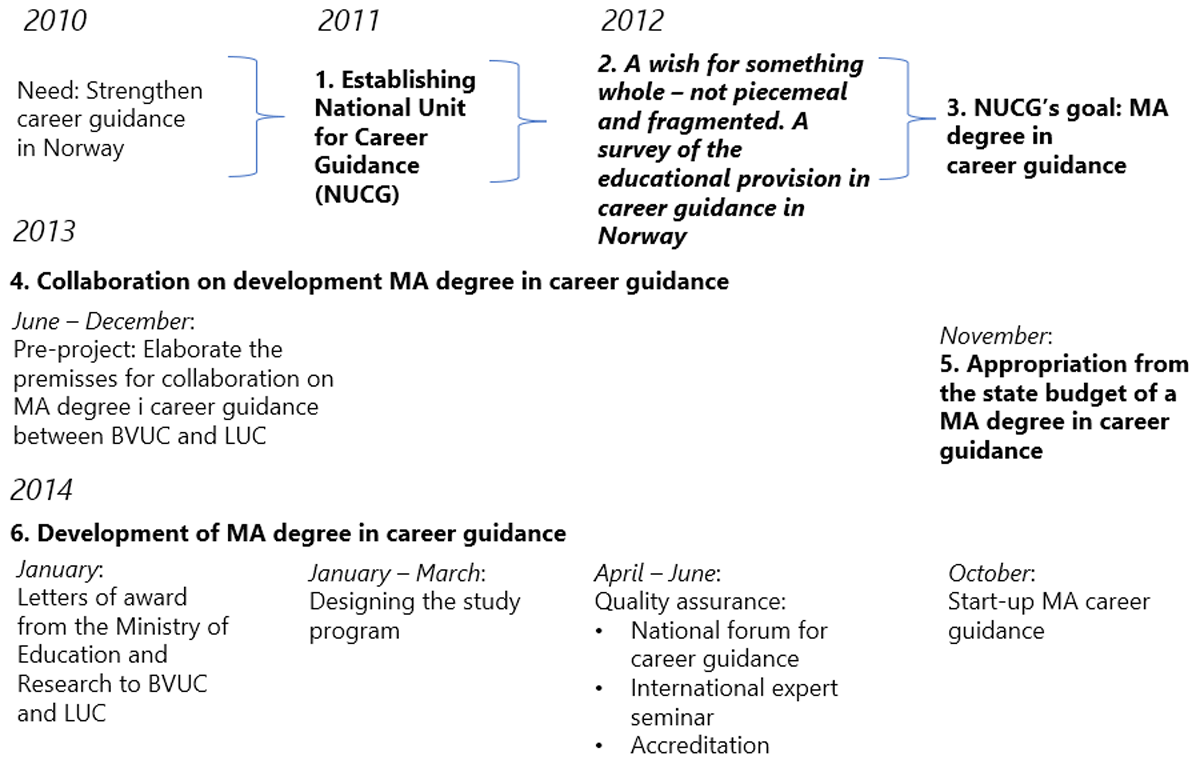
Figure 1
Events and processes.
The establishment of The National Unit for Career Guidance
In 2010, the Ministry of Education and Research commissioned Vox, the Norwegian Agency for Lifelong Learning, to establish The National Unit for Career Guidance (Nasjonal Enhet for Karriereveiledning). The unit was part of Vox and was launched in January 2011. One of its key objectives was ‘… to strengthen quality and professionalism in career guidance, increase the knowledge base, stimulate the development of equal opportunities and promote access to career guidance for young people and adults in different phases of life’ (Kunnskapsdepartementet, 2010). The letter of award specified that the unit was to ‘identify the need for training measures for career advisors.
The report on the offer and quality of education in career guidance
DAMVAD was commissioned to conduct a survey of the educational provision in career guidance in Norway. The report concluded that the educational provision in career guidance was ‘fragmented and poorly defined’ (DAMWAD, 2012, p. 10). They found 51 continuing professional development courses in advisory services or career guidance at 16 institutions. The courses were worth 15 or 30 ECTS credits. The content of the courses was poorly defined and there was no shared understanding of career guidance and the requirements for qualifications among career advisors. Thus, significant differences in students’ competence could be expected depending on where they had received their education.
The institutions lacked resources and incentives to strengthen the educational provision and academic communities in career guidance (DAMWAD, 2012, p. 10). DAMVAD proposed establishing an educational provision in career guidance up to the master level and introducing incentives and/or grants that encourage the institutions to develop a master’s programme in career guidance. Based on the analysis The National Unit for Career Guidance’s goal was to establish a programme, and it received widespread support from experts in the field of practice and academics (DAMWAD, 2012, p. 11).
DAMWAD (2012) presented an outline of the structure, organisation, and content of a master’s programme. No single institution had a career guidance academic community with a sufficient range and standard of competence to teach a master’s degree. To meet the accreditation requirements, a suggested alternative was for two institutions to collaborate. The requirement of MACG was regarded as crucial to providing a comprehensive educational program. The informants argued that MACG could be module-based, giving students the opportunity to take individual modules as standalone postgraduate courses with ECTS credits. The academic content should cover a broad scope within career guidance, with the possibility for specialisation in some areas. The informants had differing views on whether career guidance should be part of a broad-based master’s degree in guidance or whether there should be a dedicated MACG (DAMWAD, 2012, p. 74). However, there was consensus among them that MACG should build on a wide range of educational backgrounds and professional experience.
NUCG ‘s goal was a MA degree in career guidance
Based on DAMVAD’s report, NUCG goal now was to have a master’s programme established in career guidance. Their strategy was (1) to invite university colleges to collaborate on developing the programme, (2) to secure funding for the master’s programme, and (3) to contribute to accreditation. The order in which these were to be done presented a challenge because funding, collaboration, and accreditation were interdependent. Their challenge was to choose collaboration partners.
The collaboration between NUCG and the university colleges
Events leading to collaboration
In choosing collaboration partners, NUCG had to consider factors such as continuity in postgraduate courses in career guidance and advisory services; whether these were well subscribed and had good student throughput rates; whether the postgraduate courses were at master level; whether the management had prioritised student places for career guidance; and whether academic staff were well qualified in teaching and research. The institutions that provided courses in career guidance had academic communities consisting of one to seven members. Each community was insufficiently equipped to provide adequate academic resources.
NUCG spoke with people from academic communities about the possibility of MACG. They concluded that accreditation would have a more solid foundation if the two institutions collaborated. Academics at BVUC and LUC identified an opportunity to work together, and they were invited to participate in a dialogue with NUCG. However, they were not in a position to make binding decisions for their institutions. In June 2013, representatives of NUCG met with academics and management from the two university colleges to discuss a possible collaboration. The result was that a group of academics from each institution was given the task to investigate the possibility of a ‘joint master’s degree’, which allows students to take courses in collaborating educational institutions. The report was to include an outline of the structure, organisation and content of such a master’s programme, proposals for a collaboration model and costs for development and implementation.
Endorsement by the university college administrations was a further prerequisite. The university colleges invited Vox to a workshop in August 2013 in which the relevant deans and a panel of academics participated. The project thus gained support at the Dean level. Vox’s aim at the workshop was ‘… to clarify the possibilities of a master’s degree in career guidance’ (Vox, 2013). The result was that the university colleges signed a binding collaboration agreement with Vox and each other to examine the possibility of establishing a master’s degree in career guidance. The following were also agreed upon: to examine the university colleges’ capacity to develop such a programme, to assess the possibility of a national (and Nordic) joint master’s degree in career guidance, to plan an outline of the programme and to draw up a letter of intent for the further collaboration.
The university colleges’ representatives at the meeting understood that Vox had identified an opportunity to obtain funding for a master’s programme in connection with the change of government after the general election in September 2013. It was not about promises or specific obligations, but more a reference to parliamentary practices during a change of government. They referred to the ‘open window’ in the transition to a new government, where the Ministry of Education and Research had the opportunity to present issues in the preparatory work for the revision of the national budget.
Concern about a dedicated master’s degree
At the workshop in August 2013, the university colleges’ representatives expressed concern about a dedicated master’s degree in career guidance. They wanted to help elevate career guidance to the master’s level but needed support from the leadership at the university colleges. Then they had to consider the organisation of a master’s programme that the boards could approve. Important conditions were compliance with political guidelines for the development of master’s programs, demand for competence and recruitment of students, sufficient competence to receive accreditation and funding.
In the last decade, there was political pressure to develop vocationally relevant courses within more broad-based master’s programmes. Reps considered that internal support would be more likely to be obtained for a broader master’s programme in guidance than for a more specialised master’s programme in career guidance.
The university colleges were also uncertain about whether there would be a sufficient recruitment base for a master’s programme solely in career guidance and whether they would be able to fund the student places from their normal budgets. They believed that they had sufficient competence to receive accreditation for a master’s degree in guidance, with the possibility of specialisation in career guidance, but that they did not quite qualify for accreditation of a master’s programme purely in career guidance.
The representatives believed that a recruitment base existed among students who had completed various postgraduate studies in advisory services, career guidance, pedagogical guidance etc. They also wanted to allow former guidance students to take supplementary courses for a master’s degree.
NUCG’s minutes from the meeting were titled ‘Workshop for establishing a master’s degree in (career) guidance’, an indication that the unit maintained its goal of a master’s programme in career guidance but was still slightly reticent. It was understood that a master’s degree in career guidance would become a reality if funding for this was specifically obtained.
Professional responsibility for MACG
BVUC and LUC based their agreement on equal and independent academic, legal, and financial responsibility for students in a single MACG. Consideration was given to one institution assuming academic responsibility, with a requirement to collaborate with the other, to create a joint master’s degree in which both institutions provided human and financial resources. However, when determining the format and content, they chose instead to allocate ten full-time student places to each institution, thereby resulting in a joint master’s degree with the following framework: 1) Two accredited master’s programmes in career guidance at BVUC and LUC respectively; 2) Four courses worth 15 ECTS credits that are mandatory for all students; 3) Academics from both institutions would contribute to the courses; 4) Students who have been admitted to the two institutions respectively should receive joint tuition in the mandatory subjects; 5) On-campus sessions should alternate between the two institutions; 6) The institutions should establish joint projects to develop career guidance as a specialist field.
Launching the master’s programme
Launching the programme in 2014 was a challenge for BVUC and LUC. It entailed developing the content of the programme, assessing, and writing an accreditation submission in accordance with NOKUT’s requirements and obtaining approval from governing bodies at each of the university colleges. This process usually takes more than a year but was expected to be completed in six months. The solution lay in the possibility for the university colleges to perform a self-accreditation. They had to meet NOKUT’s requirement to document their ability to cover the specialist field of the master’s programme by their competence in doctoral degree programs. LUC’s assessment was that self-accreditation was justifiable within the doctoral program ‘Child and youth participation and Development of Competencies’. Meanwhile, the BVUC assessment of accreditation was within the doctoral programme ‘Pedagogical resources and learning processes’.
Allocation of student places
The allocation of student places (Kunnskapsdepartementet, 2014) corresponded to what Vox and the institutions had agreed on in the fall of 2013. The award letter stipulated that the two institutions should work together to establish a master’s program in career guidance. The collaboration was to be based on an agreement on the content, research, and future development of the new programme. The Ministry left it up to the institutions themselves to determine the wording of the agreement.
Allocation of funds
Before the funding was ready, Vox invited BVUC and LUC to collaborate to develop the master’s programme. Vox had a financial intensive but no guarantee for a fully funded master’s programme. A preliminary project was therefore agreed, which would result in a short note from the colleges about their collaboration to develop a master’s programme in career guidance. The note was to be used by Vox in a submission to the Ministry of Education regarding an allocation from the state budget in the autumn of 2013.
Vox’s procedure for obtaining funding was linked to the change of government after the general election in September 2013. They referred to the “open window” in the transition to a new government where the Ministry of Education and Research could play a role in preparations for the revision of the national budget. Vox asked BVUC and LUC to prepare a note of a maximum of two pages that could be part of the input, in which they explained their prerequisites, willingness, and ability to develop and provide a master’s programme in career guidance. The note gave the Ministry of Education and Research an assurance that expertise and institutional anchoring were in place to establish the program.
A clarification was provided with the revised national budget in November 2013 (Prop. 1 S Tillegg 1 (2013–2014)). Then it was clear that study places for a master’s degree in career guidance were included in the budget. A prerequisite that had to be in place to achieve accreditation was the requirement for professorial competence in career guidance. ME&R contributed with an allocation of 1 million NOK to finance Professor II positions and the development of a professional community in career guidance.
The development of the MA degree in career guidance
NOKUT’s requirement for accreditation and NUCG need for quality assurance constrained the design of the master’s program and its professional content.
Requirement for accreditation
NOKUT was responsible for the accreditation of higher education courses in Norway. Accreditation of a master’s degree requires documentation of 1) a plan of the study programme, setting out the structure and content of courses, forms of assessment, internationalisation, links to research and development work, and relevance to the labour market, 2) a summary of the subject-related competence of persons associated with the study programme, and 3) an academic community that had the capacity for research and development of the subject and a competence profile that covered the scope and specialisation in the field, active participation and collaboration in national and international academic networks (Nasjonalt organ for kvalitet i utdanningen, 2012).
The study programme. The master’s programme was given a scope of 120 ECTS credits, and was organised as five mandatory courses, an elective specialisation course and a master’s thesis. Except for the thesis, each course was worth 15 ECTS credits. The courses were titled ‘Career guidance in an individual and societal perspective’, ‘Changing career development and career guidance practices’, ‘Work, education and social inclusion’, ‘Processes and working methods in guidance’ and ‘Science theory and research methods’. Students could be admitted to a broad-based master’s degree which included a thesis of 30 ECTS credits, or an in-depth master’s degree with a thesis of 45 ECTS credits. Students in the former would also take a specialisation course based on research work at the relevant institution.
Competence. The competence profile of the academic staff had to include experience and knowledge from career guidance as a societal activity, insight into and application of theories on career development, learning and guidance, insight into how the disciplines of pedagogy, psychology, sociology, social anthropology, political science, law, philosophy and ethics could help develop knowledge about careers in a lifelong perspective, knowledge about initiating, leading and conducting research, development and innovation processes, as well as strategic knowledge of policies, laws, administration, the education sector and the labour market.
Capacity for research and development. The NOKUT measure for sufficient capacity for research and development was in the distribution of the share of professors (10%), associate professors (40%) and assistant professors (50%) who contributed to the master’s programme with their research, publication, and collaboration with other researchers in national and international networks. At the accreditation in spring 2014 BVUC and LUC were able to meet the criteria to some extent. Within four years the program would be fully operational and the capacity for research and development would be significantly improved.
Quality assurance
NUCG were not in a position to directly influence the professional content of the programme. Their goal was a MA in career guidance where a necessary condition was career guidance in a lifelong perspective and promoted by an education that went beyond fragmented courses. They choose to respect the domains of responsibility between the government and the university colleges with their professional autonomy and found a solution for their need for quality assurance by hosting a seminar in Oslo on 8 and 9 May 2014, where the management, organisation and content of the master’s programme were discussed.
Five experts from European universities were invited to attend by NUCG, BVUC, and LUC. The working group received valuable feedback. Themes were cooperation between political governance and universities, competition and cooperation between university colleges, quality measures for outcomes of learning, the use of master’s programmes to stimulate research in career guidance and participation in international networks with the aim of professionalising career guidance in Norway.
NUCG also established a national career guidance forum as a reference for its activities. This group consisted of 26 representatives with managerial responsibilities in public administration, trade unions and other special interest organisations. The plans for the new master’s degree were presented to this group in April 2014.
Professional content
NUGC and the university colleges agreed on that the programme should reflect the status of knowledge in career guidance nationally and internationally. This could be achieved if the programme covered a range of career theories and research methodologies, without appearing fragmentary.
The programme should reflect research-based knowledge. The emphasis should be placed on students being able to identify and understand the distinctive characteristics of careers in Norway’s multicultural society, and the major changes in the labour market and the competence requirements for jobs. They should also be able to identify and understand trends in Norwegian society considering international research on career guidance, development, and learning.
Discussion of the rationality behind the actors’ plans, ideas, strategies, and actions
In the following, the analysis is discussed in relation to three discursive expressions (Sultana, 2018). The actors had a consensus view that the need for a master’s degree in career guidance arose because of societal development. Therefore, it is crucial to bear in mind the societal context in which the master’s emerged.
Career guidance as part of societal development
According to Sultana (2018, pp. 63–64), discourses “serve as lenses that predispose us to consider specific social practises as ‘problems’, to articulate such ‘problems’ in particular ways, and to adopt one set of ‘solutions’ for them rather than another”.
From 1960, we find that the discourse on career as a phenomenon shifts from promotion to planning of people’s lives (Bengtsson, 2011). Lifelong learning, lifelong guidance, and career planning skills are presented as ‘endless’ activities. Policy documents such as the white papers on getting more people into work (Meld. St. 46 (2012–2013)) and on the education strategy (St. meld. nr. 44 (2008–2009)) place the concept of active citizenship in a discourse on qualifications and skills. Developing competence in career planning became more about taking responsibility for one’s own career within a discourse on the knowledge economy in which career guidance should be included as a welfare measure that helps to create individuals who are active, competitive, and morally responsible in terms of their education and work life (Kjærgård, 2013). Although technocratic discourse still is evident, we see a stronger emphasis on humanistic discourse in which individual personal growth is crucial (Sultana, 2018).
Career guidance was also seen as a means of maintaining the welfare of society. Welfare is dependent on people having paid employment. Participation also has its own value in that it creates social inclusion in society. Major structural changes give rise to unemployment and break up social networks, and they also provide a challenge in assisting people to identify new opportunities for employment and/or education. Career guidance is a means of helping to find work, leave a job, transition to a different line of work, exit the labour market, or find studies that provide a basis for new paid employment. Career guidance should also help people with health-related limitations find and keep a job.
The political support for the establishment of NUCG was based on the perception of career guidance as a tool for achieving education and labour market policy goals (Kunnskapsdepartementet, 2010). Here, the technocratic discourse, for its primarily concern with social efficiency, can be seen as an essential driver in development (Sultana, 2018). The objective was to create a competitive advantage for Norway in the global economy through restructuring, innovation, and novel approaches in agriculture, fisheries, industry, business, public administration, and services. During the first two decades of the 2000s, the restructuring was driven by advancements in technology which saw several activities, functions and tasks disappear and new one’s spring up along with new requirements for competence. Many of these job functions were knowledge-based and highly specialised.
Understanding career guidance and its objectives was rooted in practises that varied between actors. Different concepts among comparable practises presented a challenge for NUCG in their efforts to coordinate the thinking of the various actors. Most actors would be familiar with the concept of guidance but linking it to a career was alien to many. Educational and career counselling were traditionally the remit of schools, while NAV’s experience was in guidance linked to rehabilitation, employment services and retraining. Universities and university colleges provided study guidance and a few had established career centres. ‘Career’ was a loaded word for many, who considered it to mean ‘move fast’. This did not align with the premise of many career advisor interactions. The challenge was to introduce a mutual understanding of career guidance in a lifelong perspective. The master’s programme in career guidance was a mean to succeed.
Tensions in judgment of career guidance qualifications
The master programme had to address the discursive tensions between the perspectives of the various actors (Sultana, 2018). Practitioners seek knowledge about methods for individual career guidance methods, while policy actors want to influence adolescents’ educational and career choices based on societal needs. Many practitioners will priorities methods for career guidance for individuals and groups as well as career learning, and the curriculum for the master’s degree in career guidance accommodates this. However, a master’s degree also teaches students how to work independently, adopt novel approaches, and exercise critical thinking, thus creating career advisors who view themselves and their work in a social and cultural context.
Policy makers are primarily interested in guiding adolescents and adults toward choosing an education that meets the need for competence, with the underlying motive of ensuring growth in the Norwegian economy. This differs from the higher education sector, whose social mission is to teach independence, critical thinking, and innovation. This can involve influencing people’s educational and career choices, but its primary focus is personal growth and managing one’s own career in an unpredictable and changeable labour market.
One of the criteria, as university colleges, was to allow the programme to reflect different paradigms in an international discourse on career theories (Patton & McMahon, 2014; Sultana, 2018). Thus, the design of the master’s programme had to cater for the contrary preferences of a technocratic, humanistic, and emancipatory discourse.
Discourses in subjects
The first four courses (each worth 15 ECTS credits) in the master’s programme address each of the three discourses: technocratic, humanistic, and emancipatory (Sultana, 2018, pp. 64–65) with a slightly differing emphasis. In the course ‘Changing career development and career guidance practises’, the focus is on career development as a process in which the person’s various life roles and the contexts in which career choices are made must be considered when planning career guidance. The emancipatory discourse, with its aim to raise awareness among individuals of the source of their problems is put in the foreground, accompanied by the humanistic discourse with its focus on personal agency, and the technocratic discourses focus on the labour market needs.
In the course ‘Processes and working methods in guidance’, students develop professional competence in recognising and understanding each other, and using this as the basis to plan, justify, implement, evaluate, and develop guidance for people in relation to their career choices. Here, a humanistic discourse characterises the content of the course, supported by an emancipatory discourse. A technocratic discourse is in the background.
In the course ‘Work, education, and social inclusion’, students learn how education, work, social life, and gender affect people’s identity from a lifelong perspective. An emancipatory discourse is in the foreground, supported by perspectives from a humanistic discourse. Perspectives from a technocratic discourse are used as a contrast to the emancipatory one.
In ‘Career guidance from an individual and social perspective’, students explore the tensions, opportunities and ethical challenges that can arise between the needs of society and of the individual. The content alternates between perspectives from a humanistic, an emancipatory, and a technocratic discourse.
Research, development, and innovation
The establishment of the master’s programme entailed a significant strengthening of the research, development, and innovative work in the specialist field. To meet the accreditation requirements, the university colleges had to document the existence of an active research community within career guidance. Requirements were set for research competencies at associate professor and professor level. The master programme was to be phased in over four years. During this period, more academics would be brought on board as student numbers increased. Many would enter the qualifying pathway for a doctorate in career guidance. Students would spend 25% or 30% of the study period (45–60 ECTS credits) on their own research and development work for their master’s thesis. In general, the focus of the research generates a significant amount of new and critical knowledge that enhances the expertise in career guidance in Norway. Both by challenging and further developing the understanding of the different discourses in the field.
Why Did the Actors Succeed, Despite Tensions Between Them?
We have identified three overarching processes that led to MACG: (1) collaboration between Vox and the university colleges involved, (2) funding and (3) the development of the master’s programme.
Collaboration between NUCG and university colleges
Vox faced a paradox in their strategy to reach the goal of MACG. To obtain funding for a study programme, they had to have an agreement with at least one institution. But they could not expect the institutions to commit to carrying out the work necessary to meet the requirements unless the funding was in place. The choice of partner also required a normative endorsement to understand career guidance in a lifelong perspective, whereby a uniform interpretation of career guidance could be adopted across the varying practices and lexicons. BVUC and LUC offered a pragmatic approach where they would include courses in career guidance in a general MA in Guidance given that they were supported by economical incentives. The solution gave NUCG reliable partners that was trusted by people responsible for the application for funding of a MA in career guidance.
Collaboration between BVUC and LUC
From a cost-benefit perspective, giving responsibility to one institution instead of two may have been feasible; however, this may have led to one institution effectively becoming a subcontractor to the other. It would also mean that ownership of the programme would be strengthened in one party and weakened in the other. This would have repercussions for the efforts in competence development and research and development work. The solution was a collaboration between two equal university colleges, with accreditation of the same master’s programme at both institutions. Collaboration also involved being able to address contrary opinions, differences, and competition between the two institutions. Contrary opinions and competition can have a positive impact on development and innovation, provided both sides are able and willing to negotiate in the event of conflicts and find creative solutions.
Community of values
Our experience was that parties whose collaboration is successful find each other in a community of values. The respect for each other’s autonomy and the ability to deal with delimitations in responsibilities and functions to realise the master’s programme were important prerequisites. Although the national career guidance’s goal was to implement a programme in career guidance, they respected the independent responsibility for designing and obtaining accreditation for the programme. The unit assumed responsibility for securing the necessary financial resources to establish and run a master’s programme.
Mutual respect for their autonomy strengthened the parties’ trust in each other. Trust was reflected in their ability to listen, learn, and change plans based on a co-construction of the project. Collaboration was characterised by transparency in information, intentions, and motives for actions. The parties took ownership of the whole whilst also contributing their distinctive areas of expertise. The national unit for career guidance’s process management had a clear goal, but the path to the goal was formed through contributions from actors in policymaking, administration, and education. Differences in the parties’ interests and perceived limitations were considered and used as a basis for strengthening the quality of the master’s programme.
NUCG respected the university colleges’ responsibility to quality assure the academic content of the master’s programme within the framework of career guidance in a lifelong perspective. However, the unit required a knowledge base that was rooted in Norwegian and international research in order to enhancing the competence of career advisors in Norway. The requirement was understood in the context of the core values in the collaboration between the unit and the university colleges. The parties therefore had a shared wish to quality assure the programme beyond the accreditation, through feedback from the field of practise, the administration, and from key academics in European universities. Their wish was granted, and the national unit thus aided communication between the university college actors in Norway and international experts. This made it possible to confirm, reject or further develop aspects of the master’s degree programme. Through this process, the national unit had an indirect impact on the master’s programme corresponding to the notion of career guidance in a lifelong perspective. This confirmed that the content of the programme they had obtained funding for was in line with their expectations.
The development of a constructive collaborative environment between Vox, BVUC, and LUC was vital for the establishment of a master’s degree in career guidance. None of the parties involved had unilateral control over the policy processes that led to the master programme, but all provided necessary and complementary input. The collaboration was characterised by respect for the areas of responsibility, autonomy, and interdependence of each other. For example, the university colleges were transparent with each other and Vox about what needed to be done to obtain accreditation for a master’s degree in career guidance. The university colleges welcomed critical questions from Vox and other stakeholders. Vox, for its part, did not dictate how BVUC and LUC should collaborate, or the academic content of the master’s programme. They had views on organisation, content, and international cooperation, but no specific requirements for form and content. It was up to the university colleges to design these. The national career guidance unit and the university colleges had a mutual interest in quality assurance and development of the master’s programme through external input. The university colleges made clear the prerequisites for establishing a master’s degree in career guidance. Vox contributed in the way the university colleges had requested, including providing funding for a professor II position.
The funding came from a policy process in ME&R in which the turning point was the establishment of NUCG in 2010, whose objective was to improve the quality of career guidance in a lifelong perspective in Norway. NUCG considered that the quality of educational provision had a significant impact on the quality of career guidance. They designed a fact finding mission to gain insight into how the standard of career advisor qualifications could be raised. They followed up the recommendations with the goal of establishing a master’s degree in career guidance. Funding was a prerequisite for achieving this goal. The idea was to submit a proposal to ME&R for the funding of a master’s degree in career guidance from the national budget. The proposal was a response to a mandate in a policy process in ME&R in which the goal was to strengthen career guidance in Norway (Kunnskapsdepartementet, 2010). ME&R prioritised the proposal and received political support.
The organisation, form and content of the master’s programme had to meet formal requirements for accreditation at level 7 in the Norwegian Qualifications Framework for Lifelong Learning (Kunnskapsdepartementet, 2011). Furthermore, the programme had to have vocational relevance and reflect the knowledge based on Norwegian and international research in career guidance. The competence requirements that were set for the academic community in the programme would dictate the educational level of the new programme. The long-term collaboration and specialist competence that the two university colleges had developed through various postgraduate courses, networks, and projects over a ten-year period, were central to producing the curriculum, course plans and other accreditation documents within three months.
Conclusion
Our findings and discussions about the establishment of the master’s programme can give the impression that all involved had the same goal and that there were indeed some shared interests in the establishment of this educational provision. However, different ambitions and motives were also in evidence among the actors in terms of the profile and substance of the master’s programme. Such tensions and contradictory ideas in themselves created a certain dynamic in the development of career guidance as an academic subject and the further development of the study programme.
Competing Interests
One of the authors, has been an editorial board member of NJTCG journal in 2020–2021. The authors have no other conflict of interests to note.