
Introduction
Globally, 13% of young people belong to the not in education, employment or training (NEET) category (Apunyo et al., 2022). This means that they are unemployed or inactive and not receiving any formal or non-formal education or training in a given period (Elder, 2015; Eurostat, 2022). The reason why the NEET group has received significant attention, both in policymaking and as a field of research (Holmarsdottir & Dupuy, 2017; OECD, 2014), is related to societal and individual issues and concerns. Unemployment in early adulthood can have negative long-term effects and consequences in terms of health, social inclusion, and well-being throughout one’s life (Bäckman & Nilsson, 2016). Thus, the price of social exclusion is high for those affected while also producing major socio-economic challenges. As a result, reducing youth unemployment has been a policy priority in most high-income countries, and numerous new initiatives and programmes have been implemented over the past few decades (Holte et al., 2019; Mawn et al., 2017).
In all European countries, public employment services and youth services (i.e., services aimed specifically at the target group of young people) play a vital role in supporting the integration of NEET individuals into the labour market. In general, youth services are provided to empower young persons by improving their motivation and skills to learn and return to the labour market. Such services can include career counselling, training and youth workforce investment activities, and these services are provided by public-, private- and third-sector organisations or hybrids of the three (Alldred et al., 2018). However, estimates show that in many countries, these services fail to reach significant portions of the NEET target group (Smoter, 2022). In fact, parts of the evaluation literature are rather pessimistic concerning youth services (Ehlert et al., 2012; Holte, 2018): Nordic studies have shown that seemingly supportive practices, i.e., work placements and training, instead could have negative effects by channelling young people into a limited number of occupational tracks at the lower end of the labour market (Frøyland et al., 2022; Haikkola, 2021).
To ensure the return of young people who fall within the NEET category back into society, there is an obvious need for service innovation (Kõiv et al., 2022). A recent review of Nordic research literature (Frøyland et al., 2022, p. 120) indicated that while the inclusion issue is extensive, problematic and resource-demanding, it is nonetheless possible to solve via a number of constructive measures and efforts. This position is in line with that of Toivonen (2013), who pointed out the possibility of creating genuine alternatives to today’s standard activation services. Such new services based on young people’s voluntary participation – delivered using more personal means instead of a carrot and stick approach – promise better long-term outcomes. Tailored service designs should also be included in the ongoing development of lifelong career guidance services. However, there has been little research on the extent to which service innovation is represented in the extant literature on NEETs. In this article, we provide insights into the research-based knowledge on innovative measures targeting the NEET group. We conducted a systematic literature review to survey the state of the art based on the following research question: What are the scope and characteristics of service innovations targeting NEETs in the research literature?
Innovation in NEET services
It is important to bear in mind that NEETs are a heterogeneous group from a wide variety of backgrounds, ranging from disadvantaged and disengaged youth to highly educated young people. Young people are not in employment, education or training because, for example, they dropped out of school, lost their job or decided not to participate in the labour market or education (Eurofound, 2021; Holmarsdottir & Dupuy, 2017; OECD, 2014). Therefore, the NEET concept itself has been contested. It is problematic to generalise about a highly heterogeneous group of young people who are facing very different challenges and thus have vastly different needs. There is criticism concerning the issues of categorising an entire group under a single label and identifying a substantial part of a nation’s youth by defining what they are not (Yates & Payne, 2006).
Another challenge with the NEET concept concerns different types of explanations. Although some researchers have considered individual characteristics, circumstances and interactions (i.e., micro-level and personal factors within family, community and cultural contexts) to be the most important explanations for the NEET phenomenon, others have found these explanations to be insufficient (Holte et al., 2019). Serracant (2014) concluded that being in a state of NEET is directly linked to structural factors, which, he argued, ‘relativises the role of the individual’s attitudes as the key issue to explain the phenomenon’ (pp. 412–413). The NEET discussion considers, among other factors, the risk of assigning responsibility to individuals instead of to institutions and collectives (Watts, 1996) and how this leads to a neoliberal responsibilisation of social issues (Ball, 2008). Such responsibilisation occurs despite the fact that we know that problems related to individuals’ interactions with the labour market are structural problems and therefore require structural solutions. The system critique revolves around the issue of whether the NEET definition and application in policy and research contributes to the development of more effective measures and services (Pascual & Martin, 2017; Toivonen, 2013). When research tends to focus on identifying risk factors characterising the NEET group (using group averages and cross-sectional studies), while practitioners focus on intervening in individual processes (Blaauw et al., 2019), this may detract attention from the causes: namely, the societal forces that lie behind youth unemployment and social exclusion. Furthermore, this may have a major impact on the development and implementation of new youth services.
In this article, following Gustafsson et al. (2020), we define service innovation as ‘a new process or offering that is put into practice and is adopted by and creates value for one or more stakeholders’ (p. 114). Service innovation characteristics can be related either to the creative process of the development and implementation of a novel idea (e.g., when resources and knowledge are combined in new ways, such as through the active involvement of end users or other actors in the creation of new service delivery processes or service offerings) or to the outcomes of this process (e.g. new service concepts or models) (Witell et al., 2016). In the context of youth services, possible outcomes of innovations concern the complex social and personal skills necessary for young people’s self-development and successful transition from education to employment.
Today’s research on innovation in the public sector emphasises processes of co-creation between different stakeholders (Bekkers & Tummers, 2018; Voorberg et al., 2015). To solve complex societal challenges (e.g., youth unemployment), governments should collaborate with different relevant and affected actors, such as citizens, companies and social entrepreneurs (Sørensen & Torfing, 2011). Thus, in line with Chen et al. (2020), service innovations could be classified in terms of the innovation locus. Intentional measures to create new services can be directed internally, in which case the focal organisation works on its own to define intentions and create new interventions, models or programmes for actualising these intentions. This process entails service innovations accomplished by, and realised in, the focal organisation alone. Innovation efforts can also be directed externally, in which case organisations collaborate with other stakeholders to create value for one or more stakeholders. This approach entails outward-looking innovative processes that involve actors from outside the focal organisation. We focused on the 18–29-year-old group, limited to young adults who need support (services) to improve their chances of entering education or work. Although we work in the European context, in which the provision of employment services through active labour market policies is a public responsibility, we decided to apply a broad conception of service innovation in our literature search to include examples from other contexts.
Methods
To identify the scope and characteristics of service innovations targeting NEETs, our study followed the principles of the systematic literature review method in five main steps (Petticrew and Roberts, 2006). The first step was to (1) clearly define the question. Our main aim was to identify the scope and characteristics of the service innovations targeting NEETs as discussed in the research literature, then (2) determined the types of studies. We wanted to include all types of contributions from the peer-reviewed literature. As the vast majority of scientific articles are published in English, we narrowed the focus to English-language papers and chapters from 2000 to 2020. We imposed no restrictions on the types of innovative measures. However, the literature had to focus on services intended to help the target group return to education or work.
The next step was to (3) conduct a comprehensive literature search. We developed a search strategy based on the key concepts in the research question (Bramer et al., 2018) and the chosen definitions of the concepts presented in the Introduction. This search strategy reflected a combination of the following three key concepts: youth, NEET and service innovation. We sought to find as many synonyms as possible while avoiding highly general terms. To ensure the inclusion of all individuals in the NEET target group, we used different keywords, such as NEET, at risk, socially excluded, out of work, dropout and disadvantaged, in combination with terms like youths, teens, young, adolescent and juvenile. As evident from the extant literature, the term ‘service innovation’ is often used synonymously with ‘new service development’ (Witell et al., 2016). Therefore, we included additional keywords in the search strategy: service development, new services, innovation, innovative, invention, entrepreneurship, service design and renewal. We chose to include the terms ‘entrepreneurship’ and ‘service design’ for two reasons. First, we wanted to capture the studies that address the role of social entrepreneurship in service innovation. Second, service design has become a multidisciplinary approach that plays a key role in fostering service innovation (Joly et al., 2019). A broad, sensitive search was the main aim (Bramer et al., 2018), and the review team was prepared to screen a large number of results.
After trial searches in different databases, the final search string was compiled as follows: (youth* OR teen* OR young* OR adolescent* OR juvenile*) AND (“at risk” OR NEET* OR “social* exclu*” OR “not in employment” OR “not in education” OR “not in work” OR “not in training” OR unemploy* OR “out of work” OR “neither in employment, education or training” OR “not in employment, education or training” OR “drop* out” OR dropout* OR disadvantag* OR “neither in employment nor education and training”) AND (innovat* OR “service develop*” OR “new service*” OR invention* OR entrepreneurship* OR “service design” OR renewal OR entrepreneur*). As a quality assurance measure, a librarian outside the review group checked the search string and gave us feedback on improvement opportunities.
The main searches were conducted by two members of the review group. We searched the following databases: Social Sciences Citation Index (Web of Science), Scopus, APA PsycInfo (Ovid), ERIC and Academic Search Complete (Ebscohost), and PsychArticles. Some adjustments to the search string were necessary due to variations in the search capabilities of the different databases – for example, some databases used the term ‘not’ as a stopword, which meant that it could not be used as a search term. In the appendices, we provide the full search history for PsycInfo (Ovid) and ERIC and Academic Search Complete (Ebscohost). The searches were conducted in February 2021. For PsycInfo, we used both the advanced search interface for Boolean searches and the basic search interface for service innovation meant to help NEETs. The systematic searches produced 3,340 results, which we downloaded to an EndNote library for the subsequent removal of duplicates. To secure a unique set of results, we performed duplicate control using EndNote. For the databases of ERIC and Academic Search Complete, duplicates were removed automatically by the software.
The remaining 2,627 results were imported into Rayyan (an internet-based screening tool) to (4) screen the results based on our inclusion and exclusion criteria. In the first screening, the research team split up into two groups. We sorted the records based on titles and abstracts, and the screening was conducted in pairs. To remove any possible sources of bias, the screeners could not see any information regarding the screening decisions of the other researchers. Each pair carried out a blind screening and used labels to describe the reasons for inclusion and exclusion. The following criteria had to be met for an article to be included:
Must concern young people aged 18–29 years who are NEET.
Must focus on services intended to help this target group return to employment, education or training.
Must involve elements of service innovation (either processes or outcomes).
Peer-reviewed and published from 2000 onwards.
In English.
After the first screening, we lifted the blind to facilitate further deliberation about which references should be included. When deciding whether a study was reporting on service innovation, we emphasised the extent to which the researchers behind the peer-reviewed articles and book chapters described the efforts studied as something new and innovative. Thus, this analysis could not reveal the extent to which such efforts actually constituted service innovations. Innovation contains a subjective component: what is new to one person or organisation may not be considered so by another (Hartley et al., 2022), and the extent to which something is new depends on the context and organisations’ perspectives (Snyder et al., 2016). However, innovation should involve changes in value for one or more stakeholders, and all studies included in the review dealt with some form of renewal related to services targeting NEETs.
A total of 89 publications were sought for retrieval, while 84 were assessed for eligibility. After a thorough reading, 57 publications were excluded based on the aforementioned inclusion/exclusion criteria. Due to the nature of our research question, we did not perform a critical appraisal of the included studies. In Figure 1, the PRISMA diagram depicts the flow of information across the different phases of the systematic review.
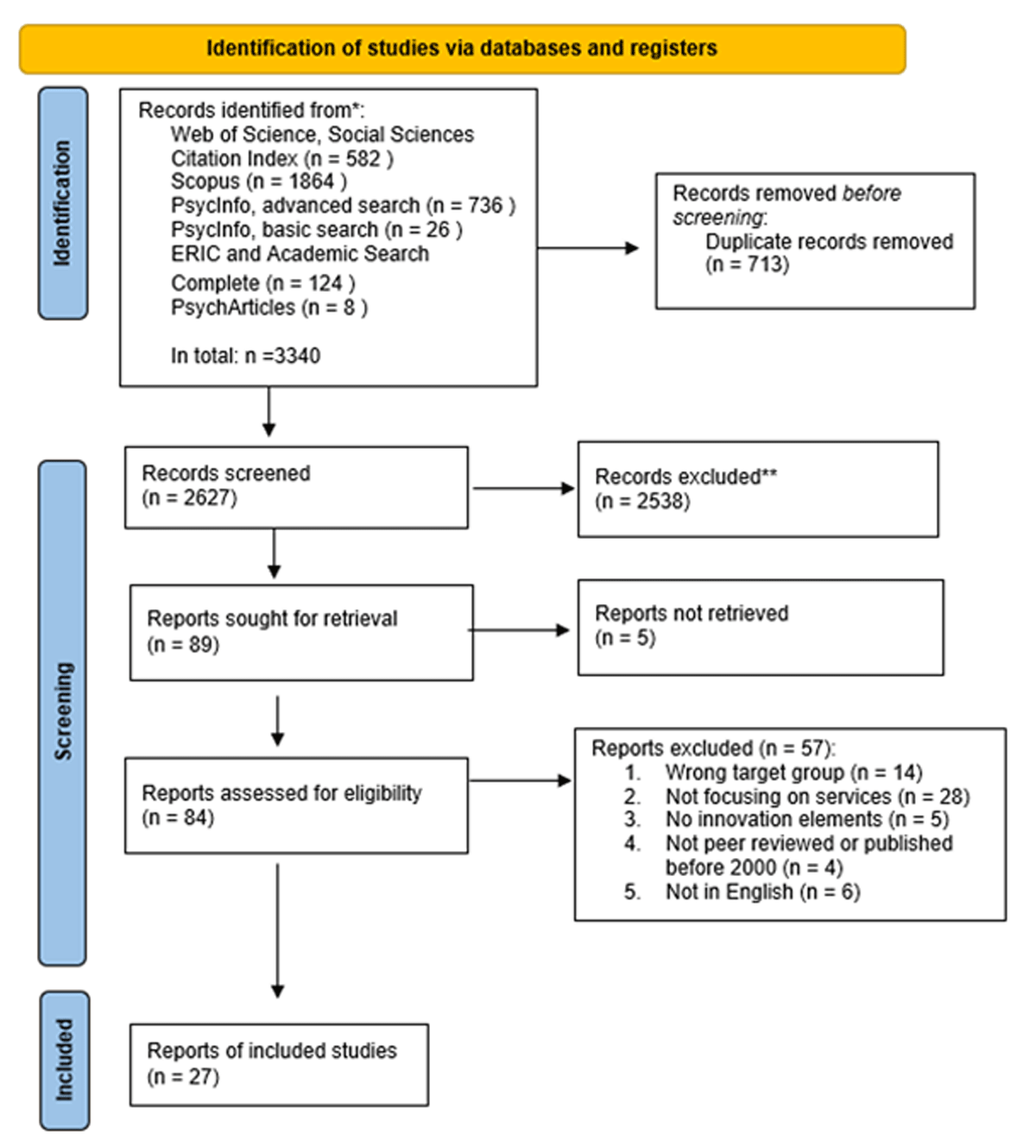
Figure 1
PRISMA diagram (Page et al., 2021).
Finally, we (5) synthesised the studies. We first used a matrix to systematise the documented research based on, for example, the studies’ main topics, the actors and sectors involved, the age span and the service innovation content addressed by the publications. Then we conducted a thematic (inductive) content analysis of the 27 articles and book chapters, to produce an understanding of the meaning/s of the scope and characteristics of service innovations targeting NEETs. In this last step, codes were identified within the included reports by the researchers individually, and refined based on comparisons, grouping and sub-dividing groups of codes. This process resulted in three main thematic content categories, from which we chose to structure the presentation of the results below.
To the greatest possible extent, we sought to find existing studies on our topic using several databases and a range of search terms. We screened 2,627 publications. Even so, we could not be sure that all relevant studies were retrieved. For example, we did not search for the terms ‘youth initiatives’, ‘youth schemes’ or ‘youth programmes’ because we focused on services. Therefore, the chosen data inclusion criteria may weaken the representativeness of the results. However, it was not our ambition to identify as many types of initiatives and programmes as possible; instead, we wanted to find new or significantly improved measures and service innovations targeting young adults. Due to our focus on peer-reviewed research literature, we did not search for other materials, such as organisational reports. Furthermore, we used only English search terms, which means that literature in other languages was overlooked.
Results
The screening process revealed that there were few publications on service innovations targeting NEETs; thus, the scope was limited. Despite our use of multiple keywords (e.g., service development, new services, innovative, invention, entrepreneurship, service design and renewal), the final number of studies included was only 27. Studies included in the review are marked with an asterisk in the reference list. During the content analysis, we found that these studies could be grouped into three main thematic categories: (1) co-creation in service development and service delivery, (2) new pedagogical approaches and (3) stimulating entrepreneurship activities. The three categories emphasize innovation processes and outcomes respectively and have different innovation locus.
Theme 1: Co-creation in service development and delivery
Nine articles belonged to this first theme. More specifically, three articles considered the use of service design in the creation of new services and technologies. Piredda et al. (2017) used participatory video and storytelling practices to foster intergenerational connections and social innovation by re-designing the role of NEETs, while Cabrero et al. (2015) conducted a study on how disadvantaged youth managed to reimagine societal issues into work opportunities, enterprise, community cohesion and overall life improvements by using service design methods. Often, the basic needs of NEETs are met only temporarily through different services. Therefore, Clarke and Burkett (2019) suggested a move towards transformational service design processes, where services are seen as a tool to create social changes, e.g., by developing new practices of decision-making which take precarity into account. Furthermore, new practices must take precarity into account to offer a more nuanced understanding of risk in service development.
Three articles examined different co-creation initiatives. The first (Krebs et al., 2013) built on a study of the Youth Advocacy Center in the USA, which has developed a successful initiative that brings self-advocacy education to youths by letting law students facilitate comprehensive 12-week seminars. The second initiative (Herne et al., 2013) was designed to nurture the creative and technological talents of small groups of young people at risk by creating a structured and mentored network driven by creative professionals to explore innovative ways for NEETs and young mentors to work together. Herne et al. (2013) investigated the potential of new technologies to improve learning in networks and developing new forms of local or virtual ‘communities of practice’. A third co-creation initiative is the Resilient Future programme in Australia, which builds on positive psychology and strength-focused interventions supported by system-focused methods to build the capacity of service providers (Raymond et al., 2018). A key insight from the study of this programme was that the partners started to develop a range of different delivery models, making significant content adaptations to match the nuances of their contexts (i.e., innovations in the delivery of the programme’s well-being and resilience content).
Three studies emphasised the conditions for co-created service innovation, by particularly focusing on characteristics of new types of cross-sector collaborations, which lead to positive outcomes. Turner and Martin (2005) conducted a case study of 103 local community-based projects connected to the Neighbourhood Support Fund (designed to combat social exclusion in deprived inner urban areas in the UK). They found different types of organisations oriented towards social innovation: from pioneers (who develop new ways of working with disaffected young people) via early adopters (who are highly receptive to others’ innovative approaches) to slow adaptors and resistors. The success of community-based projects depends not only on organisations’ entrepreneurial skills but also on their managerial capacity to operate successfully in the current policy environment. Another study, Ehlert et al. (2012, p. 1766), evaluated an ‘innovative youth program in Germany’ to help unemployed youth find permanent jobs by combining individual coaching, classroom training and work experience via temporary agency work. The results indicated that an active labour market programme that combines these three components is a promising way of integrating disadvantaged youth back into the labour market. Finally, Plunkett and Dyson (2019) reported on an Australian innovative partnership project called Broadening Horizons. The study’s findings highlighted the importance of the following aspects: an improved understanding of workplaces, work roles and pathways; an explicit focus on building aspirations and improving student retention; establishing more explicit links between school and work; parental involvement; and building ongoing, committed, and collaborative relationships.
Theme 2: New pedagogical approaches
The second theme was illuminated by 12 articles emphasising how NEETs and those at risk of becoming NEETs can benefit from innovative pedagogical approaches that create supportive learning environments. This theme focused on new pedagogical content (learning outcomes) and teaching methods (learning processes) for generating new content in services targeting NEETs. One study (Jóhannesson & Bjarnadóttir, 2016) emphasised the importance of schools’ cultures and practices by illustrating how pedagogy may enable teenagers and young adults to exercise their right to re-enter academic education. This study focused on how students who had returned to a specific school (after having quit one or more other schools) benefited from an innovative pedagogical approach for creating a supportive learning environment, relying on an online learning platform and formative continuous assessment. Other studies focused on, for example, innovative learning methodologies to stimulate motivation, emphasising language skills as a key factor in socio-scholastic integration (Lamonica et al., 2020), how literacy is taught to NEET students and what constitutes effective practice in relation to this distinct target group (Smith & Wright, 2015), and how self-efficacy perceptions are associated with perceived barriers and professional expectations (Almeida & Simões, 2020). Furthermore, Yela Aránega et al. (2020) explored the social skills that young people at risk of exclusion need to possess for labour market integration. The key competences that required the most significant changes were attitude, organisation, and planning.
This category of studies also contained examples of innovative measures meant to provide a series of integrated person-centred interventions. The CASEPT programme in the UK, for example, uses a third way philosophy that integrates both masculine (process and task) and feminine (participation and trust) dimensions of change (Flude, 2000). The use of sport-based programmes to address social exclusion among young people was another innovative measure. However, sport-based programmes’ broader impact on employability and worklessness was strongly affected by external factors: the competitive nature of the job market meant that even low-waged or unskilled jobs were not available, even if the youth were motivated for work (Spaaij et al., 2013).
Other studies addressed the use of personal advisers (PAs) and mentoring programmes. Cullen et al. (2009) found that there was a need to reduce the variability of practices in different services to provide specialist PAs with appropriate training, while Sheehy et al. (2011) concluded that a holistic approach and support over time were crucial. Blaauw et al., (2019) presented the U-Can-Act platform from the Netherlands, a technology-based tool developed to investigate the individual processes of early school leaving and the preventive actions that mentors can take to steer these processes in the right direction. Another study focused on how to empower interns (unemployed students placed in science centres with mentoring systems) with workplace skills to prepare them for entering the job market or undertaking postgraduate studies (Geber & Koyana, 2012). Finally, Linotte (2018) explored the use of the internet to develop specific actions to assist youth through e-learning, including specific modules directly related to the requirements of job searching and the labour market.
Theme 3: Stimulating entrepreneurship activities
The last six studies addressed service innovation efforts for stimulating entrepreneurship activities. One pedagogical model focused on intergenerational entrepreneurship education, whereby older entrepreneurs guided and supported the young people (Santini et al., 2020). This article considered the development and testing of such an intergenerational learning programme. Through the guidance of young people in entrepreneurship, older adults’ knowledge as entrepreneurs was valued and used. Another training intervention in India, RUDSETI (Rural Development and Self-employment Training Institute), is an institutional setup dedicated to entrepreneurship development among less-educated youth (Bhat, 2000). The essence of this training setup involved stimulating entrepreneurial traits by changing individuals’ attitudes, skills and knowledge, with a focus on technical and managerial skills. Other examples of such activities were explored by Akanle and Omotayo (2020), who examined incubation hubs and their development as well as how NEETs may benefit from such hubs, and Osgood (2012), who discussed an entrepreneurial systems approach to positive youth development. For entrepreneurship development, a business plan was used as an individual curriculum, with the business network actors acting as career counsellors. Cueto et al. (2017) presented the results of an evaluation of a Spanish programme targeting young unemployed workers, focusing on the programme’s effects on business survival and its impact (i.e., probability of new firm emergence). Based on a beekeeping training intervention, the final article claimed that limited knowledge and skills related to entrepreneurship contributed to a lack of motivation for self-employment among young adults (Iseselo et al., 2019).
Discussion
In this study, we have investigated the scope and characteristics of service innovations targeting NEETs in the research literature. Out of the 27 peer-reviewed articles and book chapters included in our analysis, nine articles addressed co-creation in service development and delivery (Theme 1). They all had a clear external innovation locus, using service design methods or facilitating co-creation with other relevant actors outside the organisation, including NEETs themselves. The findings indicated that new forms of collaboration were linked to innovation potential, not only in theory but also in practice. We identified new forms of direct collaboration with end users (e.g. young people) in the creation of new services (Cabrero et al., 2015; Clarke & Burkett, 2019; Herne et al., 2013; Piredda et al., 2017), as well as cross-sectoral forms of interactions between various public, private and civil actors (Ehlert et al., 2012; Krebs et al., 2013; Plunkett & Dyson, 2019; Raymond et al., 2018; Turner & Martin, 2005). These findings are in line with a shift towards more collaborative forms of governance, in which partnerships and networks involving multiple interdependent actors are seen as powerful avenues for increasing service innovation (Mandel & Keast, 2013). Collaborative strategies have numerous advantages (Sørensen & Torfing, 2018; Torfing & Triantafillou, 2016), and striving for greater citizen participation and practice-based knowledge is important for finding innovative solutions to solve global youth unemployment.
Co-creation initiatives embrace bottom-up participative strategies in innovation processes that place public engagement at the heart of infrastructure planning and policymaking. Through such proactive engagement, decision-making power shifts from policymakers, traditionally the ultimate decision-making authority, to citizens. Successful partnerships achieve their objectives more effectively when all stakeholders are actively involved (Mohr & Spekman, 1994). Partner diversity, especially the involvement of non-governmental organisations (NGOs), may produce more proactive outcomes (Yan et al., 2018). NGOs were involved in six of the nine identified co-creation initiatives, which indicates their importance as promoters of innovative approaches for reducing youth unemployment. Although NGO supporters point to their flexibility, cost-effectiveness and capacity for innovation, critics are concerned with NGOs’ lack of accountability (Lewis et al., 2020).
A recent Norwegian study (Sønderskov & Rønning, 2022) has shown that there are several different types of barriers linked to co-creation involving public organisations and NGOs when a service innovation is to be implemented. Among other things, these barriers are related to institutional logics, organisational cultures and the attitudes of the involved actors, which create resistance to new, innovative solutions. Hybridity, whereby elements from different logics (i.e. from the legislative bureaucracy and the market) are combined, may lead to innovative practices if organisations manage to handle institutional complexity (Fossestøl et al., 2015). However, elements from different governance paradigms may also undermine one another in terms of service innovation, especially when traditional hierarchical forms of government and market-based competition strategies are combined with interactive and collaborative governance (Sønderskov et al., 2021). Collaboration with NGOs may be more difficult in the Nordic context, in which the public sector carries most of the responsibility for establishing, financing, and providing welfare services (Esping-Andersen, 1990). Jalonen (2022) highlighted from a management perspective the importance of understanding and accepting what he called the paradox of being in charge but not in control.
Despite the importance of maintaining a focus on structural causes and explanations (Serracant, 2014), our findings show that the majority of research on service innovations targeting NEETs emphasises individual-oriented and relationship-building efforts rather than organisational and structural efforts and measures. A one-size-fits-all strategy in the development of new services targeting NEETs is not appropriate. Nonetheless, Almeida and Simões (2020) showed that employment services usually respond to underqualified young people’s needs by adopting a business-as-usual approach. However, as evidenced by the results of our study, there are also several promising initiatives, particularly regarding services based on new pedagogical approaches (Theme 2). Olmos and Torelló (2013) claimed that training programmes can only succeed if they are flexible, transferable, efficient and attitudinal and if all actors involved (including young people) play active and responsible roles.
In line with this position, our findings indicate that one important key aspect of the development of tailored services is considering young people’s individual dreams (Almeida & Simões, 2020; Flude, 2000; Jóhannesson & Bjarnadóttir, 2016). Integrated person-centred approaches in employment services are required to support NEETs’ transitions to education, employment or training (Cullen et al., 2009; Linotte, 2018; Sheehy et al., 2011; Spaaij et al., 2013). Such services can help young people adjust their self-assessments and can offer them support in matching their personal skills with local job demands. Furthermore, the most important protective factor for unemployed young people is social support (Lamonica et al., 2020; Yela Aránega et al., 2020). Early professional counselling may reduce the risk of social exclusion by preventing psychological reactions that reduce success in the labour market (Kieselbach, 2003). Finally, mentoring programmes also seem promising (Geber & Koyana, 2012; Santini et al., 2020).
There is a widespread emphasis on services aimed at creating changes in young individuals themselves, for example, by providing them with the necessary skills through training interventions and/or social support. Today’s youth training projects often rely on (and actively promote) such responsibilisation of social issues (Ball, 2008; Brunila & Ryynänen, 2017; Watts, 1996). For example, instead of focusing on improvements within the service system itself, Ose and Jensen (2017) argued that young clients need to change their attitudes and behaviours (i.e., they need a reality check to achieve normality). The idea that the NEET challenge can be solved by providing young individuals with entrepreneurial skills or capabilities is another example of responsibilisation (Theme 3). Our results show that it is possible to stimulate entrepreneurship activities through certain approaches to training (Bhat, 2000; Cueto et al., 2017; Iseselo et al., 2019; Osgood, 2012; Santini et al., 2020) and practical support (Akanle & Omotayo, 2020). Such positive intentions, with an increasing focus on young people’s motivations, can have unintended consequences: if you do not manage to navigate your career in times of social difficulties, then you as an individual are responsible (Sultana, 2012).
Mononen-Batista Costa and Brunila (2016) adopted a critical stance on entrepreneurial ideals. They problematised the fact that government measures offered to young people without education and work seem to localise the problem in the individual: a return to society seems possible only through constant individual improvement and development. Brunilla et al. (2020) stated the following: ‘This problem is constructed as a lack of entrepreneurial skills and attitudes, and this is when therapeutic means are introduced. Economic problems receive therapeutic solutions’ (p. 162). Entrepreneurship ideals put young people in difficult positions in which uncertainty is inevitable and flexibility can be either a help or an obstacle. Goals and priorities imported from the EU’s social, employment and education policies, as well as directives from the Organisation for Economic Co-operation and Development (OECD), have left their mark on the services provided. These goals and priorities form a discourse that represents the power that shapes human adaptation – not by visible force or dominance but by making people believe that certain political strategies are good for them.
Conclusion
The interdisciplinary field of research concerning NEETs requires the application of different perspectives and approaches to capture the complexity of the problem and find new ways of helping NEETs return to central social institutions. The findings of this review are relevant to both national policymakers and regional fields of practice. We have interpreted and arranged research on service innovations targeting NEETs according to three main themes and have provided descriptions of the studies included. We did not assess the effectiveness of the innovative measures, as an aggregative review might typically have done (Gough et al., 2012). Using a systematic review approach, we discovered that despite a limited number of peer-reviewed articles and book chapters dealing with service innovation, many exciting initiatives are being tested and realised to facilitate more open and collaborative innovation processes in which various actors are invited to contribute their experiences and views, thus broadening our understanding of youth unemployment and enabling the discovery of new and innovative solutions for this wicked problem.
Regarding the outcomes of these innovation efforts, we found that many new models and efforts, mostly based on individual-oriented and relationship-building approaches, are being implemented around the world. Frøyland et al. (2022) showed that although many such efforts lead to something positive for vulnerable young people whose needs may be met temporarily, they do not necessarily help NEETs return to education or work. One problem seems to be that many of the initiatives are organised as temporary projects. This is a consistent challenge in terms of service innovation: many exciting and successful measures are implemented, with the services obviously working and creating value for end users and other stakeholders; nonetheless, it is difficult to make these innovations become part of daily operations in, for example, public youth services.
In summary, there is a need for further development of research-based knowledge on service innovations targeting NEETs. A potential limitation of this review is that relevant research from some disciplines may have been excluded due to the orientation of the terminology towards the specific chosen disciplines. It is also possible that additional search techniques, such as citation searching and contacting authors, could have helped us identify more studies. In addition, the search could have been updated to cover the most recent literature. Nonetheless, this article contributes to the literature by providing an overview and description of existing studies that deal with service innovation for meeting the NEET challenge.
Competing Interests
One of the authors, has been an editorial board member of NJTCG journal in 2020–2021. The authors have no other conflict of interests to note.