
Introduction
On November 25th 2024 abortion in the State of Mexico was decriminalized. This decision, determined by a vote: 65 in favour, seven against, and four absentees in the state legislature, came 15 years after the first initiative to decriminalize abortion was presented in the State via the advocacy of women and feminist activists, human rights activists, leftist politicians and reproductive rights organisations.
Aside from direct advocacy, organised women’s collectives have also supported women seeking abortion via acompañamiento. From a social perspective, acompañamiento does not have an easy translation into English, however its essence can be readily understood.1 For example in the form of the close friend, female relative or a trusted companion, who partakes in acompañamiento by supporting – physically through presence, but also, as this article demonstrates, virtually – others in their decision to interrupt a pregnancy. However, it was not until the decriminalization of abortion in Mexico City in 2007 that the doors were opened to a more organised structure of abortion acompañamiento.
How did the system of acompañamiento function in the State of Mexico in the years leading up to legalisation during the Covid 19 pandemic which limited the capacity for direct movement essential to carry out an abortion? In this article I explore the pro-abortion written and visual discourses of Rudas Chimalhuacán (Rude Women from Chimalhuacán). Rudas are feminist advocates of abortion and abortion acompañantes living in Chimalhuacán, a municipality in the State of Mexico, that materialised on their Instagram and Facebook accounts between 2021 and 2025. I do so by refurnishing and digitising Lorena Cabnal’s concept of acuerpamiento.
Lorena Cabnal, an indigenous Maya Q’eqchi’-Xinka activist and member of the Tzk’at Red de Sanadoras Ancestrales del Feminismo Comunitario (Tzk’at Network of Ancestral Healers of Communitarian Feminism) devised the term acuerpamiento as follows:
Acuerpar [is the] personal and collective action of our bodies outraged at the injustices experienced by other bodies. It is about summoning ourselves to provide each other with political energy to resist and act against the multiple patriarchal, colonial, racist, and capitalist oppressions. El acuerpamiento generates affective and spiritual energies that transgress borders and imposed time. It provides us with closeness, collective outrage but also revitalization and new strength, to regain joy without losing our outrage (2020, my translation).
Acuerpar, could be roughly translated into English as giving one’s body, in an act of embodied solidarity. One that clearly is lived and experienced by the feminist activists that provide acompañamiento to women and pregnant individuals through medical abortion. This is what the classic understanding of acuerpamiento provides to its participants. Based on my visual and textual analysis I assert that the same is provided in the digital realm constituting a digital acuerpamiento. I base this assertion on: (1) the presence of collective action against the injustice of the control of women’s bodies through the limits of accessing abortion; (2) that this action materialises through abortion acompañamiento in digital networks first and foremost, and then later physically in the public sphere.
Different authors have approached theoretically the concept of acompañamiento in relation to abortion. (Erdman et al. 2018) and (Bercu et al. 2022) make clear that abortion acompañamiento is a feminist endeavour where trained volunteers provide step by step instructions on how to manage a medical abortion with pills. Whilst (Belfrage 2023) and (Doria 2025) highlight the significance of guidance and the embodied support by women through the entire process. (Austria 2024) points out the importance of acompañamiento as a stigma-free practice, and that the women who support abortion provide contention. A key common thread among these scholarly treatments is the effective presence of a guide as embodied solidarity and care, as well as a practice without stigmas.
The research on specific cases of abortion acompañamiento in Latin America have covered different countries, among them Mexico, Ecuador and Argentina. For example, (Zarco & López 2020) explain how Fondo Maria (Abortion Fund for Social Justice Maria), a Mexican abortion fund that provides financial and logistical assistance to women who live in states of the country where abortion remains criminalised, also provides acompañamiento and training to women who are interested in volunteering to guide women who are seeking an abortion. Austria (2024) explores three Mexican feminist organizations from different states of the country that provide acompañamiento, and the obstacles they face. She focuses on interviews with Di Ramona from Hidalgo, Morras Help Morras from Aguascalientes and Necesito Abortar from Nuevo León.
(Veldhuis et al. 2022) focuses their work on acompañantes in the Mexican States of Baja California, Chiapas and Mexico City. She elucidates how even if abortion is legal in the states, it is not necessarily easy to access; therein enunciating the central role of acompañamiento. Meanwhile, (Walsh 2020) highlights the comparative risks of abortion acompañamiento in Mexico, Guatemala, Honduras and El Salvador. (Zurbriggen et al. 2018) focus on the feminist abortion acompañamiento in Argentina during the second trimester of pregnancy.
In the case of my analysis, I focus on the dissemination of messages of feminist abortion acompañamiento in the municipality of Chimalhuacán in the State of Mexico that is part of Greater Mexico City during the COVID-19 pandemic when the procedure was still criminalized in the State of Mexico. Two contextual points need to be made at this conjuncture. Firstly, that it was the digital realm that nurtured and developed networks and affective ties when physical congregation was structurally impeded. Secondly, the feminist activists included in this study positioned themselves innately within the urban periphery of Greater Mexico City. This positioning served to highlight the need for acuerpamiento by women living in the periphery of Greater Mexico City and how the stigmas related to abortion adds to the territorial stigma of the periphery.
As a concept, acuerpamiento has gained currency over the last decade or so. It has appeared on banners and in protest chants with increasing frequency, especially during and after the Violet Spring that took place on March 8th 2020 in Mexico City as a response to the large number of feminicides in the country. According to UN Women approximately 9 women are murdered every day in Mexico (Rea et al. 2024). The concept also gained traction as a practice for legal and administrative reasons. It has been used by Feministas del Edomex, one of the State of Mexico’s feminist activists’ abortion acompañamiento groups. Members declared Gracias por acuerparnos (Thanks for accompanying us) to thank their supporters when advocating in the State of Mexico Congress for legal access to abortion in August 2021.
In this article, I firstly situate the fight for safe access to abortion in Mexico and provide an update on its current situation. Secondly, I address the methodology which is based on a visual and textual analysis of posts and associated comments made on Instagram and Facebook by Rudas Chimalhuacán in their fight for abortion access. The reason for choosing Rudas Chimalhuacán as the main source of information is twofold. Firstly, they position themselves from within the Mexico City periphery, a spatial location that is crucial to the construction of their discourse. Secondly, unlike some other collectives encountered during the study, Rudas demonstrated a greater engagement with their immediate community, Chimalhuacán.
Thirdly, I outline the then-state of feminist collective action leading up to the legalisation of abortion in the State of Mexico in November 2024. In particular, the study emphasises here the linkages between calls for action in the digital sphere, and collective action undertaken in the public sphere. Digital activities include: the generation of online petitions to lobby members of the State Congress, and the State government; the creation and advertisement of online discussion forums where women could meet and engage in digital solidarity. Actions in the public sphere include: the temporary occupation of pedestrian bridges, the hanging of banners in public designed by Rudas Chimalhuacán members, organising picnics in local parks, and disseminating safe guides for the safe use of misoprostol, a drug used as a form of medicalised abortion, outside of high schools.
Collective action in both spheres were intimately linked, creating feedback loops that served to build and sustain intra-collective ties among participants. This brings into focus the role of acompañantes as providers of care and mental health support. There is a co-constitutive dynamic whereby digital action and community building supplements and improves knowledge of action undertaken in the public sphere. Subsequently, posts on social media serve to enhance affective ties, and nurture closeness in order to transgress borders and defy both abortion and territorial stigmas. Hence, digital acompañamiento under certain circumstances makes acuerpamiento possible.
Abortion in Greater Mexico City
Abortion, or interrupción legal del embarazo (Legal Pregnancy Termination ILE) as it is known medically in Mexico, has become common in feminist activist discourse. It has been one of the main flags of the Mexican feminist movement, pushed by different groups and organizations, such as Grupo de Información en Reproducción Elegida (Information Group on Reproductive Choice, GIRE) (Lamas 2015). Mexico City was the first jurisdiction in the country to decriminalise abortion in 2007, and it was a long wait until Oaxaca became the first state to decriminalise the practice in 2019. After which, there was a quick succession of decriminalisations, culminating in the Mexican Supreme Court’s September 2021 edict that no jurisdictions in the country could criminalise the practice.2 In addition, provisions in state constitutions protecting life from conception were struck down. Subsequently in September 2023 Mexico’s Supreme Court ordered the removal of the crime of abortion from the Federal Penal Code, requiring federal public health institutions (such as IMSS and ISSSTE) to provide free abortion services nationwide (GIRE 2025).3
When Mexico City became the first administrative division in the country to legalise abortion many women from across the country travelled there to access an abortion. Between April 2007 and 30th June 2024, 77,160 women crossed from the State of Mexico to Mexico City for an abortion. In-particular, during the heaviest years of the COVID-19 pandemic (2019 to 2021), the Mexico City clinics providing safe and free abortion services attended to 12,360 women from the State of Mexico alone.4 Additionally, from July 2024 to June 2025, a further 3,528 women from the State of Mexico sought abortions in Mexico City. Finally, the most recent official statistics available at time of writing recorded that to the end of December 2025 another 4,170 women from the State of Mexico accessed a cross-state border abortion (SSP CDMX, 2025).
Access to abortion in Mexico is generally tied to pre-existing socio-economic conditions, and the associated advantages or disadvantages they entail. In that sense women with less access to safe abortions are those in situations of socio-economic vulnerability regardless of abortion’s legality (Veldhuis et al. 2022). The geographical location of women plays an important role, with those living in the periphery of Greater Mexico City at a disadvantage.
Greater Mexico City spans almost eight thousand square kilometres. It is home to 23 million people of which nine million reside in the 16 boroughs of Mexico City, with 14 million residing in the 59 municipalities of the State of Mexico that border these boroughs directly. Geographically, the State of Mexico borders Mexico City to the north, west, and east in a kind of giant embrace (INEGI 2020).
Crossing this state boundary regardless of direction is neither simple or cheap. The public transit system in the State of Mexico is thoroughly privatised, and multiple transfers between inter-city large buses, small buses, and subway lines is often required in order to arrive at a clinic in Mexico City. Routes and arrival times are unpredictable, a condition of particular acuteness when it comes to abortion. Especially when women seeking an abortion needed to arrive at a clinic before 6 am in order to be seen by a doctor that day. Then there is the question of where to stay following the procedure. Such may suggest why the use of misoprostol as an effective alternative to inter-state travel was diffuse among the abortion activists included in this study. Indeed, Singer labels this commuting as abortion exile ‘the situation of women in different parts of the world who are forced to travel for abortion services because the procedure is outlawed, stigmatised, unsafe, unaffordable or otherwise inaccessible at home’ (2020:855).
There is a wide literature related to abortion acompañamiento in Latin America. However, the main focus has been on the lived experiences of women seeking an abortion or the women who physically embark on acompañamiento and its associated processes. Comparatively less ruminates on the visual analysis of the dissemination of acompañamiento practices by feminist collectives. By this, I refer especially to the sense of how women doing the digital acompañamiento publicize their practice, socialize the information, and how they become known in their community. The interruption of a pregnancy outside the law, as well as the publicizing of one’s active support of this, carries inherent risk. In that sense the role of social media takes on a very important role because it is in this realm of the digital that the spreading of the abortion acompañamiento takes place, via guides, webinars and calls for participation.
In order to analyse the core role of social media for abortion acompañamiento it is important to highlight that the Mexican acompañamiento feminist groups use social media in a public and visible form, in contrast with their Argentinian peers, who rely more on phonelines and refer not to acompañamiento, but to socorrismo (Drovetta 2015). This has allowed them to establish a substantial presence online and then in-person, especially during COVID-19. The fear of contagion and the imposition of travel restrictions led to more women turning to online collectives for abortion acompañamiento. Evidence of this can be extrapolated by charting the beginnings of various collectives’ online presence. During the course of this study a number of groups were documented: Marías Acompañantes EdoMéx (November 2019), Marías Aborteras (October 2020), Bruja Violeta (May 2020); Rudas Chimalhuacán (September 2020), Manada Periferia (September 2020); Feministas de la cabecera EDOMEX (September 2020) and Rudas Periféricas (February 2021).
These groups have been influenced by the Marea Verde (The Green Tide), the Argentinian pro-abortion feminist movement which emerged during the 2000’s as a feminist movement for the right to legal, safe, and free abortion. In 2020 this advocacy paid off with Argentina legalizing access to abortion. The momentum generated spread through Latin America, manifested in the form of green bandanas, which have become synonymous with the struggle for progressive reproductive justice (Lopreite 2023; Felitti & Ramírez Morales 2020).
This struggle did not cease during the COVID 19 pandemic. Rather it moved online, with social media an incubator of networks. Both Instagram and Facebook were heavily utilised in Mexico to this effect during the pandemic. This is evidenced by the fact that most of the feminist collectives from the periphery in this study created their social media accounts during the first two years of the pandemic, after the ability of women to gather together physically was interrupted.
Methodology: Digital Media Activism
The pandemic, and then-government’s response to it at the federal and state levels made it difficult if not impossible to undertake more traditional qualitative research that could have been conducted before February 2020. However, the demand for abortion access did not subside while it remained criminalised in the State of Mexico. The question then arose as to how feminist activists responded to this hitherto unprecedented challenge to continue their advocacy, nurture their networks and provide solidarity and acompañamiento. Research on social media has shown that the platforms offer social scientists a unique pathway to collect data and observe social interactions from hard-to-reach populations (Brickman Bhutta 2012; King et al. 2014). If these studies and others like them are to be believed, then social media may hold a key to reaching populations under difficult circumstances.
To this end, I began by searching Facebook for feminist groups. According to a Statista survey (2024), 27.8% of online audiences in Mexico stated that Facebook was their favourite social media platform, a network with a usage reach of 92.6% among Mexican online population. My initial search criteria consisted of the following: (1) the collectives had to explicitly identify themselves as feminist and fighting for abortion rights, and (2) be geographically located in the State of Mexico and within the metropolitan zone of Greater Mexico City. I gathered information about the following six feminist collectives that matched these criteria, and as I discovered, positioned themselves as abortion acompañantes. They are: Bruja Violeta (Violet Witch); Rudas Chimalhuacán (The Rude Women from Chimalhuacán); Manada Periferia (Peripherical Pack); Feministas de la cabecera EDOMEX (Feminists from the Head of the State of Mexico), Rudas Periféricas (Rude Women from the Periphery); Marías Aborteras and Marías Acompañantes EdoMéx.
I then followed the activities of these collectives daily between September 2020 and November 2025 on both Instagram and Facebook, as many of them were on both platforms. The first phase of the investigation involved the creation of a corpus of publicly available posts and their comments from the pages of the aforementioned collectives. From this I discovered that the activism conducted centred on two elements: protocol guides for the use of misoprostol; and calls for the reappropriation of public space in a physical and digital form. After the first phase of data extraction and preliminary analysis, I decided to focus attention primarily on Rudas Chimalhuacán for two reasons. First, this group was the most active of the six in terms of the number of posts made during the research period, and the average number of interactions with posts. This last point is significant insofar as it suggests the existence of an established network offline as much as online. Such makes Rudas Chimalhuacán a suitable case to investigate the interplay between digital and face-to-face acuerpamiento. Second, of all the six groups, Rudas Chimalhuacán explicitly positions itself within the urban periphery of Greater Mexico City.
All information in the corpus was obtained in the public realm, freely accessible by any Instagram and or Facebook account holder. Human participation was not direct as this is an exploratory study of content produced and disseminated via social media designed to chart the contours of how in a local context, digital acuerpamiento is constructed and projected online. The point was to observe and analyse common themes, images etc. that were projected by these groups under the conditions of a pandemic in order to continue abortion advocacy when traditional methods could not be deployed).
This notwithstanding, it is important to recognise that abortion in the State of Mexico was illegal at the time that most of my data collection took place. Therefore, out of consideration for the security of the activists and the networks they belong to, I anonymised specific personal data.
Rudas Chimalhuacán
Rudas Chimalhuacán emerged in 2020 as a feminist collective to provide confidential and free support for safe abortions in their municipality. While initially focused on providing acompañamiento for abortions, their support also extends to accompanying families of women who have been victims of feminicide and/or forced disappearance; making it a very comprehensive collective. One illustration of this was the acompañamiento given to the mother of Diana Florencio, a victim of feminicide in 2017. Proof of this commitment and ongoing acompañamiento is the presence of Lidia Florencio alongside a banner denouncing her daughter’s feminicide during the Global Day Support of Abortion picnic organized by Rudas Chimalhuacán on September 26th 2021.
For the present analysis, I focus on abortion support provided online, and assess it as a form of digital acuerpamiento. Both informative and promotional posts are significant to this. The former concerns primarily the online dissemination of information for the use of misoprostol. The latter meanwhile refers to posts recording advocacy undertaken in the public sphere. Advocacy included occupying and hanging banners from pedestrian bridges, and speaking to high school students outside of school premises. Hence, the posts also constitute a digital archive of the group’s activity. Before proceeding to the analysis, I will geographically situate the municipality of Chimalhuacán and its socio-political conditions concerning women.
Chimalhuacán is located in the eastern part of the State of Mexico and is part of Greater Mexico City. It is surrounded by the municipality of Texcoco to the north, the municipalities of Chicoloapan and Ixtapaluca to the east, La Paz to the south, and to the west Nezahualcóyotl, which is the entry gate to Mexico City. According to the 2020 census made by the Instituto Nacional de Estadística y Geografía (National Institute of Statistics and Geography INEGI), Chimalhuacán is home to 705, 193 inhabitants (48.9% men and 51.1% women). Representing a growth of 14.8% since the last census in 2010. The main reason for population growth is internal migration, paired with the availability of affordable land to self-construct homes in informal saline settlements.
In the 1980s sociologist René Coulomb (1983) noted that since 1950 more than 150, 000 inhabitants of the centric Cuauhtémoc borough in Mexico City had been expelled, and began building settlements that would become Chimalhuacán. From 1950 to 1970, a period of quick urbanization linked to industrialization, saw the further expulsion of hundreds of thousands of residents from the central districts of the Mexican capital to the bordering municipalities in the State of Mexico, becoming the Greater Mexico City Metropolitan Area. Alongside this shift of population from city centre to city periphery, came another, as hundreds of thousands migrated to the peripheries of the capital from other states to work in the industrialising economy.
Chimalhuacán is product of these migrations and expulsions, which has resulted in limited access to public services in the locality. According to the Informe Anual sobre la Situación de Pobreza y Rezago Social (Annual Report on the Situation of Poverty) (2023) of the Mexican Government, 68.9% of Chimalhuacán’s population were living in poverty and 13.1% were living in extreme poverty. Furthermore, the State of Mexico is among the most dangerous in the country for women. As per INEGI’s 2021 Encuesta Nacional sobre la Dinámica de las Relaciones en los Hogares (National Survey on the Dynamics of Household Relationships ENDIREH), 78.7% of women aged 15 years and over have experienced some form of violence during their lives.
Additionally, data from the Executive Secretariat of the National Public Security System, records that Chimalhuacán has a femicide rate of 1.62 per 100,000 women, situating the municipality among the top 20 municipalities nationwide for femicides. These statistics convey the difficulties faced in the municipality and allude to its stigmatized condition in the Mexican media where is very common to identify this municipality as the one of the most impoverished and dangerous in the country. As Bayón noted in reference to Chimalhuacán:
Although the spatial concentration of disadvantages is certainly not an “invention” of the press or local leaders, the way these disadvantages are portrayed, and the association of poverty with “all” and the “worst” social ills, turns the place into a forbidden zone, an area to be avoided, or, in Bauman’s terms (2009), an empty space on the mental map of the middle and upper classes, and even of residents of nearby working-class neighbourhoods. Thus, the stigmas intensify the fear of outsiders toward the place, denigrate its inhabitants, and deepen their isolation. (2015:368, my translation).
Puente: ¡Aborta segura, mija, tú barria te respalda!
It is within this crucible that Rudas Chimalhuacán became abortion activists. Figure 1 demonstrates their inaugural action, the hanging of a bold message ¡Aborta segura, mija, tú barria te respalda! (Abort safely, my daughter, your neighbourhood backs you) on a bridge on September 29th 2020. Such a potent message puts Rudas on the Mexican map of feminist abortion accompaniment, making clear that Chimalhuacán is not an empty space nor an invisible one, but one where women can feel supported without judgement from within their own hood.
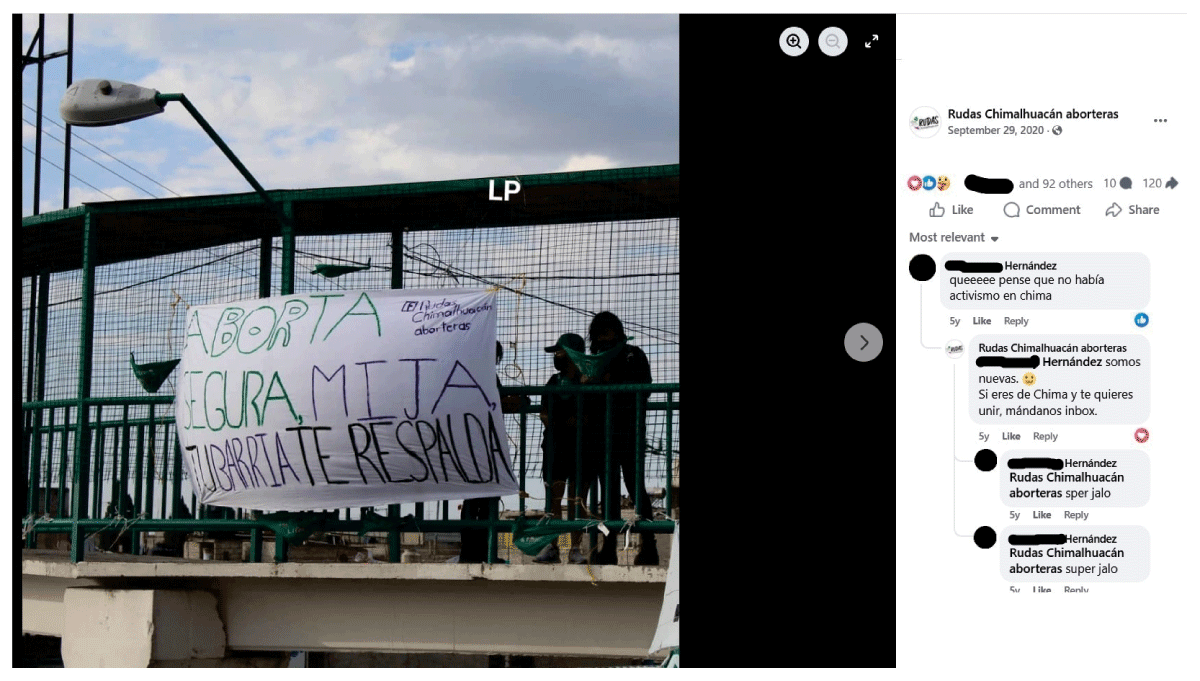
Figure 1
Rudas Chimalhuacán hang proabortion message on bridge El Peñón, Facebook post 29th September 2020.
Hanging from a gridded fence attached to a pedestrian bridge one can read in green and purple letters on a white blanket “ABORTA SEGURA MIJA TU BARRIA TE RESPALDA”, and signed on the top right corner by Rudas Chimalhuacán, aborteras with the Facebook “f” symbol. Members of the group (allegedly) in black clothes and covered faces appear standing on the pedestrian bridge besides the banner, with two pañuelos verdes, (green bandanas), a symbol of the Marea Verde.
The inaugural post appears on both Facebook and Instagram accounts of Rudas Chimalhuacán. However, the description of the image, reactions and public engagement varies. For example, Facebook has more interactions. There were 93 likes, 120 reposts and 10 comments. These provide a sense of the engagement that takes place on their social media, and evidence of digital acuerpamiento. Yet, the same post on Instagram showed 22 likes and no comments.
The Instagram account post signals 28/09/20, confirming the action took place on September 28th 2020, Day of Action for Access to Safe and Legal Abortion Worldwide. Choosing September 28th to hang this message was not accidental, as it has been an important campaign day for the decriminalization of abortion in Latin America and the Caribbean since the Fifth Latin American and Caribbean Encounter in Argentina in 1990.
The choice of bridge is similarly strategic. An Instagram tag Intervention on El Peñón pedestrian bridge, revealed the location to be the Peñón pedestrian bridge. Peñón Avenue, is the main urban artery for the municipality of Chimalhuacán, used by thousands of people every day when going to work in Mexico City. The Avenue connects Chimalhuacán with the boroughs of Iztacalco and Venustiano Carranza in Mexico City, conveying commuters to the Pantitlán subway station. It is thus a busy traffic zone with high visibility.
According to INEGI and its 2017 Origin-Destination Survey Households, 750,995 people enter Mexico City from the State of Mexico daily. 58.1% of commutes last between 31 minutes and two hours, with a further 5.3% exceeding two hours. Such movement is indicative of the inequalities faced by people living in the periphery of Greater Mexico City. It is no surprise then that the members of Rudas Chimalhuacán chose one of the pedestrian bridges situated on Avenue El Peñón to spread their message.
Pedestrian bridges function as a communal board where politicians, merchants and others place their messages seeking the attention of car drivers, commuters in taxis and buses on their way home, work or leisure. So why not position a feminist message from the local feminist collective?
Returning to the written message, one can feel a sense of closeness. The word, mija, the familiar contraction of mi hija (my daughter), is used to denote familiarity, and the affectionate warmth and playfulness of Mexican Spanish continues with the cherry on top: tú barria te respalda (your hood backs you). This phrase became well known in popular culture in Mexico in the 2000s. It is an inheritance of the cholo culture that expanded since the late 1970s in the Mexico-United States frontier among young Mexican Americans immigrants in their defiance of the racist and discriminatory behaviour towards them (Valenzuela 1988).
The sense of loyalty, communitarian protection and belonging among the members of the barrio is translated in this case to the feminized term barria. A defying feminization of the masculine barrio, barria represents an acuerpamiento in conveying that there exists a women’s community that takes care of you. In so doing, Rudas Chimalhuacán acuerpan (embody) the support of peers coming from the same geographical place, who share the same public transit experiences, and the same potential exposure to violence in the public sphere for being women.
For this reason, the post may be interpreted as an invitation to followers to engage physically with Las Rudas and their agenda. Two elements of this invitation stand out. Firstly, the text “¡Aborta segura, mija tu barria te respalda!” conveys explicitly familial overtones. Secondly, and in conjunction, through the reappropriation of public space, El Peñón bridge, that would be known and recognised by fellow inhabitants of the barrio, is an affectionate tool for constructing group solidarity. One unfortunate limitation of my method is that it was not possible to learn what were the reactions of the pedestrians, drivers, cyclists, the moto taxi drivers and the passengers of Mexibus that run along the length of Avenue El Peñón. However, we can see digital reactions to the Facebook post where some of the users expressed surprise and thrill to discover their feminist and peers living in Chimalhuacán:
… Hernández: queeeee pensé que no había activismo en Chima (whaaaaat I thought there was no activism in Chima)
Rudas Chimalhuacán aborteras: somos nuevas :s Si eres de Chima y te quieres unir, mándanos inbox (we are new :s If you are from Chima and you want to join, send inbox)
… Hernández: super jalo (great, I will join)
The familiarity of the language and the appropriation of the digital and physical space I consider to be a further materialization of acuerpamiento, through which women no longer feel isolated, but accompanied. The key is knowing of the existence of each other.
Picnic: If we know each other, we will organize ourselves together
This idea of knowing flows through other activities. Figure 2, posted on September 2nd 2021, presents an invitation amid the pandemic to participate in a virtual action supporting International Safe Abortion Day. Rudas Chimalhuacán ask their followers to send them a photo supporting the decriminalization of abortion in the State of Mexico with the hashtag #28S, and a background from the Chimalhuacán barrio where they live. The invitation asks participants to maintain the anonymity of their address and identity, so as to avoid security and legal issues.
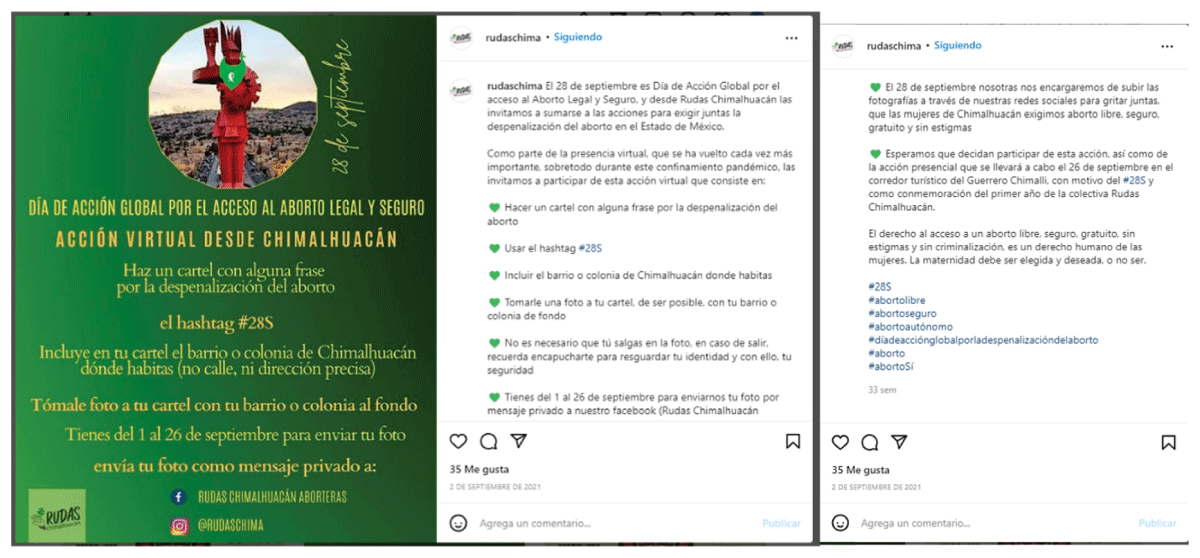
Figure 2
Invitation to virtual action in support of the Global Day of Abortion. Instagram post 2nd September 2021.
A central feature of the invitation is an altered image of Guerrero Chimalli (Shield Warrior) with a green bandana on his neck. Guerrero Chimalli is a 65-metre-high steel sculpture situated on Avenue Bordo de Xochiaca, a principal avenue of Chimalhuacán. Representing an indigenous warrior holding a chimalli (a type of shield) and a mace. Inaugurated in 2014, the landmark has gained an identity as a sentinel of the municipality. Hence, appropriating Guerrero Chimalli with a green scarf, locates the collective action to a specific geography. Simultaneously this projects a sense of ownership of the statue, converting it into a readily identifiable advocate of abortion. Thus, advocacy and local identification are brought into alignment.
Both Figures 2 and 3 serve to advertise the activities of the collective, while highlighting the significance of social media to contemporary feminist activism in facilitating online community building and solidarity. Simultaneously, Las Rudas use social media and online participation more broadly, as a bridge or entry point to activism in the urban periphery. This is communicated in the invitation to online followers to a physical event on September 26th 2021 in the touristic ally of Guerrero Chimalli, to commemorate the first anniversary of the collective’s creation.
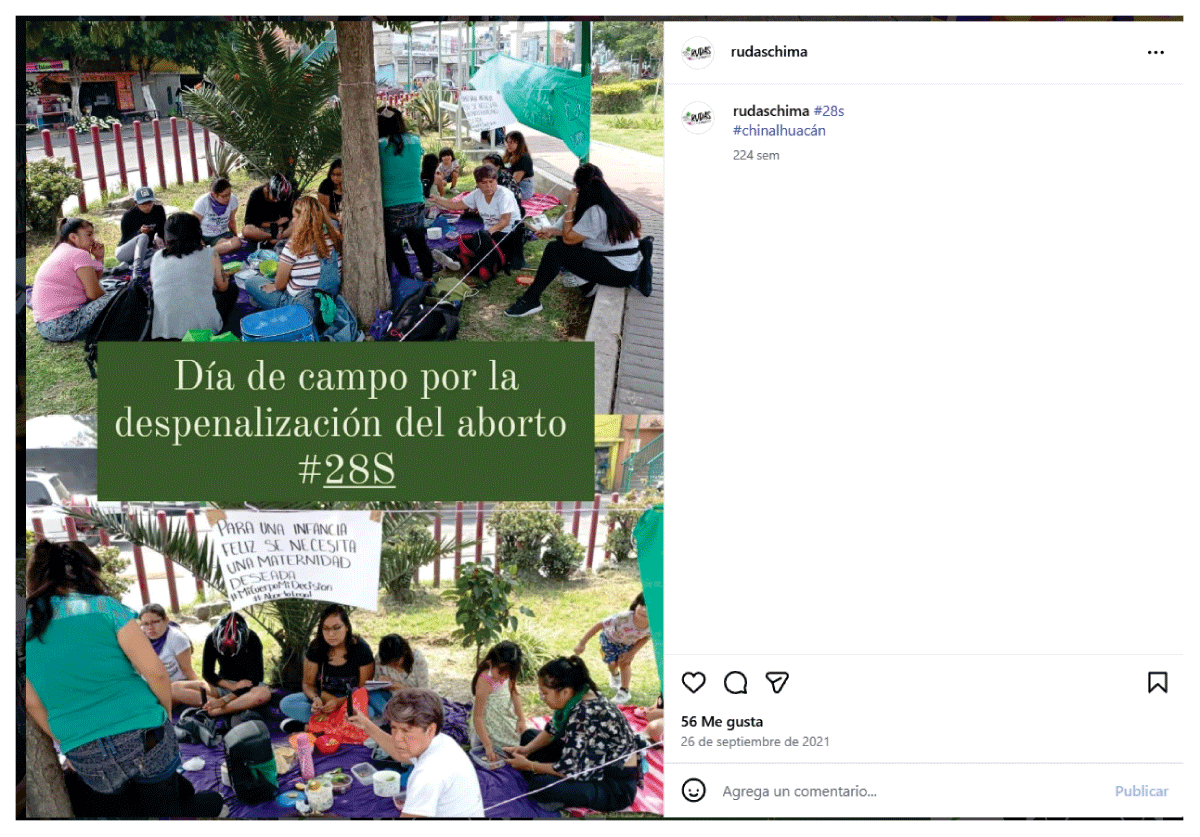
Figure 3
Picnic organised by Rudas Chimalhuacán in support of Global Abortion Day. Instagram post 26th September 2021.
This picnic commemoration also appears in two different newspapers, La Jornada and El Sol de Toluca, with the following titles, respectively: Se manifiestan por la despenalización del aborto en el Edomex (They are demonstrating for the decriminalization of abortion in the State of Mexico) (C. Salinas 2021); and Feministas de Chimalhuacán se manifestaron por la despenalización del aborto (Feminists from Chimalhuacán demonstrated for the decriminalization of abortion) (O. Salinas 2021). In this instance what makes activism work is the integration of virtual activism with physical presence in the public sphere. It’s about being present for the other, not only going to the rally by yourself but more importantly engaging together in community.
Protocol: we also have abortions in the periphery
The 2023 Global Action Day for Abortion was another day of protest for the decriminalisation of abortion in the State of Mexico. However, in this case Rudas did a bolder move: delivering the misoprostol protocol outside of public high schools in Chimalhuacán. In the following analysis I show one of a long series of photographs posted on Rudas Instagram account where they deliver misoprostol protocols with their acompañamiento information to young female students leaving the high school at night, after their afternoon school shift.5
This was not a previously publicised event in order to reduce the risk of arrest and prosecution for facilitating criminal action under the then- penal code. In light of this risk, I see they are putting acuerpamiento in action beyond the digital by approaching the potential women in need, and making themselves known to them.
Nine images compose the photo series of the delivery of misoprostol guides outside of high schools in Chimalhuacán. Due to space limitations, I am only attaching and analysing in detail one image of the series. The images cover the school facade where the delivery of the protocols takes place, the female students receiving them, and the car route taken to deliver the protocols.
Figure 4 shows a pair of hands holding white papers, offering them to uniformed school girls. A figure with long nails sporting pink nail polish extends their hand to accept the paper. Only the torsos are visible. On the post it is written: ‘We continue to take action in the periphery. We want adolescent girls and young women to know that no one but them can decide about their bodies, that no one can force them to give birth, that they are not alone, that their manada (pack) is here’ (my translation).
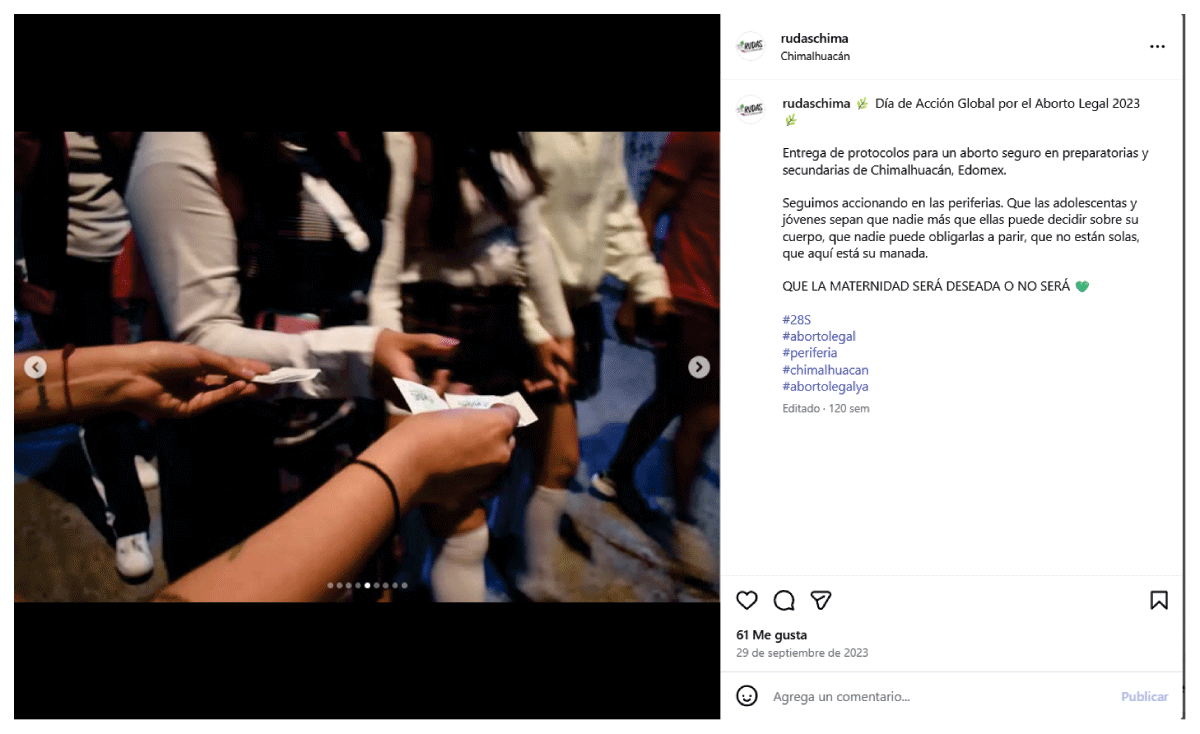
Figure 4
Rudas Chimalhuacán delivering misoprostol protocols. Instagram post 29th September 2023.
Choosing a late hour to deliver misoprostol guides outside public high schools speaks to a planned tactic to appropriate public space at one of the most dangerous times of the day. At the same time, it is a manifestation of the seriousness Rudas take acuerpamiento, even exposing themselves to risk of arrest. Furthermore, deploying the periphery on their message highlights how living on the geographical margins of the wider Greater Mexico City area is accompanied by a series of class, racial, and gendered elements. Aside from producing stigma, these also induce higher risks of being victim of gender violence, and having less access to abortion.
Therefore, it is understandable why Rudas Chimalhuacán consider misoprostol as a safe, and less hazardous practice to promote. This is also part of digital acuerpamiento, providing information about, and support while using, medical alternatives to women and girls who may not have had the financial means to travel to Mexico City. This is what Rudas Chimalhuacán try to tackle in a direct form in approaching young women who could be in need of an abortion accompaniment or that could share the information with others. It is worth highlighting the importance Rudas Chimalhuacán are giving to action in the periphery. In the Mexican urban understanding, the term periphery, periferia in Spanish, carries significant stigma (Lindón & Mendoza 2015). It is more than a reference to a geographical distance from an identified centre. It is a word that has inherited the negative elements of the word arrabal, a term used up until the 1990s in Mexican popular speech to describe the marginalised, precarious, distant areas of the central city, where out of the norm social behaviours appeared.
This condition of social stigma, understood by Erving Goffman as an ‘attribute that is deeply disturbing’, positions the individual in an isolated manner that disqualifies them from full social acceptance (Goffman 1963). This situation also permeates the urban territory, in what Loïc Wacquant would name territorial stigmatization, an ‘advanced marginality’ in the metropolis (Wacquant 2007). This is made in reference to contemporary urban settings, where advanced marginalisation takes place in the form of dispossessed neighbourhoods. Both Goffman and Wacquant emphasise stigma as something that happens to a body, whether individual or collective, without focusing on what a body might do with the stigma itself in order to challenge or combat it.
These affective and spiritual energies that Cabnal positions at the centre of acuerpamiento are evident in the defiance of territorial and abortion stigma performed and or projected by Rudas Chimalhuacán. Abortion stigma, similar with territorial stigma, is “a negative attribute ascribed to women who seek to terminate a pregnancy that marks them, internally or externally, as inferior to ideals of womanhood” (Kumar et al. 2009:628). Hence, when activists deploy analogies including acompañamiento and acuerpamiento in support of autonomous abortions, they are simultaneously combating marks of inferiority placed upon women seeking abortion. Subsequently, public policy (the criminalisation of abortion), and normative suppositions about womanhood are scrutinized through collective identification and action.
In this light, social media posts are more than a record of participation in rallies, a forum for advertising future events, denouncements of gender-based crimes, feminicides, forced disappearances, digital violence’s, and support to victim’s family members as part of awareness and community building. Rather, they constitute immersive experiences within and between the different collectives and their participating audiences. This gives rise to what I consider to be the main elements of their digital abortion activism: raising awareness of the concepts of territorial stigmatization, the importance of acuerpamiento as well as the embodied stigma; that in turn contribute to a feminist pedagogy from the periphery of Greater Mexico City.
The geography of the periphery is simultaneously gendered and social as well as physical, and it is this confluence of factors that generates stigmatizations, which in turn create exclusion, but also fuel for feminist political agency. The reality of women needing to travel across state borders to have an abortion illustrates the linkages between different forms of stigma, that effect women in the peripheral municipalities. Indeed, the recognition of this has been manifested publicly in recurrent motifs arrayed on the different protest signs that young women raise during feminist demonstrations within the municipalities of the State of Mexico.
Thus, it is significant that Rudas Chimalhuacán position themselves in the periphery working for their equals: women in the periphery. They demonstrate, or rather embody their practice in the face of inequalities and legal sanctions. Their acompañamiento, through the distribution of misoprostol protocols is understood by them as worthy to be done at the risk of their own physical and legal security.
In this way feminist activists from the peripheries embody resistance with their political action. They acuerpan esas resistencias, (embody those resistances), when giving them body, sense and image. This is possible because of their inhabitation of the urban periphery, and their intimate knowledge of the social stigma this entails, which can take different forms through gender, class and race.
Conclusion
In 2024 abortion was decriminalized in the State of Mexico, making abortion theoretically possible in the 125 municipalities of the state. However, in an Instagram post on September 28th 2025 – Global Safe Abortion Day – Rudas Chimalhuacán denounced that, one year after abortion was decriminalized, information had still not been disseminated among the population of Chimalhuacán:
Having an abortion on the margins of the cities, outside the law, without information. To have an abortion in the periphery. Without information. Without sex education. Without access to the knowledge of our sexual and reproductive rights (…) Abortion in the State of Mexico was decriminalized in November of last year, and so far, there has been no outreach campaign in Chimalhuacán to inform the women of the municipality that they have this right, how and where to exercise it. Decriminalization is useless if it remains only on paper. Abortion is a public health issue, as is teenage pregnancy. As long as the government fails to launch a public awareness campaign about the right to abortion and ensures that all adolescents are informed about this option at their health centre, their school, on social media, and on municipal notice boards, it is not fulfilling its responsibility regarding the implications of this decriminalization for a patriarchal, conservative, and deeply religious society. (my translation)
Denouncing the lack of action from the municipality to disseminate information about abortion’s decriminalization is not only a critique of governmental prioritisation and inaction. It is furthermore, evidence of what Veldhuis et al. (2022) signals when asserting that even under conditions of decriminalization, difficulties persist for women seeking to access abortion; because the broader system supposedly providing access remains precarious. Precisely because existing social vulnerabilities experienced by women seeking an abortion limits the efficacy of legalisation in practice. Therefore, Rudas Chimalhuacán need to continue their acompañamiento until such a time that access in practice matches the spirit of legalisation.
The conjugation of puente (bridge), picnic, pañuelazo (usage of the green bandana) and protocol demonstrates what makes activism work is the integration of virtual activism with physical activism in the public sphere. Rudas Chimalhuacán display banners from pedestrian bridges and use the social media to invite participation online. In a virtual sense, public monuments, including Guerrero Chimalli are given new roles as advocates of abortion in online spaces where he appears with a green bandana. Decorating Guerrero Chimalli in this manner also draws attention to his direct association with Chimalhuacán. Thus, a regional and global issue, access to abortion, is given a very local identity. Both elements come together in an effort to foster a greater sense of awareness, shared solidarity and community building.
It is necessary to highlight the influence that the COVID-19 pandemic has had on activism, and as a situation that has further marginalized women in need of an abortion. One way to overcome this has been the increase in community building, and exchanges of information and stories online. This study found that in the periphery of Greater Mexico City, women who belong to feminist collectives either initiated, or augmented presence and activism during the pandemic online, with social media platforms such as Facebook and Instagram proving to be popular vehicles of dissemination.
An interesting observation to make here is that while social media, especially Instagram has gained popularity and even notoriety for promoting a certain degree of individualism bordering narcissism; feminist collectives such as those considered by this article, actively use it to promote collective self, action and resistance.
The physical and online territory that intersect in the protagonists of this article defies not only territorial and abortion stigmatization but also opens another peripherical form of inhabiting social media. Contrary to the discourse that situates women from working class and racialized backgrounds in only disadvantaged positions, the pro-abortion activism of Rudas Chimalhuacán, locates them in a position of agency and defiance of the figure of stigma. The fact that these young women accompany their peers in the process of abortion, puts them in the centre of their struggle rather than in the periphery.
The examples of resistance personified by the feminist collectives for access to abortion in the State of Mexico, show not only the linguistic resistance for maintaining the concept of abortion above of the official ILE, but also the positioning of the body of working-class racialized women in the virtual and physical public space. Future research in this space could involve undertaking qualitative interviews with residents of Chimalhuacán and other municipalities to better ascertain the extent to which exposure to online activism influences their choices to join in acuerpamiento practices. I further consider that the image compilation of actions on their social network online serves as an archive, a memory of their activism in the periphery, a place that they are putting on the map through a digital acuerpamiento that rotates from the physical to the digital spheres.
Author Note
Daniela Villegas is a journalist, feminist and social researcher with a PhD in Gender and Cultural Studies from the University of Sydney. She investigates the intersection of cultural history, feminist activisms, pop culture representations in the media, and gender and politics in Latin America. Her latest research has focused on the construction of feminist identities from young urban working-class female activists in the periphery of Mexico City. Latin America, women and feminist movements are one of her regional areas of expertise. Among my latest publications:
Villegas Mercado, Daniela. (2023) “De mi periferia a tu periferia: aproximaciones teóricas a los activismos feministas en la zona metropolitana de la ciudad de México” pp. 139–158 en Los Feminismos en México. Reflexiones analíticas sobre su potencia histórica y política (Ed) Martha Erika Perez Dominguez, Pilar Godinez Mejia and Miguel Angel Ramirez Zaragoza UNAM, PUEDJS, INEHRM, CONAHCYT.
Villegas, Linda Daniela. (2022) “Una flaneuse en la periferia de la Ciudad de México: Tiempos Muertos de la fotógrafa Sonia Madrigal” en Marisa Belausteguigoitia (ed.), GRRRRR. Género, Rabia, Ritmo, Ruido y Responshabilidad, CIEG, UNAM, pp. 71–82.
Notes
[1] In light of this, I have elected to utilize the term acompañamiento throughout the remainder of this text as opposed to relying into a direct translation.
[2] Mexico City (2007), Oaxaca (2019), Hidalgo (2021), Veracruz (2021), Coahuila (2021), Baja California (2021), Colima (2021), Sinaloa (2022) Guerrero (2022), Baja California Sur (2022), Quintana Roo (2022), Puebla (2024), Jalisco (2024), Michoacán (2024), San Luis Potosí (2024), Zacatecas (2024), State of Mexico (2024), Chiapas (2024), Nayarit (2025), Chihuahua (2025), Campeche (2025), Yucatán (2025), Tabasco (2025), Tlaxcala (2025).
[3] Instituto de Seguridad y Servicios Sociales de los Trabajadores del Estado (ISSSTE): Mexico’s public healthcare system for public sector workers; Instituto Mexicano de Seguro Social (IMSS): Mexico’s main public healthcare system for private-sector workers.