
Introduction: a bit of context
The armed conflict in Colombia has left a lasting impact on the country’s history, with Antioquia being a severely affected department. This region has witnessed a high number and severity of victimizing events, including forced displacement, homicides, forced disappearances, among others (Registro Unico de Vicitimas [RUV], 2022). The armed conflict has exacerbated inequality in the Colombian population, with the most affected areas experiencing higher levels of poverty, social exclusion, and less equity in the restoration of rights.
Eastern Antioquia stands out as one of the subregions most affected by these events. Outlaw groups and the national army have been responsible for actions that particularly impact the civilian population, leading to homicides, forced disappearances, threats, torture, sexual violence, persecution, and other distressing situations. Many individuals have been forced to abandon their homes, crops, animals, and belongings in search of a safer environment for their families.
Covering an area of 8,094 square kilometers and comprising 23 primarily rural municipalities (Figure 1), Eastern Antioquia has ranked first in victimizing events in the country (Ministerio de Justicia de Colombia, 2022). Since 1993, the Revolutionary Armed Forces of Colombia (FARC-EP) and the National Liberation Army (ELN) have been present in Eastern Antioquia. Their confrontations with paramilitary groups and state forces have contributed to a total of 247,390 declared victims in the region (Registro Unico de Vicitimas [RUV], 2022). In this subregion, the dynamics of the armed conflict have been intertwined with natural resources, including water wealth, the fertility of lands for agriculture and livestock, and the strategic potential of the territory for the economic development of agribusiness.
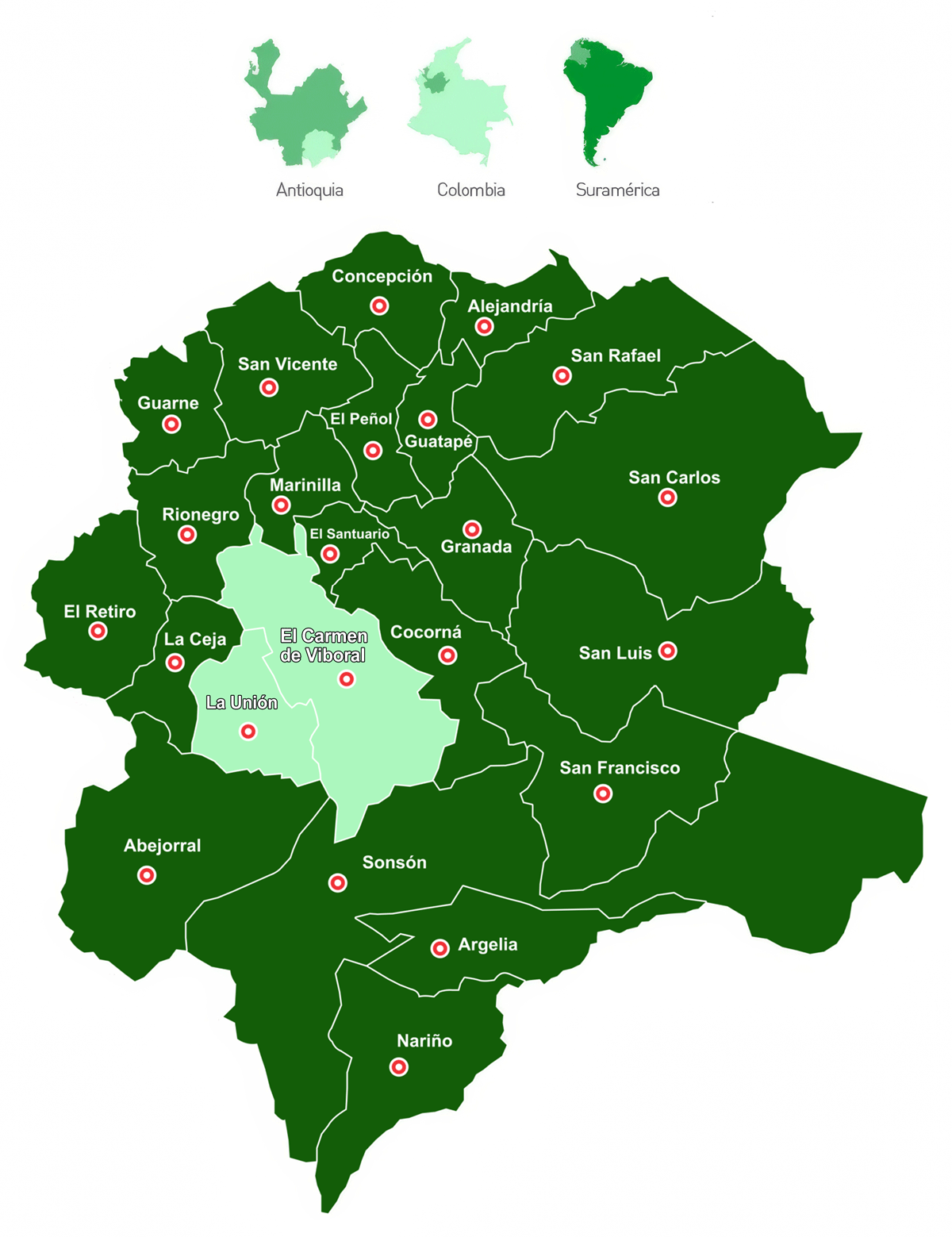
Figure 1
Location of the municipalities of La Unión and Carmen de Viboral in the Eastern Antioquia region.
Source: Authors’ elaboration.
In the municipalities of La Unión and Carmen de Viboral, where the investigation was carried out, the Registro Unico de Victimas (RUV) recorded respectively 12,258 and 8,883 victims of the armed conflict (RUV, 2022) between January 1985 and December 2022, despite these high number of victims only until 2016 in La Unión, was a municipal plan formulated for a comprehensive care and reparation of victims (Alcaldía de La Unión, 2016). Similarly, the Land Restitution Unit in Carmen de Viboral only began operating in January 2020 (Table 1).
Table 1
Number of applications for registration in the SRTDAF received by the Unidad de Restitucion de Tierras (URT) according to the municipality of the property’s location.
| MUNICIPIOS | NUMBER OF APPLICATIONS FOR REGISTRATION IN THE REGISTRY OF DISPOSSESSED AND FORCEFULLY ABANDONED LANDS (RTDAF) | NUMBER OF PROPERTIES ASSOCIATED WITH APPLICATIONS FOR REGISTRATION IN THE REGISTRY OF DISPOSSESSED AND FORCEFULLY ABANDONED LANDS (RTDAF) | NUMBER OF TITLEHOLDERS ASSOCIATED WITH APPLICATIONS FOR REGISTRATION IN THE REGISTRY OF DISPOSSESSED AND FORCEFULLY ABANDONED LANDS (RTDAF) |
|---|---|---|---|
| Abejorral | 74 | 65 | 72 |
| Alejandría | 44 | 42 | 33 |
| Argelia | 439 | 353 | 377 |
| Cocorná | 333 | 292 | 290 |
| Concepción | 33 | 33 | 27 |
| El Carmen De Viboral | 182 | 165 | 153 |
| El Peñol | 34 | 29 | 32 |
| El Retiro | 16 | 16 | 13 |
| El Santuario | 24 | 23 | 20 |
| Granada | 1.336 | 1.322 | 1.025 |
| Guarne | 46 | 45 | 41 |
| Guatapé | 23 | 22 | 20 |
| La Ceja | 9 | 9 | 7 |
| La Unión | 47 | 26 | 36 |
| Marinilla | 11 | 11 | 11 |
| Nariño | 227 | 197 | 199 |
| Rionegro | 25 | 24 | 22 |
| San Carlos | 1.988 | 1.89 | 1.63 |
| San Francisco | 233 | 219 | 208 |
| San Luis | 386 | 337 | 351 |
| San Rafael | 276 | 239 | 229 |
| San Vicente | 23 | 22 | 22 |
| Sonsón | 573 | 419 | 485 |
[i] Source: Authors’ elaboration with data from Unidad de Restitución de Tierra.
The peace process in Colombia commenced during the administration of Belisario Betancur (1982–1986), who underscored the imperative of initiating dialogue with the country’s armed groups. Betancur’s commitment set the stage for subsequent administrations to incorporate strategies of reconciliation into their governance agendas, with some experiencing minimal successes and others lacking significant achievements. It was under the presidency of Juan Manuel Santos that a pivotal moment occurred on October 18, 2011, in Oslo, Norway—the formal commencement of the peace process with the FARC guerrilla. This marked a significant milestone in the pursuit of lasting peace.
Further strides were made on November 19 of the same year in Havana, Cuba, where the first substantive discussions unfolded between FARC delegates and the national government. Topics under consideration included a Comprehensive Agrarian Development Policy, political participation, the cessation of the conflict, resolutions to the problem of illicit drugs, reparations and truth for victims, and the endorsement, implementation, and verification of agreements (Martinez and Rodriguez, 2016).
As a culmination of these efforts, the Colombian National Government and the FARC guerrilla inked a final agreement aimed at fostering peace and reconciliation. Post-legalization, the National Political Agreement took shape, a collaborative endeavor involving all political and social groups and the dynamic forces within the country. Their mission was to “define the reforms and institutional adjustments necessary to address the challenges that peace demands, setting in motion a new framework of political and social coexistence” (Gobierno de la República de Colombia, & FARC-EP, 2016).
This comprehensive agreement encompassed key facets such as comprehensive rural reform, political participation, a bilateral and definitive ceasefire, cessation of hostilities, disarmament, security guarantees, and efforts to combat criminal organizations linked to homicides, massacres, attacks on human rights defenders, and those designated as successors to paramilitarism and their support networks. Additionally, the agreement laid out plans for the prosecution of criminal behaviors jeopardizing the implementation of agreements and the construction of peace. It addressed the challenges posed by illicit drugs, outlined provisions for victims, and established mechanisms for implementation and verification (Gobierno de la República de Colombia, & FARC-EP, 2016).
Currently, the government of Gustavo Petro brings as a proposal the resignification of peace, intending to convert it into public policies that tend to Total Peace oriented to human security, without altering the 2016 agreement, on the contrary it intends to complement it by having innovative strategies, such as the creation of the Ministry of Peace and Reconciliation, the resumption of dialogues with the ELN, pacts with drug trafficking structures; transformations to the Police and Military Forces; and a change in the model of anti-drug policy. According to Hernández (2022), these are tactics with which the national government seeks to achieve the pacification of the country in a comprehensive manner, with a territorial perspective and strengthening human security. On November 4, 2022, Law 2272, called the “Total Peace Law”, was signed. Revealing as the main purpose of said Law, cited in ARTICLE 1°. Purpose: The purpose of this Act is to define peace policy as a State policy (…) creates the Social Service for Peace, among other provisions. (Congreso of Colombia, 2022).
We understand peace as a territorial issue, especially as “transformative peace”, where it refers to the real and symbolic conditions that make possible the individual and collective experience of peace. In this sense, peace is a proposal that is linked to the effective enjoyment of rights, the breaking of structural circles of violence and the reduction of inequities as an essential condition for lasting peace in terms of human development (Hernández, 2017). Peacebuilding refers to a procedural, historical, and a situated perspective that plays a decisive role in Colombia (CNMH, 2013).
We argue this in the case of two municipalities of Eastern Antioquia, La Unión and Carmen de Viboral where armed conflict did not have the capacity to destroy the ties to the territory. The social movements, and the institutional efforts on land restitution, have a particular effect on peacebuilding in rural populations of those municipalities. The value given to the territory by the campesinos is an essential aspect to optimize the processes of land restitution and return as a part of peacebuilding. By territory we refer to a place where people built real options for “the common good”, “environmental sustainability”, “community management”, and “peaceful coexistence” at the local level, related to the organisational experiences of victims of armed conflict, who have become transformed into agents of peace (CNMH, 2011; Rojas, 2012). That is why, we use the term territory and not the term “land”, territory not only refers to that same place but also in the economic sense of value accorded by Law and institutions, especially the Victims and Land Restitution Law sanctioned on 2011.
Territories, land restitution and peacebuilding, a situated discussion
In Latin America, rurality has been associated with marginality, little access to culture and poverty, but today it is being related with food sovereignty, social cohesion, local development, sustainability, agroecology and the manifestation of diverse life and family trajectories (Gascón and Mamani, 2022). Also, rural sociology has shifted from focusing on productive aspects to focusing on rural development in its multiple spheres (Romero, 2012). In this sense, rurality becomes a category with a territorial connotation and social interaction, where practices and discourses emerge that refer to a local experience (Gascón and Mamani, 2022) Rurality is now seen as a space transformed by meanings, where the inhabitants usually have a closer experience with the land, documented as roots (Romero, 2012).
For Fay and James (2008), the material value of land is the monetary, transactional, productive value and a manifestation of wealth; while the symbolic value refers to the ties that are woven with the territory and with the people who live in it, it has to do with the meaning of the land, life history and family and community trajectories linked to the territory (Boff, 2002; von Benda-Beckmann, von Benda-Beckmann and Wiber, 2006). Boff (2002) states that the land becomes the homeland/motherland of a certain human group, offering the possibility of organizing, caring for and inhabiting a space. This symbolic value of “land” refers to the notion of “territory”. For Porto-Gonçalves, territory is a dense category that presupposes a geographical space that is appropriated, and this process of appropriation, that he calls “territorialization” is what “gives rise to identities – territorialities – that are inscribed in processes, therefore, dynamic and mutable, materializing at each moment a specific order, a specific territorial configuration, a social topology” (Porto-Gonçalves, 2002, p. 230). According to Elden (2013) the territory emerges in Western political thought, because of the relations between place and power. Taking the sum of these elements he understands territory “as a distinctive mode of social/spatial organization, one that is historically and geographically limited and dependent, rather than a biological drive or social need. Territory needs to be thought of in its specificity” (p. 10). At the same time, it is an object crossed by processes of appropriation, transfer, and conflict, as we demonstrate in Eastern Antioquia, one of the regions hardest hit by the armed conflict in Colombia.
The sociological and political literature on land and rurality in Eastern Antioquia has two fundamental emphases. The decade from 2000 to 2010 saw the uprooting, the dispossession of land and the other victimizing acts: the land was glimpsed as a lack and as a rupture of links (Gaviria and Muñoz, 2007; Hernández, 2017). On the other hand, in the decade between 2010 and 2020, studies focus on return, peacebuilding, rebuilding the link to the territory, agroecology and local development. It is also highlighted in the legal aspects the need for substantive measures to speed up land restitution and return of rural populations, as a state obligation, despite operational legal and policy difficulties (Ramírez, 2015; Urrego and Barrera, 2018; Soto, 2017; Gutiérrez et al., 2020). “Collective action repertoires” (Tilly, among others, cited by Pino, 2020) can be evidenced in returned social actors in some populations of Eastern Antioquia, despite their individual vulnerability. These repertoires of collective action can be understood as situated manifestations to respond to injustice and power instituted within the framework of constraints and possibilities that actors navigate to bring their demands to the public stage and seek routes for social change (Tilly, 2015). In the case of eastern Antioquia, collective action in the face of armed conflict has been diverse and powerful, employing different strategies ranging from social protest, art, vindication of rights, and the establishment of legal processes to academic activities, construction of collective memory, and symbolic reparation (Pino, 2020).
Methodology
Research was conducted using the historical-hermeneutic approach, under which reality is diverse, plural and an understanding of it requires in turn an approach to the experiences, subjectivities and discourses of the subjects who inhabit situated realities. The design corresponds to qualitative research, which is a way of observing human subjectivity from a social dimension, focusing on their experiences and relationships with contexts and other actors.
In our examination of the meanings that the interviewees (I) and participants of the focus groups (FG) gave to rooting, the territory emerged as a category to be discussed from the legal, geographical, and political senses. The next section of the article shows how the Victims and Land Restitution Law, and the State institutions have a restricted and contradictory role on land restitution in the municipalities we studied: the lack of legal titles of the dispossessed lands is the most relevant barrier to land restitution of the displaced campesinos. The final part of the article discusses the local social movements’ agendas leaded by women and youth in peacebuilding through recuperation of territoriality, discussions about the Victims and Land Restitution Law information, and situated forms to rebuild the links to the territory. We argue they have the capacity to optimize the land processes restitution, because of their different visions and practices of territorial peace.
Analytical reflection and systematic interpretation of information were oriented as proposed by Galeano (2004), with the leading role of the inhabitants of rural areas of Eastern Antioquia, as they are the ones who have given meaning to their practices and experiences related to land and restitution processes. The sample was selected using theoretical sampling and snowball sampling techniques.
To collect the theorical information, we conducted a documentary search in databases that yielded these results: research articles, books, and undergraduate and postgraduate theses in the fields of sociology, social work, psychology, and law. The fieldwork actions were: 1) four in-depth interviews (I) with social leaders involved in peacebuilding processes; 2) two focus groups (FG) with people from the rural community of the municipalities; 3) two mental maps on the relationships between the material and the symbolic value assigned to the land and 4) two pedagogical workshops, as interaction spaces based on the knowledge dialogue methodology, 5) one event of socialisation of results (SR), meeting where the results found in the investigation framework were returned to the community. A total of 83 people from both municipalities participated in the fieldwork spaces. For the analysis of the information, we used some techniques of the grounded theory in such a way that we would arrive at the reduction and understanding of the data (Strauss and Corbin, 2002), using codification, categorisation, and theorisation.
The coding was done in an open manner, and when initial emerging categories were identified, selective coding was then performed by integrating key categories and concepts using Microsoft Excel. From these analysis matrices, information triangulation was carried out to integrate different information techniques, obtaining more organic findings validated by individuals in the territories during events with this purpose.
Finally, theoretical contrastation processes and documentary review were conducted to build elements for the discussion of the results, drawing from the prolific existing literature on the Colombian armed conflict, peace processes, the construction of historical memory, and the social struggles of communities for the defense of the right to peace and social justice.
Throughout the process, we considered the follow-up of ethical considerations, ensuring the care of the participants, and guaranteed respect for autonomy, non-maleficence, and confidentiality of the information. We used all the data only for research purposes; the participants signed informed consent consistent with the above. We obtained the endorsement of the Bioethics Committee of the University of San Buenaventura. We also considered the guidelines of Resolution 8430 of the Ministry of Health (Ministerio de Salud, 1993) for research with human beings.1
Results
Territories in dispute and feelings of rootedness
In a legal sense, the territory is an area of spatial validity of the powers of the administrative entities, where the regulations for the extraction and ownership of its resources have been established, as well as for the distribution and management of these to regulate relations with the administered and to set the powers and public budgets. However, as Blomley (2022) mentions “Territory is very often symbolic, linking the territory to some form of identity.” We called this idea of roots territorialidad campesina, defined as the form of appropriation and management of the territory by the campesinos, a territoriality that is evidenced in the festivities, treats and pilgrimages that took place in the village2 before violence. We can also find similar definitions in the literature, especially in: (Bendini and Steimbreger, 2014; Silva, 2016; Valencia-Castro, 2020; Pineda and Valencia, 2022).
In a geographical sense, the territory is the concrete relational space of society, where the transversal links by power take place, determining the global-local reconfigurations and the conflicts for the material or symbolic benefits that the territory procures; this evidences agreements or tensions between the actors on the appropriation of disputed resources, emerging territoriality as a category of situated analysis that reviews power relations, as well as the juxtapositions, resiliences and relationships between social actors and their territory (Haesbaert, 2013; Castro, 2020; Pineda and Valencia, 2022).
The case of Eastern Antioquia is due to a process of transformation and spatial, geographic, and political configuration as a space of globalisation, in which developmental interests linked to an economic project initiated from an industrial movement converge, but also territorialidad campesina that have been emerging in different historical moments (Pimienta and Pineda, 2021; Pineda and Valencia, 2022).
The graphic above (Figure 2) clearly reveals fluctuations in population growth and decline, particularly highlighting a notable decrease in the population of Eastern Antioquia between 1993 and 2005—a phenomenon attributed to the impact of the armed conflict. During this period, a significant population decrease is observed, reflecting the direct consequences of displacement. Between 2005 and 2009, despite slight growth, the majority of the population remains displaced, influencing the growth rate. However, starting from 2017, a substantial increase in the population is evident, indicating a significant change. This noticeable increase is directly related to the peace process, facilitating the return of the population to their original territories. This temporal analysis provides a detailed insight into the complex interactions among factors such as armed conflict, displacement, and reconciliation efforts, underscoring the importance of understanding the historical context to interpret demographic trends.
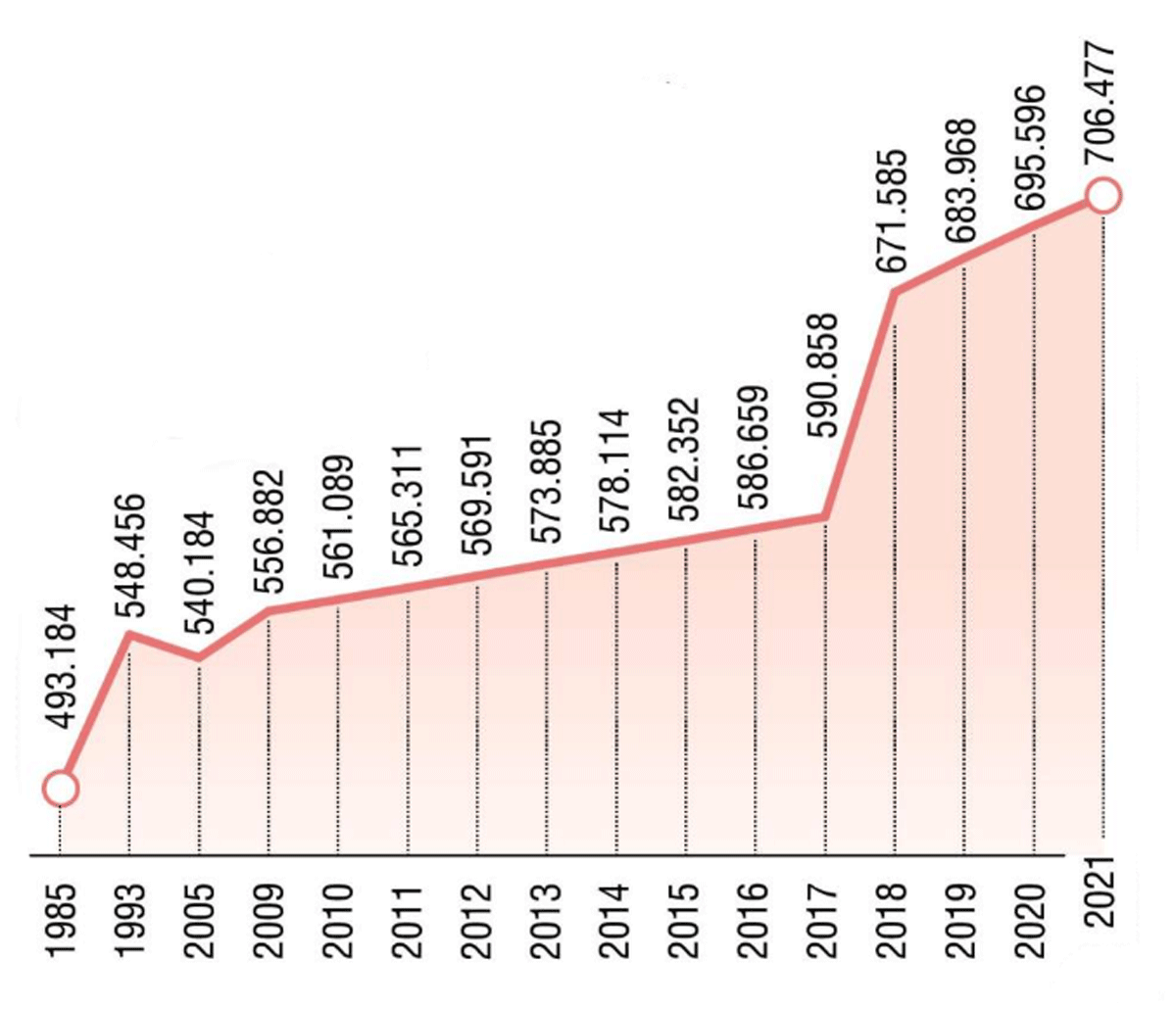
Figure 2
Population Growth in the Eastern Antioquia region.
Source: Authors’ elaboration with data from El Colombiano.
The Ordinance 41 of 1975, enacted by the Antioquia Departmental Assembly, was intended to create a sense of homogeneity in a subregion characterized by diverse terrain including moorland, forest, plains, and water reservoirs. Subsequently, a series of territorial intervention projects were implemented, predominantly of an economic-functional nature, with some being state-military interventions between 2004 and 2006, prior to the “total war” confrontation (Aramburo and García, 2011, cited by Pineda and Valencia, 2022) resulting in the displacement of campesinos. This intervention facilitated a deepening of territorial development based on industrial economic endeavours. Finally, social interventions have emerged to promote the idea of territorialidad campesina (Pineda and Valencia, 2022).
For this reason, following Pimienta and Pineda (2021), what emerges is, then, a dynamic process of transformation of the territory based on its functionality and advantageous uses by companies of all kinds and the tensions or adaptations that local actors carry out to this process through political action.
According to the participants in this research, the effects of the war broke the continuity of life, the ways of being and existing in the territory, and the collective functions of the social fabric. The disputed territory was not only a place of settlement but also a display of cultures, customs, and meanings, of roots of the people who inhabit or inhabited it, as well as the place where forms of subsistence take place, an economic network created by people whom they identify themselves as political, social, and socio-cultural subjects (I2, 2021, personal communication). Comparable studies in the field of forced migration have likewise uncovered that conflict and war have disrupted the local populations meanings and experiences associated with territory and place among the populations under examination. (Sakti, 2022; Sigona, 2014).
The war and the massive displacement brought “diverse effects on the community, being the fragmentation of the fabric and the community organisation, aspects particularly referenced by the campesinos as losses that the armed conflict left to the village” (Valencia-Castro, 2020: p. 20). However, the recent repertoires of political action in the territory include multiple expressions of unarmed civil resilience, local initiatives for food sovereignty and campesino autonomy, festivities for the defence of the territory and water against extractive projects which are considered by interviewees as actions of territorial intervention that “can lead to the expulsion of its inhabitants or that alter ways of life, such as the campesinos” (Pineda and Valencia-Castro, 2022). Other political actions are mobilised from various sectors of civil society that allude to criteria of link, of rootedness with the territory, similar actions can be found in other communities as alluded in like James Scott’s Weapons of the Weak (1985).
This sociocultural plot shows that the described territory has several characteristics over time, before, during and after the most significant actions of the armed conflict. So then, the territory is described as follows.
It has been and is the subject and object of dispute because it is considered a resource that encompasses other valuable assets for the communities, but also for the armed groups and economic interest groups: biodiversity, water wealth, land for livestock, agriculture, or “fattening”.3 The territory is a victim of the conflict and, therefore, an object of collective reparation (I2, 2021, personal communication; I3, 2021, personal communication), which contrasts with difficulties in the plan to return to some villages where there are interests of private actors over the lands, and little clarity on the legal titling of the same (FG1, 2021, focus group).
It is the place abandoned both by the inhabitants due to the victimising act of forced displacement (I4, 2021, personal communication; FG1, 2021, focus group) and by the State. The territory is also a place of return due to land restitution processes. However, without guarantees of permanence (I3, 2021, personal communication), and many times, a place to which some campesinos return without healing wounds from the past: “People said that they hadn’t come back because they were scared, because it made them angry, they remembered when they killed their son, when they made them go, and of course that marks the way of relating” (I3, 2021, personal communication).
In turn, we find that those victims who inhabit the territory identify it or re-signify it in their narration from different perspectives:
The place to which it is difficult to return, but hope remains: returning to the territory has not been an easy process, but at the same time, there is the belief that land restitution is the path to peace; it is the way to build peace “returning has not been easy for many reasons; economically, emotionally… trying to start up again is not easy” (I4, 2021, personal communication), “but that figure of land restitution is helping us to return and recover, all of that goes hand in hand” (I4, 2021, personal communication).
The place where damages occurred. Without a doubt, in Eastern Antioquia, forced displacements, selective and systematic homicides, disappearances of persons, sexual violence, damage to infrastructure and the economic apparatus of the region and forced recruitment (FG1, 2021, focus group) were registered, which affected the relationship with the land and territory: “the territoriality that people live, from Santa Rita, la Honda, La Unión, Mesopotamia, El Cardal, has been a very fragmented territorial identity and hit by the conflict” (I3, 2021, personal communication).
The place where women became “spoils of war.” Many women, including those from the village of San Miguel de La Unión, were affected by sexual abuse by paramilitaries who were present in their territories. In this sense, women became “spoils of war” as an object of demonstration of the power of paramilitarism and its ability to break with the dignity of people (I1, 2021, personal communication). In the same way, in the municipality of Carmen de Viboral, the effects on women are not only observed in front of those who were raped, murdered or disappeared but also “in the women who were left alone, they took away our spouses or partners, siblings or fathers and that we have had to face this not only in rural areas, but also in urban areas” (FG1, 2021, focus group).
The place where the “chained love” took place, here the role of women romantically involved with actors in the conflict is described, who ended up being part of an armed group, perhaps without military or political conviction, but: “they simply fell in love of a very dear boy, beautiful and who also had a weapon that was very striking” (I1, 2021, personal communication), and that, then (…) “they ended up entangled in a conflict that was not theirs”. Another face of this phenomenon was explicitly presented in the municipality of La Unión with the paramilitaries since “many fell in love with a girl, and they put their eye on that girl, and that girl was for me by hook or by crook” (I1, 2021, personal communication).
So then, the feelings that accompany the narrative of the people consulted when they refer to roots are restlessness, rage, and impotence. The speeches reveal to us how the meaning of the bond with the land goes from an idealistic, romantic vision, from an emotional value to a material gain, “the sadness of leaving dreams, leaving things that one acquired with so much effort, my parents …and leave it thrown at the mercy of anyone where everyone takes advantage, everyone benefits, they take advantage of the vulnerability.” (I4, 2021, personal communication). Uprooting configures a rupture in the historical community and personal processes of connection with the land, accompanied by a loss of meaning and value to the “terruño”, a situation enhanced by the physical and mental consequences experienced by people and by the loss of attractions and reasons to want to stay (FG2, 2021, focus group). The relationship between territory and community has been subject to a profound study from a somewhat recent discipline called legal geography. As Nicolini (2022) specifically says “Territory and community are not separable and physical geography turns into legal geography” (p. 90).
In short, we show how rootedness is manifested in the narratives as the longing to recover past experiences in which one could be the owner of the land, but at the same time, one could share it with others, enjoy nature, and build stories and be happy (I2, 2021, personal communication). For this reason, it should be noted that: “The concept of land demonstrates the complexity of pigeonholing the discussion on the objectives and interests of transitional justice in simple terms of legal ascription to a particular class of rights” (Sánchez, 2017, p. 107). Land interventions vary based on their meaning and approach, and legal relationships related to land can involve different rights depending on the specific circumstances.
For the campesino population of this subregion, the land becomes a socio-spatial reference, a territory, a possibility of livelihood and a sphere of production of ways of life that claim singular and traditional practices in aspects such as the cultivation of the land, the construction of human relations, alternative initiatives against the model of capitalist development of accumulation, and land restitution processes (Ramírez 2015; Cuadros, 2019; Sierra, 2019) This shows that rural inhabitants build a feeling of rootedness with the territory, which manifests itself even as resistance to abandoning it despite the threat or occupation of armed groups or as an expectation of return when these territories have already been occupied (Puerta, 2015). The symbolic link with the territory is not lost for the person who has been dispossessed: control of space may be lost, the value of land as a resource may be lost, but the meaning It has is not renounced (Sierra, 2019).
The role of the State: between absences and contradictions
The Victims and Land Restitution Law (Law 1448 of 2011), a state response to human rights violations, care, assistance, and comprehensive reparation for victims of the internal armed conflict, establishes a legal recognition of land restitution as a form of reparation according to the status of “victim”. The political, regulatory, and institutional difficulties with the implementation of this law (Gutiérrez, Peña and Parada, 2019) have led to its characterization as “exclusive”, “restrictive” (Delgado, 2015) and “even inoperative” (Otálvaro and Witt, 2020). Given this, the social movements have sustained criticism denouncing how in their territories, the forms of illegal armed organizations impose social control, hindering, in practice, the restitution processes (Delgado, 2015, p. 137). One of the most significant problems is that in the implementation of land restitution, the strong local and national opposition was not considered, nor were the necessary mechanisms to protect the lives of the people who led these processes correctly implemented (Gutiérrez et al., 2020).
However, although it is a crucial Law, little is said or discussed about the actual situation that the victims covered by this law go through, especially those who want to return or have done so to re-establish ties with the territories, destroyed in the past. This, considering that the Victims and Land Restitution Law was created, among other things, to implement measures of attention, assistance, and integral reparation to the victims of the internal armed conflict through legal frameworks and public policy of the Colombian State to implement return and relocation processes in compliance with international principles and standards, such as voluntariness, security, and dignity (Ramírez, 2015).
Another important instrument is the Territorially Focused Development Programs (PDET for its initials in Spanish) created within the context of the Final Agreement between the Colombian government and the now-defunct guerrilla group FARC, these were adopted to devise strategies for achieving peace in rural areas and promoting social, political, and economic development during the post-conflict period. In addition, the Observatory of Transitional Justice of the Ministerio de Justicia de Colombia underscored the need to strengthen the restitution of land to victims of the conflict and transform it into a mechanism for collective reparation. In this regard, it was emphasized that its transformative nature should be aligned with the objectives of comprehensive rural reform through the PDET. Therefore, land restitution would not only serve a corrective function but would also play a pivotal role in achieving peace (Ministerio de Justicia de Colombia, 2022).
The lack of land ownership in Eastern Antioquia has been a “historical constant in the area” (Valencia Castro, 2020: 22). The land, in most cases, is not (legally) titled. In fact, as one of the interviewees in Carmen de Viboral pointed out to us, “there is an informality of land close to 70% and even more in rural areas” (I2, 2021, personal communication). The same was expressed in one of the focus groups: “the land was not titled, simply, it was the landowner who built his little house, the improvements, or what we call the terruño, there was never a title that guaranteed that it is mine” (FG2, 2021, focus group).
This problem deepened due to the dynamics of the armed conflict, especially forced displacement and the arrival of third parties. This led municipal public entities to adopt land protection measures, for example, freezing businesses or real estate sales also called protection against third parties.
However, because few people remained in the villages that were the object of confrontations during the armed conflict, many of those who abandoned did not request protection measures. Due to the absence of the cadastral registry (FG1, 2021, focus group), many families have not yet recovered their old properties. The land restitution processes are advancing slowly; for example, we found that, in Carmen de Viboral, there is a delay in the restitution processes; of 118 requests for land restitution submitted before the year 2021, only 12 rulings have been achieved (FG1, 2021, focus group and Socialization of Results, 2022, workshop).
In addition, to the difficulties in the restitution processes was added the declaration of the Regional Protective Forest Reserve Zone of the Melcocho and Santo Domingo River Canyons, through agreement 323 of 2015 of Departmental Assembly; part of the land declared as a reserve converges in the village of La Honda in the municipality of Carmen de Viboral and has restrictions for its economic exploitation, which means for the returning families, difficulties in stabilising their economic livelihood.
We observe that these situations: informality, due to lack of title and witnesses, and restrictions for the economic exploitation of the land, are seen as a problem without a clear legal solution, as can be deduced from the accounts of the officials who participated in FG1 and the socialisation of results, SR1. Even so, if property titles are hypothetically delivered, the mere delivery of the title for land restitution, is only a first step, it is important to guarantee these people’s inclusion in a new society and this must be comprehensive, which implies guidance and psychological and emotional support.
Despite this, in the context of the phenomena that we relate here, the State is a crucial actor that configures actions and relationships in the territory and barriers to guaranteeing the rights of the communities, which is contradictory. On the one hand, the Colombian State has designed attention routes and reparation measures. The interviewees pointed out the importance of Victims and Land Restitution Law and its socialisation spaces to dismantle the “culture of silence” (FG2, 2021, focus group). Additionally, they told us that they had access to programs and productive projects that facilitate the lives of the families that return to the land. However, simultaneously, they also pointed out that many times the State was not only late but “did its job wrong” (FG2, 2021, focus group).
The weak institutional, technical, and financial capacity, especially at the local level, allowed many mistakes in the registration, reporting and preparation of the baseline, making it possible for many abusive acts to remain unpunished and silent. Currently, there is underreporting of sexual and gender-based violence, timely psychosocial care is not provided, and information on mental health care routes is very precarious (FG2, 2021, personal communication). This weak institutional capacity in the municipalities is recognised in the literature as one of the problems of the Victims and Land Restitution Law since the Municipalities “do not have the necessary professionals in terms of suitability and quantity to respond to all the required aspects and do not have own sufficient resources to do so” (Vargas, 2014).
The delay, the doubts of victims and officials, and the barriers in the land restitution processes cause uneasiness. Still, at the same time, a kind of hope: “(…) for me he is a very valid and important figure because if it were not because of this land restitution, the truth is, I would be in (…) despair and uncertainty (…)” (I3, 2021, personal communication).
Given this panorama, we found that it is the duty of those who develop and apply restitution processes to adopt a focus on territorialidad campesina, which is urgently needed, given the discontent, lack of interest and misinformation of some victims of the conflict. The focus on territorialidad campesina, according to Silva (2016), involves “a commitment to opening up possibilities for autonomous development where it is possible to decide what is grown, how it is grown, and what all this effort is for” (p. 13). This entails a constant struggle for land, sovereignty, and independence and respect for their own projects and the land that forms a vital part of their way of life.
Some of the victims of the conflict have resorted to the option of mobilisation and other repertoires of political action to assert their rights, to problematise the economic planning model of the region, while at the same time assuming burdens derived from the decision to insert themselves in restitution processes to recover what was taken and try to re-establish themselves in the territory in decent and viable conditions to obtain personal or family economic support.
Situated peace: resilient organisational processes for the guarantee of rights to “overcome the conflict”
From the conversation with the social actors interviewed, we observed dissatisfaction with the role of state institutions in the two municipalities since they have not been able to generate pedagogical and socialisation strategies to build capacities. In this way, the victims of the armed conflict restore their violated rights and obtain truth, justice, reparation and guarantees of non-repetition. Faced with the omissions of the State, the groups involved in the construction of peace have organised themselves and generated mechanisms of affective and political bonding; they shave been trained on legal aspects, the construction of historical memory, and at the same time, they have articulated themselves to manage needs and consolidate initiatives mainstreamed by art, multimedia resources and community production of mental health. In short, an essential tradition of resilience and communality has been configured in eastern Antioquia that is expressed to this day.
One of the interviewees in the municipality of Carmen de Viboral told us that these community self-management processes are essential “so that many people who have not found the way, find it” (I4, 2021, personal communication). This “finding” process is a subjective and common task. Restoring capacities for mental health production is an asset of resilience and a connection with the common goals co-constructed within the framework of the relationship between the local territory and the social actors.
According to the above, the theoretical approaches and research product lead to paying particular attention to the concept of resilience and actions in favour of reconfiguring the social fabric, the link with the land and organisational processes. For Arias (2014), resilience operates as a possibility of confrontation with power relations, not only those related to the State but all those manifestations that generate multiple and diffuse forces of power in everyday life, in a micropolitical level. In the two municipalities we studied, civil resilience actions appear, mainly at the head of women and young people who produce mobilisations in the local power configuration. These mobilisations and tensions in themselves contribute to the manifestation of strengthened mental health from psychosocial action, the reconfiguration of the social fabric and roots from self-managed initiatives. According to the scientific literature, these actions can be grouped in two ways: first, the resilience generated ways of dealing with adversity, confronting injustices and psychological and social conflicts within the framework of a society strongly affected by the capitalist and neoliberal model, which it produces human and nature suffering (Nieto, 2009). In the second sense, resilience made possible the emergence of processes of association, collective construction and production of identities connected by affections, events, stories, beliefs, and similar desires (Arias, 2014; Scott, 2004). These links are the primary inputs of a social framework that allows the re-establishing of the collective functions of the territories where life happens in the municipalities of La Unión and Carmen de Viboral.
Women have configured a fertile setting for the emergence of new forms of resilience and proposals for social change. The role of victim-led processes stands out, being a successful case in the municipality of La Unión, where they managed to design and approve a public policy for the entire municipality (FG2, 2021, personal communication). The Victims’ Roundtables stand out in both municipalities since they are positioned as institutional settings for the organisation but have had difficulties and disarticulation in their operation, problems that, among other things, are associated with the restrictions on meetings due to the COVID-19 pandemic mainly in the years 2020 and 2021.
Similarly, women are the ones who historically overcame the conflict and achieved unionisation and “joining” processes even in the tensest and most challenging moments (Higuita, 2018; Ramírez, 2018). In this sense, peacebuilding movements such as that of the Association of Women of Eastern Antioquia (A.M.O.R) allow us to affirm that rebuilding the ability to face conflicts with integrity, empathy, non-violence, and creativity is possible, valuable and necessary to resist the multiple forms of violence within and between human beings, societies, cultures and their roots, and about what it means to be a man and a woman in contexts of war (Rojas, 2012; Ramírez, 2018); thinking about the relationships between body and territory, as a great struggle of many women who see in the territory-land the display of their own body and the ability to make decisions about themselves and the common, as scenarios of autonomy, life and care (Haesbaert, 2020).
In this perspective, the territory is the collective body. It becomes a political issue in which care is an intersubjective framework and connects with the territory and the ecosystem processes that occur in it, with essential pedagogical and educational elements; preventive measures that favour the human development of families, young people and other populations highly exposed to violence (Ramírez, 2018).
On the other hand, we currently see a generational change in peacebuilding processes, which positions young people in favour of different discourses and practices, which place issues such as care for the territory, water, nature, agroecology practices, and the strengthening of social organization for peaceful coexistence on the public agenda as essential elements for peace. Youth groups appear with this agenda, among which the following stand out: the Community Tulpa Corporation, the Social Movement for Life, and the Defence of the Territory – MOVETE, the Adagio Artistic, Social and Cultural Corporation, the Awa Collective and UBUNTU – Youth Platform of the Union (FG1, FG2).
This incipient but significant movement of young people questions, challenges, and produces self-managed research processes, social mobilisation, and incidence on extractive practices of the territory and colonisers of subjectivity. According to one of the interviewees, this resurgence of critical thought and youth political subjectivities in the territory occurs after almost two decades of silence and “confined bodies” (I3, 2021, personal communication) due to the paramilitary violence that generated an escalation of terror, subjugation and subjection of any identity that distanced itself from the dominant pattern of power in both municipalities.
The political subjectivities that make up the youth have promoted change processes in the two municipalities and a new political and social agenda. The organisational processes for the effective enjoyment of youth citizenship, the processes of resilience and re-existence in the face of violence, the artistic and cultural manifestations that become mechanisms of social mobilisation and identity expression, and recently, the promotion of socio-environmental initiatives and defence of the territory. Here, Kattya Hernández’s concept (2019) of insurgent bodies and territories of re-existence helps understand the ways in which individuals shape their bodies as political territories. Simultaneously, they deploy ways of inhabiting places in a reciprocal and creative experience of life production and daily power dispute. In La Unión and El Carmen de Viboral, people reconfigured the ways of being and inhabiting the territory, generating new social struggles towards water conservation, critique of land use, and clean production.
The findings in this regard show consolidation of youth political participation, with a territorial deployment that brings global and local awareness into play when it comes to an understanding of social problems, as well as possible solutions or transformative actions (Agudelo-Ramírez et al., 2013; Alvarado and Vommaro, 2010).
These experiences suggest a proliferation in the discourses that are built on subjectivity in the territory and manage to impact other political and social scenarios, such as those related to the armed conflict, socio-environmental conflicts and the effective participation of youth, which connects identity issues with peacebuilding process (Higuita, 2018).
These organisational processes configure a practice of situated peace insofar as it is produced from the experience of individuals and groups with the capacity to act and state their positions regarding the situation they are experiencing. It is a practice that generates knowledge about how peace is built in the territory.
The peace process in Colombia must continue to advance along the lines of generating participatory processes in the different territories, endowed with a binding and autonomous nature – that is, not subject to the agreements reached at the negotiating table, but understood as spaces for symbiotic exchange with them, and at the same level of importance- since this becomes a necessity when it comes to meeting the demands, and guaranteeing the rights of Colombian citizens (Ramos, 2016).
Peace is a construct that takes a process and considerable time, in which collectivity is imperative, as well as the active participation of State and non-governmental actors; it is in this way that the overflowing violent structures found, not only in the social conflict, but also in the armed conflict, and citizen security, can be minimized.
Conclusions
The research revealed the progress, challenges, and possibilities for peacebuilding in rural areas of the municipalities studied. We were able to verify that peace is a situated social construction process in which psychological, social, and legal elements interact. In this process, resistance, resilience, and self-managed collective strategies are produced; dynamics of association, social relations and collaborative construction of historical memory, mental health and the social fabric are condensed.
The social actors, mainly young people and women, the territory and historicity are the elements that account for the artisanal and daily way in which peace is built in the practices and voice of the victims who embody processes that, although with ruptures and discontinuities, also express important aspirations to achieve truth, justice, reparation, and non-repetition. Peace, the fieldwork confirmed, goes far beyond the absence of military confrontations; it is a psychosocial, cultural, legal, and symbolic process closely linked to being able to re-establish links with the once-abandoned territory and with the guarantee of the rights to life, food, justice, and the truth of what happened and why what happened in the studied territory.
The national government, in its eagerness to develop strategies that allow peace, has been trying for years to integrate dialogues, agreements, disarmament, reparation and reconciliation, in order to mitigate the negative impact that the violence exercised by the different armed groups and outside the law has been having on the Colombian population, both rural and urban. Although there have been significant achievements and progress since 2016 in relation to peace, there is still a long way to go, as a result of the gaps and errors that have been evident throughout this process, as mentioned by Guarnizo (2023), for this demand for a cessation of hostilities to have a chance of success, It is necessary to move forward as soon as possible in defining a security policy that, in accordance with the Government’s vision, is focused on protecting life and guaranteeing the safety and integrity of people, particularly the civilian population. This is not only talking about Total Peace and Just Peace, but also about all the work carried out with the Peace process in Colombia.
However, a very big challenge remains, not only for the national government, but also for the local governments, since the commitment of the public policy of Total Peace is to reduce violence to its minimum expression and for this it must focus on the causes and for this it must be articulated with the entire governmental level and initiate the pertinent changes and adjustments to the law and its applicability. Moreover, since there has been a significant increase in episodes that threaten citizen security, human rights and public order, the dispute for control of territory in certain regions of the country continues, the collateral damage that some communities and localities that had previously been the infallible target of armed groups are once again experiencing. It cannot yet be said that Colombia is a territory of peace, however, the first steps have been taken to achieve it, all that remains is to reach a true agreement of wills.
So then, the investigation revealed questions without clear answers at the time. For example: whose land is it, and what rightfully belongs to whom? They denote a matter of particular importance still unresolved, and a collective need related to the possibility that the returnees-land claimants be recognised as victims of the conflict. It is not by chance that the research participants point out that the return and, in general, all guarantees of land restitution require an effective state presence because the State is seen as the social actor that must resolve the conflict over land and define their economic vocation and allow the conditions so that they can once again develop agriculture, livestock and other activities necessary for the survival of the returning families.
Thus, the construction of peace in the municipalities studied has compromised the participation of the State and social society. We observe how the voices of the victims have been promoted and grouped in important organisations such as “mesas municipals”. These organisations have achieved significant psychosocial, economic and cultural interventions for the reparation and comprehensive care of the victims. However, in terms of land restitution, although they have made progress in judicial matters, the scope is still incipient for several reasons:
Land ownership is not fully consolidated. An example is the municipality of Carmen de Viboral, up to the closing date of the investigation. This generates slowness in the judicial processes of restitution.
There is neither sufficient nor adequate political will to undertake cadastral titling processes.
Some actors own abandoned properties in the conflict which, amid the lack of clarity in land titles, were occupied and are being claimed property rights.
The idea of territorialidad campesina has not been a focus on the way the State applicates the Law, and that has debilitated the effectiveness of land restitution.
There are changes in the economic vocation of the land, which generates conflicts since the land declared as part of a reserve has restrictions for financial exploitation, and this means for the returning family’s obstacles to economic stabilisation after having returned.
Although the current Colombian government, with its public policy of Total Peace and Law 2272, seeks to resolve the problems caused by the country’s armed conflict in a comprehensive manner, deepening the exercise of democracy; the vestiges of progress have been very slow and have generated complex situations, identifying that the security policy does not go hand in hand with the peace policy, as well as the disarticulation between the Ministry of Defense and the office of the Commissioner for Peace and this makes it even more complex to obtain optimal and short-term results. leaving gaps in the attainment of total peace.
Thus, then, we find a challenge essentially from and towards the public: more training is required for both officials and the community in land restitution processes and other instruments for guaranteeing the rights of victims since it is vital to understand that beyond ensuring land titling, the economic, cultural and psychosocial processes in the territory must also be strengthened, to finally (re)inhabit it in a dignified manner.
Notes
[2] Throughout the process, we considered the follow-up of ethical considerations, ensuring the care of the participants, and guaranteed respect for autonomy, non-maleficence, and confidentiality of the information. We used all the data only for research purposes; all the participants correctly signed informed consent consistent with the above. We obtained the endorsement of the Bioethics Committee of the University of San Buenaventura. We also followed the guidelines of Resolution 8430 of the Ministerio de Salud de Colombia (1993) for research with human beings.
[3] Villages or Veredas (in spanish) correspond to the smallest geographic-political division in the current Colombian territorial system. They are grouped into corregimientos and refer to small farming communities made up of numerous plots and residents along rural roads. Most villages have schools and some public services. Typically, a village has between 50 and 1,000 inhabitants. Historically, a corregimiento was the jurisdiction of an official called “corregidor”. In Colombia, the rural area of a municipality is divided into “corregimientos”. The jurisdiction of a municipality consists of an urban center or “cabecera municipal” and the rural area made up of these corregimientos. Corregimientos include a population nucleus (“centros poblados”) located far from or not attached to the municipal seat. In turn, each Corregimiento encompasses a group of smaller rural divisions of villages, and may also contain hamlets and police inspections.
Acknowledgements
The authors want to thank the students Johana Murillo, Yiney Suarez and Andres Felipe Correa that collaborated as research assistants.
Part of this research is connected to the doctoral thesis “Political subjectivation and its relationship with good living in young people from La Unión, Antioquia” of author Botero Suaza, JC, within the framework of the doctoral program in Social Sciences at the University of Antioquia.
Funding Information
Research funded by the Universidad de San Buenaventura and Corporacion Universitaria Minuto de Dios, through the Convocatoria de la Red de Universidades Católicas Colombia (RUCC) 2020–2021.
Competing Interests
The authors have no competing interests to declare.
Author Informations
Jose Camilo Botero Suaza: Psychologist. Master in Collective Health. Doctoral candidate in Social Sciences at the Universidad de Antioquia. Google Scholar: https://scholar.google.com/citations?user=0XQSpr0AAAAJ.
Manuel José Gómez Restrepo: Political Scientist. Lawyer. Master in Constitutional Law. Doctoral candidate in Humanities at the Universidad Eafit. Google Scholar: https://scholar.google.com/citations?user=-z23LOoAAAAJ.
Susana Valencia Cárdenas: Lawyer. Master in Social Sciences with a mention in Political Studies. Doctoral candidate in Law at the Universidad de Antioquia. Google Scholar: https://scholar.google.com/citations?user=i6TT950AAAAJ.
Yolima Lezcano Pajon: Family Development Professional. Master in Education and Diversity. Google Scholar: https://scholar.google.com/citations?user=o9gxg7AAAAAJ.