
1. Introduction
This article1 explores how a ‘human rights-based’ approach in migration operated during the pandemic in one of the most sensitive areas regarding the equal rights of migrants and refugees: social policy, particularly, in non-contributory cash transfers made by the State. By taking into account that social policies gained prominence in public agendas during the COVID-19 pandemic (Dettano and Cena 2021), I am going to describe and analyze how migrants and refugees accessed social rights, focusing on an emergency social aid program (the IFE, Emergency Family Income [Spanish acronym for Ingreso Familiar de Emergencia]) provided by the Argentine government during 2020. In short, as Brumat and Finn (2020) already asked, ‘did government[s] sustain equal rights for (non)nationals [during the pandemic]?’
During the last half-century, there has been a growing connection between migration and human rights all over the world: from being an ethical dimension in migration management (Mármora, 2004) to being included in many international and regional documents, human rights have been definitely incorporated in, at least, migration policy narratives (Ceriani 2018). It has been presented as a cross-cutting view of human rights on migration, as ‘a new and necessary framework for more constructive and effective migration policies’ (ECLAC 2006: 276) but also as the missing link that has not received the attention it deserves (Ghosh 2008). In any case, human rights are a framework and, especially, the prohibition of discrimination, which is at the center of all the human rights treaties, gives equal protection to both citizens and migrants (UNHCHR 2006). In this ‘humanization’ of public policies (García 2016), human rights are a tool to empower traditionally excluded populations, to entitle migrants and refugees to claim for their social needs and also a set of guidelines or frame for any public policy (Abramovich 2006).
This principle of human rights law seems to have become a principle in Latin American public policies, an issue of utmost importance once we become aware that the ‘main challenge [in human rights of migrants] is still their implementation at the domestic level’ (Chetail 2013: 254). Within the region, a human rights perspective has been gradually adopted at different levels, in both regional integration and consultative processes on migration and in domestic laws and policies (IPPDH-IOM 2016; García 2016; Ceriani 2018). The Latin American experience, a unique phenomenon of a reversal paradox (Acosta and Freier 2015), consists precisely in emphasizing migrants’ rights and promoting universal human mobility. In sum, freedom of residence and equal rights form the two pillars of the South American mobility system (Brumat and Finn 2020).
In connection with these equal rights pillars, in 2003, Argentina (later followed by Ecuador and Uruguay in 2008, and Bolivia in 2013) passed a federal law (Act 25,871) that explicitly recognized the human right to migrate,2 a groundbreaking measure (Hines 2010) that, together with a provision against the discrimination of foreigners and other rights (regardless of any administrative situation) even surpasses the standards set forth at the international level. With regards to the right to social security, the law provides that ‘the State shall guarantee immigrants and their families equal access to social services (…) and social security in the same conditions of protection, support, and rights as the nationals’ (Act 25,871, Section 6).
Equality between foreigners and nationals was already mentioned in the Argentine National Constitution, a framework that already in 1853 conceived human mobility with rights (García 2021): (i) for all inhabitants the National Constitution recognizes liberal rights, namely to work, and to enter, remain in, travel through and leave the Argentine territory (Article 14), including equality before the law (Article 16); (ii) for foreigners in particular, ‘all civil rights of citizens’ (Article 20) and (iii) for workers the ‘benefits of social security (…) [such as] adjustable retirement benefits and pensions; full family protection; protection of homestead; family allowances and access to a worthy housing’ (Article 14 bis). However, de facto social security rights portray a different reality: there is an ‘accepted’ gap that can be expected in Global North and South countries (Roemer et al. 2021). The size of this gap depends on many factors.
Cecchini and Martínez (2012) have identified four main periods in Latin American social policies in accordance with the different development models that were used: (I) the first period was before the Great Depression, under a ‘primary liberal development model’; (ii) the second period was between 1930 and the early 1980s, a period of industrialization and inward grow (under an ‘import substitution’ model); (iii) the third period, between the 1980s and the 2000s, under a ‘fiscal discipline and austerity’ model and finally (iv) the fourth period, from the beginning of the 21st century until the present day. At the same time, each period embodied different conceptions of the State and social issues, but, in brief, three main perspectives emerged (Halperin et al 2005): the neoliberal mainstream which rejects the idea of dealing with such social benefits in terms of rights and obligations (because it pertains to charity); the social liberalism, where certain basic social rights are accepted insofar a right to a decent life is recognized to ‘disadvantaged groups’ (Halperin et al 2005: 26) and finally, a ‘Marxist and social-democrat thinking’, where social rights are public goods distributed by the State. The conception of social policy in terms of rights is by no means irrelevant: there has been a growing effort to link the ‘system of social policies with the set of human rights to further build another bridge to the political system and economic policy’ (Abramovich and Pautassi, 2009: 5). The very idea of dealing with social policy from a human rights-based approach transforms charity into obligations and people who receive welfare benefits into ‘possessors of rights who have the legal and social power to demand certain behaviors from the State’, (Abramovich 2006: 38) and allows for both enforcement and accountability (Abramovich 2006).
In Argentina, under the primary liberal model of development (…) social policy was considered charity (Cecchini and Martinez 2012) and was managed by the Society of Charity (Sociedad de Beneficencia), an institution created in 1823 by the Government of Buenos Aires under the influence of liberal European ideas with later philanthropic and hygienist components (Facciuto 2003). Interestingly, the Society of Charity relocated the social issue from the Catholic Church to the State, which then ‘became a priority and power-holding actor’ (Facciuto 2003: 174) in the area through laws, funding and legitimizing discourses. Later, the beginning of a second period coincided with the so-called ‘social liberalism’ that envisaged a more involved State (Halperin et al 2005) and the Society of Charity was disbanded in 1946 after President Juan Domingo Perón won the elections. The Peronist government represents another milestone in the history of social policies (Golbert 2013) due to the adoption of many measures benefiting employees. Thus, social protection focused mainly on formal employment with marginal assistance policies (Cazzaniga 2013). After that, the third period of fiscal discipline and austerity brought neoliberalism back to the mainstream. In Argentina, this period officially started in 1976, when the last and ‘most violent dictatorship in Argentine society’s living memory’ took over power and a ‘new chapter in Argentine social policy’ begun (Golbert 2013: 23). By means of a ‘fierce repression’, the military government ‘laid the basis for the introduction of neoliberal policies’ (Cazzaniga 2013: 164) and promoted many reforms aimed to undermine employment security by reducing the mass of formal workers as well as its benefits. Thereby, budget cuts in public services and in focused care programs together with the privatization of social services (Osuna 2017) provoked an appalling inequity (Cazzaniga 2013).
To sum up, Argentina’s social policy development follows, in general terms, the LA patterns with its progress and setbacks and is by no means linear, but the State got involved even from the beginning. Additionally, it relies on constitutional equality clauses for foreigners and a law that clearly states that social rights shall not discriminate against migrants. Finally, it was one of the few countries that had developed a form of welfare state before the structural reforms that came after 1985 (Molyneux s.f.).
After the ‘lost decade’, in the 21st Century two social policy approaches coexisted in Latin America: the first one related to ‘systemic competitiveness’ and key concepts such as intergenerational transmission of poverty, and the second one ‘linked to a rights-based approach and citizen guarantees, supported by international [human rights] covenants and treaties entered into by countries’ (Cecchini and Martínez 2012: 25) that were actually adopted by many LA countries by 2012. Additionally, in 2007–2008, Argentina had the highest rate of public social investment per capita within LA and the Caribbean (Cecchini and Martínez 2012).
Notwithstanding that, since 2015 the whole South American region has experienced profound changes in its economic, social and political scenarios that have had a direct impact on migrants. In Argentina, a right-wing political party, identified by Romero (2016) as a ‘neoconservative restoration’, governed the country during 2015–2019 and made human mobility a matter of national security (García 2017) by developing policies of hostility (Domenech 2020) towards migrants, which paved the way for the many difficulties they had to face during the pandemic.
Hence, the transition from initially generous policies for migrants to more restrictive ones was already ongoing before the COVID-19 pandemic began (Freier and Castillo Jara 2020) and one of the key issues was the access to social rights. Despite most countries in the Global South providing (emergency) cash transfers to the so-called ‘missing middle class’ (those not qualifying for poverty-targeted social assistance programs nor covered by social insurance schemes) and hard-to-reach vulnerable groups (IPC-IG 2021), foreigners were mostly not included in such economic subsidies, such was the case in Ecuador, Peru (Freier and Castillo Jara 2020) and Mexico, while other LA countries implemented emergency aids based only on legal residence status (Brazil) or in combination with previous enrollment in pre-existing non-contributory programs (Chile, Colombia). Uruguay was the only LA country in this typology that provided full access regardless of any kind of legal residence status (Vera Espinoza et al. 2021).
Since Argentina was not part of such study, this paper inquires about it. The question is relevant since most migrants around the world face specific difficulties that curtail their access to social security (Romer et al. 2021) and many of those difficulties are imposed by the States themselves through direct or indirect measures, such as eligibility conditions or prohibiting family reunification for recipients of welfare benefits (Romer et al. 2021). Thus, this research focuses on non-contributory based schemes that do not depend on contributions made by beneficiaries or their employers but are tax-funded or financed by other state revenues. Among them, cash transfers targeting unprivileged populations are an innovative and increasingly popular approach in social assistance and Latin America has been at the forefront of introducing these programs (Rawlings 2004). Brazil was one of the pioneers, followed by Mexico, Ecuador, Colombia and Argentina.
In the following section, I shall introduce the pre-pandemic situation in Argentina regarding social security rights to then explain the main emergency scheme carried out during the pandemic (the Family Emergency Income) in two main parts: de jure rights and de facto rights (Romer et al. 2021); direct and indirect restrictions will be identified together with obstacles. To do so, this contribution is based on literature review, including surveys conducted during the pandemic by Civil Society Organizations (e.g., Agenda Migrante 2020) and public documents produced by the Argentine State. It is completed with data personally collected for a migrant social protection dataset that covered the period 1980–2018 (published as Roemer et al. 2021), interviews I made to key-informants (migrant and refugee leaders) in 2020 to explore first-hand the impact that the pandemic and confinement measures have had, and interviews I made in 2021 as Argentina’s chapter coordinator in a larger project to inquiry about living conditions of migrants in LA during pandemic.3
2. Social Policies in Argentina before the COVID-19 Pandemic
Historically, Argentina has been shaped by international migration. The greatest waves of immigration took place before WWI and the number of immigrants reached a historical peak in 1914, representing 30% of the total population at the time. Nowadays, foreigners make up 5% (more than 2 million) over a total population of 44,780,675 inhabitants (OSUMI 2020), while in South America the percentage of foreign population is around 1.9% (IOM 2019).
The (hi)story of social security policies finds a starting point in the non-contributory old-age pension approved during the first Peron’s government in 1948. Initially, there were no further requirements for foreigners, however, they were added during the aforementioned fiscal discipline and austerity model of development by requiring 20 years of residence in the country (Executive order -EO- 432/1997). Nonetheless, in 2003 and even under a period of a rights-based approach, the required residence reached 40 years (EO 582/2003); years later (in 2016), all beneficiaries would be transferred to the Universal Pension for Old People (created by Act 27,260), a more inclusive (and better paid) program. On the other hand, the Disability Pensions were included in the 1948 pension regime by Act No. 20,267 (1973), with no initial requisites for foreigners, but it suffered the 20-year residence amendment made in 1997. Finally, favorable modifications for migrants were made in 2023: (i) the five-years-requirement for naturalized foreigners was eliminated, (ii) the twenty-years-requisite for foreigners was reduced to ten years and (iii) if the applicant is a child, only three years of residence by their mother, father or guardian (not the children) is currently4 required. Other social programs adopt a similar pattern, as shown Table 1.
Table 1
Non-contributory cash transfers in social security policy in Argentina.
| LEGAL FRAMEWORK | GOVERNMENTAL AGENCY | NATIONALITY CRITERIA | CONTINUOUS RESIDENCE REQUIREMENT | |
|---|---|---|---|---|
| Social pensions | ||||
| NC Old-age Pension Pensión por vejez | Act No. 13,478 (1948). | ANSES (National Social Security Agency) | Being Argentine (native) | no |
| Executive Order (EO) 432/1997 | Naturalized | +5 years (required since 1997) | ||
| EO 432/1997 | Foreigners | +20 years (since 1997 and up to 2003) | ||
| EO 582/2003 | +40 years (since 2003) | |||
| Universal Pension for Older Persons Pensión Universal para el adulto mayor | Act No. 27,260 (2016) | ANSES | Being Argentine (native) | no |
| naturalized Argentine | + 10 years | |||
| Foreigner | + 20 years (with 10 years of continued residence before application) | |||
| Disability Pension Pensión por invalidez | Acts No. 13,478 (1948) and 20,267 (1973) | National Disability Agency | Being Argentine (native) | no |
| EO 432/1997 | Naturalized | +5 years (since 1997 until January 2023) | ||
| EO 432/1997 | Foreigner | +20 years (since 1997 until January 2023) | ||
| EO 7/2023 | +10 years (since January 2023), except children (+3 years are required for their mother/father/tutor) | |||
| Pension for mothers of 7 or more children Pensión para madre de siete hijos o más | Act No. 23,746 (1989) and EO 2360/1990 | ANSES | being Argentine (native) | no |
| Naturalized | + 1 year | |||
| Foreigner | + 15 years | |||
| Programs for working-age poor population (Leisering 2019) | ||||
| Promoting Employment Potenciar trabajo, formerly Haciendo futuro | Res. No. 121/2020 | Ministry of Social Development | Being Argentine (native) | no |
| Foreigner | Permanent residence | |||
| Young people with more and better Jobs Jóvenes con más y mejor trabajo | Res. No. 497/2008 | Ministry of Labor | Being Argentine (native) | NO |
| Foreigner | Permanent residence | |||
| Training and Employment Assistance Seguro capacitación y empleo | EO 336/2006 | Ministry of Labor | Being Argentine (native) | NO |
| Foreigner | Permanent residence | |||
| Family allowances -CCT | ||||
| Universal Child Allowance AUH | EO 1602/2009 Act No. 24,714 EO 840/2020 | ANSES | Being Argentine (both parents and children) | No |
| Naturalized | +3 years of legal residence (until 2020) | |||
| Argentine children, foreign parents | +3 years of legal residence for parents (until 2020), +2 years since then. | |||
| Foreigners (parents, children) | +3 years of legal residence (each), until 2020; +2 years legal residence since then. | |||
| Universal Allowance for Pregnancy | EO 446/2011 Act No. 24,714. | ANSES | Being Argentine (native) | No |
| Naturalized | + 2 years of residence | |||
| Foreigner | + 2 years of residence | |||
[i] Source: My own work based on www.infoleg.gob.ar.
As the table shows, foreigners are eligible for any non-contributory based program but they are also required to maintain residence status for a specific number of years, sometimes legal residence (e.g., AUH) or permanent (e.g., Potenciar Trabajo Program). It is important to highlight that in some cases, even naturalized individuals are also required to comply with a certain period of residence. So far, these are all direct measures.
In this context, I would like to draw attention to the Universal Child Allowance (AUH) insofar as it is the starting point of a new stage in Argentine social policies (Pautasi, Arcidiácono and Straschnoy 2013). The AUH incorporates a per child allowance into the social security system for the children of unemployed, informal and other workers earning salaries below the Adjustable Minimum Living Wage. The AUH is also a good example of how foreign nationals deal with direct measures that prevent them from accessing social security rights, even in the most universal program in Argentina. According to the eligibility criteria, children and adults must be either: (i) Argentine, (ii) naturalized citizens or (iii) legal residents for a given number of years. Thus, only ‘when a foreigner’s regular status has been certified and they have been granted a National Identity Document (Documento Nacional de Identidad – DNI) in Argentina, is that person entitled to the same labor and Social Security rights as national residents’ (Carmona Barrenechea, Messina and Straschnoy 2020: 46).
However, the issue is not that simple; this is when law and bureaucratic practices collide: even when a national identity document or ‘DNI’ is not a requirement in itself but the standard method to verify the identity of an individual, a foreign person is only issued a DNI once they have achieved a regular status. Additionally, no other IDs (such as passports) are allowed in the application process. Moreover, foreigners’ DNIs include in the back further information: date of entry, category of residence (temporary or permanent) and residence date, which is the date taken into account when calculating the period of continuous residence. However, a permanent residence is usually granted after two or three years of temporary residence, so once the permanent residence DNI is issued, the previous period of residence virtually disappears -at least from the ID. Thus, the period used to calculate the continuous residence is, at the end, two years of permanent residence. Interestingly, this has not always been the case: the pension for mothers of 7-or-more-children establishes that residence ‘shall be proved with a public document demonstrating a specific period of residence within the country’ (Executive Order with Regulations 2360/1990).
Argentine courts have ruled on the legal residence requisites to be granted the AUH: in a case submitted by a Public Interest Legal Clinic, it was decided, in 2014, that a Paraguayan woman living in Argentina since at least 2006 with her 1-year-old Argentine son was not eligible for AUH given that she was not able to prove legal residence by way of a DNI. The Judge, by arguing upon Articles 14.bis and 20 of the National Constitution together with the right to social security, family protection and children’s rights recognized by many international documents on human rights ratified by Argentina, decided that residence is a matter of fact and it can be proved by different means (Argentina-Judiciary 2015).
3. Urgent aid during the pandemic: The Emergency Family Income (IFE)
The Argentine government approved the ‘Emergency Family Income’ (Ingreso Familiar de Emergencia, or IFE), one of the ‘most important measures adopted by the Argentine government’ (Debandi, Nicolao, Penchaszadeh 2021: 102) that allowed vulnerable populations to cope with the mandatory confinement together with other measures such as the prohibition of dismissals, forced evictions and utility service disconnections, and the freezing of prices of essential products (Manzanelli, Calvo and Basualdo 2020). It is worth mentioning that, although with different degrees of restrictions on mobility, the border closure in Argentina lasted a year and a half.
3.1. Legal Framework: De Jure Rights
The IFE, an ‘extraordinary non-contributory cash transfer to compensate for the loss or severe decrease of income experienced by individuals affected by the health emergency’ (EO 310/2020) consisted of three cash transfers of about USD 125 each (ARS 10,000, at the time) to people in vulnerable situations. They were paid during 2020, in April, June and August (see Table 2).
Table 2
IFE, legal framework.
| PIECE OF LEGISLATION | DATE | RELEVANT CONTENT |
|---|---|---|
| Executive Order 310/2020 | 03/24/2020 | Creation and 1st Cash transfer to be paid in April. |
| —Ministry of Labor Resolution (Social Security Secretary -ML-SSS) 8/2020 | 03/30/2020 | Implementation and clarifications (e.g., domestic workers, resident status for foreigners) |
| —Social Security National Administration Resolution (ANSES) 84/2020 | 04/06/2020 | The legal residence required shall be of two full years immediately prior to March 31st. |
| Executive Order 511/2020 | 06/05/2020 | 2nd cash transfer to be paid in June. It explicitly includes foreigners. |
| Executive Order 626/2020 | 07/30/2020 | 3rd cash transfer to be paid in August. |
[i] Source: My own work on www.infoleg.gov.ar.
This manner, the IFE targeted informal workers, the unemployed and low tax bracket households, in other words, those areas of the population with a higher degree of vulnerability in socio-economic terms. Thus, those eligible (from 18 to 65 years old) had to meet some requirements, exhibit in Table 3.
Table 3
IFE, Eligibility Criteria.
| ECONOMIC REQUIREMENTS | NATIONALITY | PRIOR RESIDENCE |
|---|---|---|
| Applicant (or any of his/her family unit) (1) shall: (i) have no formal employment (with exceptions). (ii) not receive unemployment insurance or any social assistance other than the AUH, AUE and PROGRESAR. (iii) not be a high tax bracket taxpayer (Monotributo C and above) (iv) receive retirement benefits or pensions. | Argentine (native or naturalized) | N/A |
| Foreigners | + 2 years of legal residence |
[i] Source: My own work on www.infoleg.gov.ar.
Regarding the foreigners’ situation, those who were already recipients of the Universal Child Allowance, were paid straight away (Res. 8/2020). Although ANSES’s reports have not disclosed how many foreigners received the IFE in this manner, it is estimated that by July 2019, only 1.3% of the children receiving the AUH were foreigners (Bermúdez, July 10, 2019). Interestingly, by November 2020, the AUH experienced many favorable modifications (including the reduction of the required residence period for foreigners from three to two years), the mitigation of the COVID19 pandemic socio-economic impact being the main explanation for those changes.
On the other hand, all (the other) foreigners were required to maintain a legal residence within the country for a minimum of two years. Hence, newcomer migrants (e.g., from Venezuela), undocumented migrants and people living in the country for more than two years but unable to provide proof of it by way of their IDs were excluded by a direct measure.
3.2. Bureaucratic Practices and Others: de Facto Rights
Among the 13,409,000 people that applied to the IFE, only 6.6% were foreigners (Argentina-ANSES 2020), a little more than 5% of the total foreign population within the country. Moreover, 69% of all the applicants actually received the first cash transfer (IFE1), but in this statistic there is a huge gap between foreigners and nationals: the IFE1 benefited 68% of the Argentine applicants but only 43% of the foreigners. In numbers, the IFE1 reached 381,500 foreigners, a number that increased for the second transfer (385,000) and decreased for the third one (375,300 people) (Observatorio 2021). Figure 1 shows the difference by main nationalities for the IFE1: granted subsidies (in percentages) are in light green, denied subsidies are in dark green.
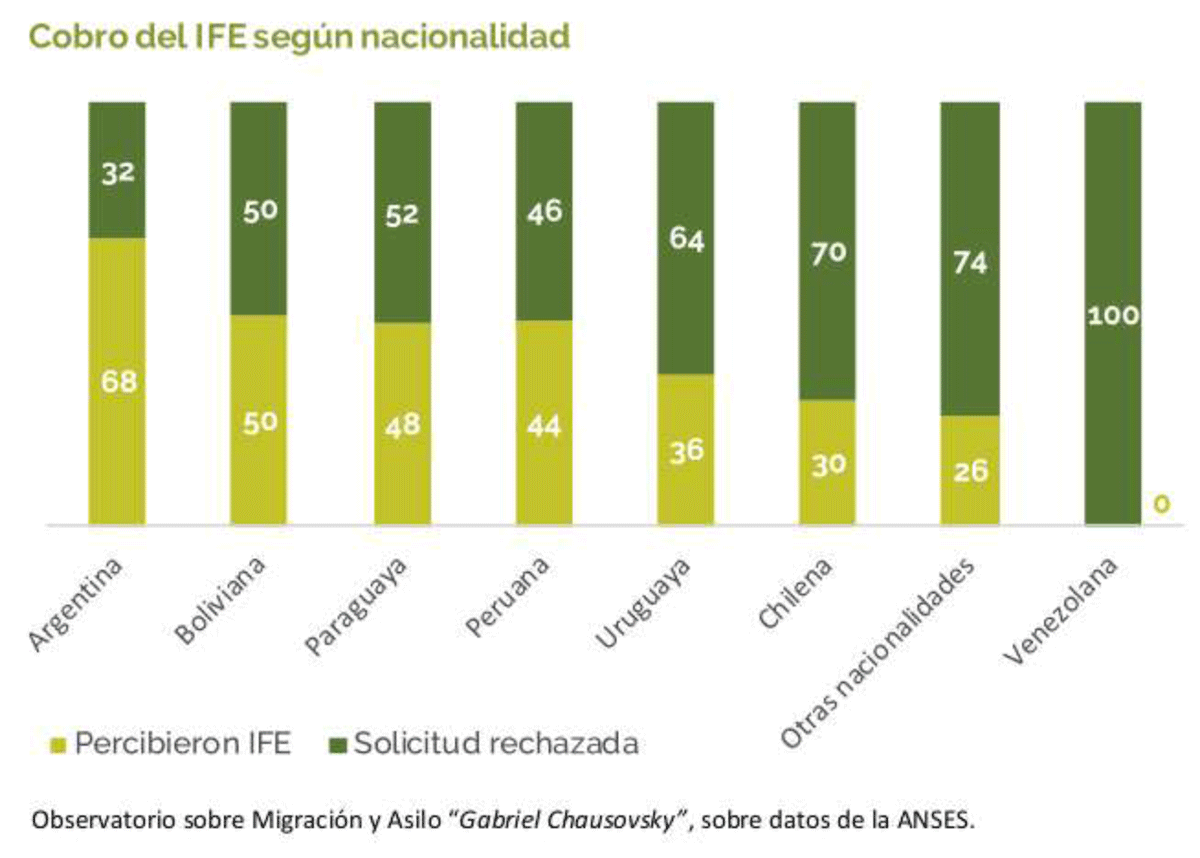
Figure 1
Granted and denied aids by nationality.
Source: taken from Observatorio (2021: 19).
Figure 1 shows that all applications from Venezuelan individuals were rejected but also that many submissions from long-term migrant communities (Paraguayan, Bolivian) were also turned down. Indeed, some surveys estimated that 83% of the migrant population in the country did not access the IFE1 (Agenda Migrante 2020), ‘because they either failed to meet the two-year residence requirement or because their applications were rejected’ (Brumat and Finn 2020: 331). Nevertheless, the explanation is slightly more complex and actually, the percentages for foreigners improved to some extent for the IFE2. Firstly, there is a significant bias in the initial survey of Agenda Migrante2020: having been conducted via Internet (using Google Forms), the survey itself recognizes that Venezuelan respondents were over-represented, accounting for approximately 80% of participants. Since this migrant flow consists mainly of newcomers, they did not fulfill the two-year (legal) residence requirement. A more comprehensive survey conducted afterwards (Debandi et al. 2021) indicated that 3% of the Venezuelan respondents eventually received the IFE. Secondly, the latter survey (conducted after the tree cash transfers were made) surprisingly indicates that (i) 37% of the survey respondents were not interested in applying to the IFE, while (ii) 20% said they were actually interested but did not meet the eligibility criteria, and finally, (iii) only 23% of the respondents answered that they did apply but the subsidy was denied to them.
Let us analyze these rejections thoroughly. The Social Security authority reported a list of reasons for rejection, ranging from people having formal employment (43.6%) or other type of income to 200,000 rejections related to foreigners that provided ‘insufficient data’ (Argentina-ANSES 2020). Additionally, there were two categories not applicable to nationals: ‘foreigners that did not meet the residence requirement’ (57,000 rejections) and ‘foreigners with no permanent residence’ (14,000). However, we still do not know what insufficient data meant and a permanent residence permit is not mentioned in the legal framework as a requirement (see Table 3) to receive the benefit. This is why a group of NGOs denounced that, in practice, the requirement of maintaining a legal residence in Argentina for a minimum of two years by March 31st, 2020, became in the end, a requirement for permanent residence and the period was calculated starting from the date entered in the DNI. Finally, the mentioned survey (Debandi et al., 2021) also revealed other grounds for exclusion: (iv) 13% were not able to use the on-line application and (v) 7% just learned too late how to apply. Only 18% of the respondents did end up receiving the IFE. In this fragmented scenario, there are obstacles at very different levels. Among those not interested in applying, one interviewee expressed: ‘If I have to ask for social assistance, I’d better go back to my country’ (Debandi et al. 2021). Another set of exclusions is clearly located at the law itself when requirements are not met. What nobody is sure about (Campos 2022) is what foreigners with insufficient data means and thus, the uncertainty related to social policies was increased regarding the IFE, mainly by doubt and arbitrariness (Dettano and Cena 2021).
Collectively, bureaucratic practices overlooked many situations that migrants face before achieving a permanent residence: (i) most foreigners are granted temporary permits before they become eligible to apply for a permanent residence; (ii) the many obstacles to acquiring a regular status of any sort, ranging from delays from the Immigration Board (CAREF-IOM-ACNUR 2019) to a widespread fear of being deported that prevent migrants from making themselves visible, particularly taken into account the control migration system in force until March 2021 (García 2017; 2021). Regarding those who were unaware of the subsidy or just discovered it after the deadline, and also those who did not succeed in dealing with the online application process (since, for instance, the only language available was Spanish), they faced obstacles located in a pre-level, a stage that embodies the real meaning of accessibility.
Finally, there were two legal cases regarding the IFE submitted by the Public Defender Office. The first one involves a Dominican woman that had been living in Argentina since 2011 but was not able to prove two years of legal residence by means of her ID. The Court ruled in her favor by taking into consideration that she was in a vulnerable situation and the IFE was, in fact, a social inclusion tool (Argentina-Judiciary 2020.a). The second case is even more interesting: a Venezuelan woman who arrived in Argentina in 2018 with her 1-year-old son was not only experiencing a vulnerable situation but also lacked both a national ID and a two-year legal residence of any kind. The claim was rejected by the Trial Court, but the Court of Appeals ruled in her favor on the grounds that she was a woman with no family ties in Argentina and with a precarious job as a street vendor that was immediately affected by the confinement measures. In addition, the Court considered that her gender and the domestic violence she was suffering affected her migratory process. As a result, by arguing upon the State’s obligations pursuant to many human rights conventions, including the superior interest of the child, the Court ordered the Social Security authority (ANSES) to take all necessary steps to allow the woman to start the application process (Argentina-Judiciary 2020.b).
On the contrary, some key informants have reported that the IFE was denied even in cases where foreigners did comply with the required residence period. As a migrant leader stated, there were ‘very absurd answers [from ANSES]’. They [ANSES] said, for example, ‘the person does not fulfill the years of residence’ and the person has been residing here for 30 years. She felt that ANSES ‘had some lines already written down and simply cut and pasted the most suitable ones’ (Migrant leader, Province of Cordoba, Argentina, interview dated 10/06/2021). There were also other feelings on the matter: a Paraguayan woman who runs a merendero (soup kitchen) in a shanty town in the province of Córdoba expressed that there was a political decision of leaving migrants behind (Alvites Baiadera et al 2021). In a personal interview with the authors, they emphasized that even when ‘there is no record of that decision nor the possibility of an admission by whoever is behind that public policy’ the feeling was that ‘the IFE was a place where they [migrants] were not allowed to enter (…) the feeling of being in a secondary place, there [in their countries] and here [in Argentina]’. (Angélica, interview dated 13/10/2021).
4. Final Remarks
This contribution systematized the non-contributory social security requirements for foreigners and thus, identified two categories and different types of requisites: on the one hand, foreigners and even naturalized citizens, and, among the requirements, years of residence, type, legality, and national ID. Furthermore, requesting for permanent residence or considering the residence date entered in the permanent DNIs are bureaucratic practices that, together with direct measures, challenge the Constitutional equal rights and the social security rights on equal conditions recognized by Migration Act No. 25,871.
It is far from the scope of this contribution to identify and debate what the problema actually is (e.g., if restrictions on migrants and refugees are unconstitutional, although I think they are and I think that the requirement of a legal residence for a certain number of years proved by a DNI is not reasonable), but to put the Argentine experience in a global dialogue about migrant social rights and show the achievements and outstanding debts of a double human rights approach: in migration and in social policies. Suggestively, the Judiciary fixed many of the gaps by directly emphasizing human rights covenants over the constitutional provisions. In doing so, they shed light on the importance of dealing with rights and obligations instead of benefits and charity. Unfortunately, this approach faces limitations since even positive results depend on each court and case, given that case-law is not binding and rulings are made on a case-by-case basis.
All in all, this article identified a first stage of obstacles faced before applying, namely access to the internet, management of an online application, language, knowledge about the program but also the rights themselves and even representations of what being a migrant entails: as a migrant referred, ‘If I have to ask for social assistance, I’d better go back to my country’. Then, the legal sphere shapes a second level of exclusion by establishing a minimum threshold based on residence and documentation instead of needs or vulnerability. Rather than protecting the most vulnerable inhabitants in equal conditions, the IFE targeted excluded but still included citizens. Thirdly, standard (and instituted) bureaucratic practices overlook (in the best of cases) how difficult accessing and keeping a permanent residence is, particularly for non-MERCOSUR migrants. In the worst of cases, such overlooking hides a way of taking advantage of a situation: if not in terms of budget, at least in facing public opinion. Some (fake) news about Bolivians or Paraguayans that ‘came to Argentina to get the IFE’ (El Economista, 08/20/2020) were in circulation during 2020. In a recent investigation about discrimination in Argentina, researchers showed pieces of those fake news and the participants concluded that there was no migration control, that ‘Argentina was too generous’ with foreigners and such generosity causes ‘social injustice’ (UNSAM 2021: 14). Nobody questioned whether the news was true or not.
Other perceptions appeared upon closer analysis: the policies of leaving migrants behind, of being in a secondary place everywhere. Social rights are a measure of inclusion but at the same time, of exclusion and the feeling of (not) belonging, which is also caused by the decision to exclude them. A decision that is political rather than legal.
Overall, despite a human rights perspective that has been gradually adopted at different levels, particularly in Argentina, not even a critical situation as a pandemic (with a mandatory social isolation that in Argentina lasted for a year and a half) was able to break the ceiling that migrants experience when non-contributory social assistance is at stake. The good news is that in the last few years requirements have been reduced (from three to two years for the AUH in 2020; from 20 to 10 years in disability pensions in 2023) but the threshold remains. Social security rights are the Achilles heel of the universal rights which migrants and refugees are entitled to. Argentina guarantees a more favorable position for migrants than other countries, but still there is an outstanding debt regarding equal social rights.
Notes
[4] A shorter version of this paper was discussed in the Migrant Social Protection Project Virtual Workshop organized by the MigSP Team (University of Bremen) in January 2022. The final version was revised during my Visiting as a FFTV Fellow at CHREN-FAU (Erlangen-Nurnberg) during 2023.
[5] Act No. 25,871, Article 4: “the right to migrate is essential and inalienable and the Republic of Argentina guarantees it based on the principles of equality and universality.”
[6] Interviews in 2020 were part of a national diagnosis conducted by the Ministry of Science and Technique, CONICET and AGENCIA to assess the impact of COVID19 measures. Full report available here: https://www.conicet.gov.ar/wp-content/uploads/Informe_Final_Covid-Cs.Sociales-1.pdf.
[7] This requirement pays a debt to an old judgment from the Supreme Court of Justice that had declared the 40-years-residence requirement unconstitutional (Argentina-Judiciary 2007). In such a leading case involving a Bolivian 12 year-old-girl, the Court had ruled that the requirement prevent any kid from accessing the disability pension and thus, it undermined the right social security recognizes in the American Declaration of Rights and Duties of Man (article XVI) and in the International Covenant on Economic, Social and Cultural Rights (article 9) together with the right to security in case of disability (article 25.1, Universal Declaration of Human Rights), in connection with the right to life. Inasmuch that judgments from the Supreme Court neither abrogate laws nor are compulsory, the requirement remained the same until January 2023.
Competing Interests
The author has no competing interests to declare.