
Introduction
Both authors work mainly with e‑resources and support researchers during their publication process. We are employed at two different universities in Sweden: Karolinska Institutet (KI) and Södertörn University. KI is a medical university, while Södertörn University is multidisciplinary, encompassing the social sciences, humanities and science. Table 1 below provides some basic information about the authors’ universities and libraries.
Table 1
Our universities and libraries in numbers, year 2023
| Karolinska Institutet | Södertörn University |
|---|---|
| FTE: 6,500 | FTE: 7,500 |
| Researchers: 2,500 | Researchers: 680 |
| Employees, Library: 100 | Employees, Library: 31 |
| Published articles: 7,195, of which 85% OA | Published articles: 366, of which 86% OA |
In a previous case study (Parmhed & Säll, 2023), we described how transformative agreements (TAs) affected our everyday work as university librarians. However, we omitted a fundamental component of TAs, namely the financial aspect. This case study therefore focuses entirely on the monetary aspects of TAs. We first provide some background on the open access landscape in Sweden, focusing on the rise of TAs and their economic impact. We then describe the difficulties of budgeting for TAs. Subsequently, we analyse four TAs in order to determine whether they have been cost‑effective. Finally, we discuss some general problems with TAs and conclude with an outlook for the future.
Background
The first TA in Sweden was introduced in 2016 and was offered by the Swedish National Library Consortium, Bibsam (National Library of Sweden, 2025c). It was a pilot agreement with the publisher Springer for open access publication in hybrid journals. Since TAs include the costs for article processing charges (APCs) and not just reading, the National Library of Sweden and the Swedish Research Council covered some of the extra costs associated with this agreement.
‘open access policies at the universities were updated and became stricter, requiring immediate open access’
In the following years, Bibsam offered an increasing number of TAs but without additional financial support, which meant that the increasing costs had to be covered by the universities. The price increases for the new TAs could vary between 5% and 150%, depending on the publisher and/or university and the pricing model used. To avoid excessive price increases, many of the early agreements included restrictions either on the number of articles or on the total amount invested. In 2020 and 2021, several of those capped agreements ran out of money or articles much earlier than expected. One contributing factor was the pandemic, which caused a surge in publications, forcing libraries to secure additional funding or forcing researchers to pay with their own funds. At the same time, research funders increasingly demanded immediate open access to the research results they had funded. In addition, open access policies at the universities were updated and became stricter, requiring immediate open access where possible, so the TAs came at the right time and were used extensively.
The Swedish government’s current vision for open science is ‘that scholarly publications that are the result of publicly funded research should be made available with immediate open access. For research data, the transition should be fully implemented by 2026’ (National Library of Sweden, 2025b). We are not there yet, as Sweden’s total share of open access articles was 76% in 2024 (National Library of Sweden, 2025a).
Impact on our universities
‘the responsibility for open access publishing costs shifted from individual researchers or their affiliated institutions to the library’s budget’
Due to escalating costs for TAs, we have needed to elucidate the new circumstances to the university management at our universities. We were fortunate that they listened and understood the situation, which led to our libraries receiving an increased budget. This enabled us to participate in the TAs. This meant the responsibility for open access publishing costs shifted from individual researchers or their affiliated institutions to the library’s budget.
To illustrate the financial impact of the TAs, we calculated the price increases for our respective universities when the seven biggest agreements shifted from read‑only agreements to TAs. Table 2 below shows the percentage increase in costs in the original currency (Euros or GBP). According to our experience, a ‘normal’ price increase, not for a TA, is usually between 2% and 5% annually.
Table 2
Cost increase as a percentage when the seven largest publishing agreements became TAs
| Publisher | First year as TA | Unlimited/limited publishing | Approx. number of journals in TA | Karolinska Institutet, price increase | Södertörn University, price increase |
|---|---|---|---|---|---|
| Cambridge University Press | 2019 | Unlimited | 400 | 112% | 24% |
| Elsevier | 2020 | Unlimited | 2,300 | 16% | 8% |
| Oxford University Press | 2019 | Limited | 300 | 136% | 30% |
| Sage | 2020 | Unlimited | 1,000 | 12% | 6% |
| Springer Nature | 2017 | Limited | 2,100 | 34% | 14% |
| Taylor & Francis | 2018 | Limited | 2,000 | 11% | 10% |
| Wiley | 2020 | Limited | 1,500 | 31% | 12% |
As shown in Table 2, the price increase grew significantly larger when the agreements became transformative, even though four of them restricted the number of articles included. Fortunately, the agreements did not all materialize in the same year. However, it still posed financial challenges when prices rose sharply from one year to the next. The agreements with Cambridge University Press and Oxford University Press contained fewer journals (fewer than 500) than those with Elsevier, Springer Nature, Taylor & Francis and Wiley, which contain over 1,500 journals each, so the high percentage for Cambridge University Press and Oxford University Press is not particularly surprising in terms of actual cost, as it is for larger journal packages. As an example, the most expensive agreement for KI was with Elsevier, which constituted 46% of the total journal budget. For Södertörn University, the most expensive agreement was with Wiley, which constituted 21% of the total journal budget.
At KI, rising costs led to the implementation of a new financing model in 2022, which distributed the costs among KI’s 22 departments. It consists of two parts: a reading fee applied at the individual level for all KI employees and affiliates, and a publication fee, which is distributed to KI’s departments based on publication activity over the past five years. How these costs are handled at each department will vary. Each head of the department decides whether central funds will be used to cover these costs, or whether the costs will be distributed to the section or research group level and, if so, based on which parameters. We have not yet evaluated whether the new financing model has affected publishing frequency.
Distribution of costs on a national level
‘The mounting costs for TAs meant that Bibsam had to develop a new model for allocating the costs’
The mounting costs for TAs meant that Bibsam had to develop a new model for allocating the costs between the participating organizations in the consortium. The model is based on a study commissioned by the National Library of Sweden in 2019 (National Library of Sweden, 2019), which suggested that 90% of the cost should be based on the amount of publishing, and the rest should be an entrance fee based on tiers. The model has been implemented gradually over several years and includes dampening mechanisms so that institutions will be subject to a maximum price increase in a single year.
In general, the allocation model means that for institutions who publish a lot with a specific publisher, the costs will increase significantly. For institutions that do not publish as much, the costs may decrease significantly.
To describe the effects of the allocation model, we looked at three different agreements where the model has been introduced and that we both have at our universities. Not all Bibsam agreements have currently implemented the allocation model. The price model before the new allocation was also based on publishing, but not to the same extent, and reading costs were still a significant part of the total cost. Figure 1 below shows the cost impact of the new allocation model.
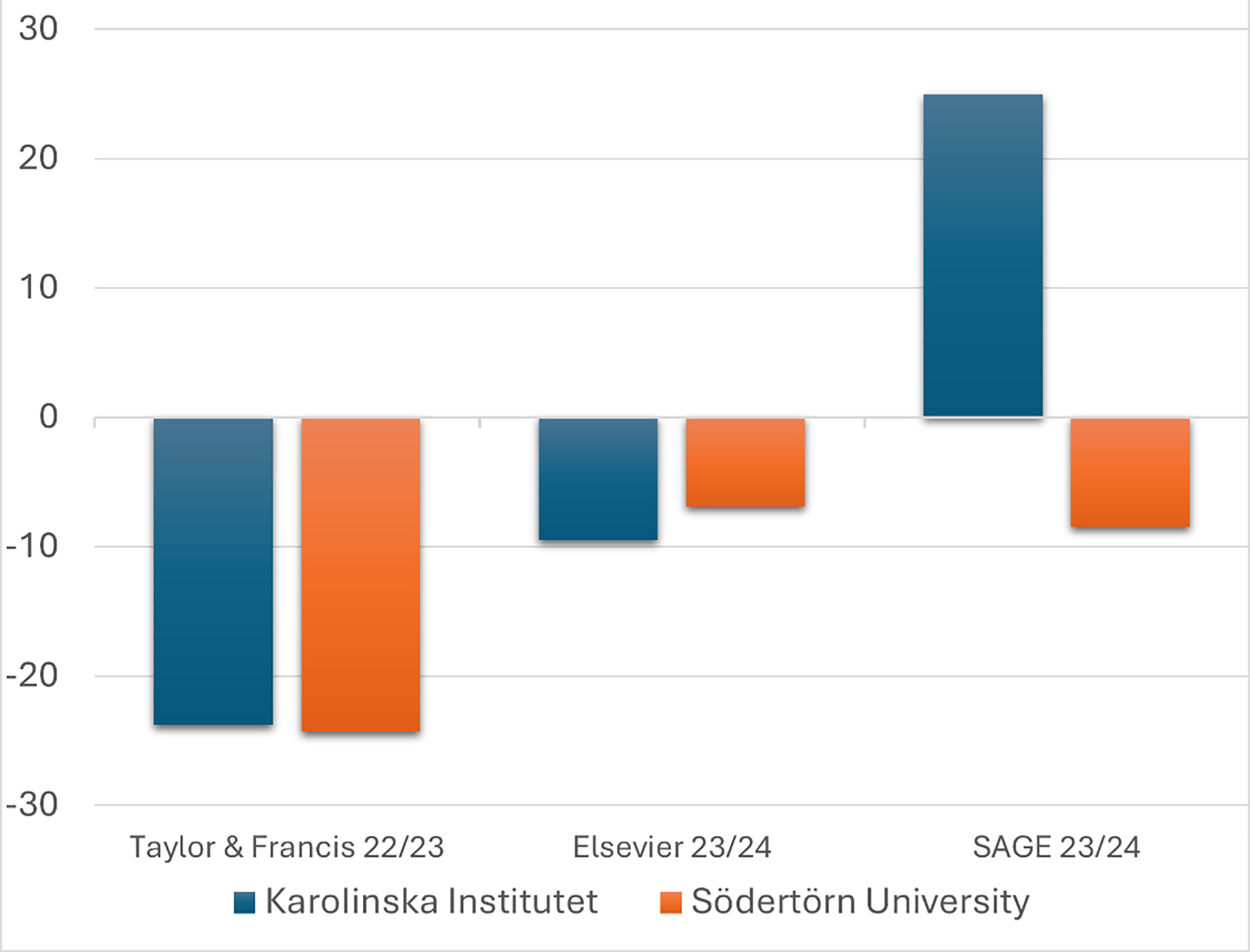
Figure 1
New allocation model. Cost difference in %
For Taylor & Francis, the cost for both KI and Södertörn University was reduced. KI does not publish that much with Taylor & Francis, which explains the decrease. Södertörn University publishes quite a lot with Taylor & Francis, but compared with larger universities, the amount is considered small.
For Elsevier, there was also a reduction – albeit a smaller one – for both our universities, indicating that both paid for more than they published before the allocation model was introduced.
For SAGE, the difference was far more diverse: KI experienced an increase of 25%, indicating that it paid for less than it published. For Södertörn University, there was a decrease of almost 10%, indicating that it paid for more than it published.
Another significant change that has affected the costs on a national level is that some research funders (Formas, Forte, Vinnova and VR) in Sweden have partially financed the agreement with Springer Nature for several years. They covered about 50% of the cost for publishing in fully open access journals within Springer Nature. However, in 2025, they decided instead to only finance the publication costs for the following fully open access publishers (National Library of Sweden, 2023): Copernicus, eLife, Frontiers, JMIR (Journal of Medical Internet Research), MJS Publishing (Medical Journals Sweden) and PLOS (Public Library of Science). This means that researchers affiliated to a Swedish research institution have their APC paid for by the research funders without any involvement from the libraries. The consequence for our universities when the funders dropped out of the Springer Nature agreement was a 60% price increase for KI and a 13% increase for Södertörn University, even with damping mechanisms.
Budgets
‘The TAs have highly affected the libraries’ budgeting and made it much harder to predict future needs’
The budget process at publicly funded higher education institutions in Sweden is slow. In the spring, the library makes an initial estimate and requests funds for the next year. However, it is not until late autumn or early winter that the final decision on allocation is made. Information about changes to agreements often comes late in the year, long after the budget request has been handed in. The TAs have highly affected the libraries’ budgeting and made it much harder to predict future needs, partially due to the factors described below:
Prices are calculated based on previous publishing for all universities that are part of the Bibsam consortium, and despite much data, it is difficult to predict the future. The number of published articles tends to increase each year as increasing numbers of researchers choose to publish open access within these agreements.
A few TAs in Sweden still limit the amount of money or the number of articles allowed in a year. If the money and/or articles run out, we must have a backup plan. Can we cover the extra cost or not? So far, we have been able to cover articles when the money and/or articles have run out because we have taken the risk into account. Recently, Bibsam has instead started transferring last year’s over‑publication to next year’s agreement invoice.
Many publishers do not have a fixed APC for their journals; the APC can vary as much as a couple of thousand pounds/dollars/euros, as shown in Steinberg’s article (2025). This depends on the journal, making calculations particularly difficult, since we do not know in which journals our researchers will publish in.
Unexpected or unpredicted events – like when research funders cut their finances, as in the fully open access case of Springer Nature described earlier. It could also be events like the pandemic, causing a spur in publications – as shown, for example, in Rousseau’s et al.’s article (2023) – or the effect of changing policies, nationally or locally, at the universities.
These aspects have forced librarians working with these agreements to make highly uncertain estimates of what the agreements will cost, so that the library management has something to work with when requesting a new budget. Previously, we could just add a couple of percentage points to the budget request, but now there can be radical changes that are incompatible with the slow budget process at universities.
Analysis of four agreements
In an attempt to discover if TAs are worth the money, we chose to analyse four agreements that we both have had for many years, so we have plenty of data, and the data are reasonably comparable. The publishers are Elsevier, Oxford University Press, Springer Nature and Taylor & Francis, and we selected the year 2022 – before the new allocation model came into effect. Since 2022, the prices have been largely affected by the new allocation model, making it harder to calculate and compare.
We compared the cost for the actual TA with the cost for the same agreement, simulating that it was still a reading agreement. To calculate the cost as a read‑only agreement, we took the average price increase from previous years. Since we have subscribed to these journal packages for many years, we had a good basis. We then added the costs for APCs, which, without TAs, would have been paid by the university’s departments or researchers. We know how many articles our respective university has published in that agreement, so we multiplied that number by the cost for the APCs in their original currency.
For Oxford University Press, Taylor & Francis and Springer Nature, we know the exact cost for APCs since it is fixed, and for Elsevier, we calculated an average cost for the APCs since it varies among their different journals. For one publisher, Taylor & Francis, there was a fixed price for the APCs for hybrid journals but varied APCs for the open access journals, with a 10% discount in 2022. We therefore calculated the average cost of the open access journals’ APCs without the discount, since we would not have had the discount outside the TA. For the other publishers, there was no discount on the APCs.
The results are presented in Figure 2 and Figure 3 below, where we have compared the estimated cost of a subscription agreement plus the cost for APCs with the actual cost of the TA.
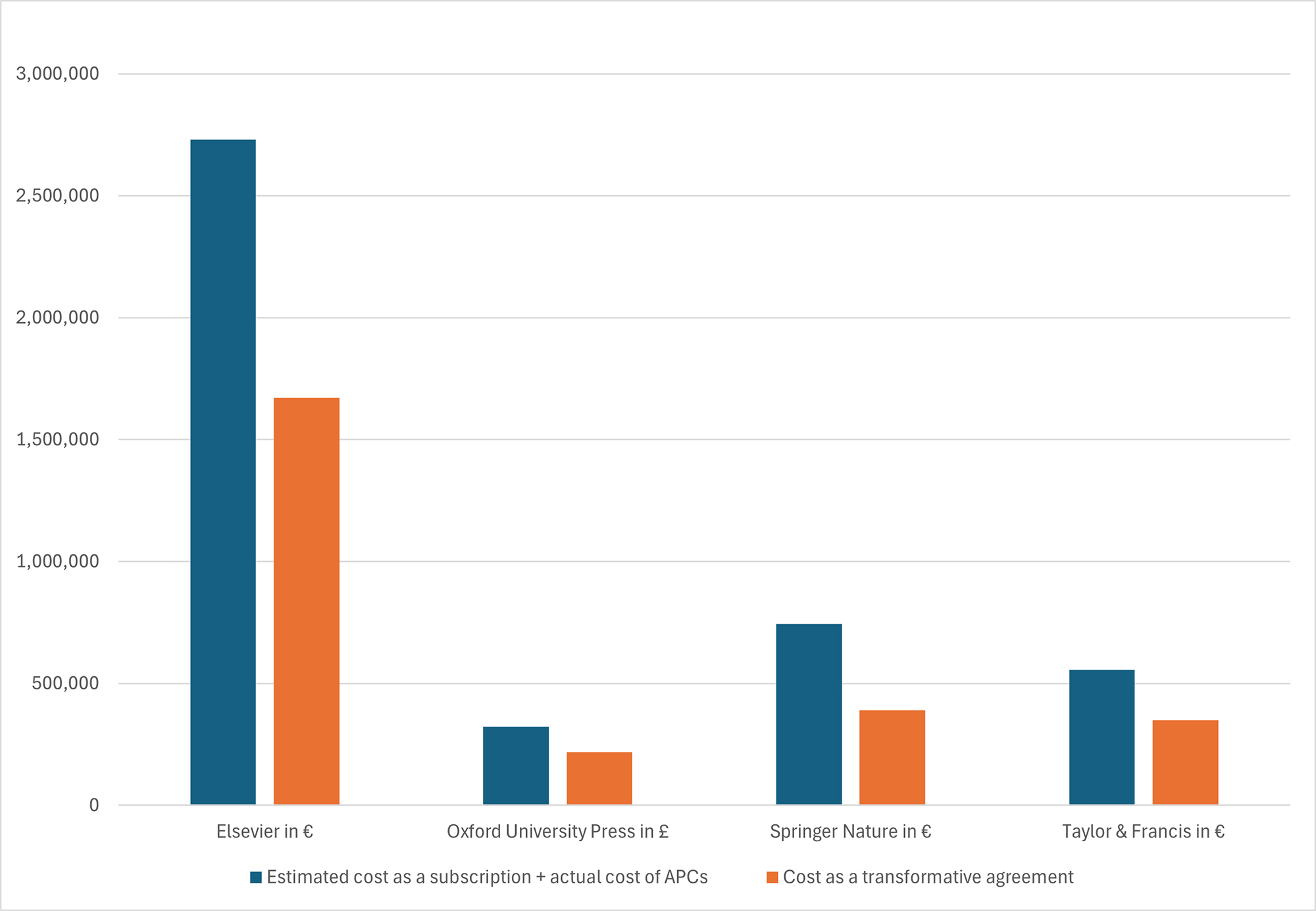
Figure 2
KI: four agreements 2022
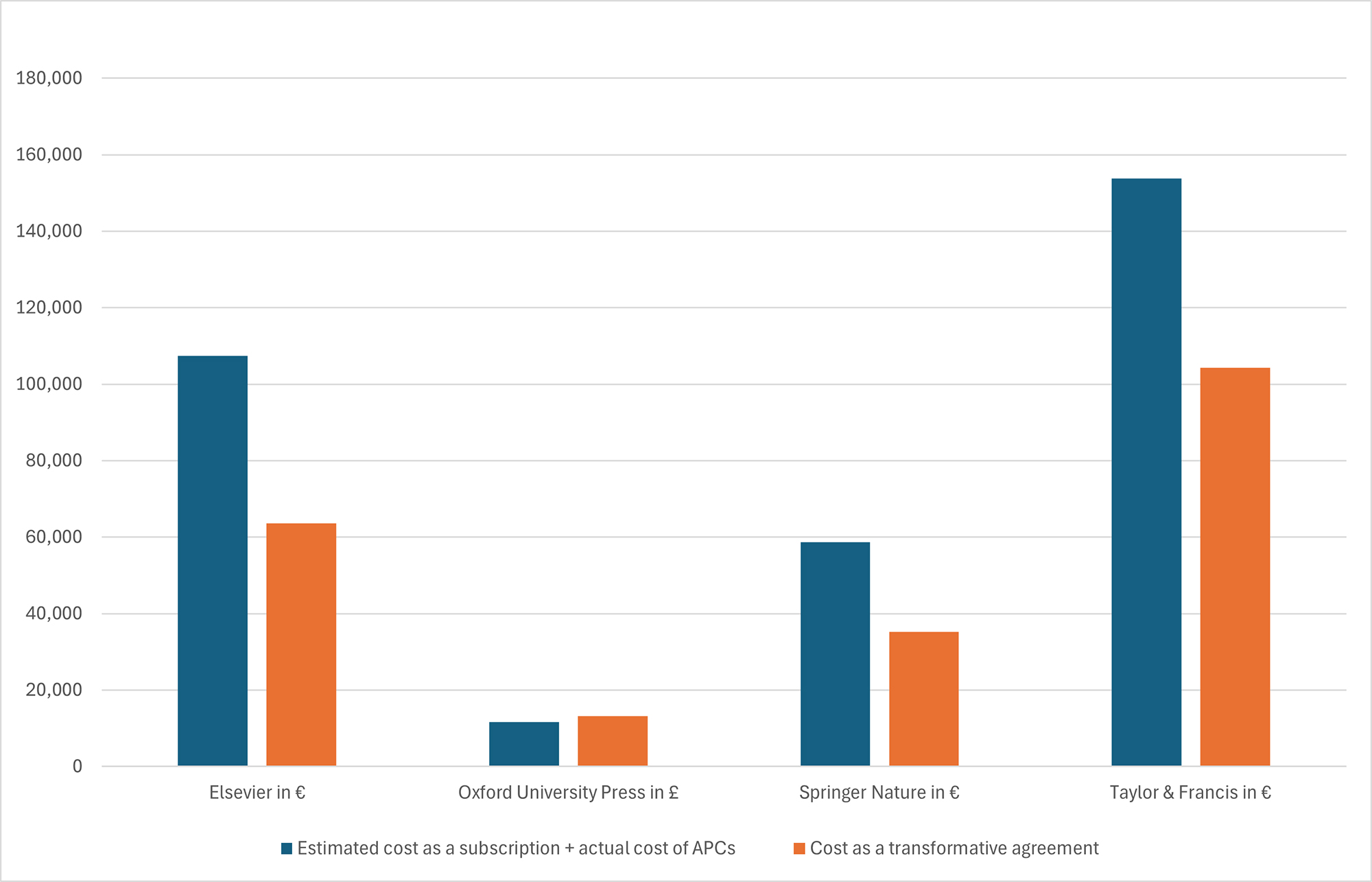
Figure 3
Södertörn University: four agreements 2022
The figures indicate that it would have been more expensive for both of our universities to pay for the subscriptions and the APCs separately, with one exception, discussed below. The cost for KI without a TA would have been about 63% higher for Elsevier, 48% higher for Oxford University Press, 91% higher for Springer Nature and 59% higher for Taylor & Francis.
For Södertörn University, the difference is 69% higher for Elsevier, 12% lower for Oxford University Press, 67% higher for Springer Nature and about 47% higher for Taylor & Francis. In the case of Oxford University Press, Södertörn University had so few published articles in 2022 that it would have been more favourable without the TA.
Therefore, in this scenario, TAs have been favourable in terms of costs for both universities, apart from Oxford University Press for Södertörn University.
However, we do not think that the number of open access articles would have been as great had it not been for the TAs. We believe that many more articles would have been published behind a paywall if the researchers did not have access to these agreements. We also suspect that the total number of published articles may have increased due to the TAs, as researchers do not have to pay for the APCs.
Discussion
There is a lack of standardization and transparency regarding TAs, which makes them hard to assess. As the recent NISO initiative on a recommended practice for operationalizing open access business processes states, ‘... the true cost and value of individual articles are not ascertainable.’ (NISO Information Policy & Analysis Topic Committee, 2023). Hopefully, this initiative will remedy some of these issues, and it will be interesting to see the results of its work.
‘TAs do not cover all open access publishing at the universities’
One issue is that the TAs do not cover all open access publishing at the universities, so many APCs are paid for outside the agreements. In an effort to map the total costs for open access publishing in Sweden, the Open APC Sweden initiative was launched in 2016 (National Library of Sweden, 2025d). The project is inspired by other similar projects around Europe where libraries collect information about APCs outside the TAs and then publish the data openly. This is a time‑consuming task because it involves searching for individual APC payments in the financial system and entering information about the specific article and its cost into the Open APC Sweden system. Recently, this initiative has also allowed other publication costs to be added, such as page charges and colour charges. These types of costs can amount to big sums and are therefore valuable to include. Since the Open APC Sweden initiative began, we have seen a yearly decrease in the number of APCs paid for outside the TAs, mainly due to the increasing number of TAs. Between the years 2021 and 2024, the average yearly decrease for both our universities amounted to 45%. Despite the amount of work involved in this project, we believe it is a commendable initiative since it is the only way to gain a clear picture of how much Swedish researchers pay publishers per article.
Another issue with TAs is that they have sparked a debate in Sweden about which publishers are supported by the Swedish research funders and which agreements are entered into by Bibsam. Some argue that support for specific publishers and the agreements negotiated by Bibsam give these publishers a seal of quality, and they find it problematic when publishers or journals are included whose quality has sometimes been questioned. Others say that it is entirely up to the researchers to decide where they want to publish and that these agreements are merely an offer and do not include any valuation of the publishers. At the libraries, we try to navigate this landscape, which sometimes feels like a minefield. We encourage our researchers to evaluate each journal individually on its own merits and try to disregard the publisher and whether there is a publishing agreement or not.
From our libraries’ financial perspective, we can conclude that library costs have increased with the introduction of TAs. However, our study shows that the situation is different for both universities. Provided that the universities had published the same number of open access articles as in the agreements, the cost would have been even higher if it were not for TAs. Thus, the publication costs for both universities regarding the articles in the agreements have decreased. However, as we mentioned earlier, we believe that the number of articles published open access has increased because of the TAs and that more articles would have been published behind a paywall.
‘TAs have brought both opportunities and challenges; they have increased the amount of open access articles, but they are costly’
In conclusion, we can say that TAs have brought both opportunities and challenges; they have increased the amount of open access articles, but they are costly. Publishers can basically set whatever prices they want for APCs. Sometimes they are extremely expensive, with prices reaching upwards of €10,000, which we at the universities must accept in the current situation. The TAs have forced new financial models and redirected revenue streams to the libraries. The new national allocation model and the cut of financial aid from research funders have had big consequences on the libraries’ budgets.
What’s next?
In Sweden, a working group called ‘Beyond transformative agreements’ produced a report in which the main recommendation is that, from 2026, Bibsam should not sign agreements for reading and publishing in hybrid journals but only sign agreements for publishing in fully open access journals (Association of Swedish Higher Education Institutions [SUHF], 2023). As a result of this report, Bibsam has adopted an action plan to implement these recommendations. One part of the action plan is what they call ‘publishing as a service’, meaning that they only want to pay for publishing and not for reading. It will be interesting to see how this will work out. We suspect it will not be easy to bring all publishers on board, as the transformation to fully open access is still slow and publishers make a lot of money from hybrid journals. Also, some journals and publishers have a large amount of editorial material and are dependent on subscription revenues to pay for it, so it would be particularly difficult for them to abandon a subscription model. From a library perspective, we might have to sign our own agreements with publishers since we still need to offer reading, which makes it difficult for us to follow the action plan.
‘new models will continue to evolve and … publishers will find new ways of making money while they adapt to the open access landscape’
We believe that new models will continue to evolve and that publishers will find new ways of making money while they adapt to the open access landscape. We have already seen new fees popping up, like ‘flat fees’, charges for green publishing or ‘fast track fees’, and then there are the S2O (Subscribe to Open) models. We at the libraries will also adapt and strive to navigate the future publishing landscape while holding on to our core values of equitable access and scholarly sustainability – that is all we can do.
Abbreviations and Acronyms
A list of the abbreviations and acronyms used in this and other Insights articles can be accessed here – click on the following URL and then select the ‘full list of industry A&As’ link: http://www.uksg.org/publications#aa.
Competing Interests
The authors have declared no competing interests.