
Introduction
As of 2020, Kenya had made significant strides in FP, exceeding its FP2020 commitment with a 61% modern contraceptive prevalence rate (mCPR).1 However, substantial regional disparities persisted, particularly in underserved counties like Wajir, Mandera, Marsabit, Garissa, and Isiolo, which are counties with the lowest mCPR, with North Eastern counties (Mandera, Wajir, and Garissa) having mCPR below 10%.1 The Total Fertility Rate was 3.4 in 2019,2 an achievement largely driven by use of modern FP methods—nonetheless, there was still an unmet need for FP. Kenya’s FP2020 (currently FP 2030) commitments were dedicated to increasing modern contraceptive prevalence rate from 61% to 66% by the year 2030 and reduce teenage pregnancy among adolescent women 15-19 years from 18% to 12% by 2020 and 10% by 2025.3
Continued investment in FP is key for Kenya to build on current gains, achieve last mile for FP, and achieve its goals on reducing maternal and child mortality. Entrenched socio-cultural barriers, desire for large families, patriarchal decision-making, faith-motivated opposition to FP, high poverty, illiteracy, myths, and misconceptions are demand-oriented barriers to FP uptake. Service delivery barriers include limited-service coverage, long distances, incomplete method mix, low quality of care, and provider bias. Biomedical interventions of provision of FP methods do not guarantee uptake due to varied socio-cultural factors, including religious beliefs.
Religion has often functioned as a barrier to uptake of FP services due to misinterpretations of scripture, myths, and misconceptions about FP. Faith certainly influences healthcare beliefs and behaviours and as authoritative sources of information, faith leaders can be either barriers or facilitators in FP uptake. Given the important health promotion role that they play in the community, it is imperative they have a positive attitude towards FP.
F2AN implemented an interfaith FP programming approach as part of the DESIP programme, in Narok, Turkana, Homabay, Isiolo, Migori, Marsabit, Garissa, Mandera, and Wajir counties between 2019-2023, where mCPR ranged from 2% to 45%, and with poor health and FP indices.1,4,5 A Service Availability and Readiness Assessment using health facility assessment tool was conducted in 514 facilities (162 public, 86 FBO, 266 private). Common challenges identified were inconsistent delivery of quality FP services, including an insufficient number of trained personnel, high turnover of skilled staff for the delivery of full range of contraceptive methods, and inadequate funding for provision of consumables and contraceptives including Long-Acting Reversible Contraception. This compromised availability and readiness of the health sector to meet clients’ needs and to generate evidence for decision-making to support the planning and managing of a health system.
A Social Exclusion and Gender Analysis (SEGA), reaching 625 respondents, established and articulated the systems of exclusion and gender inequality and how they affected access, demand, and uptake of FP and Sexual Reproductive Health and Rights (SRHR) services. The analysis indicated positive community perception of FP as it helped in child spacing. However, some cited unfriendly health staff and infrastructure as barriers to access to FP and SRHR services by Persons with Disabilities (PwDs). The programme conducted client exit interviews reaching 2,150 respondents, which showed inconsistency in equity in access to and utilisation of FP healthcare services among the women of reproductive age in the nine counties of implementation particularly among youth, the poor, and PwDs.
For the first two years of DESIP, 2019-2021, F2AN implemented the programme in nine Kenyan Counties, four of them in arid and semi-arid regions. The programme worked with the national Ministry of Health (MoH), local government, faith-based health facilities, and religious leaders. The counties are characterised by insecurity, long distances between health facilities, high illiteracy levels, and occasional droughts. The complex and challenging environment included communities where socio-economic, political, and religious factors intertwined to shape daily life and health seeking behaviours. The direct programme beneficiaries were poor rural women, adolescents, and PwDs. Intermediary beneficiaries included faith-based organisations (FBOs), county health management teams addressing gaps in service delivery and the health system, as well as interfaith leaders addressing religious and cultural barriers. F2AN utilised existing MoH data collection, reporting tools, and the national aggregate reporting and analysis dashboard (Kenya Health Information System-KHIS) to track performance. Indicators monitored included number of clients reached with FP messages, couple-years of protection, which is the estimated protection provided by FP methods during a one-year period, range of FP methods provided, reporting rates, commodity stocks, and data quality assessment scores.
Context and Rationale
Kenya is a deeply religious country, with 85.5% Christians and 11% Muslims as of 2019.6 Many Kenyans look to religion for guidance on decision-making, with 85% of surveyed youth citing faith as their top value, while 86% of the respondents reported religious organisations as the second most trusted institution after the family.7 Accounting for 40% of health service provision and operating 38 Medical Training Colleges, faith-based health facilities are a critical component of the health system in Kenya.8
The Muslim populations are largely concentrated in the Northern Kenyan regions.6 This regional concentration of a specific religious group, in contrast to national averages, profoundly influences local interfaith dynamics. When one religious group forms a significant majority/minority in a particular area, the nature of interfaith relations, including potential tensions or opportunities for collaboration, can differ substantially from patterns observed nationally. This localised religious concentration can amplify the influence of religious differences on various social issues, including health. Religious beliefs and their interpretations play a complex and often contradictory role in the acceptance and uptake of FP in Northern Kenya.
Approach
Addressing deep-rooted, faith-based resistance to FP required a novel strategy. F2AN employed an interfaith, clientcentred approach, partnering with five faith organisations (Muslim, Christian and Indigenous Christian faiths) to address religion related barriers to FP. This intentional interfaith approach was key for several reasons. Firstly, a comprehensive interfaith approach was crucial due to the diverse faiths and cultures of the target groups. It was essential to ensure they were all reached with contextually relevant and culturally appropriate FP information that addressed their lived experiences, leaving no one behind. Secondly, the interfaith approach created avenues for interfaith dialogues among leaders from different faiths, deepening shared values and effective strategies for addressing faith-specific nuances. Thirdly, the health care workers (HCWs) and community health volunteers (CHVs) attached to different faithbased, health facilities provided FP information and services to everyone, regardless of their faith. It was, thus, imperative that they were aware of common religious-based myths and misconceptions of FP and how to address them. Further, it was important for the different faiths to present a united faith front in advocacy efforts at County and National level MoH to underscore the importance of incorporating faith strategies to FP and to include faith leaders at the decision-making tables where FP and RH were discussed.
F2AN worked with 248 Faith Leaders as key influencers in the uptake of FP engaged in a values clarification workshop, which provided a safe space for them to better understand and articulate their personal beliefs and values related to FP and SRHR. The training provided an avenue for cross-learning and identified areas of shared values between Christians and Muslims with regards to child spacing and reproductive health before delving deeper into each faith. This included dialogue, scriptural clarification, and re-interpretation of religious texts and teachings led by renowned theologians. Faith leaders were also trained on FP, providing an avenue to unlearn the myths and misconceptions they held and learn about the health benefits of FP. The training included 33 county level faith leaders, as Trainers of Trainers, who cascaded the training to 215 faith leaders across the nine counties of implementation, ensuring a wider reach of the programme.
In Marsabit and Isiolo counties, which have a majority of Muslims, faith leaders were also involved in the implementation of Social Behaviour Change and Communication Strategy (SBCC) strategy, providing guidance to the County Health Management Team ensuring religious and cultural nuances. Through this dialogue, the participants developed action plans that supported the community-based, religious leaders in preparing sermons and guides for awareness creation on Healthy Timing and Spacing of Pregnancies. This collaborative approach strengthened the involvement of faith leaders in demand creation and ensured that the programme’s message FP was disseminated widely within the community.
While the underlying Islamic religious doctrines often permit or even support child spacing for health and well-being of the mother and child, the interpretation and dissemination of these teachings at the community level are heavily influenced by cultural norms and community leaders and can significantly diverge from broader theological stances. This means that interventions must go beyond simply stating religious permissibility and actively engage faith leaders and scholars in clarifying nuanced interpretations, dispelling myths, and integrating FP messages into local religious discourse in a culturally sensitive manner. F2AN collaborated with respected Islamic theologians and scholars to empower the CHVs and HCWs to confidently address myths and misconceptions about Islam and FP.
Key messages included the fact that child spacing is allowed and encouraged in the Quran, as it promotes the well-being of a family and that contraceptives are an effective way of ensuring spacing. Subsequently, CHVs integrated faithbased awareness creation into their demand creation activities, leading to increased uptake of FP services in the communities.
With increased knowledge and confidence, faith leaders promoted FP through faith-based, social behaviour change communication during community dialogues, men engagement forums, couples counselling sessions, radio shows, and in places of worship. These advocacy messages then enabled clients to take up a child spacing method provided at a health facility, during an outreach or provided by Community Based Distributors during household visits.
F2AN supported 16 interfaith forums where the faith leaders shared learnings, challenges, and strategies that were working. The forums also provided an opportunity to review community members’ perspectives on FP and the services they were receiving, ensuring that FP messages remained accurate and consistent through regular re-sensitisation.
Programme Results
I. Enhanced referral completion rates through interfaith community dialogues
The project supported 307 monthly dialogues which incorporated interfaith conversations led by faith leaders, CHVs, Community Health Assistants (CHAs), and HCWs. These dialogues enabled community discussion on the benefits of child spacing and addressed key barriers including religious objections. This integrated interfaith approach created a shared understanding of the health benefits and scriptural backing of child spacing, leading to improvements in complete referral rates for FP services. For example, Isiolo county, which has a high Muslim population, recorded an improvement in complete referral for FP services from 75% in April 2022 to 87% in June 2022.
II. Increased male engagement and support for FP
To address the patriarchal decision making and resultant barriers to FP uptake, 85 male engagement sessions were held in communities to raise awareness among men on FP’s importance, address misconceptions, and ultimately increase male acceptance, access, and support for FP. These sessions included faith leaders and provided scriptural backing for child spacing, with both Christian and Muslim examples depending on the context. The men were eager to learn, asking for more information. The project witnessed an increase in acceptance of FP following these sessions.
III. Leveraging faith platforms for widespread awareness
The interfaith approach included supporting Faith Leaders and HCWs to disseminate integrated messages on the health benefits of child spacing, as well as its scriptural backing through 12 community radio sessions. This increased community awareness and contributed, in part, to improved uptake of FP services as depicted in Figure 1 which shows feedback from a caller during a radio session.
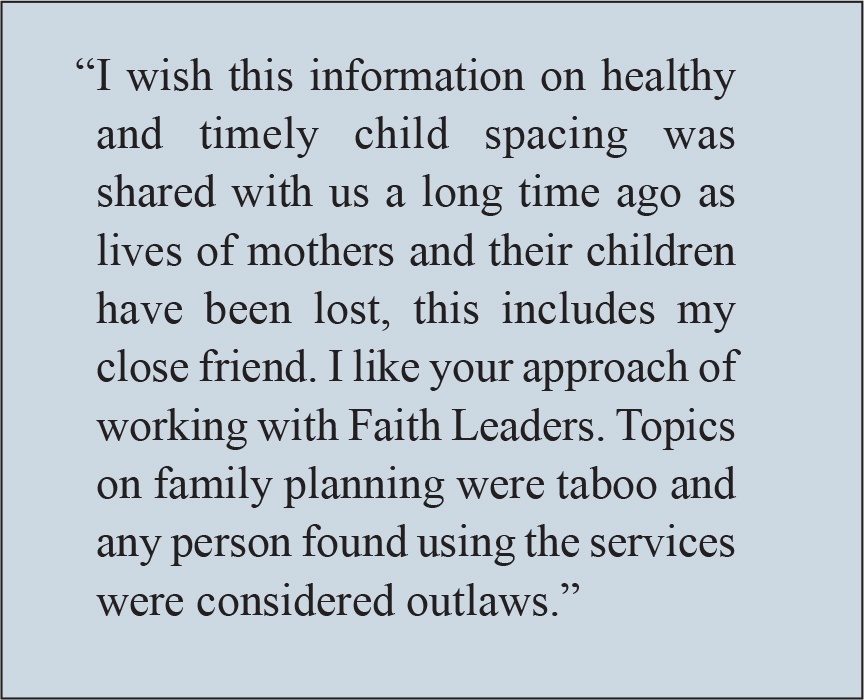
Figure 1
Radio caller feedback during interfaith radio session on importance of child spacing and FP
IV. Expanded reach to women of reproductive age (WRA)
F2AN’s interfaith approach contributed to reaching 192,809 WRA with FP services, including 20,748 adolescents and youth (10-19yrs) and 850 persons with disabilities. Through the programme, 210,156 FP methods were provided as seen in figure 2.
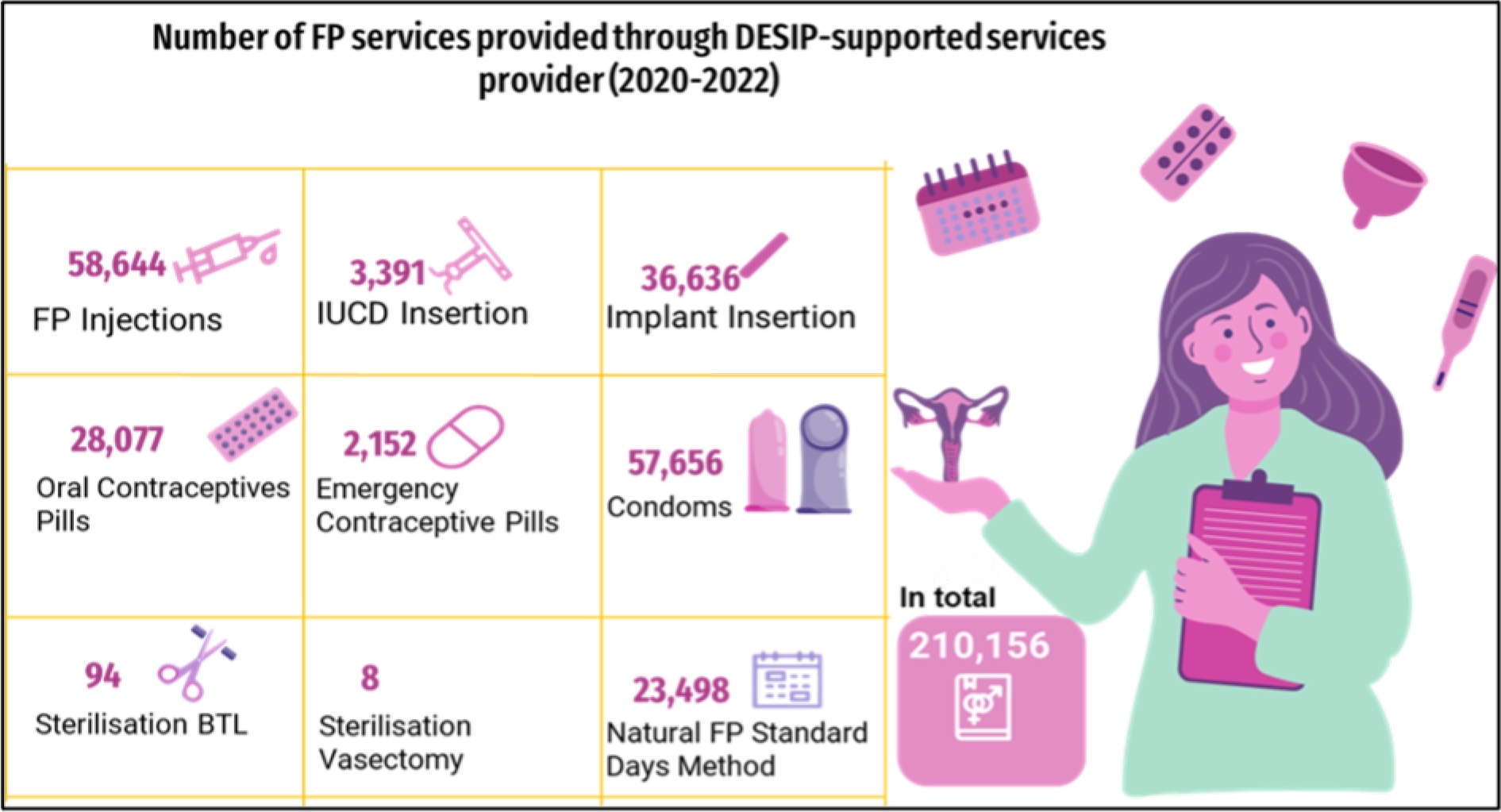
Figure 2
FP services provided through F2AN DESIP Programme
Practice and policy implications
The evidence above clearly demonstrates the value of an interfaith approach to enhancing uptake of FP, particularly in rural and underserved areas, utilising the faith sector’s untapped readily available potential in demand creation. The faith community has organised structures, a wide reach, and highly influential leaders; hence, FP is a cost-effective, highly replicable, and scalable approach. Specifically, the interfaith approach opens policy spaces for faith participation and mobilises and capacitates faith-inspired actors on problemsolving without advancing a partisan agenda or ideology. The scripture clarifications training provided scriptural basis for FP and empowered Faith Leaders who used faith platforms for FP awareness creation. This has been successful in unifying Christian, Muslim, and Indigenous African Churches’ voices in the counties of implementation in advocacy for FP and other interventions. The following recommendations draw on the programme’s experience:
Incorporation of faith and cultural leaders into national and county level planning structures:
Religious and cultural leaders play a crucial role in shaping the beliefs and attitudes of individuals in their communities. To ensure that FP services are provided in a culturally sensitive and acceptable manner, it is important that religious and cultural leaders participate in the county health management structures. This will facilitate collaboration between the health sector and the community, helping to address any cultural and religious barriers that may hinder access to FP services.
Incorporating faith and cultural leaders into county health management structures will also provide an opportunity for them to share their knowledge and experience in working with the community. This will ensure policies and strategies are responsive to the cultural and religious beliefs of the community.
Further, involving religious and cultural leaders in county health management structures can help to increase the visibility and acceptability of FP services within the community, ultimately increasing their demand. County health management teams should engage with faith and cultural leaders and seek their input on FP issues. Additionally, faith and cultural leaders should be trained on benefits of FP and child spacing and how they can support the community in accessing these services.
Replication of interfaith collaboration models
Interfaith collaboration models such as this one should be replicated with investments in training of faith leaders on faith-based demand creation and interfaith advocacy.
Sustainability
The key driver of sustainability for this approach was its ability to strengthen the knowledge of faith leaders to give correct information on FP and address resistance caused by misinterpretation of scripture. While specific project supported activities, e.g., community radio sessions, ceased with the funding, the trained faith leaders now routinely integrate the scripturally backed FP messages into their platforms, ensuring the message continues to be disseminated on existing, sustainable faith platforms. This has created well informed community resource persons who continue to advocate for child spacing even beyond the project. Further, the HCWs and CHVs have skills and continue to offer quality services in their facilities and communities. For example, the trained Community Based Distributors continue to offer FP methods at the community level. However, Kenya’s current mCPR (as of 2022) declined to 57%,9 which could be related to declining funding and support for FP programmes such as DESIP which was forced to scale down to due to funding cuts. This calls for increased efforts to integrate successful strategies into health systems at national, county, and community levels.
Limitations
This was a descriptive case study that did not offer a comparison, which may affect its replicability. It is important to acknowledge that the success of this interfaith approach is underpinned by unique Kenyan contextual factors which may limit its replicability in different contexts. Specifically, the country’s deep value for faith and faith leaders provides them with strong, existing platforms to influence health behaviours. Thus, successful implementation of an interfaith approach, requires pre-existing power of faith leaders to influence SRHR behaviour change and platforms to provide SRHR SBCC messaging. Similarly, openness and willingness to engage among different faiths and constructive collaboration for improved SRHR outcomes are necessary for a successful interfaith approach. Thus, future implementors should assess the influence of faith leaders, willingness to engage in interfaith dialogues, and the maturity of existing interfaith relations to determine whether this is an appropriate approach for their local context.
The donor supported nature of the initiative means that some activities were halted after the programme ended, which may negatively affect gains made. Additionally, the current changing global funding landscape has resulted in decreased funding for SRHR. While county and national governments and other development partners are attempting to step in the gap, this continues to be a challenge. This calls for integration of successful approaches into county and national MoH systems and at community levels. Further, the anti-rights and anti-gender rhetoric compromise support and funding for SRHR initiatives. This shows the increasing need for interfaith approaches to promote dialogue, challenge harmful narratives, and promote understanding to enable SRHR for improved wellbeing for all.
Conclusions
This case study confirms the strategic role that interfaith organisations such as F2AN play in mobilising religious leaders to contribute towards effective FP in communities. By working with faith leaders, addressing myths, misconceptions, and misinterpretation of sacred texts and teachings handed down from one generation to another, F2AN and partners succeeded in generating a critical mass of transformed and transforming Faith Leaders. Recognising the sensitivities relating to FP within the communities, there was a major investment in enhancing their capacities to contribute towards promoting more progressive attitudes towards FP. The collaboration with government was highly strategic, as it enabled the deepening of trust. By adopting an interfaith perspective, the interventions contributed towards more comprehensive approach in terms of coverage. It also enabled mutual learning and sharing of experiences. As this case study confirms, the strategies adopted by the F2AN demonstrated the ongoing relevance of religious leaders to social transformation and sustainable development in Kenya and beyond.
Acknowledgement
We would extend our heartfelt gratitude to UKAid, through the Foreign Commonwealth Development Office (FCDO) for their support to deliver the DESIP Programme. Our thanks also go to Population Services Kenya (PSK) for their leadership of the consortium. We also thank the consortium partners Population Services International (PSI), Health Right International (HRI), Voluntary Services Overseas (VSO), Options Consultancy Services, and AMREF Kenya. Special thanks to the Faith to Action Network’s faith consortium members- Christian Health Association of Kenya (CHAK), Anglican Services of Mt. Kenya East (ADSMKE), Council of Anglican Provinces of Africa (CAPA), Organisation of African Instituted Churches (OAIC), and Supreme Council of Kenyan Muslims (SUPKEM). We are deeply grateful to all the Faith Leaders, healthcare workers, CHVs who enabled the success of the programme. We are also deeply appreciative to the community members including women of reproductive age, adolescents, and persons with disabilities who participated in the programme.
Data Accessibility
The data provided in this case study is accessible through Kenya’s national data repository (Kenya Health Information System-KHIS). Other programmatic data are available through Faith to Action Network.
Disclosure
There is no conflict of interest.
Funding statement
This case study represents interventions enabled through the UKAid funded DESIP Programme through the Foreign and Commonwealth Development Office (FCDO). The Programme was implemented in a Consortium led by Population Services Kenya (PSK). Faith to Action Network (F2AN) led the programme implementation among faith-based partners, working with five organisations (Christian Health Association of Kenya, Council of Anglican Provinces of Africa, Organisation of African Instituted Churches, Anglican Development Services of Mt. Kenya East, and Supreme Council of Kenyan Muslims).
Ethical approval was not required
A formal ethical review was deemed unnecessary for this case study and not pursued. Data utilised for this case study was derived from routinely collected, aggregated, and de-identified programme data, reported and publicly available through Kenya’s national data repository (Kenya Health Information System-KHIS). Other data presented included programmatic interventions and the numbers of people reached, which were also aggregated and did not identify individuals. Further insights were drawn from routine learning and reflection sessions, which were key to programme adaptation. These did not involve individual participant identification and, thus, did not require ethical approval.
Authors Contribution
The authors were responsible for the planning, implementation, and documentation of the interventions presented in this case study.
Evelyn Gathuru (Christian Health Association of Kenya - CHAK)
Data Curation and Formal Analysis: Designed the programme’s Monitoring, Evaluation, and Learning (MEL) system, and was responsible for the collection, validation, aggregation, and analysis of all quantitative and qualitative data, including the KHIS and programmatic results (e.g., referral rates, WRA reached, methods provided) presented in the Results section.
Methodology: Contributed significantly to outlining the programme approach.
Writing – Original Draft: Led the initial drafting of the entire manuscript, compiling information from the programme’s design, implementation, and results.
Writing – Review & Editing: Critically reviewed and revised the manuscript, ensuring the accurate representation of programme outcomes and data integrity.
Judy Amoke (Faith to Action Network - F2AN)
Conceptualisation, Methodology, and Project Administration: Provided strategic and operational leadership for the entire Family Planning Programme, overseeing the implementation of the interfaith approach across the nine Kenyan counties.
Supervision: Managed the project team and partners, ensuring fidelity to the programme design and achievement of objectives.
Writing – Review & Editing: Critically reviewed and finalised the manuscript, synthesising inputs from all contributors and ensuring it met submission standards and accurately reflected the programme’s implementation.
Ezra Chitando (Faith to Action Network - F2AN)
Conceptualisation, Resources, and Methodology: Provided crucial intellectual guidance on the theological and cultural components of the programme.
Writing – Original Draft: Contributed substantially to the conceptual framing.
Writing – Review & Editing: Critically reviewed and edited the manuscript for academic rigour, clarity, and the accurate articulation of the programme’s strategic knowledge, findings, and interfaith narrative.
All authors have read and approved the final version of the manuscript.