
Introduction
From 2022 to 2024, the authors actively engaged in health campaign initiatives on Nias Island, focusing on efforts to reduce stunting in Indonesia. At that time, we committed to supporting the Indonesian government’s goal to reduce stunting prevalence to 14 percent by 2024. Nias Island is among the regions facing significant maternal and child health challenges, including the consequences of stunting. This campaign began with the signing of a Memorandum of Understanding (MoU) with one of the largest local churches on the island, Banua Niha Keriso Protestan (BNKP). BNKP has over 1,000 church buildings spread across Nias Island and its surrounding smaller islands, serving a Protestant Christian community of more than 800 members. In the MoU, the second author served as the General Secretary of BNKP, while the first author was the director of a health-focused NGO that includes maternal and child health in its agenda.
Every two weeks, meetings were held with pregnant women and mothers of young children at rotating church locations. Activities were conducted in three main regions of the island: the Western, Central, and Southern parts. In the Western region, activities took place at BNKP Tuwuna Church; in the Central region, meetings were held at BNKP Nalawõ Church; and in the Southern region, educational sessions were conducted at BNKP Lahusa Church Hall.
The sessions typically focused on educating pregnant women and mothers of young children about health, particularly on stunting prevention during pregnancy, proper nutrition during pregnancy, and early childhood development.1 However, what stood out were the reflective insights gained from participants during these sessions.
Story 1
In one of the sessions, a young mother raised her hand and asked, “May I invite my mother-in-law to attend these sessions as well? Because if we follow what is being taught here and it differs from what our mothers-in-law believe, we might get scolded by them.” At the time, we were discussing exclusive breastfeeding. Based on our observations and the information gathered, the rate of exclusive breastfeeding was notably low. This appeared to be strongly linked to limited public understanding of its importance. Yet, the mother's question revealed something deeper: that maternal health practices are heavily influenced by the social structure in the community.
In the local cultural context, mothers-in-law play a dominant role, and daughters-in-law are expected to comply with their guidance. This includes decisions about what toddlers should eat, the activities of pregnant women, and even their dietary patterns. Thus, this situation is demonstrating the powerful influence of intergenerational dynamics on maternal and child health behavior.
This condition is closely tied to the sociocultural configuration in which mothers-in-law hold a central role in Nias tradition, particularly in marriage customs. In fact, the mother-in-law is often referred to as ina sowõli, which literally means “the purchasing mother.” Meanwhile, the daughter-in-law is called bõli gana’a, meaning “the gold purchase.”
Why is such a transactional term used? In practice, marriage in Nias resembles an asset exchange process. The bride’s family “offers” their daughter, while the groom’s family is expected to sacrifice their wealth, especially in the form of gold as dowry to “acquire” the bride. The mother-in-law, before her son’s marriage, is considered to have worked hard accumulating the family’s wealth and gold, which would later be paid to the bride’s family during the wedding. This is the cultural basis behind the naming of the daughter-in-law as bõli gana’a.
Therefore, it is unsurprising that the young mother felt she had no authority over her own child and even less over herself. Her perceived role in the family structure was subordinated to her mother-in-law’s authority.
Story 2
In another session, we encountered a mother who had already stopped exclusively breastfeeding her infant. Related to the previous account, this mother revealed something revealing: after childbirth; she had to return to work immediately to support her family; otherwise, she would be labeled as lazy and face reprimands from her mother-in-law.
This immediate return to labor post-delivery left her with no time to recover and posed long-term risks to her own health. More concerningly, her baby was left in the care of others, usually her mother-in-law, which opened the door to early substitution of exclusive breastfeeding with alternatives.
For many women in Nias, being seen as hardworking is considered far more important than seeking health services. Although traditional health practices are still observed, they are often more socially acceptable than missing work for medical care. Farming labor, especially, is strongly associated with securing the family's future.
In several areas we visited, local midwives had long given up on encouraging women to attend antenatal checkups. Many midwives expressed frustration, uncertain of how to even persuade mothers to attend basic health education sessions. Work and family obligations consistently took precedence. Adherence to cultural norms led many women to neglect their own health. These women are often the backbone of their families, working long and physically demanding hours on family land.
This deeply entrenched work ethic cannot be separated from the extreme poverty that has long afflicted Nias Island. People are forced to work harder, often through manual labor rooted in tradition. However, the burden falls disproportionately on women, reinforced by social expectations and cultural norms. As Zaluchu noted in his writings on the concept of dowry in Nias,2 this is closely tied to the systemic weakening of women’s status. Similar to the myths surrounding Black women, as discussed in Kelly Brown Douglas’s essay 3 women in Nias—despite their vulnerable position—are mythologized as resilient figures who can immediately resume labor after childbirth.
Story 3
During one of our sessions, we distributed pre-test questionnaires. A pregnant woman seated in the front row remained completely silent. She accepted the paper and pen, but did not respond to any questions. We approached her and asked why she wasn’t engaging with the form. To our astonishment, we discovered that the woman was illiterate. Even more surprising was the fact that she was only 16 years old and already married.
Marriage in Nias is deeply steeped in tradition. From a young age, girls are taught to dream of happiness through marriage. This message is transmitted primarily through the teachings of their mothers. During fieldwork, the first author frequently heard mothers scolding their daughters with statements like: “Behave well and work hard so you’ll be happy when you get married.” Conversely, if a girl misbehaved, the mother might say: “You’ll regret it later—once you're married and still lazy, you’ll suffer under your mother-in-law’s anger. You must change your bad behavior now.”
Although not all mothers use these exact words, similar sentiments are often heard as advice given to young girls. Future happiness in married life is closely linked to present behavior. Girls are trained early to serve their families like washing clothes, fetching water, tending livestock, all are perceived as preparation for serving their future households. This transmission of norms is long-standing and tightly regulated, often under close supervision by their biological mothers.
Because family norms are the foundation of life in Nias, marriage is seen as the gateway to happiness. Love or romantic relationships are not seen as prerequisites. Arranged marriages remain common, especially in rural areas. Some women we met had never even met their prospective husbands before the wedding. Girls are told by their families that forming a family is their primary calling and must be acted upon swiftly. Unmarried or “late-married” women are considered a social disgrace. They are labeled as undesirable, and their families, especially their parents will bear the shame. As a result, early marriage is common, often at the expense of education, as exemplified by the participant mentioned earlier.
Empowering the Church: A Reflection
These stories offer important insights. All the experiences we described occurred during church-based activities, which leads us to reflect on the vital role the church can play in addressing these challenges.
The involvement of churches beyond spiritual matters has been well-documented.4–6 However, focusing specifically on maternal and child health as well as the deeply embedded issues surrounding them, presents a new challenge. We know that maternal and child health reflects inequities between regions, countries, and even individuals within the same nation. Wherever the church exists, it must be alert and active. BNKP has set an example by opening its doors to serve as a platform for responding to a national issue in Indonesia and becoming an agent of change at the local and individual levels.7,8
We were encouraged by this partnership. Not long after our activities began, the BNKP leadership invited us to train senior pastors and other church leaders on stunting and maternal-child health (Figure 1).
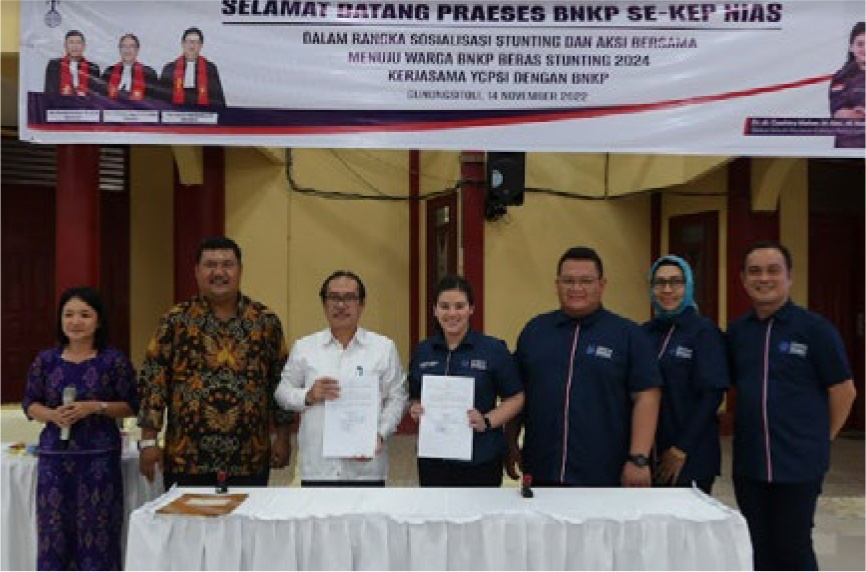
Figure 1
Stunting Training Activity with BNKP Senior Pastors
These three field experiences might never have been revealed had we not carried out activities within the church buildings. Therefore, churches must position themselves as gateways to understanding personal and household-level issues. They should avoid generalizing the problems of their members with slogans that apply to all. Instead, churches must be sensitive to individual struggles.
Jesus himself showed that each person has different needs and circumstances: He saw the fever of Peter’s mother-in-law (Matthew 8:14), the suffering of the woman who bled for 12 years (Matthew 9:20), the grief of the widow who lost her only son (Luke 7:15), and the spiritual thirst of the woman at the well (John 4:21). He desires that His church do the same: listen to the needs of those who have been redeemed by His blood.
Maternal and child health is deeply influenced by the social determinants of health (WHO, 2021).9 Churches must recognize that their members live in complex social realities. The stories we’ve shared underline the importance of the church being socially aware and responsive.
Churches should serve as the first filter in detecting the social issues surrounding maternal and child health. Mothers and children bound by harmful norms should concern the church. It should act as a medium for social transformation, offering practical solutions rooted in the community.10 The church must work to dismantle practices and norms that conflict with God's will and manifest the Kingdom of God on earth through its tangible engagement with societal issues.11,12
Conclusion
This short communication highlights how partnerships between churches and external actors can empower the church to fulfill its calling in the world entrusted to it by Jesus. It offers an inspiring model of BNKP, a local church embraced by the majority of the Nias population, stepping forward and opening itself to confront and respond to pressing social issues in its surrounding environment.
Funding
None.
Competing Interests
The author declares no competing interests.