
History of Christian mission health work in the Ethiopian context
In Ethiopia, Christian missions, with their establishment of modern healthcare in the 19th century, have influenced the development of healthcare. Before 1974, a critical year in Ethiopian history, Christian missions established many hospitals, clinics, and health centers, particularly in the provinces.1 As governmental health services were lacking outside the larger towns, by 1974, about 80% of hospitals had been established by mission organizations (B. Lindtjørn, unpublished). In addition, the missions often established nursing schools, thereby laying the groundwork for a small but essential healthcare workforce in rural Ethiopia. Focusing on education and training ensured that the mission’s health work had a lasting impact and was sustainable.2
One example of mission health work is the Norwegian Lutheran Mission (NLM), which initiated its holistic mission work in Yirga Alem, in southern Ethiopia, in 1950.2 The NLM took over a military hospital and transformed it into a mission hospital. This hospital provided essential medical services, including tuberculosis and HIV control, maternal health, childcare, and nutrition programs.3 The NLM's efforts in Ethiopia demonstrated the potential for mission organizations to collaborate with the government and ensure the sustainability of healthcare services.2
The development of healthcare in Ethiopia was like that of other African countries. From the 1950s until 1979, it was based on the delivery of basic health services. In Africa, missionary doctors such as Stanley G. Brown were influential in defining the broader role of mission hospitals beyond the institutions where they worked.4 In the 1960s, the publication of Maurice King's book, “Medical Care in Developing Countries,” contributed to the establishment of basic health services. The book highlighted the limitations of relying solely on institutional work and emphasized the importance of outreach to the districts, underscoring the significance of child and maternal health.5
With the launch of the Primary Health Care (PHC) initiative in 1978, much of the focus shifted to preventing common diseases in rural areas.6,7 It marked a shift in the thinking of medicine in the tropics, underscoring the importance of primary health care (PHC) in achieving “Health for All.”8 This approach raised awareness about “accessible, equitable, and community-oriented services;” yet, challenges persisted in low-income countries.7 Even if PHC improved health outcomes through preventive, curative, and promotive care, limited funding, lack of political commitment, and infrastructure hindered its implementation. Following the fall of the Soviet Union, this approach was gradually dismantled and has, over the last 20 to 30 years, been replaced by the thoughts of the Millennium Development Goals and the Sustainable Development Goals.9
During Haile Selassie’s rule (1930-1974), healthcare in Ethiopia was characterized by deep poverty and inequality, alongside slow development of essential health services. Unfortunately, the situation remained bleak under the subsequent communist regime.10 Since 2005, Ethiopia has made considerable efforts in health development, with a focus on expanding access to healthcare services and improving health outcomes for all.11 The country has strengthened its primary healthcare system through initiatives like the Health Extension Program that trains community health workers to deliver vital services in rural areas.12 Child mortality rates have declined, and efforts to combat diseases such as malaria and HIV/AIDS have shown progress through collaborations with organizations like USAID, the Global Fund, and the WHO.13 Furthermore, Ethiopia has enhanced its health infrastructure by establishing emergency obstetric care facilities, which has contributed to improved healthcare delivery nationwide.14 Unfortunately, the population's use of hospitals and health centers has been very low.15
Unfortunately, Ethiopia has been heavily dependent on external aid to support its health programs. In 2019-20, external donors and loans contributed approximately one-third to half of the total health expenditure, while onethird came from out-of-pocket payments, and the remainder came from the government.16,17
Over the last few years, many NGOs have been replaced by large programs supporting national efforts. Many of these NGOs served as proxies for external development programs by Western countries. Recent global developments have further complicated this question. Several of the larger donors of preventive programs, notably USAID and WHO, have decreased their support. Unfortunately, this reduction is not limited to changes in the US administration; major European donors of development efforts have also cut their support by almost 10% in the last year. The end of such funding has resulted in the regrettable collapse of several important programs. As a result, many patients and communities have felt the impact, and it may take considerable time for the government to establish sustainable programs that meet the country's needs.18
The decline in mission hospitals
Since 1974, mission hospitals in Ethiopia have faced a decline due to political, social, and economic factors. A significant turning point was the change in government policies following the 1974 Ethiopian Revolution, which introduced nationalization efforts and reduced the role of foreign missionaries in the healthcare sector.19 Previously, mission hospitals were crucial in providing medical services; however, they now faced challenges such as decreased funding, government restrictions, and shifting healthcare priorities. Some mission hospitals transitioned into government-run facilities, while others struggled to maintain operations. Additionally, broader discussions on Ethiopia’s healthcare sector indicate that the decline of mission hospitals was part of a larger makeover in the country’s medical infrastructure.
Another issue that has complicated the quality of health services is wars and civil unrest. During the last decade, there have been over 30 wars and 25.000 conflict events per year in sub-Saharan Africa, many of them in Ethiopia.20 Civil unrest has a direct and indirect impact on health, educational institutions, and research institutions. Recent estimates of poverty show that almost three-quarters of the rural population lives below the poverty line. An additional 16% are near this line, and the prevalence of poverty has increased in Ethiopia since 2019. This occurs at a time when the government has spent large amounts of money renewing its towns, building museums, and modernizing the capital, Addis Ababa.21
Reducing maternal and neonatal deaths at mission-run hospitals
Methods used to assess maternal and neonatal health
A key focus at mission hospitals in Southern Ethiopia was to deliver quality medical care for maternal, neonatal, and child health. Often, patients come from a great distance.3 The proportion of people who seek care at such institutions declines with distance from the facility.5 However, many expected that the work conducted at these facilities should lead to improved health outcomes in the communities they serve (catchment areas). To some extent, such a statement is probably true. A key unanswered question for mission institutions in many countries is whether they have a significant impact on the communities they serve.
To answer this question, we conducted several studies, which can be classified as surveys and operational research. The studies were conducted by master’s and PhD students from Southern Ethiopia, and I supervised them, receiving funding to support the research.
Our goal was to assess the impact of the work at the institutions on maternal and neonatal health in their catchment areas using various methods. As maternal deaths are clustered around labor, delivery, and the immediate postpartum period, the focus was to strengthen intrapartum care through improved Basic and Comprehensive Emergency Obstetric Care (BEmOC and CEmOC).22, 23
In Southwest Ethiopia, including two mission-run hospitals at Gidole and Arba Minch, we established representative community birth registration systems to register maternal and neonatal events.24 Additionally, we assessed the inadequacy of maternal services at government facilities in the same area.25 In Sidama, one of the most densely populated areas in Ethiopia, we used surveys of randomly selected populations to estimate maternal and neonatal mortality rates. Yirga Alem Hospital (a former mission hospital) is the oldest hospital in this area.2 The locations of these three hospitals, along with their primary catchment areas, are shown in Figure 1.
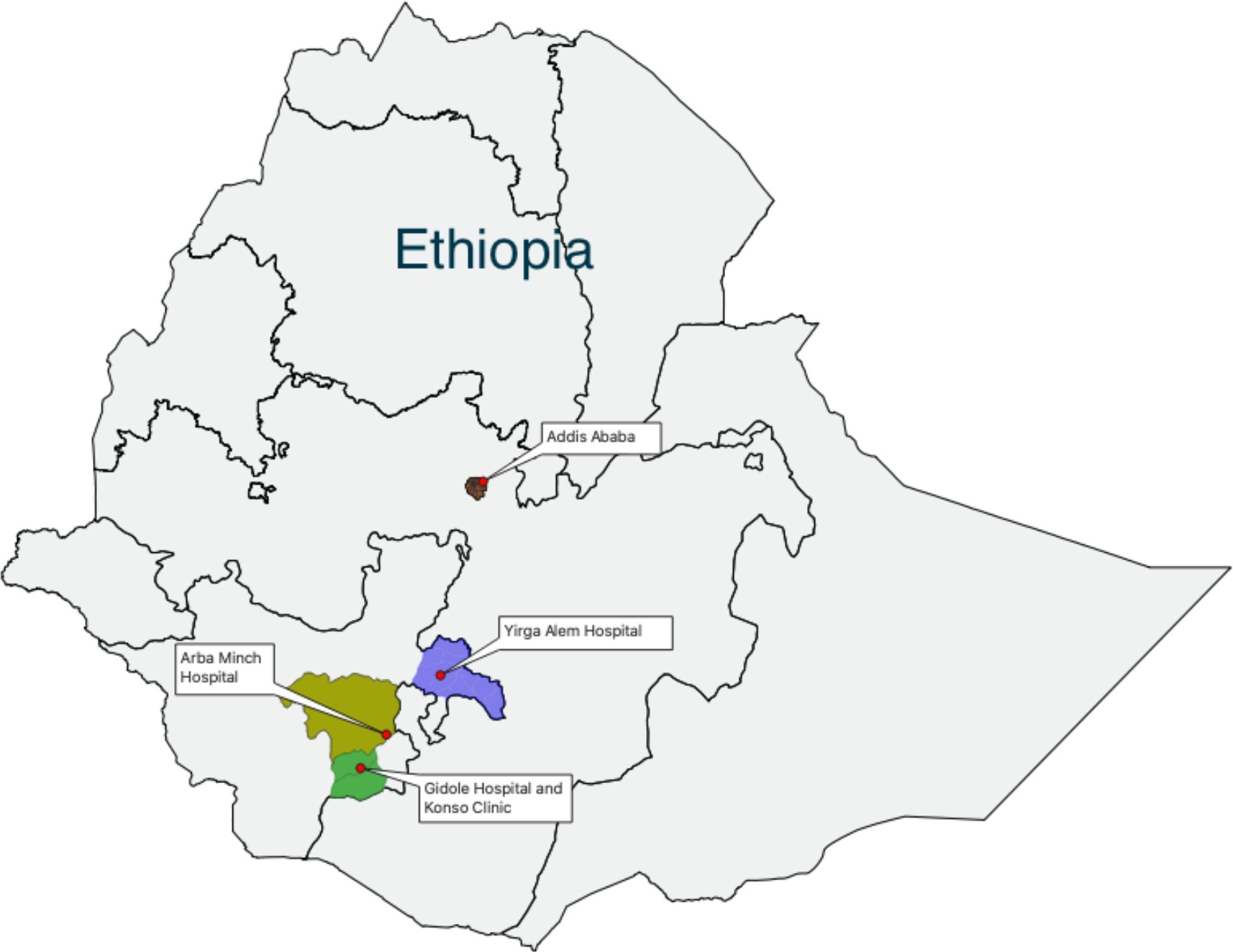
Figure 1
Map of Ethiopia showing the catchment areas of the hospitals included in this study
In general, when the maternal mortality ratio (MMR), which is defined as a population-based estimate, exceeds 1000 maternal deaths per 100.000 live births, there is little or no access to modern obstetric care. The Sustainable Development Goal (SDG) target 3.1 is to reduce the global maternal mortality ratio to fewer than 70 deaths per 100,000 live births.26 Countries that do not manage this goal should at least reduce the MMR by two-thirds compared to 2010 values. As shown in the data below, decreasing maternal mortality to around 400 from a starting point above 1000 is considered a noteworthy achievement, even if the SDG target is not reached.
In 2009, an extensive implementation program was introduced, and the results were examined after four years of service. This study evaluated a comprehensive health intervention designed to reduce maternal mortality in rural Southwestern Ethiopia, encompassing three districts with a population of approximately 700,000.22 The initiative, conducted from 2010 to 2013, focused on strengthening healthcare systems by upgrading institutions, training health workers, and improving emergency obstetric care. Key interventions and methods included:
Training non-physician clinicians and midwives to perform emergency obstetric procedures.22
Equipping facilities with essential tools for Basic and Comprehensive Emergency Obstetric Care (BEmOC and CEmOC).22, 27
Using the health extension workers, the program implemented a population-based birth registration system to monitor maternal and neonatal outcomes.23
The work employed a “continuum of care” approach, involving improvements to antenatal services, emergency obstetric care (BEmOC and CEmOC), and training of healthcare workers.
Experiences from Mission-run hospitals
Gidole Hospital
At the church owned Gidole Hospital in Southern Ethiopia, the mission was aware of its community responsibility and had been providing essential maternal services to patients since 1956. This small rural hospital served a limited population of about 150,000 people. Over the years, outreach programs were established to provide antenatal services in a few rural areas, and a maternity waiting area was constructed at the hospital, which received a favorable evaluation.28
However, questions arose regarding the coverage and accessibility of essential services for the population. With the initiation of a population-based, birth registration in 2009, it became evident that maternal mortality rates were high (447 maternal deaths per 100.000 live births).23 Therefore, we concluded that the traditional role of the mission hospital had reduced the MMR from very high levels (probably over 1000). However, even with an active outreach program, it was inadequate to lower maternal mortality to levels in line with the SDG goals.
The results of our community-based registry and interventions can be summarized as follows:
The maternal mortality ratio (MMR) decreased by 68%, from 477 to 145 deaths per 100,000 live births.
Home births declined from 90 % to 54%, and institutional deliveries increased significantly.
The use of traditional birth attendants declined (77% to 55%), while reliance on skilled health professionals increased.
Households located closer to all-weather roads experienced lower MMR compared to those in remote areas.
The study emphasized that targeted, wellimplemented interventions, such as decentralizing CEmOC services, improving healthcare infrastructure, and improving ambulance services, can substantially improve maternal health, even in resource-limited settings.
Based on a population-based, birth registry of 10,281 deliveries, the study also found a 75% reduction in stillbirths, from 11.8 to 2.8 per 1,000 births.27 These results are in line with studies conducted in Tanzania several years later.29
Arba Minch Hospital
Arba Minch Hospital is a government hospital supported by mission initiatives that was included in the birth registry studies and improvements in BEmOC and CEmOC services. It has a larger catchment area and population than Gidole Hospital. The results show that in the district (Arba Minch Zuria woreda) near the hospital, the MMR rate fell by 53%, from 494 to 231. In a more remote, mountainous area (Bonke), with only BEmOC services and ambulance services, the MMR decreased by 32%, from 482 to 327.24
In summary, the birth registration results show that the lowest MMR occurred when the hospital had a smaller catchment population and the population had good access to CEmOC services. We did not record a decline in stillbirth rates at Bonke, suggesting that the time factor in receiving CEmOC services is critical for this outcome.27
Yirga Alem Hospital and the Sidama region
A recent study from Sidama in South-central Ethiopia assessed mortality in one of the densely populated areas in Ethiopia.30 It is also the region where the NLM managed the Yirga Alem Hospital for almost 70 years.2,22 The study examined maternal mortality in the Sidama National Regional State. The sisterhood method (a survey-based technique to estimate maternal mortality in populations where vital registration systems are weak) estimated a MMR of 623 deaths per 100,000 live births, referencing approximately 10 years before the survey (2000 - 10).31 The 5-year, recall, population-based survey of the Sidama region provided a lower MMR estimate of 419 deaths per 100,000 live births, reflecting the period from July 2014 to June 2019.30 Notably, significant disparities in maternal mortality reduction were observed across districts. Peripheral districts experienced high maternal mortality rates due to poor infrastructure, inadequate emergency obstetric care, and a shortage of skilled health personnel.31,32
In contrast, more central districts, such as Yirga Alem (where a mission hospital had been located), experienced lower, but still high, maternal mortality rates. These findings emphasize that good institutional services alone may not be sufficient to reduce maternal mortality in the population substantially. Even if the services provided at the mission hospital were good, its population coverage was inadequate to reduce the maternal mortality rates, and this suggests that many women may have died in their homes without getting care.
The historical development of the Yirga Alem, Arba Minch, and Gidole hospitals, which practiced traditional missionary health work, did not achieve the desired reduction in maternal mortality rates. It was with a focused, community-based work with emphasis on identifying pregnant women in their communities and providing BEmOC and CEmOC services closer to the patients’ homes that the maternal and neonatal rates declined.
Financing of the interventions and hospitals
The primary costs of the interventions included staff training, supervision, and investment in equipment, as well as some minor maintenance work to paint and prepare rooms for maternity services, were covered by external funding. However, once the project was established, all ongoing costs, such as salaries, additional duty payments, medications, and maintenance were covered by the local Ministry of Health institutions.
Over the years, NLM developed a model for financing sustainable hospitals in the Ethiopian context. With the government paying salaries, operational costs were paid with patient fees. This scheme, developed at Arba Minch and Yirga Alem hospitals and based on evaluations by the Ministry of Health, became the basis of a new healthcare financing law for Ethiopia.33 Since then, all Ethiopian hospitals and health centers operate under a modified version of this model, which now also includes a voluntary health insurance scheme.
An unpublished evaluation conducted in 2024 revealed that all institutions in the catchment area where the intervention had been implemented were operational in 2024. They solely rely on the financing model shown above and have not received external support.
Some Conclusions on Faith-Based Organizations’ Large-Scale Community Interventions
The program from the Gidole Hospital produced promising results. However, it may have been too large for faith-based organizations, as it required external funding as well as research and educational skills (implementation research) beyond what can be expected from smaller faith-based organizations. Thus, the question raised in this paper is whether such an exercise can be repeated with more limited resources.
The changes in the theological framework of mission organizations
Paul J. Hudson notes that the changes by PHC started to shift the focus of Christian, mission-initiated, health work from a holistic approach that also included evangelism to prioritizing medical care.34 He mentions that this shift was shaped by the interactions between WHO and the World Council of Churches’ Christian Medical Commission (CMC). In turn, the CMC was guided by consultations with mainline churches and missions, particularly those from the Institute for Medical Missions in Tübingen, Germany. The motivation behind transforming traditional mission health work stems from a desire to shift the perception that medical missions were “primarily a means of proselytizing or ‘saving bodies to save souls.’” While the new PHC efforts were built on constructive intentions, there was a risk that they might undervalue evangelism. These evolving influences have presented new challenges for today's healthcare mission community, and in the long term, have weakened traditional, faith-based work in countries such as Ethiopia.
With limited resources in the “home country” of missions, this led to challenges. Some missions sought support from government development initiatives to navigate these challenges. One such example involved the Norwegian Lutheran Mission. During the first 25 years of its operations, NLM raised its funds through its base in Norway. However, with access to Norwegian government support and gradual expansion of the health work, the Norwegian government gradually encouraged full integration with the Ministry of Health. Unfortunately, this change led to a shift in how the organization utilized its resources, and the NLM gradually reduced its efforts to generate its funding for its health work. Consequently, with changes in Norwegian government support, NLM was unable to sustain this extensive work.
The Indian experiences
Mission hospitals in India have played a crucial role in the country’s healthcare system, especially in rural and underserved areas. These hospitals, often affiliated with Christian missionary organizations, have made significant contributions to public health, medical education, and social services. After India's independence in 1947, mission hospitals faced both opportunities and challenges. The number of mission hospitals declined from approximately 1,000 to fewer than 250. Some continued to serve as vital healthcare providers, especially in rural and tribal regions. Still, their role evolved in response to national development, changing regulations, and shifts in healthcare policy.35
Some hospitals, such as Christian Medical College (CMC) in Vellore and Ludhiana, have expanded their roles as premier centers for medical education. Others have become key players in national health initiatives, including the eradication of leprosy, the control of tuberculosis, and the promotion of maternal and child health. Many of these examples, however, were to some degree dependent on external support. After 1947, many Indian mission hospitals faced a decline in foreign donations and missionary support, making it difficult for them to sustain their operations. Furthermore, doctors and nurses trained at mission institutions were increasingly drawn to better-paying jobs in urban centers or abroad. At the same time, some hospitals struggled to modernize or maintain their aging buildings and equipment.35
In recent years, efforts have been made to revitalize faith-based, Indian hospitals through the establishment of partnerships and networks, such as the Emmanuel Hospital Association and the Christian Medical Association of India. These groups have collaborated to coordinate mission hospital efforts, providing essential support in capacity building, advocacy, and resource sharing. They are widely recognized for their ethical and compassionate care, as well as their affordable treatment, often serving as models for community health engagement. One example of such an institution is Makunda Hospital.36
The “Makunda Model” describes how a mission hospital in a remote area of Northeast India delivers high-quality, affordable healthcare in a low-resource setting. By combining poverty-centric strategies—such as ability-topay pricing, equal services for all, and tailored charity—with thoughtful cost management, including revised treatment standards and a mission-driven workforce, Makunda Hospital operates sustainably with minimal external funding. With high patient volumes, excellent maternal care, and strong local trust, the model demonstrates how targeted, mission-oriented practices can enable accessible healthcare and inspire replication in similar environments.36
Quality of health care services across public, private, and faith-based institutions
A requirement for good health work is that it must be of high quality and genuinely compassionate. Unfortunately, evaluations of the care levels at mission hospitals vary. Data from household surveys suggest that market shares may be lower than often assumed; yet they reveal a surprisingly high level of satisfaction compared to public facilities.37 While faith-based, health providers play a vital role in countries across Africa, especially within fragile or weakened health systems, many of them face challenges and demonstrate a limited ability to adapt to the evolving contexts of their health systems and financial constraints.
Ethiopia has made improvements in maternal and child health (MCH) over the past 80 years. The median life expectancy has increased. Government policies, international support, and community-based interventions have collectively contributed to a reduction in child mortality rates. However, challenges persist, including limited access to healthcare in rural areas, high rates of malnutrition, and high fertility rates.
There are many examples of private healthcare providers, and it is possible to run private, for-profit institutions provided that the population can afford the services. However, the quality of private hospitals in Ethiopia varies, although they generally offer better person-centered care compared to public hospitals. A comparative study in Addis Ababa found that about 70% of patients in private hospitals rated their care as good, compared to about 35% in public hospitals.38 Nevertheless, overall healthcare quality in Ethiopia remains a challenge. A broader assessment of primary care facilities revealed low quality and low coverage.15 A recent study on public surgical activities in the country shows that 60% of surgeons reside in the capital city. The institutions lack essential support services, demonstrate low productivity, and the average surgeon's workload is only 2.5 operations per week.39
Can local churches undertake the task of running health services?
One aspect of the mission work at many hospitals is its progression from a small institution serving a limited community to a facility serving a broader population. However, as the organizations expanded, so did the challenges of securing the necessary resources to operate these larger institutions. As previously shown in this paper, most healthcare costs in Ethiopia are covered by aid or patients. Recent shifts in how international NGOs operate indicate that they have increasingly relied on support from official assistance from developed countries. Unfortunately, such a system is often linked to priorities that are not always aligned with local needs. With changes in the geopolitical landscape, this has led to declines in Western aid. Therefore, the critical question is whether faith-based organizations and churches should thoughtfully scale their efforts to align with their resources, generate local income, and become independent of foreign assistance. By adopting this approach, they can develop an even more valuable Christian healthcare model, even if serving larger populations is not feasible.
The need for basic health services in remote rural areas is often expressed as an urgent local necessity. Frequently, individuals, community representatives, or churches raise such concerns. These concerns are based on real needs. “Too many mothers and their children die” is their sincere worry.
Recent dialogues I had with church leaders and members of Protestant churches in Ethiopia centered on whether they should again prioritize health work. One of these churches had previously operated a small rural hospital and several clinics, but their efforts had failed due to weak leadership and excessive dependence on external funding. As with many institutions, the leadership lacked the necessary professionalism and ownership of the institution. Thus, the church was reluctant to invest in it because of a lack of resources. However, during our deliberations, we reviewed some examples of private, for-profit hospitals in the area, demonstrating that it is possible to establish health institutions. Should the churches be encouraged to develop institutions that could provide basic health services to a limited rural population in their main catchment area?
Is it possible to restore the mission hospital's function in today's African countries, for example, Ethiopia? Such work should be thoughtfully managed. The goal should be to deliver high-quality and appropriate services through dedicated staff. This approach could be most effective in smaller, well-defined areas with strong community ties. However, church-based institutions must provide higher-quality care than public sector and private, for-profit hospitals. Higher quality of care is not based on advanced equipment. As the Makunda Model demonstrates, this is possible and realistic by combining poverty-centric strategies, thoughtful cost management, appropriate and sound low-cost, treatment protocols, and a mission-driven workforce.36 At the same time, they should consistently recognize the need for spiritual care among patients, their families, and the communities they serve.
Furthermore, experiences from India demonstrate that this is best achieved when the church-owned hospital operates independently of the church leadership (clergy), and it requires dedicated staff for extended periods. Such institutions should not be seen as sources of revenue for the church. They are a crucial part of the church’s ministry, created to demonstrate Christ’s compassion by providing affordable, accessible, and high-quality healthcare. Their primary goal is to serve communities, particularly the poor, marginalized, and vulnerable, without discrimination, as a crucial component of the church’s comprehensive mission to promote both physical and spiritual well-being.
Mission hospitals have historically focused on delivering quality, compassionate care to the most vulnerable communities. Western-trained missionary physicians and nurses provided leadership for clinical care, and many of the hospitals were funded, owned, and overseen by mission agencies. The growth of national churches and church leaders has often coincided with a decline in the number of healthcare missionaries and a decrease in funding from Western churches. However, there are instances where hospitals have transitioned to develop local governance with mature financial, human resource, and clinical services systems.36 One of the many challenges in building viable institutions in countries such as Ethiopia is that they must become sustainable. Achieving institutional sustainability often requires a mixture of local income and external support, which may be needed for investments in essential equipment, especially at the outset.
Furthermore, health work can be integrated with the social activities of congregations. A notable example available in Ethiopia is the International Child Development Program (ICDP). This psychosocial intervention program aims to enhance children’s emotional and cognitive development by training parents in positive communication and interaction. As a low-cost initiative, it has shown remarkable effectiveness in reducing child abuse and improving childcare in families. Additionally, when fathers participate in the program, it can help decrease partner violence within families, a prevalent issue in Ethiopia. It is a program that can be implemented as part of the deaconate services (for example, women’s groups) of local churches and can be integrated and synergized with health work.40
In principle, institutions should operate based on income generation. This could involve a diversified funding scheme that includes patient payments, some government support, community-based health insurance, and international aid, thereby reducing reliance on out-of-pocket costs. Measures that minimize waste and optimize resource use and procurement must be implemented to ensure sustainable practices. Management should allow hospitals to adopt strategic, human resource, management practices and innovate in service delivery. This also involves building trust and collaboration with local communities to ensure that healthcare services meet their needs.
As this paper outlines with examples from Southern Ethiopia, formalized higher education may be challenging. However, part of this can be achieved by developing collaborative teaching networks amongst church-based institutions to enhance their institutions and staffing.
Ensuring that appropriately skilled healthcare professionals, including doctors, nurses, and technicians, are available to meet patient needs is essential. Ethiopia faces a low physician-to-population ratio, making strategies such as training programs and retention incentives crucial for addressing this issue. Furthermore, ongoing education and professional development are vital for enhancing skills and adapting to the evolving demands of healthcare.
Acknowledgements
I want to thank Dr. Taye Gari and Dr. Daniel Gemechu for their constructive comments.
Data Accessibility
This paper is based on several original research studies. The data for each of these studies has already been made available, and the locations of the data can be found in each respective paper.
Ethics and Consent Statement
This article is based on several original research papers. Each of these research papers has received Institutional Review Board approval, and references to these permissions can be found in their respective papers.
Funding
No special funding was allocated for writing this article. However, the original research papers on which this article is based have received funding, as detailed in each of the papers.
Competing interests
There are no competing interests for this paper.