
Introduction
Ghana stands at a crossroads where vibrant, religious devotion and fervent, prayer culture meets persistent developmental challenges. With 71% of the population identifying as Christian1 and high levels of religious observance: 70% praying daily, 78% attending weekly services, and 73% fasting during holy periods.2 Ghana’s spiritual commitment is deeply woven into its national identity. Yet, this deep religiosity has not translated into broad national transformation. Ghana continues to struggle with a 23% stunting rate among children under five due to malnutrition, only 34% safe sanitation coverage and an estimated $3 billion lost annually to corruption.3 This paradox raises an urgent question: how can the power of prayer and faith move from private devotion to become instruments of public good?
The Prayer, Progress, and Health (PPH) Model, proposed by this paper, offers a theological and practical framework to bridge this gap, transforming spiritual fervor into societal transformation. The biblical call in Jeremiah (Jeremiah, 29:7) “Seek the peace of the city” offers a theological imperative for holistic societal engagement. This paper responds by building upon Bediako’s theology of African public faith4 and Agyeman’s analysis of the developmental role of Ghanaian churches.5 Agyeman highlights how churches serve as trusted institutions capable of influencing civic behavior and fostering community resilience through spiritual and social capital.5 Drawing from these foundations, the paper advances a framework in which spiritual practice meaningfully informs public action, particularly in the areas of health, environmental sustainability, and governance, bridging private devotion and public transformation.
The Church of Pentecost exemplifies how faith can drive social transformation. Through its Environmental Care Campaign, it mobilizes communities for clean-up exercises and sanitation improvement.6,7 In 2024, it planted over 1.6 million trees nationwide in support of Green Ghana Day.8 Its PENTSOS directorate provides health, education, and social services, including support for CHPS clinics and Pentecost University.9,10 The “Jesus Saves” sanitation campaign has delivered hundreds of public toilet facilities across Ghana.11 During the COVID-19 pandemic, the Church donated ambulances, supplies, and built isolation centers.12 These efforts show how theological conviction, when matched with strategic planning, can fuel national development.
The faith-health landscape in Ghana exemplifies both promise and tension. Faithbased actors like the Christian Health Association of Ghana (CHAG)13 deliver approximately 40% of national healthcare services, showcasing the potential of religious institutions to promote universal health coverage.14 Yet, these efforts are often hindered by underfunding and logistical barriers, as seen in the nation’s limited frontline response capacity during outbreaks such as Marburg virus.15
Clergy and religious leaders hold immense social influence but remain underutilized in shaping public health and development policy.16 This stands in contrast to the demands of public theology, which encourages direct engagement with structural issues like poverty and health inequity.17,18 Moreover, health-seeking behaviors in Ghana often bifurcate “treatment” (biomedical) and “healing” (spiritual), a divide most visible in mental healthcare, where prayer camps, despite documented human rights concerns, remain dominant.19,20 The PPH Model challenges this false choice, advocating for synergy rather than separation. Just as Jesus both prayed over and anointed with oil (a medicinal practice) in Mark 6:13, Ghana’s healthcare system must harmonize spiritual support with evidence-based treatment especially for vulnerable populations currently underserved by both sectors. Nonetheless, successful hybrid models do exist. For example, training neo-prophetic healers in patient referral systems has improved collaboration between spiritual and clinical care providers.21 Similarly, Christian-led responses to HIV/AIDS combined prayer with evidence-based education, contributing meaningfully to stigma reduction and behavior change.22 However, significant challenges persist. The spread of prosperity gospel teachings has promoted passive fatalism toward poverty and illness,23 while notions of “divine immunity” have contributed to vaccine hesitancy, particularly during the COVID-19 pandemic.24 Despite these concerns, some faithbased groups, such as CHAG, Evangelical and Protestant denominations, Charismatic and Pentecostal movements, and Neo-Pentecostal churches like the Presbyterian Church and the Church of Pentecost, demonstrate how spiritual commitment can drive meaningful social impact. Their efforts in health, sanitation, and pandemic response prove that when faith aligns with strategy and evidence, it can fuel national transformation just as envisioned in the Prayer, Progress, and Health (PPH) Model. In sum, Ghana’s high religiosity is a latent resource for national transformation. The challenge lies in channeling this spiritual energy into coordinated, theologically grounded action across health, governance, and ecological domains.
Bible-based Prayer as the Foundation for Action
Scripture provides numerous examples where prayer and practical action work in tandem to address societal needs. In matters of health, Jesus’ ministry in Luke 10:9 demonstrates this integration as He both proclaimed the kingdom of God and healed the sick, modeling what Deressa et al. describes as a “praxis of incarnational mission” that merges divine proclamation with tangible acts of mercy25 and Reardon also describes as “embodied salvation.”26 The early Christian community maintained this balance, as seen in James 5:14-16, where anointing with oil (a medicinal practice in the ancient world) accompanied prayer for healing.27,28 Regarding environmental stewardship, Psalm 24:1’s declaration that “the earth is the Lord’s” establishes creation care as a spiritual imperative. This theological foundation finds contemporary expression in the work of Veldman, et al.29 who document growing evangelical engagement with climate action worldwide. The story of Nehemiah offers particularly relevant insights for nation-building, as his prayerful dependence on God (Nehemiah 1:4) fueled practical reconstruction efforts including wall-building and economic reforms (Nehemiah 5:1-12). This biblical model aligns with modern development principles that emphasize both spiritual and structural transformation.
Holistic Health as Sacred Mission
The disconnect between Ghana’s strong prayer culture and its health outcomes presents both a challenge and opportunity for faith communities. Research by Ofori-Atta, et al.30 reveals that 72% of patients in Ghana’s prayer camps suffer from diagnosable mental illnesses that go untreated, highlighting the need to integrate spiritual and medical care. This situation contrasts sharply with the Presbyterian Church of Ghana’s extensive healthcare network comprising 55 institutions, including hospitals, clinics, and health centres, which has played a key role in improving maternal health outcomes. For example, Agogo Presbyterian Hospital recorded zero maternal deaths in 2023 following the implementation of qualityfocused initiatives.31 In family planning, a study by Otchere, et al.32 revealed how the Channels of Hope initiative implemented by World Vision in partnership with local churches can drive public health progress. By equipping faith leaders to promote family planning, communities saw significant increases in contraceptive use. This aligns with the PPH model’s call for prayerful leadership to engage real-world health challenges for lasting impact. These examples depict the potential when churches view prayer not as a substitute for medical intervention, but as a companion to evidence-based, healthcare practices. The challenge remains to scale these successful models nationwide while addressing theological misconceptions that sometimes promote spiritual solutions over medical ones. Completing the cycle, this paper proposed model redefines wellbeing through integrated spiritual-physical care.
Environmental Stewardship as Sacred Duty
Ghana’s environmental crisis demands a theological response that connects faith with ecological responsibility. The country loses approximately 135,000 hectares of forest annually, with cocoa farming accounting for nearly 50% of this deforestation.33 In response, initiatives like the Catholic Diocese of Sunyani’s “Faith Farms” program are demonstrating how faith-based approaches can make a difference. By training 2,000 cocoa farmers in sustainable, shade-grown techniques, the program has simultaneously improved yields and conserved biodiversity.34 At the urban level, the Church of Pentecost’s PENTSOS initiative launched a plastic waste recycling campaign in its schools, collecting a significant volume of materials in 2023,35 embodying the biblical principle of creation care found in Romans 8:21. These efforts show how environmental action can flow naturally from spiritual conviction when churches recognize that caring for God’s creation is an act of worship as much as prayer or praise. The challenge remains to mainstream such initiatives across denominations and connect them with national climate adaptation strategies.
Governance, Corruption, and Faith-Based Accountability
The intersection of faith and governance presents another critical arena for translating prayer into tangible national progress and active civic participation. Ghana’s ongoing challenge with corruption, reflected in its 72nd place ranking on Transparency International’s Corruption Perceptions Index, contrasts sharply with its modest annual foreign direct investment (FDI) inflow of approximately US$1.5 billion.3 This disparity highlights an urgent need for innovative, faith-informed strategies to strengthen integrity, promote transparency, and drive sustainable national development. The Pentecostal Council’s “Integrity Clubs” in schools have shown promise, contributing to a significant reduction in bribery incidents among participating institutions.36 Similarly, research has shown that Ghanaian churches often use biblical teachings, such as Proverbs 29:4, to promote anti-corruption values among congregants, fostering civic engagement and encouraging active participation in democratic processes.37 These initiatives demonstrate how spiritual formation can nurture civic virtue when grounded in biblical principles of justice and accountability. The story of Nehemiah’s reforms (Nehemiah 5:1-12) provides a powerful model for contemporary faith leaders, showing how prayerful discernment can inform concrete policy interventions and structural reforms.
A Call to Holistic Prayerful Participation
The PPH Model offers Ghana a blueprint to harness its spiritual capital for national development. By integrating proven models of faith community nursing38,39 with African public theological frameworks,4,17,18 expanding ecological Lent observances (like tree-planting liturgies and plastic-fast campaigns)11,35 and scaling initiatives like integrity clubs (which reduced bribery by 32% in pilot communities),36 churches can fulfill their public theology mandate. As John Stott writes,40 the contemporary Christian must be rooted in the truth of God’s Word and prayer while radically applying that truth to the realities of today: health care, corruption, environmental degradation, and social inequality. Ghanaian believers must become “double listeners”,40 discerning both the cry of the people and the call of God, integrating prayer with public health action, where prayer doesn’t just echo in sanctuaries but answers in streets, clinics, and parliaments; fasting with forest renewal; and liturgy with legislative engagement. Only then will the nation experience the holistic blessing promised in Leviticus 26:3–6, where prayer moves from personal devotion to national transformation.
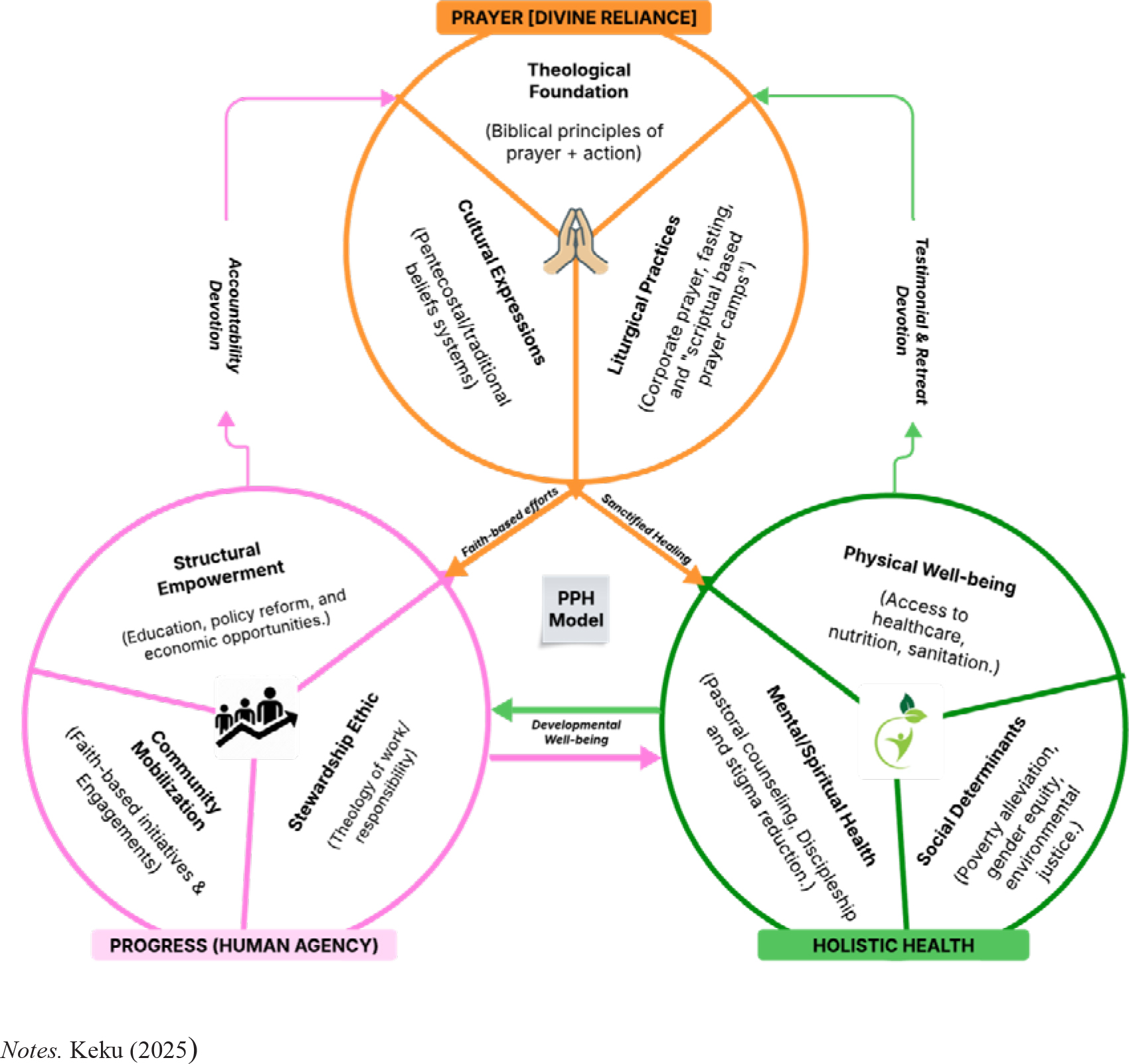
Figure 1
The Prayer, Progress, and Health (PPH) Model
The Prayer, Progress, and Health (PPH) Model offers a contextually grounded framework for national transformation in Ghana, integrating three interdependent domains: prayer (divine reliance), progress (human agency), and holistic health. The model challenges the false separation between spiritual devotion and practical responsibility, proposing instead that prayer fuels progress, progress enables health, and health, in turn, deepens faith. It is designed to reflect dynamic interdependence: each element feeds into and strengthens the others, forming a cycle where divine power and human responsibility operate in harmony.
At the core of the model is Prayer, conceptualized as divine reliance. This dimension affirms Ghana’s deeply embedded spiritual ethos and positions prayer not merely as personal petition but as a generative force for social engagement. Within this space, prayer serves as a catalyst for ethical governance, community empowerment, and prophetic advocacy in the public square. Rather than retreat from the world, prayer in the PPH model propels the faithful toward active responsibility. It undergirds moral action and sustains hope, channeling spiritual conviction into social consequence.
Flowing from this divine reliance is the domain of progress, representing human agency. This component translates spiritual values into tangible transformation by emphasizing education, economic justice, innovation, and stewardship. It acknowledges that faith alone, while essential, is insufficient without accompanying action. In the PPH framework, progress is not secularized independence but covenantal partnership where humans co-labor with God for the renewal of society. Institutions, policies, and development programs are not viewed as separate from spiritual life but as expressions of embodied obedience to divine mandates of justice and love.
The third node, Holistic Health, captures the integrated well-being of individuals and communities, which includes spiritually, physically, mentally, and socially. This domain advocates for synergy between medical systems and faith-based care, recognizing that true health requires more than clinical intervention. It includes preventative medicine, mental health support, nutrition, sanitation, and spiritual accompaniment. By placing holistic health within the cycle, the model asserts that well-being is both a fruit of faithful prayer and a foundation for sustained human progress. Health, in this view, is sacred and communal, a gift to be nurtured through both divine trust and human action.
The model’s cyclical nature is completed by two vital feedback loops: (1) “Accountability Devotion” (Progress to Prayer), where development milestones become occasions for corporate spiritual reflection, recommitment, and discernment of next steps; and (2) “Testimonial & Retreat Devotion” (Health to Prayer), where periods of healing naturally transition into seasons of spiritual retreat, where communities both celebrate restoration and seek deeper consecration. These devotional returns transform achievements into altars of remembrance and healing into sanctuaries of renewed purpose, ensuring progress remains worshipful and health remains holy.
The model’s circular design reflects a dynamic interdependence: when Ghanaians pray and act, they unlock a sustainable future where God’s power and human responsibility work in unison. This framework doesn’t diminish divine sovereignty; it amplifies it through faithful action, proving that when God hears, His people must move.
Competing Interests
None declared.