
Introduction
Measles is one of the most common infectious illnesses in the world and one of the main causes of morbidity and death.1,2 Globally, the number of deaths from this disease has significantly decreased as a result of vaccination, falling by 73% between 2000 and 2018.3,4
Nonetheless, most nations have decreased measles vaccination efforts after the Covid-19 outbreak broke out.5, 6 Between 2021 and 2022, there was a 43% increase in measles deaths and an 18% increase in cases worldwide as a result of this decline.4, 7
The World Health Organization (WHO) and the Centers for Disease Control and Prevention (CDC) in the United States have projected that by 2022, there would be 9 million cases of measles worldwide and 136,000 deaths—the majority of which will be in children8. In fact, significant and disruptive outbreaks of epidemics have impacted 37 nations. Africa and the Eastern Mediterranean region contained the majority of the nations impacted by these epidemics 9.
The Ministry of Health and Social Protection has documented a considerable rise in measles infections since September 2023, primarily in the Souss-Massa area (South of Morocco), indicating that Morocco is not an exception to this trend. According to epidemiological field surveys conducted in a number of urban areas, there has been a decline in vaccination rates, which has allowed the virus to propagate and given rise to epidemic outbreaks.10
The province of Essaouira has a very high probability of a measles outbreak. In fact, the province is near areas where multiple measles cases have been documented. Against the goals of the national immunization program, which intends to reach a vaccine coverage rate of more than 95% per antigen, the province has not attained 77% vaccination coverage against measles in 2023. Considering that herd immunity against measles requires at least 95% vaccination coverage, this level remains insufficient.
Taking into account the difficulties in eradicating measles, the World Health Organization published a strategic framework to combat the disease in 2020.11 This framework is comprised of seven axes, one of which is the implementation of an epidemiological surveillance system in primary health establishments. This system will enable prompt identification of measles cases, hence mitigating the disease’s morbidity and mortality.12,13
The majority of probable measles cases should be discovered, appropriately diagnosed, and treated, and full data on reported cases should be available for public health action, according to measles surveillance.14 Frontline health professionals providers are vital to the success of any epidemiological program, and their support is critical in fortifying surveillance networks.15 Given that the level of knowledge of health professionals about the disease and the surveillance system in place can have an impact on the epidemiological system, the goal of this study was to assess the knowledge, attitudes, and practices (KAP) of health professionals in the province of Essaouira regarding the epidemiological surveillance of the measles.
Methods
Parameter and sample
This cross-sectional study was conducted in March 2024 and included a sample of 41 health professionals (doctors, nurses, and midwives), comprising 21 women and 20 men.
Dimensions and sampling methods
A purposive sampling technique was used to conduct qualitative interviews. The study comprised informants in charge of epidemiological monitoring who work in level 1 and 2 urban and rural health centers in Essaouira province. Interviews with more experienced health extension workers at health centers in charge of monitoring activities provided valuable information.
The questionnaire
The study questionnaire was developed according to a comprehensive literature review and national measles surveillance guidelines. This tool was specifically tailored to evaluate healthcare workers knowledge, attitudes and practices related to measles epidemiological surveillance. While the content of the questionnaire was inspired by previously validated tools used in similar contexts, it was not formally validated because of lack of time and due to the limited availability of comparable, validated instruments in the local setting. Data were pilot tested with a sample of health professionals to test clarity and consistency and modified accordingly.
The questionnaire was composed of four sections:
Knowledge – covers questions regarding measles transmission, symptoms, diagnosis, case
Attitudes – examines how people perceive their own attitudes regarding the importance of measles surveillance, motivation to report, and trust in the health system.
Practices – how well does actual reporting behavior, use of existing surveillance tools, training received, and engagement frequency compare to desired practices.
Recommendations or Suggestions for Improvement — identify perceived barriers and request suggestions to improve the surveillance system.
Measles surveillance in Morocco
In Morocco, measles surveillance at the primary health care level is largely passive, with cases reported by individuals in charge of epidemiological surveillance. The process starts when a case of measles is suspected at the facility level. Those in charge of epidemiological surveillance in each establishment must immediately report the suspected case to the Provincial Epidemiology Unit (PEU) using a notification sheet (also referred to as a notification form), a standardized form designed to achieve timely and standardized reporting of suspected cases of measles in the national surveillance system. These managers must guarantee that a blood sample is collected and promptly transmitted to the PEU, who will then send it to the National Institute of Hygiene (INH) for biological confirmation.
The results of the laboratory examinations and the outcome of the case must be documented in the individual investigation file, and the person in charge of epidemiological surveillance must consider an investigation into the biologically confirmed case (identification of transmission chains). It is important to note that measles is a notifiable disease in Morocco, and reporting is mandatory.
The data analysis
The frequency distributions of the specified variables were investigated, and the results were shown as percentages and medians with fourchettes. To compare different proportions, the Fisher exact tests or the Chi-square test was used.
A statistical significance was deemed to be indicated by a P-value of less than 0.05. All analyses were performed using SPSS software, version 26.
Ethical considerations
Although formal ethics board approval was not required for this type of study under national public health regulations, official authorization for the conduct of the research project was obtained from the Provincial Health Delegation of Essaouira under reference number 744. The provincial health center was contacted through the head of each center to determine the aims and objectives of the study. Health Professionals were invited to participate voluntarily, an interview with one of the researchers was conducted using a pre-defined questionnaire after taking informed
Results
In total, 41 of 69 health professionals in charge of epidemiological monitoring answered to the questionnaire, for a response rate of 59.4%.
The participants’ ages range from 22 to 62 years, with an average of 35.1 years (± 11.5). Women made up 51.2% of the total, with nurses accounting for the vast majority (85.4%). The majority (70.8%) worked in rural structures, with 48.8% employed in first-level rural health center. Years of experience varied from a few months to 40 years, with an average of 11.4 years (± 11.1 years). Table 1. includes a full overview of the participants’ sociodemographic and socioprofessional characteristics.
Table 1
Sociodemographic and socio-professional characteristics of participants
| Characteristic | N(%) or average(SD) | Test of Sig. | P-value |
|---|---|---|---|
| Age (years) | 35,07 ± 11,46 | t= 19,601 | 0,0001** |
| Gender: | |||
| female | 21 (51,2 %) | χ²= 8,013 | 0,432 |
| Male | 20 (48,8 %) | ||
| Framework : | |||
| Doctor | 4 (9,8 %) | χ²= 34,675 | 0,004** |
| Nurse | 35 (85,4 %) | ||
| Midwife | 2 (4,9 %) | ||
| Establishment : | |||
| RHC1 | 20 (48,8 %) | χ²= 46,342 | |
| RHC2 | 7 (17,1 %) | 0,049* | |
| UHC1 | 8 (19,5 %) | ||
| UHC2 | 4 (9,8 %) | ||
| RD | 2 (4,9 %) | ||
| Years of experience: | 11,25 ± 8,10 | ||
| ≤ 5 years old | 15 (36,5 %) | t= 6,671 | 0,0001** |
| Between 6 and 15 years old > | 17 (41,5 %) | ||
| > 15 years old | 9 (22 %) | ||
Professional knowledge of the disease
All health professionals understand the viral etiology of measles, and almost all (95.1%) mentioned airborne transmission as a means of transmission. In terms of clinical indicators of the disease, the majority of participants (78% and 75.6%, respectively) identified Koplik’s sign and maculopapular rash, while only 51.2% characterized the disease as non-pruritic. The percentage of health experts who understand the descending character of the lesions does not reach 58.5% (Table 2).
Table 2
Knowledge of participants regarding epidemiological surveillance of measles
| Variables* (the correct answer) | Frequency (n=41) | Percentage % | P-value |
|---|---|---|---|
| Do you know how measles is transmitted? (Yes) | 39 | 95,12 % | 0,835 |
| What is the order in which the lesions appear? (Descending) | 24 | 58,5 % | 0,351 |
| What are the clinical manifestations of measles that you know? a- Prodrome b- Enanthems c- Köplik sign d- Catarrh e- Maculopapular rash f- Non-pruritic lesions | 13 16 32 18 31 21 | 31,7 % 39 % 78 % 43,9 % 75,6 % 51,2 % | 0,004** |
| Is the immunity resulting from the illness lifelong? (Yes) | 35 | 85,4 % | 0,082 |
| Have you learned the 2023 vaccination schedule? (Yes) | 38 | 95,1 % | 0,911 |
Professionals’ knowledge and behavior regarding epidemiological surveillance systems
Table 3. reveals that the majority (90.2%) of participants consider measles is a notifiable disease, and the majority (65.9%) understand the importance of biological confirmation before reporting a case. It also demonstrates that only 24.4% of healthcare workers understand the sample delivery circuit, whereas 39% receive feedback on the results of the samples taken. In terms of notification, 70.7% are aware of the support employed (notification form), however only 34.1% agree that suspected cases of measles should be reported.
Table 3
Practice of participants regarding epidemiological surveillance of measles
| Variables | Response | Frequency (n=41) | Percentage % | P-value |
|---|---|---|---|---|
| Are measles notifiable disease? | Yes | 40 | 90,2 | ----- |
| Do you think that biological diagnostic confirmation is essential before declaration? | Yes | 27 | 65,9 | 0,112 |
| Do you know the sample delivery circuit? | Yes | 10 | 24,4 | 0,387 |
| Do you receive feedback on the results of the samples? | Yes | 16 | 39 | 0,913 |
| When is measles reported? | Suspected case Confirmed case Severe case No answer | 14 23 1 3 | 34,1 56,1 2,4 7,3 | 0,957 |
| What support do you use for the notification? | Notification sheet Analysis sheet No answer | 29 2 10 | 70,7 4,9 24,4 | 0,774 |
| What to do in case of a suspected case: | Report only Report and treat Refer to hospital | 18 15 17 | 36 30 34 | 0,165 |
| Have you already reported cases of measles to the epidemiological surveillance system? | Yes | 12 | 29,3 | 0,012* |
| How often do you use existing epidemiological surveillance tools to track measles? | Daily Weekly Monthly Never No answer | 2 1 5 18 4 | 4,9 2,4 12,2 43,9 9,8 | 0,008** |
| Have you already participated in training on epidemiological surveillance of measles? | Yes | 3 | 7,3 | 0,387 |
| Is there a measles epidemiological surveillance guide at your establishment? | Yes | 2 | 4,9 | 0,0001** |
In contrast, 29.3% of participants had previously reported cases of measles, and 43.9% had never used existing epidemiological monitoring systems.
Difficulties related to epidemiological surveillance of measles
92.7% of participants had never benefited from training on the epidemiological surveillance of measles and 95.1% did not have an epidemiological surveillance guide for the disease at their establishment.
According to participants’ statements, lack of continuing education, low community awareness and cooperation are among the main factors hindering measles epidemiological survival activities (Figure 1.)
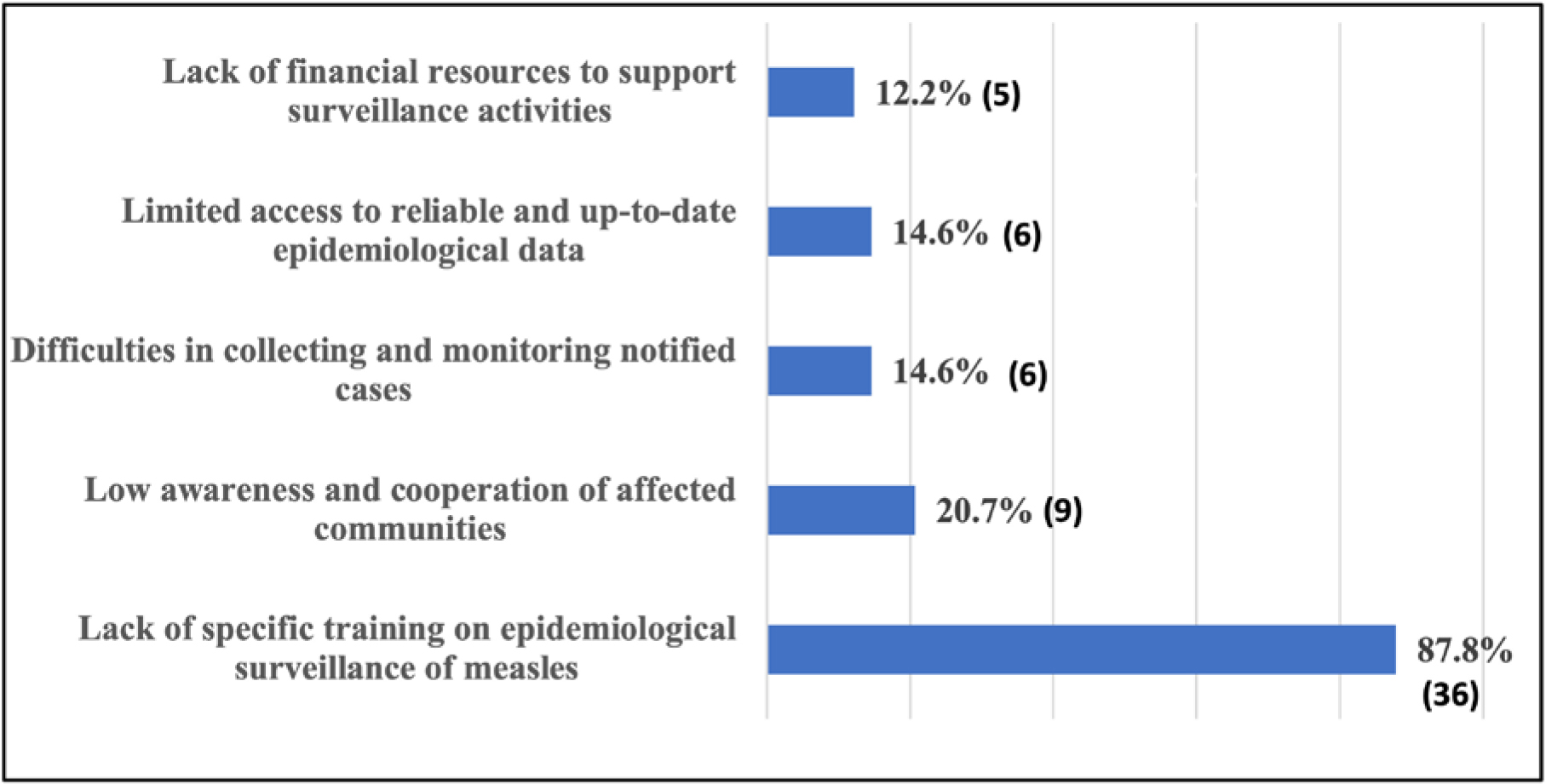
Figure 1
Difficulties related to epidemiological surveillance of measles
Discussion
Our research on the knowledge, attitudes and practices (KAP) of health professionals in the province of Essaouira regarding the epidemiological surveillance of measles highlights several important gaps that need to be examined taking into account other studies available in literature.
Morocco’s epidemiological data indicate that there is a very high likelihood of a measles outbreak breaking out in each of the nation’s regions16. Thus, one of the primary tactics to reduce this risk and accomplish the measles elimination aim is epidemiological surveillance.17 This study was out to assess health professionals’ knowledge, attitudes, and behaviors regarding epidemiological monitoring of this disease in the province of Essaouira. We recruited 41 health professionals who oversee epidemiological surveillance at the province’s health centers in order to accomplish this goal.
The overwhelming majority of nurses (85.4%) in our survey acknowledge the shortage of qualified medical personnel in Morocco, particularly in the province of Essaouira, where only 16 doctors are responsible for providing primary medical care across 69 healthcare facilities. Given the province’s geography and demography -marked by a predominantly rural population representing three-quarters of the total- the majority of study participants (70.8%) worked in rural areas.18
Knowledge of Health Professionals
A disease monitoring strategy cannot exist without an accurate understanding of the case definition.12 Morocco uses the biological confirmation of a measles case using a blood sample obtained for any clinical case, in compliance with WHO guidelines. According to this study, 34.1% of medical professionals are not familiar with the measles case definition. Clinically, only 51.2% of participants were aware that that measles is not associated with pruritus, and 58.5% correctly identified the descending pattern of the rash. This highlights a significant gap in clinical knowledge and the need for targeted educational interventions.
Countries differ in the percentage of medical personnel who are correctly aware of the definition of a measles case. In Kenya19 it is not more than 27.3%, and it reaches 90.7% in Qatar.20 A number of variables, most notably the significant decline in measles occurrence in recent decades in most parts of the world, including Morocco, due to vaccination, could account for the lack of information regarding the disease. 21
Training and Professional Experience
Due to their limited clinical exposure, particularly among recently certified health professionals, many participants may lack direct experience with measles in clinical practice. This assumption is supported by several findings from our study. In fact, of the individuals in our sample, 41.5% have no more than five years of professional experience; only 29.3% have previously reported cases of measles; 43.9% have never used the measles surveillance system; and the majority (92.7%) have never profited from additional training in measles epidemiological surveillance. However, In Qatar, 14.1% had received training in disease surveillance.20
Attitudes and Practices of Surveillance
The findings of our research highlight significant disparities in the understanding and application of measles case reporting protocols among health professionals in the province of Essaouira.
1. Share of experts who report suspected cases of measles.
Only 34.1% of participants indicated that they would report all suspected cases of measles. This percentage is quite low, as international and national guidelines emphasize the importance of reporting not only confirmed cases, but also suspected cases to facilitate rapid intervention. This lack of compliance with reporting protocols can be explained by a lack of awareness or training, as we have seen where 92.7% of participants never received additional training in epidemiological surveillance.
2. The proportion of experts who report only verified cases.
56.1% of participants think that only cases of measles that have been confirmed should be reported. Although this conduct could appear reasonable, there is a chance that it will postpone the epidemiological response because it can take some time to confirm instances.20
3. Proportion of experts who only report serious cases
2.4% of participants say they only report cases of measles considered serious. This behavior is particularly worrying, because it demonstrates an essential misunderstanding of the objectives of epidemiological surveillance, which consists of taking into account all cases in order to have a global vision of the epidemiological situation.20
According to these results, it is essential to strengthen the training of health professionals on the importance of reporting suspected, confirmed and serious cases of measles, respecting established protocols. It is equally essential to raise awareness of the role of early and comprehensive reporting in the prevention and control of epidemics, in order to ensure a rapid and effective response in the event of flooding.
There are differing opinions among health professionals regarding measles case reporting notification supports in the province of Essaouira, which could have a big impact on the effectiveness of epidemiological surveillance.
Making use of the notification sheet
The majority of participants (70.7%) said that measles cases must be reported using a notification sheet. This shows that the majority of health professionals are well-versed in the standardized instrument needed to report communicable infections. The notification sheet is crucial because it ensures that data is gathered consistently and methodically, facilitating efficient epidemiological analysis. Positive adherence to surveillance measures is demonstrated by this majority adherence.
Utilizing the analysis sheet
Conversely, 4.9% of participants think that reporting cases requires the use of an analysis sheet. This minority may be the result of people being confused about the different kinds of documents that are used to manage epidemiological data. The analysis sheet—a tool more frequently utilized for data assessment and interpretation—is not the first reporting tool for measles cases. This finding emphasizes how crucial it is to let health professionals know exactly what each tool’s functions are.
Uncertainty about the use of the support.
Of those who took part, 24.4% said they had trouble knowing how to report measles cases. This confusion is particularly concerning since it may cause people to report instances with inaccuracies or delays, jeopardizing epidemic surveillance. It is obvious that health professionals need to have their training and knowledge of monitoring techniques and equipment strengthened.
Results show that while most medical professionals understand the value of the notification sheet, 25% of participants do not know exactly which materials to utilize, and a tiny percentage misidentify the instruments. The implementation of targeted training programs is crucial to maximizing the efficacy of epidemiological monitoring. These programs should clarify the usage of various supports and increase the understanding of notification protocols among health professionals.
Applying the Surveillance System
As per the Moroccan measles surveillance guidance, it is mandatory to promptly report every suspected case to the provincial epidemiology unit through the use of a notification form.22 While the majority of participants (70.7%) were aware of the notification form used as assistance, only 34.1% agreed that suspected cases of measles should be reported. The quality of data from the epidemiological surveillance system may be lowered as a result of under- or overestimation of cases resulting from poor reporting methods.23
However, when faced with suspicious cases, the majority of health professionals surveyed (70%) are unsure of exactly what to do. The Ministry of Health and Social Protection’s guideline states that cases should be declared and treated after obtaining a blood sample for biological confirmation.
Activities that support surveillance are components that make it easier to carry out crucial surveillance tasks.20 The current study’s findings demonstrated that 61% of health professionals do not receive feedback on surveillance data, and nearly all (95.1%) of health establishments lack an epidemiological surveillance guide for measles. These findings support those of earlier research that found that over half of medical staff members in primary care settings in a number of nations, including Germany24, Nigeria25, and Qatar20 did not receive feedback on their surveillance data.
Conclusion
The current study demonstrated the relatively insufficient knowledge and practices of health professionals working in primary healthcare structures in the province of Essaouira related to epidemiological surveillance of measles. These results are consistent with the evidence that highlights the role of robust surveillance systems in controlling measles, as recommended by the Moroccan Ministry of Health and Social Protection and the World Health Organization. In light of the existing research gaps, trainings particularly on case identification and reporting procedures must be established. In this study, we propose improving access to epidemiological data and reinforcing feedback mechanisms as other measures necessary to reinforce the performance of frontline healthcare workers. Also, providing health facilities with all the input needed to perform measles and other potentially epidemic diseases surveillance is crucial. Finally, the mobilization and coordination of all local public health stakeholders should be ensured to achieve the national goal of measles elimination in Morocco.
Acknowledgments
The authors acknowledge the technical support provided by the provincial Health Delegation of Essaouira, Morocco, and the diligent efforts, cooperative nature, and valuable assistance provided by all study participants in streamlining the data collection process.
Competing Interests
None declared.
Funding
None.