
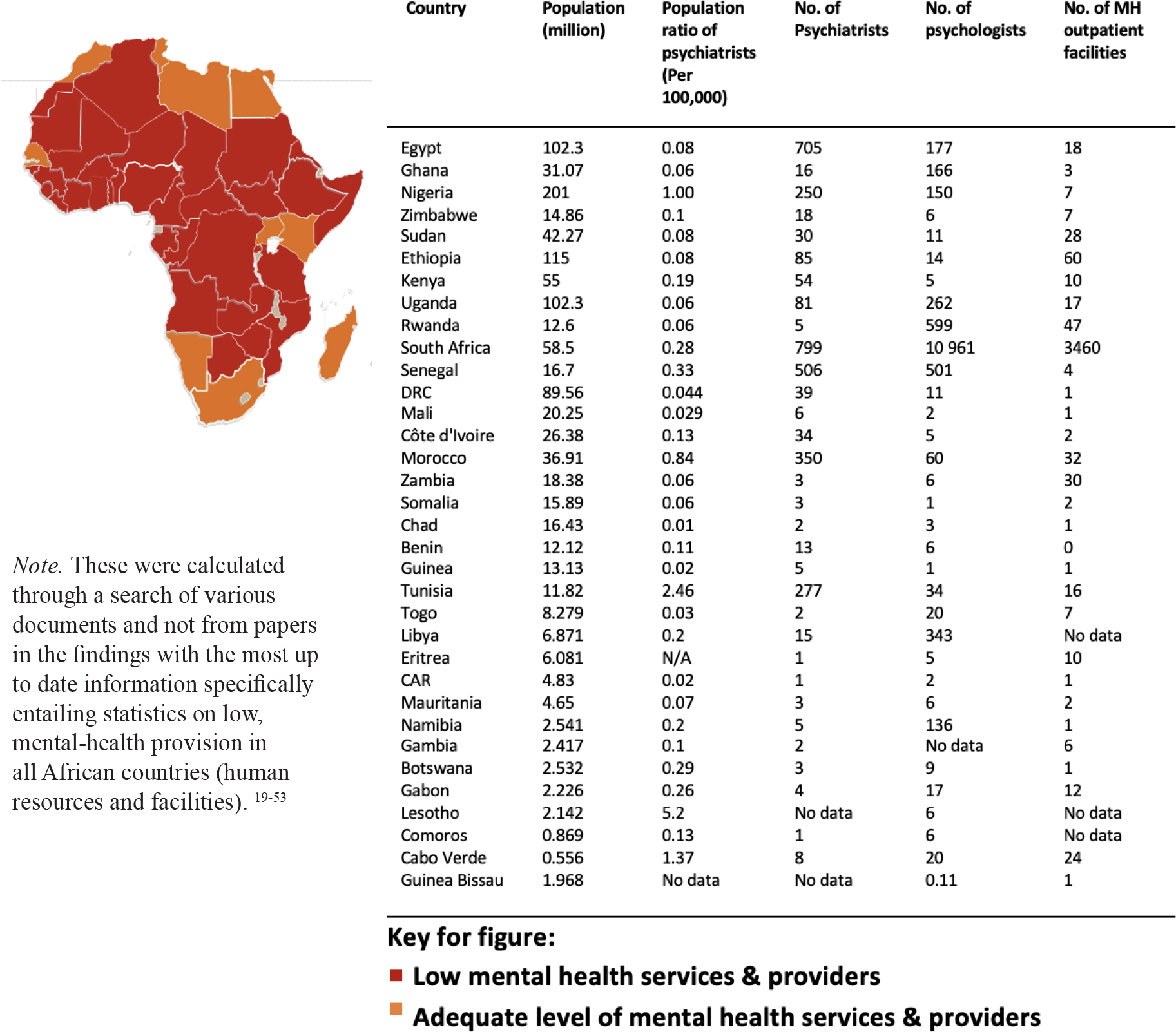
Figure 1
Map of Africa indicating (lack of) mental-health services in relation to a population ratio
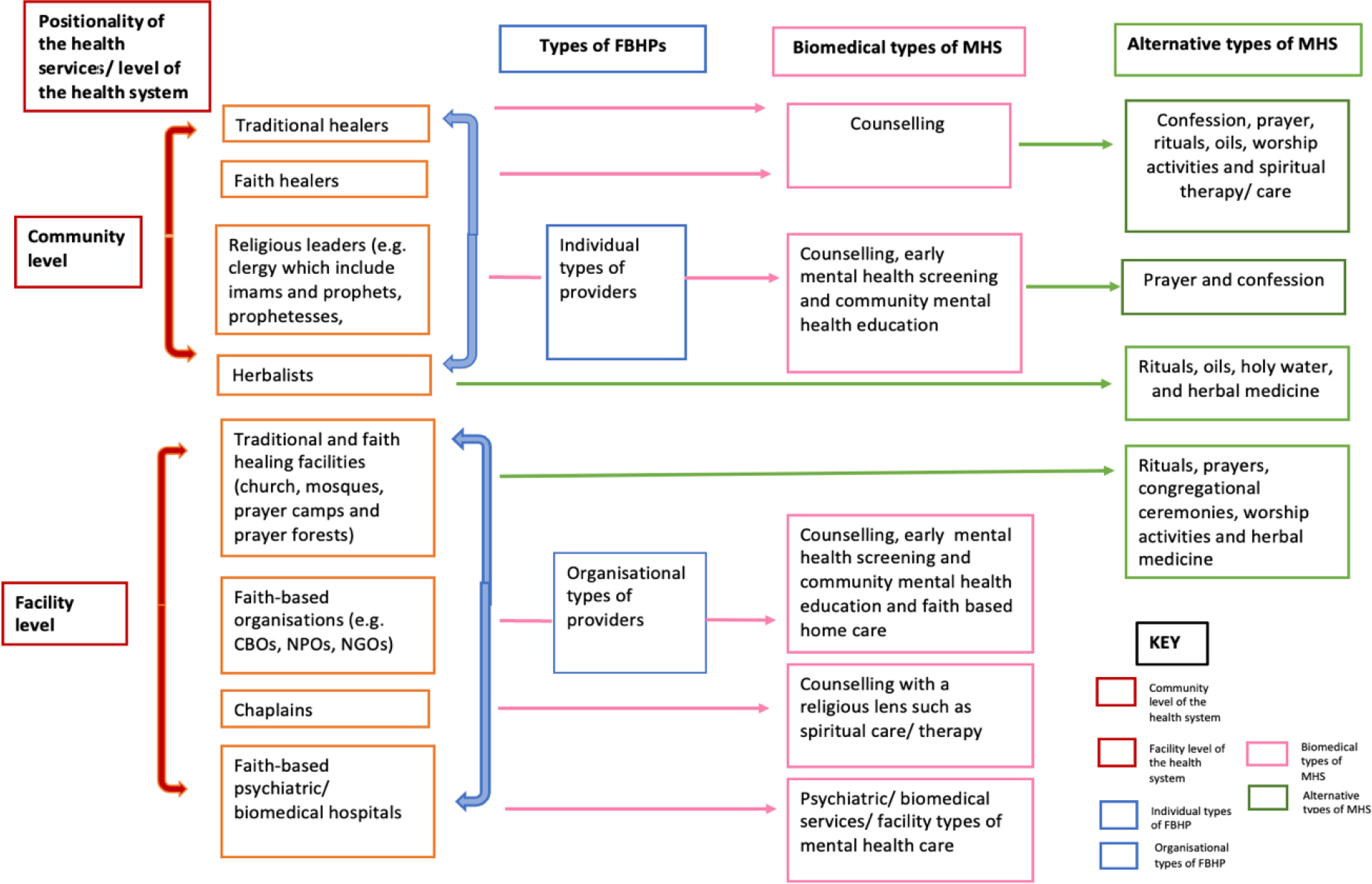
Figure 2
Types of FBHPs (individual and organisational) and MHC (alternative and biomedical) delivering MHS at the community- and facility-level in the health system (positionality of the service)
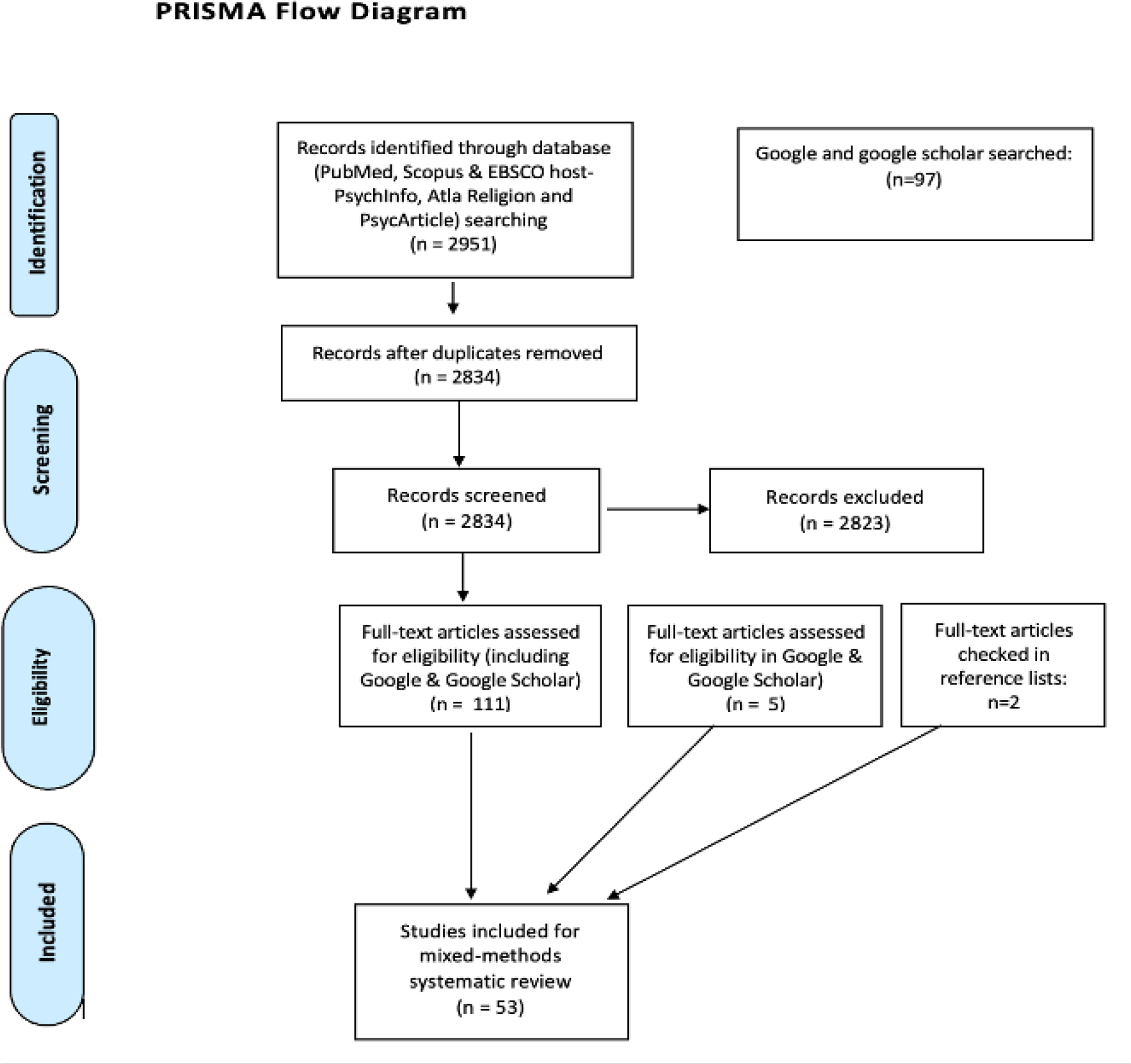
Figure 3
PRISMA flow diagram for systematic review results
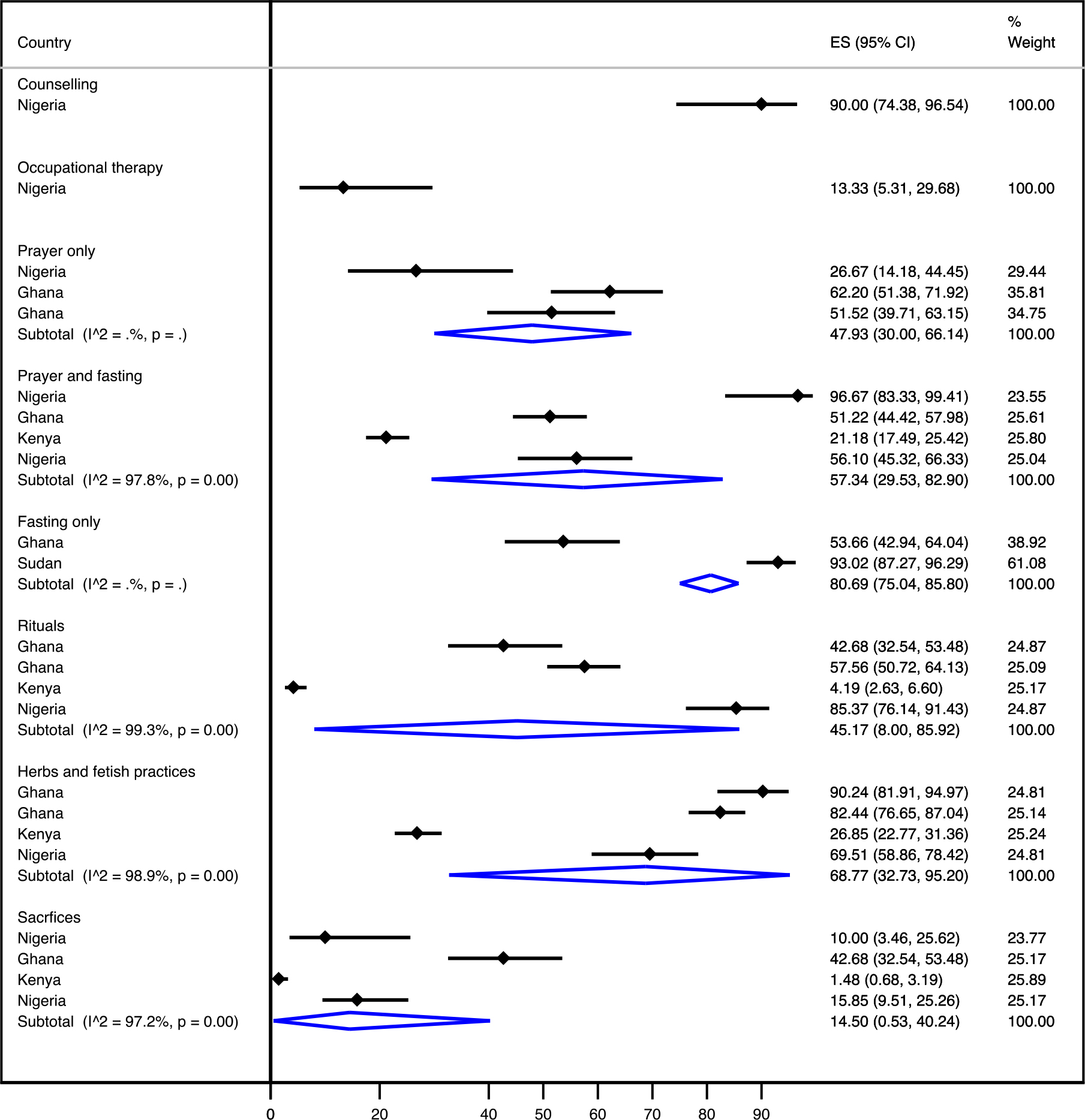
Figure 4
Meta-analyses on frequency (%) of use based on :”biomedical” and “alternative” types of faith-based mental healthcare in Africa
Table 1
Frequency of use of varied forms of FB MHC (based on meta-analyses of included studies with quantitative data)
| Country | Title of study (year) | Ratio/ Frequency of use (%) |
|---|---|---|
| Counselling | ||
| Nigeria | Agara 2008 | 27/30 (90%) |
| Prayer | ||
| Nigeria | Agara 2008 | 8/30 (26.7%) |
| Ghana | Lambert 2020 | 51/82 (62%) |
| Nigeria | Kaiser 2020 | 34/66 (52%) |
| Fasting & prayer | ||
| Nigeria | Agara et al., 2008 | 29/30 ( 96.7%) |
| Ghana | Esan 2019 | 105/205 (51.2%) |
| Kenya | Esan 2019 | 86/406 (21.2%) |
| Nigeria | Esan 2019 | 46/82 (56.1%) |
| Fasting only | ||
| Ghana | Lambert 2020 | 33/82 (40.2%) |
| Sudan | Sorketti 2013 | 120/129 (93%) |
| Rituals | ||
| Ghana | Lambert 2020 | 35/82 (42.6%) |
| Ghana | Esan 2019 | 118/205 (57.6%) |
| Kenya | Esan 2019 | 17/406 (17.5%) |
| Nigeria | Esan 2019 | 70/82 (85.4% |
| Herbs and fetish practices | ||
| Ghana | Lambert 2020 | 74/82 (90%) |
| Ghana | Esan 2019 | 169/205 (82.4%) |
| Kenya | Esan 2019 | 109/406 (26.9%) |
| Nigeria | Esan 2019 | 57/82 (69.5%) |
| Sacrifices | ||
| Nigeria | Agara 2008 | 3/30 (10%) |
| Ghana | Esan 2019 | 35/82 (42.6%) |
| Kenya | Esan 2019 | 6/406 (1.5%) |
| Nigeria | Esan 2019 | 13/82 (15.9%) |
[i] Notes. Sources: 18, 62, 63, 81
Table 2
The frequency of use from the limited types of FBHPs found in included studies which were sought for faith-based mental healthcare in Africa.
| Author (date) | Country | Type of FBHPs sought for MHC | Frequency (%) of use/ ratio |
|---|---|---|---|
| Assad 2015 | Egypt | Traditional healers | 89/143 (62.2%) |
| Esan 2019 | Ghana | Herbalist | 13/205 (6.4%) |
| Diviners | 104/205 (51%) | ||
| Christian faith healers | 43/205 (21.1%) | ||
| Islamic faith healers | 3/205 (1.5%) | ||
| Herbalist and Christian | 28/205 (13.7%) | ||
| Herbalist and Islam | 13/205 (6.4%) | ||
| Esan 2019 | Kenya | Herbalist | 355/406 (88.8%) |
| Diviners | 5/406 (1.2%) | ||
| Christian faith healers | 14/406 (3.5%) | ||
| Islamic faith healers | 4/406 (1%) | ||
| Herbalist and Christian | 15/406 (3.8%) | ||
| Herbalist and Islam | 1/406 (0.2%) | ||
| Esan 2019 | Nigeria | Herbalist | 23/82 (28%) |
| Diviners | 20/82 (24.4%) | ||
| Christian faith healers | 11/82 (13.4%) | ||
| Islamic faith healers | 25/82 (39.5%) | ||
| Herbalist and Christian | 2/82 (2.4%) | ||
| Herbalist and Islam | 1/82 (1.2%) | ||
| Ibrahim 2016 | Traditional or religious healers | 25/107 (23.3%) | |
| Ibrahim Awaad 2020 | Traditional healers | 97/232 (41.8%) | |
| Khiari 2019 | Tunisia | Traditional or religious healers | 79 (34.1%) |
| Nartey 2019 | Ghana | Faith-based practitioners | 171/542 (31.5%) |
| Shin 2017 | Ghana | Individual religion coping | 562/703 (80%) |
| Sorketti 2013 | Kenya | Traditional healer centres | 68/129 53% |
| Sorketti 2011 | Sudan | Traditional healers | 169/405 (41.7%) |
| Sorsdahl 2010 | South Africa | Traditional, spiritual advisor, and herbalist | 73/3651 (20%) |
| Van Duijl 2014 | Uganda | Traditional healers and churches | 40/119 (33.7%) |
| Zingela 2019 | South Africa | Traditional and alternative healers | 78/254 (31%) |
[i] Notes. Sources: 10, 14, 20, 64, 68, 87, 93, 109, 110, 116
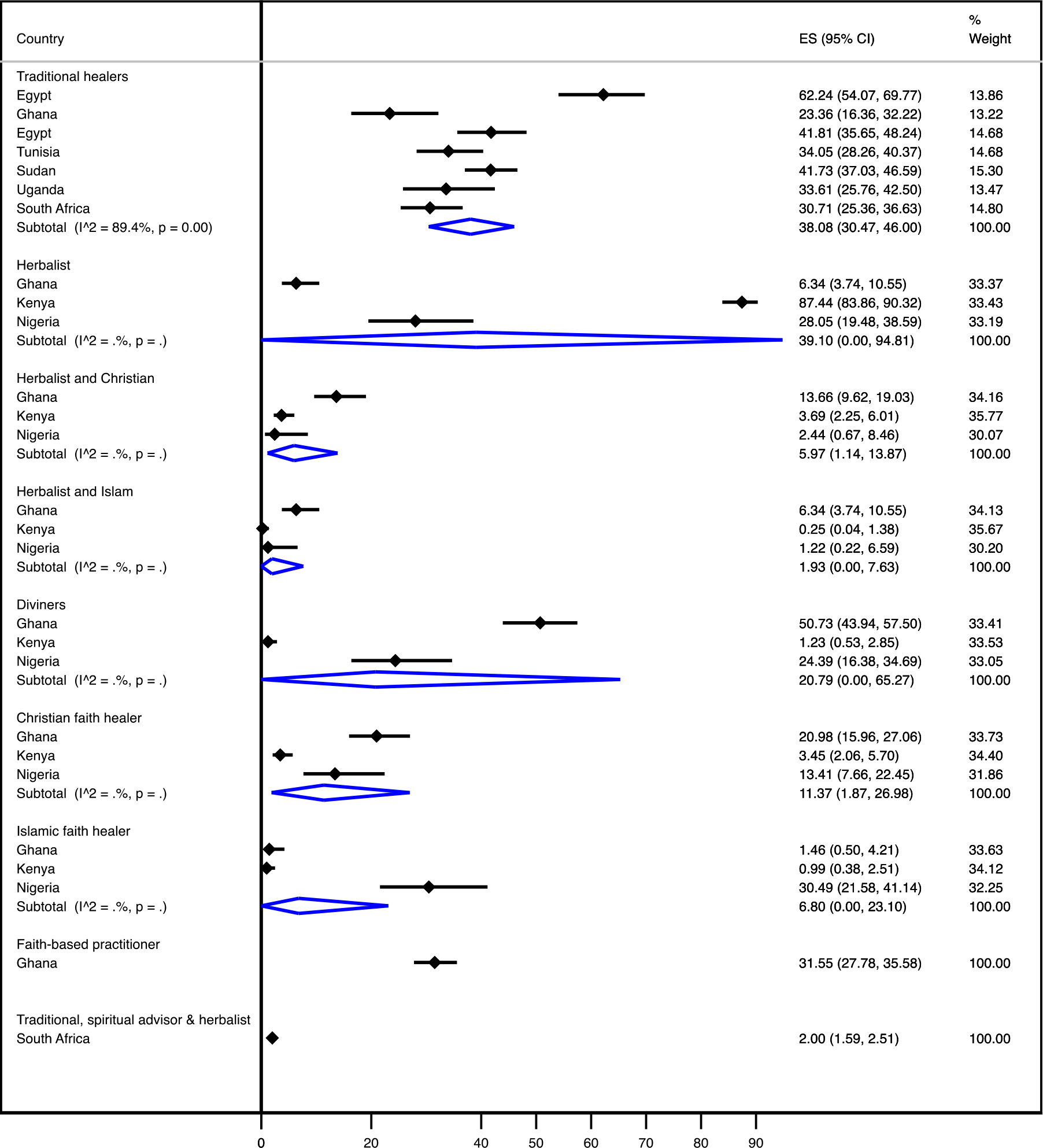
Figure 5
Meta-analyses of the magnitude of FBHPs (traditional, faith healers and herbalists) use for mental health services in included studies
Table 3
Results on the types of faith-based harmful practices in Africa
| Type of harmful practice | Author (date) | Ratio of use of practices (%) |
|---|---|---|
| Chaining | ||
| Esan 2019 | 40/205 (19.5%) | |
| Kenya | Esan 2019 | 6/406 (1.5%) |
| Nigeria | Esan 2019 | 40/82 (48.8%) |
| Sudan | Sorketti 2013 | 106/129 (82.2%) |
| Cumulative frequency | All studies | 192/ 822 (23.4%) |
| Beating | ||
| Country | Title of study (year) | Frequency of use (%) |
| Nigeria | Agara 2008 | 12/30 (40) |
| Sudan | Omer 2018 | 6/111 (5.4%) |
| Ghana | Esan 2019 | 2/205 (1%) |
| Kenya | Esan 2019 | 5/406 (1.2%) |
| Nigeria | Esan 2019 | 7/82 (8.5%) |
| Sudan | Sorketti 2013 | 31/129 (24%) |
| Cumulative frequency | All studies | 63/834 (7.6%) |
| Confinement | ||
| Ghana | Esan 2019 | 1/205 (0.5%) |
| Kenya | Esan 2019 | 1/406 (0.3%) |
| Nigeria | Esan 2019 | 14/82 (17.1%) |
| Sudan | Sorketti 2013 | 44/129 (34%) |
| Cumulative frequency | All studies | 60/822 (0.07%) |
| Scarification | ||
| Ghana | Esan 2019 | 27/205 (13.2%) |
| Kenya | Esan 2019 | 16/406 (3.9%) |
| Nigeria | Esan 2019 | 32/82 (39%) |
| Cumulative frequency | All studies | 79/693 (10.8%) |
| Shackles | ||
| Ghana | Esan 2019 | 1/205 (0.0048%) |
| Kenya | Esan 2019 | 0/406 (0%) |
| Nigeria | Esan 2019 | 16/82 (0.2%) |
| Cumulative frequency | All studies | 17/ 822 (0.025%) |
| Ropes and cloth | ||
| Ghana | Esan 2019 | 6/205 (0.02926%) |
| Kenya | Esan 2019 | 8/406 (0.0197%) |
| Nigeria | Esan 2019 | 0/82 (0%) |
| Cumulative frequency | All studies | 14/822 (0.75%) |
[i] Notes. Source: 18, 62, 64, 115
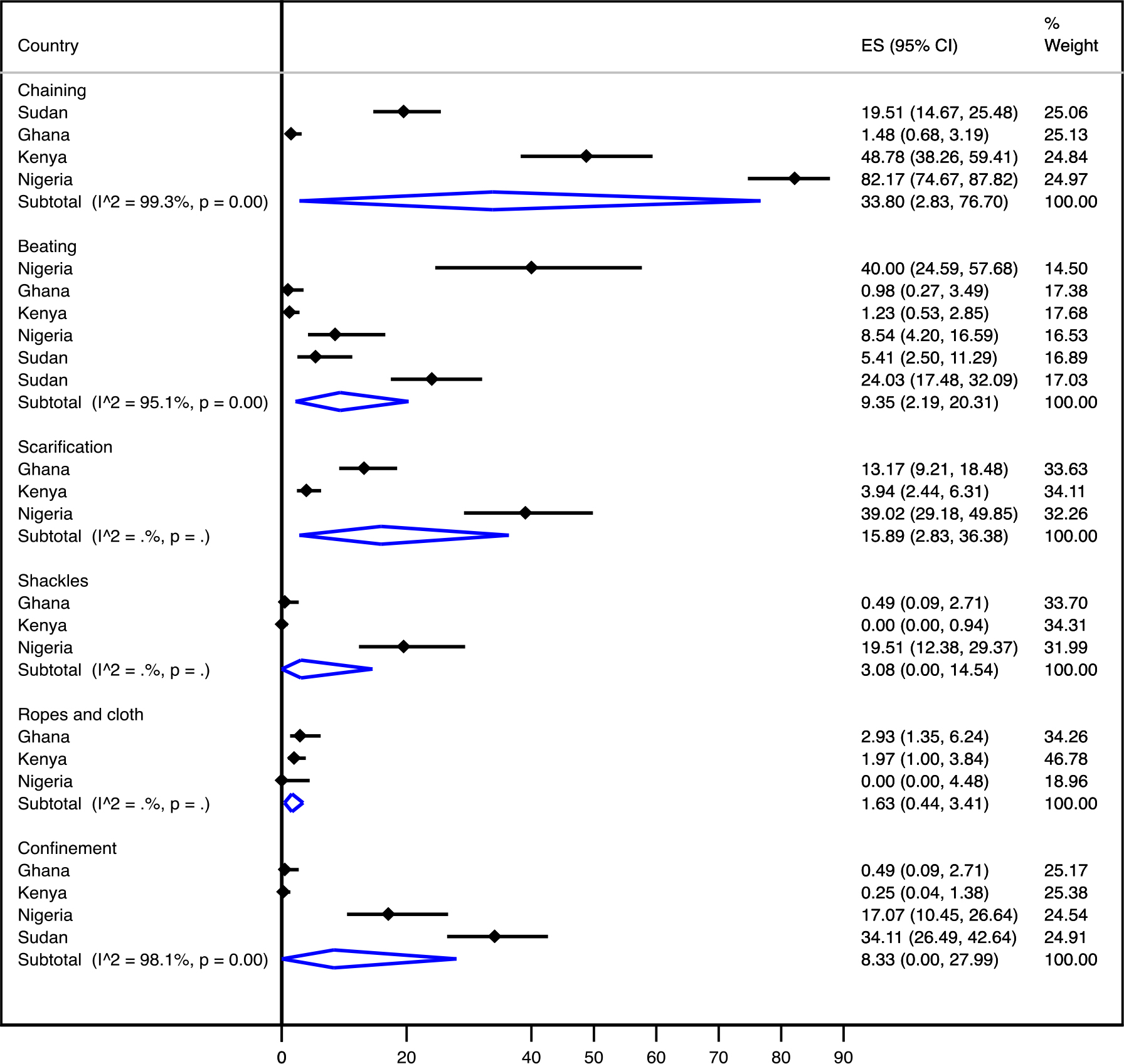
Figure 6
Meta-analyses of religious perils (types of human rights abuses/ harmful practices) in Africa