
Introduction
Research indicates that more than 83% of maternal deaths, stillbirths, and neonatal deaths could be prevented with universal access to skilled midwives.1 Despite progress in reducing maternal mortality, significant barriers to midwifery education and continuous training remain in Sierra Leone, contributing to a maternal mortality ratio that remains six times higher than the Sustainable Development Goal Target. This case study will present the report of a collaborative midwifery training administered in Kenema, Sierra Leone.
Literature identifies several clinical, systemic, and socioeconomic drivers of maternal mortality in low-resource settings. The leading causes of maternal deaths include obstetric hemorrhage, hypertensive disorders of pregnancy, sepsis, and non-obstetric complications, which are often preventable but are exacerbated by systemic challenges.2,3 Multiple sources underscore that insufficient emergency obstetric care, inadequate antenatal care (ANC), and poorly equipped health facilities further compound risks.3,4 Studies also emphasize the need to focus on training skilled staff through simulations and hands-on learning to address delays in care, improve clinical confidence, and improve service delivery.4,5
Studies in Sub-Saharan Africa and, specifically, Sierra Leone highlight barriers to effective midwifery training, including insufficient training opportunities, ill-equipped clinical learning environments, inconsistent expectations in clinical training, limited resources and trained preceptors, and a lack of feedback and supervision.6,7,8 Traditional training models often face efficacy challenges due to a lack of essential supplies and design flaws such as short, one-off sessions that fail to change practice or build confidence.9.10,11 Healthcare worker burnout, further exacerbated in Sierra Leone due to limited access to resources, high demands from patient loads, and the psychological strain of providing care during public health emergencies, diminishes the capacity to absorb and apply training.9 Limited post-training supervision and reinforcement of skills through continuous medical education further erode newly acquired skills. These structural and contextual constraints suggest that effective programs require investment in working conditions, facility readiness, and long-term capacity development.10,11
The “low-dose, high-frequency” and peer support-led model of capacity building is highly effective at improving health outcomes in resource-limited areas.12,13,14 This model emphasizes building the competence of health care workers through team-based trainings where content is delivered in short periods, and then simulation-based practice is used to practice skills. Trainings are repeated regularly, and during the interim period, trainees practice skills in their facilities with peer support and mentorship. The Helping Mothers Survive curriculum, developed by Jhipego, is based on this model and has been shown to improve birth outcomes.12,13 Asiedu, et al. identified that when this training model was used in Ghana, it was shown to increase health worker confidence and competency as well as help promote a “culture of learning.”14 Several studies have also found that this training model increases the retention of maintenance of skills and knowledge over time, increases the competency of health workers, and leads to better outcomes.15,16
Program description
In 2021, Members of the Together for Global Health coalition Helping Children Worldwide, Tenki for Born, and Healey International Relief Foundation joined forces with the Christian Health Association of Sierra Leone (CHASL) to improve maternal and newborn outcomes through midwife training, utilizing the Helping Mothers Survive and Essential Newborn Care curricula and the low-dose, high-frequency, training model.
Goals and objectives
The goals and objectives of this midwifery training project were to:
Foster collaboration: By gathering together organizations with a range of expertise to not only collaborate on the project but also share best practices, each organization was able to accomplish much more than they would individually.
Increase the competence and confidence of professionals working in maternal and child health: Obstetric and neonatal emergencies require skilled care providers with the ability to effectively carry out procedures and make critical life-saving decisions, as well as the confidence for knowledge.
Provide respectful maternal care and protect against midwife burnout: Midwives who provide respectful maternal care can increase service utilization and improve maternal health outcomes. To advocate well for the mental health of their patients, midwives need the skills to recognize, cope, and regulate their own emotions.
Increase the capacity of maternal, newborn, and child health service providers to train other midwives: By creating a cohort of local trainers, the knowledge can be cascaded through facilities, making it more accessible geographically and financially.
Improve maternal and neonatal health outcomes in Sierra Leone
Theory of change
Drawing from the recommendation from Toomey, et al.to address fidelity at all stages of the intervention, a five-step theory of change was developed that links high-quality, well-delivered training to participant, knowledge acquisition, application in healthcare settings, and ultimately, improved maternal health outcomes (See Figure 1).17, 18
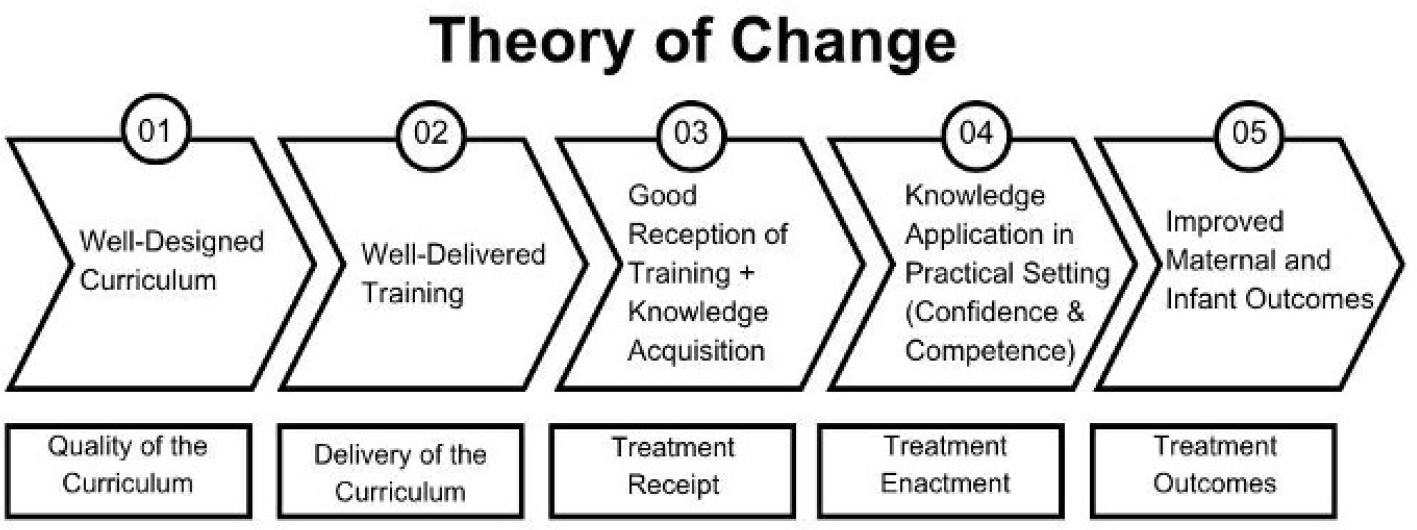
Figure 1
Theory of Change18
Methods
Program description
Participants were purposely selected by the Ministry of Health and Sanitation and CHASL to include healthcare professionals who would benefit the most from training. The initial training in Bo in January 2024 involved 80 participants over four days (with two days devoted to each curriculum), followed by a three-day refresher for 23 of the highperforming participants. Drawing from lessons learned in the first iteration, a smaller group of 47 nurses and midwives were trained in the third iteration in January 2025 in Kenema (Table 1). Half of the participants were trained for four days on maternal health, and half were trained for four days in newborn health. Rising Trainers from the Bo training were invited to help lead the training and practice their teaching skills, beginning with a one-day training on how to teach in healthcare settings. Between each of the iterations, rising trainers were asked to hold “low-dose, high-frequency” monthly sessions in their facility to continue to practice and reinforce their skills and train their co-workers. These LDHF sessions were reported to the program team using Whatsapp. Ethical approval was obtained from the Sierra Leone Ministry of Health and Sanitation Office of the Sierra Leone Ethics and Scientific Review Committee (Reference Number 009/11/2024), and consent was obtained from all participants for the third iteration. Research question and evaluation tool development, as well as data collection, were done in collaboration with the Center of Excellence for Maternal and Child Health Education and Research at the University of Makeni (UNIMAK).
Table 1
Overview of the iterations of this project
| Iteration | Date | Location | N of Participants | Participants cadres |
|---|---|---|---|---|
| 1 | January 2024 | Bo, Sierra Leone | 80 | Nurses, Community Health Officers, Midwives |
| 2 (Refresher Training) | October 2024 | Bo, Sierra Leone | 23 | Nurses, Midwives |
| 3 | January 2025 | Kenema, Sierra Leone | 47 | Nurses, Midwives |
These trainings used the standard curriculum from from JHPIEGO’s Helping Mothers Survive: Bleeding After Birth (BAB) for the identification, prevention, and management of postpartum hemorrhage and the World Health Organization’s Essential Newborn Care (ENC) Curricula that covers newborn care from birth to 1 month. These curricula are designed to include both lectures and discussions to build the knowledge base, as well as skills practice and simulations to build procedural competence. In the third iteration of the training, the latest version of the BAB Curriculum, still under revision by WHO and other collaborators, was piloted. In addition to this standard curriculum, one-hour modules on maternal and provider mental health and respectful maternal care were held each morning. Participants were purposely selected to complete either the Essential Newborn Care curriculum or the Bleeding After Birth curriculum based on their job position and to ensure each facility had at least one participant complete each training. Participants were then randomly selected into one of two rooms for each curriculum using a random number generator.
Evaluation plan
The evaluation plan sought to answer the following research questions:
To what extent were the training topics aligned with the needs of local health workers and communities?
What changes in participants’ knowledge, skills, or confidence were reported immediately following the training?
How did participants perceive the usefulness and applicability of the training content in their daily work?
The two curricula contained materials with a standardized scoring rubric for evaluating knowledge acquisition using knowledge tests requiring a passing score of 80% and delivered pre- and post-training. Skills acquisition was measured using the curriculum’s Observed Structured Clinical Evaluations (OSCEs), scenario-based tests that measure the participant’s ability to assess patients, determine a course of action, and perform timely and correct procedures for patient care based on the requirements of the scenario. Participants were evaluated on skills acquisition by completing three OSCEs and were provided with up to three opportunities to retake. The BAB curriculum also contains a confidence assessment, also delivered in a pre- and post-training format to measure participants’ confidence to diagnose and perform 12 different conditions/procedures using a 5-point Likert Scale. An adapted version of Jhpiego’s pre-training survey was used to measure the education, experience, and skill level of participants before the training. In addition to the Jhpiego materials, a post-training survey was developed to allow participants to provide feedback on the training, and informal focus group interviews with master trainers were conducted to evaluate the training process, progress, and outcomes, evaluating strengths and weaknesses. Finally, post conference, the frequency of LDHF sessions was reported by rising trainers in a WhatsApp group with the program team.
This study used IBM SPSS Statistics 29.0 through Boston College’s license to conduct the statistical analysis assessing the short-term competence and confidence gained by the participants through the training. Related-Samples Wilcoxon Signed Rank Tests and Independent-Samples Mann-Whitney U Tests were conducted to compare the difference between pre- and post-training tests’ mean scores and different training rooms’ mean test scores as appropriate.
Results
While training sessions have been conducted in both 2024 and 2025, ethical approval from the Sierra Leone Ethics and Scientific Review Committee was only received for the third iteration of the training in 2025. Therefore, only data from 2025 is reported. Ethics approval did not include approval to share the full data set collected so data has not been made publicly accessible.
Descriptive statistics
At the start of the third iteration of training, a pre-conference survey was administered to collect information on the training experience and positions of the trainees (see Table 2). This study received 82 valid responses in total, including 20 valid responses (2 responses were missing due to testing error) for ENC 1 assessment, 21 valid responses for ENC 2 assessment, 22 valid responses for BAB assessment, and 19 valid responses for the confidence assessment.
Pre- and post-training assessment comparison & room comparison
For the short-term competence and confidence gained by the participant through training, Table 4 and Figure 2 present the overall differences in the pre- and post-test mean scores across three assessments from OSCEs. Results showed that there was a significant increase between pre- and post- mean test scores of BAB assessment (Z=4.11, p<0.001), ENC 1 assessment (Z=3.69, p<0.001), and ENC 2 assessment (Z=4.00, p<0.001) after training.
Table 3
Assessment of total difference in pre- and post-tests administered during the training
| Variables | Pass rate | Mean | SD | (Min-Max) | Z | P- value |
|---|---|---|---|---|---|---|
| ENC 1 assessment (total score = 20) | ||||||
| Pre-test | 14 out of 20 | 15.95 | 2.33 | (9.00-20.00) | 3.69 | <0.001 |
| Post-test | 19 out of 20 | 18.95 | 1.28 | (15.00-20.00) | ||
| Difference | 5 out of 20 | 3.00 | 2.73 | - | ||
| ENC 2 assessment (total score = 25) | ||||||
| Pre-test | 10 out of 21 | 19.29 | 2.37 | (15.00-23.00) | 4.00 | <0.001 |
| Post-test | 21 out of 21 | 23.48 | 1.12 | (21.00-25.00) | ||
| Difference | 11 out of 21 | 4.19 | 2.44 | - | ||
| BAB assessment (total score = 39) | ||||||
| Pre-test | 0 out of 19 | 21.16 | 4.15 | (12.00-30.00) | 4.11 | <0.001 |
| Post-test | 10 out of 19 | 32.68 | 4.16 | (25.00-39.00) | ||
| Difference | 10 out of 19 | 11.52 | 5.50 | - | ||
[i] Note. Related-Samples Wilcoxon Signed Rank Tests were conducted to compare the mean scores between pre-test and post-test across the three OCSE assessments. SD refers to the Standard Deviation.
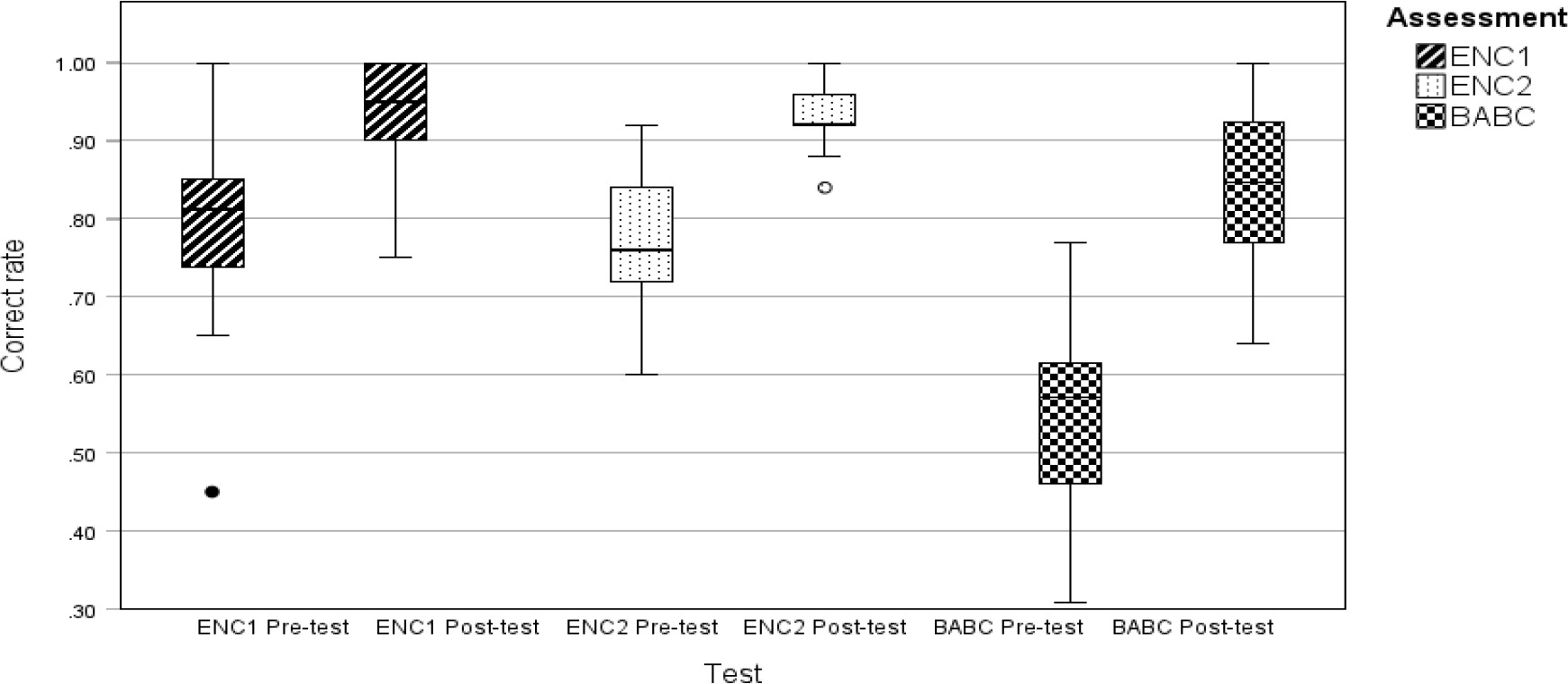
Figure 2
Clustered boxplot of correct rate by pre-and post-tests across OCSEs assessment
The study also analyzed differences in mean scores between rooms across the three assessments. Significant differences were found in the pre-test mean scores between Room A and Room B for both the ENC 1 assessment (Z = -2.47, p = 0.01) and the ENC 2 assessment (Z = -2.37, p = 0.02). However, no significant differences were observed in the post-test mean scores between the two rooms for ENC 1 (Z = -0.04, p = 0.97) and ENC 2 (Z = 1.01, p = 0.35). In contrast, for the BAB assessment, no significant difference was found between the pre-test mean scores of Room C and Room D (Z = 0.89, p = 0.38), whereas a significant difference emerged in the post-test scores (Z = 2.118, p = 0.04).
Participants were required to pass three OSCEs in order to complete certification for each set of curricula. Among participants completing the BAB training, OSCEs had a first-time pass rate of 12 out of 19, and all participants who did not pass during the first round passed during the second round. Among participants completing the ENC training, OSCEs had a first-time pass rate of 21 out of 25 and a second-round pass rate of 23 out of 25.
Participants in the BAB room (N=19) completed the confidence assessment before and after the training. There was a statistically significant improvement in confidence between the pre- and post-training, with a mean confidence score of 3.24 pre-training and 4.12 post-training (t=-7.24, p<.001).
Perceived value of training
Out of 47 total participants, 15 completed a post-training survey where participants were asked to rate the likelihood of using the skills from the training in their work. All respondents from the BAB rooms (N=10) reported that they are “Very Likely” to use these skills. Among the participants from the ENC rooms who answered this question (N= 5), one reported they were “Likely” to use the skills and four reported they were “Very Likely” to use the skills.
The post-training survey was also used to evaluate the usefulness of the supplemental curriculum on respectful care, mental health, and burnout (N=15). When asked about training on respectful maternal care, nine respondents reported they are “Very Likely” and five responded that they were “Likely” to use these skills, and one respondent reported they are “Very Unlikely” to use these skills. When asked about the curriculum for perinatal mental health, 11 respondents reported they are “Very Likely” or “Likely to use this in their practice, and 1 reported they were very unlikely to use the material. When asked about training on self-care and burnout prevention, 13 respondents reported they are “Very Likely” or “Likely” to use this in their practice, and one reported they were very unlikely to use the material. All participants who completed (N=15) the survey reported that they would recommend the training to other nurses and midwives and all reported being “Very Satisfied” with the training, the highest ranking on a 5-point Likert Scale.
In the post-training survey, participants were asked to identify potential reasons why they would not be able to utilize their training in their clinical practice.
Answers included:
Nothing will prevent this: six responses
Lack of proper medication and supplies: five responses
Lack of effort/willingness to apply training: two responses
Lack of infrastructure/facility readiness: three responses
Rising training capacity
On the final day of training, 12 rising trainers were selected from the top-performing group of trainees. These rising trainers were provided with training materials, including simulators to support “low-dose, high-frequency” training in their home facilities. Trainers from a total of nine facilities represented in the 2025 training have been implementing monthly training sessions in their facilities. To date, a total of 35 training sessions have been reported across these nine facilities between February 2025 and May 2025. In a follow-up evaluation, the training team will specifically assess how this support for continued “low-dose, high-frequency” training has helped to contribute to knowledge retention and maternal health outcomes at these facilities.
Discussion
Results from the post-conference survey indicate that participants found the curricula useful, and outcomes from the training show a statistically significant increase in knowledge across the ENC 1, ENC 2, and BAB training modules, along with enhanced confidence among BAB participants. These results suggest that the curricula quality was found to be high, and the training interventions were effective in enhancing knowledge acquisition in essential newborn care and postpartum hemorrhage management.
Room-to-room comparisons provide insights into the consistency and quality of training delivery. While there were significant differences in pre-test scores between rooms for ENC 1 and ENC 2, these differences disappeared in the post-test, indicating that participants across rooms reached a comparable level of knowledge after training. This suggests that the instructional approach and materials used were successful in standardizing learning outcomes across different training environments.
For the BAB assessment, no significant differences were detected between rooms in the pre-test phase, but post-test results did show significant variation. One possible explanation is that this pre-test for BAB had some testing challenges, as some multiple-choice questions required selecting multiple answers, and others did not. We identified more potential testing errors in the BAB tests than in the ENC tests. These testing errors may have obscured differences in baseline knowledge levels, which became more apparent after the training. Alternatively, differences in instructional delivery, group dynamics, or facilitation techniques between rooms C and D could have contributed to this difference. Finally, the continuation of “low-dose, high-frequency” trainings by rising trainers indicates that this is a feasible model for continuous medical education and promoting continued learning at facilities.
Limitations
This research presents a singular case study as a model through which a collaborative training program may result in improvements in the knowledge and confidence of midwives and nurses in Sierra Leone.
The limited sample size limits the generalizability of these findings, and also results in limits to the analysis able to be conducted due to the limited statistical significance. For example, in future analysis it would be helpful to specifically analyze the cadre and prior experience of the participants related to the gains in knowledge and confidence of individual participants, but due to the limited sample size and small number of each cadre represented, this analysis was not able to be conducted. Additionally, participants for this training were selected by both the Sierra Leone Ministry of Health and the facilities themselves. Participants also elected to attend the training after selected. Therefore, participants were selected through convenience sampling and not randomly selected, and there may be sampling bias influencing the results. Participants also elected to complete the post-conference survey, and respondents were not randomly sampled. Participants in this training were selected from two regions in Sierra Leone and do not represent all districts or geographic areas. Future trainings will be conducted in additional districts.
Resource limitations have influenced the ability to conduct follow-up research and obtain data regarding long-term impacts of this training, as this requires in-depth site visits to facilities and monitoring conducted through observation. In the future with more funding, site visits and longitudinal data will be collected.
Implications for policy and practice
Implications for future training design and delivery
Initially designed for two days, after the first iteration, the curriculum was expanded to four days with smaller group sizes to allow more hands-on learning and interaction. Because participant experience levels varied, the application of the Benner Novice to Expert theory was used for setting participant knowledge expectations.21 Recognizing that the teaching pedagogy employed in Sierra Leone relies heavily on memorization and punitive responses instead of fostering learning and critical thinking, training on effective teaching methodologies and evaluation of the application of these methodologies was added to the rising training curriculum.
A future focus of work to strengthen the maternal health system will also include examining the impact of the provision of medications and supplies taught in the training, as literature identifies a lack of supplies and equipment as a major barrier for participant engagement in training and skill application post-training.10 The Ministry of Health and Sanitation in Sierra Leone and other health partners should address the medical supply and equipment shortage to promote the implementation of best practices.
Future training will be held within facilities to better tailor content to local constraints and practices, and to establish ongoing LDHF training plans. For example, while the training on respectful maternal care emphasizes the importance of allowing birth companions to be present during birth, three respondents from three different facilities identified that this is not a current practice, as there is not enough space in the facility.22 The healthcare workers should also be monitored to evaluate how they are applying their knowledge and skills during maternal and infant care in the facility.
Policy and partnership implications
Many stakeholders are working within the health sector in Sierra Leone, including the Ministry of Health and Sanitation, international and local non-governmental organizations, and private and faith-based organizations. The government can promote collaborative partnerships between organizations with the same values. In order to promote effective partnerships between organizations, there must be a shared commitment to collaboration and a sense of shared responsibility for project successes and failures. Also, organizations should be transparent about the role they will play in the project and their financial commitment; in the case of this project, organizations agreed to maintain distinct financial operations while honoring all agreed-upon financial contributions. Lastly, organizations should foster trust through maintaining open lines of communication and being honest and upfront regarding potential threats to the project. The government can promote these factors in collaborative efforts.
A key strategic focus area of the Ministry of Health and Sanitation is education regulation and accreditation of nursing and midwifery training programs.23 The Ministry of Health and Sanitation in Sierra Leone and other relevant stakeholders should implement a plan for continuous medical education and monitor if health care workers are undergoing regular re-training and re-certification in maternal and child health skills. The increases in knowledge and confidence indicate that this training model has the potential to be effective. The Ministry of Health and Sanitaton and other health partners should conduct further training on maternal health to capacitate the health workforce. To promote sustainability and effectiveness, local actors should be championed throughout all project stages, including development, delivery, and evaluation. They should ensure that the program is adapted to the context and culturally relevant to the participants. When given the resources and support, enterprising individuals who are empowered to be rising trainers can continue the work long after the program is over, cascading the training in their own facilities and contexts.
Conclusion
Investments in midwifery training are proven to be an effective approach to improving maternal and neonatal outcomes in low- and middle-income countries. This collaboration to train midwives in Sierra Leone was successful in fostering organizational collaboration, increasing the competence and confidence of midwives, and establishing a cohort of local trainers. However, systemic barriers to the application of training remain, and research is needed to determine the long-term effectiveness of training on midwives’ skill retention, training capacity, and overall maternal and child health outcomes. Overall, lessons learned from this training, especially the investment in local capacity and the values required for successful collaboration, can serve as a model for other organizations that can build on this promising approach.
Acknowledgements
We extend our sincere gratitude to all the organizations and individuals who contributed to the success of this project. We acknowledge and thank the Ministry of Health and Sanitation for Sierra Leone for their essential collaboration and support. Deep appreciation is extended to the Healey International Relief Foundation, Tenki for Born, Helping Children Worldwide, and the Christian Health Association of Sierra Leone (CHASL) for their invaluable collaborative efforts and shared commitment to this vital maternal and newborn health initiative. Special thanks are also due to Christian Connections for International Health (CCIH) for creating the 30x30 Health System Strengthening Initiative, which was instrumental in bringing these organizations together. We particularly recognize Kathleen Pfohl for her dedicated work on the first iteration of the training. We are grateful to our research partners at the Center of Excellence for Maternal and Child Health Education and Research at the University of Makeni (UNIMAK), Njala University, and the School of Midwifery, Kenema for their invaluable collaboration and provision of in-kind support.
This project was made possible through the generous funding and in-kind support from CHAMPS (Child Health and Mortality Prevention Surveillance), Tzu Chi Foundation, SOS Health and Hope, Direct Relief, Friends of Sierra Leone (FOSL), Project Hope, Brother’s Brother USA, Poly Clinic Medical, MAP International, SEED Global Health, and Embrace International.
Generative AI was used to provide editorial and structural assistance on an advisory basis, including suggestions for the condensing of content for clarity and conciseness. It was not used to generate any of the research content, findings, or analytical conclusions.
Funding
None declared.
Conflict of Interest
None declared.