
Table 1
Breast MRI protocol
| Sequence | TR/TE (ms) | in-plane resolution mm | Slice thickness (mm) | Scanning time |
|---|---|---|---|---|
| T1-FFE | 4.57/2.3 | 0.48 × 0.48 | 0.7 | 6 min 11 s |
| T2-TSE | 5000/120 | 0.6 × 0.6 | 2 | 3 min 20 s |
| STIR | 5000 /60 | 1 × 1 | 2 | 5 min 40 s |
| T1 dynamic* | 4.67/ 2.31 | 0.96 × 0.96 | 1 | 58.5 s |
| DWI# | 7168 /95 | 1.15 × 1.15 | 4 | min 8 s |
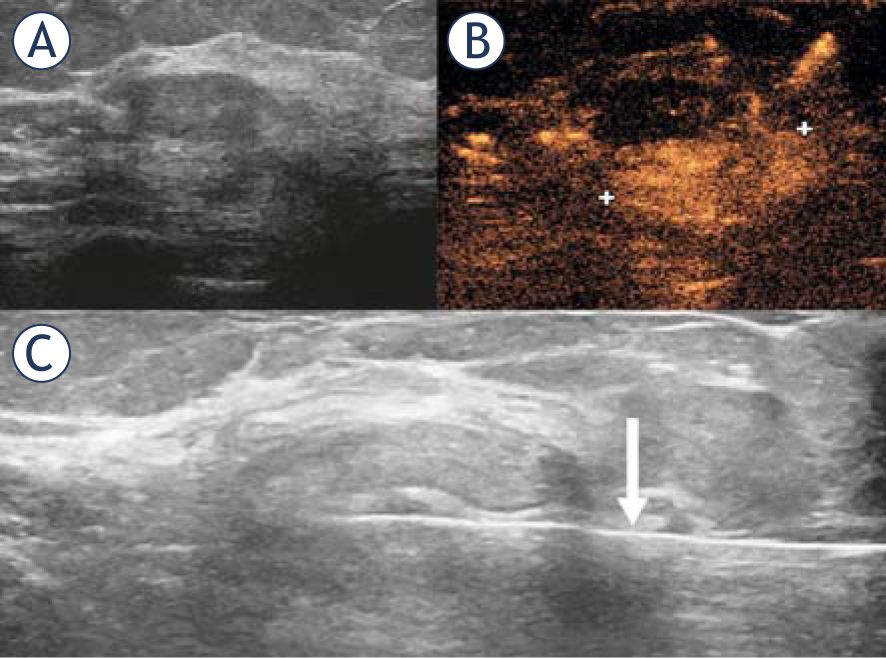
Figure 1
53 year old female patient with invasive carcinoma of the right breast. MRI detected an occult, BI-RADS 5, oval, 20×16 mm irregular mass lesion in the lower medial quadrant of the left breast (not shown). Targeted US (A) was negative. Contrast-enhanced ultrasound (B) revealed a 21 mm enhancement. Core biopsies were obtained from the enhancement area (C, ARROW) showing the core biopsy needle’s position). Both core biopsy and final histology showed high grade invasive carcinoma.
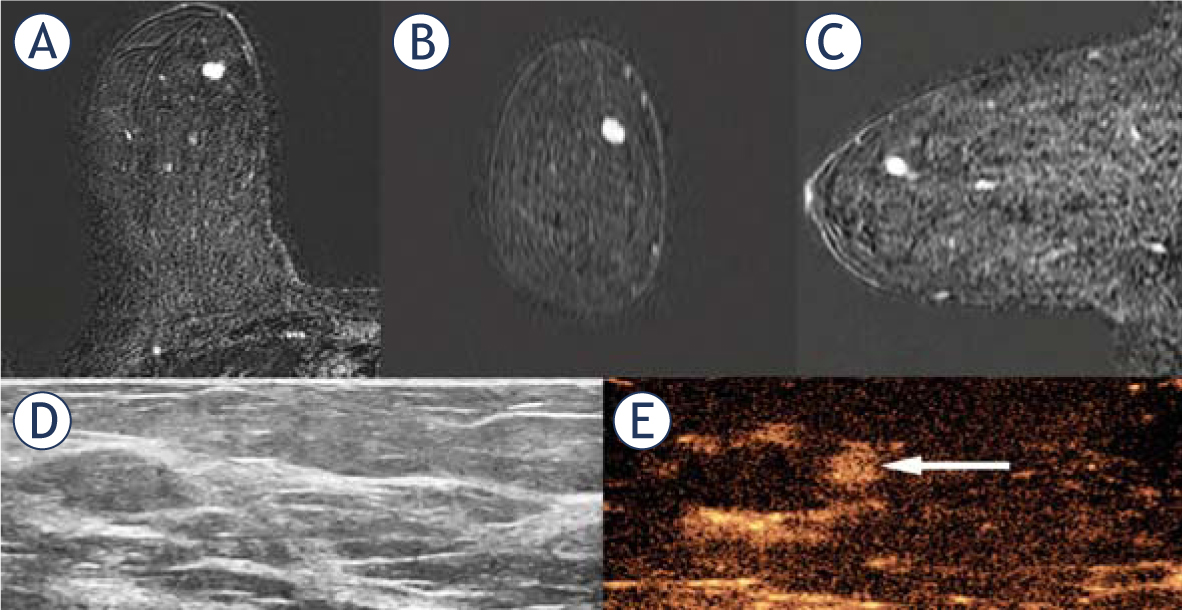
Figure 2
60 year old female patient with invasive carcinoma of no specific type (NST) of the left breast (not shown). MRI detected an occult BI-RADS 4 oval, 7×5 mm mass lesion in the upper medial quadrant of the right breast (A-C) thin slice multiplanar reconstruction in axial, coronal and sagittal orientations). Targeted US was negative (D). Contrast-enhanced ultrasound (E, ARROW) revealed a 5 mm round enhancement. Low grade ductal carcinoma in situ (DCIS) was diagnosed in the core biopsy of the enhanced lesion. The final histology was both DCIS (6×4 mm) and low grade invasive carcinoma NST (6×5 mm) in close vicinity.
Table 2
Patients, indications for MRI and MRI-only detected lesions’ characteristics, interventions and histopathological diagnosis
| Case | Age yrs | Indication for MRI | Occult-lesion characteristics on MRI | Occult lesion size | CEUS visualization | Intervention | CB and final histopathological diagnosis and size of lesion |
|---|---|---|---|---|---|---|---|
| 1 | 71 | Preoperative local staging | Mass, round, circumscribed, washout kinetic curve | 6 mm | Positive | CEUS-guided CB | CB: Low grade DCIS Final: Low grade DCIS. 3 mm |
| 2 | 78 | Problem solving | Mass, oval, circumscribed, washout kinetic curve | 7 mm | Negative | MRI-guided localization | Final: Papilloma. 5 mm |
| 3 | 64 | Incidental breast lesion on CT | NME, focal, heterogeneous | 20 mm | Negative | US-guided CB | CB: high grade DCIS. Final: high grade DCIS.16 mm |
| 4 | 54 | Preoperative local staging | Mass, round, circumscribed, heterogeneous, washout kinetic curve | 7 mm | Positive | CEUS-guided clip placement | Final: Intermediate grade IC NST. 5 mm |
| 5 | 54 | Axillary metastasis from an occult breast cancer | Mass, irregular, not circumscribed, plateau kinetic curve | 12 mm | Negative | MRI-guided CB | VAB: Carcinoma with medullary feature Final: Carcinoma with medullary feature and high grade DCIS.10 mm |
| 6 | 66 | Problem solving | Mass, round, circumscribed, ring like enhancement, persistent kinetic curve | 5 mm | Positive | CEUS-guided CB. Follow-up | CB: Fibrocystic lesion, liponecrosis |
| 7 | 30 | Problem solving | NME, focal, heterogeneous | 10 mm | Negative | Follow-up | -- |
| 8 | 61 | Preoperative local staging | Mass, oval, irregular, washout kinetic curve | 10 mm | Positive | CEUS-guided CB | CB: Low grade DCIS Final: low grade IC NST 6 mm and Low grade DCIS 5mm |
| 9 | 53 | Preoperative local staging | Mass, oval, irregular, washout kinetic curve | 16 mm | Positive | CEUS-guided CB | CB: High grade IC NST Final: High grade IC NST. 13 mm |
| 10 | 65 | Axillary recurrence | Mass, oval, circumscribed, homogeneous, persistent kinetic curve | 9 mm | Negative | MRI-guided VAB | VAB: High grade DCIS + suspected microinvasion |
[i] CB = Core biopsy; CEUS = Contrast-enhanced ultrasound; CT = Computed tomography; DCIS = Ductal carcinoma in situ; IC NST = Invasive carcinoma no special type; MRI = Magnetic resonance imaging; NME = Non-mass-enhancing; US = Ultrasound; VAB = Vacuum assisted biopsy