
Table 1
Antibodies used in the study
| Antibody | Specificity | Type | Species | Source | Dilution | Pretreatment |
|---|---|---|---|---|---|---|
| Anli-humun CD3 | Pan-T lymphocytes | Policonal | Rabbit | (A0552) Dako UK Ltd. Ely UK | 1:50 | Citrate buffer pH6 |
| Anti-human CD20 | Pan-B lymphocytes | Policonal | Rabbit | (RB-9013-PO) Thermo Scientific, Chesire, UK | 1:400 | None |
| Anti-human Foxp3 | T-reg lymphocytes | Monoclonal | Mouse | (7979) Affymetrix eBioscience, san Diego, CA USA | 1:100 | Triss-EDTA pH9 |
| Anti-human CD68 | Macrophages | Monoclonal | Mouse | (PG-M1) Thermo Scientific, Chesire, UK | 1:100 | Proteinase K |
| Anti-human Ki-67 | Proliferating cells | Monoclonal | Mouse | (610538) BD Biosciences, Wyckoff, NJ, USA5 | 1:100 | Citrate buffer pH6 |
| Anti-human Bcl-2 | Antiapoptotic protein | Monoclonal | Mouse | (610538) BD Biosciences, Wyckoff, NJ, USA5 | 1:100 | Citrate buffer pH6 |
| Anti-human Von Willebrand Factor - | Endothelial cells | Policlonal | Rabbit | (A0082) Dako UK Ltd. Ely UK | 1:300 | Citrate buffer pH6 |
| Anti-human CD31 | Endothelial cells | Monoclonal | Mouse | (JC70A) Dako UK Ltd. Ely UK | 1:100 | Citrate buffer pH6 |
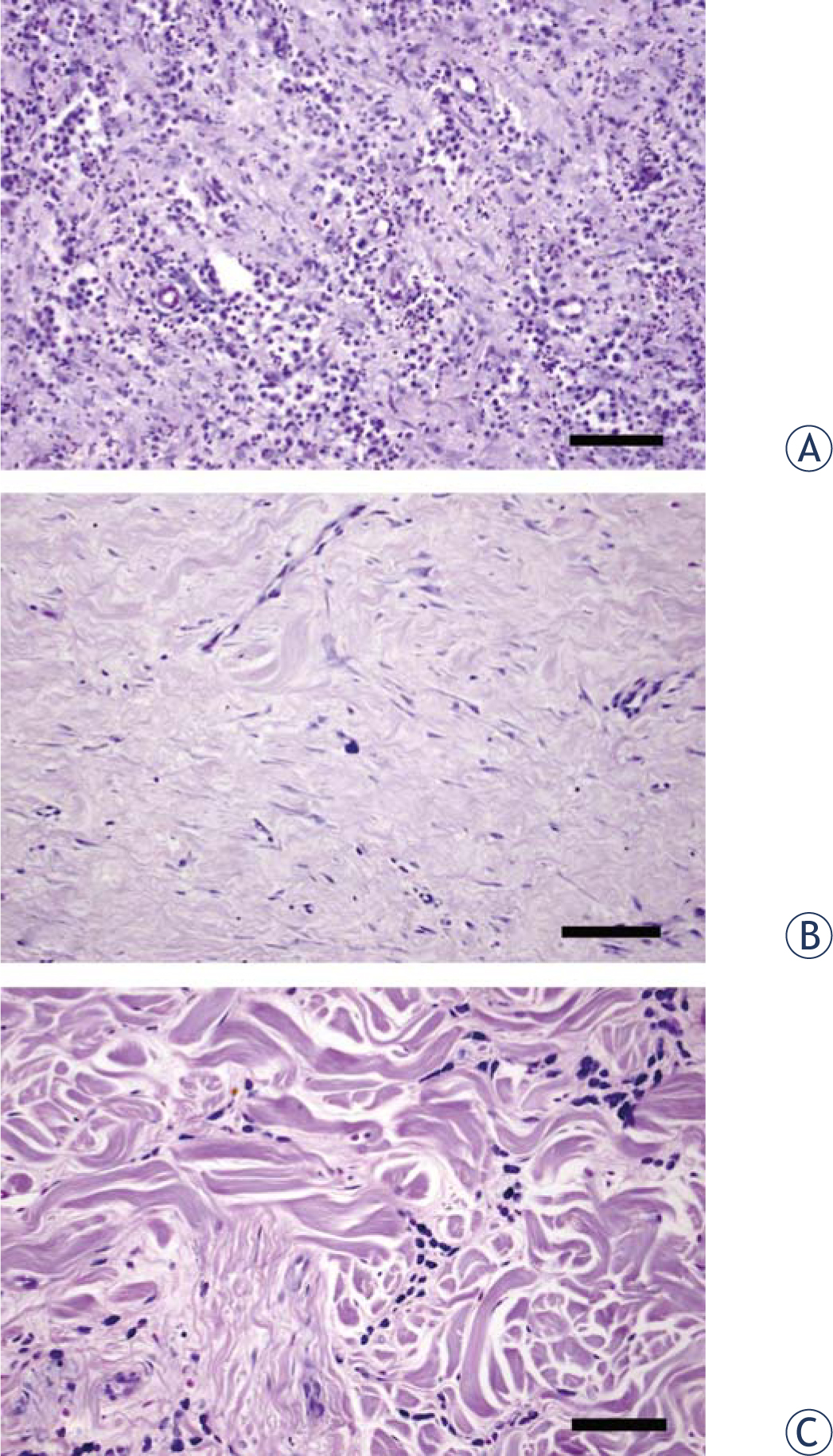
Figure 1
Histology of tissue samples collected before the combined therapy (T0) and at 4 (T1) and 8 weeks (T2) post-treatment. (A) At T0 sheets of neoplastic cells with abundant cytoplasm containing variable number of metachromatic granules were present in the superficial and deep dermis; (B) At T1 The neoplastic tissue was substituted by a fibrotic tissue associated with scanty inflammatory infiltrates mainly constituted by mononuclear cells; (C) At T2 in dogs with partial response between connective tissue bundles were evident thin aggregates of neoplastic mast cells. Haematoxylin Eosin; bar = 100 mm.
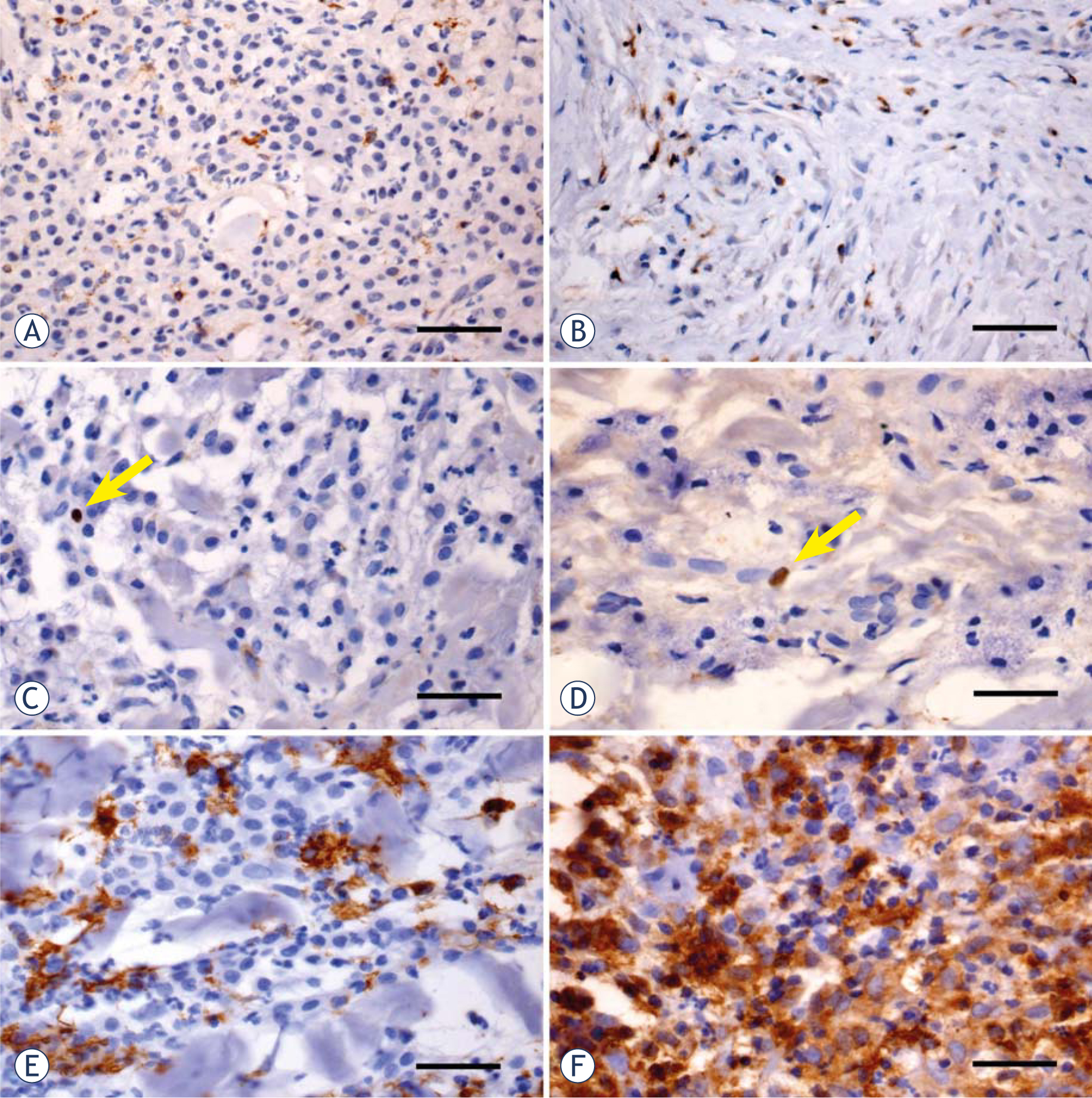
Figure 2
Immunoistochemical staining of tissue samples collected at T0 (A, C and E) and, T1 (B, D and E). CD3+ lymphocytes infiltrating the neoplastic tissue at T0 (A) and the fibrotic tissue at T1 (B). Scanty Foxp3+ Treg lymphocytes at the periphery of neoplastic tissue at T0 (C) and in a tissue sample collected at T1 (D). CD68+ macrophages in the neoplastic tissue at T0 (E) and in the fibrotic tissue at T1 (F). Immunohistochemical staining using DAB chromogen and haematoxylin counterstain. Bar = 100 mm.
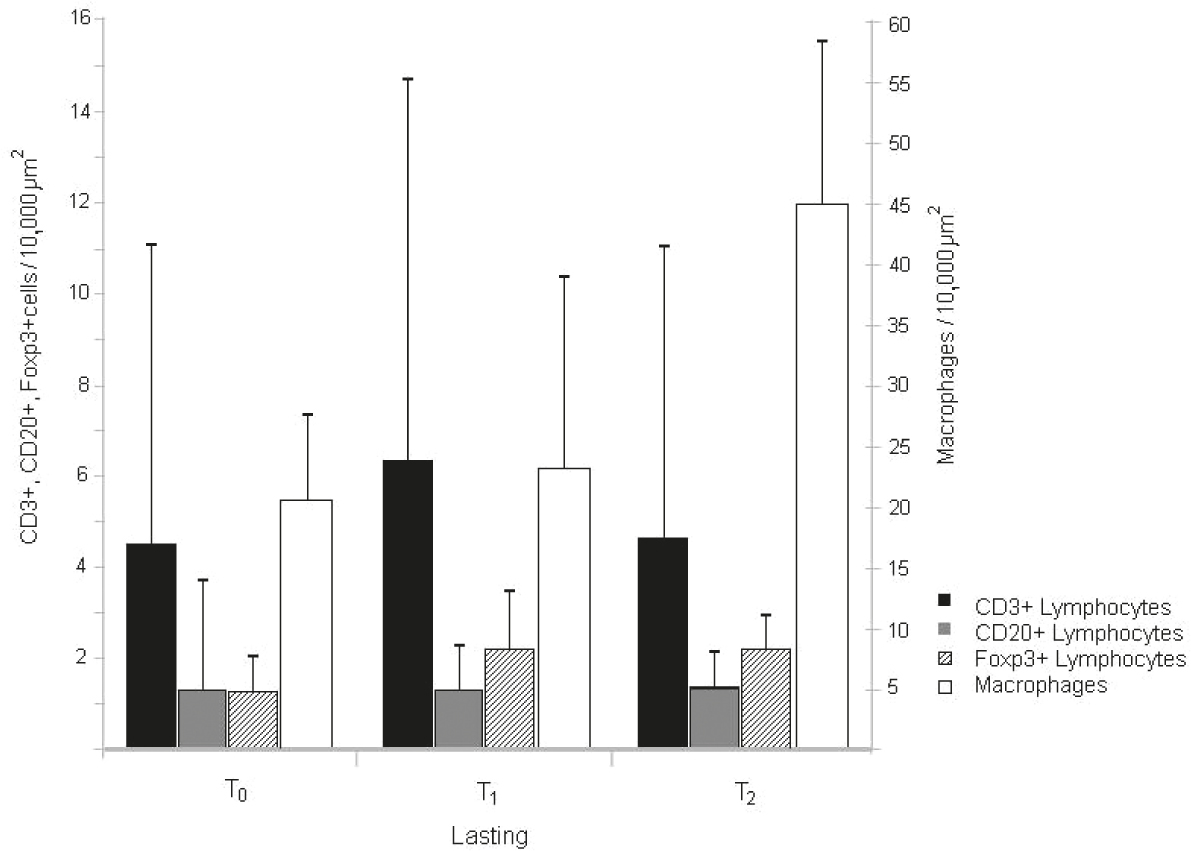
Figure 3
Histogram of number of immune cells in 10,000 µm2 of tissue samples collected al T0, T1 and T2. Slight increase of CD3+ lymphocytes at T1, while macrophages significantly increased at T2 and Treg lymphocytes at T1.
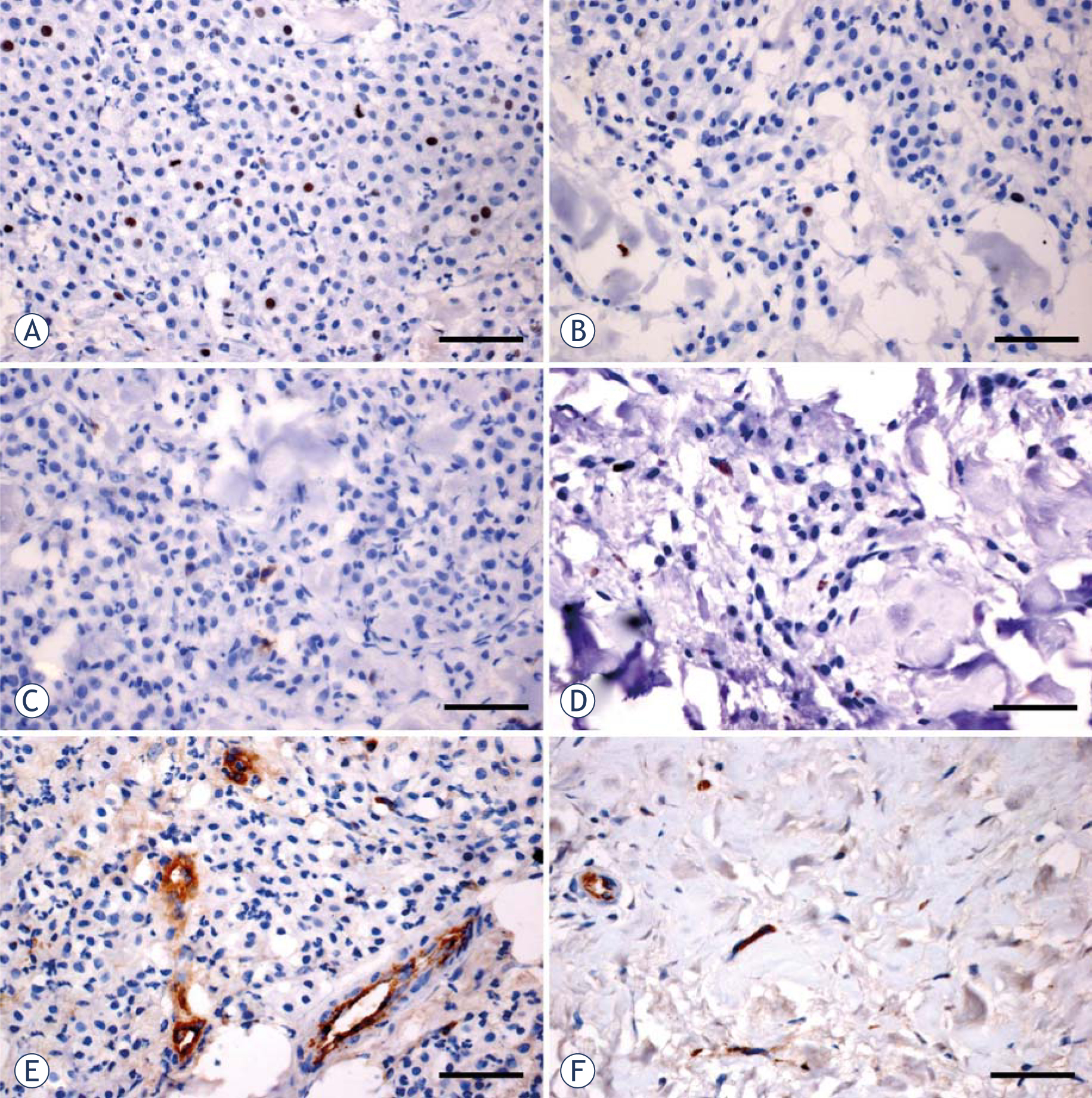
Figure 4
Immunoistochemical staining of tissue samples collected at T0 (A, C and E) and , T1 (B, D and E). Ki-67+ neoplastic cells at T0 (A) and at T1 in a dog with partial response (B). Bcl-2+ neoplastic cells at T0 (C) and at T1 in a dog with partial response (D). Microvessels stained using an anti-CD31 primary antibody at T0 (E) and in the fibrotic tissue at T1 in a dog with a complete response (F). Immunohistochemical staining using DAB chromogen and haematoxylin counterstain. Bar = 100 mm.
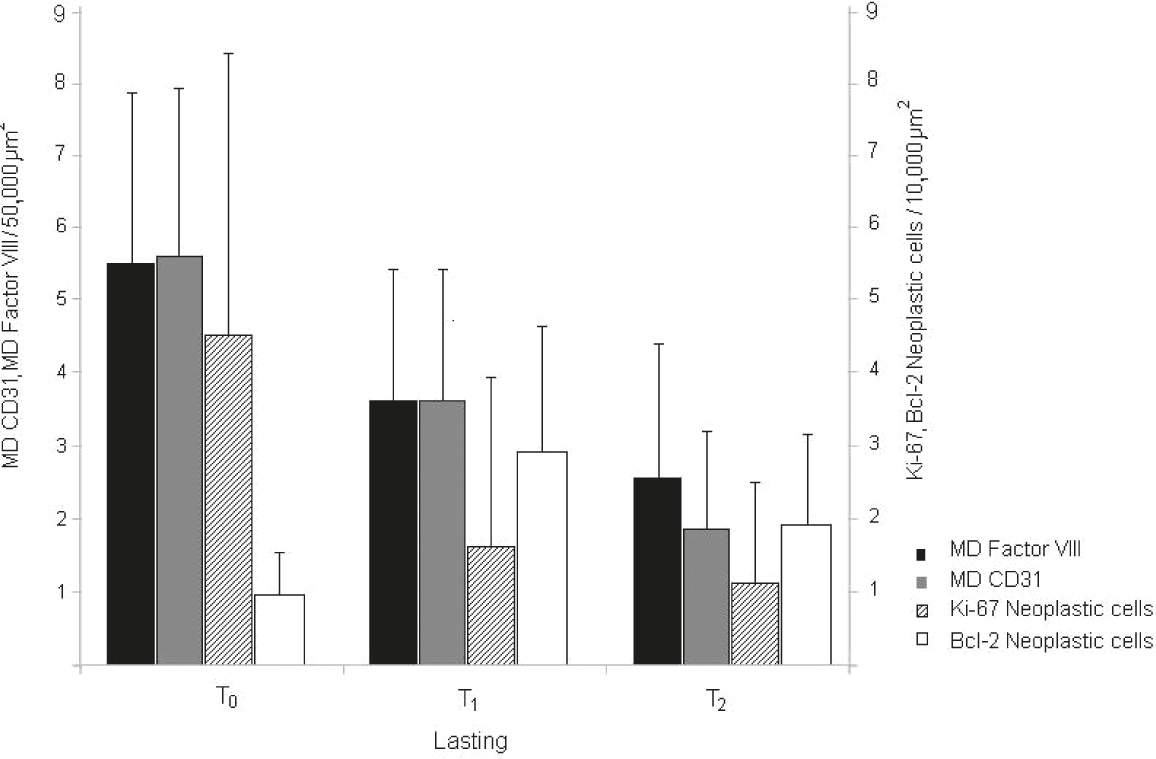
Figure 5
Histogram of microvessel density determineg using both primary antibodies against Factor VIII and CD31positive-cells in 50,000 µm2 of tissue samples and number of Ki-67+ and Bcl-2+ neoplastic cells in 10,000 µm2 of tissue samples collected al T0, T1 and T2. Microvessel density was drastically reduced at T1 and T2. as well as the proliferation activity of neoplastic cells, while Bcl-2 expression was increased at T1.