
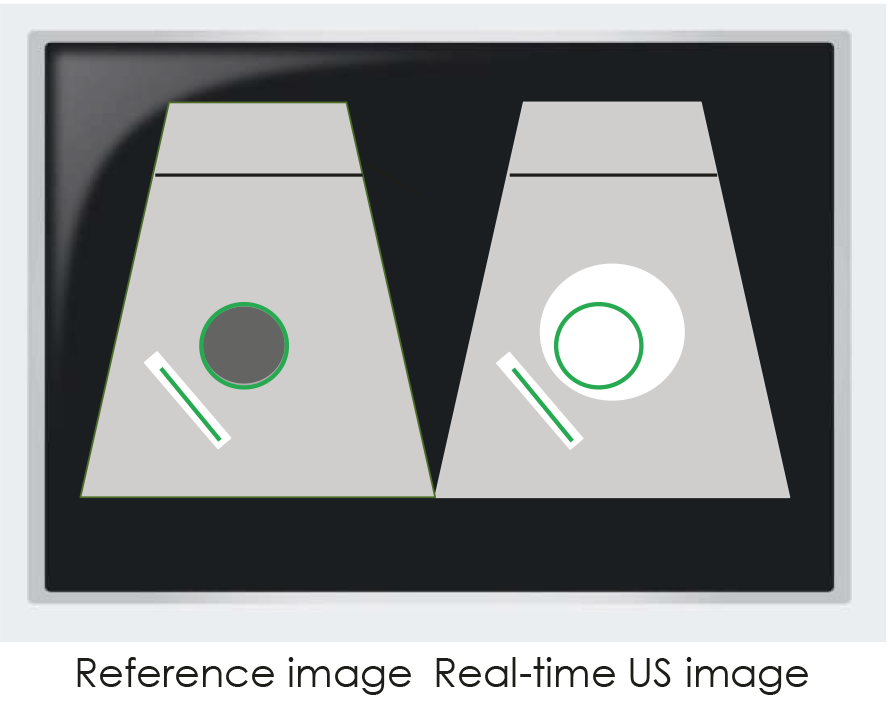
Figure 1
Schema of our IFS. An US monitor shows a reference image (left) and a real-time US image (right) immediately after RFA. Two synchronized straight markers depicted in identical positions in the same intrahepatic vessels ensure correct image fusion. On the reference image, a spherical marker (unfilled green circle) was drawn along the contour of a target tumor (filled black circle). On the real-time US image, a high echoic area (filled white circle) due to RFA-induced microbubbles completely covers the synchronized spherical marker, indicating the exact position of the tumor contour, suggesting potential complete ablation.
IFS = image fusion system; RFA = radiofrequency ablation; US = ultrasound
Table 1
Baseline characteristics of patients
| IFS group (n = 25) | Control group (n = 20) | P-value * | |
|---|---|---|---|
| Age (years) | 73 ± 8 a | 74 ± 9 a | 0.39 |
| Sex, male/female | 14/11 | 8/12 | 0.37 |
| Etiology, viral/non-viral | 15/10 | 17/3 | 0.10 |
| Child-Pugh grade, A/B | 22/3 | 16/4 | 0.68 |
| Occurrence, new/recurrent | 23/2 | 18/2 | 1.00 |
| Tumor size (mm) | 19 ± 6 a | 19 ± 8 a | 0.42 |
| Tumor location, L/M/A/P | 2/4/11/8 | 0/2/11/7 | 0.53 |
| Tumor vascularity, hypo/hyper | 3/22 | 1/19 | 0.62 |
| Electrode tip, 2 cm/3 cm | 9/16 | 2/18 | 0.08 |
| CEUS guidance for RFA, no/yes | 22/3 | 18/2 | 1.00 |
| Artificial ascites and/or pleural effusion, no/yes | 12/13 | 8/12 | 0.76 |
| Combined with TACE, no/yes | 21/4 | 18/2 | 0.68 |
IFS = image fusion system; L = lateral segment; M = medial segment; A = anterior segment; P = posterior segment; CEUS = contrast enhanced ultrasound; RFA = radiofrequency ablation; TACE = transcatheter arterial chemoembolization.
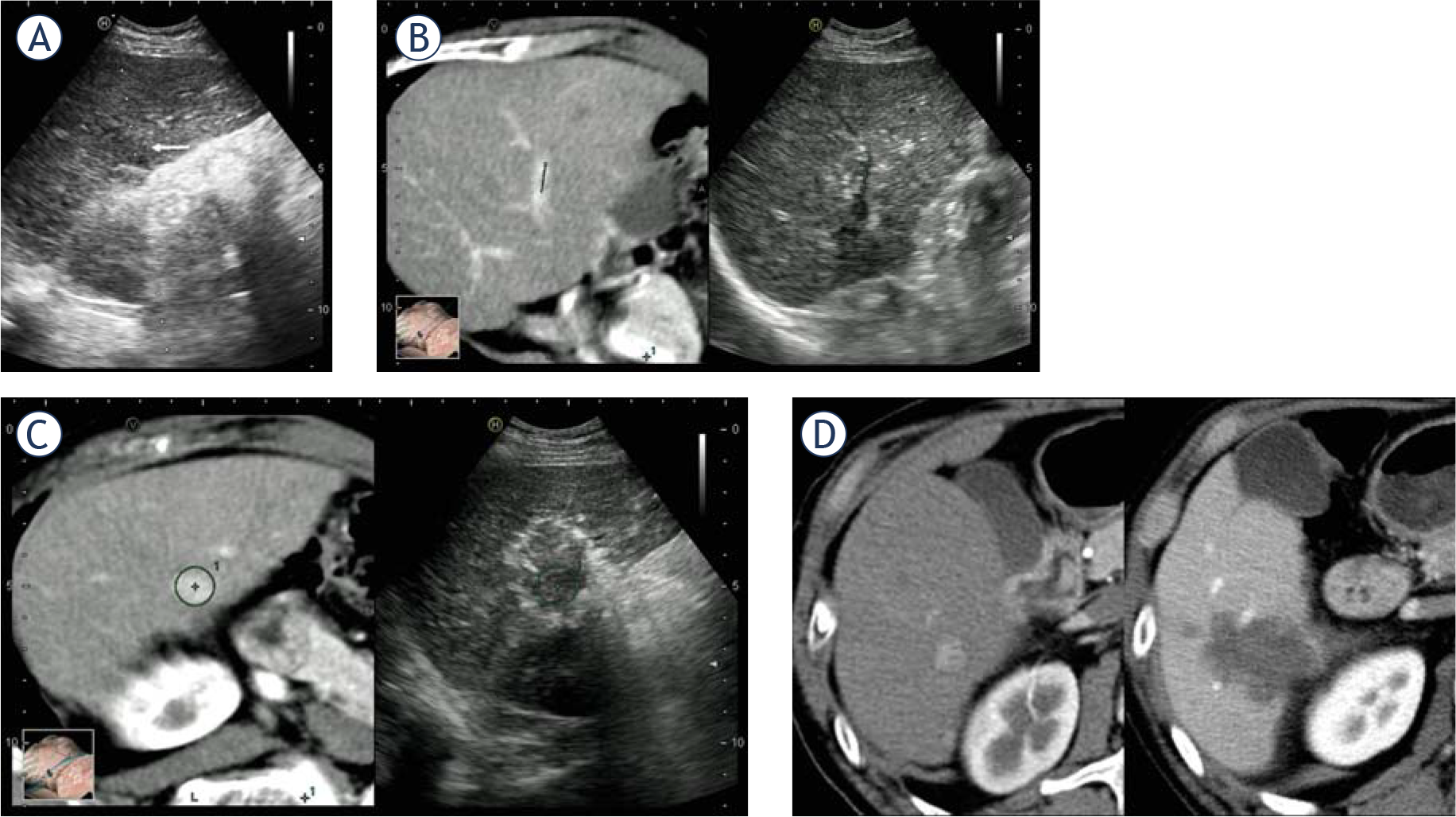
Figure 2
Case 1. A 67-year-old male patient had a 15-mm HCC in segment VI. (A) The HCC is depicted as a low echoic tumor (white arrow) on US. A dot-line represents a puncture line for RFA. (B) A reference CT image (left) and a real-time US image (right) immediately after the first RF electrode insertion in the first RFA session. In this case, reference images were created by retrieving pre-treatment arterial phase images from a dynamic CT. Two synchronized straight markers depicted at the same positions in the same portal vein branches ensured correct image fusion. (C) Another reference CT image depicting the tumor (right) and the corresponding real-time US image (left). On the reference image, a spherical marker was drawn along the tumor contour. On the real-time US image, the tumor is almost invisible because of a high echoic area due to RFA-induced microbubbles. However, the synchronized spherical marker indicates the exact position of the tumor contour. The high echoic area completely covers the synchronized spherical marker, thus suggesting the potential complete ablation. (D) Pre-treatment (left) and post-treatment (right) dynamic CT images. The pre-treatment arterial phase image depicts a hypervascular tumor, while the post-treatment portal phase image depicts an RFA-induced avascular area larger than the original tumor. These findings are suggestive of the achievement of complete ablation after the first RFA session.
CT = computed tomography; HCC = hepatocellular carcinoma; RFA = radiofrequency ablation; US = ultrasound
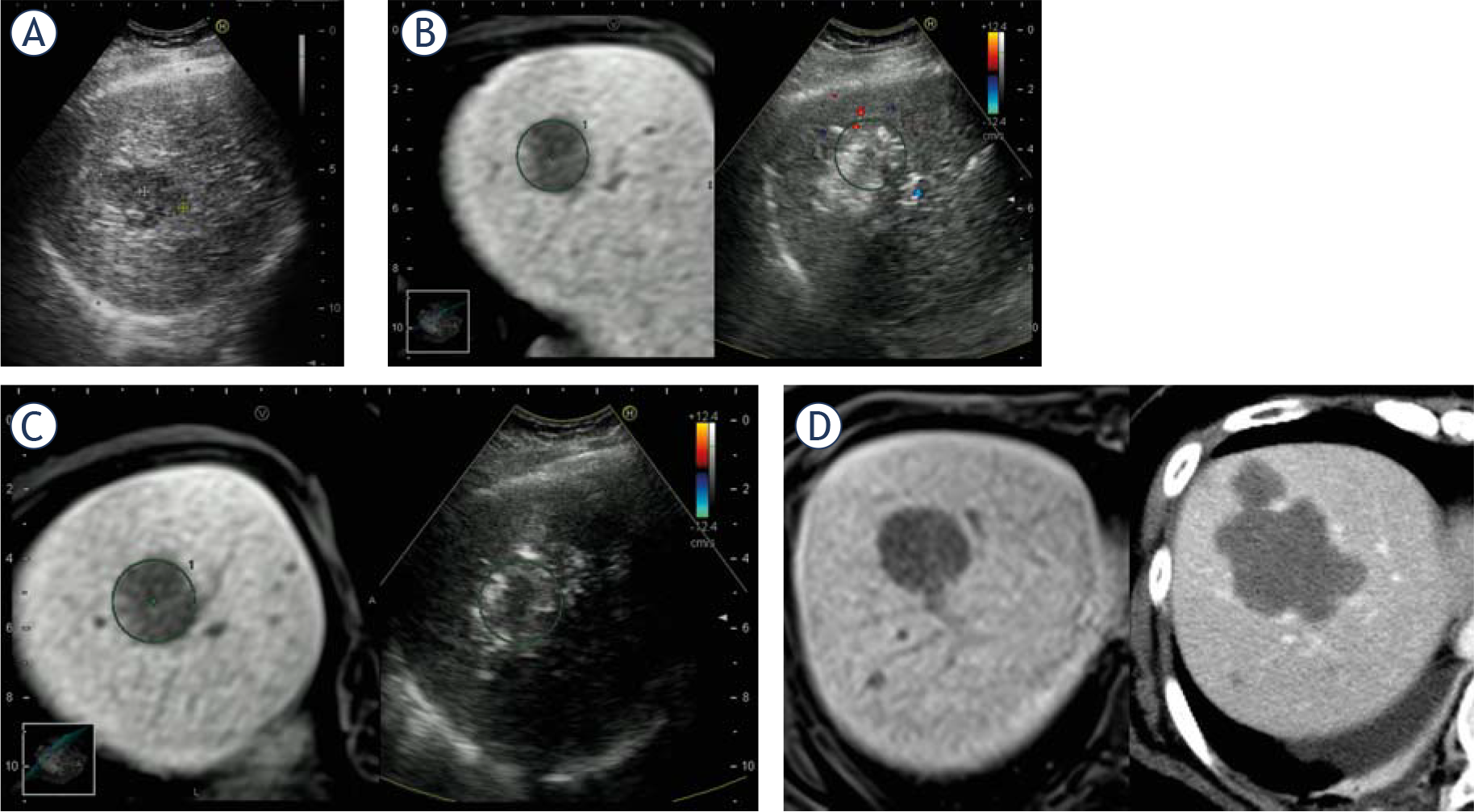
Figure 3
Case 2. A 66-year-old female patient had a 28-mm HCC in segment VIII. (A) The HCC is depicted as a low echoic tumor on US. A dot-line represents a puncture line for RFA. (B) A reference MRI image (left) and a real-time US image (right) immediately after the first RF electrode insertion in the first RFA session. In this case, reference images were created by retrieving pre-treatment hepatobiliary phase images of Gd-EOB-DTPA-enhanced MRI. On the reference image, a spherical marker was drawn along the tumor contour. Although the tumor is almost invisible on the real-time US image because of a high echoic area due to RFA-induced microbubbles, the synchronized spherical marker indicates the exact position of the tumor contour. The positional relationship between the high echoic area and the synchronized spherical marker suggests incomplete ablation. (C) A reference MRI image (left) and a real-time US image (right) immediately after the fourth RF electrode insertion in the first RFA session. The extent of the high echoic area due to RFA-induced microbubbles is larger than that after the first RF electrode insertion. The positional relationship between the high echoic area and the synchronized spherical marker suggests potential complete ablation. (D) A pre-treatment MRI image (left) and a post-treatment dynamic CT image (right). The pre-treatment hepatobiliary image depicts a hypointense tumor, while the post-treatment portal phase image depicts an RFA-induced avascular area larger than the original tumor. These findings are suggestive of the achievement of complete ablation after the first RFA session.
CT = computed tomography; Gd-EOB-DTPA = gadolinium-ethoxybenzyl-diethylenetriamine pentaacetic acid; HCC = hepatocellular carcinoma; MRI = magnetic resonance imaging; RFA = radiofrequency ablation; US = ultrasound