
Table 1
The patients’ clinical characteristics and patohystologic characteristics of the tumor
| All | pCR | non-pCR | |
|---|---|---|---|
| Average age, years | 59.6 ±11.5 | 58.5 ±11.2 | 59.9 ±11.8 |
| Gender* | |||
| Male | 18 | 5 | 13 |
| Female | 15 | 2 | 13 |
| Clinical T stage pre-CRT (MRI classification)* | |||
| T2 | 3 | 1 | 2 |
| T3 | 23 | 5 | 18 |
| T4 | 7 | 1 | 6 |
| Average tumor distance to the anus (cm)* | 5.1 (± 2.2) | 6.1 (± 1.3) | 4.8 (± 2.3) |
| Type of resection* | |||
| Low anterior resection | 15 | 3 | 12 |
| Abdominoperineal resection | 15 | 4 | 11 |
| Pelvic exenteration | 3 | 0 | 3 |
| Histologic grade (biopsy)* | |||
| Well differentiated | 6 | 2 | 4 |
| Moderately differentiated | 23 | 4 | 19 |
| Poorly differentiated | 4 | 1 | 3 |
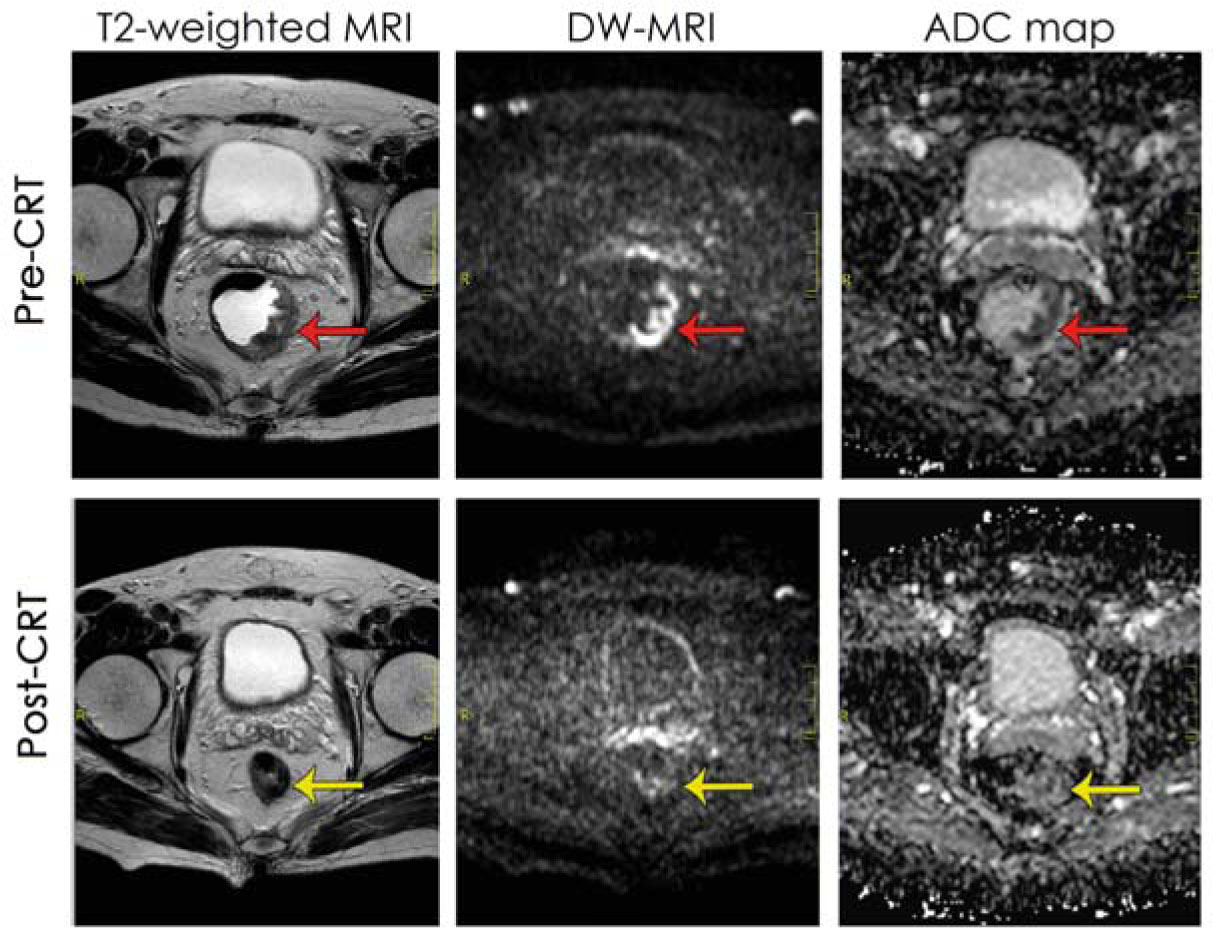
Figure 1
Sample of a T2-weighted MRI, DW-MRI (b-value 1000 s/mm2), and ADC map from a locally advanced rectal tumor. The red arrows point to different aspects of the left lateral pre-CRT tumor area. The yellow arrows point to the cancer shrinkage in the post-CRT. Pre- and post-CRT ADC values were 0.92 × 10⁻³ mm2/s and 1.50 × 10⁻³ mm2/s, with pCR in the surgical specimen.
Table 2
Calculation of diagnostic performance of conventional T2W MRI and combined set of conventional T2W MRI in addition to DWI for the diagnosis of complete rectal cancer response to neoadjuvant therapy
| T2W | 95% CI | T2W + DWI | 95% CI | |
|---|---|---|---|---|
| Sensitivity% | 86.9 | (0.65−0.96) | 96.1 | (0.78−0.99) |
| Specificity% | 50 | (0.20−0.79) | 71.4 | (0.30−0.94) |
| PPV% | 80 | (0.58−0.92) | 92.6 | (0.74−0.98) |
| NPV% | 62.5 | (0.25−0.89) | 83.3 | (0.36−0.99) |
| Accuracy% | 75.7 | (0.57−0.88) | 81.8 | (0.63−0.92) |
[i] 95% CI = 95% confidence interval; DWI = diffusion-weighted imaging; T2W = T2-weighted; NPV = negative predictive value; PPV = positive predictive value
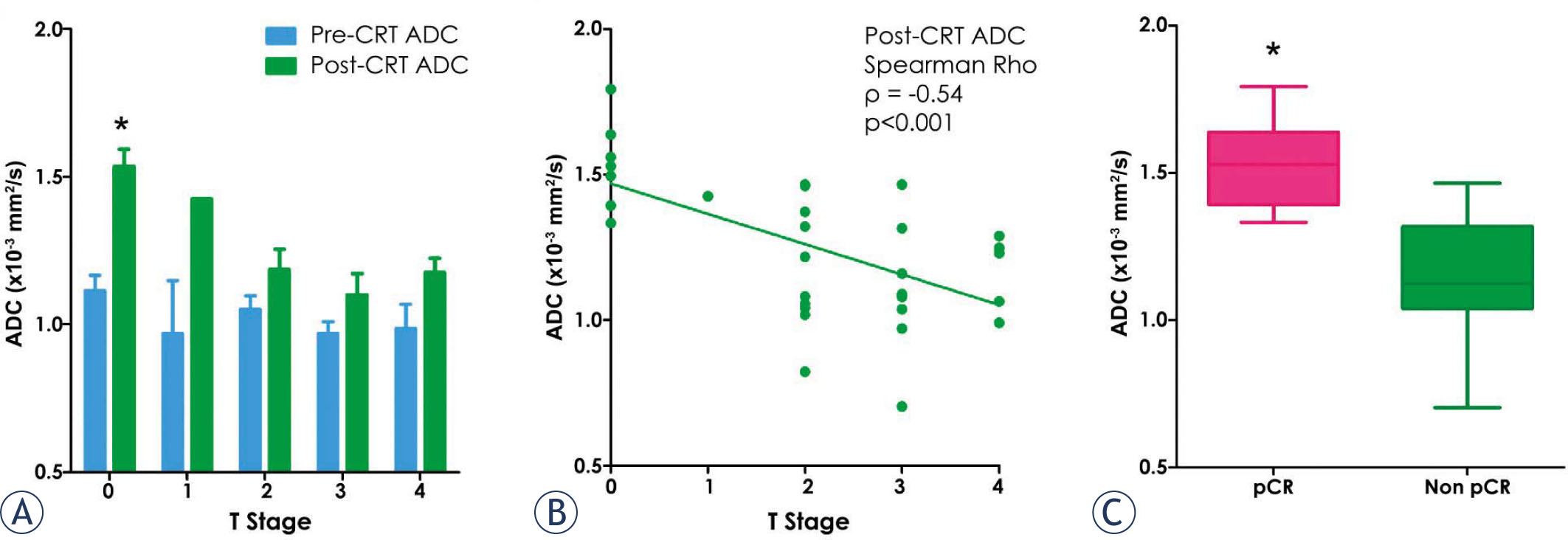
Figure 2
Correlation between ADC values and final T staging. (A) The pre-CRT ADC values were similar in the different groups (blue bars, (p > 0.05), although post-CRT ADC values differed in each group (green bars, p < 0.01); statistical significance (*). (B) Post-CRT ADC values with a moderate negative correlation and slope different from zero degrees (Spearman’s Rho = -0.54; 95% confidence interval -0.75 to -0.24). (C) Box plot analysis between post-CRT ADC values and final T staging. The pCR ADC-median value (1.53 × 10’−3 mm2/s) is far away from the lower and upper boundaries of the non-pCR box (p < 0.01).
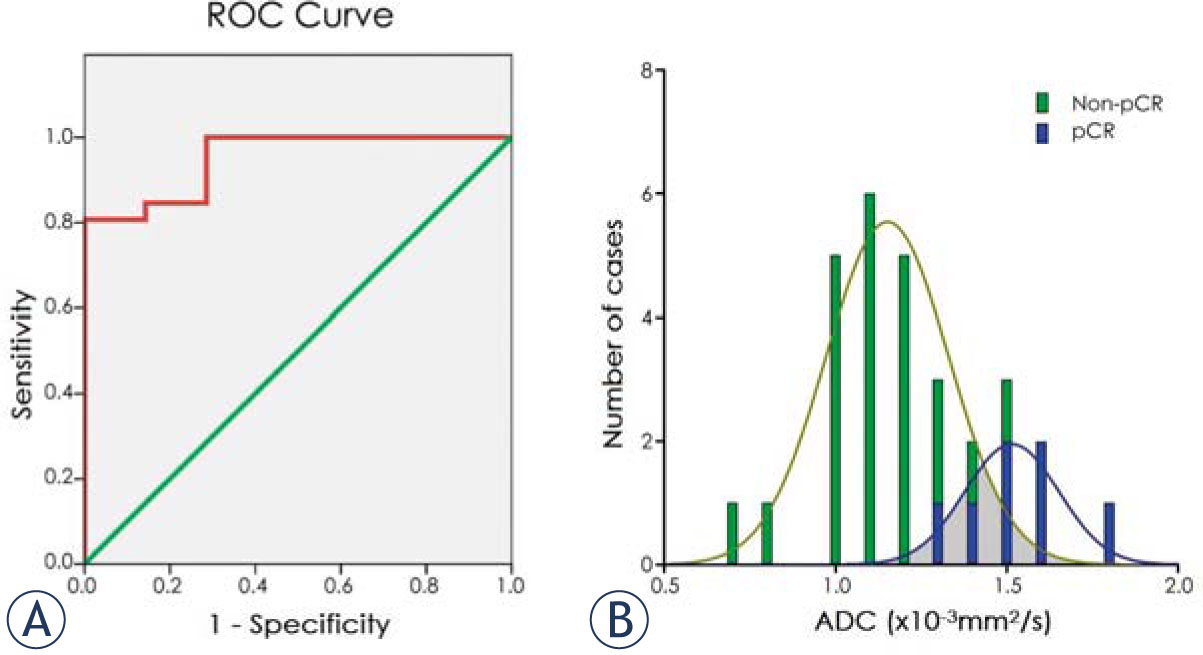
Figure 3
Receiver operating characteristic (ROC) curve and histogram in patients with rectal carcinoma with a normal distribution. (A) The optimal post-CRT ADC cutoff value 1.49 × 10⁻³ mm2/s (area under the curve = 0.95). (B) Histogram. The mean post-CRT ADC values of patients with pCR was 1.53 (± 1.96 × 0.15 × 10−3 mm2/s) and of patients with non-pCR 1.16 (± 1.96 × 0.19 × 10−3 mm2/s); the area in gray highlights the possible overlap in these values.