
Table 1
MRI sequence parameters
| TR | TE | MATRIX | N OF SLICE | SLICE THICKNESS | FOV | NSA | TSE-TFE FACTOR | SLAB THICK | |
|---|---|---|---|---|---|---|---|---|---|
| T2 W Images (Ax and Coronal) | 962ms | 100 ms | 256x256 | 24 | 6 mm | 350-400 mm | 2 | 158 | - |
| GRE Balanced TFE (Ax and Coronal) | 4 ms | 1.24 ms | 156x213 | 24 | 7 mm | 300-400 mm | 2 | 219 | - |
| 3D-TSE T2 W respiratory-triggered | 1466 ms | 650 ms | 256x256 | 1 | 0.8 mm | 250-300 mm | 1 | 105 | 40 mm |
Ax = axial; ETL = echo train length; GRE = gradient-recalled echo; N = number; NSA = number of signal acquired; TE = echo time; TFE = turbo field echo; TR = repetition time; TSE = turbo spin echo; W = weighted
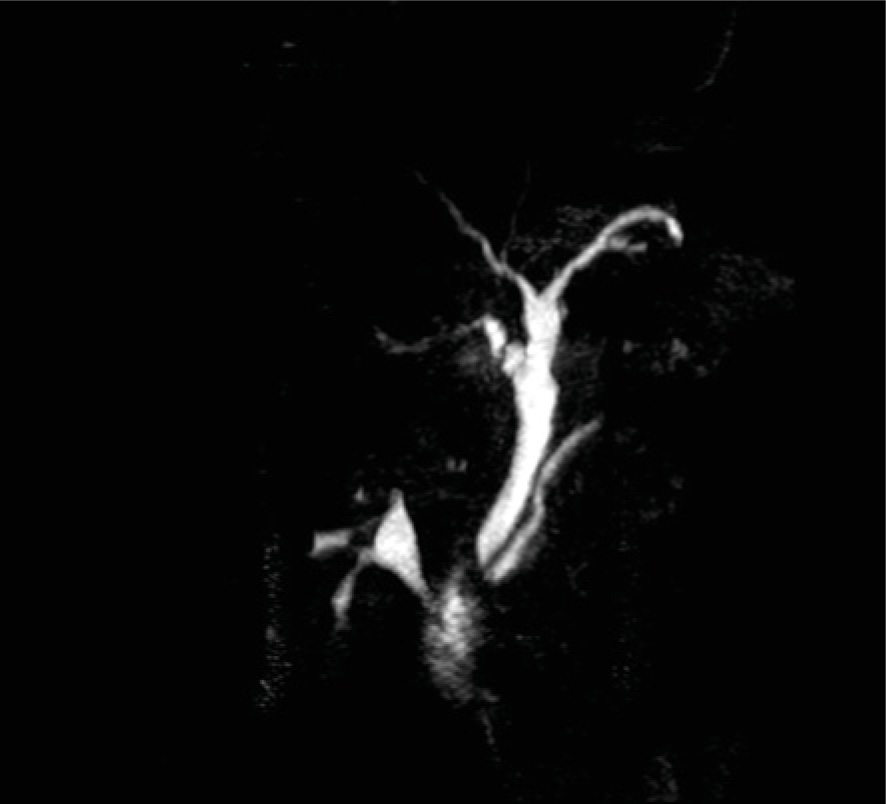
Descending course of pancreatic duct in 60 year of woman who had cholecystectomy. There is a Type 3b variation (the right posterior duct drained into the main hepatic duct) at the level of bifurcation of the biliary ducts and mild forms of renal pelvis dilatation.
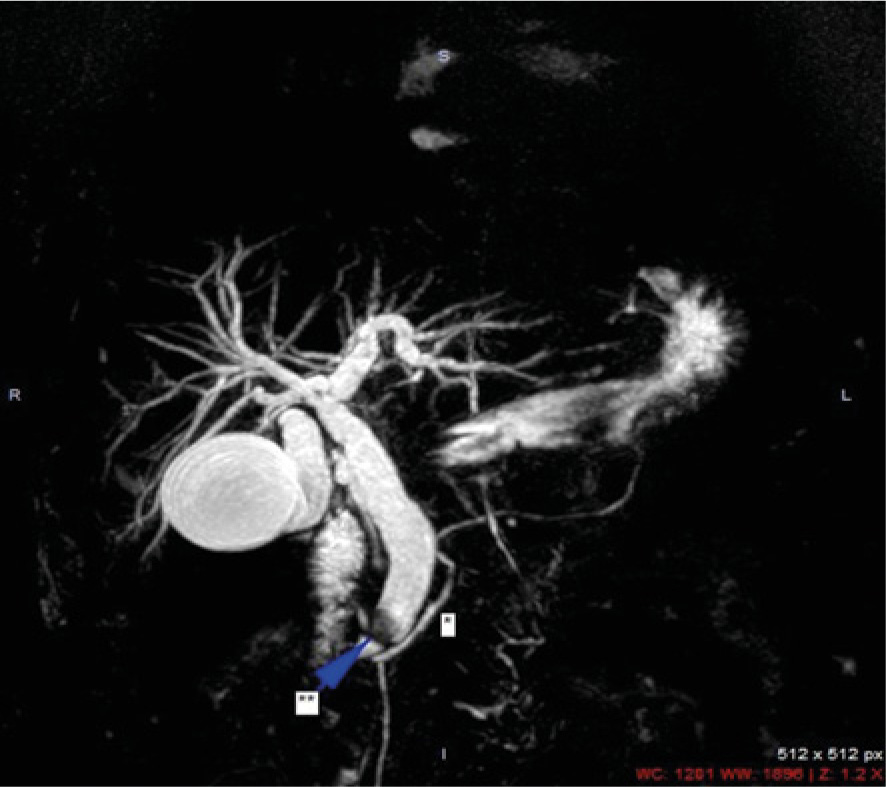
Sigmoid course of pancreatic duct in 49 year-old woman with and trifurcation at the level of bifurcation of the biliary ducts (*): Sigmoid course of the pancreatic duct, (**): choledocholithiasis.
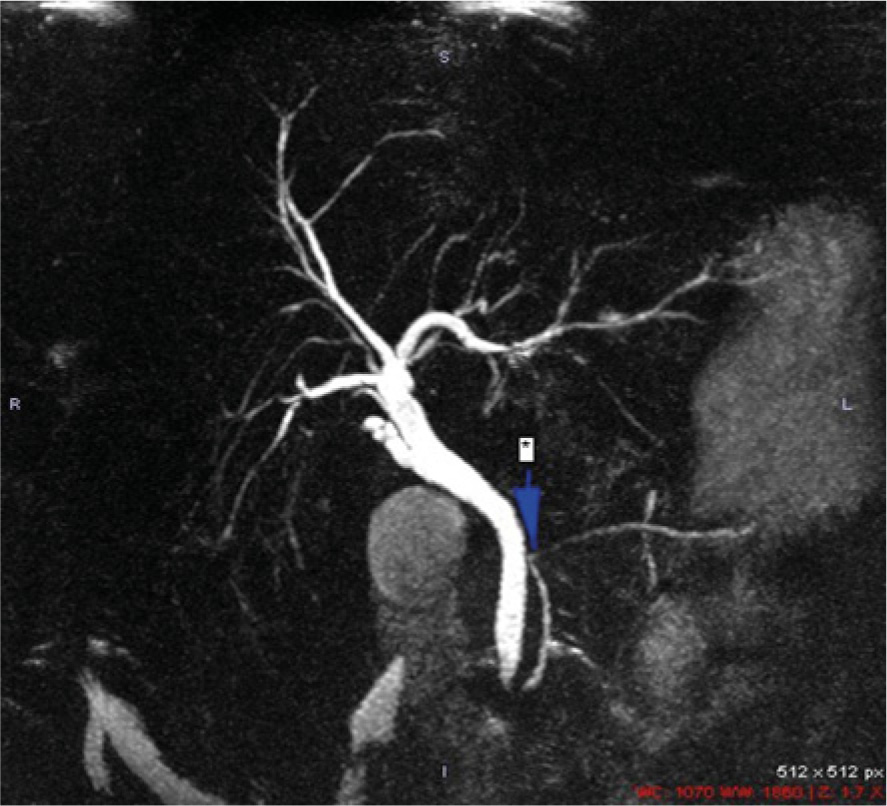
Vertical course (*) of pancreatic duct in 55 year-old woman who had cholecystectomy.
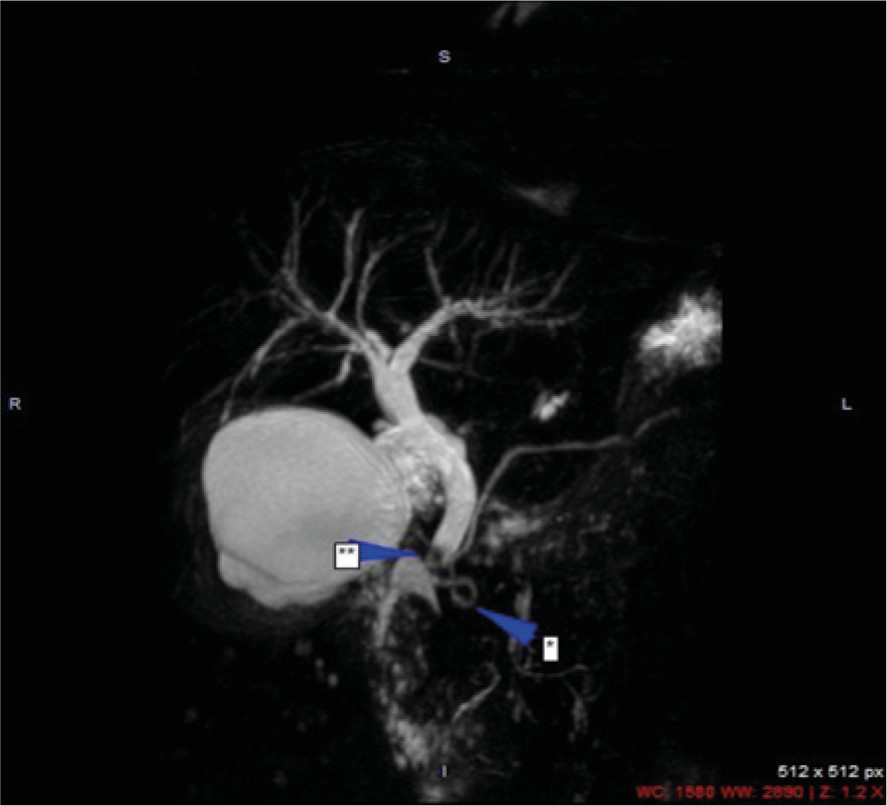
Loop course (*) of pancreatic duct in in 38 year-old woman with choledocholithiasis (**).
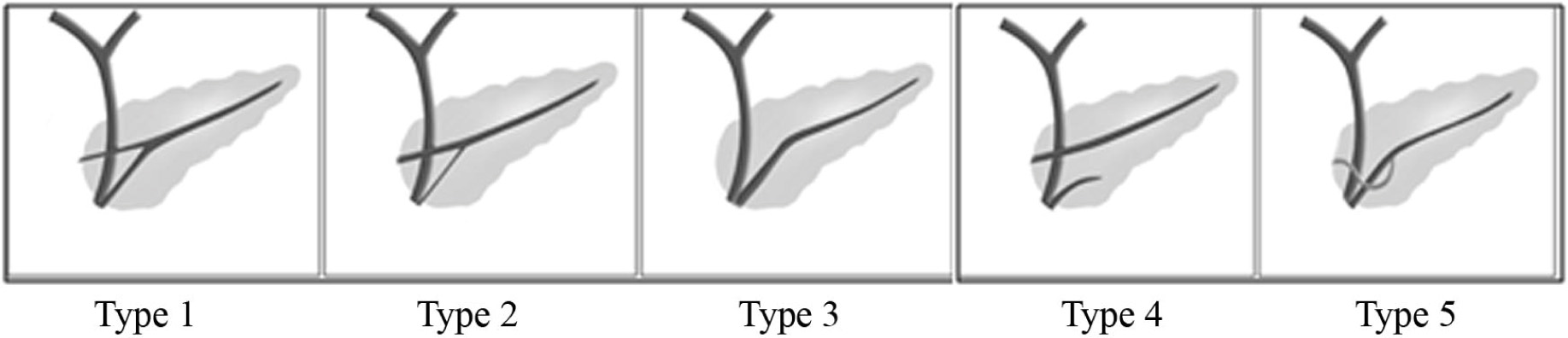
Variations in the configuration of the pancreas duct. Type 1: Bifid configuration with dominant duct of Wirsung, Type 2: Bifid configuration with dominant duct of Santorini without divisum, Type 3: Rudimentary non-draining duct of Santorini, Type 4: Pancreas divisum, Type 5: Ansa pancreatica.
Table 2
THE distribution of the course types of main pancreatic duct
| Number of variations n (%) | Male n (%) | Female n (%) | |
|---|---|---|---|
| Descending type | 724 (62.5) | 321 (65.5) | 403 (60) |
| Sigmoid type | 343 (30) | 134 (27.5) | 199 (30) |
| Vertical type | 68 (5.5) | 17 (5.4) | 51 (7.8) |
| Loop type | 23 (2) | 8 (1.6) | 15 (2.2) |
| Total | 1158 | 490 | 668 |
Table 3
The distribution of ductal configuration types of main pancreatic duct
| Variation in configuration | Number of Variations, n (%) | Male, n (%) | Female, n (%) |
|---|---|---|---|
| Type 1 | 521 (45) | 233 (47.5) | 288 (43.1) |
| Type 2 | 42 (3.6) | 11 (2.3) | 31 (4.6) |
| Type 3 | 528 (45.6) | 220 (44.9) | 308 (46.1) |
| Type 4 | 54 (4.6) | 19 (3.9) | 35 (5.3) |
| Type 5 | 13 (1.2) | 7 (1.4) | 6 (0.9) |
| Total | 1158 | 490 | 668 |
Type 1 = a bifid configuration with a dominant duct of Wirsung; Type 2 = a bifid configuration with dominant duct of Santorini without divisum; Type 3 = Wirsung duct is seen with absent duct of Santorini or rudiment duct of Santorini without communication with Wirsung; Type 4 = pancreas divisum; Type 5 = ‘ansa pancreatica’, where the duct of Santorini forms an inferior loop and connects with a side branch of the duct of Wirsung
Table 4
The distribution of pancreas divisum subtypes.
| Pancreas divisum subtypes | Number of variations | Male, n (%) | Female, n (%) |
|---|---|---|---|
| P. divisum subtype 1 | 24 (44.4) | 8 (40) | 16 (47) |
| P. divisum subtype 2 | 20 (37) | 7 (35) | 13 (38.2) |
| P. divisum subtype 3 | 10 (18.6) | 5 (25) | 5 (14.8) |
| Total | 54 | 20 | 34 |
Pancreas divisum were evaluated as; in subtype 1 or classical divisum, there was total failure of fusion; in subtype 2, there was only dominant dorsal drainage with the absence of the duct of Wirsung; in subtype 3 or incomplete divisum, a small communicating branch was present.
Table 5
The relationship between Cambridge classification and the distribution of the course types, ductal configuration types of main pancreatic duct, pancreas divisum subtypes
| Cambridge 1; n - (%) | Cambridge 2 and 3; n - (%) | Cambridge 4; n - (%) | Cambridge 5; n - (%) | TOTAL n - (%) | |
|---|---|---|---|---|---|
| Descending type | 612 (85) | 82 (11) | 25 (3) | 5 (1) | 724 (62.5) |
| Sigmoid type | 292 (85) | 34 (10) | 13 (4) | 4 (1) | 343 (30) |
| Vertical type | 57 (84) | 7 (10) | 3 (4) | 1 (2) | 68 (5.5) |
| Loop type | 17 (74) | 4 (17) | 2 (9) | 0 (0) | 23 (2) |
| TOTAL | 978 (85) | 127 (11) | 43 (4) | 10 (1) | 1158 (100) |
| Type 1 | 445 (85) | 54(10) | 18 (4) | 4 (1) | 521 (45) |
| Type 2 | 34 (81) | 6 (14) | 2 (5) | 0 (0) | 42 (3.6) |
| Type 3 | 447 (84) | 57 (11) | 19 (4) | 5 (1) | 528 (45.6) |
| Type 4 | 44 (81) | 8 (15) | 2 (4) | 0 (0) | 54 (4.6) |
| Type 5 | 8 (62) | 2 (15) | 2 (15) | 1 (8) | 13 (1.2) |
| TOTAL | 978 (85) | 127 (11) | 43 (4) | 10 (1) | 1158 (100) |
| PD subtype 1 | 19 (79) | 4 (17) | 1 (4) | 0 (0) | 24 (44.4) |
| PD subtype 2 | 16 (80) | 3 (15) | 1 (5) | 0 (0) | 20 (37) |
| PD. subtype 3 | 9 (90) | 1 (10) | 0 (0) | 0 (0) | 10 (18.6) |
| TOTAL FOR PD | 44 (81) | 8 (15) | 2 (4) | 0 (0) | 54 (100) |
PD = pancreas divisum