
Table 1
Distribution of traditional prognostic factors, HER2 status, uPA and PAI-1 in the study group of node-negative breast cancer patients (N = 858)
| Factors | No. of patients | % |
|---|---|---|
| Age | 858 | |
| ≥ 40 years | 821 | 95.7 |
| < 40 years | 37 | 4.3 |
| Pathological tumor size | 846 | |
| < 2 cm | 474 | 56.0 |
| ≥ 2 cm | 372 | 44.0 |
| Pathological tumor type | 858 | |
| Ductal invasive | 720 | 83.9 |
| Other invasive | 138 | 16.1 |
| Histological grade | 799 | |
| G1-2 | 557 | 69.7 |
| G3 | 242 | 30.3 |
| Lymphovascular invasion | 795 | |
| No | 720 | 90.6 |
| Yes | 75 | 9.4 |
| Estrogen receptor status | 854 | |
| Positive | 674 | 78.9 |
| Negative | 180 | 21.1 |
| Progesterone receptor status | 803 | |
| Positive | 466 | 58.0 |
| Negative | 337 | 42.0 |
| HER2 status | 761 | |
| Negative | 610 | 80.2 |
| Positive, without adjuvant trastuzumab | 97 | 12.7 |
| Positive, with adjuvant trastuzumab | 54 | 7.1 |
| uPA and PAI-1 level | 332 | |
| Both low | 159 | 47.9 |
| One or both high | 173 | 52.1 |
Some factors could not be assessed in all tumors.
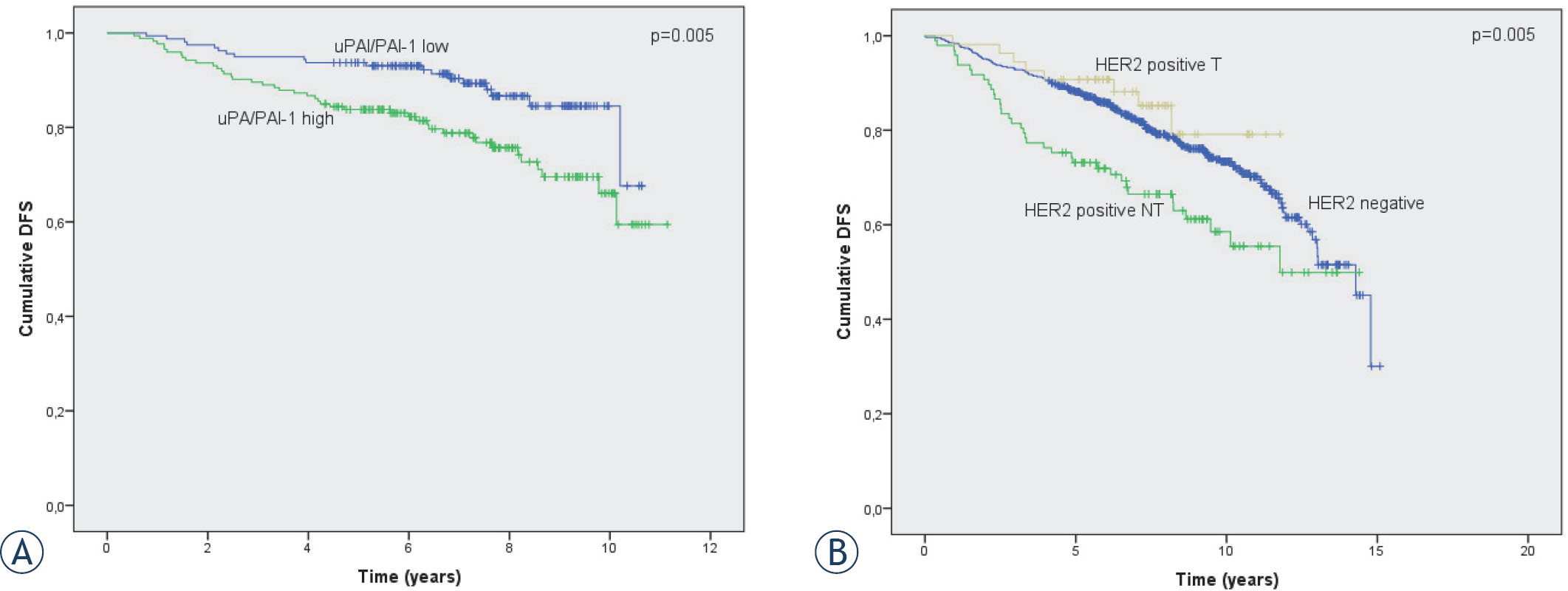
Effect of uPA/PAI-1 level and HER2 status on disease-free survival (DFS) in lymph-node negative breast cancer patients. (A) uPA/PAI-1 low (19 of 159 relapsed or died) versus uPA/PAI-1 high (43 of 173 relapsed or died). (B) HER2 negative (154 of 610 relapsed or died) versus HER2 positive not treated with adjuvant trastuzumab (NT) (37 of 97 relapsed or died) and HER2 positive treated with adjuvant trastuzumab (T) (8 of 54 relapsed or died).
NT = not treated with adjuvant trastuzumab; T = treated with adjuvant trastuzumab
Table 2
Univariate and multivariate analysis of disease–free survival in lymph node–negative breast cancer patients with a median follow–up time of 100 months. Multivariate analysis was performed in the 273 patients for whom complete data were available
| Univariate analysis | Multivariate analysis withall variables | Multivariate analysis –backward LR model | Model if term removed | ||||
|---|---|---|---|---|---|---|---|
| hazard ratio (95 % CI) | p | hazard ratio (95 % CI) | p | hazard ratio (95 % CI) | p | p | |
| Age (continuous, unit = 10 years) | 1.80 (1.60–2.02) | < 0.001 | 1.53 (1.20–1.96) | 0.001 | 1.51 (1.19–1.93) | 0.001 | < 0.001 |
| Tumor size (≥2 vs. <2 cm) | 1.41 (1.08–1.83) | 0.012 | 1.01 (0.56–1.80) | 0.982 | – | – | 0.982 |
| Tumor type (other invasive vs. ductal invasive) | 1.08 (0.76–1.55) | 0.658 | 1.28 (0.51–3.20) | 0.598 | – | – | 0.606 |
| Grade (G3 vs. G1–2) | 1.37 (1.03–1.81) | 0.031 | 1.54 (0.75–3.17) | 0.240 | – | – | 0.240 |
| Lymphovascular invasion (present vs. absent) | 1.54 (1.03–2.29) | 0.035 | 1.43 (0.65–3.15) | 0.377 | – | – | 0.393 |
| Estrogen receptors (negative vs. positive) | 1.19 (0.87–1.61) | 0.271 | 1.81 (0.79–4.16) | 0.165 | 2.25 (1.24–4.09) | 0.008 | 0.158 |
| Progesterone receptors (negative vs. positive) | 1.10 (0.84–1.45) | 0.496 | 1.03 (0.48–2.23) | 0.935 | – | – | 0.935 |
| HER2 status | 0.005 | 0.355 | 0.379 | ||||
| positive NT vs. negative | 1.73 (1.21–2.47) | 0.003 | 1.66 (0.83–3.31) | 0.150 | – | – | |
| positive T vs. negative | 0.70 (0.35–1.43) | 0.332 | 1.16 (0.46–2.91) | 0.758 | – | – | |
| uPA/PAI–1 (one or both high vs. both low) | 2.16 (1.23–3.72) | 0.005 | 1.76 (0.89–3.49) | 0.106 | 1.99 (1.05–3.77) | 0.035 | 0.098 |
NT = not treated with adjuvant trastuzumab; T = treated with adjuvant trastuzumab
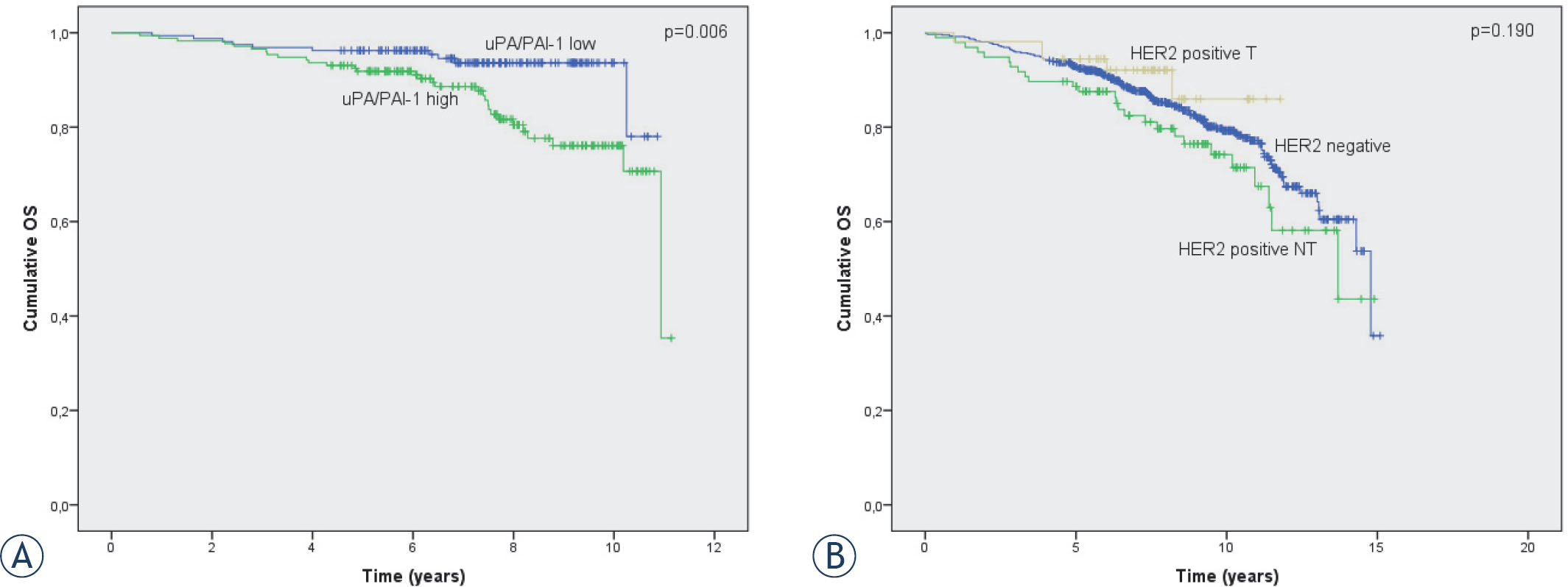
Effect of uPA/PAI-1 level and HER2 status on overall survival (OS) in lymph-node negative breast cancer patients. (A) uPA/PAI-1 low (10 of 159 died) versus uPA/PAI-1 high (31 of 173 died). (B) HER2 negative (118 of 610 died) versus HER2 positive not treated with adjuvant trastuzumab (26 of 97 died) and HER2 positive treated with adjuvant trastuzumab (5 of 54 died).
NT = not treated with adjuvant trastuzumab; T = treated with adjuvant trastuzumab
Table 3
| Univariate analysis | Multivariate analysis withall variables | Multivariate analysis –backward LR model | Model if term removed | ||||
|---|---|---|---|---|---|---|---|
| hazard ratio (95 % CI) | p | hazard ratio (95 % CI) | p | hazard ratio (95 % CI) | p | p | |
| Age (continuous, unit = 10 years) | 2.18 (1.88–2.52) | < 0.001 | 1.61 (1.19–2.17) | 0.002 | 1.68 (1.25–2.27) | 0.001 | 0.001 |
| Tumor size (≥2 vs. <2 cm) | 1.38 (1.02–1.88) | 0.036 | 0.94 (0.47–1.88) | 0.865 | – | – | 0.865 |
| Tumor type (other invasive vs. ductal invasive) | 1.24 (0.83–1.85) | 0.298 | 2.24 (0.76–6.59) | 0.142 | – | – | 0.165 |
| Grade (G3 vs. G1-2) | 1.40 (1.01–1.94) | 0.042 | 2.39 (0.95–6.02) | 0.066 | 2.69 (1.34–5.40) | 0.005 | 0.064 |
| Lymphovascular invasion (present vs. absent) | 1.34 (0.83–2.16) | 0.236 | 1.36 (0.46–4.01) | 0.582 | – | – | 0.594 |
| Estrogen receptors (negative vs. positive) | 1.24 (0.88–1.75) | 0.224 | 1.80 (0.67–4.81) | 0.242 | – | – | 0.233 |
| Progesterone receptors (negative vs. positive) | 1.01 (0.74–1.38) | 0.955 | 0.62 (0.25–1.54) | 0.299 | – | – | 0.279 |
| HER2 status | 0.190 | 0.843 | 0.837 | ||||
| positive NT vs. negative | 1.37 (0.89–2.09) | 0.152 | 0.76 (0.31–1.90) | 0.562 | – | – | |
| positive T vs. negative | 0.63 (0.26–1.55) | 0.318 | 0.90 (0.26–3.18) | 0.871 | – | – | |
| uPA/PAI-1 (one or both high vs. both low) | 2.73 (1.33–5.58) | 0.006 | 1.98 (0.83–4.76) | 0.126 | – | – | 0.114 |
NT = not treated with adjuvant trastuzumab; T = treated with adjuvant trastuzumab
Table 4
Univariate and multivariate analysis of breast cancer specific survival in lymph node-negative breast cancer patients with a median follow-up time of 100 months. Multivariate analysis was performed in the 273 patients for whom complete data were available
| Univariate analysis | Multivariate analysis withall variables | Multivariate analysis –backward LR model | Model if term removed | ||||
|---|---|---|---|---|---|---|---|
| hazard ratio (95 % CI) | p | hazard ratio (95 % CI) | p | hazard ratio (95 % CI) | p | p | |
| Age (continuous, unit = 10 years) | 1.16 (0.95–1.41) | 0.148 | 0.76 (0.51–1.12) | 0.162 | – | – | 0.160 |
| Tumor size (≥2 vs. <2 cm) | 2.44 (1.45–4.13) | 0.001 | 1.72 (0.55–5.38) | 0.350 | – | – | 0.340 |
| Tumor type (other invasive vs. ductal invasive) | 1.20 (0.63–2.29) | 0.587 | 3.33 (0.64–17.23) | 0.152 | – | – | 0.196 |
| Grade (G3 vs. G1-2) | 3.58 (2.12–6.05) | < 0.001 | 7.10 (1.23–40.86) | 0.028 | 10.34 (2.33–45.97) | 0.002 | 0.014 |
| Lymphovascular invasion (present vs. absent) | 1.48 (0.70–3.12) | 0.305 | 1.43 (0.36–5.65) | 0.608 | – | – | 0.618 |
| Estrogen receptors (negative vs. positive) | 2.21 (1.33–3.66) | 0.002 | 1.24 (0.28–5.36) | 0.778 | – | – | 0.776 |
| Progesterone receptors (negative vs. positive) | 1.74 (1.06–2.86) | 0.028 | 0.81 (0.17–3.77) | 0.789 | – | – | 0.788 |
| HER2 status | 0.031 | 0.663 | 0.614 | ||||
| positive NT vs. negative | 2.18 (1.21–3.93) | 0.009 | 1.29 (0.39–4.31) | 0.683 | – | – | |
| positive T vs. negative | 0.96 (0.30–3.10) | 0.944 | 0.46 (0.06–3.68) | 0.460 | – | – | |
| uPA/PAI-1 (one or both high vs. both low) | 6.46 (1.47–28.43) | 0.014 | 2.79 (0.57–13.67) | 0.205 | – | – | 0.166 |
NT = not treated with adjuvant trastuzumab; T = treated with adjuvant trastuzumab