
Introduction
Head and neck squamous cell carcinoma (HNSCC), which arises in the head and neck region that composes pharynx, larynx, nasal cavity, oral cavity, paranasal sinuses and salivary glands, has an estimated 500,000 new cases and becomes the sixth most common cancer in 2010 worldwide.1 As one type of HNSCC, hypopharyngeal squamous cell carcinoma (HSCC) has a poor prognosis, and the overall survival rate for HSCC patients is only 15–45%.2,3 The patients diagnosed with HSCC are often at a late stage and distant metastasis occur after conventional treatments.2 Thus, the poor survival of patients with HSCC may be due to lacking of early detection and highly metastatic behavior.4 Radiotherapy is the principal treatment of loco-regionally advanced squamous-cell carcinoma of the head and neck region (including oral cavity, oropharynx, hypopharynx, and larynx).5,6 Recently, instead of radiotherapy, chemoradiotherapy has become the standard treatment for patients with locally advanced disease.7 Many small molecules have been identified to enhance the radiation response. For example, panitumumab has been discovered to have an enhanced effect on radiation in the preclinical setting of upper aerodigestive tract cancer.8 Moreover, it has been found that the p53-reactivating small-molecule RITA (reactivation of p53 and induction of tumor cell apoptosis), alone or in combination with cisplatin, can induce the reactivation of p53 in many HNSCC cell lines.9,10 However, this effect is not universal. The HNSCC cell line JHU-028 can express wild type (wt) p53, but the cells do not undergo apoptosis in response to RITA treatment.10
Previously, we used RITA combined with X-ray to investigate the effect of RITA on X-ray susceptibility for the treatment of HSCC cell line FaDu (which is HPV-negative cell line) and found that RITA could enhance the radiation response of HSCC (data not shown). In this study, using RNA sequencing data from the HSCC cell line FaDu, we aimed to screen differentially expressed genes (DEGs) between 8 Gy X-ray-treated FaDu cells and 0 Gy X-ray-treated FaDu cells, as well as those between 8 Gy X-ray + RITA treated FaDu cells and 8 Gy X-ray treated FaDu cells. The underlying functions of the DEGs were predicted by Gene Ontology (GO), Kyoto Encyclopedia of Genes and Genomes (KEGG) and BioCarta enrichment analysis. Moreover, the genes related to RITA were further analyzed. Additionally, a protein-protein interaction (PPI) network was constructed to identify key genes involved in enhanced X-ray susceptibility of FaDu cells treated with RITA.
Materials and methods
Cell culture and processing
The HSCC cell line FaDu was purchased from American Type Culture Collection (ATCC, Manassas, VA, USA). The FaDu cells were cultured in media made from Dulbecco modified Eagle medium (DMEM, GIBCO, Gaithersburg, USA), 10% fetal bovine serum (FBS, GIBCO) and 1% mycillin double antibody (GIBCO) at 37°C in a humidified, 5% CO2 incubator (Thermo, Pittsburgh, USA). When the confluency of FaDu cells covered 80%-90% of the petri dish, they were digested with pancreatin (GIBCO), centrifuged, and the supernatant was discarded. Next, the FaDu cells were resuspended in a frozen stock solution composed of 10% dimethyl sulfoxide (DMSO, GIBCO), 40% FBS and 50% DMEM, and preserved in a program frozen box.
After digestion, FaDu cells were centrifuged and counted, and then inoculated in 9 6-well plates (ABI, Foster City, USA) (6×10⁴ cells/well) and cultured overnight. Subsequently, RITA (10 μM) (Selleck, Houston, USA) was added to each well of the experimental group, and DMSO (0.1%) was added to that the wells of the control group. The cells were preprocessed for 24 h at 37°C in a humidified, 5% CO2 incubator. The plates were then sealed by parafilm and placed in a radiometer, and the cells in the experimental group were irradiated with a radiation dose of 8 Gy and a radiation speed of 1 Gy/min. After irradiation, the parafilm was removed and the plates were placed at 37°C in a humidified, 5% CO2 incubator for 48 h.
RNA isolation and sequencing preparation
The total RNA was extracted from the cells using the SV total RNA Isolation System (Invitrogen, Shanghai, CHN) according to the manufacturer’s instructions. The integrity of the total RNA was verified by 2% Agarose Gel Electrophoresis. The purity of RNA was determined by the A260/ A280 ratio as determined by a sp ectrophotometer (Merinton, Beijing, CHN).
Construction of cDNA library
The cDNA libraries were constructed using a NEBNext® UltraTM RNA Library Prep Kit for Illumina®(NEB E7530) (Vazyme, Na njing, CHN), according to the manufacturer's instructions. Through heating, mRNA was broken into short fragments (200 nt). Using these short fragments as templates, random hexamer-primer (Sangon, Shanghai, CHN) was used to synthesize the first-strand of cDNA. Next, the second-strand of cDNA was synthesized. The short fragments were connected to sequencing adapters after poly (A) sequences were added. Afterwards, the UNG enzyme (Prospect B iosystems, Newark, USA) was used to degrade the second-strand cDNA, and the product was purified using a Mi niElute PCR Purification Kit (Qiagen, Dusseldorf, GER) before PCR amplification. Finally, the library could be sequenced using an Illumin a Hiseq 2500 v4 100PE (Illumina, San Diego, USA), and raw reads were generated. Reads with adap tor sequences, with unknown nucleotide content higher than 10% and/or those with low quality bases accounting for higher than 50% of the total nucleotides were filtered out.
Sequence alignment and identification of differentially expressed genes
The high quality reads were mapped to the human genome (version: hg19) using Tophat (version: 2.0.12), and BAM files were obtained.11 The parameters were set to defaults. Cuffdiff in Cufflinks12 was used to identify DEGs. The Benjamini & Hochberg method13 was applied to correct for multiple tests. The adjus ted p -value (that is false discovery rate, FDR) < 0.05 and |log fold change (FC)| ≥ 1 were used as the cut-off criteria.
Functional enrichments
The KEGG pathway database can be used to identify the relationships and interactions between genes in a given system.14 KEGG was used for pathway enrichment analysis, and a p-value < 0.05 was considered a significantly enriched pathway.
The genes related to RITA (RITA genes) screening
To further investigate the effect of RITA on FaDu cells, we identified common DEGs in 0 Gy X-ray treated FaDu cells vs 8 Gy X-ray treated FaDu cells, and 8 Gy X-ray treated FaDu cells vs 8 Gy X-ray + RITA treated FaDu cells (Figure 1). A previous study showed that X-rays could reduce cell viability and that treatment with RITA could enhance the susceptibility of FuDa cells to the deleterious effects of X-rays.10 Therefore, the genes that were consistently up- or down-regulated in 8 Gy X-ray treated FaDu cells vs 0 Gy X-ray treated FaDu cells and 8 Gy X-ray + RITA treated FaDu cells vs 8 Gy X-ray treated FaDu cells were characterized as the RITA genes.
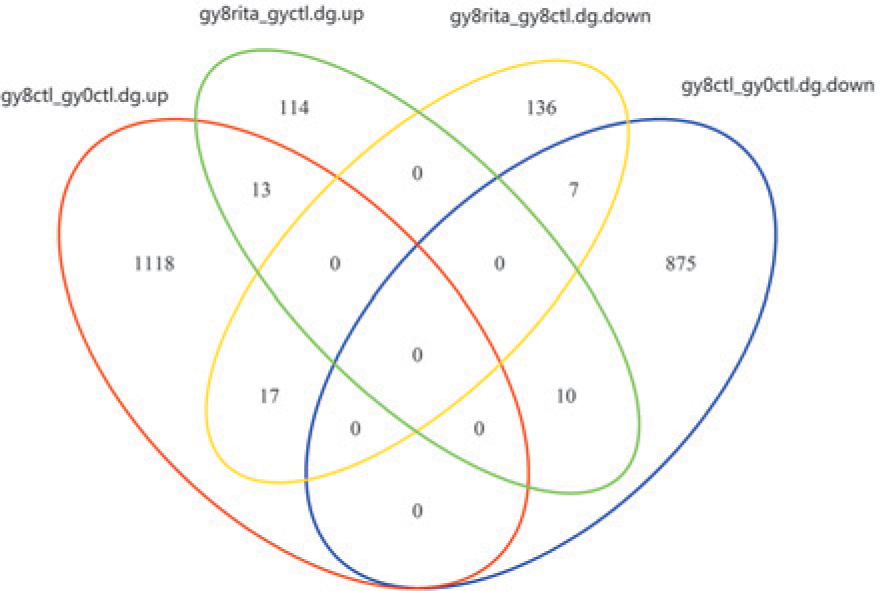
Venn diagram of DEGs between 0 GY X-ray-treated FaDu cells and 8 GY X-ray-treated FaDu cells, as well as the DEGs between 8 GY X-ray-treated FaDu cells and 8 GY X-ray + RITA-treated FaDu cells.
PPI network construction
The online tool STRING15 was utilized to analyze the interactions between the proteins encoded by the common DEGs. A required confidence (combined score) > 0.4 was used as the cut-off criterion. Subsequently, Cytoscape software16 was used to visualize the PPI network.
ClueGO analysis
ClueGO17 in Cytoscape was used to conduct GO, KEGG and BioCarta enrichment analyses. Further, ClueGO divided terms into different functional groups based on the common genes involved in different terms. In our study, ClueGO was used for KEGG pathway enrichment analysis. A p-value < 0.05 was used as the cut-off criterion.
Results
Alignment analysis
The total reads were above 82% and the mapped reads were above 70% in all of the data sets. The detailed sequencing information is shown in Table 1.
DEG analysis
Compared with 0 Gy X-ray-treated FaDu cells, a total of 2,040 DEGs (1,148 up-regulated and 892 down-regulated DEGs) were identified in the 8 Gy X-ray-treated FaDu cells. Moreover, 297 DEGs (137 up-regulated and 160 down-regulated DEGs) were identified in the 8 Gy X-ray + RITA-treated FaDu cells compared with the 8 Gy X-ray-treated FaDu cells.
Table 1
SUMMARY statistics of paired-end (PE) RNA-Seq reads in six cell lines
| Sample | Total PE reads | Total high quality PE reads | Total mapped PE reads | Total uniquely mapped PE reads |
|---|---|---|---|---|
| Sample_L141211001 | 10467886 | 8650424 (82.3%) | 6846290 (79.1%) | 6749179 |
| Sample_L141211002 | 11510210 | 9627883 (83.6%) | 7197526 (74.7%) | 7097908 |
| Sample_L141211003 | 11119410 | 9365349 (84.2%) | 6910499 (73.7%) | 6825529 |
| Sample_L141211004 | 11271934 | 9510517 (84.3%) | 6752339 (70.9%) | 6669811 |
| Sample_L141211005 | 10854414 | 9110446 (83.9%) | 7129465 (78.2%) | 7043831 |
| Sample_L141211006 | 10532245 | 8802840 (83.5%) | 6752224 (76.7%) | 6671073 |
Pathway enrichment analysis
The results of KEGG pathway enrichment for the DEGs are listed in Table 2. Replication factor C subunit 2 (RFC2) was significantly enriched in DNA replication (p = 5.85E-19) and nucleotide excision repair (p = 2.25E-04). Poly (ADP-ribose) polymerase 3 (PARP3) and nei endonuclease VIII-like 1 (NEIL1) were significantly enriched in the pathway of base excision repair (p = 2.00E-08). Moreo ver, cyclin-dependent kinase 1 (CDK1) was significantly enriched in the p53 signaling pathway (p = 1.85E-02).
RITA genes screening
A total of 20 consistently dysregulated genes in the 8 Gy X-ray-treated FaDu cells vs 0 Gy X-ray-treated FaDu cells and in the 8 Gy X-ray + RITA-treated FaDu cells vs 8 Gy X-ray-treated FaDu cells were identified, including 13 consistently up-regulated (B cell lymphomas 6, BCL6; integrin, beta 2-antisense RNA 1, ITGB2-AS1; L1 cell adhesion molecule, L1CAM ; LIM and calponin homology domains 1, LIMCH1; latent transforming growth factor-β binding protein 3, LTBP3; v-MAF avian musculoaponeurotic fibrosarcoma onco-gene family, MAFF ; neutrophil cytosolic factor 2, NCF2; nuclear factor of activated T-cells, cytoplasmic, calcineurin-dependent 1, NFATC1; PARP3; RAB43, member RAS oncogene family, RAB43; regulator of cell cycle, RGCC ; Src homology 2 domain containing F, SHF; and troponin T type 1, TNNT1) and 7 consistently down-regulated DEGs (adenylosuccinate lyase, ADSL ; enhancer of zeste homolog 2, EZH2; nudix-type motif 1, NUDT1; proteasome 26S subunit, non-ATPase 11, PSMD11; RFC2; Treacher Collins-Franceschetti syndrome 1, TCOF1; and X-ray repair cross-complementing group 3, XRCC3) (Figure 1).
Table 2
The top ten up- and down-regulated DEGs between 0 GY X-ray treated FaDu cells and 8 GY X-ray treated FaDu cells, as well as 8 GY X-ray treated FaDu cells and 8 GY X-ray + RITA treated FaDu cells.
| Gene symbols | log2 fold change | P-value | Gene symbols | log2 fold change | P-value | |
|---|---|---|---|---|---|---|
| BMF | −1.79769e+308 | 1.23E-11 | BMF | −1.79769e+308 | 1.23E-11 | |
| SDCBP | −1.79769e+308 | 0.00097112 | SDCBP | −1.79769e+308 | 0.00097112 | |
| IL32 | −1.79769e+308 | 0.0110064 | IL32 | −1.79769e+308 | 0.0110064 | |
| MAD1L1 | −1.79769e+308 | 9.77E-05 | MAD1L1 | −1.79769e+308 | 9.77E-05 | |
| SIRT3 | −1.79769e+308 | 0.00289562 | SIRT3 | −1.79769e+308 | 0.00289562 | |
| Up-regulated | KAZN | −1.79769e+308 | 7.93E-10 | KAZN | −1.79769e+308 | 7.93E-10 |
| TSPAN4 | −1.79769e+308 | 0.0136997 | TSPAN4 | −1.79769e+308 | 0.0136997 | |
| PPAN-P2RY11 | −1.79769e+308 | 4.71E-08 | PPAN-P2RY11 | −1.79769e+308 | 4.71E-08 | |
| CDC14B | −1.79769e+308 | 1.49E-06 | CDC14B | −1.79769e+308 | 1.49E-06 | |
| CXCL16 | −1.79769e+308 | 0.000434357 | CXCL16 | −1.79769e+308 | 0.000434357 | |
| C3orf14 | −5.88442 | 0.006353 | KCTD2 | −3.8901 | 1.23E-06 | |
| TTC28-AS1 | −3.10554 | 1.30E-09 | TSPAN4 | −3.68234 | 0.0124825 | |
| KRT4 | −2.86398 | 0 | FGFR3 | −3.47603 | 0.0322468 | |
| ALPP | −2.68741 | 1.30E-13 | PLEKHM1.1 | −3.41618 | 0.0191408 | |
| MND1 | −2.64752 | 0.022297 | CHFR | −3.39824 | 0.0369514 | |
| Down-regulated | DHRS2 | −2.38983 | 4.17E-11 | KREMEN2 | −3.32824 | 0.033903 |
| FGF3 | −2.33156 | 2.25E-12 | SMAP2 | −3.3199 | 0.0215792 | |
| TERC | −2.268 | 0.027132 | EPS15L1 | −3.30518 | 0.00562372 | |
| UTP20 | −2.23728 | 0 | MORF4L2 | −3.0731 | 0.0300806 | |
| GAL | −2.22661 | 0 | PIGQ | −2.94079 | 0.0327601 |
PPI network and module analysis
The PPI network for RITA genes and the DEGs related to RITA had 448 interactions (Figure 2). In the PPI network, the RITA genes of RFC2 (degree = 126) and EZH2 (degree = 115) had relatively higher degrees. Additionally, RFC2 and EZH2 could interact with CDK1. The results of the pathway enrichment analysis for RFC2, EZH2 and their interaction genes are shown in Figure 3. RFC2 and EZH2 were enriched in the cell cycle pathways, oocyte meiosis, and DNA replication.
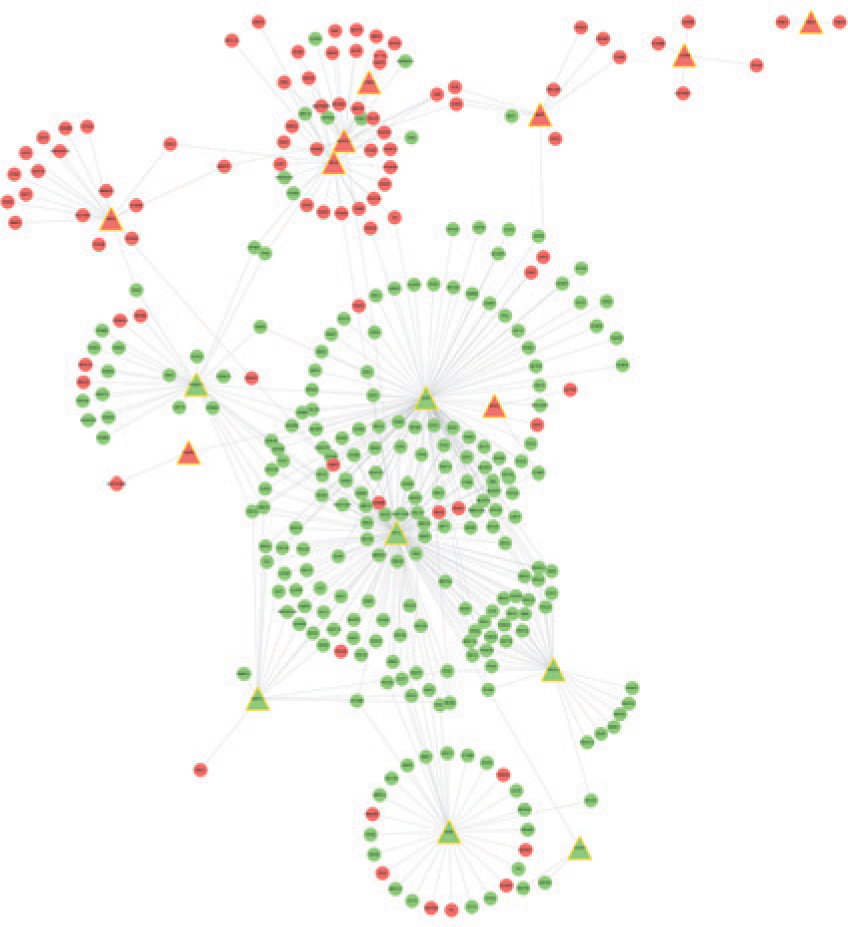
The PPI network for the RITA genes and their related DEGs. The red hubs represent the up-regulated DEGs; the green hubs represent the down-regulated DEGs; the triangle hubs represent the RITA genes; the lines represent the interactions between the genes.
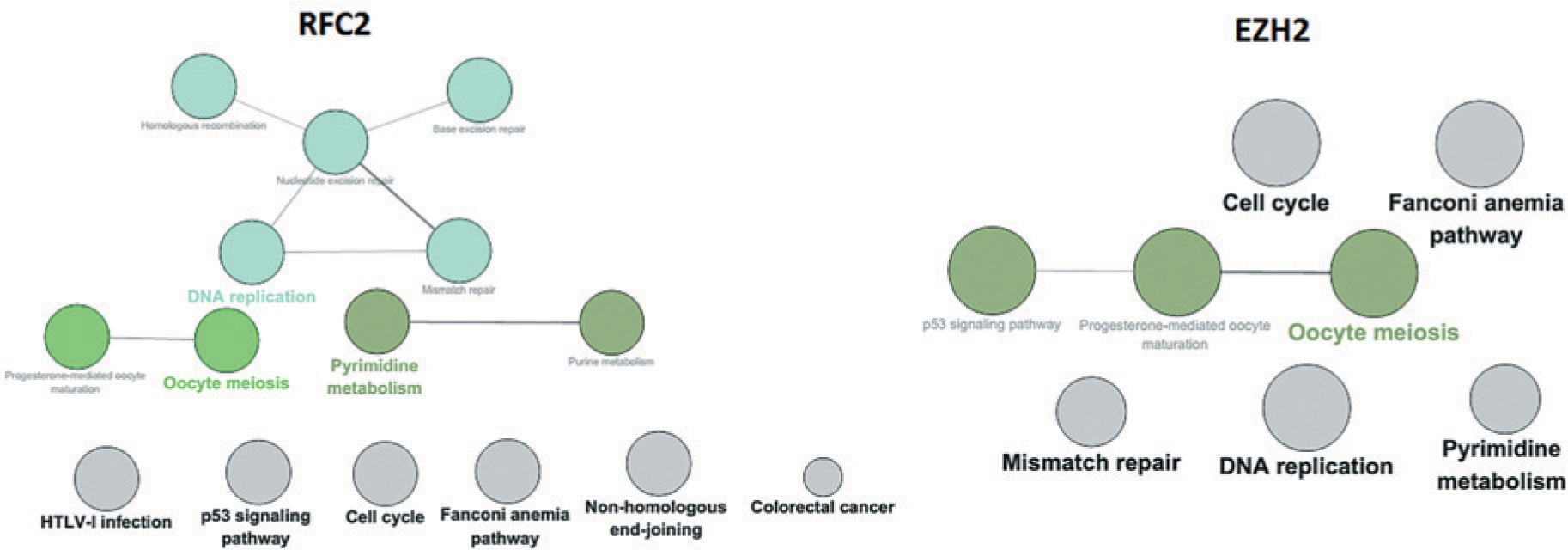
Functional annotation for RFC2 and EZH2 clusters. Node color represents the functional groups; node size reflects the p-value, with the smaller the node size indicating larger p-values, while the larger node size represents smaller p-values.
Discussion
In the present study, a total of 2,040 DEGs, including 1,148 up-regulated and 892 down-regulated DEGs, were identified in 8 Gy X-ray-treated FaDu cells, compared with 0 Gy X-ray-treated FaDu cells. Moreover, 297 DEGs, including 137 up-regulated and 160 down-regulated DEGs, were identified in 8 Gy X-ray + RITA-treated FaDu cells, compared with 8 Gy X-ray-treated FaDu cells. Among these DEGs, EZH2 and RFC2, which we re consistently down-regulated in 8 Gy X-ray-treated FaDu cells vs 0 Gy X-ray-treated FaDu cells and 8 Gy X-ray + RITA-treated FaDu cells vs 8 Gy X-ray-treated FaDu cells, were characterized as the RITA genes. A previous study has reported that enhancers of EZH2, which is the enzymatic component of the polycomb repressive complex 2, can regulate cell proliferation and differentiation during embryonic development.18 Moreover, it has also been demonstrated that targeting EZH2 can suppress cancer progression and recurrence by reversing oncogenic properties and stemness of tumor cells.19RFC2, belonging to the replication factor C family, has been implicated in nasopharyngeal carcinoma.20
In our study, ClueGO analysis showed that RFC2 and EZH2were related to the cell cycle. Cell cycle regulation by p53 is widely accepted as the major mechanism for tumor formation.21 Therefore, we speculated that RFC2 and EZH2 may regulate the cancer cell proliferation of HSCC cells through the cell cycle pathway. According to the PPI network, both RFC2 and EZH2 could int eract with CDK1, and the KEGG pathway enrichments showed that CDK1 was signi ficantly enriched in the p53 signaling pathway.p53 can negatively regulate the transcription of a large number of genes (including BCL-2 and MCL1) that suppress apoptosis.22 Additionally, a former study has also demonstrated that the reactivation of p53 can induce apoptosis in HNSCC, which includes HSCC.23 Consequently, we proposed that CDK1 could be correlated with HSCC by regulation of apoptosis of the cancer cells through the p53 signaling pathway. In addition, CDK1 might also function in HSCC through interacting with RFC2 and EZH2.
Table 3
The KEGG pathway enrichment for the DEGs between 0 GY X-ray treated FaDu cells and 8 GY X-ray treated FaDu cells, as well as 8 GY X-ray treated FaDu cells and 8 GY X-ray + RITA treated FaDu cells.
| Term | Count | P value | Gene symbols |
|---|---|---|---|
| gy8ctl vs. gy0ctl | |||
| hsa03030: DNA replication | 28 | 5.85E-19 | POLA1, POLA2, RPA3, RPA1, PRIM1, RPA2, POLE4, MCM7, POLE3, FEN1 |
| hsa04110: Cell cycle | 43 | 1.91E-11 | E2F1, E2F2, DBF4, PRKDC, PKMYT1, CHEK1, CDC45, MCM7, CDKN2B, CDKN2C … |
| hsa03430: Mismatch repair | 16 | 1.15E-09 | EXO1, SSBP1, MSH2, LIG1, MLH1, RPA3, RFC5, POLD3, RPA1, RPA2 … |
| hsa00240: Pyrimidine metabolism | 32 | 2.00E-08 | POLR2G, DTYMK, POLA1, CAD, POLA2, CMPK2, TK1, PRIM1, TYMS, POLE4 … |
| hsa03410: Base excision repair | 16 | 2.06E-06 | HMGB1, UNG, NEIL3, LIG1, POLE, NEIL1, POLD3, POLD4, POLE4, POLE3 … |
| hsa03440: Homologous recombination | 14 | 3.36E-06 | RAD51C, XRCC3, NBN, BLM, SSBP1, MRE11A, EME1, RPA3, RAD51, POLD3 … |
| hsa03420: Nucleotide excision repair | 15 | 2.25E-04 | LIG1, POLE, RPA3, RFC5, POLD3, RPA1, RPA2, POLD4, RFC3, POLE4 … |
| hsa00230: Purine metabolism | 33 | 3.73E-04 | XDH, POLR2G, POLA1, POLA2, PFAS, PRIM1, POLE4, POLE3, PDE4A, ENTPD8 … |
| hsa05200: Pathways in cancer | 52 | 0.010417112 | FGF19, E2F1, HSP90AB1, E2F2, PTGS2, PDGFB, PGF, STAT5A, ARNT2, FGF11 … |
| hsa05219: Bladder cancer | 11 | 0.016627297 | E2F1, E2F2, TYMP, CDKN1A, PGF, VEGFA, RB1, DAPK2, CDK4, MMP2, DAPK1 |
| hsa04115: p53 signaling pathway | 15 | 0.018499656 | CDK1, CYCS, CHEK1, ATR, CDK4, CCNG2, GTSE1, CCNB1, CDKN1A, CCNB2 … |
| hsa04512: ECM-receptor interaction | 17 | 0.024887625 | HSPG2, SDC4, COL5A1, CHAD, HMMR, VWF, LAMB3, LAMB2, ITGB8, ITGA5 … |
| hsa03020: RNA polymerase | 8 | 0.03298698 | POLR3G, POLR2G, POLR3K, POLR1E, POLR1A, POLR1C, POLR1B, POLR3B |
| hsa00970: Aminoacyl-tRNA biosynthesis | 10 | 0.036943456 | IARS, NARS2, LARS, FARSB, EPRS, WARS2, DARS2, AARS2, KARS, EARS2 |
| hsa03040: Spliceosome | 22 | 0.044130211 | NCBP1, MAGOH, TRA2B, LSM6, TRA2A, SNRPD1, HSPA1A, PRPF4, RBMX, HNRNPA1 … |
| hsa05222: Small cell lung cancer | 16 | 0.048720159 | E2F1, TRAF1, E2F2, CKS1B, PTGS2, PIK3CD, CYCS, SKP2, RB1, BIRC3 … |
| gy8rita vs. gy8ctl | |||
| hsa03410: Base excision repair | 4 | 0.014381142 | NEIL1, LIG3, PARP3, SMUG1 |
| hsa05212: Pancreatic cancer | 5 | 0.021107952 | AKT1, PGF, PIK3CB, ERBB2, RALGDS |
| hsa05213: Endometrial cancer | 4 | 0.040674333 | AKT1, PIK3CB, ERBB2, CTNNA1 |
| hsa04150: mTOR signaling pathway | 4 | 0.040674333 | AKT1, PGF, PIK3CB, EIF4E2 |
DEGs = differentially expressed genes
Additionally, the RITA gene PARP3 was sig n ificantly enriched in base excision repair. Base excision repair is a cellular mechanism that repairs damaged DNA throughout the cell cycle. It has been reported that the DNA repair capacity is crucial for preventing genomic instability and, in turn, may be associated with heightened risk of cancer.24 Furthermore, reduced expression of nucleotide excision repair core genes such as Cockayne's syndrome complementary group B/excision repair cross-complementing 6 (CSB/ERCC6), excision repair cross-complementing 1 (ERCC1), Xeroderma pigmentosum group G/excision repair cross-complementing 5 (XPG/ERCC5) and Xeroderma pigmentosum group B/excision repair cross-complementing 3 (XPB/ERCC3) can increase the risk for development of HNSCC for more than two-fold.25
The ADP ribosyl trans ferase PARP3 gene has been identified as a vital player in the stabilization of mitotic spindles and in telomere integrity. Notably, PARP3 associates and regulates the mitotic components NuMA and tankyrase 1; therefore, PARP3 can be a potential biomarker in cancer therapy.26 In the PPI network, PARP3 is capable of interacting with EZH2. Accordingly, it came to the speculation that PARP3, as well as its interaction with EZH2, could play a role in HSCC by regulating DNA damage through the base excision repair pathway. Moreover, NEIL1 was also enriched in base excision repair. A former study showed that the functional variants of the NEIL1 protein can lead to risk and progression of squamous cell carcinomas of the oral cavity and oropharynx.27 Therefore, PARP3 and NEIL1 could be involved in development of HSCC through the base excision repair pathway.
RFC2, EZH2, CDK1, PARP3 and NEIL1 may be related to an enhancement of the susceptibility of FaDu cells to X-rays with co-treatment of RITA. However, further research is needed to illustrate their mechanisms.