
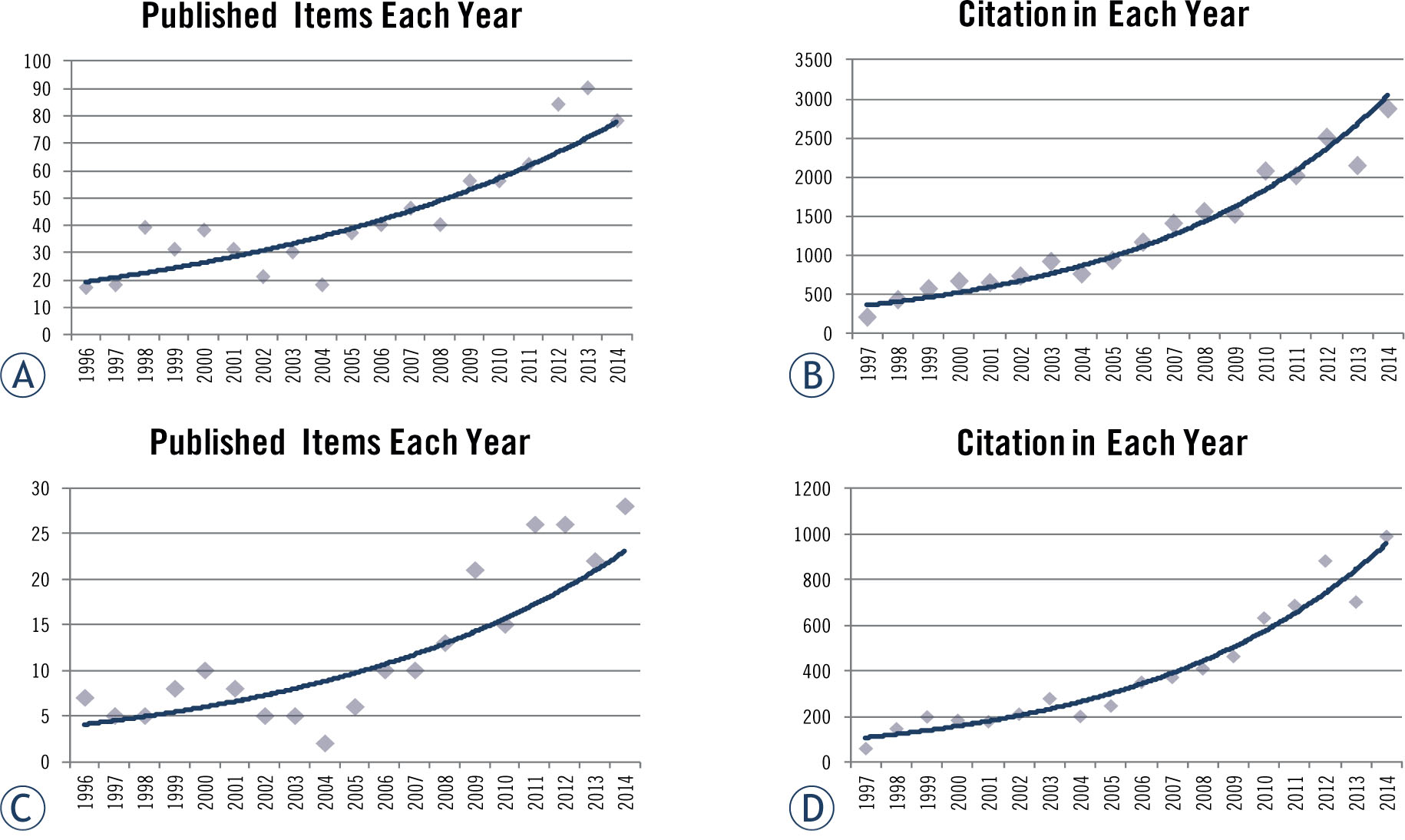
Figure 1.
Search in Web of Science demonstrates a steady increase in number of publications under the key word “electrochemotherapy” (A,B) as well under the “electrochemotherapy, clinical” (C,D). The Meta data indicate the expanding field.
Table 1.
Manuscript quality criteria
| Manuscript quality criteria | |||
|---|---|---|---|
| Trial design | Description of Patient population | Treatment delivery and outcome assessment | Analysis of results and interpretation |
| 1. Prospective trial | 1. Setting (curative / palliative) | 1. Type of anaesthesia | 1. Summary of trial endpoints |
| 2. Trial registration | 2. Drug route and dosages | ||
| 3. Comparative trial | 2. Demographic data (in tabular form) | 3. Pulse generator | 2. Predictive factors |
| 4. Mention of trial design | 4. EP parameters | ||
| 5. Multicenter study | 3. No of tumors | 5. Electrode description | 3. Other patient outcome parameters |
| 6. Mention of sponsor | 6. Tumor safety margins indicated | ||
| 7. Trail hypothesis and sample size | 4. Tumor location | 7. Deviation from SOPs | 4. Results interpretation |
| 8. Informed consent | 5. Tumor histotype | 9. Criteria for retreatment | 5. Comparison to historical controls |
| 9. EC approval | 8. Tumor coverage with EP | ||
| 10. Structured abstract | 10. Total No of ECT sessions | ||
| 11. Rationale of the trial | 6. Tumor size | 11. ECT sessions requiredaa | 6. Future directions |
| 12. A priori inclusion criteria | 12. Toxicity criteria | ||
| 13. Follow-up dates | 7. Visceral mts indicated | 13. Response criteria | 7. COI statement |
| 14. Statistical methods | 14. Evaluation of tumor control | ||
| 15. Software used | 8. Concomitant treatments | 15. ECT successbb | |
| 16. C.I., p-values | 16. Keep track of patients lost to follow-up | ||
C.I. = confidence intervals; COI = conflict of interest statement; EC = Ethic Committee; EP = electric pulses (including number, duration and amplitude); mts = metastases; SOPs = Standard Operating Procedures.
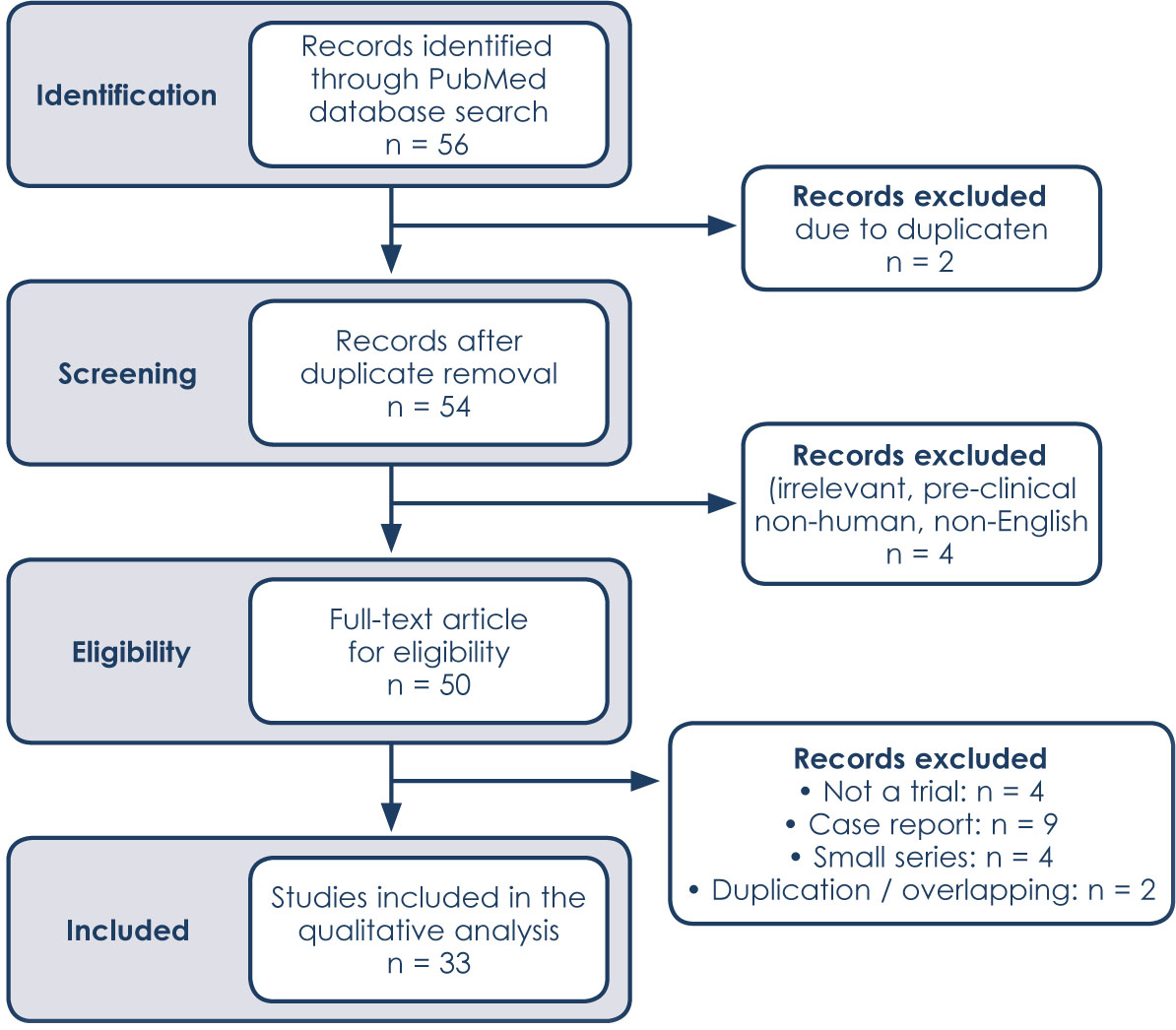
Figure 2.
PRISMA flow diagram of identification, screening, eligibility and inclusion of studies.
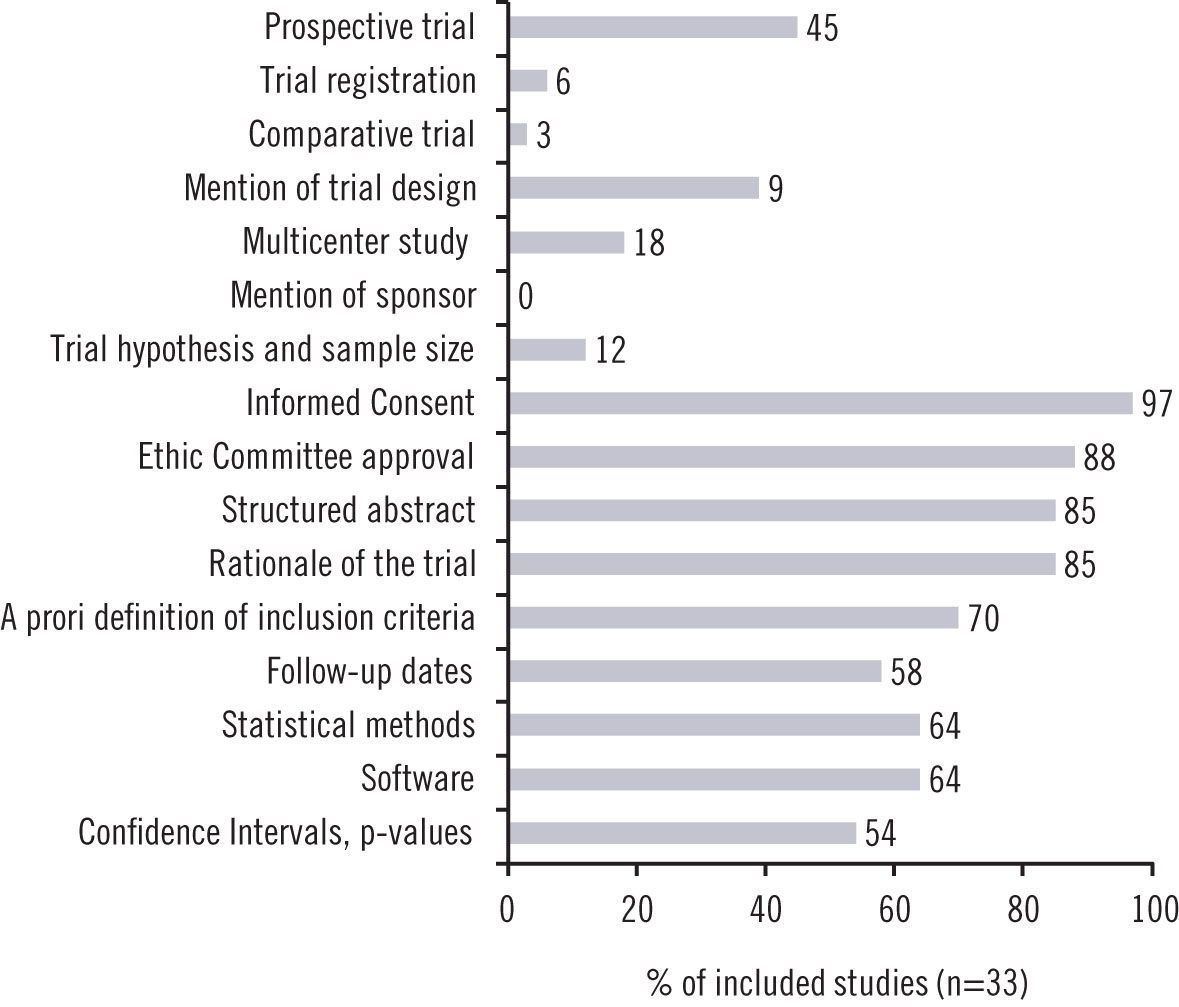
Figure 3.
Assessment of published studies according to quality criteria concerning trial design.
Table 2.
Trials identified included in the qualitative analysis
| Study, year | Setting | No of pts | Tumor histotype | ECT protocol |
|---|---|---|---|---|
| Rotunno, 201537 | Two-center, Italy | 55 | non-melanoma SC | ESOPE |
| Cabula, 201538 | Multi-center, Italy | 125 | BC | ESOPE |
| Mozzillo, 201539 | Single-center, Italy | 15 | melanoma | ESOPE |
| Landstrom, 201540 | Single-center, Sweden | 19 | HNSCC | Othera |
| Granata, 201541 | Single-center, Italy | 13 | pancreatic cancer | ESOPE |
| Kreuter, 201542 | Multi-center, Germany | 56 | various | ESOPE |
| Quaglino, 201543 | Multi-center, Europe | 121 | various | ESOPE |
| Mir-Bonafé, 201544 | Single-center, Spain | 31 | melanoma | ESOPE |
| Campana, 201445 | Single-center, Italy | 39 | HNSCC | ESOPE |
| Ricotti, 201446 | Single-center, Italy | 30 | melanoma | ESOPE |
| Campana, 201447 | Single-center, Italy | 55 | BC | ESOPE |
| Edhemovic, 201429 | Single-center, Slovenia | 16 | CRC-liver mts | ESOPEb |
| Seccia, 201448 | Single-center, Italy | 9 | HNSCC | ESOPE |
| Campana, 201450 | Two-center, Italy | 34 | STS | ESOPE |
| Solari, 201451 | Single-center, Italy | 39 | various | ESOPE |
| Di Monta, 201452 | Single-center, Italy | 19 | KS | ESOPE |
| Caracò, 201349 | Single-center, Italy | 60 | melanoma | ESOPE |
| Perrone, 201353 | Single-center, Italy | 9 | V-SCC | ESOPE |
| Benevento, 201254 | Single-center, Italy | 12 | BC | ESOPE |
| Mevio, 201255 | Single-center, Italy | 15 | HNSCC | ESOPE |
| Campana, 201220 | Single-center, Italy | 35 | BC | ESOPE |
| Latini, 201256 | Single-center, Italy | 18 | KS | ESOPE |
| Matthiessen, 201257 | Single-center, Denmark | 12 | BC | ESOPE |
| Gargiulo, 201258 | Single-center, Italy | 52 | non-melanoma SC | ESOPE |
| Campana, 201221 | Single-center, Italy | 85 | melanoma | ESOPE |
| Curatolo, 201259 | Two-center, Italy | 23 | KS | ESOPE |
| Kis, 201160 | Single-center, Hungary | 9 | melanoma | ESOPE |
| Matthiessen, 201122 | Two-center, Denmark-UK | 52 | various | ESOPE |
| Skarlatos I, 201161 | Multi-center, Greece | 52 | various | ESOPE |
| Campana, 200962 | Single-center, Italy | 52 | various | ESOPE |
| Quaglino, 200863 | Single-center, Italy | 14 | melanoma | ESOPE |
| Larkin, 200764 | Single-center, Ireland | 30 | various | ESOPE |
| Gaudy, 200665 | Single-center, France | 12 | melanoma | Otherc |
BC = breast cancer; ECT = electrochemotherapy; CRC-liver mts = colorectal cancer liver metastases; HNSCC = head and neck squamous cell cancer; KS = Kaposi’s sarcoma; SC = skin cancer; STS = soft tissue sarcomas; V-SCC = vaginal squamous cell cancer
a Intratumoral BLM injection (1000 IU/cm3 and tumor electroporation by means of six 1100 V/cm square wave pulses with 0.1 ms duration
b In this trial, the ESOPE protocol was integrated by the application of variable geometry electrodes for the treatment of deep visceral metastases.
c Intratumoral BLM injection (concentration, 4 mg/mL; dose, 1 mg/cm3 of tumor volume was followed, after 10 minutes, by the application of electric pulses (six 100 μsec-long pulses, 4 pulses/sec, electric field >600V/cm
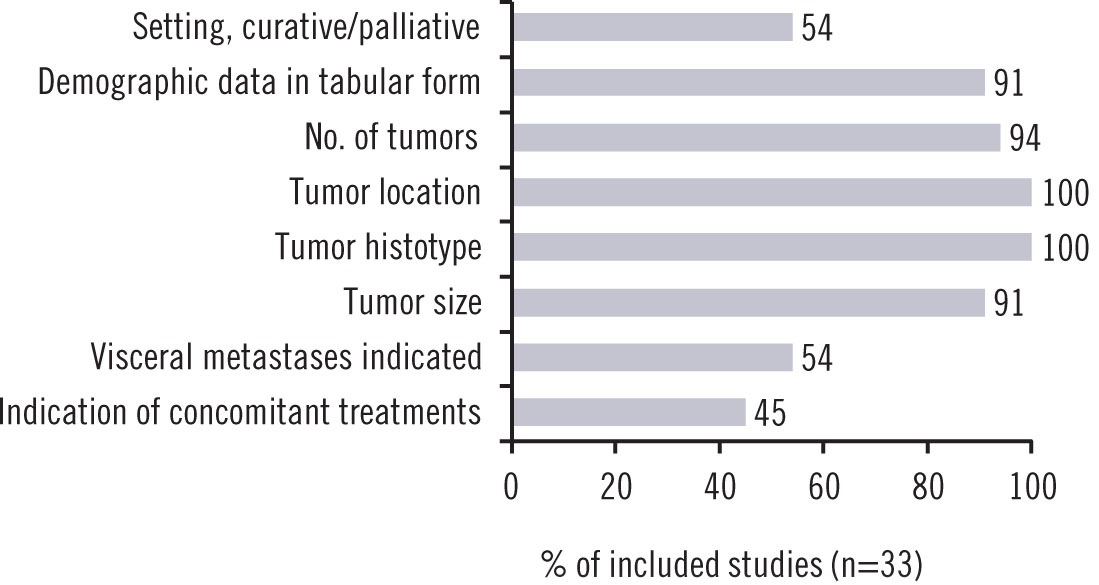
Figure 4.
Assessment of published studies according to quality criteria conceming description of patient population.
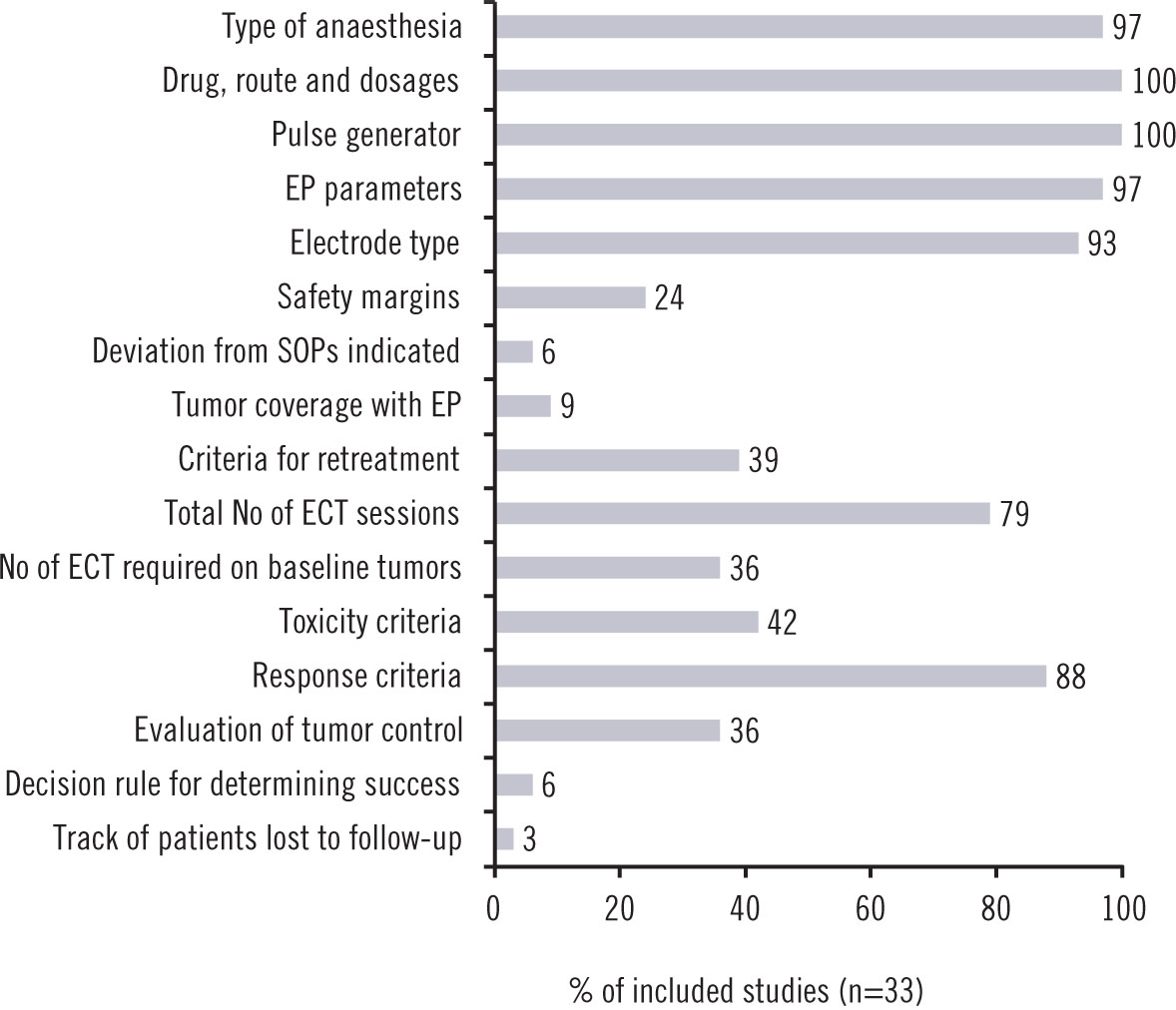
Figure 5.
Assessment of published studies according to quality criteria conceming treatment delivery and outcome assessment.
ECT = electrochemotherapy; EP = electric pulses.
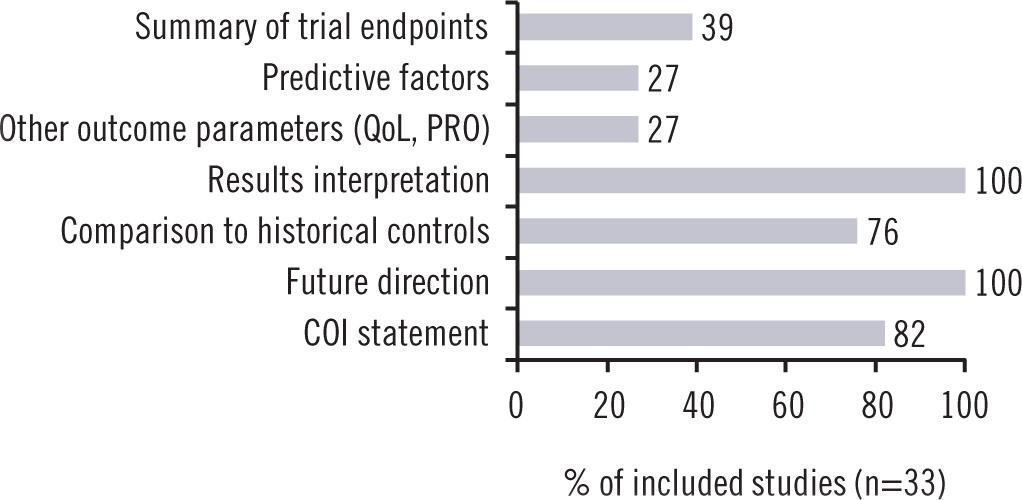
Figure 6.
Assessment of published studies according to quality criteria conceming analysis of results and interpretation.
COI = conflict of interest statement; PRO = patient reported outcomes; QoL = quality of life.
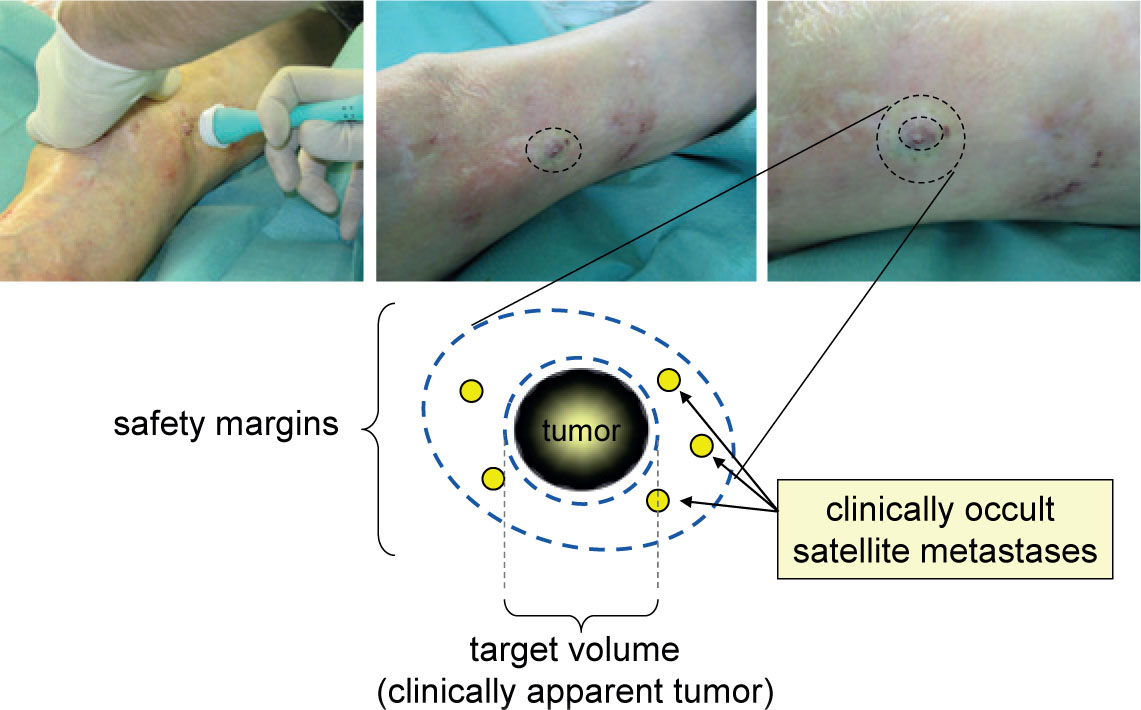
Figure 7.
Importance of covering whole tumor area along with safety margins. Reporting of the type of electrode applied is essential.