
Table 1
Inherited mutation present in patients with malignant gliomas
| Syndrome | Gene name | Chromosomal location |
|---|---|---|
| Neurofibromatosis 1 | Neurofibromin 1 (NF1) | 17q11 |
| Neurofibromatosis 2 | Neurofibromin 2 (NF2) | 22q12 |
| Tuberous sclerosis | Tuberous sclerosis 1 (TSC1) Tuberous sclerosis 2 (TSC2) | 9q34 16p13 |
| Retinoblastoma | Retinoblastoma 1 (RB1) | 13q14 |
| Li-Fraumeni syndrome | Tumor suppressor p53 (TP53) | 17p13 |
| Turcot's syndrome and multiple hamartoma | Adenomatous polyposis coli (APC) DNA mismatch repair genes: Recombinant human MutL homolog-1 (hMLH2) MutS homolog 2 (hMSH2) Mismatch repair endonuclease (PMS2) Phosphatase and tensin homolog (PTEN) | 5q21 3p21.3 2p22-21 7p22 10q23.3 |
Table 2
The chromosomal alterations, mostly observed in gliomas
| Chromosomal region | Type of alteration | Candidate gliomas genes |
|---|---|---|
| 1p36.31-pter | Gains and deletions | Not known |
| 1p36.22-p36.31 | Gains and deletions | Not known |
| 1p34.2-p36.1 | Gains and deletions | Not known |
| 1q32 | Gains | Receptor interacting protein kinase 5 (RIPK5), mouse double minute 4 (MDM4), phosphatidylinositol-4-phosphate 3-kinase, catalytic subunit type 2 beta (PIK3C2B) and others |
| 4q | Deletions | NIMA-related kinase 1 (NEK1), NIMA |
| 7p11.2-p12 | Amplifications or gains | Epidermal growth factor receptor (EGFR) |
| 9p21-p24 | Deletions | Cyclin-dependent kinase inhibitor 2A (CDKN2) |
| 10q23 | Deletions | Phosphatase and tensin homolog (PTEN) |
| 10q25-q26 | Deletions | O-6-methylguanine-DNA methyltransferase (MGMT) |
| 11p | Deletions | Between cyclin-dependent kinase inhibitor 1C (CDKN1C) and related RAS viral (r-ras) oncogene homolog 2 (RRAS2) |
| 12q13.3-q15 | Amplifications | Mouse double minute 2 homolog (MDM2), cyclin-dependent kinase 4 (CDK4) and others |
| 13p11-p13 and 13q14-q34 | Loss | Retinoblastoma 1 (RB1) |
| 19q13 | Loss | Glioma tumor suppressor candidate region gene 1 (GLTSCR1), GLTSCR2, ligase I, DNA, ATP-dependent (LIG1), cytohesin 2 (CYTH2) and many others |
| 22q11.21-q12.2 | Loss | 28 genes, including integrase interactor 1 (INI1) |
| 22q13.1-q13.3 | Loss | Not known |
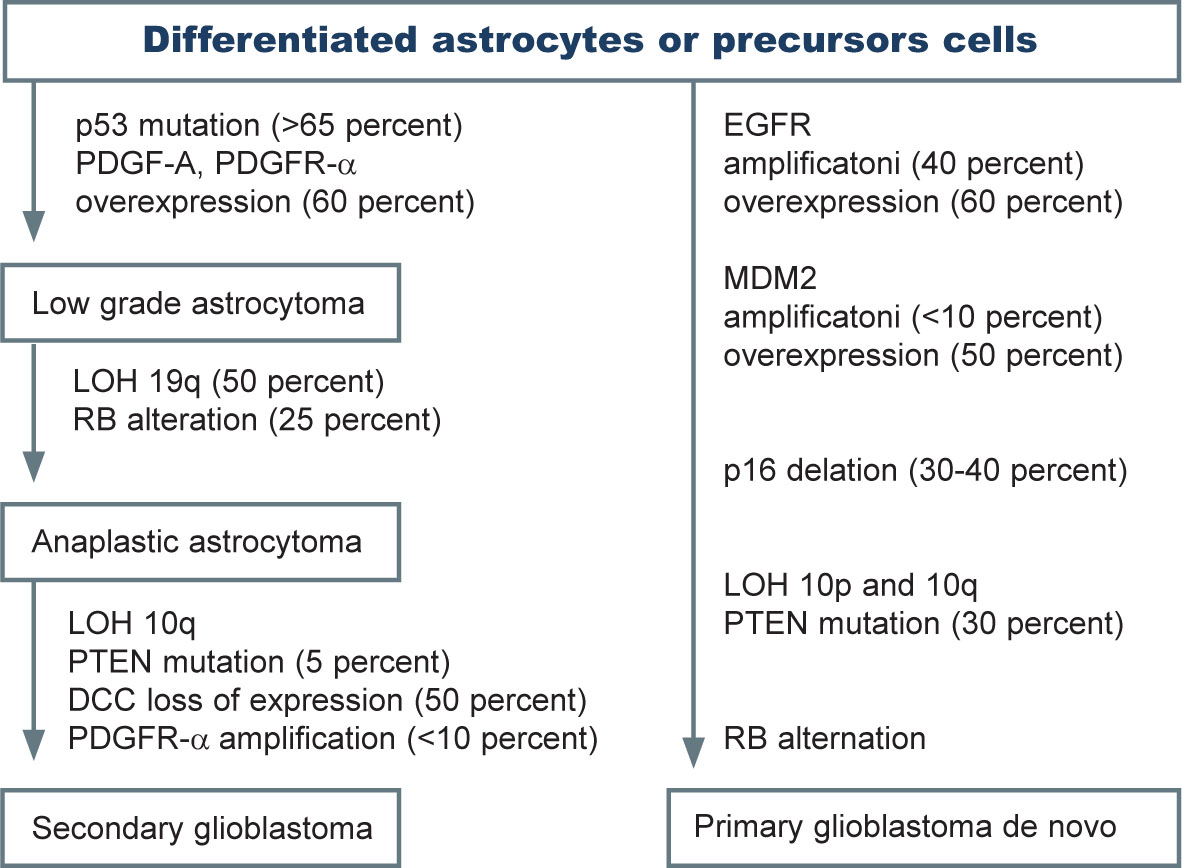
Development of primary and secondary glioblastoma
DCC = deleted in colon cancer gene; LOH = loss of heterozygosity; PDGF = platelet-derived growth factor; PDGFR = platelet-derived growth factor receptor; RB = retinoblastoma gene
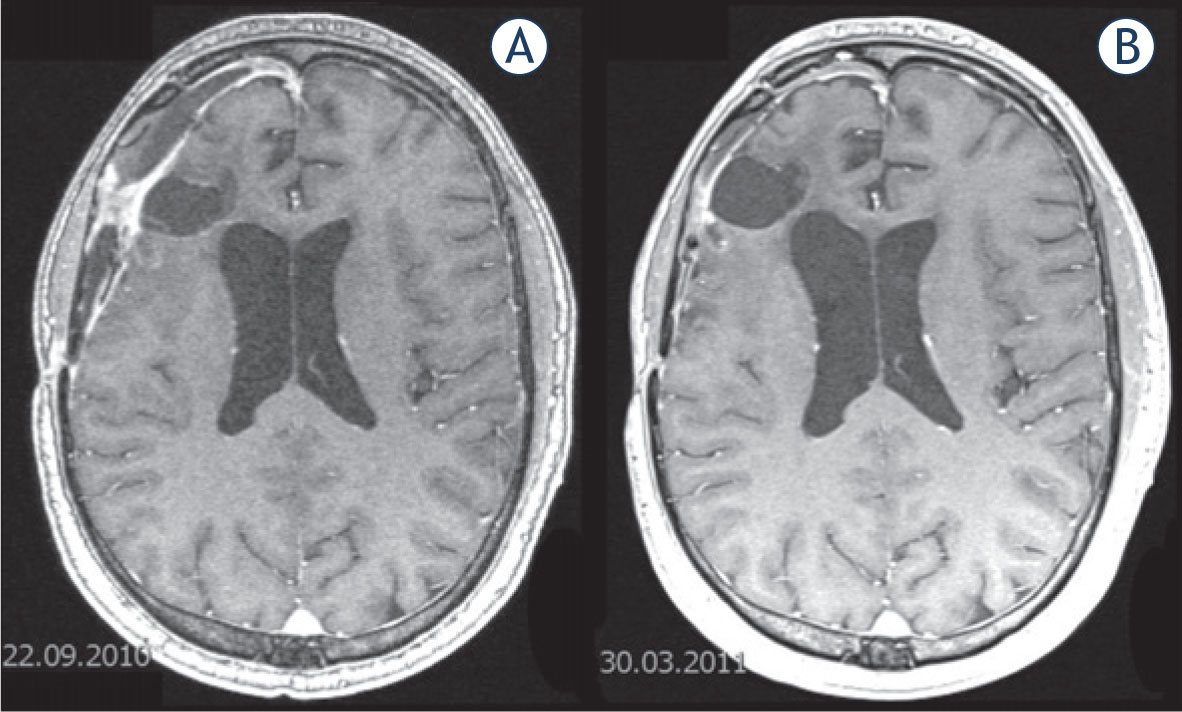
Magnetic resonance imaging (MRI) in recurrent g lioblastoma patient, treated at Institute of Oncology Ljubljana, with bevacizumab/irinotecan, (A) before and (B) after six months of treatment.
Table 3
Symptoms at presentation of glioblastoma
| Headache |
|---|
| Nausea/vomiting |
| Cognition changes |
| Personality changes |
| Gait imbalance |
| Urinary incontinence |
| Hemiparesis |
| Aphasia |
| Hemineglect |
| Visual field defect |
| Seizures |
Table 4
Summary of current treatments for malignant gliomas* (Adapted from ref.28)
| Type of Tumour | Therapy |
|---|---|
| Newly diagnosed tumours | |
| Glioblastoma (WHO grade IV) | Maximal surgical resection, plus radiotherapy, plus concomitant and adjuvant TMZ** |
| Anaplastic astrocytoma (WHO grade III) | Maximal surgical resection, with the following options after surgery (no accepted standard treatment): radiotherapy, plus concomitant and adjuvant TMZ or adjuvant TMZ alone** |
| Anaplastic oligodendroglioma and anaplastic oligoastrocytoma (WHO grade III) | Maximal surgical resection, with the following options after surgery (no accepted standard treatment): radiotherapy alone, TMZ or PCV with or without radiotherapy afterward, radiotherapy plus concomitant and adjuvant TMZ, or radiotherapy plus adjuvant TMZ**+ |
| Recurrent tumours | Reoperation in selected patients, conventional chemotherapy (e.g., lomustine, carmustine, PCV, carboplatin, irinotecan, etoposide), bevacizumab plus irinotecan, experimental therapies + |
* Additional data are from Sathornsumette et al.47, Furnari et al.48, Chi and Wen49 and Sathornsumetee et al.50
** Radiotherapy is administered at a dose of 60 Gy given in 30 fractions over a period of 6 weeks. ; Adjuvant TMZ = adjuvant temozolomide, beginning 4 weeks after radiotherapy, 150 mg/m2/day on days 1 to 5 of the first 28-day cycle, followed by 200 mg/m2/day on days 1 to 5 of each subsequent 28-day cycle, if the first cycle was well tolerated; Concomitant TMZ = concomitant temozolomide, 75 mg/m2/ day for 42 days with radiotherapy; PCV = lomustine (CCNU), 110 mg/m2, on day 1; procarbazine, 60 mg/m2 on days 8 to 21; vincristine, 1,5 mg/m2 (maximum dose, 2 mg), on days 8 and 29; WHO = World Health Organization
** Radiotherapy is administered at a dose of 60 Gy given in 30 fractions over a period of 6 weeks. ; Adjuvant TMZ = adjuvant temozolomide, beginning 4 weeks after radiotherapy, 150 mg/m2/day on days 1 to 5 of the first 28-day cycle, followed by 200 mg/m2/day on days 1 to 5 of each subsequent 28-day cycle, if the first cycle was well tolerated; Concomitant TMZ = concomitant temozolomide, 75 mg/m2/ day for 42 days with radiotherapy; PCV = lomustine (CCNU), 110 mg/m2, on day 1; procarbazine, 60 mg/m2 on days 8 to 21; vincristine, 1,5 mg/m2 (maximum dose, 2 mg), on days 8 and 29; WHO = World Health Organization
** Radiotherapy is administered at a dose of 60 Gy given in 30 fractions over a period of 6 weeks. ; Adjuvant TMZ = adjuvant temozolomide, beginning 4 weeks after radiotherapy, 150 mg/m2/day on days 1 to 5 of the first 28-day cycle, followed by 200 mg/m2/day on days 1 to 5 of each subsequent 28-day cycle, if the first cycle was well tolerated; Concomitant TMZ = concomitant temozolomide, 75 mg/m2/ day for 42 days with radiotherapy; PCV = lomustine (CCNU), 110 mg/m2, on day 1; procarbazine, 60 mg/m2 on days 8 to 21; vincristine, 1,5 mg/m2 (maximum dose, 2 mg), on days 8 and 29; WHO = World Health Organization
Table 5
Selected investigational therapies for malignant gliomas* (Adapted from ref. 28)
| Type of treatment | Example |
|---|---|
| Convection enhanced surgical delivery of pharmacologic agent | Cintredekin besudotox |
| Drugs to overcome resistance to TMZ | |
| Dose dense TMZ | O6-benzylguanine |
| MGMT inhibitors | BSI-201, ABT-888 |
| PARP inhibitors | RTA 744, ANG 1005 |
| New chemotherapies | |
| Antiangiogenic therapies | |
| Anti-avb5 integrins | Cilengitide |
| Anti-hepatocyte growth factor | AMG-102 |
| Anti-VEGF | Bevacizumab, aflibercept (VEGF-trap) |
| Anti-VEGFR | Cediranib, pazopanib, sorafenib, sunitinib, vandetinib, vatalanib, XLI 84, CT-322 |
| Other agents | Thalidomide |
| Targeted molecular therapies | |
| Akt | Perifosine |
| EGFR inhibitors | Erlotinib, gefitinib, lapatinib, BIBW2992, nimotuzumab, cetuximab |
| FTI inhibitors | Tipifarnib, lonafanib |
| HDAC inhibitors | Vorinostat, depsipeptide, LBH589 |
| HSP90 inhibitors | ATI3387 |
| Met | XLI84 |
| mTOR inhibitors | Everolimus, sirolimus, temsirolimus, deforolimus |
| PI3K inhibitors | BEZ235, XL765 |
| PKCb | Enzastaurin |
| PDGFR | inhibitors Dasatinib, imatinib, tandutinib |
| Proteasome | Bortezomib |
| Raf | Sorafenib |
| Src | Dasatinib |
| TGF | b API2009 |
| Combination therapies | Erlotinib plus temsirolimus, gefitinib plus everolimus, gefitinib plus sirolimus, saorafenib plus temsirolimus, erlotinib, or tipifarnib, pazopanib plus lapatinib |
| Immunotherapies | |
| Dendritic cell and EGFRvIII peptide vaccines | DCVax, CDX-110 |
| Monoclonal antibodies | 131I-anti-tenascin antibody |
| Gene therapy | |
| Other therapies | 131I-TM-601 |
* Additional data are from Sathorsumetee et al.47, Furnari et al.48, Chi and Wen49, Sathornsumetee et al.50 ; EGFR = epidermal growth factor; FTI = farnesyltransferase; HDAC = histone deacetylase; HSP90 = heat-shock protein 90; MGMT = O6-methylguanine-DNA methyltransferase; mTOR = mammalian target of rapamycin; PARP = poly (ADP-ribose) polymerase; PDGFR = platelet-derived growth factor receptor; PI3K = phosphatidylinositol 3-kinase; PKCb = protein kinase Cb; TGF = transforming growth factor; TMZ = temozolomide; VEGFR = vascular ednosthelial growth factor receptor; WHO = World Health Organization